Here’s how to ‘expertly’ hit a link-building home run
Use expert opinions in content so when you build it, the links will come.
Please visit Search Engine Land for the full article.
What if people copy content from your site?
It can happen to you: other people copy content from your site and republish it on their own site. You have gone the extra mile to write an awesome article for your website, when, all of a sudden, another website takes possession of it. It can be frustrating to see this happen, and it happens more […]
The post What if people copy content from your site? appeared first on Yoast.
Measuring the Effectiveness of Site Architecture Improvements
Improving site architecture optimisation is an iterative process. Here is a framework for measuring and monitoring the impact of these changes over time by looking at more than just site traffic.
Post from Sam Marsden
Google Chrome now shows search result answers in the omnibox by default
Chrome 69, Google’s latest browser version, also removes the green label for HTTPS URLs.
Please visit Search Engine Land for the full article.
How We More than Doubled Conversions & Leads for a New ICO [Case Study]
Posted by jkuria
Summary
We helped Repux generate 253% more leads, nearly 100% more token sales and millions of dollars in incremental revenue during their initial coin offering (ICO) by using our CRO expertise.
The optimized site also helped them get meetings with some of the biggest names in the venture capital community — a big feat for a Poland-based team without the pedigree typically required (no MIT, Stanford, Ivy League, Google, Facebook, Amazon, Microsoft background).
The details:
Repux is a marketplace that lets small and medium businesses sell anonymized data to developers. The developers use the data to build “artificially intelligent” apps, which they then sell back to businesses. Business owners and managers use the apps to make better business decisions.
Below is the original page, which linked to a dense whitepaper. We don’t know who decided that an ICO requires a long, dry whitepaper, but this seems to be the norm!

This page above suffers from several issues:
- The headline is pretty meaningless (“Decentralized Data & Applications Protocol for SMEs). Remember, as David Ogilvy noted, 90% of the success of an ad (in our case, a landing page) is determined by the headline. Visitors quickly scan the headline and if it doesn’t hold their interest, bounce immediately. With so much content on the web, attention is scarce — the average time spent on a page is a few seconds and the average bounce rate is about 85%.
- The call to action is “Get Whitelisted,” which is also meaningless. What’s in it for me? Why should I want to “Get Whitelisted”?
- A lack of urgency to act. There is a compelling reason to do so, but it was not being clearly articulated (“Get 50% OFF on the tokens if you buy before a certain date.”)
- Lack of “evidentials”: Evidentials are elements that lend credibility or reduce anxiety and include things like mentions in trusted publications, well-known investors or advisors, industry seals, association affiliations, specific numbers (e.g. 99% Net Promoter Score), and so on.
- Too much jargon and arcane technical language: Our research using Mouseflow’s on-page feedback feature showed that the non-accredited-investor ICO audience isn’t sophisticated. They typically reside outside of the US and have a limited command of English. Most are younger men (18–35) who made money from speculative activities on the Internet (affiliate marketing, Adsense arbitrage, and of course other crypto-currencies). When we surveyed them, many did not initially understand the concept. In our winning page (below), we dumbed down things a lot!
Below is the new page that produced a 253% gain in leads (email opt-ins). Coupled with the email follow-up sequence shown below, it produced a nearly 100% gain in token sales.
Winning page (above the fold):

Here are few of the elements that we believe made a difference:
- Much clearer headline (which we improved upon further in a subsequent treatment).
- Simple explanation of what the company is doing
- Urgency to buy now — get 50% off on tokens if you buy before the countdown timer expires
- Solicited and used press mentions
- Social proof from the Economist; tapping a meme can be powerful as it’s always easier to swim downstream than upstream. “Data is the new oil” is a current meme.
More persuasive elements (below the fold):
In the second span (the next screenful below the fold) we added a few more persuasive elements.
For one, we highlighted key Repux accomplishments and included bios of two advisors who are well known in the crypto-community.

Having a working platform was an important differentiator because only one in 10 ICOs had a working product. Most launched with just a whitepaper!
A survey of the token buyers showed that mentioning well-known advisors worked — several respondents said it was the decisive factor in persuading them to buy. Before, the advisors were buried in a little-visited page. We featured them more prominently.
Interestingly, this seemed to cut both ways. One of the non-contributors said he was initially interested because of a certain advisor’s involvement. He later chose not to contribute because he felt this advisor’s other flagship project had been mismanaged!
We also used 3 concrete examples to show how the marketplace functions and how the tokens would be used:

When your product is highly abstract and technical, using concrete examples aids understanding. We also found this to be true when pitching to professional investors. They often asked, “Can you give me an example of how this would work in the real world?”
We like long-form pages because unlike a live selling situation, there’s no opportunity for a back-and-forth conversation. The page must therefore overcorrect and address every objection a web visitor might have.
Lastly, we explained why Repux is likely to succeed. We quoted Victor Hugo for good measure, to create an air of inevitability:

How much impact did Victor Hugo have? I don’t know, but the page did much better overall. Our experience shows that radical redesigns (that change many page elements at the same time) produce higher conversion lifts.
Once you attain a large lift, if you like, you can then do isolation testing of specific variables to determine how much each change contributed.
13% lift: Simplified alternate page
The page below led to a further 13% lift.

The key elements we changed were:
- Simplified the headline even further: “Repux Monetizes Data from Millions of Small Enterprises.” What was previously the headline is now stated in the bullet points.
- Added a “5 Reasons Why Repux is Likely to Succeed” section: When you number things, visitors are more likely to engage with the content. They may not read all the text but will at least skim over the numbered sub-headlines to learn what all the points are — just like power abhors a vacuum, the mind can’t seem to stand incompleteness!
We’ve seen this in Mouseflow heatmaps. You can do this test yourself: List a bunch of bullet points versus a numbered list and with a compelling headline: The 7 Reasons Why 20,0000 Doctors Recommend Product X or The 3 Key Things You Need to Know to Make an Informed Decision.

Follow-up email sequence
We also created a follow-up email sequence for Repux that led to more token sales.

As you can see, the average open rate is north of 40%, and the goal attained (token sales) is above 8%. According to Mailchimp, the average email marketing campaign open rate is about 20%, while the average CTR is about 3%.
We got more sales than most people get clicks. Here’s a link to three sample emails we sent.
Our emails are effective because:
- They’re educational (versus pure sales pitch). This is also important to avoid “burning out” your list. If all you do is send pitch after pitch, soon you’ll be lucky to get a 1.3% open rate!
- They employ storytelling. We use a technique known as the “Soap Opera Sequence.” Each email creates anticipation for the next one and also refers to some interesting fact in previous ones. If a person would only have opened one email, they are now likely to want to open future ones as well as look up older ones to “solve the puzzle.” This leads to higher open rates for the entire sequence, and more sales.
- The calls to action are closer to the bottom, having first built up some value. Counterintuitively, this works better, but you should always test radically different approaches.
Email is a massively underutilized medium. Most businesses are sitting on goldmines (their email list) without realizing it! You can — and should — make at least 2x to 3x as many sales from your email list as you do from direct website sales.
It takes a lot of work to write an effective sequence, but once you do you can run it on autopilot for years, making money hand over fist. As customer acquisition gets ever more competitive and expensive, how well you monetize your list can make the difference between success and failure.
Conclusion
To increase the conversion rate on your website and get more sales, leads, or app downloads, follow these simple steps:
- Put in the work to understand why the non-converting visitors are leaving and then systematically address their specific objections. This is what “research-driven” optimization means, as opposed to redesign based purely aesthetic appeal or “best practices.”
- Find out why the converting visitors took the desired action — and then accentuate these things.
- Capture emails and use a follow-up sequence to educate and tell stories to those who were not convinced by the website. Done correctly, this can produce 2x to 3x as many sales as the website.
Simple, but not easy. It takes diligence and discipline to do these things well. But if you do, you will be richly rewarded!
And if you’d like to learn more about conversion rate optimization or review additional case studies, we encourage you to take our free course.
Thanks to Jon Powell, Hayk Saakian, Vlad Mkrtumyan, and Nick Jordan for reading drafts of this post.
Sign up for The Moz Top 10, a semimonthly mailer updating you on the top ten hottest pieces of SEO news, tips, and rad links uncovered by the Moz team. Think of it as your exclusive digest of stuff you don’t have time to hunt down but want to read!
The new Search Console is graduating out of Beta 🎓
Today we mark an important milestone in Search Console’s history: we are graduating the new Search Console out of beta! With this graduation we are also launching the Manual Actions report and a “Test Live” capability to the recently launched URL inspection tool, which are joining a stream of reports and features we launched in the new Search Console over the past few months.
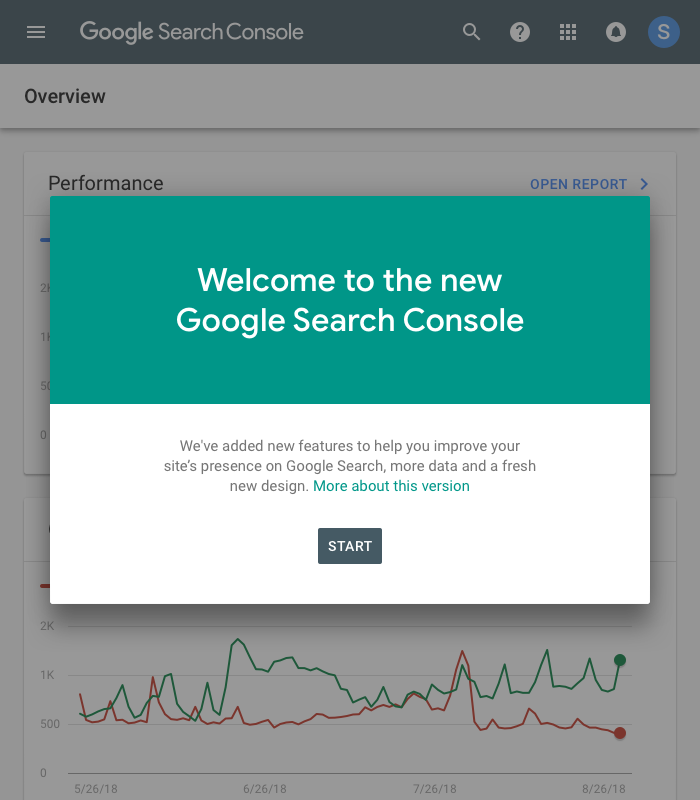
Our journey to the new Search Console
We launched the new Search Console at the beginning of the year. Since then we have been busy hearing and responding to your feedback, adding new features such as the URL Inspection Tool, and migrating key reports and features. Here’s what the new Search Console gives you:
More data:
- Get an accurate view of your website content using the Index Coverage report.
- Review your Search Analytics data going back 16 months in the Performance report.
- See information on links pointing to your site and within your site using the Links report.
- Retrieve crawling, indexing, and serving information for any URL directly from the Google index using the URL Inspection Tool.
Better alerting and new “fixed it” flows:
- Get automatic alerts and see a listing of pages affected by Crawling, Indexing, AMP, Mobile Usability, Recipes, or Job posting issues.
- Reports now show the HTML code where we think a fix necessary (if applicable).
- Share information quickly with the relevant people in your organization to drive the fix.
- Notify Google when you’ve fixed an issue. We will review your pages, validate whether the issue is fixed, and return a detailed log of the validation findings.
Simplified sitemaps and account settings management:
- Let Google know how your site is structured by submitting sitemaps
- Submit individual URLs for indexing (see below).
- Add new sites to your account, invite and manage users.
Out of Beta
While the old Search Console still has some features that are not yet available in the new one, we believe that the most common use cases are supported, in an improved way, in the new Search Console. When an equivalent feature exists in both old and new Search Console, our messages will point users to the new version. We’ll also add a reminder link in the old report. After a reasonable period, we will remove the old report.
Read more about how to migrate from old to the new Search Console, including a list of improved reports and how to perform common tasks, in our help center.
Manual Actions and Security Issues alerts
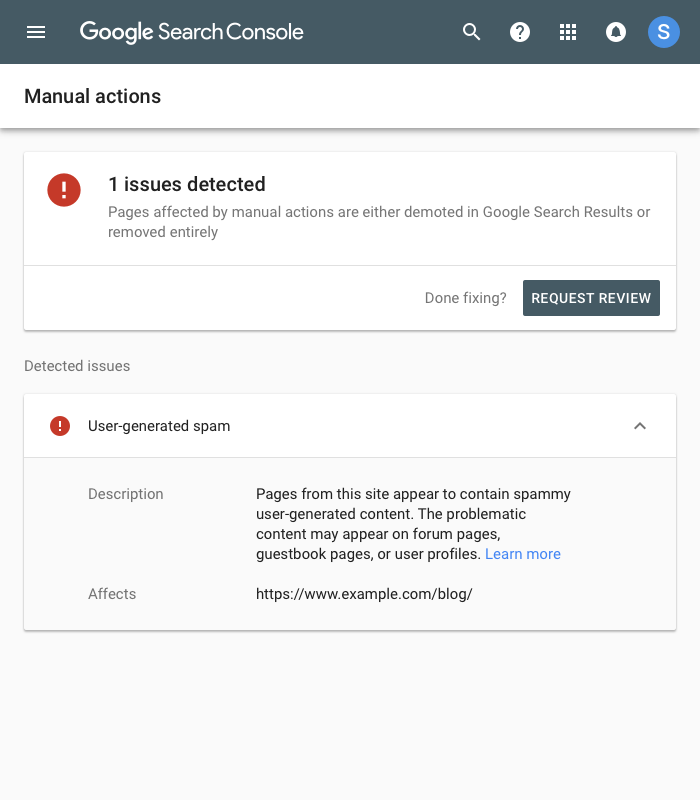
To ensure that you don’t miss any critical alerts for your site, active manual actions and security issues will be shown directly on the Overview page in the new console. In addition, the Manual Actions report has gotten a fresher look in the new Search Console. From there, you can review the details for any pending Manual Action and, if needed, file a reconsideration request.
URL Inspection – Live mode and request indexing
The URL inspection tool that we launched a few months ago now enables you to run the inspection on the live version of the page. This is useful for debugging and fixing issues in a page or confirming whether a reported issue still exists in a page. If the issue is fixed on the live version of the page, you can ask Google to recrawl and index the page.

We’re not finished yet!
Your feedback is important to us! As we evolve Search Console, your feedback helps us to tune our efforts. You can still switch between the old and new products easily, so any missing functionality you need is just a few clicks away. We will continue working on moving more reports and tools as well as adding exciting new capabilities to the new Search Console.
Posted by Hillel Maoz and Yinnon Haviv, Engineering Leads, Search Console team


SearchCap: Google and Facebook accused of plundering, GSC gets new features, IF functions & more
Below is what happened in search today, as reported on Search Engine Land and from other places across the web.
Please visit Search Engine Land for the full article.
Google Displays AMP Icon Within Story Image
Google is showing the AMP icon in the carousel within the story image, as opposed to outside of the story image. You can still see both versions depending on the type of snippet you are looking at.
Google Search Console Now Defaults To BETA Version
When you go to the main Google Search Console home page at google.com/webmasters and click the sign in button, you are now taken to the new BETA version of the Google Search Console. You are no longer defaulted to the old version of the Google Search C…
Google Ads Restricts Third-Party Technical Support Providers
Google announced late Friday that they will begin restricting ads from third-party technical support providers due to an increase in misleading ad experiences. Google will roll out a “verification program” to validate these technical support providers…
Google: If You Want Your Images To Rank Then Use Alt Text
Google’s John Mueller said this morning on Twitter that if you want your images to rank in Google Image search, it is extremely helpful to Google if you add alt text to your images. The advice itself is not new, it dates back over 10 years ago but thi…
Google’s John Mueller: “Why Not Put A Date On It”
As you all know, I am a huge fan of dates on articles and blog content. I even suggested Google should penalize pages that do not put dates on articles. Google has not gone that far, yet – but John Mueller seems to be a fan of dates on articles as wel…
European publishers accuse Google and Facebook of ‘plundering’ their content
Publishers and media companies have stepped up lobbying for a restrictive copyright law that would effectively create ‘link taxes.’
Please visit Search Engine Land for the full article.
Google Search Console out of beta, adds more features
Google has added a manual actions section to the new Google Search Console, and the URL inspection tool now works in real time.
Please visit Search Engine Land for the full article.
Are content blocks the future? And, what’s the benefit for SEO?
In Yoast SEO 8.0 you’ve met with the Yoast SEO Gutenberg sidebar. Since the 8.1 release, you can see the snippet preview in action in this sidebar. These are our first step of integrating Yoast SEO with Gutenberg. But there is more to come. Shortly, we’ll also introduce a whole new concept: Yoast SEO content blocks. […]
The post Are content blocks the future? And, what’s the benefit for SEO? appeared first on Yoast.
7 Off-Page SEO Techniques to Build Your Website’s Reputation and Visibility
Tips for moving beyond internal SEO to build links and reputation across external sites.
Find anomalies in your campaign spending with this Google Ads script
Contributor Daniel Gilbert shares a customizable script that lets you check for overspending or underspending in your Google Ads account by finding changes in spending.
Please visit Search Engine Land for the full article.
Google’s somewhat-new guide to totally excellent ads
As responsive search ads make their way to an account near you, contributor and Googler Matt Lawson shares suggestions on how to implement all of the ad formats in one big happy account.
Please visit Search Engine Land for the full article.
How to use IF functions to speak to different audiences
If you have several remarketing audiences created, contributor Joe Martinez explains how to use IF functions to advertise to each user group depending on where they might be in your sales funnel.
Please visit Search Engine Land for the full article.
…
Featured Snippets: Tips and tricks on reaching the top
.png)
Most companies with a presence on Google will have an interest in appearing at the top of search results.