Data Studio: Q1 2019 best new feature round-up
Christmas is over, New Year’s resolutions have been broken and “spring” is here. Since the last round-up after Christmas, the Data Studio team have been busy spoiling us with eight product updates so far this year. This quarter has been heavily weighted towards making the management of Data Studio dashboards easier with better date range, […]
The post Data Studio: Q1 2019 best new feature round-up appeared first on Builtvisible.
4 Unconventional Ways to Become a Better SEO
Posted by meagar8
Let’s get real for a moment: As much as we hear about positive team cultures and healthy work environments in the digital marketing space, many of us encounter workplace scenarios that are far from the ideal. Some of us might even be part of a team where we feel discouraged to share new ideas or alternative solutions because we know it will be shot down without discussion. Even worse, there are some who feel afraid to ask questions or seek help because their workplace culture doesn’t provide a safe place for learning.
These types of situations, and many others like it, are present in far too many work environments. But what if I told you it doesn’t have to be this way?
Over the last ten years as a team manager at various agencies, I’ve been working hard to foster a work environment where my employees feel empowered to share their thoughts and can safely learn from their mistakes. Through my experiences, I have found a few strategies to combat negative culture and replace it with a culture of vulnerability and creativity.
Below, I offer four simple steps you can follow that will transform your work environment into one that encourages new ideas, allows for feedback and positive change, and ultimately makes you and your team better digital marketers.
Vulnerability leads to creativity
I first learned about the impact of vulnerability after watching a viral TED talk by Dr. Brene Brown. She defined vulnerability as “uncertainty, risk, and emotional exposure.” She also described vulnerability as “the birthplace of love, belonging, joy, courage, empathy, and creativity.” From this, I learned that to create a culture of vulnerability is to create a culture of creativity. And isn’t creativity at the heart of what we SEOs do?
A culture of vulnerability encourages us to take risks, learn from mistakes, share insights, and deliver top results to our clients. In the fast-paced world of digital marketing, we simply cannot achieve top results with the tactics of yesterday. We also can’t sit around and wait for the next Moz Blog or marketing conference, either. Our best course of action is to take risks, make mistakes, learn from those mistakes, and share insights with others. We have to learn from those with more experience than us and share what we know to those with less experience. In other words, we have to be vulnerable.
Below is a list of four ways you can help create a culture of vulnerability. Whether you are a manager or not, you can impact your team’s culture.
1. Get a second pair of eyes on your next project
Are you finishing up an exciting project for your client? Did you just spend hours of research and implementation to optimize the perfect page? Perfect! Now go ask someone to critique it!
As simple as it sounds, this can make a huge difference in fostering a culture of creativity. It’s also extremely difficult to do.
Large or small, every project or task we complete should be the best your team can provide. All too often, however, team members work in silos and complete these projects without asking for or receiving constructive feedback from their teammates before sending it to the client. This leaves our clients and projects only receiving the best one person can provide rather than the best of an entire team.
We all work with diverse team members that carry varying levels of experience and responsibilities. I bet someone on your team will have something to add to your project that you didn’t already think of. Receiving their feedback means every project that you finish or task that you complete is the best your team has to offer your clients.
Keep in mind, though, that asking for constructive feedback is more than just having someone conduct a “standard QA.” In my experience, a “standard QA” means someone barely looked over what you sent and gave you the thumbs up. Having someone look over your work and provide feedback is only helpful when done correctly.
Say you’ve just completed writing and editing content to a page and you’ve mustered up the courage to have someone QA your work. Rather than sending it over, saying “hey can you review this and make sure I did everything right,” instead try to send detailed instructions like this:
“Here is a <LINK> to a page I just edited. Can you take 15 minutes to review it? Specifically, can you review the Title Tag and Description? This is something the client said is important to them and I want to make sure I get it right.”
In many cases, you don’t need your manager to organize this for you. You can set this up yourself and it doesn’t have to be a big thing. Before you finish a project or task this week, work with a team member and ask them for help by simply asking them to QA your work. Worried about taking up too much of their time? Offer to swap tasks. Say you’ll QA some of their work if they QA yours.
Insider tip
You will have greater success and consistency if you make QA a mandatory part of your process for larger projects. Any large project like migrating a site to https or conducting a full SEO audit should have a QA process baked into it.
Six months ago I was tasked to present one of our 200+ point site audits to a high profile client. The presentation was already created with over 100 slides of technical fixes and recommendations. I’m normally pretty comfortable presenting to clients, but I was nervous about presenting such technical details to THIS particular client.
Lucky for me, my team already had a process in place for an in-depth QA for projects like this. My six team members got in a room and I presented to them as if they were the client. Yes, that’s right, I ROLE PLAYED! It was unbearably uncomfortable at first. Knowing that each of my team members (who I respect a whole lot) are sitting right in front of me and making notes on every little mistake I make.
After an agonizing 60 minutes of me presenting to my team, I finished and was now ready for the feedback. I just knew the first thing out of their mouths would be something like “do you even know what SEO stands for?” But it wasn’t. Because my team had plenty of practice providing feedback like this in the past, they were respectful and even more so, helpful. They gave me tips on how to better explain canonicalization, helped me alter some visualization, and gave me positive feedback that ultimately left me confident in presenting to the client later that week.
When teams consistently ask and receive feedback, they not only improve their quality of work, but they also create a culture where team members aren’t afraid to ask for help. A culture where someone is afraid to ask for help is a toxic one and can erode team spirit. This will ultimately decrease the overall quality of your team’s work. On the other hand, a culture where team members feel safe to ask for help will only increase the quality of service and make for a safe and fun team working experience.
2. Hold a half-day all hands brainstorm meeting
Building strategies for websites or solving issues can often be the most engaging work that an SEO can do. Yes that’s right, solving issues is fun and I am not ashamed to admit it. As fun as it is to do this by yourself, it can be even more rewarding and infinitely more useful when a team does it together.
Twice a year my team holds a half-day strategy brainstorm meeting. Each analyst brings a client or issues they are struggling to resolve its website performance, client communication, strategy development, etc. During the meeting, each team member has one hour or more to talk about their client/issue and solicit help from the team. Together, the team dives deep into client specifics to help answer questions and solve issues.
Getting the most out of this meeting requires a bit of prep both from the manager and the team.
Here is a high-level overview of what I do.
Before the Meeting
Each Analyst is given a Client/Issue Brief to fill out describing the issue in detail. We have Analysts answer the following 5 questions:
- What is the core issue you are trying to solve?
- What have you already looked into or tried?
- What haven’t you tried that you think might help?
- What other context can you provide that will help in solving this issue?
After all client briefs are filled out and about 1-2 days prior to the half day strategy meeting I will share all the completed briefs to the team so they can familiarize themselves with the issues and come prepared to the meeting with ideas.
Day of the Meeting
Each Analyst will have up to an hour to discuss their issue with the team. Afterwards, the team will deep dive into solving it. During the 60 minute span, ideas will be discussed, Analysts will put on their nerd hats and dive deep into Analytics or code to solve issues. All members of the team are working toward a single goal and that is to solve the issue.
Once the issues is solved the Analyst who first outlined the issue will readback the solutions or ideas to solving the issue. It may not take the full 60 minutes to get to a solution. Whether it takes the entire time or not after one issue is solved another team member announces their issue and the team goes at it again.
Helpful tips
- Depending on the size of your team, you may need to split up into smaller groups. I recommend 3-5.
- You may be tempted to take longer than an hour but in my experience, this doesn’t work. The pressure of solving an issue in a limited amount of time can help spark creativity.
This meeting is one of the most effective ways my team practices vulnerability allowing the creativity flow freely. The structure is such that each team member has a way to provide and receive feedback. My experience has been that each analyst is open to new ideas and earnestly listens to understand the ways they can improve and grow as an analyst. And with this team effort, our clients are benefitting from the collective knowledge of the team rather than a single individual.
3. Solicit characteristic feedback from your team
This step is not for the faint of heart. If you had a hard time asking for someone to QA your work or presenting a site audit in front of your team, then you may find this one to be the toughest to carry out.
Once a year I hold a special meeting with my team. The purpose of the meeting is to provide a safe place where my employees can provide feedback about me with their fellow teammates. In this meeting, the team meets without me and anonymously fills out a worksheet telling me what I should start doing, stop doing, and keep doing.
Why would I subject myself to this, you ask?
How could I not! Being a great SEO is more than just being great at SEO. Wait, what?!? Yes, you read that right. None of us work in silos. We are part of a team, interact with clients, have expectations from bosses, etc. In other words, the work we do isn’t only technical audits or site edits. It also involves how we communicate and interact with those around us.
This special meeting is meant to focus more on our characteristics and behaviors, over our tactics and SEO chops, ensuring that we are well rounded in our skills and open to all types of feedback to improve ourselves.
How to run a keep/stop/start meeting in 4 steps:
Step 1: Have the team meet together for an hour. After giving initial instructions you will leave the room so that it is just your directs together for 45 minutes.
Step 2: The team writes the behaviors they want you to start doing, stop doing, and keep doing. They do this together on a whiteboard or digitally with one person as a scribe.
Step 3: When identifying the behaviors, the team doesn’t need to be unanimous but they do need to mostly agree. Conversely, the team should not just list them all independently and then paste them together to make a long list.
Step 4: After 45 minutes, you re-enter the room and over the next 15 minutes the team tells you about what they have discussed
Here are some helpful tips to keep in mind:
- When receiving the feedback from the team you only have two responses you can give, “thank you” or ask a clarifying question.
- The feedback needs to be about you and not the business.
- Do this more than once. The team will get better at giving feedback over time.
Here is an example of what my team wrote during my first time running this exercise.

Let’s break down why this meeting is so important.
- With me not in the room, the team can discuss openly without holding back.
- Having team members work together and come to a consensus before writing down a piece of feedback ensures feedback isn’t from a single team member but rather the whole team.
- By leaving the team to do it without me, I show as a manager I trust them and value their feedback.
- When I come back to the room, I listen and ask for clarification but don’t argue which helps set an example of receiving feedback from others
- The best part? I now have feedback that helps me be a better manager. By implementing some of the feedback, I reinforce the idea that I value my team’s feedback and I am willing to change and grow.
This isn’t just for managers. Team members can do this themselves. You can ask your manager to go through this exercise with you, and if you are brave enough, you can have you teammates do this for you as well.
4. Hold a team meeting to discuss what you have learned recently
Up to this point, we have primarily focused on how you can ask for feedback to help grow a culture of creativity. In this final section, we’ll focus more on how you can share what you have learned to help maintain a culture of creativity.
Tell me if this sounds familiar: I show up at work, catch up on industry news, review my client performance, plug away at my to-do list, check on tests I am running and make adjustments, and so on and so forth.
What are we missing in our normal routines? Collaboration. A theme you may have noticed in this post is that we need to work together to produce our best work. What you read in industry news or what you see in client performance should all be shared with team members.
To do this, my team put together a meeting where we can share our findings. Every 2 weeks, my team meets together for an hour and a half to discuss prepared answers to the following four questions.
Question 1: What is something interesting you have read or discovered in the industry?
This could be as simple as sharing a blog post or going more in depth on some research or a test you have done for a client. The purpose is to show that everyone on the team contributes to how we do SEO and helps contribute knowledge to the team.
Question 2: What are you excited about that you are working on right now?
Who doesn’t love geeking out over a fun site audit, or that content analysis that you have been spending weeks to build? This is that moment to share what you love about your job.
Question 3: What are you working to resolve?
Okay, okay, I know. This is the only section in this meeting that talks about issues you might be struggling to solve. But it is so critical!
Question 4: What have you solved?
Brag, brag, brag! Every analyst has an opportunity to share what they have solve. Issues they overcame. How they out-thought Google and beat down the competition.
In conclusion
Creativity is at the heart of what SEOs do. In order to grow in our roles, we need to continue to expand our minds so we can provide stellar performance for our clients. To do this requires us to receive and give out help with others. Only then will we thrive in a culture that allows us to be safely vulnerable and actively creative.
I would love to hear how your team creates a culture of creativity. Comment below your ideas!
Sign up for The Moz Top 10, a semimonthly mailer updating you on the top ten hottest pieces of SEO news, tips, and rad links uncovered by the Moz team. Think of it as your exclusive digest of stuff you don’t have time to hunt down but want to read!
Track Quality Score daily with this advanced Adwords script
This script will help you measure the impact of your optimizations on a daily basis.
Please visit Search Engine Land for the full article.
Google: Use Site Command For Checking Individual URLs
Google’s John Mueller said on Twitter that you can use the site command to check individual pages and see if they are indexed. Generally Google tells SEOs not to depend on the site command but with the URL inspection tool and other Search Console issue…
Google Search Algorithms Are Designed To Be Granular But Older Updates Were More Broad
Google’s John Mueller said on Twitter that when it comes to Google’s search algorithms they try to go as granular as possible. But in the older days, the older Google updates may have been broader, he said.
OMG: Google’s Internal Alert System
At the BirghtonSEO conference last Friday, John Mueller was interviewed by Hannah Smith – and one thing she brought up that was new was that Google has an internal system to deal with big issues called OMG. The way the Q&A went with that question was kind of funny.
Google: It Is Hard To Measure If Publishers & Content Producers Are Happy
Again, at the BirghtonSEO conference, John Mueller was asked about how do they know if they are doing a good job with making publishers happy. Do they have metrics to determine if they are doing a good job. John Mueller said they do look to make publ…
Google My Business Rolling Out Short Names & URLs
Google My Business is rolling out a new feature to let businesses define their short name and URLs within Google My Business. This way you can when you share your short name, customers can enter the short name URL in the browser’s address bar, like “g….
The Fractured Web
Anyone can argue about the intent of a particular action & the outcome that is derived by it. But when the outcome is known, at some point the intent is inferred if the outcome is derived from a source of power & the outcome doesn’t change.
Or, put another way, if a powerful entity (government, corporation, other organization) disliked an outcome which appeared to benefit them in the short term at great lasting cost to others, they could spend resources to adjust the system.
If they don’t spend those resources (or, rather, spend them on lobbying rather than improving the ecosystem) then there is no desired change. The outcome is as desired. Change is unwanted.
Engagement is a toxic metric.
Products which optimize for it become worse. People who optimize for it become less happy.
It also seems to generate runaway feedback loops where most engagable people have a) worst individual experiences and then b) end up driving the product bus.— Patrick McKenzie (@patio11) April 9, 2019
News is a stock vs flow market where the flow of recent events drives most of the traffic to articles. News that is more than a couple days old is no longer news. A news site which stops publishing news stops becoming a habit & quickly loses relevancy. Algorithmically an abandoned archive of old news articles doesn’t look much different than eHow, in spite of having a much higher cost structure.
According to SEMrush’s traffic rank, ampproject.org gets more monthly visits than Yahoo.com.

That actually understates the prevalence of AMP because AMP is generally designed for mobile AND not all AMP-formatted content is displayed on ampproject.org.
Part of how AMP was able to get widespread adoption was because in the news vertical the organic search result set was displaced by an AMP block. If you were a news site either you were so differentiated that readers would scroll past the AMP block in the search results to look for you specifically, or you adopted AMP, or you were doomed.
Some news organizations like The Guardian have a team of about a dozen people reformatting their content to the duplicative & proprietary AMP format. That’s wasteful, but necessary “In theory, adoption of AMP is voluntary. In reality, publishers that don’t want to see their search traffic evaporate have little choice. New data from publisher analytics firm Chartbeat shows just how much leverage Google has over publishers thanks to its dominant search engine.”
It seems more than a bit backward that low margin publishers are doing duplicative work to distance themselves from their own readers while improving the profit margins of monopolies. But it is what it is. And that no doubt drew the ire of many publishers across the EU.
And now there are AMP Stories to eat up even more visual real estate.
If you spent a bunch of money to create a highly differentiated piece of content, why would you prefer that high spend flagship content appear on a third party website rather than your own?
Google & Facebook have done such a fantastic job of eating the entire pie that some are celebrating Amazon as a prospective savior to the publishing industry. That view – IMHO – is rather suspect.
Where any of the tech monopolies dominate they cram down on partners. The New York Times acquired The Wirecutter in Q4 of 2016. In Q1 of 2017 Amazon adjusted their affiliate fee schedule.
Amazon generally treats consumers well, but they have been much harder on business partners with tough pricing negotiations, counterfeit protections, forced ad buying to have a high enough product rank to be able to rank organically, ad displacement of their organic search results below the fold (even for branded search queries), learning suppliers & cutting out the partners, private label products patterned after top sellers, in some cases running pop over ads for the private label products on product level pages where brands already spent money to drive traffic to the page, etc.
They’ve made things tougher for their partners in a way that mirrors the impact Facebook & Google have had on online publishers:
“Boyce’s experience on Amazon largely echoed what happens in the offline world: competitors entered the market, pushing down prices and making it harder to make a profit. So Boyce adapted. He stopped selling basketball hoops and developed his own line of foosball tables, air hockey tables, bocce ball sets and exercise equipment. The best way to make a decent profit on Amazon was to sell something no one else had and create your own brand. … Amazon also started selling bocce ball sets that cost $15 less than Boyce’s. He says his products are higher quality, but Amazon gives prominent page space to its generic version and wins the cost-conscious shopper.”
Google claims they have no idea how content publishers are with the trade off between themselves & the search engine, but every quarter Alphabet publish the share of ad spend occurring on owned & operated sites versus the share spent across the broader publisher network. And in almost every quarter for over a decade straight that ratio has grown worse for publishers.
When Google tells industry about how much $ it funnels to rest of ecosystem, just show them this chart. It’s good to be the “revenue regulator” (note: G went public in 2004). pic.twitter.com/HCbCNgbzKc— Jason Kint (@jason_kint) February 5, 2019
The aggregate numbers for news publishers are worse than shown above as Google is ramping up ads in video games quite hard. They’ve partnered with Unity & promptly took away the ability to block ads from appearing in video games using googleadsenseformobileapps.com exclusion (hello flat thumb misclicks, my name is budget & I am gone!)
They will also track video game player behavior & alter game play to maximize revenues based on machine learning tied to surveillance of the user’s account: “We’re bringing a new approach to monetization that combines ads and in-app purchases in one automated solution. Available today, new smart segmentation features in Google AdMob use machine learning to segment your players based on their likelihood to spend on in-app purchases. Ad units with smart segmentation will show ads only to users who are predicted not to spend on in-app purchases. Players who are predicted to spend will see no ads, and can simply continue playing.”
And how does the growth of ampproject.org square against the following wisdom?
If you do use a CDN, I’d recommend using a domain name of your own (eg, https://t.co/fWMc6CFPZ0), so you can move to other CDNs if you feel the need to over time, without having to do any redirects.— John (@JohnMu) April 15, 2019
Literally only yesterday did Google begin supporting instant loading of self-hosted AMP pages.
China has a different set of tech leaders than the United States. Baidu, Alibaba, Tencent (BAT) instead of Facebook, Amazon, Apple, Netflix, Google (FANG). China tech companies may have won their domestic markets in part based on superior technology or better knowledge of the local culture, though those same companies have largely went nowhere fast in most foreign markets. A big part of winning was governmental assistance in putting a foot on the scales.
Part of the US-China trade war is about who controls the virtual “seas” upon which value flows:
it can easily be argued that the last 60 years were above all the era of the container-ship (with container-ships getting ever bigger). But will the coming decades still be the age of the container-ship? Possibly not, for the simple reason that things that have value increasingly no longer travel by ship, but instead by fiberoptic cables! … you could almost argue that ZTE and Huawei have been the “East India Company” of the current imperial cycle. Unsurprisingly, it is these very companies, charged with laying out the “new roads” along which “tomorrow’s value” will flow, that find themselves at the center of the US backlash. … if the symbol of British domination was the steamship, and the symbol of American strength was the Boeing 747, it seems increasingly clear that the question of the future will be whether tomorrow’s telecom switches and routers are produced by Huawei or Cisco. … US attempts to take down Huawei and ZTE can be seen as the existing empire’s attempt to prevent the ascent of a new imperial power. With this in mind, I could go a step further and suggest that perhaps the Huawei crisis is this century’s version of Suez crisis. No wonder markets have been falling ever since the arrest of the Huawei CFO. In time, the Suez Crisis was brought to a halt by US threats to destroy the value of sterling. Could we now witness the same for the US dollar?
China maintains Huawei is an employee-owned company. But that proposition is suspect. Broadly stealing technology is vital to the growth of the Chinese economy & they have no incentive to stop unless their leading companies pay a direct cost. Meanwhile, China is investigating Ericsson over licensing technology.
Amazon will soon discontinue selling physical retail products in China: “Amazon shoppers in China will no longer be able to buy goods from third-party merchants in the country, but they still will be able to order from the United States, Britain, Germany and Japan via the firm’s global store. Amazon expects to close fulfillment centers and wind down support for domestic-selling merchants in China in the next 90 days.”
India has taken notice of the success of Chinese tech companies & thus began to promote “national champion” company policies. That, in turn, has also meant some of the Chinese-styled laws requiring localized data, antitrust inquiries, foreign ownership restrictions, requirements for platforms to not sell their own goods, promoting limits on data encryption, etc.
The secretary of India’s Telecommunications Department, Aruna Sundararajan, last week told a gathering of Indian startups in a closed-door meeting in the tech hub of Bangalore that the government will introduce a “national champion” policy “very soon” to encourage the rise of Indian companies, according to a person familiar with the matter. She said Indian policy makers had noted the success of China’s internet giants, Alibaba Group Holding Ltd. and Tencent Holdings Ltd. … Tensions began rising last year, when New Delhi decided to create a clearer set of rules for e-commerce and convened a group of local players to solicit suggestions. Amazon and Flipkart, even though they make up more than half the market, weren’t invited, according to people familiar with the matter.
Amazon vowed to invest $5 billion in India & they have done some remarkable work on logistics there. Walmart acquired Flipkart for $16 billion.
Other emerging markets also have many local ecommerce leaders like Jumia, MercadoLibre, OLX, Gumtree, Takealot, Konga, Kilimall, BidOrBuy, Tokopedia, Bukalapak, Shoppee, Lazada. If you live in the US you may have never heard of *any* of those companies. And if you live in an emerging market you may have never interacted with Amazon or eBay.
It makes sense that ecommerce leadership would be more localized since it requires moving things in the physical economy, dealing with local currencies, managing inventory, shipping goods, etc. whereas information flows are just bits floating on a fiber optic cable.
If the Internet is primarily seen as a communications platform it is easy for people in some emerging markets to think Facebook is the Internet. Free communication with friends and family members is a compelling offer & as the cost of data drops web usage increases.
At the same time, the web is incredibly deflationary. Every free form of entertainment which consumes time is time that is not spent consuming something else.
Add the technological disruption to the wealth polarization that happened in the wake of the great recession, then combine that with algorithms that promote extremist views & it is clearly causing increasing conflict.
If you are a parent and you think you child has no shot at a brighter future than your own life it is easy to be full of rage.
Empathy can radicalize otherwise normal people by giving them a more polarized view of the world:
Starting around 2000, the line starts to slide. More students say it’s not their problem to help people in trouble, not their job to see the world from someone else’s perspective. By 2009, on all the standard measures, Konrath found, young people on average measure 40 percent less empathetic than my own generation … The new rule for empathy seems to be: reserve it, not for your “enemies,” but for the people you believe are hurt, or you have decided need it the most. Empathy, but just for your own team. And empathizing with the other team? That’s practically a taboo.
A complete lack of empathy could allow a psychopath to commit extreme crimes while feeling no guilt, shame or remorse. Extreme empathy can have the same sort of outcome:
“Sometimes we commit atrocities not out of a failure of empathy but rather as a direct consequence of successful, even overly successful, empathy. … They emphasized that students would learn both sides, and the atrocities committed by one side or the other were always put into context. Students learned this curriculum, but follow-up studies showed that this new generation was more polarized than the one before. … [Empathy] can be good when it leads to good action, but it can have downsides. For example, if you want the victims to say ‘thank you.’ You may even want to keep the people you help in that position of inferior victim because it can sustain your feeling of being a hero.” – Fritz Breithaupt
News feeds will be read. Villages will be razed. Lynch mobs will become commonplace.
Many people will end up murdered by algorithmically generated empathy.
As technology increases absentee ownership & financial leverage, a society led by morally agnostic algorithms is not going to become more egalitarian.
The more I think about and discuss it, the more I think WhatsApp is simultaneously the future of Facebook, and the most potentially dangerous digital tool yet created. We haven’t even begun to see the real impact yet of ubiquitous, unfettered and un-moderatable human telepathy.— Antonio García Martínez (@antoniogm) April 15, 2019
When politicians throw fuel on the fire it only gets worse:
It’s particularly odd that the government is demanding “accountability and responsibility” from a phone app when some ruling party politicians are busy spreading divisive fake news. How can the government ask WhatsApp to control mobs when those convicted of lynching Muslims have been greeted, garlanded and fed sweets by some of the most progressive and cosmopolitan members of Modi’s council of ministers?
Mark Zuckerburg won’t get caught downstream from platform blowback as he spends $20 million a year on his security.
The web is a mirror. Engagement-based algorithms reinforcing our perceptions & identities.
And every important story has at least 2 sides!
The Rohingya asylum seekers are victims of their own violent Jihadist leadership that formed a militia to kill Buddhists and Hindus. Hindus are being massacred, where’s the outrage for them!? https://t.co/P3m6w4B1Po— Imam Tawhidi (@Imamofpeace) May 23, 2018
Some may “learn” vaccines don’t work. Others may learn the vaccines their own children took did not work, as it failed to protect them from the antivax content spread by Facebook & Google, absorbed by people spreading measles & Medieval diseases.
Passion drives engagement, which drives algorithmic distribution: “There’s an asymmetry of passion at work. Which is to say, there’s very little counter-content to surface because it simply doesn’t occur to regular people (or, in this case, actual medical experts) that there’s a need to produce counter-content.”
As the costs of “free” become harder to hide, social media companies which currently sell emerging markets as their next big growth area will end up having embedded regulatory compliance costs which will end up exceeding any sort of prospective revenue they could hope to generate.
The Pinterest S1 shows almost all their growth is in emerging markets, yet almost all their revenue is inside the United States.
As governments around the world see the real-world cost of the foreign tech companies & view some of them as piggy banks, eventually the likes of Facebook or Google will pull out of a variety of markets they no longer feel worth serving. It will be like Google did in mainland China with search after discovering pervasive hacking of activist Gmail accounts.
Just tried signing into Gmail from a new device. Unless I provide a phone number, there is no way to sign in and no one to call about it. Oh, and why do they say they need my phone? If you guessed “for my protection,” you would be correct. Talk about Big Brother…— Simon Mikhailovich (@S_Mikhailovich) April 16, 2019
Lower friction & lower cost information markets will face more junk fees, hurdles & even some legitimate regulations. Information markets will start to behave more like physical goods markets.
The tech companies presume they will be able to use satellites, drones & balloons to beam in Internet while avoiding messy local issues tied to real world infrastructure, but when a local wealthy player is betting against them they’ll probably end up losing those markets: “One of the biggest cheerleaders for the new rules was Reliance Jio, a fast-growing mobile phone company controlled by Mukesh Ambani, India’s richest industrialist. Mr. Ambani, an ally of Mr. Modi, has made no secret of his plans to turn Reliance Jio into an all-purpose information service that offers streaming video and music, messaging, money transfer, online shopping, and home broadband services.”
Publishers do not have “their mojo back” because the tech companies have been so good to them, but rather because the tech companies have been so aggressive that they’ve earned so much blowback which will in turn lead publishers to opting out of future deals, which will eventually lead more people back to the trusted brands of yesterday.
Publishers feeling guilty about taking advertorial money from the tech companies to spread their propaganda will offset its publication with opinion pieces pointing in the other direction: “This is a lobbying campaign in which buying the good opinion of news brands is clearly important. If it was about reaching a target audience, there are plenty of metrics to suggest his words would reach further – at no cost – on Facebook. Similarly, Google is upping its presence in a less obvious manner via assorted media initiatives on both sides of the Atlantic. Its more direct approach to funding journalism seems to have the desired effect of making all media organisations (and indeed many academic institutions) touched by its money slightly less questioning and critical of its motives.”
When Facebook goes down direct visits to leading news brand sites go up.
When Google penalizes a no-name me-too site almost nobody realizes it is missing. But if a big publisher opts out of the ecosystem people will notice.
The reliance on the tech platforms is largely a mirage. If enough key players were to opt out at the same time people would quickly reorient their information consumption habits.
If the platforms can change their focus overnight then why can’t publishers band together & choose to dump them?
CEO Jack Dorsey said Twitter is looking to change the focus from following specific individuals to topics of interest, acknowledging that what’s incentivized today on the platform is at odds with the goal of healthy dialoguehttps://t.co/31FYslbePA— Axios (@axios) April 16, 2019
In Europe there is GDPR, which aimed to protect user privacy, but ultimately acted as a tax on innovation by local startups while being a subsidy to the big online ad networks. They also have Article 11 & Article 13, which passed in spite of Google’s best efforts on the scaremongering anti-SERP tests, lobbying & propaganda fronts: “Google has sparked criticism by encouraging news publishers participating in its Digital News Initiative to lobby against proposed changes to EU copyright law at a time when the beleaguered sector is increasingly turning to the search giant for help.”
Remember the Eric Schmidt comment about how brands are how you sort out (the non-YouTube portion of) the cesspool? As it turns out, he was allegedly wrong as Google claims they have been fighting for the little guy the whole time:
Article 11 could change that principle and require online services to strike commercial deals with publishers to show hyperlinks and short snippets of news. This means that search engines, news aggregators, apps, and platforms would have to put commercial licences in place, and make decisions about which content to include on the basis of those licensing agreements and which to leave out. Effectively, companies like Google will be put in the position of picking winners and losers. … Why are large influential companies constraining how new and small publishers operate? … The proposed rules will undoubtedly hurt diversity of voices, with large publishers setting business models for the whole industry. This will not benefit all equally. … We believe the information we show should be based on quality, not on payment.
Facebook claims there is a local news problem: “Facebook Inc. has been looking to boost its local-news offerings since a 2017 survey showed most of its users were clamoring for more. It has run into a problem: There simply isn’t enough local news in vast swaths of the country. … more than one in five newspapers have closed in the past decade and a half, leaving half the counties in the nation with just one newspaper, and 200 counties with no newspaper at all.”
Google is so for the little guy that for their local news experiments they’ve partnered with a private equity backed newspaper roll up firm & another newspaper chain which did overpriced acquisitions & is trying to act like a PE firm (trying to not get eaten by the PE firm).
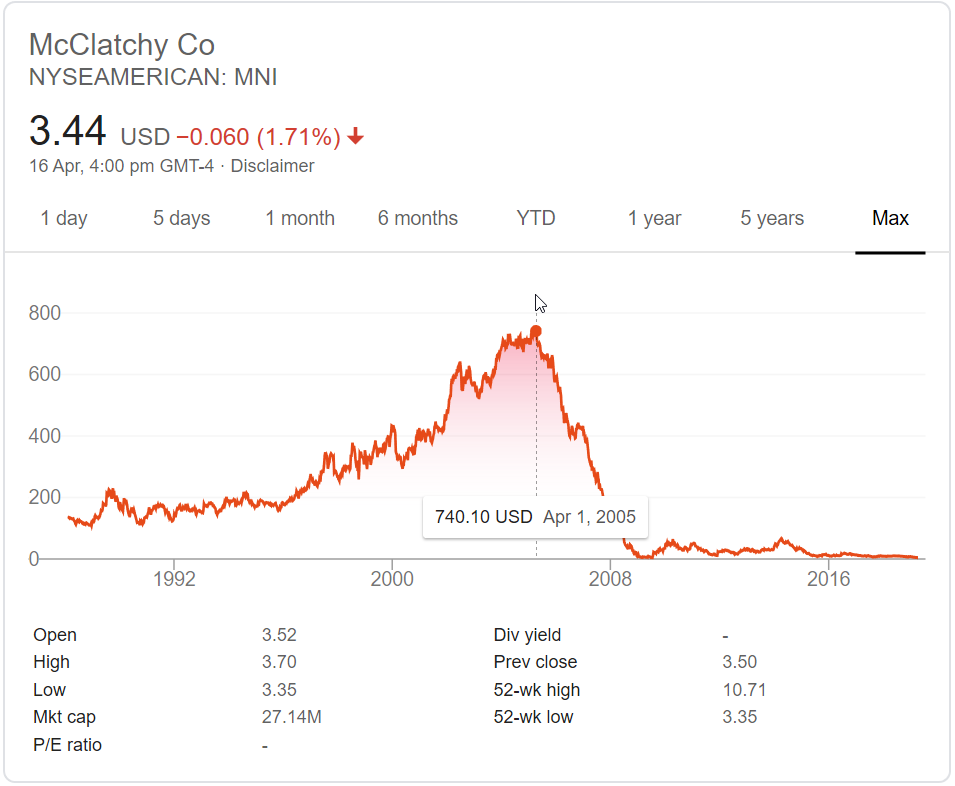
Does the above stock chart look in any way healthy?
Does it give off the scent of a firm that understood the impact of digital & rode it to new heights?
If you want good market-based outcomes, why not partner with journalists directly versus operating through PE chop shops?
If Patch is profitable & Google were a neutral ranking system based on quality, couldn’t Google partner with journalists directly?
Throwing a few dollars at a PE firm in some nebulous partnership sure beats the sort of regulations coming out of the EU. And the EU’s regulations (and prior link tax attempts) are in addition to the three multi billion Euro fines the European Union has levied against Alphabet for shopping search, Android & AdSense.
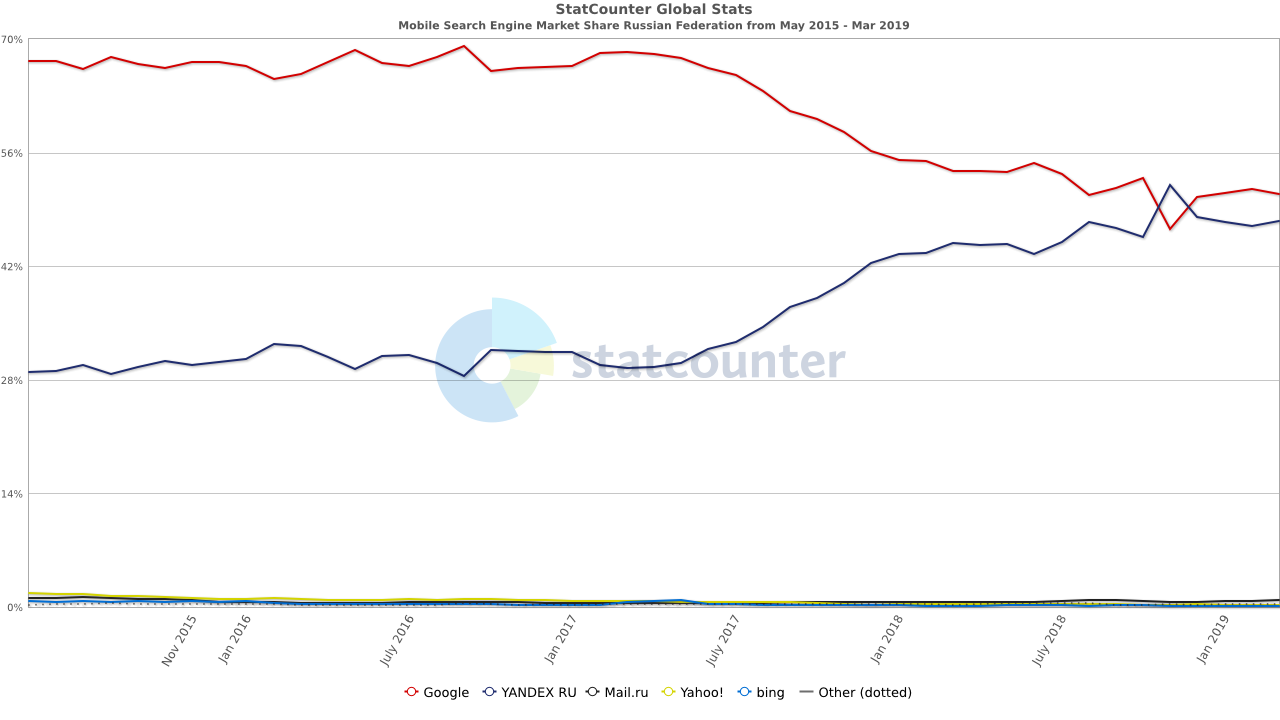
Google was also fined in Russia over Android bundling. The fine was tiny, but after consumers gained a search engine choice screen (much like Google pushed for in Europe on Microsoft years ago) Yandex’s share of mobile search grew quickly.
The UK recently published a white paper on online harms. In some ways it is a regulation just like the tech companies might offer to participants in their ecosystems:
Companies will have to fulfil their new legal duties or face the consequences and “will still need to be compliant with the overarching duty of care even where a specific code does not exist, for example assessing and responding to the risk associated with emerging harms or technology”.
If web publishers should monitor inbound links to look for anything suspicious then the big platforms sure as hell have the resources & profit margins to monitor behavior on their own websites.
Australia passed the Sharing of Abhorrent Violent Material bill which requires platforms to expeditiously remove violent videos & notify the Australian police about them.
There are other layers of fracturing going on in the web as well.
Programmatic advertising shifted revenue from publishers to adtech companies & the largest ad sellers. Ad blockers further lower the ad revenues of many publishers. If you routinely use an ad blocker, try surfing the web for a while without one & you will notice layover welcome AdSense ads on sites as you browse the web – the very type of ad they were allegedly against when promoting AMP.
There has been much more press in the past week about ad blocking as Google’s influence is being questioned as it rolls out ad blocking as a feature built into Google’s dominant Chrome web browser. https://t.co/LQmvJu9MYB— Jason Kint (@jason_kint) February 19, 2018
Tracking protection in browsers & ad blocking features built directly into browsers leave publishers more uncertain. And who even knows who visited an AMP page hosted on a third party server, particularly when things like GDPR are mixed in? Those who lack first party data may end up having to make large acquisitions to stay relevant.
Voice search & personal assistants are now ad channels.
Google Assistant Now Showing Sponsored Link Ads for Some Travel Related Queries
“Similar results are delivered through both Google Home and Google Home Hub without the sponsored links.” https://t.co/jSVKKI2AYT via @bretkinsella pic.twitter.com/0sjAswy14M— Glenn Gabe (@glenngabe) April 15, 2019
App stores are removing VPNs in China, removing Tiktok in India, and keeping female tracking apps in Saudi Arabia. App stores are centralized chokepoints for governments. Every centralized service is at risk of censorship. Web browsers from key state-connected players can also censor messages spread by developers on platforms like GitHub.
Microsoft’s newest Edge web browser is based on Chromium, the source of Google Chrome. While Mozilla Firefox gets most of their revenue from a search deal with Google, Google has still went out of its way to use its services to both promote Chrome with pop overs AND break in competing web browsers:
“All of this is stuff you’re allowed to do to compete, of course. But we were still a search partner, so we’d say ‘hey what gives?’ And every time, they’d say, ‘oops. That was accidental. We’ll fix it in the next push in 2 weeks.’ Over and over. Oops. Another accident. We’ll fix it soon. We want the same things. We’re on the same team. There were dozens of oopses. Hundreds maybe?” – former Firefox VP Jonathan Nightingale
This is how it spreads. Google normalizes “web apps” that are really just Chrome apps. Then others follow. We’ve been here before, y’all. Remember IE? Browser hegemony is not a happy place. https://t.co/b29EvIty1H— DHH (@dhh) April 1, 2019
In fact, it’s alarming how much of Microsoft’s cut-off-the-air-supply playbook on browser dominance that Google is emulating. From browser-specific apps to embrace-n-extend AMP “standards”. It’s sad, but sadder still is when others follow suit.— DHH (@dhh) April 1, 2019
YouTube page load is 5x slower in Firefox and Edge than in Chrome because YouTube’s Polymer redesign relies on the deprecated Shadow DOM v0 API only implemented in Chrome. You can restore YouTube’s faster pre-Polymer design with this Firefox extension: https://t.co/F5uEn3iMLR— Chris Peterson (@cpeterso) July 24, 2018
As phone sales fall & app downloads stall a hardware company like Apple is pushing hard into services while quietly raking in utterly fantastic ad revenues from search & ads in their app store.
Part of the reason people are downloading fewer apps is so many apps require registration as soon as they are opened, or only let a user engage with them for seconds before pushing aggressive upsells. And then many apps which were formerly one-off purchases are becoming subscription plays. As traffic acquisition costs have jumped, many apps must engage in sleight of hand behaviors (free but not really, we are collecting data totally unrelated to the purpose of our app & oops we sold your data, etc.) in order to get the numbers to back out. This in turn causes app stores to slow down app reviews.
Apple acquired the news subscription service Texture & turned it into Apple News Plus. Not only is Apple keeping half the subscription revenues, but soon the service will only work for people using Apple devices, leaving nearly 100,000 other subscribers out in the cold: “if you’re part of the 30% who used Texture to get your favorite magazines digitally on Android or Windows devices, you will soon be out of luck. Only Apple iOS devices will be able to access the 300 magazines available from publishers. At the time of the sale in March 2018 to Apple, Texture had about 240,000 subscribers.”
Apple is also going to spend over a half-billion Dollars exclusively licensing independently developed games:
Several people involved in the project’s development say Apple is spending several million dollars each on most of the more than 100 games that have been selected to launch on Arcade, with its total budget likely to exceed $500m. The games service is expected to launch later this year. … Apple is offering developers an extra incentive if they agree for their game to only be available on Arcade, withholding their release on Google’s Play app store for Android smartphones or other subscription gaming bundles such as Microsoft’s Xbox game pass.
Verizon wants to launch a video game streaming service. It will probably be almost as successful as their Go90 OTT service was. Microsoft is pushing to make Xbox games work on Android devices. Amazon is developing a game streaming service to compliment Twitch.
The hosts on Twitch, some of whom sign up exclusively with the platform in order to gain access to its moneymaking tools, are rewarded for their ability to make a connection with viewers as much as they are for their gaming prowess. Viewers who pay $4.99 a month for a basic subscription — the money is split evenly between the streamers and Twitch — are looking for immediacy and intimacy. While some hosts at YouTube Gaming offer a similar experience, they have struggled to build audiences as large, and as dedicated, as those on Twitch. … While YouTube has made millionaires out of the creators of popular videos through its advertising program, Twitch’s hosts make money primarily from subscribers and one-off donations or tips. YouTube Gaming has made it possible for viewers to support hosts this way, but paying audiences haven’t materialized at the scale they have on Twitch.
Google, having a bit of Twitch envy, is also launching a video game streaming service which will be deeply integrated into YouTube: “With Stadia, YouTube watchers can press “Play now” at the end of a video, and be brought into the game within 5 seconds. The service provides “instant access” via button or link, just like any other piece of content on the web.”
Google will also launch their own game studio making exclusive games for their platform.
When consoles don’t use discs or cartridges so they can sell a subscription access to their software library it is hard to be a game retailer! GameStop’s stock has been performing like an ICO. And these sorts of announcements from the tech companies have been hitting stock prices for companies like Nintendo & Sony: “There is no doubt this service makes life even more difficult for established platforms,” Amir Anvarzadeh, a market strategist at Asymmetric Advisors Pte, said in a note to clients. “Google will help further fragment the gaming market which is already coming under pressure by big games which have adopted the mobile gaming business model of giving the titles away for free in hope of generating in-game content sales.”
The big tech companies which promoted everything in adjacent markets being free are now erecting paywalls for themselves, balkanizing the web by paying for exclusives to drive their bundled subscriptions.
How many paid movie streaming services will the web have by the end of next year? 20? 50? Does anybody know?
Disney alone with operate Disney+, ESPN+ as well as Hulu.
And then the tech companies are not only licensing exclusives to drive their subscription-based services, but we’re going to see more exclusionary policies like YouTube not working on Amazon Echo, Netflix dumping support for Apple’s Airplay, or Amazon refusing to sell devices like Chromecast or Apple TV.
The good news in a fractured web is a broader publishing industry that contains many micro markets will have many opportunities embedded in it. A Facebook pivot away from games toward news, or a pivot away from news toward video won’t kill third party publishers who have a more diverse traffic profile and more direct revenues. And a regional law blocking porn or gambling websites might lead to an increase in demand for VPNs or free to play points-based games with paid upgrades. Even the rise of metered paywalls will lead to people using more web browsers & more VPNs. Each fracture (good or bad) will create more market edges & ultimately more opportunities. Chinese enforcement of their gambling laws created a real estate boom in Manila.
So long as there are 4 or 5 game stores, 4 or 5 movie streaming sites, etc. … they have to compete on merit or use money to try to buy exclusives. Either way is better than the old monopoly strategy of take it or leave it ultimatums.
The publisher wins because there is a competitive bid. There won’t be an arbitrary 30% tax on everything. So long as there is competition from the open web there will be means to bypass the junk fees & the most successful companies that do so might create their own stores with a lower rate: “Mr. Schachter estimates that Apple and Google could see a hit of about 14% to pretax earnings if they reduced their own app commissions to match Epic’s take.”
As the big media companies & big tech companies race to create subscription products they’ll spend many billions on exclusives. And they will be training consumers that there’s nothing wrong with paying for content. This will eventually lead to hundreds of thousands or even millions of successful niche publications which have incentives better aligned than all the issues the ad supported web has faced.
Added: Facebook pushing privacy & groups is both an attempt to thwart regulation risk while also making their services more relevant to a web that fractures away from a monolithic thing into more niche communities.
One way of looking at Facebook in this moment is as an unstoppable behemoth that bends reality to its will, no matter the consequences. (This is how many journalists tend to see it.) Another way of looking at the company is from the perspective of its fundamental weakness — as a slave to ever-shifting consumer behavior. (This is how employees are more likely to look at it.) … Zuckerberg’s vision for a new Facebook is perhaps best represented by a coming redesign of the flagship app and desktop site that will emphasize events and groups, at the expense of the News Feed. Collectively, the design changes will push people toward smaller group conversations and real-world meetups — and away from public posts.
Categories:
The Fractured Web
Anyone can argue about the intent of a particular action & the outcome that is derived by it. But when the outcome is known, at some point the intent is inferred if the outcome is derived from a source of power & the outcome doesn’t change.
Or, put another way, if a powerful entity (government, corporation, other organization) disliked an outcome which appeared to benefit them in the short term at great lasting cost to others, they could spend resources to adjust the system.
If they don’t spend those resources (or, rather, spend them on lobbying rather than improving the ecosystem) then there is no desired change. The outcome is as desired. Change is unwanted.
Engagement is a toxic metric.Products which optimize for it become worse. People who optimize for it become less happy.It also seems to generate runaway feedback loops where most engagable people have a) worst individual experiences and then b) end up driving the product bus.— Patrick McKenzie (@patio11) April 9, 2019
News is a stock vs flow market where the flow of recent events drives most of the traffic to articles. News that is more than a couple days old is no longer news. A news site which stops publishing news stops becoming a habit & quickly loses relevancy. Algorithmically an abandoned archive of old news articles doesn’t look much different than eHow, in spite of having a much higher cost structure.
According to SEMrush’s traffic rank, ampproject.org gets more monthly visits than Yahoo.com.
That actually understates the prevalence of AMP because AMP is generally designed for mobile AND not all AMP-formatted content is displayed on ampproject.org.
Part of how AMP was able to get widespread adoption was because in the news vertical the organic search result set was displaced by an AMP block. If you were a news site either you were so differentiated that readers would scroll past the AMP block in the search results to look for you specifically, or you adopted AMP, or you were doomed.
Some news organizations like The Guardian have a team of about a dozen people reformatting their content to the duplicative & proprietary AMP format. That’s wasteful, but necessary “In theory, adoption of AMP is voluntary. In reality, publishers that don’t want to see their search traffic evaporate have little choice. New data from publisher analytics firm Chartbeat shows just how much leverage Google has over publishers thanks to its dominant search engine.”
It seems more than a bit backward that low margin publishers are doing duplicative work to distance themselves from their own readers while improving the profit margins of monopolies. But it is what it is. And that no doubt drew the ire of many publishers across the EU.
And now there are AMP Stories to eat up even more visual real estate.
If you spent a bunch of money to create a highly differentiated piece of content, why would you prefer that high spend flaghship content appear on a third party website rather than your own?
Google & Facebook have done such a fantastic job of eating the entire pie that some are celebrating Amazon as a prospective savior to the publishing industry. That view – IMHO – is rather suspect.
Where any of the tech monopolies dominate they cram down on partners. The New York Times acquired The Wirecutter in Q4 of 2016. In Q1 of 2017 Amazon adjusted their affiliate fee schedule.
Amazon generally treats consumers well, but they have been much harder on business partners with tough pricing negotiations, counterfeit protections, forced ad buying to have a high enough product rank to be able to rank organically, ad displacement of their organic search results below the fold (even for branded search queries), learning suppliers & cutting out the partners, private label products patterned after top sellers, in some cases running pop over ads for the private label products on product level pages where brands already spent money to drive traffic to the page, etc.
They’ve made things tougher for their partners in a way that mirrors the impact Facebook & Google have had on online publishers:
“Boyce’s experience on Amazon largely echoed what happens in the offline world: competitors entered the market, pushing down prices and making it harder to make a profit. So Boyce adapted. He stopped selling basketball hoops and developed his own line of foosball tables, air hockey tables, bocce ball sets and exercise equipment. The best way to make a decent profit on Amazon was to sell something no one else had and create your own brand. … Amazon also started selling bocce ball sets that cost $15 less than Boyce’s. He says his products are higher quality, but Amazon gives prominent page space to its generic version and wins the cost-conscious shopper.”
Google claims they have no idea how content publishers are with the trade off between themselves & the search engine, but every quarter Alphabet publish the share of ad spend occurring on owned & operated sites versus the share spent across the broader publisher network. And in almost every quarter for over a decade straight that ratio has grown worse for publishers.
When Google tells industry about how much $ it funnels to rest of ecosystem, just show them this chart. It’s good to be the “revenue regulator” (note: G went public in 2004). pic.twitter.com/HCbCNgbzKc— Jason Kint (@jason_kint) February 5, 2019
The aggregate numbers for news publishers are worse than shown above as Google is ramping up ads in video games quite hard. They’ve partnered with Unity & promptly took away the ability to block ads from appearing in video games using googleadsenseformobileapps.com exclusion (hello flat thumb misclicks, my name is budget & I am gone!)
They will also track video game player behavior & alter game play to maximize revenues based on machine learning tied to surveillance of the user’s account: “We’re bringing a new approach to monetization that combines ads and in-app purchases in one automated solution. Available today, new smart segmentation features in Google AdMob use machine learning to segment your players based on their likelihood to spend on in-app purchases. Ad units with smart segmentation will show ads only to users who are predicted not to spend on in-app purchases. Players who are predicted to spend will see no ads, and can simply continue playing.”
And how does the growth of ampproject.org square against the following wisdom?
If you do use a CDN, I’d recommend using a domain name of your own (eg, https://t.co/fWMc6CFPZ0), so you can move to other CDNs if you feel the need to over time, without having to do any redirects.— John (@JohnMu) April 15, 2019
Literally only yesterday did Google begin supporting instant loading of self-hosted AMP pages.
China has a different set of tech leaders than the United States. Baidu, Alibaba, Tencent (BAT) instead of Facebook, Amazon, Apple, Netflix, Google (FANG). China tech companies may have won their domestic markets in part based on superior technology or better knowledge of the local culture, though those same companies have largely went nowhere fast in most foreign markets. A big part of winning was governmental assistance in putting a foot on the scales.
Part of the US-China trade war is about who controls the virtual “seas” upon which value flows:
it can easily be argued that the last 60 years were above all the era of the container-ship (with container-ships getting ever bigger). But will the coming decades still be the age of the container-ship? Possibly not, for the simple reason that things that have value increasingly no longer travel by ship, but instead by fiberoptic cables! … you could almost argue that ZTE and Huawei have been the “East India Company” of the current imperial cycle. Unsurprisingly, it is these very companies, charged with laying out the “new roads” along which “tomorrow’s value” will flow, that find themselves at the center of the US backlash. … if the symbol of British domination was the steamship, and the symbol of American strength was the Boeing 747, it seems increasingly clear that the question of the future will be whether tomorrow’s telecom switches and routers are produced by Huawei or Cisco. … US attempts to take down Huawei and ZTE can be seen as the existing empire’s attempt to prevent the ascent of a new imperial power. With this in mind, I could go a step further and suggest that perhaps the Huawei crisis is this century’s version of Suez crisis. No wonder markets have been falling ever since the arrest of the Huawei CFO. In time, the Suez Crisis was brought to a halt by US threats to destroy the value of sterling. Could we now witness the same for the US dollar?
China maintains Huawei is an employee-owned company. But that proposition is suspect. Broadly stealing technology is vital to the growth of the Chinese economy & they have no incentive to stop unless their leading companies pay a direct cost. Meanwhile, China is investigating Ericsson over licensing technology.
India has taken notice of the success of Chinese tech companies & thus began to promote “national champion” company policies. That, in turn, has also meant some of the Chinese-styled laws requiring localized data, antitrust inquiries, foreign ownership restrictions, requirements for platforms to not sell their own goods, promoting limits on data encryption, etc.
The secretary of India’s Telecommunications Department, Aruna Sundararajan, last week told a gathering of Indian startups in a closed-door meeting in the tech hub of Bangalore that the government will introduce a “national champion” policy “very soon” to encourage the rise of Indian companies, according to a person familiar with the matter. She said Indian policy makers had noted the success of China’s internet giants, Alibaba Group Holding Ltd. and Tencent Holdings Ltd. … Tensions began rising last year, when New Delhi decided to create a clearer set of rules for e-commerce and convened a group of local players to solicit suggestions. Amazon and Flipkart, even though they make up more than half the market, weren’t invited, according to people familiar with the matter.
Amazon vowed to invest $5 billion in India & they have done some remarkable work on logistics there. Walmart acquired Flipkart for $16 billion.
Other emerging markets also have many local ecommerce leaders like Jumia, MercadoLibre, OLX, Gumtree, Takealot, Konga, Kilimall, BidOrBuy, Tokopedia, Bukalapak, Shoppee, Lazada. If you live in the US you may have never heard of *any* of those companies. And if you live in an emerging market you may have never interacted with Amazon or eBay.
It makes sense that ecommerce leadership would be more localized since it requires moving things in the physical economy, dealing with local currencies, managing inventory, shipping goods, etc. whereas information flows are just bits floating on a fiber optic cable.
If the Internet is primarily seen as a communications platform it is easy for people in some emerging markets to think Facebook is the Internet. Free communication with friends and family members is a compelling offer & as the cost of data drops web usage increases.
At the same time, the web is incredibly deflationary. Every free form of entertainment which consumes time is time that is not spent consuming something else.
Add the technological disruption to the wealth polarization that happened in the wake of the great recession, then combine that with algorithms that promote extremist views & it is clearly causing increasing conflict.
If you are a parent and you think you child has no shot at a brighter future than your own life it is easy to be full of rage.
Empathy can radicalize otherwise normal people by giving them a more polarized view of the world:
Starting around 2000, the line starts to slide. More students say it’s not their problem to help people in trouble, not their job to see the world from someone else’s perspective. By 2009, on all the standard measures, Konrath found, young people on average measure 40 percent less empathetic than my own generation … The new rule for empathy seems to be: reserve it, not for your “enemies,” but for the people you believe are hurt, or you have decided need it the most. Empathy, but just for your own team. And empathizing with the other team? That’s practically a taboo.
A complete lack of empathy could allow a psychopath to commit extreme crimes while feeling no guilt, shame or remorse. Extreme empathy can have the same sort of outcome:
“Sometimes we commit atrocities not out of a failure of empathy but rather as a direct consequence of successful, even overly successful, empathy. … They emphasized that students would learn both sides, and the atrocities committed by one side or the other were always put into context. Students learned this curriculum, but follow-up studies showed that this new generation was more polarized than the one before. … [Empathy] can be good when it leads to good action, but it can have downsides. For example, if you want the victims to say ‘thank you.’ You may even want to keep the people you help in that position of inferior victim because it can sustain your feeling of being a hero.” – Fritz Breithaupt
News feeds will be read. Villages will be razed. Lynch mobs will become commonplace.
Many people will end up murdered by algorithmically generated empathy.
As technology increases absentee ownership & financial leverage, a society led by morally agnostic algorithms is not going to become more egalitarian.
The more I think about and discuss it, the more I think WhatsApp is simultaneously the future of Facebook, and the most potentially dangerous digital tool yet created. We haven’t even begun to see the real impact yet of ubiquitous, unfettered and un-moderatable human telepathy.— Antonio García Martínez (@antoniogm) April 15, 2019
When politicians throw fuel on the fire it only gets worse:
It’s particularly odd that the government is demanding “accountability and responsibility” from a phone app when some ruling party politicians are busy spreading divisive fake news. How can the government ask WhatsApp to control mobs when those convicted of lynching Muslims have been greeted, garlanded and fed sweets by some of the most progressive and cosmopolitan members of Modi’s council of ministers?
Mark Zuckerburg won’t get caught downstream from platform blowback as he spends $20 million a year on his security.
The web is a mirror. Engagement-based algorithms reinforcing our perceptions & identities.
And every important story has at least 2 sides!
The Rohingya asylum seekers are victims of their own violent Jihadist leadership that formed a militia to kill Buddhists and Hindus. Hindus are being massacred, where’s the outrage for them!? https://t.co/P3m6w4B1Po— Imam Tawhidi (@Imamofpeace) May 23, 2018
Some may “learn” vaccines don’t work. Others may learn the vaccines their own children took did not work, as it failed to protect them from the antivax content spread by Facebook & Google, absorbed by people spreading measles & Medieval diseases.
Passion drives engagement, which drives algorithmic distribution: “There’s an asymmetry of passion at work. Which is to say, there’s very little counter-content to surface because it simply doesn’t occur to regular people (or, in this case, actual medical experts) that there’s a need to produce counter-content.”
As the costs of “free” become harder to hide, social media companies which currently sell emerging markets as their next big growth area will end up having embedded regulatory compliance costs which will end up exceeding any sort of prospective revenue they could hope to generate.
The Pinterest S1 shows almost all their growth is in emerging markets, yet almost all their revenue is inside the United States.
As governments around the world see the real-world cost of the foreign tech companies & view some of them as piggy banks, eventually the likes of Facebook or Google will pull out of a variety of markets they no longer feel worth serving. It will be like Google did in mainland China with search after discovering pervasive hacking of activist Gmail accounts.
Just tried signing into Gmail from a new device. Unless I provide a phone number, there is no way to sign in and no one to call about it. Oh, and why do they say they need my phone? If you guessed “for my protection,” you would be correct. Talk about Big Brother…— Simon Mikhailovich (@S_Mikhailovich) April 16, 2019
Lower friction & lower cost information markets will face more junk fees, hurdles & even some legitimate regulations. Information markets will start to behave more like physical goods markets.
The tech companies presume they will be able to use satellites, drones & balloons to beam in Internet while avoiding messy local issues tied to real world infrastructure, but when a local wealthy player is betting against them they’ll probably end up losing those markets: “One of the biggest cheerleaders for the new rules was Reliance Jio, a fast-growing mobile phone company controlled by Mukesh Ambani, India’s richest industrialist. Mr. Ambani, an ally of Mr. Modi, has made no secret of his plans to turn Reliance Jio into an all-purpose information service that offers streaming video and music, messaging, money transfer, online shopping, and home broadband services.”
Publishers do not have “their mojo back” because the tech companies have been so good to them, but rather because the tech companies have been so aggressive that they’ve earned so much blowback which will in turn lead publishers to opting out of future deals, which will eventually lead more people back to the trusted brands of yesterday.
Publishers feeling guilty about taking advertorial money from the tech companies to spread their propaganda will offset its publication with opinion pieces pointing in the other direction: “This is a lobbying campaign in which buying the good opinion of news brands is clearly important. If it was about reaching a target audience, there are plenty of metrics to suggest his words would reach further – at no cost – on Facebook. Similarly, Google is upping its presence in a less obvious manner via assorted media initiatives on both sides of the Atlantic. Its more direct approach to funding journalism seems to have the desired effect of making all media organisations (and indeed many academic institutions) touched by its money slightly less questioning and critical of its motives.”
When Facebook goes down direct visits to leading news brand sites go up.
When Google penalizes a no-name me-too site almost nobody realizes it is missing. But if a big publisher opts out of the ecosystem people will notice.
The reliance on the tech platforms is largely a mirage. If enough key players were to opt out at the same time people would quickly reorient their information consumption habits.
If the platforms can change their focus overnight then why can’t publishers band together & choose to dump them?
CEO Jack Dorsey said Twitter is looking to change the focus from following specific individuals to topics of interest, acknowledging that what’s incentivized today on the platform is at odds with the goal of healthy dialoguehttps://t.co/31FYslbePA— Axios (@axios) April 16, 2019
In Europe there is GDPR, which aimed to protect user privacy, but ultimately acted as a tax on innovation by local startups while being a subsidy to the big online ad networks. They also have Article 11 & Article 13, which passed in spite of Google’s best efforts on the scaremongering anti-SERP tests, lobbying & propaganda fronts: “Google has sparked criticism by encouraging news publishers participating in its Digital News Initiative to lobby against proposed changes to EU copyright law at a time when the beleaguered sector is increasingly turning to the search giant for help.”
Remember the Eric Schmidt comment about how brands are how you sort out (the non-YouTube portion of) the cesspool? As it turns out, he was allegedly wrong as Google claims they have been fighting for the little guy the whole time:
Article 11 could change that principle and require online services to strike commercial deals with publishers to show hyperlinks and short snippets of news. This means that search engines, news aggregators, apps, and platforms would have to put commercial licences in place, and make decisions about which content to include on the basis of those licensing agreements and which to leave out. Effectively, companies like Google will be put in the position of picking winners and losers. … Why are large influential companies constraining how new and small publishers operate? … The proposed rules will undoubtedly hurt diversity of voices, with large publishers setting business models for the whole industry. This will not benefit all equally. … We believe the information we show should be based on quality, not on payment.
Facebook claims there is a local news problem: “Facebook Inc. has been looking to boost its local-news offerings since a 2017 survey showed most of its users were clamoring for more. It has run into a problem: There simply isn’t enough local news in vast swaths of the country. … more than one in five newspapers have closed in the past decade and a half, leaving half the counties in the nation with just one newspaper, and 200 counties with no newspaper at all.”
Google is so for the little guy that for their local news experiments they’ve partnered with a private equity backed newspaper roll up firm & another newspaper chain which did overpriced acquisitions & is trying to act like a PE firm (trying to not get eaten by the PE firm).
Does the above stock chart look in any way healthy?
Does it give off the scent of a firm that understood the impact of digital & rode it to new heights?
If you want good market-based outcomes, why not partner with journalists directly versus operating through PE chop shops?
If Patch is profitable & Google were a neutral ranking system based on quality, couldn’t Google partner with journalists directly?
Throwing a few dollars at a PE firm in some nebulous partnership sure beats the sort of regulations coming out of the EU. And the EU’s regulations (and prior link tax attempts) are in addition to the three multi billion Euro fines the European Union has levied against Alphabet for shopping search, Android & AdSense.
Google was also fined in Russia over Android bundling. The fine was tiny, but after consumers gained a search engine choice screen (much like Google pushed for in Europe on Microsoft years ago) Yandex’s share of mobile search grew quickly.
The UK recently published a white paper on online harms. In some ways it is a regulation just like the tech companies might offer to participants in their ecosystems:
Companies will have to fulfil their new legal duties or face the consequences and “will still need to be compliant with the overarching duty of care even where a specific code does not exist, for example assessing and responding to the risk associated with emerging harms or technology”.
If web publishers should monitor inbound links to look for anything suspicious then the big platforms sure as hell have the resources & profit margins to monitor behavior on their own websites.
Australia passed the Sharing of Abhorrent Violent Material bill which requires platforms to expeditiously remove violent videos & notify the Australian police about them.
There are other layers of fracturing going on in the web as well.
Programmatic advertising shifted revenue from publishers to adtech companies & the largest ad sellers. Ad blockers further lower the ad revenues of many publishers. If you routinely use an ad blocker, try surfing the web for a while without one & you will notice layover welcome AdSense ads on sites as you browse the web – the very type of ad they were allegedly against when promoting AMP.
There has been much more press in the past week about ad blocking as Google’s influence is being questioned as it rolls out ad blocking as a feature built into Google’s dominant Chrome web browser. https://t.co/LQmvJu9MYB— Jason Kint (@jason_kint) February 19, 2018
Tracking protection in browsers & ad blocking features built directly into browsers leave publishers more uncertain. And who even knows who visited an AMP page hosted on a third party server, particularly when things like GDPR are mixed in? Those who lack first party data may end up having to make large acquisitions to stay relevant.
Voice search & personal assistants are now ad channels.
Google Assistant Now Showing Sponsored Link Ads for Some Travel Related Queries “Similar results are delivered through both Google Home and Google Home Hub without the sponsored links.” https://t.co/jSVKKI2AYT via @bretkinsella pic.twitter.com/0sjAswy14M— Glenn Gabe (@glenngabe) April 15, 2019
App stores are removing VPNs in China, removing Tiktok in India, and keeping female tracking apps in Saudi Arabia. App stores are centralized chokepoints for governments. Every centralized service is at risk of censorship. Web browsers from key state-connected players can also censor messages spread by developers on platforms like GitHub.
Microsoft’s newest Edge web browser is based on Chromium, the source of Google Chrome. While Mozilla Firefox gets most of their revenue from a search deal with Google, Google has still went out of its way to use its services to both promote Chrome with pop overs AND break in competing web browsers:
“All of this is stuff you’re allowed to do to compete, of course. But we were still a search partner, so we’d say ‘hey what gives?’ And every time, they’d say, ‘oops. That was accidental. We’ll fix it in the next push in 2 weeks.’ Over and over. Oops. Another accident. We’ll fix it soon. We want the same things. We’re on the same team. There were dozens of oopses. Hundreds maybe?” – former Firefox VP Jonathan Nightingale
This is how it spreads. Google normalizes “web apps” that are really just Chrome apps. Then others follow. We’ve been here before, y’all. Remember IE? Browser hegemony is not a happy place. https://t.co/b29EvIty1H— DHH (@dhh) April 1, 2019
In fact, it’s alarming how much of Microsoft’s cut-off-the-air-supply playbook on browser dominance that Google is emulating. From browser-specific apps to embrace-n-extend AMP “standards”. It’s sad, but sadder still is when others follow suit.— DHH (@dhh) April 1, 2019
YouTube page load is 5x slower in Firefox and Edge than in Chrome because YouTube’s Polymer redesign relies on the deprecated Shadow DOM v0 API only implemented in Chrome. You can restore YouTube’s faster pre-Polymer design with this Firefox extension: https://t.co/F5uEn3iMLR— Chris Peterson (@cpeterso) July 24, 2018
As phone sales fall & app downloads stall a hardware company like Apple is pushing hard into services while quietly raking in utterly fantastic ad revenues from search & ads in their app store.
Part of the reason people are downloading fewer apps is so many apps require registration as soon as they are opened, or only let a user engage with them for seconds before pushing aggressive upsells. And then many apps which were formerly one-off purchases are becoming subscription plays. As traffic acquisition costs have jumped, many apps must engage in sleight of hand behaviors (free but not really, we are collecting data totally unrelated to the purpose of our app & oops we sold your data, etc.) in order to get the numbers to back out. This in turn causes app stores to slow down app reviews.
Apple acquired the news subscription service Texture & turned it into Apple News Plus. Not only is Apple keeping half the subscription revenues, but soon the service will only work for people using Apple devices, leaving nearly 100,000 other subscribers out in the cold: “if you’re part of the 30% who used Texture to get your favorite magazines digitally on Android or Windows devices, you will soon be out of luck. Only Apple iOS devices will be able to access the 300 magazines available from publishers. At the time of the sale in March 2018 to Apple, Texture had about 240,000 subscribers.”
Apple is also going to spend over a half-billion Dollars exclusively licensing independently developed games:
Several people involved in the project’s development say Apple is spending several million dollars each on most of the more than 100 games that have been selected to launch on Arcade, with its total budget likely to exceed $500m. The games service is expected to launch later this year. … Apple is offering developers an extra incentive if they agree for their game to only be available on Arcade, withholding their release on Google’s Play app store for Android smartphones or other subscription gaming bundles such as Microsoft’s Xbox game pass.
Verizon wants to launch a video game streaming service. It will probably be almost as successful as their Go90 OTT service was. Microsoft is pushing to make Xbox games work on Android devices. Amazon is developing a game streaming service to compliment Twitch.
The hosts on Twitch, some of whom sign up exclusively with the platform in order to gain access to its moneymaking tools, are rewarded for their ability to make a connection with viewers as much as they are for their gaming prowess. Viewers who pay $4.99 a month for a basic subscription — the money is split evenly between the streamers and Twitch — are looking for immediacy and intimacy. While some hosts at YouTube Gaming offer a similar experience, they have struggled to build audiences as large, and as dedicated, as those on Twitch. … While YouTube has made millionaires out of the creators of popular videos through its advertising program, Twitch’s hosts make money primarily from subscribers and one-off donations or tips. YouTube Gaming has made it possible for viewers to support hosts this way, but paying audiences haven’t materialized at the scale they have on Twitch.
Google, having a bit of Twitch envy, is also launching a video game streaming service which will be deeply integrated into YouTube: “With Stadia, YouTube watchers can press “Play now” at the end of a video, and be brought into the game within 5 seconds. The service provides “instant access” via button or link, just like any other piece of content on the web.”
Google will also launch their own game studio making exclusive games for their platform.
When consoles don’t use discs or cartridges so they can sell a subscription access to their software library it is hard to be a game retailer! GameStop’s stock has been performing like an ICO. And these sorts of announcements from the tech companies have been hitting stock prices for companies like Nintendo & Sony: “There is no doubt this service makes life even more difficult for established platforms,” Amir Anvarzadeh, a market strategist at Asymmetric Advisors Pte, said in a note to clients. “Google will help further fragment the gaming market which is already coming under pressure by big games which have adopted the mobile gaming business model of giving the titles away for free in hope of generating in-game content sales.”
The big tech companies which promoted everything in adjacent markets being free are now erecting paywalls for themselves, balkanizing the web by paying for exclusives to drive their bundled subscriptions.
How many paid movie streaming services will the web have by the end of next year? 20? 50? Does anybody know?
Disney alone with operate Disney+, ESPN+ as well as Hulu.
And then the tech companies are not only licensing exclusives to drive their subscription-based services, but we’re going to see more exclusionary policies like YouTube not working on Amazon Echo, Netflix dumping support for Apple’s Airplay, or Amazon refusing to sell devices like Chromecast or Apple TV.
The good news in a fractured web is a broader publishing industry that contains many micro markets will have many opportunities embedded in it. A Facebook pivot away from games toward news, or a pivot away from news toward video won’t kill third party publishers who have a more diverse traffic profile and more direct revenues. And a regional law blocking porn or gambling websites might lead to an increase in demand for VPNs or free to play points-based games with paid upgrades. Even the rise of metered paywalls will lead to people using more web browsers & more VPNs. Each fracture (good or bad) will create more market edges & ultimately more opportunities. Chinese enforcement of their gambling laws created a real estate boom in Manila.
So long as there are 4 or 5 game stores, 4 or 5 movie streaming sites, etc. … they have to compete on merit or use money to try to buy exclusives. Either way is better than the old monopoly strategy of take it or leave it ultimatums.
The publisher wins because there is a competitive bid. There won’t be an arbitrary 30% tax on everything. So long as there is competition from the open web there will be means to bypass the junk fees & the most successful companies that do so might create their own stores with a lower rate: “Mr. Schachter estimates that Apple and Google could see a hit of about 14% to pretax earnings if they reduced their own app commissions to match Epic’s take.”
As the big media companies & big tech companies race to create subscription products they’ll spend many billions on exclusives. And they will be training consumers that there’s nothing wrong with paying for content. This will eventually lead to hundreds of thousands or even millions of successful niche publications which have incentives better aligned than all the issues the ad supported web has faced.
Categories:
How Do I Improve My Domain Authority (DA)?
Posted by Dr-Pete
The Short Version: Don’t obsess over Domain Authority (DA) for its own sake. Domain Authority shines at comparing your overall authority (your aggregate link equity, for the most part) to other sites and determining where you can compete. Attract real links that drive traffic, and you’ll improve both your Domain Authority and your rankings.
Unless you’ve been living under a rock, over a rock, or really anywhere rock-adjacent, you may know that Moz has recently invested a lot of time, research, and money in a new-and-improved Domain Authority. People who use Domain Authority (DA) naturally want to improve their score, and this is a question that I admit we’ve avoided at times, because like any metric, DA can be abused if taken out of context or viewed in isolation.
I set out to write a how-to post, but what follows can only be described as a belligerent FAQ …
Why do you want to increase DA?
This may sound like a strange question coming from an employee of the company that created Domain Authority, but it’s the most important question I can ask you. What’s your end-goal? Domain Authority is designed to be an indicator of success (more on that in a moment), but it doesn’t drive success. DA is not used by Google and will have no direct impact on your rankings. Increasing your DA solely to increase your DA is pointless vanity.
So, I don’t want a high DA?
I understand your confusion. If I had to over-simplify Domain Authority, I would say that DA is an indicator of your aggregate link equity. Yes, all else being equal, a high DA is better than a low DA, and it’s ok to strive for a higher DA, but high DA itself should not be your end-goal.
So, DA is useless, then?
No, but like any metric, you can’t use it recklessly or out of context. Our Domain Authority resource page dives into more detail, but the short answer is that DA is very good at helping you understand your relative competitiveness. Smart SEO isn’t about throwing resources at vanity keywords, but about understanding where you realistically have a chance at competing. Knowing that your DA is 48 is useless in a vacuum. Knowing that your DA is 48 and the sites competing on a query you’re targeting have DAs from 30-45 can be extremely useful. Likewise, knowing that your would-be competitors have DAs of 80+ could save you a lot of wasted time and money.
But Google says DA isn’t real!
This topic is a blog post (or eleven) in and of itself, but I’m going to reduce it to a couple points. First, Google’s official statements tend to define terms very narrowly. What Google has said is that they don’t use a domain-level authority metric for rankings. Ok, let’s take that at face value. Do you believe that a new page on a low-authority domain (let’s say DA = 25) has an equal chance of ranking as a high-authority domain (DA = 75)? Of course not, because every domain benefits from its aggregate internal link equity, which is driven by the links to individual pages. Whether you measure that aggregate effect in a single metric or not, it still exists.
Let me ask another question. How do you measure the competitiveness of a new page, that has no Page Authority (or PageRank or whatever metrics Google uses)? This question is a big part of why Domain Authority exists — to help you understand your ability to compete on terms you haven’t targeted and for content you haven’t even written yet.
Seriously, give me some tips!
I’ll assume you’ve read all of my warnings and taken them seriously. You want to improve your Domain Authority because it’s the best authority metric you have, and authority is generally a good thing. There are no magical secrets to improving the factors that drive DA, but here are the main points:
1. Get more high-authority links
Shocking, I know, but that’s the long and short of it. Links from high-authority sites and pages still carry significant ranking power, and they drive both Domain Authority and Page Authority. Even if you choose to ignore DA, you know high-authority links are a good thing to have. Getting them is the topic of thousands of posts and more than a couple of full-length novels (well, ok, books — but there’s probably a novel and feature film in the works).
2. Get fewer spammy links
Our new DA score does a much better job of discounting bad links, as Google clearly tries to do. Note that “bad” doesn’t mean low-authority links. It’s perfectly natural to have some links from low-authority domains and pages, and in many cases it’s both relevant and useful to searchers. Moz’s Spam Score is pretty complex, but as humans we intuitively know when we’re chasing low-quality, low-relevance links. Stop doing that.
3. Get more traffic-driving links
Our new DA score also factors in whether links come from legitimate sites with real traffic, because that’s a strong signal of usefulness. Whether or not you use DA regularly, you know that attracting links that drive traffic is a good thing that indicates relevance to searches and drives bottom-line results. It’s also a good reason to stop chasing every link you can at all costs. What’s the point of a link that no one will see, that drives no traffic, and that is likely discounted by both our authority metrics and Google.
You can’t fake real authority
Like any metric based on signals outside of our control, it’s theoretically possible to manipulate Domain Authority. The question is: why? If you’re using DA to sell DA 10 links for $1, DA 20 links for $2, and DA 30 links for $3, please, for the love of all that is holy, stop (and yes, I’ve seen that almost verbatim in multiple email pitches). If you’re buying those links, please spend that money on something more useful, like sandwiches.
Do the work and build the kind of real authority that moves the needle both for Moz metrics and Google. It’s harder in the short-term, but the dividends will pay off for years. Use Domain Authority to understand where you can compete today, cost-effectively, and maximize your investments. Don’t let it become just another vanity metric.
Sign up for The Moz Top 10, a semimonthly mailer updating you on the top ten hottest pieces of SEO news, tips, and rad links uncovered by the Moz team. Think of it as your exclusive digest of stuff you don’t have time to hunt down but want to read!
Google AMP Now Can Support Real Publisher URLs
We knew this was coming and at the AMP Conference in Tokyo, Google announced support for publishers to use their own URLs when serving AMP pages in Google search. This is powered through signed exchanges and supported with more modern browsers.
…
Google Fixing Another Indexing Bug With Google News
Google said yesterday they are aware of an indexing bug impacting a limited number of publishers and they are working to fix it. It seems like the fix has been rolling out, although Google has yet to confirm this issue has been resolved yet.
Google: No, You Can’t Force Someone To Link To You Legally
Back in December we reported that Google updated their link schemes guidelines to disallow “requiring a link as part of a Terms of Service, contract, or similar arrangement” to link to you with a do-follow. The topic came back up when SEO personality …
Google: Some Other Google Bugs May Be Related To The De-Indexing Bug
It seems like the past month or so has been a tough one for the Google engineers. We have seen bug after bug, many we haven’t even covered yet over here. The question is, are they related and when will most of them be resolved. Of course, one thing …
Google: Google News indexing bug has been resolved
Resolved: Google has resolved the issue with Google News not indexing some publisher’s content.
Please visit Search Engine Land for the full article.
Three fundamental factors in the production of link-building content
I’ve analyzed over 120 pieces of content across 16 industries to define common threads between campaigns that exceed or fall short of their expectations.
The post Three fundamental factors in the production of link-building content appeared first on Search Engine Watch.
A story about Schema, structured data and robots
Once upon a time, a little robot came to a site to figure out what it was about. The robot read some words and followed some links and said: “Well, there are a lot of mentions of this particular word, so this page must be about that!” She sent out orders to the mothership to […]
The post A story about Schema, structured data and robots appeared first on Yoast.
Choosing a marketing automation platform
Who are the major vendors? What should I be looking for? What are the costs?
Please visit Search Engine Land for the full article.
How Web Marketers Should Classify Search Queries
For years Web marketers and search specialists have used a fairly rigid classification system for identifying queries by type. You should have these three types burned into your soul by now: Informational queries Navigational queries Transactional queries I’ve identified other…