What SEOs & Webmasters Should Watch At Google I/O
Google published an agenda of which sessions they think would be most relevant and useful to SEOs and webmasters. This is in addition to watching the keynote, which by the way Martin Splitt says it well worth watching if you are an SEO.
Google’s New How Google News Works Portal
Google launched a new portal named How News Works on Google. This is similar to the How Search Works portal Google launched in 2013 and revamped a couple times but now for news.
Google My Business Reporting Also Buggy
The folks in the Local Search Forums are complaining that some of their clients are showing weird reporting glitches within the Google My Business Insights section. It is supposedly not too uncommon to see weird dips and/or data glitches in this repor…
Google: Disallowed URLs Can Still Collect Links
Just like you can sometimes see listings in Google search for URLs that are disallowed, those URLs can also “collect” links in Google search. What this means is that while Google is not authorized to crawl the URL, if people are linking to the URL, Go…
The new evergreen Googlebot
Googlebot is the crawler that visits web pages to include them within Google Search index. The number one question we got from the community at events and social media was if we could make Googlebot evergreen with the latest Chromium. Today, we are happy to announce that Googlebot now runs the latest Chromium rendering engine (74 at the time of this post) when rendering pages for Search. Moving forward, Googlebot will regularly update its rendering engine to ensure support for latest web platform features.
What that means for you
Compared to the previous version, Googlebot now supports 1000+ new features, like:
- ES6 and newer JavaScript features
- IntersectionObserver for lazy-loading
- Web Components v1 APIs
You should check if you’re transpiling or use polyfills specifically for Googlebot and if so, evaluate if this is still necessary. There are still some limitations, so check our troubleshooter for JavaScript-related issues and the video series on JavaScript SEO.
Any thoughts on this? Talk to us on Twitter, the webmaster forums, or join us for the online office hours.
Posted by Martin Splitt, friendly internet fairy at the Webmasters Trends Analyst team


What defines high-quality links in 2019 and how to get them?
Assertive Media’s 2018 study of 230 UK link-building agencies found that nine out 10 used unscrupulous techniques. So, what makes a high-quality link?
The post What defines high-quality links in 2019 and how to get them? appeared first on Search Engine Watch.
Google search bug has search suggestions crawling off the page
Google, that just looks ugly. Can you fix it?
Please visit Search Engine Land for the full article.
Google Assistant moves from the cloud to the phone, now 10X faster
The faster Assistant will be available on Pixel phones ‘later this year’ and could become a major competitive advantage.
Please visit Search Engine Land for the full article.
The evolution of SEO and the shift from point solutions to platform
SEO methods and insights are supporting strategy and decision making beyond website content. Uncover the broader use of SEO intelligence in evolution.
The post The evolution of SEO and the shift from point solutions to platform appeared first on Search Engine Watch.
Google’s web crawler Googlebot now runs on the latest version of Chromium: Why that’s a good thing
Googlebot has been upgraded and should now be able to crawl more modern web sites with less of an issue.
Please visit Search Engine Land for the full article.
IAB: U.S. search spend grew 19% in 2018, but its share of digital ad spend ticked down, again
Search remains the primary digital format, but video continues to see rapid spend growth.
Please visit Search Engine Land for the full article.
Google announced updates to news in search, adds 3D support to search results and more
Breaking news from Google I/O on search related topics including Google top stories, AR and 3D objects, Google Lens, Google Assistant and Lens.
Please visit Search Engine Land for the full article.
The future of search: Capturing the hearts and minds of Generation Z
What makes Gen Z tick when it comes to search, ads, and their preferred brands?
Please visit Search Engine Land for the full article.
Google Search experiments with showing less relevant search results when requested
Google experiments with a message in search that reads, “Hmm… the results for your search don’t seem very relevant.”
Please visit Search Engine Land for the full article.
The Future of Analytics and How It’s Changing Digital Marketing
Data science and machine learning are quickly transforming every industry, empowering users by giving them the opportunity to accomplish more with their time.
Post from Therese Palmere
All-new and improved: the SEO copywriting training!
As of today, you can get your hands on a completely overhauled version of the SEO copywriting training. We’re very proud to present a much more hands-on training, which will really take you by the hand, and guide you through every step of writing an SEO-friendly blog post. It’s chock-full of real-life examples and practical […]
The post All-new and improved: the SEO copywriting training! appeared first on Yoast.
Kill the mystery: the power of a robust brief
Let me tell you a story about the worst meeting of my career… Before my time at Builtvisible, I was project managing a new website development. The primary goal was to simplify customer user journey. All was going well: we had completed the customer research, user journey mapping, site architecture and were presenting the initial […]
The post Kill the mystery: the power of a robust brief appeared first on Builtvisible.
I Want to Rank Beyond My Location: A Guide to How This Works
Posted by MiriamEllis
Staff at your agency get asked this question just about every day, and it’s a local SEO forum FAQ, too:
“I’m located in ‘x’, but how do I rank beyond that?”
In fact, this query is so popular, it deserves a good and thorough answer. I’ve written this article in the simplest terms possible so that you can instantly share it with even your least-technical clients.
We’ll break rankings down into five easy-to-grasp groups, and make sense out of how Google appears to bucket rankings for different types of users and queries. Your clients will come away with an understanding of what’s appropriate, what’s possible, and what’s typically impossible. It’s my hope that shooting this link over to all relevant clients will save your team a ton of time, and ensure that the brands you’re serving are standing on steady ground with some good education.
There’s nothing quite like education as a sturdy baseline for creating achievable goals, is there?
One hypothetical client’s story

We’ll illustrate our story by focusing in on a single fictitious business. La Tortilleria is a tortilla bakery located at 197 Fifth Avenue in San Rafael, Marin County, California, USA. San Rafael is a small city with a population of about 60,000. La Tortilleria vends directly to B2C customers, as well as distributing their handmade tortillas to a variety of B2B clients, like restaurants and grocery stores throughout Marin County.
La Tortilleria’s organic white corn tortillas are so delicious, the bakery recently got featured on a Food Network TV show. Then, they started getting calls from San Francisco, Sacramento, and even Los Angeles asking about their product. This business, which started out as a mom-and-pop shop, is now hoping to expand distribution beyond county borders.
When it comes to Google visibility, what is La Tortilleria eligible for, and is there some strategy they can employ to show up in many places for many kinds of searches? Let’s begin:
Group I: Hyperlocal rankings
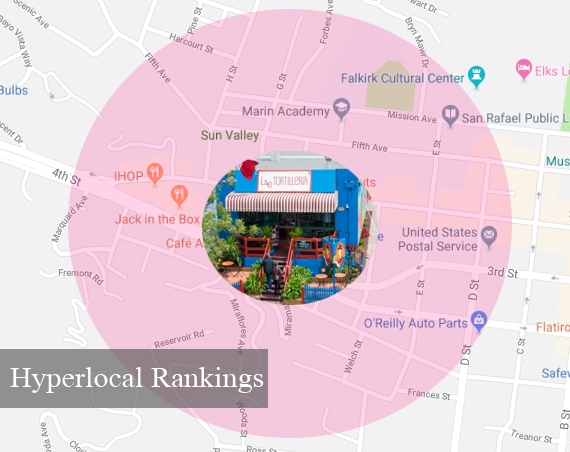
Scenario
Your supreme chance of ranking in Google’s local pack results is typically in the neighborhood surrounding your business. For example, with the right strategy, La Tortilleria could expect to rank very well in the above downtown area of San Rafael surrounding their bakery. When searchers are physically located in this area or using search language like “tortilleria near me,” Google can hyper-localize the radius of the search to just a few city blocks when there are enough nearby options to make up a local pack.
Ask the client to consider:
- What is my locale like? Am I in a big city, a small town, a rural area?
- What is the competitive level of my market? Am I one of many businesses offering the same goods/services in my neighborhood, or am I one of the only businesses in my industry here?
Google’s local pack radius will vary greatly based on the answers to those two questions. For example, if there are 100 tortilla bakeries in San Rafael, Google doesn’t have to go very far to make up a local pack for a searcher standing on Fifth Avenue with their mobile phone. But, if La Tortilleria is one of only three such businesses in town, Google will have to reach further across the map to make up the pack. Meanwhile, in a truly rural area with few such businesses, Google’s smallest radius could span several towns, or if there simply aren’t enough options, not show a local pack in the results at all.
Strategy
To do well in the hyperlocal packs, tell your client their business should:
- Create and claim a Google My Business listing, filling out as many fields as possible. Earn some reviews and respond to them
- Build out local business listings on top local business information platforms, either manually or via a service like Moz Local.
- Mention neighborhood names or other hyperlocal terms on the company website, including on whichever page of the site the Google listing points to.
- If competition is strong in the neighborhood, invest in more advanced tactics like earning local linktations, developing more targeted hyperlocal content, using Google Posts to highlight neighborhood-oriented content, and managing Google Q&A to outdistance more sluggish competitors.
*Note that if you are marketing a multi-location enterprise, you’ll need to undertake this work for each location to get it ranking well at a hyperlocal level.
Group II: Local rankings

Scenario
These rankings are quite similar to the above but encompass an entire city. In fact, when we talk about local rankings, we are most often thinking about how a business ranks within its city of location. For example, how does La Tortilleria rank for searches like “tortilleria,” “tortilla shop,” or “tortillas san rafael” when a searcher is anywhere in that city, or traveling to that city from another locale?
If Google believes the intent of such searches is local (meaning that the searcher wants to find some tortillas to buy near them rather than just seeking general information about baked goods), they will make up a local pack of results. As we’ve covered, Google will customize these packs based on the searcher’s physical location in many instances, but a business that becomes authoritative enough can often rank across an entire city for multiple search phrases and searcher locales.
For instance, La Tortilleria might always rank #1 for “tortilla shop” when searchers on Fifth Avenue perform that search, but they could also rank #1 for “organic tortillas San Rafael” when locals in any part of that city or even out-of-towners do this lookup, if the business has built up enough authority surrounding this topic.
With the right strategy, every business has a very good chance of ranking locally in its city of physical location for some portion of its most desired search phrases.
Ask the client to consider:
- Does my location + Google’s results behavior create small or large hurdles in my quest for city-wide rankings? When I look at the local packs I want to rank for, does Google appear to be clustering them too tightly in some part of the city to include my location in a different part of town? If so, can I overcome this?
- What can I specialize in to set me apart? Is there some product, service, or desirable attribute my business can become particularly known for in my city over all other competitors? If I can’t compete for the biggest terms I’d like to rank for, are there smaller terms I could become dominant for city-wide?
- How can I build my authority surrounding this special offering? What will be the most effective methodologies for becoming a household name in my community when people need the services I offer?
Your agency will face challenges surrounding this area of work. I was recently speaking with a business owner in Los Angeles who was disappointed that he wasn’t appearing for the large, lucrative search term “car service to LAX.” When we looked at the results together from various locations, we saw that Google’s radius for that term was tightly clustered around the airport. This company’s location was in a different neighborhood many miles away. In fact, it was only when we zoomed out on Google Maps to enlarge the search radius, or zoomed in on this company’s neighborhood, that we were able to see their listing appear in the local results.
This was a classic example of a big city with tons of brands offering nearly-identical services — it results in very stiff competition and tight local pack radius.
My advice in a tough scenario like this would revolve around one of these three things:
- Becoming such a famous brand that the business could overcome Google’s famous bias
- Specializing in some attribute that would enable them to seek rankings for less competitive keywords
- Moving to an office near that “centroid” of business instead of in a distant neighborhood of the large city.
Your specific scenario may be easier, equal to, or even harder than this. Needless to say, a tortilla shop in a modestly-sized town does not face the same challenges as a car service in a metropolis. Your strategy will be based on your study of your market.
Strategy
Depending on the level of competition in the client’s market, tell them they will need to invest in some or all of the following:
- Identify the keyword phrases you’re hoping to rank for using tools like Moz Keyword Explorer, Answer the Public, and Google Trends combined with organized collection and analysis of the real-world FAQs customers ask your staff.
- Observe Google’s local pack behavior surrounding these phrases to discover how they are clustering results. Perform searches from devices in your own neighborhood and from other places around your city, as described in my recent post How to Find Your True Local Competitors. You can also experiment with tools like BrightLocal’s Local Search Results Checker.
- Identify the top competitors in your city for your targeted phrases and then do a competitive audit of them.
- Stack these discovered competitors up side-by-side with your business to see how their local search ranking factors may be stronger than yours. Improve your metrics so that they surpass those of the competitors, whether this surrounds Google My Business signals, Domain Authority, reputation, citation factors, website quality, or other elements.
- If Google’s radius is tight for the most lucrative terms and your efforts to build authority so far aren’t enabling you to overcome it due to your location falling outside their reach, consider specialization in other smaller, but still valuable, search phrases. For instance, La Tortilleria could be the only bakery in San Rafael offering organic tortillas. A local business might significantly narrow the competition by being pet-friendly, open later, cheaper, faster, more staffed, women-led, serving specific dietary restrictions or other special needs, selling rarities, or bundling goods with expert advice. There are many ways to set yourself apart.
- Finally, publicize your unique selling proposition. Highlight it on your website with great content. If it’s a big deal, make connections with local journalists and bloggers to try to make news. Use Google My Business attributes to feature it on your listing. Cross-sell with related local businesses and promote one another online. Talk it up on social media. Structure review requests to nudge customers towards mentioning your special offering in their reviews. Do everything you can to help your community and Google associate your brand name with your specialty.
Group III: Regional rankings

Scenario
This is where we typically hit our first really big hurdle, and where the real questions begin. La Tortilleria is located in San Rafael and has very good chances of ranking in relation to that city. But what if they want to expand to selling their product throughout Marin County, or even throughout several surrounding counties? Unless competition is very low, they are unlikely to rank in the local packs for searchers in neighboring cities like Novato, Mill Valley, or Corte Madera. What paths are open to them to increase their visibility beyond their city of location?
It’s at this juncture that agencies start hearing clients ask, “What can I do if I want to rank outside my city?” And it’s here that it’s most appropriate to respond with some questions clients need to be asking themselves.
Ask the client to consider:
- Does my business model legitimately lend itself to transactions in multiple cities or counties? For example, am I just hoping that if my business in City A could rank in City B, people from that second location would travel to me? For instance, the fact that a dentist has some patients who come to their practice from other towns isn’t really something to build a strategy on. Consumers and Google won’t be excited by this. So, ask yourself: “Do I genuinely have a model that delivers goods/services to City B or has some other strong relationship to neighbors in those locales?”
- Is there something I can do to build a physical footprint in cities where I lack a physical location? Short of opening additional branches, is there anything my business can do to build relationships with neighboring communities?
Strategy
- First, know that it’s sometimes possible for a business in a less-competitive market to rank in nearby neighboring cities. If La Tortilleria is one of just 10 such businesses in Marin County, Google may well surface them in a local pack or the expanded local finder view for searchers in multiple neighboring towns because there is a paucity of options. However, as competition becomes denser, purely local rankings beyond city borders become increasingly rare. Google does not need to go outside of the city of San Francisco, for example, to make up complete local results sets for pizza, clothing, automotive services, attorneys, banks, dentists, etc. Assess the density of competition in your desired regional market.
- If you determine that your business is something of a rarity in your county or similar geographical region, follow the strategy described above in the “Local Rankings” section and give it everything you’ve got so that you can become a dominant result in packs across nearby multiple cities. If competition is too high for this, keep reading.
- If you determine that what you offer isn’t rare in your region, local pack rankings beyond your city borders may not be feasible. In this case, don’t waste money or time on unachievable goals. Rather, move the goalposts so that your marketing efforts outside of your city are targeting organic, social, paid, and offline visibility.
- Determine whether your brand lends itself to growing face-to-face relationships with neighboring cities. La Tortilleria can send delivery persons to restaurants and grocery stores throughout its county. They can send their bakers to workshops, culinary schools, public schools, food festivals, expos, fairs, farmers markets, and a variety of events in multiple cities throughout their targeted region. They can sponsor regional events, teams, and organizations. They can cross-sell with a local salsa company, a chocolatier, a caterer. Determine what your brand’s resources are for expanding a real-world footprint within a specific region.
- Once you’ve begun investing in building this footprint, publicize it. Write content, guest blog, make the news, share socially, advertise online, advertise in local print, radio, and TV media. Earn links, citations and social mentions online for what you are doing offline and grow your regional authority in Google’s eyes while you’re doing it.
- If your brand is a traditional service area business, like a residential painting company with a single location that serves multiple cities, develops a website landing page for each city you serve. Make each page a showcase of your work in that city, with project features, customer reviews, localized tips, staff interviews, videos, photos, FAQs and more. As with brick-and-mortar models, your level of rarity will determine whether your single physical office can show up in the local packs for more than one city. If your geo-market is densely competitive, the main goal of your service city landing pages will be organic rankings, not local ones.
Group IV: State-wide rankings

Scenario
This is where our desired consumer base can no longer be considered truly local, though local packs may still occasionally come into play. In our continuing story, revenue significantly increased after La Tortilleria appeared on a popular TV show. Now they’ve scaled up their small kitchen to industrial strength in hopes of increasing trade across the state of California. Other examples might be an architectural firm that sends staff state-wide to design buildings or a photographer who accepts event engagements across the state.
What we’re not talking about here is a multi-location business. Any time you have a physical location, you can simply refer back to Groups I–III for strategy because you are truly in the local running any place you have a branch. But for the single location client with a state-wide offering, the quest for broad visibility begs some questions.
Ask the client to consider:
- Are state-wide local pack results at all in evidence for my query or is this not the reality at all for my industry? For example, when I do a non-modified search just for “sports arena” in California, it’s interesting to see that Google is willing to make up a local pack of three famous venues spanning Sonora to San Diego (about 500 miles apart). Does Google return state-wide packs for my search terms, and is what I offer so rare that I might be included in them?
- Does my business model genuinely lend itself to non-local queries and clients willing to travel far to transact with me or hire me from anywhere in the state? For example, it would be a matter of pure vanity for me to want my vacuum cleaner repair shop to rank state-wide, as people can easily access services like mine in their own towns. But, what if I’m marketing a true rara avis, like a famous performing arts company, a landmark museum, a world-class interior design consultancy, or a vintage electronics restoration business?
- Whether Google returns state-wide local packs or only organic results for my targeted search terms, what can I do to be visible? What are my resources for setting myself apart?
Strategy
- First, let’s take it for granted that you’ve got your basic local search strategy in place. You’re already doing everything we’ve covered above to build a strong hyperlocal, local, and regional digital and offline footprint.
- If Google does return state-wide local packs for your search phrases, simply continue to amp up the known local pack signals we’ve already discussed, in hopes of becoming authoritative enough to be included.
- If your phrases don’t return state-wide local packs, you will be competing against a big field for organic results visibility. In this case, you are likely to be best served by three things. Firstly, take publication on your website seriously. The more you can write about your offerings, the more of an authoritative resource you will become. Delve deeply into your company’s internal talent for developing magazine-quality content and bring in outside experts where necessary. Secondly, invest in link research tools like Moz Link Explorer to analyze which links are helping competitors to rank highly in the organic results for your desired terms and to discover where you need to get links to grow your visibility. Thirdly, seek out your state’s most trusted media sources and create a strategy for seeking publicity from them. Whether this comes down to radio, newspapers, TV shows, blogs, social platforms, or organizational publications, build your state-wide fame via inclusion.
- If all else fails and you need to increase multi-regional visibility throughout your state, you will need to consider your resources for opening additional staffed offices in new locales.
Group V: National rankings & beyond
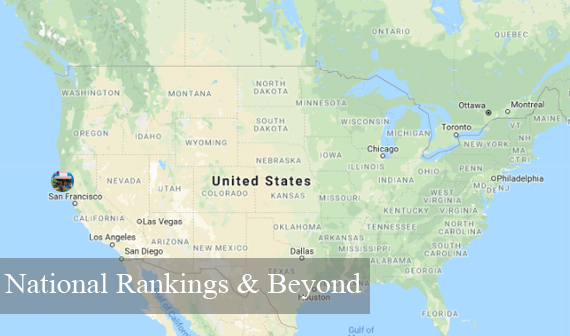
Scenario
Here, we encounter two common themes, neither of which fall within our concept of local search.
In the first instance, La Tortilleria is ready to go multi-state or nation-wide with its product, distributing goods outside of California as a national brand. The second is the commonly-encountered digital brand that is vending to a multi-state or national audience and is often frustrated by the fact that they are being outranked both in the local and organic results by physical, local companies in a variety of locations. In either case, the goals of both models can sometimes extend beyond country borders when businesses go multinational.
Ask the client to consider:
- What is my business model? Am I selling B2B, B2C, or both?
- Which marketing strategies will generate the brand recognition I need? Is my most critical asset my brand’s website, or other forms of off-and-online advertising? Am I like Wayfair, where my e-commerce sales are almost everything, bolstered by TV advertising? Or, am I like Pace Foods with a website offering little more than branding because distribution to other businesses is where my consumers find me?
- Does my offering need to be regionalized to succeed? Perhaps La Tortilleria will need to start producing super-sized white flour tortillas to become a hit in Texas. McDonald’s offers SPAM in Hawaii and green chile cheeseburgers in New Mexico. Regional language variants, seasonality, and customs may require fine-tuning of campaigns.
Strategy
- If your national brand hinges on B2C online sales, let me put the e-commerce SEO column of the Moz blog at your fingertips. Also highly recommended, E-commerce SEO: The Definitive Guide.
- If your national brand revolves around getting your product on shelves, delve into Neilsen’s manufacturer/distributor resources and I’ve also found some good reading at MrCheckout.
- If you are expanding beyond your country, read Moz’s basic definition of International SEO, then move on to An In-Depth Look at International SEO and The Ultimate Guide to International SEO.
- This article can’t begin to cover all of the steps involved in growing a brand from local to an international scale, but in all scenarios, a unifying question will revolve around how to cope with the reality that Google will frequently rank local brands above or alongside your business for queries that matter to you. If your business has a single physical headquarters, then content, links, social, and paid advertising will be the tools at your disposal to compete as best you can. Rarity may be your greatest strength, as seen in the case of America’s sole organic tulip bulb grower, or authority, as in the case of this men’s grooming site ranking for all kinds of queries related to beards.
- You’ll be wanting to rank for every user nationwide, but you’ll also need to be aware of who your competitors are at a local and regional level. This is why even national/international brands need some awareness of how local search works so that they can identify and audit strong local brands in target markets in order to compete with them in the organic SERPs, sometimes fine-tuning their offerings to appeal to regional needs and customs.
- I often hear from digital-only brands that want to rank in every city in the nation for a virtual service. While this may be possible for a business with overwhelming authority and brand recognition (think Amazon), a company just starting out can set a more reasonable goal of analyzing a handful of major cities instead of thousands of them to see what it would take to get in the running with entrenched local and digital brands.
- Finally, I want to mention one interesting and common national business model with its own challenges. In this category are tutoring businesses, nanny services, dog walking services, and other brands that have a national headquarters but whose employees or contractors are the ones providing face-to-face services. Owners ask if it’s possible to create multiple Google listings based on the home addresses of their workers so that they can achieve local pack rankings for what is, in fact, a locally-rendered service. The answer is that Google doesn’t approve of this tactic. So, where a local pack presence is essential, the brand must find a way to staff an office in each target region. Avoid virtual offices, which are explicitly forbidden, but there could be some leeway in exploring inexpensive co-working spaces staffed during stated business hours and where no other business in the same Google category is operating. A business that determines this model could work for them can then pop back up to Groups I-IV to see how far local search can take them.
Summing up
There may be no more important task in client-onboarding than setting correct expectations. Basing a strategy on what’s possible for each client’s business model will be the best guardian of your time and your client’s budget. To recap:
- Identify the client’s model.
- Investigate Google’s search behavior for the client’s important search phrases.
- Gauge the density of competition/rarity of the client’s offerings in the targeted area.
- Audit competitors to discover their strengths and weaknesses.
- Create a strategy for local, organic, social, paid, and offline marketing based on the above four factors.
For each client who asks you how to rank beyond their physical location, there will be a unique answer. The work your agency puts into finding that answer will make you an expert in their markets and a powerful ally in achieving their achievable goals.
Sign up for The Moz Top 10, a semimonthly mailer updating you on the top ten hottest pieces of SEO news, tips, and rad links uncovered by the Moz team. Think of it as your exclusive digest of stuff you don’t have time to hunt down but want to read!
Why set it and forget it doesn’t work with feeds or campaigns
Create a checklist to regularly test and review search terms, manage errors and analyze custom label usage to make sure you’re not losing revenue in your product feeds or campaigns.
Please visit Search Engine Land for the full article.
Can You Reverse A 301 Redirect?
Posted by Dr-Pete
The short answer is “yes.” You can reverse a 301-redirect, even though it’s technically permanent. The long answer, though, is that this change may not work the way you’d expect or hope, and it could even make your problems worse. Let’s explore the long answer with four real-world scenarios …
First: A note and a warning…
Before we dive into the scenarios, there are two things you need to know. This stuff all sounds easy in theory, but — in the real world — 301-redirects take time to process, and reversing them (or changing signals in any major way) often takes even more time. Be prepared for those delays, and prepare your stakeholders. You may see ranking flux during this time period. Most of the time, it will pass fairly quickly, but reversals tend to get messy.
This leads me to the warning – don’t reverse a 301-redirect simply because something is taking too long or you’re in a full-on panic. A midstream reversal can create mixed signals, delays things even more, and cause serious short-term ranking loss. If you’re going to undo a 301-redirect, make sure you’re undoing it for sound reasons or that the reasons for the original 301 no longer apply.
Scenario #1: Single-page, full reverse

Let’s start with the easiest scenario. Page A 301-redirects to Page B (A→B) and you’d like to reverse that. I’m assuming here that Page B will be going away completely. Here are the basic steps:
- Remove the 301-redirect from A→B
- Add a 301-redirect from B→A
- Re-point internal links to Page A
- Submit both pages to Google Search Console (GSC)
- Give Google time to re-cache Page B
It’s that last step that trips most people up. You’re going to be tempted to treat Page B as persona non grata and disavow its existence entirely (including removing it from XML sitemaps). Don’t. The problem is that Google needs time to process the new signals, and it can’t do that if you’re hiding Page B, or worse yet, entirely blocking crawlers from it. Let Google crawl Page B and process the new signals. Leave it alone for a while.
Scenario #2: Single-page, keep both
What if you’ve redirected A→B, and you want to reverse the redirect, but you want Page B to live on? You can’t 301 redirect B→A or Page B will be gone for everyone (search engines and visitors). This can be further split into two sub-scenarios, depending on whether you want Page B to be available to search engines …
Scenario #2A: Page B available to search

If you want both pages to live on with equal status, you really only have one option: remove the 301-redirect, and resubmit both pages. Google may take time to honor this signal, as there’s not a new, strong signal to override it. Here’s the step-by-step breakdown:
- Remove the 301-redirect from A→B
- Add self-referencing rel-canonicals (A→A, B→B)
- Submit both pages to Google Search Console (GSC)
Self-referencing rel-canonicals are fairly weak signals, but they’re at least a nudge to Google to say that Page B is now something you consider to be an independent entity. You can try to kick-start the process by building new links (internal or external) to both pages. If you were passing significant authority from A→B with the original 301-redirect, realize that you’re now splitting that authority. There’s no easy fix for that. You can’t give someone half the eggs in your basket and still expect to count all of your chickens, as the old saying goes.
Scenario #2B: Page B hidden from search

If you want Page B to be available to humans but don’t care if it’s available to search engines (maybe it’s an internal page that exists for legal reasons but isn’t important to marketing), then you could rel-canonical B→A. That will allow Page B to stay visible, but will consolidate the ranking signals on Page A. The steps looks like this:
- Remove the 301-redirect from A→B
- Add a rel-canonical tag from B→A
- Re-point internal links to Page A
- Submit both pages to Google Search Console (GSC)
Note that rel-canonical is a strong suggestion, but it doesn’t completely guarantee that Page B won’t rank. If Page B has no particular search value and you want to consolidate authority into Page A, then this is your best bet.
Scenario #3: Site-wide URL reverse

Here’s where things start to get ugly. Let’s say you’ve made a site-wide URL change, such as switching from http→https, updating your sub-folder structure, or adding/removing URL parameters. This change impacts most or all of the pages on your site, but we’re going to assume that your root domain and sub-domain structure are staying the same.
If you’re reversing a change like http→https because it didn’t do what you had hoped (i.e. you didn’t get a ranking boost), then let me take a moment to urge you to reconsider. All site-wide URL changes are risky, and a reversal is going to confuse the signals even more. You could easily compound your problems.
Noting all of those warnings, here are the key steps:
- Remove all 301-redirects from A→B
- Add site-wide 301-redirects from B→A
- Add self-referencing canonical to all pages
- Re-point internal links to “A-type” URLs
- Re-build XML sitemap(s) for A-type URLs
- Submit critical pages to Google Search Console (GSC)
- Re-point select inbound links to “A-type” URLs
Google Search Console seems to have some limits on how many pages you can submit (it appears that limit varies by site in the new version), and there’s currently no easy mass-submission process, so focus on high-authority pages and pages that are higher in the internal linking structure. This is should encourage Google to re-crawl lower pages as well, at least to some degree.
For a site-wide change, especially given the risks involved, it’s also worth reaching out to authoritative inbound/external links and asking people to re-point those links to the original, A-type URLs. This is ultimately a link outreach task and requires some delicacy. Focus on quality over quantity and on sites that you have a good relationship with – even re-pointing a few high-authority links can help boost your new signals.
Like any mass-redirect, plan well and document thoroughly. People invest a lot of time and money in changes, but then often rush reversals, usually because they’re over-reacting. A site-wide reversal is just as dangerous as the original change, and probably even more so. Making this kind of change in a panic is an invitation to disaster.
Scenario #4: Domain change reverse

You moved your entire site to a new domain, and now, just weeks later, you’ve learned that your new domain is also the name of a Nickelback cover band. Naturally, you panic. First, take a breath. Really assess if the problem is as bad as you think. If it is, this situation is similar to #3, but it’s often riskier because there are aspects to your domain and its history that can influence rankings independently of how well or poorly you implemented 301-redirects.
If you really have no choice, here are your critical steps:
- Remove all 301-redirects from A→B
- Add site-wide 301-redirects from B→A
- Add self-referencing canonical to all pages
- Re-point internal links to Domain A
- Re-add Domain A to Google Search Console (GSC)
- Re-build XML sitemap(s) for Domain A
- Submit critical pages to Google Search Console (GSC)
- Re-point select inbound links to Domain A
In this case, you’ll need a separate GSC profile. If you’ve removed the old one, re-add it and re-create your full XML sitemap(s). You’ll still want to submit critical pages, just to speed up the process.
If you don’t have access to Domain B (maybe the domain registration expired, and someone snatched it up), you’re not going to be able to set up B→A redirects. The truth is that, in that scenario, this is going to be a long and probably painful process. Secondary signals, like inbound links, are going to be very important in that scenario.
How do you re-submit pages in GSC?
I’m still warming up to the new Google Search Console (GSC), and I find the UI a bit too mysterious at times. Here are the steps to submit (or re-submit) a page to be indexed.
(1) Inspect URL in the toolbar
This is hidden in plain sight. At the top of the new GSC, there’s an “Inspect any URL …” search box. To re-submit a URL, you’ll have to inspect it first.

Just enter the full URL you’d like to re-submit and hit [Enter].
(2) Request (re-)indexing
GSC will return a status page with the current index status and some additional information. Whether you’re indexing the URL for the first time or re-indexing it, though, click on “REQUEST INDEXING”…

In most of our 301-redirect reversal scenarios, you should get the “URL is on Google” status back. If the URL is not currently indexed, the rest of the page will have diagnostic details.
(3) Cross your fingers…
That’s about all you can do. Google should return a status window like this:

Now, you cross your fingers and wait. Re-indexing times will vary, and Google doesn’t give ETAs or promises.
A couple of notes on this process. First, it’s (currently at least), pretty slow. Second, there do seem to be limits on how often you can use the tool, although those limits vary from site to site. Unfortunately, there’s no bulk option in GSC. For any large-scale changes, you’re going to have to rely primarily on updating your XML sitemaps.
Lastly: A note and a warning…
This post is going to start and end with a warning. One last note, though – the biggest difference between theory and practice in these situations is that real sites too often mix signals. If you reverse a 301-redirect, you’re already sending a mixed signal, in a sense (compared to your past signals). If, on top of that change, you have mismatched internal links or bad rel-canonical tags or outdated XML sitemaps or redirect chains so long and broken that you’re not even consistently returning the same page, then all of this is going to be higher risk and take even longer. Make sure all of your new signals are consistent before you pull the switch.
Final warning – don’t do any of this in a panic, because rankings or traffic aren’t behaving the way you’d hoped after a few hours or even a few days. A major reversal, especially a site-wide or domain change, could easily compound your problems. Think it through, and make sure you’re fixing the right problem.
Sign up for The Moz Top 10, a semimonthly mailer updating you on the top ten hottest pieces of SEO news, tips, and rad links uncovered by the Moz team. Think of it as your exclusive digest of stuff you don’t have time to hunt down but want to read!