Two Acquisitions Rocking the Analytics Industry – June 2019
1) Google Acquires Looker
Acquisition Details:
On June 6, 2019, Google announced its acquisition of Looker, a business intelligence and analytics startup. The acquisition is set to complete at the end of the year.

Acquisition Features:
With this acquisition, Looker will join the Google Cloud Platform (GCP) to provide a full end-to-end analytics solution that collects, analyzes, and visualizes data.…
The post Two Acquisitions Rocking the Analytics Industry – June 2019 appeared first on Seer Interactive.
A Perfect Pair: Analytics 360 & Optimize 360
Why Use a Marketing Testing Tool?
For a refresher on the marketing testing tool, Google Optimize 360, and its capabilities compared to the free version Google Optimize, read my previous blog post here.
For the purposes of this post, I’ll do a deep dive into Optimize 360’s Personalization and Audience Targeting capabilities, including showing you step by step walkthrough on how to create a personalization experiment in Optimize 360.…
The post A Perfect Pair: Analytics 360 & Optimize 360 appeared first on Seer Interactive.
All Links are Not Created Equal: 20 New Graphics on Google’s Valuation of Links
Posted by Cyrus-Shepard
Twenty-two years ago, the founders of Google invented PageRank, and forever changed the web. A few things that made PageRank dramatically different from existing ranking algorithms:
- Links on the web count as votes. Initially, all votes are equal.
- Pages which receive more votes become more important (and rank higher.)
- More important pages cast more important votes.
But Google didn’t stop there: they innovated with anchor text, topic-modeling, content analysis, trust signals, user engagement, and more to deliver better and better results.
Links are no longer equal. Not by a long shot.
Rand Fishkin published the original version of this post in 2010—and to be honest, it rocked our world. Parts of his original have been heavily borrowed here, and Rand graciously consulted on this update.
In this post, we’ll walk you through 20 principles of link valuation that have been observed and tested by SEOs. In some cases, they have been confirmed by Google, while others have been patented. Please note that these are not hard and fast rules, but principles that interplay with one another. A burst of fresh link can often outweigh powerful links, spam links can blunt the effect of fresh links, etc.
We strongly encourage you to test these yourselves. To quote Rand, “Nothing is better for learning SEO than going out and experimenting in the wild.”
1. Links From Popular Pages Cast More Powerful Votes
Let’s begin with a foundational principle. This concept formed the basis of Google’s original PageRank patent, and quickly help vault it to the most popular search engine in the world.
PageRank can become incredibly complex very quickly—but to oversimplify—the more votes (links) a page has pointed to it, the more PageRank (and other possible link-based signals) it accumulates. The more votes it accumulates, the more it can pass on to other pages through outbound links.
In basic terms, popular pages are ones that have accumulated a lot of votes themselves. Scoring a link from a popular page can typically be more powerful than earning a link from a page with fewer link votes.

2. Links “Inside” Unique Main Content Pass More Value than Boilerplate Links
Google’s Reasonable Surfer, Semantic Distance, and Boilerplate patents all suggest valuing content and links more highly if they are positioned in the unique, main text area of the page, versus sidebars, headers, and footers, aka the “boilerplate.”
It certainly makes sense, as boilerplate links are not truly editorial, but typically automatically inserted by a CMS (even if a human decided to put them there.) Google’s Quality Rater Guidelines encourage evaluators to focus on the “Main Content” of a page.

Similarly, SEO experiments have found that links hidden within expandable tabs or accordions (by either CSS or JavaScript) may carry less weight than fully visible links, though Google says they fully index and weight these links.
3. Links Higher Up in the Main Content Cast More Powerful Votes
If you had a choice between 2 links, which would you choose?
- One placed prominently in the first paragraph of a page, or
- One placed lower beneath several paragraphs
Of course, you’d pick the link visitors would likely click on, and Google would want to do the same. Google’s Reasonable Surfer Patent describes methods for giving more weight to links it believes people will actually click, including links placed in more prominent positions on the page.

Matt Cutts, former head of Google’s Webspam team, once famously encouraged SEOs to pay attention to the first link on the page, and not bury important links. (source)
4. Links With Relevant Anchor Text May Pass More Value
Also included in Google’s Reasonable Surfer patent is the concept of giving more weight to links with relevant anchor text. This is only one of several Google patents where anchor text plays an important role.
Multiple experiments over the years repeatedly confirm the power of relevant anchor text to boost a page’s ranking better than generic or non-relevant anchor text.
It’s important to note that the same Google patents that propose boosting the value of highly-relevant anchors, also discuss devaluing or even ignoring off-topic or irrelevant anchors altogether.
Not that you should spam your pages with an abundance of exact match anchors. Data typically shows that high ranking pages typically have a healthy, natural mix of relevant anchors pointing to them.

Similarly, links may carry the context of the words+phrases around/near the link. Though hard evidence is scant, this is mentioned in Google’s patents, and it makes sense that a link surrounded by topically relevant content would be more contextually relevant than the alternative.
5. Links from Unique Domains Matter More than Links from Previously Linking Sites
Experience shows that it’s far better to have 50 links from 50 different domains than to have 500 more links from a site that already links to you.
This makes sense, as Google’s algorithms are designed to measure popularity across the entire web and not simply popularity from a single site.
In fact, this idea has been supported by nearly every SEO ranking factor correlation study ever performed. The number of unique linking root domains is almost always a better predictor of Google rankings than a site’s raw number of total links.

Rand points out that this principle is not always universally true. “When given the option between a 2nd or 3rd link from the NYTimes vs. randomsitexyz, it’s almost always more rank-boosting and marketing helpful to go with another NYT link.”
6. External Links are More Influential than Internal Links
If we extend the concept from #3 above, then it follows that links from external sites should count more than internal links from your own site. The same correlation studies almost always show that high ranking sites are associated with more external links than lower ranking sites.
Search engines seem to follow the concept that what others say about you is more important than what you say about yourself.

That’s not to say that internal links don’t count. On the contrary, internal linking and good site architecture can be hugely impactful on Google rankings. That said, building external links is often the fastest way to higher rankings and more traffic.
7. Links from Sites Closer to a Trusted Seed Set May Pass More Value
The idea of TrustRank has been around for many years. Bill Slawski covers it here.
More recently, Google updated its original PageRank patent with a section that incorporates the concept of “trust” using seed sites. The closer a site is linked to a trusted seed site, the more of a boost it receives.
In theory, this means that black hat Private Blog Networks (PBNs) would be less effective if they were a large link distance away from more trusted sites.

Beyond links, other ways that Google may evaluate trust is through online reputation—e.g. through online reviews or sentiment analysis—and use of accurate information (facts). This is of particular concern with YMYL (Your Money or Your Life) pages that “impact the future happiness, health, financial stability, or safety of users.”
This means links from sites that Google considers misleading and/or dangerous may be valued less than links from sites that present more reputable information.
8. Links From Topically Relevant Pages May Cast More Powerful Votes
You run a dairy farm. All things being equal, would you rather have a link from:
- The National Dairy Association
- The Association of Automobile Mechanics
Hopefully, you choose “a” because you recognize it’s more relevant. Though several mechanisms, Google may act in the same way to toward topically relevant links, including Topic-Sensitive PageRank, phrase-based indexing, and local inter-connectivity.
These concepts also help discount spam links from non-relevant pages.

While I’ve included the image above, the concepts around Google’s use of topical relevance is incredibly complex. For a primer on SEO relevance signals, I recommend reading:
- Topical SEO: 7 Concepts of Link Relevance & Google Rankings
- More than Keywords: 7 Concepts of Advanced On-Page SEO
9. Links From Fresh Pages Can Pass More Value Than Links From Stale Pages
Freshness counts.
Google uses several ways of evaluating content based on freshness. One way to determine the relevancy of a page is to look at the freshness of the links pointing at it.
The basic concept is that pages with links from fresher pages—e.g. newer pages and those more regularly updated—are likely more relevant than pages with links from mostly stale pages, or pages that haven’t been updated in a while.
For a good read on the subject, Justing Briggs has described and named this concept FreshRank.
A page with a burst of links from fresher pages may indicate immediate relevance, compared to a page that has had the same old links for the past 10 years. In these cases, the rate of link growth and the freshness of the linking pages can have a significant influence on rankings.

It’s important to note that “old” is not the same thing as stale. A stale page is one that:
- Isn’t updated, often with outdated content
- Earns fewer new links over time
- Exhibits declining user engagement
If a page doesn’t meet these requirements, it can be considered fresh – no matter its actual age. As Rand notes, “Old crusty links can also be really valuable, especially if the page is kept up to date.”
10. The Rate of Link Growth Can Signal Freshness
If Google sees a burst of new links to a page, this could indicate a signal of relevance.
By the same measure, a decrease in the overall rate of link growth would indicate that the page has become stale, and likely to be devalued in search results.
All of these freshness concepts, and more, are covered by Google’s Information Retrieval Based on Historical Data patent.

If a webpage sees an increase in its link growth rate, this could indicate a signal of relevance to search engines. For example, if folks start linking to your personal website because you’re about to get married, your site could be deemed more relevant and fresh (as far as this current event goes.)
11. Google Devalues Spam and Low-Quality Links
While there are trillions of links on the web, the truth is that Google likely ignores a large swath of them.
Google’s goal is to focus on editorial links, e.g. “links that you didn’t even have to ask for because they are editorially given by other website owners.” Since Penguin 4.0, Google has implied that their algorithms simply ignore links that they don’t feel meet these standards. These include links generated by negative SEO and link schemes.

That said, there’s lots of debate if Google truly ignores all low-quality links, as there’s evidence that low-quality links—especially those Google might see as manipulative—may actually hurt you.
12. Link Echos: The Influence Of A Link May Persist Even After It Disappears
Link Echos (a.k.a. Link Ghosts) describe the phenomenon where the ranking impact of a link often appears to persist, even long after the link is gone.
Rand has performed several experiments on this and the reverberation effect of links is incredibly persistent, even months after the links have dropped from the web, and Google has recrawled and indexed these pages several times.
Speculation as to why this happens includes: Google looking at other ranking factors once the page has climbed in rankings (e.g. user engagement), Google assigning persistence or degradation to link value that isn’t wholly dependent on its existence on the page, or factors we can’t quite recognize.

Whatever the root cause, the value of a link can have a reverberating, ethereal quality that exists separately from its HTML roots.
As a counterpoint, Niel Patel recently ran an experiment where rankings dropped after low-authority sites lost a large number of links all at once, so it appears possible to overcome this phenomenon under the right circumstances.
13. Sites Linking Out to Authoritative Content May Count More Than Those That Do Not
While Google claims that linking out to quality sites isn’t an explicit ranking factor, they’ve also made statements in the past that it can impact your search performance.
“In the same way that Google trusts sites less when they link to spammy sites or bad neighborhoods, parts of our system encourage links to good sites.” – Matt Cutts

Furthermore, multiple SEO experiments and anecdotal evidence over the years suggest that linking out to relevant, authoritative sites can result in a net positive effect on rankings and visibility.
14. Pages That Link To Spam May Devalue The Other Links They Host
If we take the quote above and focus specifically on the first part, we understand that Google trusts sites less when they link to spam.
This concept can be extended further, as there’s ample evidence of Google demoting sites it believes to be hosting paid links, or part of a private blog network.

Basic advice: when relevant and helpful, link to authoritative sites (and avoid linking to bad sites) when it will benefit your audience.
15. Nofollowed Links Aren’t Followed, But May Have Value In Some Cases
Google invented the nofollow link specifically because many webmasters found it hard to prevent spammy, outbound links on their sites – especially those generated by comment spam and UGC.
A common belief is that nofollow links don’t count at all, but Google’s own language leaves some wriggle room. They don’t follow them absolutely, but “in general” and only “essentially” drop the links from their web graph.

That said, numerous SEO experiments and correlation data all suggest that nofollow links can have some value, and webmasters would be wise to maximize their value.
16. ManyJavaScript Links Pass Value, But Only If Google Renders Them
In the old days of SEO, it was common practice to “hide” links using JavaScript, knowing Google couldn’t crawl them.
Today, Google has gotten significantly better at crawling and rendering JavaScript, so that most JavaScript links today will count.

That said, Google still may not crawl or index every JavaScript link. For one, they need extra time and effort to render the JavaScript, and not every site delivers compatible code. Furthermore, Google only considers full links with an anchor tag and href attribute.
17. If A Page Links To The Same URL More Than Once, The First Link Has Priority
… Or more specifically, only the first anchor text counts.
If Google crawls a page with two or more links pointing to the same URL, they have explained that while PageRank flows normally through both, they will only use the first anchor text for ranking purposes.
This scenario often comes into play when your sitewide navigation links to an important page, and you also link to it within an article below.

Through testing, folks have discovered a number of clever ways to bypass the First Link Priority rule, but newer studies haven’t been published for several years.
18. Robots.txt and Meta Robots May Impact How and Whether Links Are Seen
Seems obvious, but in order for Google to weigh a link in it’s ranking algorithm, it has to be able to crawl and follow it. Unsurprisingly, there are a number of site and page-level directives which can get in Google’s way. These include:
- The URL is blocked from crawling by robots.txt
- Robots meta tag or X-Robots-Tag HTTP header use the “nofollow” directive
- The page is set to “noindex, follow” but Google eventually stops crawling

Often Google will include a URL in its search results if other pages link to it, even if that page is blocked by robots.txt. But because Google can’t actually crawl the page, any links on the page are virtually invisible.
19. Disavowed Links Don’t Pass Value (Typically)
If you’ve built some shady links, or been hit by a penalty, you can use Google’s disavow tool to help wipe away your sins.
By disavowing, Google effectively removes these backlinks for consideration when they crawl the web.

On the other hand, if Google thinks you’ve made a mistake with your disavow file, they may choose to ignore it entirely – probably to prevent you from self-inflicted harm.
20. Unlinked Mentions May Associate Data or Authority With A Website
Google may connect data about entities (concepts like a business, a person, a work of art, etc) without the presence of HTML links, like the way it does with local business citations or with which data refers to a brand, a movie, a notable person, etc.
In this fashion, unlinked mentions may still associate data or authority with a website or a set of information—even when no link is present.

Bill Slawski has written extensively about entities in search (a few examples here, here, and here). It’s a heady subject, but suffice to say Google doesn’t always need links to associate data and websites together, and strong entity associations may help a site to rank.
Below, you’ll find all twenty principals combined into a single graphic. If you’d like to print or embed the image, click here for a higher-res version.

Please credit Moz when using any of these images.
Sign up for The Moz Top 10, a semimonthly mailer updating you on the top ten hottest pieces of SEO news, tips, and rad links uncovered by the Moz team. Think of it as your exclusive digest of stuff you don’t have time to hunt down but want to read!
AMP’d Up for Recaptcha
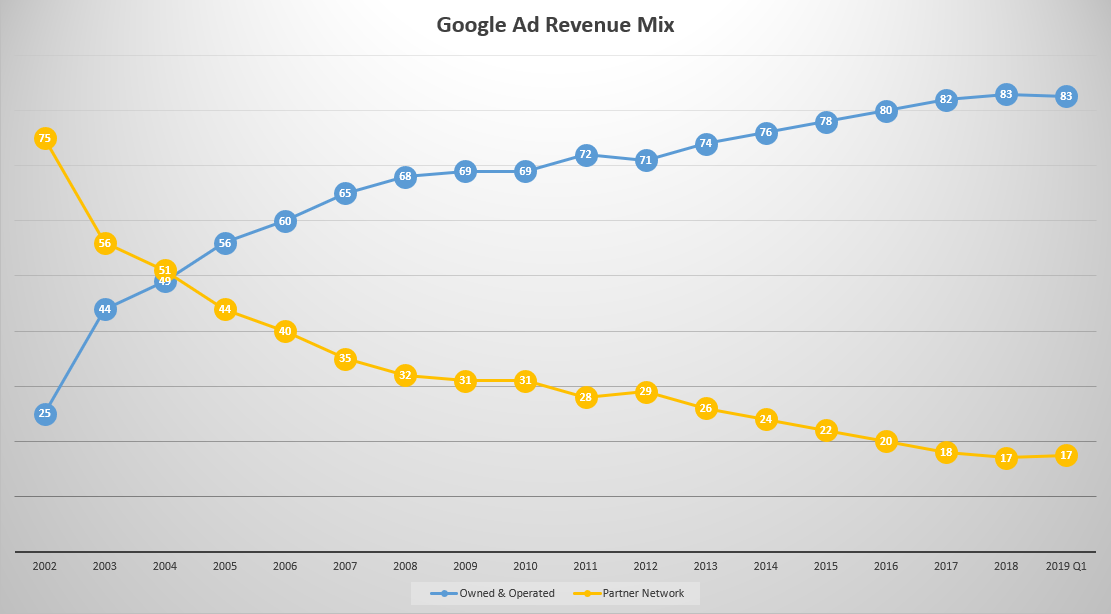
Beyond search Google controls the leading distributed ad network, the leading mobile OS, the leading web browser, the leading email client, the leading web analytics platform, the leading free video hosting site.
They win a lot.
And they take winnings from one market & leverage them into manipulating adjacent markets.
Embrace. Extend. Extinguish.
Imagine taking a universal open standard that has zero problems with it and then stripping it down to it’s most basic components and then prepending each element with your own acronym. Then spend years building and recreating what has existed for decades. That is @amphtml— Jon Henshaw (@henshaw) April 4, 2019
AMP is an utterly unnecessary invention designed to further shift power to Google while disenfranchising publishers. From the very start it had many issues with basic things like supporting JavaScript, double counting unique users (no reason to fix broken stats if they drive adoption!), not supporting third party ad networks, not showing publisher domain names, and just generally being a useless layer of sunk cost technical overhead that provides literally no real value.
Over time they have corrected some of these catastrophic deficiencies, but if it provided real value, they wouldn’t have needed to force adoption with preferential placement in their search results. They force the bundling because AMP sucks.
Absurdity knows no bounds. Googlers suggest: “AMP isn’t another “channel” or “format” that’s somehow not the web. It’s not a SEO thing. It’s not a replacement for HTML. It’s a web component framework that can power your whole site. … We, the AMP team, want AMP to become a natural choice for modern web development of content websites, and for you to choose AMP as framework because it genuinely makes you more productive.”
Meanwhile some newspapers have about a dozen employees who work on re-formatting content for AMP:
The AMP development team now keeps track of whether AMP traffic drops suddenly, which might indicate pages are invalid, and it can react quickly.
All this adds expense, though. There are setup, development and maintenance costs associated with AMP, mostly in the form of time. After implementing AMP, the Guardian realized the project needed dedicated staff, so it created an 11-person team that works on AMP and other aspects of the site, drawing mostly from existing staff.
Feeeeeel the productivity!
Some content types (particularly user generated content) can be unpredictable & circuitous. For many years forums websites would use keywords embedded in the search referral to highlight relevant parts of the page. Keyword (not provided) largely destroyed that & then it became a competitive feature for AMP: “If the Featured Snippet links to an AMP article, Google will sometimes automatically scroll users to that section and highlight the answer in orange.”
That would perhaps be a single area where AMP was more efficient than the alternative. But it is only so because Google destroyed the alternative by stripping keyword referrers from search queries.
The power dynamics of AMP are ugly:
“I see them as part of the effort to normalise the use of the AMP Carousel, which is an anti-competitive land-grab for the web by an organisation that seems to have an insatiable appetite for consuming the web, probably ultimately to it’s own detriment. … This enables Google to continue to exist after the destination site (eg the New York Times) has been navigated to. Essentially it flips the parent-child relationship to be the other way around. … As soon as a publisher blesses a piece of content by packaging it (they have to opt in to this, but see coercion below), they totally lose control of its distribution. … I’m not that smart, so it’s surely possible to figure out other ways of making a preload possible without cutting off the content creator from the people consuming their content. … The web is open and decentralised. We spend a lot of time valuing the first of these concepts, but almost none trying to defend the second. Google knows, perhaps better than anyone, how being in control of the user is the most monetisable position, and having the deepest pockets and the most powerful platform to do so, they have very successfully inserted themselves into my relationship with millions of other websites. … In AMP, the support for paywalls is based on a recommendation that the premium content be included in the source of the page regardless of the user’s authorisation state. … These policies demonstrate contempt for others’ right to freely operate their businesses.
After enough publishers adopted AMP Google was able to turn their mobile app’s homepage into an interactive news feed below the search box. And inside that news feed Google gets to distribute MOAR ads while 0% of the revenue from those ads find its way to the publishers whose content is used to make up the feed.
Appropriate appropriation. :D
Thank you for your content!!!
Well this issue (bug?) is going to cause a sh*t storm… Google @AMPhtml not allowing people to click through to full site? You can’t see but am clicking the link in top right iOS Chrome 74.0.3729.155 pic.twitter.com/dMt5QSW9fu— Scotch.io (@scotch_io) June 11, 2019
The mainstream media is waking up to AMP being a trap, but their neck is already in it:
European and American tech, media and publishing companies, including some that originally embraced AMP, are complaining that the Google-backed technology, which loads article pages in the blink of an eye on smartphones, is cementing the search giant’s dominance on the mobile web.
Each additional layer of technical cruft is another cost center. Things that sound appealing at first blush may not be:
The way you verify your identity to Let’s Encrypt is the same as with other certificate authorities: you don’t really. You place a file somewhere on your website, and they access that file over plain HTTP to verify that you own the website. The one attack that signed certificates are meant to prevent is a man-in-the-middle attack. But if someone is able to perform a man-in-the-middle attack against your website, then he can intercept the certificate verification, too. In other words, Let’s Encrypt certificates don’t stop the one thing they’re supposed to stop. And, as always with the certificate authorities, a thousand murderous theocracies, advertising companies, and international spy organizations are allowed to impersonate you by design.
Anything that is easy to implement & widely marketed often has costs added to it in the future as the entity moves to monetize the service.
This is a private equity firm buying up multiple hosting control panels & then adjusting prices.
This is Google Maps drastically changing their API terms.
This is Facebook charging you for likes to build an audience, giving your competitors access to those likes as an addressable audience to advertise against, and then charging you once more to boost the reach of your posts.
This is Grubhub creating shadow websites on your behalf and charging you for every transaction created by the gravity of your brand.
Shivane believes GrubHub purchased her restaurant’s web domain to prevent her from building her own online presence. She also believes the company may have had a special interest in owning her name because she processes a high volume of orders. … it appears GrubHub has set up several generic, templated pages that look like real restaurant websites but in fact link only to GrubHub. These pages also display phone numbers that GrubHub controls. The calls are forwarded to the restaurant, but the platform records each one and charges the restaurant a commission fee for every order
Settling for the easiest option drives a lack of differentiation, embeds additional risk & once the dominant player has enough marketshare they’ll change the terms on you.
Small gains in short term margins for massive increases in fragility.
“Closed platforms increase the chunk size of competition & increase the cost of market entry, so people who have good ideas, it is a lot more expensive for their productivity to be monetized. They also don’t like standardization … it looks like rent seeking behaviors on top of friction” – Gabe Newell
The other big issue is platforms that run out of growth space in their core market may break integrations with adjacent service providers as each want to grow by eating the other’s market.
Those who look at SaaS business models through the eyes of a seasoned investor will better understand how markets are likely to change:
“I’d argue that many of today’s anointed tech “disruptors” are doing little in the way of true disruption. … When investors used to get excited about a SAAS company, they typically would be describing a hosted multi-tenant subscription-billed piece of software that was replacing a ‘legacy’ on-premise perpetual license solution in the same target market (i.e. ERP, HCM, CRM, etc.). Today, the terms SAAS and Cloud essentially describe the business models of every single public software company.
Most platform companies are initially required to operate at low margins in order to buy growth of their category & own their category. Then when they are valued on that, they quickly need to jump across to adjacent markets to grow into the valuation:
Twilio has no choice but to climb up the application stack. This is a company whose ‘disruption’ is essentially great API documentation and gangbuster SEO spend built on top of a highly commoditized telephony aggregation API. They have won by marketing to DevOps engineers. With all the hype around them, you’d think Twilio invented the telephony API, when in reality what they did was turn it into a product company. Nobody had thought of doing this let alone that this could turn into a $17 billion company because simply put the economics don’t work. And to be clear they still don’t. But Twilio’s genius CEO clearly gets this. If the market is going to value robocalls, emergency sms notifications, on-call pages, and carrier fee passed through related revenue growth in the same way it does ‘subscription’ revenue from Atlassian or ServiceNow, then take advantage of it while it lasts.
Large platforms offering temporary subsidies to ensure they dominate their categories & companies like SoftBank spraying capital across the markets is causing massive shifts in valuations:
I also think if you look closely at what is celebrated today as innovation you often find models built on hidden subsidies. … I’d argue the very distributed nature of microservices architecture and API-first product companies means addressable market sizes and unit economics assumptions should be even more carefully scrutinized. … How hard would it be to create an Alibaba today if someone like SoftBank was raining money into such a greenfield space? Excess capital would lead to destruction and likely subpar returns. If capital was the solution, the 1.5 trillion that went into telcos in late ’90s wouldn’t have led to a massive bust. Would a Netflix be what it is today if a SoftBank was pouring billions into streaming content startups right as the experiment was starting? Obviously not. Scarcity of capital is another often underappreciated part of the disruption equation. Knowing resources are finite leads to more robust models. … This convergence is starting to manifest itself in performance. Disney is up 30% over the last 12 months while Netflix is basically flat. This may not feel like a bubble sign to most investors, but from my standpoint, it’s a clear evidence of the fact that we are approaching a something has got to give moment for the way certain businesses are valued.”
Circling back to Google’s AMP, it has a cousin called Recaptcha.
Recaptcha is another AMP-like trojan horse:
According to tech statistics website Built With, more than 650,000 websites are already using reCaptcha v3; overall, there are at least 4.5 million websites use reCaptcha, including 25% of the top 10,000 sites. Google is also now testing an enterprise version of reCaptcha v3, where Google creates a customized reCaptcha for enterprises that are looking for more granular data about users’ risk levels to protect their site algorithms from malicious users and bots. … According to two security researchers who’ve studied reCaptcha, one of the ways that Google determines whether you’re a malicious user or not is whether you already have a Google cookie installed on your browser. … To make this risk-score system work accurately, website administrators are supposed to embed reCaptcha v3 code on all of the pages of their website, not just on forms or log-in pages.
About a month ago when logging into Bing Ads I saw recaptcha on the login page & couldn’t believe they’d give Google control at that access point. I think they got rid of that, but lots of companies are perhaps shooting themselves in the foot through a combination of over-reliance on Google infrastructure AND sloppy implementation
Today when making a purchase on Fiverr, after converting, I got some of this action
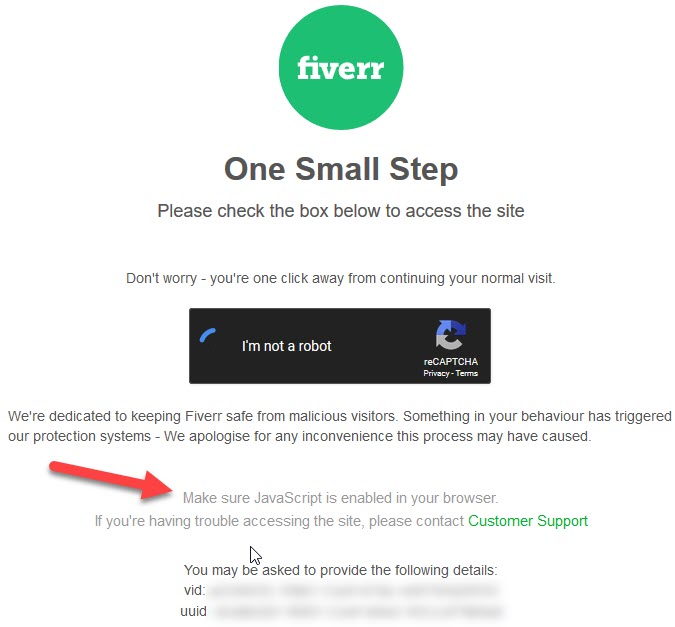
Hmm. Maybe I will enable JavaScript and try again.
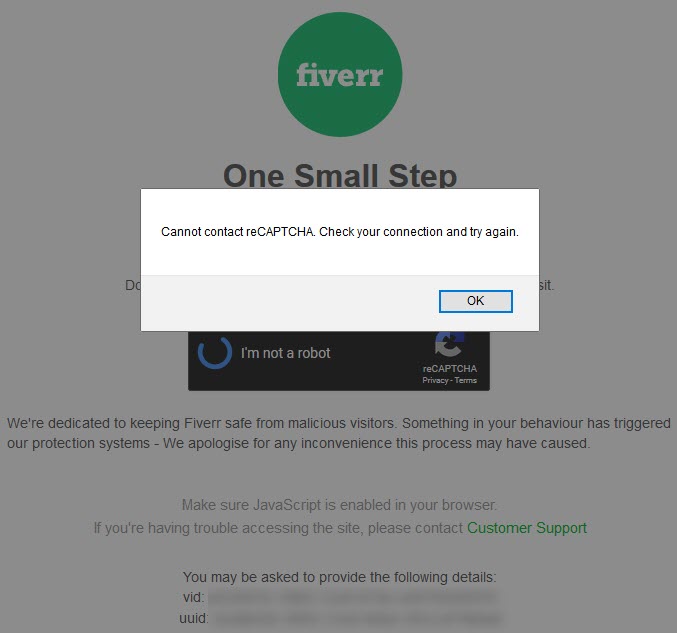
Oooops.

That is called snatching defeat from the jaws of victory.
My account is many years old. My payment type on record has been used for years. I have ordered from the particular seller about a dozen times over the years. And suddenly because my web browser had JavaScript turned off I was deemed a security risk of some sort for making an utterly ordinary transaction I have already completed about a dozen times.
On AMP JavaScript was the devil. And on desktop not JavaScript was the devil.
Pro tip: Ecommerce websites that see substandard conversion rates from using Recaptcha can boost their overall ecommerce revenue by buying more Google AdWords ads.
—
As more of the infrastructure stack is driven by AI software there is going to be a very real opportunity for many people to become deplatformed across the web on an utterly arbitrary basis. That tech companies like Facebook also want to create digital currencies on top of the leverage they already have only makes the proposition that much scarier.
If the tech platforms host copies of our sites, process the transactions & even create their own currencies, how will we know what level of value they are adding versus what they are extracting?
Who measures the measurer?
And when the economics turn negative, what will we do if we are hooked into an ecosystem we can’t spend additional capital to get out of when things head south?
Categories:
AMP’d Up for Recaptcha
Beyond search Google controls the leading distributed ad network, the leading mobile OS, the leading web browser, the leading email client, the leading web analytics platform, the leading free video hosting site.
They win a lot.
And they take winnings from one market & leverage them into manipulating adjacent markets.
Embrace. Extend. Extinguish.
Imagine taking a universal open standard that has zero problems with it and then stripping it down to it’s most basic components and then prepending each element with your own acronym. Then spend years building and recreating what has existed for decades. That is @amphtml— Jon Henshaw (@henshaw) April 4, 2019
AMP is an utterly unnecessary invention designed to further shift power to Google while disenfranchising publishers. From the very start it had many issues with basic things like supporting JavaScript, double counting unique users (no reason to fix broken stats if they drive adoption!), not supporting third party ad networks, not showing publisher domain names, and just generally being a useless layer of sunk cost technical overhead that provides literally no real value.
Over time they have corrected some of these catastrophic deficiencies, but if it provided real value, they wouldn’t have needed to force adoption with preferential placement in their search results. They force the bundling because AMP sucks.
Absurdity knows no bounds. Googlers suggest: “AMP isn’t another “channel” or “format” that’s somehow not the web. It’s not a SEO thing. It’s not a replacement for HTML. It’s a web component framework that can power your whole site. … We, the AMP team, want AMP to become a natural choice for modern web development of content websites, and for you to choose AMP as framework because it genuinely makes you more productive.”
Meanwhile some newspapers have about a dozen employees who work on re-formatting content for AMP:
The AMP development team now keeps track of whether AMP traffic drops suddenly, which might indicate pages are invalid, and it can react quickly.
All this adds expense, though. There are setup, development and maintenance costs associated with AMP, mostly in the form of time. After implementing AMP, the Guardian realized the project needed dedicated staff, so it created an 11-person team that works on AMP and other aspects of the site, drawing mostly from existing staff.
Feeeeeel the productivity!
Some content types (particularly user generated content) can be unpredictable & circuitous. For many years forums websites would use keywords embedded in the search referral to highlight relevant parts of the page. Keyword (not provided) largely destroyed that & then it became a competitive feature for AMP: “If the Featured Snippet links to an AMP article, Google will sometimes automatically scroll users to that section and highlight the answer in orange.”
That would perhaps be a single area where AMP was more efficient than the alternative. But it is only so because Google destroyed the alternative by stripping keyword referrers from search queries.
The power dynamics of AMP are ugly:
“I see them as part of the effort to normalise the use of the AMP Carousel, which is an anti-competitive land-grab for the web by an organisation that seems to have an insatiable appetite for consuming the web, probably ultimately to it’s own detriment. … This enables Google to continue to exist after the destination site (eg the New York Times) has been navigated to. Essentially it flips the parent-child relationship to be the other way around. … As soon as a publisher blesses a piece of content by packaging it (they have to opt in to this, but see coercion below), they totally lose control of its distribution. … I’m not that smart, so it’s surely possible to figure out other ways of making a preload possible without cutting off the content creator from the people consuming their content. … The web is open and decentralised. We spend a lot of time valuing the first of these concepts, but almost none trying to defend the second. Google knows, perhaps better than anyone, how being in control of the user is the most monetisable position, and having the deepest pockets and the most powerful platform to do so, they have very successfully inserted themselves into my relationship with millions of other websites. … In AMP, the support for paywalls is based on a recommendation that the premium content be included in the source of the page regardless of the user’s authorisation state. … These policies demonstrate contempt for others’ right to freely operate their businesses.
After enough publishers adopted AMP Google was able to turn their mobile app’s homepage into an interactive news feed below the search box. And inside that news feed Google gets to distribute MOAR ads while 0% of the revenue from those ads find its way to the publishers whose content is used to make up the feed.
Appropriate appropriation. :D
Each additional layer of technical cruft is another cost center. Things that sound appealing at first blush may not be:
The way you verify your identity to Let’s Encrypt is the same as with other certificate authorities: you don’t really. You place a file somewhere on your website, and they access that file over plain HTTP to verify that you own the website. The one attack that signed certificates are meant to prevent is a man-in-the-middle attack. But if someone is able to perform a man-in-the-middle attack against your website, then he can intercept the certificate verification, too. In other words, Let’s Encrypt certificates don’t stop the one thing they’re supposed to stop. And, as always with the certificate authorities, a thousand murderous theocracies, advertising companies, and international spy organizations are allowed to impersonate you by design.
Anything that is easy to implement & widely marketed often has costs added to it in the future as the entity moves to monetize the service.
This is a private equity firm buying up multiple hosting control panels & then adjusting prices.
This is Google Maps drastically changing their API terms.
This is Facebook charging you for likes to build an audience, giving your competitors access to those likes as an addressable audience to advertise against, and then charging you once more to boost the reach of your posts.
This is Grubhub creating shadow websites on your behalf and charging you for every transaction created by the gravity of your brand.
Shivane believes GrubHub purchased her restaurant’s web domain to prevent her from building her own online presence. She also believes the company may have had a special interest in owning her name because she processes a high volume of orders. … it appears GrubHub has set up several generic, templated pages that look like real restaurant websites but in fact link only to GrubHub. These pages also display phone numbers that GrubHub controls. The calls are forwarded to the restaurant, but the platform records each one and charges the restaurant a commission fee for every order
Settling for the easiest option drives a lack of differentiation, embeds additional risk & once the dominant player has enough marketshare they’ll change the terms on you.
Small gains in short term margins for massive increases in fragility.
“Closed platforms increase the chunk size of competition & increase the cost of market entry, so people who have good ideas, it is a lot more expensive for their productivity to be monetized. They also don’t like standardization … it looks like rent seeking behaviors on top of friction” – Gabe Newell
The other big issue is platforms that run out of growth space in their core market may break integrations with adjacent service providers as each want to grow by eating the other’s market.
Those who look at SaaS business models through the eyes of a seasoned investor will better understand how markets are likely to change:
“I’d argue that many of today’s anointed tech “disruptors” are doing little in the way of true disruption. … When investors used to get excited about a SAAS company, they typically would be describing a hosted multi-tenant subscription-billed piece of software that was replacing a ‘legacy’ on-premise perpetual license solution in the same target market (i.e. ERP, HCM, CRM, etc.). Today, the terms SAAS and Cloud essentially describe the business models of every single public software company.
Most platform companies are initially required to operate at low margins in order to buy growth of their category & own their category. Then when they are valued on that, they quickly need to jump across to adjacent markets to grow into the valuation:
Twilio has no choice but to climb up the application stack. This is a company whose ‘disruption’ is essentially great API documentation and gangbuster SEO spend built on top of a highly commoditized telephony aggregation API. They have won by marketing to DevOps engineers. With all the hype around them, you’d think Twilio invented the telephony API, when in reality what they did was turn it into a product company. Nobody had thought of doing this let alone that this could turn into a $17 billion company because simply put the economics don’t work. And to be clear they still don’t. But Twilio’s genius CEO clearly gets this. If the market is going to value robocalls, emergency sms notifications, on-call pages, and carrier fee passed through related revenue growth in the same way it does ‘subscription’ revenue from Atlassian or ServiceNow, then take advantage of it while it lasts.
Large platforms offering temporary subsidies to ensure they dominate their categories & companies like SoftBank spraying capital across the markets is causing massive shifts in valuations:
I also think if you look closely at what is celebrated today as innovation you often find models built on hidden subsidies. … I’d argue the very distributed nature of microservices architecture and API-first product companies means addressable market sizes and unit economics assumptions should be even more carefully scrutinized. … How hard would it be to create an Alibaba today if someone like SoftBank was raining money into such a greenfield space? Excess capital would lead to destruction and likely subpar returns. If capital was the solution, the 1.5 trillion that went into telcos in late ’90s wouldn’t have led to a massive bust. Would a Netflix be what it is today if a SoftBank was pouring billions into streaming content startups right as the experiment was starting? Obviously not. Scarcity of capital is another often underappreciated part of the disruption equation. Knowing resources are finite leads to more robust models. … This convergence is starting to manifest itself in performance. Disney is up 30% over the last 12 months while Netflix is basically flat. This may not feel like a bubble sign to most investors, but from my standpoint, it’s a clear evidence of the fact that we are approaching a something has got to give moment for the way certain businesses are valued.”
Circling back to Google’s AMP, it has a cousin called Recaptcha.
Recaptcha is another AMP-like trojan horse:
According to tech statistics website Built With, more than 650,000 websites are already using reCaptcha v3; overall, there are at least 4.5 million websites use reCaptcha, including 25% of the top 10,000 sites. Google is also now testing an enterprise version of reCaptcha v3, where Google creates a customized reCaptcha for enterprises that are looking for more granular data about users’ risk levels to protect their site algorithms from malicious users and bots. … According to two security researchers who’ve studied reCaptcha, one of the ways that Google determines whether you’re a malicious user or not is whether you already have a Google cookie installed on your browser. … To make this risk-score system work accurately, website administrators are supposed to embed reCaptcha v3 code on all of the pages of their website, not just on forms or log-in pages.
About a month ago when logging into Bing Ads I saw recaptcha on the login page & couldn’t believe they’d give Google control at that access point. I think they got rid of that, but lots of companies are perhaps shooting themselves in the foot through a combination of over-reliance on Google infrastructure AND sloppy implementation
Today when making a purchase on Fiverr, after converting, I got some of this action
Hmm. Maybe I will enable JavaScript and try again.
Oooops.
That is called snatching defeat from the jaws of victory.
My account is many years old. My payment type on record has been used for years. I have ordered from the particular seller about a dozen times over the years. And suddenly because my web browser had JavaScript turned off I was deemed a security risk of some sort for making an utterly ordinary transaction I have already completed about a dozen times.
On AMP JavaScript was the devil. And on desktop not JavaScript was the devil.
Pro tip: Ecommerce websites that see substandard conversion rates from using Recaptcha can boost their overall ecommerce revenue by buying more Google AdWords ads.
—
As more of the infrastructure stack is driven by AI software there is going to be a very real opportunity for many people to become deplatformed across the web on an utterly arbitrary basis. That tech companies like Facebook also want to create digital currencies on top of the leverage they already have only makes the proposition that much scarier.
If the tech platforms host copies of our sites, process the transactions & even create their own currencies, how will we know what level of value they are adding versus what they are extracting?
Who measures the measurer?
And when the economics turn negative, what will we do if we are hooked into an ecosystem we can’t spend additional capital to get out of when things head south?
Categories:
Google SEO Mythbusting Video On SEO Challenges With Web Frameworks
Google’s Martin Splitt and Jason Miller, a Senior Web Developer Programs Engineer at Google, got together to create a video on the challenges around using web frameworks and how that may impact your SEO efforts.
Google Confirms GoogleBot Does Not Support HTTP Pipelining
Gary Illyes from Google confirmed yesterday that GoogleBot does not support HTTP pipelining. The truth is, most modern browsers don’t support it either by default. HTTP pipelining is a technique in which multiple HTTP requests are sent on a single TC…
Google: Site Migrations Can Take About A Day If Done Correctly
John Mueller of Google was asked about doing site migrations and if it can impact your SEO. The short answer is that it can impact your SEO but if you do everything correctly it can be a matter of days until everything is back to where it was prior to…
Google Might Be Testing A Text Based Button In Its Search Box
Google might be testing, or it might be a bug, or some browser issue, I am not 100% sure, a text based search button in its search box. So instead of the magnifying glass in the search box, there is a text based button or link that says “Search.”
…
Potential Google Search Ranking Algorithm Update On June 27th
I am seeing chatter within the SEO community throughout the past 24 hours and many of the automated Google tracking tools seem to be corroborating with that chatter that there may have been a Google update yesterday. Now, Google has not confirmed this…
Search Buzz Video Recap: Google Algorithm Update, Social Profile Markup, Mobile-First Indexing, Search Console & Tests vs Bugs
This week in search we had a possible Google algorithm update touch down yesterday, June 27th. Google removed support for social profile markup specifically with the knowledge panels…
Who’s poised to win the brewing v-commerce wars?
While Google is an obvious “horse to bet on,” ubiquity, UX and utility will dominate the voice-search innovation race in 2020 and beyond.
The post Who’s poised to win the brewing v-commerce wars? appeared first on Search Engine Watch.
Today’s customer decision journey is so complex but AI can help
Consumers jump between devices and online/offline activity and we need to keep up with creating personalized touchpoints.
Please visit Search Engine Land for the full article.
SMX Replay: How to use data storytelling to earn top-tier media coverage
Amanda Milligan explains three factors that have earned coverage from NPR and CNN.
Please visit Search Engine Land for the full article.
What do you do if Google My Business doesn’t understand your business?
Pop-up shops, mobile by design, are legitimate businesses but Google has no easy way to help you find them.
Please visit Search Engine Land for the full article.
How to Deliver JSON-LD Recommendations the Easy Way – Whiteboard Friday
Posted by sergeystefoglo
When you work with large clients whose sites comprise thousands (or hundreds of thousands) of pages, it’s a daunting task to add the necessary markup. In today’s Whiteboard Friday, we welcome Sergey Stefoglo to share his framework for delivering JSON-LD recommendations in a structured and straightforward way.

Click on the whiteboard image above to open a high-resolution version in a new tab!
Video Transcription
Hello, Moz fans. My name is Serge. I’m a consultant at Distilled, and this is another edition of Whiteboard Friday. Today I want to take the next few minutes to talk to you about one of my processes for delivering JSON-LD recommendations.
Now it’s worth noting upfront that at Distilled we work with a lot of large clients that have a lot of pages on their website, thousands, hundreds of thousands of pages. So if you work at an agency that works with local businesses or smaller clients, this process may be a bit overkill, but I hope you find some use in it regardless.

So as I mentioned, oftentimes at Distilled we get clients that have hundreds and thousands of pages on their site, and you can imagine if your point of contact comes to you and essentially asks, “Hey, we don’t have any markup on our site. Can you recommend all of the JSON-LD on all the pages, please?” If you’re anything like me, that could be a bit daunting, right, like that’s a big ask. Your wheels start spinning so to speak, and oftentimes that leads to a little bit of unproductivity. So I hope this process kind of helps get you unstuck and get started and get to work.
Step 1: List out all the page templates
The first step in this process essentially is to list out all of the templates on the site. I’m assuming you’re going to be dealing with an e-commerce site or something like that. That’s really the way that you’re going to break down this problem and take it from kind of a larger picture, where someone comes to you and says, “Hey, I need all of the things on all of the things,” and you break it down and say, “Okay, well, really what I need to focus on is a section at a time, and what I need to do is give recommendations for each section at a time.” To me, that’s a much more kind of organized way to come at this, and it’s helped me a lot.

So when you list out the templates, if you’ve had this client for a while, you probably already know the templates that they have. If they’re new, it’s worth getting familiar with their site and thinking about things at a template level regardless. So just simply hopping on the site, browsing around, and making a list of, yes, they have product pages and category pages and some different variations of those. They have blog pages and a bunch of other kinds of pages. It’s good to be familiar with them. Our goal is to essentially recommend JSON-LD for each of those templates. So that’s really the first step is getting clear on which templates we’re looking at and what exists on the site.
Step 2: Choose one template and note what can be marked up
The second step is to choose one of those templates, just one, for example, like the product page template, and essentially go through that page and jot down anything you think that can be marked up. Now if you’ve recommended schema before or if you’ve worked with JSON-LD or any kind of markup, you’ll be familiar with a lot of the kind of standards across the board, and it does get familiar over time. So once you do this your 2nd time or 3rd time or 10th time, you’ll have a good idea of what kind of markup goes on a product page or what kind of markup goes on a category page.
If it’s your first time, just go on the page and I’d encourage you to just browse through and look at schema.org or some other example sites that are similar, see what they’re doing, and kind of jot down by yourself, in a notebook or something, what you think can be marked up. So on a product page, you can note down that, yes, there’s an image of the product. There’s a price. There’s a URL. There are breadcrumbs on the page. There are reviews, etc. You’re just going through and kind of making a list of that very simply.
Step 3: Convert notes into JSON-LD, validate with the schema testing tool, and paste into doc
The next step is to essentially take those notes and convert them into JSON-LD. At this point, people tend to kind of freak out a little bit, but you don’t have to be a developer to do this. It’s very accessible. If this is your first time going about it, I’m not going to get into all of the specifics on how to do that. This is more of a framework of approaching that. But there are a lot of great articles that I can link to. Just reach out to me and I can hook you up with that.
- JSON-LD in Real Life: Understanding and Implementing Structured Data
- The Beginner’s Guide to Structured Data for SEO: How to Implement It
- A Guide to JSON-LD for Beginners
- An SEO’s Guide to Writing Structured Data (JSON-LD)
- Understand how structured data works
- 7 Tips for Structured Data on E-commerce Sites
But the third step, again, is to convert those notes into actual JSON-LD. That process is fairly straightforward. What I like to do is open up the page or a representative URL from that template that I’m working on. So for a product page, open that up in my browser. I would like to have schema.org open. That’s kind of the canonical resource for schema information. Then I also like to have a few competitor sites open that are similar. If you’re working on an e-commerce brand, you’re fortunate that there are a lot of great examples of sites that are doing this well, and that’s publicly available to you and you can check out what they’re doing and how they’re doing it.
So my process is kind of just going through that list, going on schema.org or going on a competitor’s site or a previous site you’ve worked on. If you’re looking at something like, let’s say, the cost of the product, you can look that up on schema.org. You can see that there’s an Offer-type markup. You can copy that into the schema testing tool and essentially validate that it works. Once you validate it, you just go down the list further. If you start off with the price, you can move on to breadcrumbs, etc.
At the end of step three, you essentially have all of the JSON-LD that you need and certainly the core elements to kind of start down the next step.
Step 4: Check with your point-of-contact/developer!
The next step is to pause and check in with your point of contact, because if you’re working on a large-scale site and you’re going to have 10 or 15 of these templates you’re working on for JSON-LD, it’s worthwhile to essentially say, “Hey, can we do a 30-minute check-in because I’m done with the first template and I want to make sure that this all makes sense and this is in a format that’s going to be good for you?”
Speaking of format, what I like to do personally is just use Google Drive, set up a folder in the client folder and title it JSON-LD, give the client access to that, and within that folder you’re just going to have a bunch of different documents, and each document is going to be per template. So for the product page example, you would have a document in that folder titled “Product JSON-LD,” and you would copy any of the JSON-LD that you validated in the schema testing tool and paste it in that doc. That’s what you would be walking through with your point of contact or with the developer. Pretty much take any feedback they have. If they want it in a different format, take that into account and revise it and meet with them again. But pretty much get a green light before moving forward to work on the other templates.
Step 5: Repeat from Step 2 onward for all your templates
That’s really the next step is, at that point, once you have the green light and the developer feels good about it or your point of contact feels good about it, you’re just going to kind of rinse and repeat. So you’re going to go back to Step 2, and you’re going to choose another template. If you’ve done the product page one, hop over to the category page template and do the same thing. Jot down what can be marked up. Transfer those notes into JSON-LD using competitor sites or similar sites, using schema.org, and using the structured data validating tool. It’s the same process. At that point, you’re just kind of on cruise control. It’s nice because it takes, again, something that initially could have been fairly stressful, at least for me, and it breaks it down in a way that makes sense and you can focus because of that.
So again, this process has worked really well for me. At Distilled, we like to think about kind of frameworks and how to approach bigger problems like this and break them down and kind of make them more simple, because we’ve found that allows us to do our best work. This is just one of those processes.
So that’s all I have for you all today. Thank you so much for tuning in. If you have any questions or comments, or if you have any experiences kind of implementing or recommending JSON-LD, I’d love to hear them. So give me a shout on Twitter or in the comments or anything like that. Thank you so much for tuning in, and we will see you next time.
Video transcription by Speechpad.com
Sign up for The Moz Top 10, a semimonthly mailer updating you on the top ten hottest pieces of SEO news, tips, and rad links uncovered by the Moz team. Think of it as your exclusive digest of stuff you don’t have time to hunt down but want to read!
Google Search Console Alerts: Change In Top Queries For Your Site
Google is now sending out newish, not 100% new, alerts for changes in your top queries for your site. This is an email from Google Search Console that will show you either large increases or decreases in your ranking positions according to Google Searc…
Alexa.com adds more search tools to its competitive analysis
Now, the free tool “automatically generates top competing sites that it uses as the basis for a more in-depth competitive analysis report,” Alexa.com President Andrew Ramm told SEW.
The post Alexa.com adds more search tools to its competitive analysis appeared first on Search Engine Watch.
Businesses Can No Longer Specify Its Social Media Buttons In Local Panels
With Google deprecating the social profile markup, some businesses may be out of luck with being able to control the social buttons shown in their local knowledge panels.
Google Possibly Testing Stackable People Also Search For Buttons
Dave Cain posted a screen shot on Twitter of Google showing him the people also search for buttons under a snippet but in this case they were stacked up on top of each other instead of a carousel format.