Google unleashed the Panda algorithm 9 years ago today
Has SEO got easier or harder since the first Google Panda update rolled out nearly a decade ago?
Please visit Search Engine Land for the full article.
Video: Dixon Jones on building tools for the SEO industry
This man has helped countless people in the SEO industry – he is a true friend.
Please visit Search Engine Land for the full article.
Google patent application reveals hints to E-A-T and categorizing health sites
Was there a Medic update? Can Google measure E-A-T? Can Google classify a YMYL site?
Please visit Search Engine Land for the full article.
Spot Zero is Gone — Here’s What We Know After 30 Days
Posted by PJ_Howland
As you are probably aware by now, recent updates have changed the world of search optimization. On January 22nd Google, in its infinite wisdom, decided that the URL that has earned the featured snippet in a SERP would not have the additional spot in that SERP. This also means that from now on the featured snippet will be the true spot-one position.
If a web page listing is elevated into the featured snippet position, we no longer repeat the listing in the search results. This declutters the results & helps users locate relevant information more easily. Featured snippets count as one of the ten web page listings we show.
— Danny Sullivan (@dannysullivan) January 22, 2020
Rather than rehash what’s been so eloquently discussed already, I’ll direct you to Dr. Pete’s post if you need a refresher on what this means for you and for Moz.
30 days is enough to call out trends, not all of the answers
I’ve been in SEO long enough to know that when there’s a massive shake-up (like the removal of spot zero), bosses and clients want to know what that means for the business. In situations like this, SEOs responses are limited to 1) what they can see in their own accounts, and 2) what others are reporting online.
A single 30-day period isn’t enough time to observe concrete trends and provide definitive suggestions for what every SEO should do. But it is enough time to give voice to the breakout trends that are worth observing as time goes on. The only way for SEOs to come out on top is by sharing the trends they are seeing with each other. Without each other’s data and theories, we’ll all be left to see only what’s right in front of us — which is often not the entire picture.
So in an effort to further the discussion on the post-spot-zero world, we at 97th Floor set out to uncover the trends under our nose, by looking at nearly 3,000 before-and-after examples of featured snippets since January 22nd.
The data and methodology
I know we all want to just see the insights (which you’re welcome to skip to anyway), but it’s worth spending a minute explaining the loose methodology that yielded the findings.
The two major tools used here were Google Search Console and STAT. While there’s more traffic data in Google Analytics than GSC, we’re limited in seeing the traffic driven by actual keywords, being limited by page-wide traffic. For this reason, we used GSC to get the click-through rates of specific keywords on specific pages. This pairs nicely with STAT’s data to give us a daily pinpoint of both Google Rank and Google Base Rank for the keywords at hand.
While there are loads of keywords to look at, we found that small-volume keywords — anything under 5,000 global MSV (with some minor exceptions) — produced findings that didn’t have enough data behind them to claim statistical significance. So, all of the keywords analyzed had over 5,000 global monthly searches, as reported by STAT.
It’s also important to note that all the difficulty scores come from Moz.
Obviously we were only interested in SERPs that had an existing featured snippet serving to ensure we had an accurate before-and-after picture, which narrows down the number of keywords again. When all was said and done, the final batch of keywords analyzed was 2,773.
We applied basic formulas to determine which keywords were telling clear stories. That led us to intimately analyze about 100 keywords by hand, sometimes multiple hours looking at a single keyword, or rather a single SERP over a 30-day period. The findings reported below come from these 100 qualitative keyword analyses.
Oh, and this may go without saying, but I’m doing my best to protect 97th Floor’s client’s data, so I won’t be giving anything incriminating away as to which websites my screenshots are attached to. 97th Floor has access to hundreds of client GSC accounts and we track keywords in STAT for nearly every one of them.
Put plainly, I’m dedicated to sharing the best data and insight, but not at the expense of our clients’ privacy.
The findings… not what I expected
Yes, I was among the list of SEOs that said for the first time ever SEOs might actually need to consider shooting for spot 2 instead of spot 1.
Who saw @dannysullivan‘s tweet on spot zero no longer playing a part in SERPs?
The biggest takeaway from this article is that for the first time since the launch of featured snippets 6 years ago SEOs may want to actually consider deoptimizing for featured snippets. https://t.co/5eqSZiQhvz
— PJ Howland (@askPJHowland) January 23, 2020
I still don’t think I was wrong (as the data below shows), but after this data analysis I’ve come to find that it’s a more nuanced story than the quick and dirty results we all want from a study like this.
The best way to unfold the mystery from the spot-zero demotion is to call out the individual findings from this study as individual lessons learned. So, in no particular order, here’s the findings.
Longtime snippet winners are seeing CTR and traffic drops
While the post-spot-zero world may seem exciting for SEOs that have been gunning for a high-volume snippet spot for years, the websites who have held powerful snippet positions indefinitely are seeing fewer clicks.
The keyword below represents a page we built years ago for a client that has held the snippet almost exclusively since launch. The keyword has a global search volume of 74,000 and a difficulty of 58, not to mention an average CPC of $38.25. Suffice it to say that this is quite a lucrative keyword and position for our client.
We parsed out the CTR of this single keyword directing to this single page on Google Search Console for two weeks prior to the January 22d announcement and two weeks following it. I’d love to go back farther than two weeks, but if we did, we would have crept into New Years traffic numbers, which would have muddled the data.

As you can see, the impressions and average position remained nearly identical for these two periods. But CTR and subsequent clicks decreased dramatically in the two weeks immediately following the January 22nd spot-zero termination.
If this trend continues for the rest of 2020, this single keyword snippet changeup will result in a drop of 9,880 clicks in 2020. Again, that’s just a single keyword, not all of the keywords this page represents. When you incorporate average CPC into this equation that amounts to $377,910 in lost clicks (if those were paid clicks).
Sure, this is an exaggerated situation due to the volume of the keyword and inflated CPC, but the principle uncovered over and over in this research remains the same: Brands that have held the featured snippet position for long periods of time are seeing lower CTRs and traffic as a direct result of the spot-zero shakeup.
When a double snippet is present, CTR on the first snippet tanks
Nearly as elusive as the yeti or Bigfoot, the double snippet found in its natural habitat is rare.

Sure this might be expected; when there are two results that are both featured snippets, the first one gets fewer clicks. But the raw numbers left us with our jaws on the floor. In every instance we encountered this phenomenon we discovered that spot one (the #1 featured snippet) loses more than 50% of its CTR when the second snippet is introduced.

This 40,500 global MSV keyword was the sole featured snippet controller on Monday, and on Tuesday the SERP remained untouched (aside from the second snippet being introduced).
This small change brought our client’s CTR to its knees from a respectable 9.2% to a crippling 2.9%.
When you look at how this keyword performed the rest of the week, the trend continues to follow suit.
Monday and Wednesday are single snippet days, while Tuesday, Thursday, and Friday brought the double snippet.

Easy come, easy go (not a true Spot 1)
There’s been a great deal of speculation on this fact, but now I can confirm that ranking for a featured snippet doesn’t come the same way as ranking for a true spot 1. In the case below, you can see a client of ours dancing around spots 5 and 6 before taking a snippet. Similarly when they lose the snippet, they fall back to the original position.

Situations like this were all too common. Most of the time we see URLs losing the snippet to other URLs. Other times, Google removes the snippet entirely only to bring it back the following day.
If you’re wondering what the CTR reporting on GSC was for the above screenshot, I’ve attached that below. But don’t geek out too quickly; the findings aren’t terribly insightful. Which is insightful in itself.
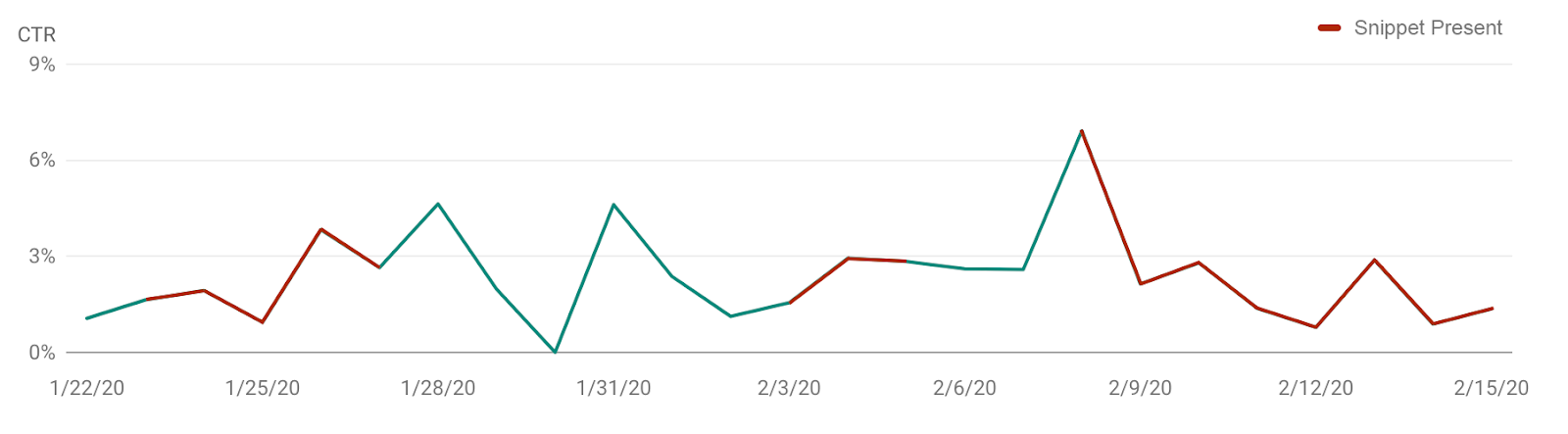
This keyword has 22,200 global volume and a keyword difficulty of 44. The SERP gets significant traffic, so you would think that findings would be more obvious.
If there’s something to take away from situations like this, here it is: Earning the snippet doesn’t inherently mean CTRs will improve beyond what you would be getting in a below-the-fold position.
Seeing CTR bumps below the fold
Much of the data addressed to this point either speaks of sites that either have featured snippets or lost them, but what about the sites that haven’t had a snippet before or after this shakeup?
If that describes your situation, you can throw yourself a tiny celebration (emphasis on the tiny), because the data is suggesting that your URLs could be getting a slight CTR bump.
The example below shows a 74,000 global MSV keyword with a difficulty that has hovered between spots 5 and 7 for the week preceding and the week following January 22nd.

The screenshot from STAT shows that this keyword has clearly remained below the fold and fairly consistent. If anything, it ranked worse after January 22nd.
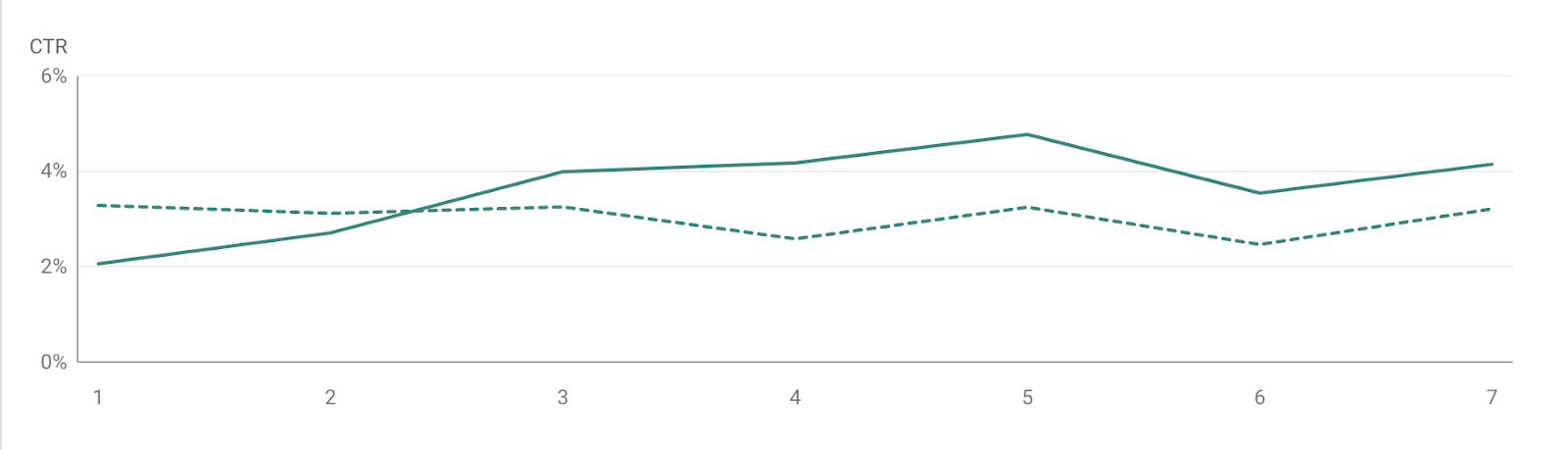
The click-through rate improved the week following January 22nd from 3% to 3.7%. Perhaps not enough to warrant any celebration for those that are below the fold, as this small increase was typical across many mid-first-page positions.
“People Also Ask” boxes are here to steal your snippet CTR
Perhaps this information isn’t new when considering the fact that PAA boxes are just one more place that can lead users down a rabbit hole of information that isn’t about your URL.
On virtually every single SERP (in fact, we didn’t find an instance where this wasn’t true), the presence of a PAA box drops the CTR of both the snippet and the standard results.
The negative effects of the PAA box appearing in your SERP are mitigated when the PAA box doesn’t serve immediately below the featured snippet. It’s rare, but there are situations where the “People Also Ask” box serves lower in the SERP, like this example below.

If your takeaway here is to create more pages that answer questions showing up in relevant PAA boxes, take a moment to digest the fact that we rarely saw instances of clicks when our clients showed up in PAA boxes.
In this case, we have a client that ranks for two out of the first four answers in a high-volume SERP (22,000 global monthly searches), but didn’t see a single click — at least none to speak of from GSC:

While its counterpart page, which served in spot 6 consistently, is at least getting some kind of click-through rate:

If there’s a lesson to be learned here, it’s that ranking below the fold on page one is better than getting into the PAA box (in the terms of clicks anyway).
So, what is the takeaway?
As you can tell, the findings are a bit all over the place. However, the main takeaway that I keep coming back to is this: Clickability matters more than it ever has.
As I was crunching this data, I was constantly reminded of a phrase our EVP of Operations, Paxton Gray, is famous for saying:
“Know your SERPs.”
This stands truer today than it did in 2014 when I first heard him say it.
As I reflected on this pool of frustrating data, I was reminded of Jeff Bezo’s remarks in his 2017 Amazon Shareholder’s letter:
“One thing I love about customers is that they are divinely discontent. Their expectations are never static — they go up. It’s human nature. We didn’t ascend from our hunter-gatherer days by being satisfied. People have a voracious appetite for a better way, and yesterday’s ‘wow’ quickly becomes today’s ‘ordinary’.”
And then it hit me: Google wasn’t built for SEOs; it’s built for users. Google’s job is our job, giving the users the best content. At 97th Floor our credo is: we make the internet a better place. Sounds a little corny, but we stand by it. Every page we build, every ad we run, every interactive we build, and every PDF we publish for our clients needs to make the internet a better place. And while it’s challenging for us watching Google’s updates take clicks from our clients, we recognize that it’s for the user. This is just one more step in the elegant dance we perform with Google.
I remember a day when spots 1, 2, and 3 were consistently getting CTRs in the double digits. And today, we celebrate if we can get spot 1 over 10% CTR. Heck, I‘ll even take an 8% for a featured snippet after running this research!
SEO today is more than just putting your keyword in a title and pushing some links to a page. SERP features can have a more direct effect on your clicks than your own page optimizations. But that doesn’t mean SEO is out of our control — not by a long shot. SEOs will pull through, we always do, but we need to share our learnings with each other. Transparency makes the internet a better place after all.
Sign up for The Moz Top 10, a semimonthly mailer updating you on the top ten hottest pieces of SEO news, tips, and rad links uncovered by the Moz team. Think of it as your exclusive digest of stuff you don’t have time to hunt down but want to read!
Search Marketing: A Decade in Review
Can We Chill with Monthly Search Volume Already?
OK, it’s 2020. To celebrate a new year and a new decade, let’s take a brief look at how search results have progressed over the past 10 years:
2010

2020

An entire decade has passed between these two images.…
The post Search Marketing: A Decade in Review appeared first on Seer Interactive.
Google Will Slow Crawling For 429/503 HTTP Status Codes But…
Gary Illyes from Google came on to Twitter for a brief moment to share a PSA about 429/503 HTTP status codes. He said while you probably know 429/503 HTTP status codes will slow GoogleBot’s crawling activity, what you might not know is that if those …
Google Maps Removed 4 Million Fake Business & 75 Million Local Reviews
Google announced this week that what it has done in 2019 to combat Google Maps spam and violations. Google removed 4 million fake business profiles from Google My Business in 2019. It also removed 75 million policy-violating reviews from local profil…
Google’s John Mueller On Where To Start With Hreflang
John Mueller from Google posted a mindful and useful response on Reddit mostly around where to start with hreflang. He said “It’s easy to dig into endless pits of complexity with hreflang.” “My recommendation would be first to limit the number of pages you create to those that are absolutely critical & valuable,” he added.
VPN and SEO: Why professionals should care
One of the most significant advantages of a VPN for SEO is, it helps see search results country-wise. More on why there’s nothing is like a VPN.
The post VPN and SEO: Why professionals should care appeared first on Search Engine Watch.
New local SERP live in Europe
Branded directory buttons are being displayed above the map.
Please visit Search Engine Land for the full article.
Google Local & Map Ads Purple Ad Label Again
Back in 2016 we reported that Google Maps ads can and do show a purple ad label next to the local listings that are ads. But that has changed over the years and now Google is once again testing the purple ad label in the local ads, even on desktop.
…
Again, Google Does Not Use BBB Ratings As A Search Ranking Factor
In 2012, 2017 and 2018 Google said they do not use the BBB (Better Business Bureaus) rating of a business as part of its search ranking factors. Well, Google had to say it again, this time in 2020. Danny Sullivan of Google said on Twitter “No, we don…
Example Of How Google Communicates Search Issues Internally
We report issues to Google in many ways, but did you ever wonder how Google reports issues with search internally? Danny Sullivan from Google shared an example of how he documents the issue for internal reporting and posted the example on Twitter.
…
Search Buzz Video Recap: Google Search & Local Updates, New Bing Webmaster Tools, EAT, BBB, Maps Spam & More
This week I did the recap video from the United lounge in San Francisco airport. So I prerecorded it and scheduled it to go live Friday morning because I want to get this video out early and I don’t land until around 7am Friday…
How to tackle rising Facebook CPAs
Madeline Fitzgerald of 3Q Digital offers tips for making the algorithm work in your favor.
Please visit Search Engine Land for the full article.
Marketing on Amazon in 2020 [Report]
Anders Hjorth and Dan Saunders have compiled a detailed research report about marketing on Amazon, full of insightful data and actionable tactics.
Post from Barry Adams
Stop phrase and broad match modifier keywords from unnecessarily spending on close variants with this script
This script automatically applies phrase match negatives to your BMM and phrase match keywords to prevent them being triggered by close variant search queries.
Please visit Search Engine Land for the full article.
New Bing Webmaster Tools – Tons Of Screen Shots
Bing announced phase one of the new Bing Webmaster Tools last night at SMX West. I covered it at Search Engine Land in some detail but here are some more detailed screen shots, now that I have access to it.
Which of My Competitor’s Keywords Should (& Shouldn’t) I Target? – Best of Whiteboard Friday
Posted by randfish
You don’t want to try to rank for every one of your competitors’ keywords. Like most things with SEO, it’s important to be strategic and intentional with your decisions. In this fan favorite Whiteboard Friday, Rand shares his recommended process for understanding your funnel, identifying the right competitors to track, and prioritizing which of their keywords you ought to target.
Plus, don’t miss our upcoming webinar on Wednesday, March 11: Competitive Analysis for SEO: Size Up & Surpass Your Search Rivals presented by Director of Growth Marketing Kelly Cooper.

Click on the whiteboard image above to open a high-resolution version in a new tab!
Video Transcription
Howdy, Moz fans, and welcome to another edition of Whiteboard Friday. So this week we’re chatting about your competitors’ keywords and which of those competitive keywords you might want to actually target versus not.
Many folks use tools, like SEMrush and Ahrefs and KeywordSpy and Spyfu and Moz’s Keyword Explorer, which now has this feature too, where they look at: What are the keywords that my competitors rank for, that I may be interested in? This is actually a pretty smart way to do keyword research. Not the only way, but a smart way to do it. But the challenge comes in when you start looking at your competitors’ keywords and then realizing actually which of these should I go after and in what priority order. In the world of competitive keywords, there’s actually a little bit of a difference between classic keyword research.
So here I’ve plugged in Hammer and Heels, which is a small, online furniture store that has some cool designer furniture, and Dania Furniture, which is a competitor of theirs — they’re local in the Seattle area, but carry sort of modern, Scandinavian furniture — and IndustrialHome.com, similar space. So all three of these in a similar space, and you can see sort of keywords that return that several of these, one or more of these rank for. I put together difficulty, volume, and organic click-through rate, which are some of the metrics that you’ll find. You’ll find these metrics actually in most of the tools that I just mentioned.
Process:
So when I’m looking at this list, which ones do I want to actually go after and not, and how do I choose? Well, this is the process I would recommend.
I. Try and make sure you first understand your keyword to conversion funnel.
So if you’ve got a classic sort of funnel, you have people buying down here — this is a purchase — and you have people who search for particular keywords up here, and if you understand which people you lose and which people actually make it through the buying process, that’s going to be very helpful in knowing which of these terms and phrases and which types of these terms and phrases to actually go after, because in general, when you’re prioritizing competitive keywords, you probably don’t want to be going after these keywords that send traffic but don’t turn into conversions, unless that’s actually your goal. If your goal is raw traffic only, maybe because you serve advertising or other things, or because you know that you can capture a lot of folks very well through retargeting, for example maybe Hammer and Heels says, “Hey, the biggest traffic funnel we can get because we know, with our retargeting campaigns, even if a keyword brings us someone who doesn’t convert, we can convert them later very successfully,” fine. Go ahead.
II. Choose competitors that tend to target the same audience(s).
So the people you plug in here should tend to be competitors that tend to target the same audiences. Otherwise, your relevance and your conversion get really hard. For example, I could have used West Elm, which does generally modern furniture as well, but they’re very, very broad. They target just about everyone. I could have done Ethan Allen, which is sort of a very classic, old-school furniture maker. Probably a really different audience than these three websites. I could have done IKEA, which is sort of a low market brand for everybody. Again, not kind of the match. So when you are targeting conversion heavy, assuming that these folks were going after mostly conversion focused or retargeting focused rather than raw traffic, my suggestion would be strongly to go after sites with the same audience as you.
If you’re having trouble figuring out who those people are, one suggestion is to check out a tool called SimilarWeb. It’s expensive, but very powerful. You can plug in a domain and see what other domains people are likely to visit in that same space and what has audience overlap.
III. The keyword selection process should follow some of these rules:
A. Are easiest first.
So I would go after the ones that tend to be, that I think are going to be most likely for me to be able to rank for easiest. Why do I recommend that? Because it’s tough in SEO with a lot of campaigns to get budget and buy-in unless you can show progress early. So any time you can choose the easiest ones first, you’re going to be more successful. That’s low difficulty, high odds of success, high odds that you actually have the team needed to make the content necessary to rank. I wouldn’t go after competitive brands here.
B. Are similar to keywords you target that convert well now.
So if you understand this funnel well, you can use your AdWords campaign particularly well for this. So you look at your paid keywords and which ones send you highly converting traffic, boom. If you see that lighting is really successful for our furniture brand, “Oh, well look, glass globe chandelier, that’s got some nice volume. Let’s go after that because lighting already works for us.”
Of course, you want ones that fit your existing site structure. So if you say, “Oh, we’re going to have to make a blog for this, oh we need a news section, oh we need a different type of UI or UX experience before we can successfully target the content for this keyword,” I’d push that down a little further.
C. High volume, low difficulty, high organic click-through rate, or SERP features you can reach.
So basically, when you look at difficulty, that’s telling you how hard is it for me to rank for this potential keyword. If I look in here and I see some 50 and 60s, but I actually see a good number in the 30s and 40s, I would think that glass globe chandelier, S-shaped couch, industrial home furniture, these are pretty approachable. That’s impressive stuff.
Volume, I want as high as I can get, but oftentimes high volume leads to very high difficulty.
Organic click-through rate percentage, this is essentially saying what percent of people click on the 10 blue link style, organic search results. Classic SEO will help get me there. However, if you see low numbers, like a 55% for this type of chair, you might take a look at those search results and see that a lot of images are taking up the other organic click-through, and you might say, “Hey, let’s go after image SEO as well.” So it’s not just organic click-through rate. You can also target SERP features.
D. Are brands you carry/serve, generally not competitor’s brand names.
Then last, but not least, I would urge you to go after brands when you carry and serve them, but not when you don’t. So if this Ekornes chair is something that your furniture store, that Hammers and Heels actually carries, great. But if it’s something that’s exclusive to Dania, I wouldn’t go after it. I would generally not go after competitors’ brand names or branded product names with an exception, and I actually used this site to highlight this. Industrial Home Furniture is both a branded term, because it’s the name of this website — Industrial Home Furniture is their brand — and it’s also a generic. So in those cases, I would tell you, yes, it probably makes sense to go after a category like that.
If you follow these rules, you can generally use competitive intel on keywords to build up a really nice portfolio of targetable, high potential keywords that can bring you some serious SEO returns.
Look forward to your comments and we’ll see you again next week for another edition of Whiteboard Friday. Take care.
Video transcription by Speechpad.com
For more on competitor analysis, join our upcoming webinar on Wednesday March 11 at 10am PST: Competitive Analysis for SEO: Size Up & Surpass Your Search Rivals, hosted by Moz’s Director of Growth Marketing Kelly Cooper:
Sign up for The Moz Top 10, a semimonthly mailer updating you on the top ten hottest pieces of SEO news, tips, and rad links uncovered by the Moz team. Think of it as your exclusive digest of stuff you don’t have time to hunt down but want to read!
How to Use SEO Data to Inform PPC Keyword Expansions
PPC specialists are tasked with keyword research and expansion frequently. We use Google Keyword Planner, search query data, landing page content, and various other tools to guide strategy. However, at Seer, we like to think about search holistically – as one results page, regardless of which channel the results come from.…
The post How to Use SEO Data to Inform PPC Keyword Expansions appeared first on Seer Interactive.