UserInteraction Schema For SEO & Social?
A WebmasterWorld thread has a webmaster who asked if Google will give him a boost because one piece of his content on his site hit over 1,000 Facebook likes.
It is one of those weird questions that makes you nod your head sideways. Why?
Video Recap of Weekly Search Buzz :: January 3, 2014
It was a slow week in search, being New Years and all but we still covered some fun topics. Do you need to use structure data to survive in search…
Preparing For The Link Apocalypse That May Or May Not Be Coming
Something big is happening to link building. Hummingbird might have been the writing on the wall signaling more changes to come; but, we still have no idea what those changes will actually look like. Will links be less important in 2014? Is it possible that they could go away? Should I start link…
Please visit Search Engine Land for the full article.
Search In Pics: Glasshole Receipt, GDG Gingerbread Cookies & Penguin Popper
In this week’s Search In Pictures, here are the latest images culled from the web, showing what people eat at the search engine companies, how they play, who they meet, where they speak, what toys they have, and more. Glasshole Printed On Bar Receipt: Source: Google+ GDG Gingerbread Cookies:…
Please visit Search Engine Land for the full article.
Link Building the Right Way in 2014
Link building, if done correctly, isn’t cheap or easy. If your objective is to improve a website’s visibility in organic search results, then relevant links are still the best way to do so in 2014. But you’ll need to invest and avoid link schemes.
5 Essential Elements for Mobile SEO Success in 2014
Adopting a successful mobile SEO strategy as part of your overall SEO strategy will undoubtedly give your organization a competitive advantage in 2014. Here are five essential elements to ensure your mobile SEO investments pay off.
6 Essential Elements for Mobile SEO Success in 2014
Adopting a successful mobile SEO strategy as part of your overall SEO strategy will undoubtedly give your organization a competitive advantage in 2014. Here are five essential elements to ensure your mobile SEO investments pay off.
Gray Hat Search Engineering
Almost anyone in internet marketing who has spent a couple months in the game has seen some “shocking” case study where changing the color of a button increased sales 183% or such. In many cases such changes only happen when the original site had not had any focus on conversion at all.
Google, on the other hand, has billions of daily searches and is constantly testing ways to increase yield:
The company was considering adding another sponsored link to its search results, and they were going to do a 30-day A/B test to see what the resulting change would be. As it turns out, the change brought massive returns. Advertising revenues from those users who saw more ads doubled in the first 30 days.
…
By the end of the second month, 80 percent of the people in the cohort that was being served an extra ad had started using search engines other than Google as their primary search engine.
One of the reasons traditional media outlets struggle with the web is the perception that ads and content must be separated. When they had regional monopolies they could make large demands to advertisers – sort of like how Google may increase branded CPCs on AdWords by 500% if you add sitelinks. You not only pay more for clicks that you were getting for free, but you also pay more for the other paid clicks you were getting cheaper in the past.
That’s how monopolies work – according to Eric Schmidt they are immune from market forces.
Search itself is the original “native ad.” The blend confuses many searchers as the background colors fade into white.
Google tests colors & can control the flow of traffic based not only on result displacement, but also the link colors.
It was reported last month that Google tested adding ads to the knowledge graph. The advertisement link is blue, while the ad disclosure is to the far right out of view & gray.
I was searching for a video game yesterday & noticed that now the entire Knowledge Graph unit itself is becoming an ad unit. Once again, gray disclosure & blue ad links.
Where Google gets paid for the link, the link is blue.
Where Google scrapes third party content & shows excerpts, the link is gray.
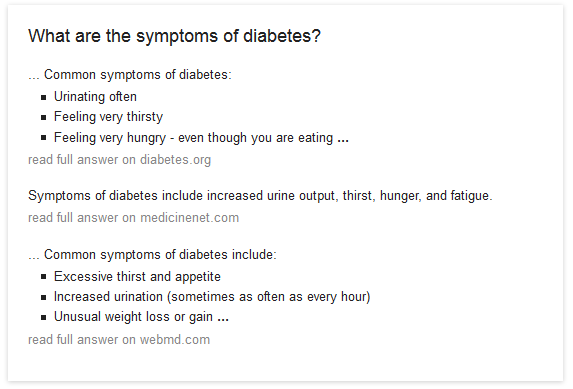
The primary goal of such a knowledge block is result displacement – shifting more clicks to the ads and away from the organic results.
When those blocks appear in the search results, even when Google manages to rank the Mayo Clinic highly, it’s below the fold.
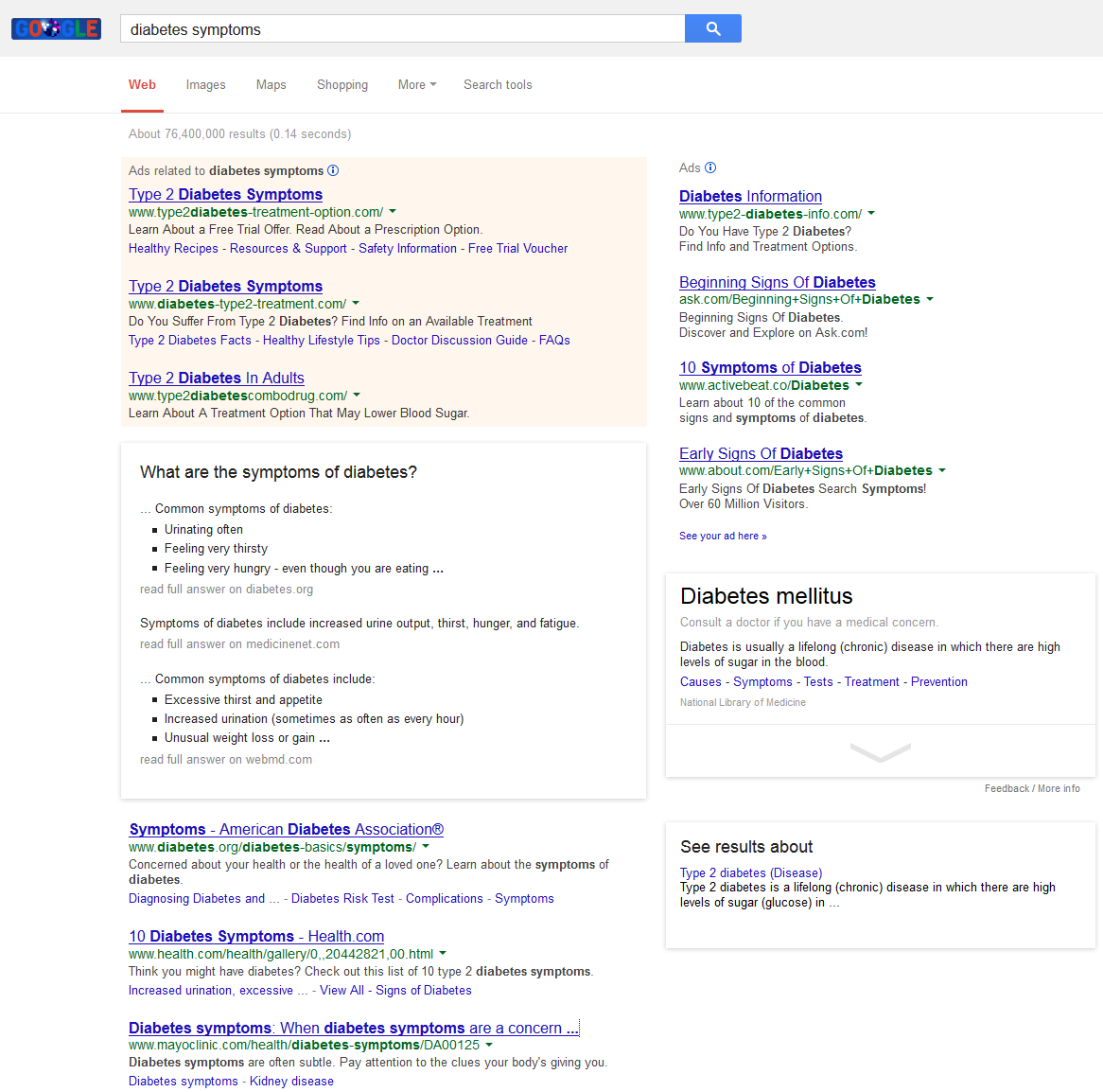
What’s so bad about this practice in health
- Context Matters: Many issues have overlapping symptoms where a quick glance at a few out-of-context symptoms causes a person to misdiagnose themselves. Flu-like symptoms from a few months ago turned out to be indication of a kidney stone. That level of nuance will *never* be in the knowledge graph. Google’s remote rater documents discuss your money your life (YMYL) topics & talk up the importance of knowing who exactly is behind content, but when they use gray font on the source link for their scrape job they are doing just the opposite.
- Hidden Costs: Many of the heavily advertised solutions appearing above the knowledge graph have hidden costs yet to be discovered. You can’t find a pharmaceutical company worth $10s of billions that hasn’t plead guilty to numerous felonies associated with deceptive marketing and/or massaging research.
- Artificially Driving Up Prices: in-patent drugs often cost 100x as much as the associated generic drugs & thus the affordable solutions are priced out of the ad auctions where the price for a click can vastly exceed than the profit from selling a generic prescription drug.
Where’s the business model for publishers when they have real editorial cost & must fact check and regularly update their content, their content is good enough to be featured front & center on Google, but attribution is nearly invisible (and thus traffic flow is cut off)? As the knowledge graph expands, what does that publishing business model look like in the future?
Does the knowledge graph eventually contain sponsored self-assessment medical quizzes? How far does this cancer spread?
Where do you place your chips?
Google believes it can ultimately fulfil people’s data needs by sending results directly to microchips implanted into its user’s brains.
Categories:
Spammers Cold Calling Local Businesses – Claiming They Need To Update Their Business Listings
Baruch Labunski from Rank Secure in Canada pinged me the other day asking me why I can’t stop the phone calls he is getting from spammers claiming implying they are from Google…
Google: Can’t Crawl Your Robots.txt Then We Stop Crawling Your Site
Did you know that if Google cannot crawl your robots.txt file, that it will stop crawling your whole site…
Google Kills Location History Summary Dashboard
Google has dropped support for the location history dashboard. Alex Chitu first covered this explaining that the location history dashboard, that provides summaries of where you’ve been, has been discontinued…
4 Surprisingly Awesome Google Retail Opportunities for 2014
Google did a lot in 2013, but the retail opportunities and places the search giant could grow based on its current technology and resources are a bit mindboggling. Here are some areas where Google could potentially grow in 2014.
SearchCap: The Day In Search, January 2, 2014
Below is what happened in search today, as reported on Search Engine Land and from other places across the web. From Search Engine Land: Search Engine Land’s Most-Shared Stories on Google+ for 2013: What’s Right, What’s Wrong, What’s Next, & What’s Dead Happy New…
Please visit Search Engine Land for the full article.
Succeeding With Content In A Mobile World
In 2013, mobile traffic in the US almost doubled. Cyber Monday of 2013 was the year that cyber Monday went mobile. And, according to Gartner, Q2 of 2013 was the first time that sales of smartphones surpassed sales of feature phones, with the former accounting for 51.8 percent of mobile phone sales…
Please visit Search Engine Land for the full article.
Search Engine Land’s Most-Shared Stories on Google+ for 2013: What’s Right, What’s Wrong, What’s Next, & What’s Dead
Happy New Year to you, search marketing friends! Surely you’re eager to dive head-first into 2014, weighing predictions and forecasts of what’s next in the worlds of SEO and SEM, but we’ve still got an installment or two in our Search Engine Land Year In Review series! So…
Please visit Search Engine Land for the full article.
Googlers Working On New Years Day Also
Just like on Christmas, Googlers were working throughout New Years Day.
Truth is, I don’t think any were working publicly in the support forums New Years Eve, I may be wrong. But we had Zineb Ait Bahajji and Gary Illyes both active New Years day in t…
Google: You Must Wait A Few Weeks To Submit A Reconsideration Requests
We know Google doesn’t like it when you submit a new reconsideration request a day or two after you get a rejection response from your reconsideration request. They want to see you put effort in after you get that response…
Forum Owner: I Was Hit By Pure Spam But It Should Be User-Generated Spam
So we know Google has penalized sites that accept user generared content, such as Mozilla…
SMX Israel: My Two Presentations On 2013/2014 & Predictive Search
I and my volunteer advisor team have been working incredibly hard on putting together an awesome SMX Israel on January 26th in Jerusalem. The agenda is complete and the speakers are 95% finalized…
5 Ways to Have Killer Content in 2014
Content will continue to be a key part of SEO in 2014. But your strategy has to adapt to your users if you’re going to keep up. Here are five ways to make sure your content will sustain in the New Year and move you past your competitors.