Prescription Frames Now Available For Google Glass
Google announced on Google+ that they are finally offering prescription frames and a set of new sunshades for Google Glass.
Google Glass launched the “Titanium Collection” with four feather-light titanium frames…
Google’s Matt Cutts On When Old Sites No Longer Rank Well
Yesterday, Matt Cutts of Google released another video, this one answering why an old site that always ranked well, no longer ranks as well these days…
How to Make the Most of Google Analytics Acquisition Reports
Understanding how users reach your website is fundamental to planning your marketing activity and increasing relevant traffic to your website. The place for all of this wonderful information is within the Acquisitions section in Google Analytics.
2014 AdWords Wishlist
Enhanced campaigns, image extensions, third party reviews… Fantastic features that have improved performance for search marketers. But we always want more, don’t we? What do we hope that 2014 will bring from Google to make us really happy?
Live @ SMX West: Top Social Tactics For The Search Marketer
Are you a search marketer who’s been tasked with taking on social media marketing for your firm or client? You’ve probably noticed that the chops and tactics you’ve developed for organic optimization or paid search campaigns are radically different from the techniques that social…
Please visit Search Engine Land for the full article.
Matt Cutts: Facebook, Twitter Social Signals Not Part of Google Search Ranking Algorithms
Says Cutts: “As far as doing special specific work to say ‘you have this many followers on Twitter’ or ‘this many likes on Facebook’, to the best of my knowledge we don’t currently have any signals like that in our web search ranking algorithms.”
Measure For Business Benefit

Matt Cutts is just toying with SEO’s these days.
Going by some comments, many SEOs still miss the big picture. Google is not in the business of enabling SEOs. So he may as well have a little fun – Matt has “called it” on guest posting.
Okay, I’m calling it: if you’re using guest blogging as a way to gain links in 2014, you should probably stop. Why? Because over time it’s become a more and more spammy practice, and if you’re doing a lot of guest blogging then you’re hanging out with really bad company.
The hen-house erupted.
The hens should know better by now. If a guest post is good for the audience and site, then do it. If it’s being done for no other reason than to boost rank in Google, then that’s a sign a publishing strategy is weak, high risk, and vulnerable to Google’s whims. Change the publishing strategy.
Measuring What Is Important
Although far from perfect, Google is geared towards recognizing utility. If Google doesn’t recognize utility, then Google will become weaker and someone else will take their place. Only a few people remember Alta Vista. They didn’t provide much in the way of utility, and Google ate their lunch.
Which brings me onto the importance of measurement.
It’s important we measure the right things. If people get upset because guest posting is called out, are they upset because they are counting the number of inbound links as if that were the only benefit? Why are they counting inbound links? To get a ranking boost? So, why are some people getting upset? They know Google doesn’t like marketing practices that serve no other purpose than to boost rank. Or are people concerned Google might confuse a post of genuine utility with link spam?
A publishing strategy based on nothing more than Google rankings is not a publishing strategy, it’s a tactic. Given the changes Google has made recently, it’s not a good tactic, because if they can isolate and eliminate SEO tactics, they will. Those who guest post on other sites, and offer guest post placement in order to provide utility, should continue to do so. They are unlikely to eliminate genuine utility, regardless of links, and at worst, they’ll likely ignore the site it appears on.
Interesting
To prosper, we need to be more interesting that the next guy. We need to focus on delivering “interestingness”.
The buzzword term is “visitor engagement”, but that really means “be interesting”. If we provide interesting material, people will read it, and if we provide it on a regular basis, they might come back, or remember our brand name, and then search on that brand name, and then they might link to it, and that this activity combined helps us rank. Ranking is a side effect of being genuinely interesting.
This is not to say measuring links, or page views, are unimportant. But they can be an oversimplification when taken in isolation.
Demand Media’s eHow focused on pageviews rather than engagement. Which is a big part of the reason why the guys who sold them eHow were able to beat them with wikiHow.
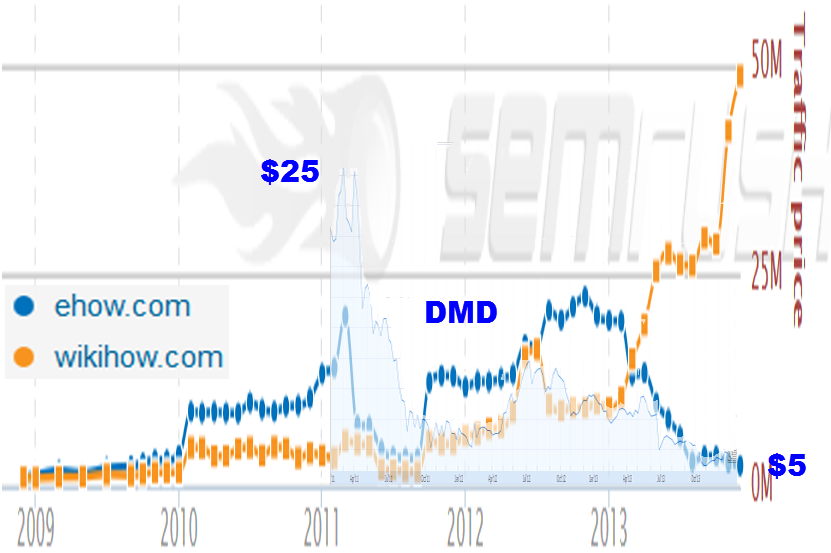
Success depends on achieving the underlying business goal. Perhaps high page views are not important if a site is targeting a very specific audience. Perhaps rankings aren’t all that important if most of the audience is on social media or repeat business. Sometimes, focusing on the wrong metrics leads to the wrong marketing tactics.
What else can we measure? Some common stuff….
- Page views
- Subscriptions
- Comments
- Quality of comments
- Syndication
- Time on site
- Videos watched
- Unique visitors
- Traffic sent to partner sites
- Bookmarking activity
- Search engine exposure
- Brand searches
- Offline mentions
- Online mentions
- Customer satisfaction
- Conversion rates
- Number of inquiries
- Relationships
- Sales
- Reduced costs
The choice of what we measure depends on what we’re trying to achieve. The SEO may say they are trying to achieve a high rank, but why? To get more traffic, perhaps. Why do we want more traffic? In the hope more people will buy our widget.
So, if buying more widgets is the goal, then perhaps more energy needs to be placed into converting the traffic we already have, as opposed to spending the same energy getting more? Perhaps more time needs to be spent on conversion optimization. Perhaps more time needs to be spent refining the offer. Or listening to customers. Hearing their objections. Writing Q&A that addresses those objections. Guest posting somewhere else and addressing industry wide objections. Thinking up products to sell to previous customers. Making them aware of changes via an email list. Optimizing the interest factor of your site to make it more interesting than your competitors, then treat the rankings as a bonus. Link building starts with “being interesting”.
When it comes to the guest post, if you’re only doing it to get a link, then you’re almost certainly selling yourself short. A guest post should serve a number of functions, such as building awareness, increasing reach, building brand, and be based on serving your underlying marketing objective. Pick where you post carefully. Deliver real value. If you do guest post, always try and extract way more benefit than just the link.
There was a time when people could put low-quality posts on low-quality sites and enjoy a benefit. But that practice is really just selling a serious web business short.
How Do We Know If We’re Interesting?
There are a couple of different types of measurement marketers use. One is an emotional response, where the visitor becomes “positively interested”. This is measured by recall studies, association techniques, customers surveys and questionnaires. However, the type of response on-line marketers focus on, which is somewhat easier to measure, is behavioural interest. When people are really interested, they do something in response.
So, to measure the effectiveness of a guest posting, we might look for increased name or brand searches. More linkedin views. We might look at how many people travel down the links. We look at what they do when they land on the site, and – the most important bit – whether they do whatever that thing is that translates to the bottom line. Was it subscribing? Commenting? Downloading a white paper? Watching a video? Getting in contact? Tweeting? Bookmarking? What was that thing you wanted them to do in order to serve your bottom line?
Measurement should be flexible and will be geared towards achieving business goals. SEOs may worry that if they don’t show rankings and links, then the customer will be dissatisfied. I’d wager the customer will be a lot more dissatisfied if they do get a lot of links and a rankings boost, yet no improvement in the bottom line. We could liken this to companies that have a lot of meetings. There is an air of busyness, but are they achieving anything worthwhile? Maybe. Maybe not. We should be careful not to mistake frenzy for productivity.
Measuring links, like measuring the number of meetings, is reductive. So is measuring engagement just by looking at clicks. The picture needs to be broad and strategic. So, if guest posts help you build your business, measured by business metrics, keep doing them. Don’t worry about what Google may or may not do, because it’s beyond your control, regardless.
Control what you can. Control the quality of information you provide.
Categories:
SearchCap: The Day In Search, January 27, 2014
Below is what happened in search today, as reported on Search Engine Land and from other places across the web. From Search Engine Land: SMX West Rates Increase Saturday – Register Now, Save $200! Early Bird rates for Search Engine Land’s SMX West conference expire Saturday. Register…
Please visit Search Engine Land for the full article.
Affiliate programs and added value
Webmaster level: All
Our quality guidelines warn against running a site with thin or scraped content without adding substantial added value to the user. Recently, we’ve seen this behavior on many video sites, particularly in the adult industry, but also elsewhere. These sites display content provided by an affiliate program—the same content that is available across hundreds or even thousands of other sites.
If your site syndicates content that’s available elsewhere, a good question to ask is: “Does this site provide significant added benefits that would make a user want to visit this site in search results instead of the original source of the content?” If the answer is “No,” the site may frustrate searchers and violate our quality guidelines. As with any violation of our quality guidelines, we may take action, including removal from our index, in order to maintain the quality of our users’ search results. If you have any questions about our guidelines, you can ask them in our Webmaster Help Forum.
Posted by Chris Nelson, Search Quality Team


Google Search Features Images, News or Shopping Results 34% of the Time [Study]
SEO technology company Conductor has published research that looks at how many search results had a healthy number of “blue links,” what percentage had universal search results, and how many ads were common for 1.5 million keywords.
SMX West Rates Increase Saturday – Register Now, Save $200!
Early Bird rates for Search Engine Land’s SMX West conference expire Saturday. Register now and get three days of exceptional content and invaluable networking for only $1595. Join us March 11-13 in San Jose, CA for expert tactics, best practices and strategies to help you adapt and succeed…
Please visit Search Engine Land for the full article.
Keyword Research After The Keyword Tool, (Not Provided) & Hummingbird Apocalypse
It wasn’t all that long ago that our world came crashing down around us. In a very short span of time, Google took keyword research and ripped out its heart and shoved it down its throat. Then, it put all our keywords through a meat grinder. Then cooked them up, ate the dish with a […]
Please visit Search Engine Land for the full article.
Israel Wants To Tax Google To Support Local Content Publishers
A new bill making its way to Israel’s parliament (the Knesset) would assess a tax of 7 percent on search engine ad revenues to subsidize local content publishers. The story was reported in the Financial Times. While it’s not explicit or exclusive to any individual company, the bill has been…
Please visit Search Engine Land for the full article.
How to Write Headlines Google Will Love & You and I Will Click, Read, and Share
The best headlines are ones which marry SEO with emotion. They are the ones we want to click on but they are also the ones that convey the essence of the article and follow through on the promise of the headline. So how do you do this? Read on…
Eugène Viollet-le-Duc Google Gothic Architect Logo
Today on Google, I am currently in Israel (well when I wrote this, I should be over the ocean now at the time this goes live), Google has a special Google Doodle, logo, for the gothic revivalist architect Eugène Viollet-le-Duc.
I am not 100% sure if it is on Google…
Google Search Distance Calculator
Google announced on Google+ that you can now search for [how far between X & Y] and Google will show you the distance in miles and map it for you.
So as this is being published, I am traveling from Tel Aviv to New York:
You can try it yourself…
Google Play Movie Ads In Search Results
Spotted via Moz and posted on Google+, Google is testing a new ad format for Google Play movie downloads.
Here is a search for [cars online], a very competitive search term, showing this new Google Play movie download where you can “watch online” the …
Why Does Irwin Mitchell’s Redirect Rank, If Google Penalized Them?
Cyrus Shepard last week posted on Google+ that the big UK law firm was likely penalized by Google based on looking at:
(1) A recent large drop in traffic and search visibility as reported by Search Metrics and
(2) Irwin Mitchell’s web site no longer…
10 Pro Online Reputation Management Tips For Local Businesses
Online marketing experts have spent a lot of time providing advice on managing online ratings and reviews for local businesses — but reputation can have much broader impact than your reviews in Yelp and Google. There’s hardly a business out there that doesn’t have an occasional…
Please visit Search Engine Land for the full article.
Understanding Seasonality in Search
A good analytical organic search tactician should do their homework in year-over-year by month analysis and not simply in month-over month ongoing review. It is only over a long run of time (yearly) that we can assess for true success.