Online Marketers: Make Sure You Surface The Right Content To Your Audience
When it comes to online marketing, the conventional wisdom has been that the overarching goal is to have content — any content, so long as it links back to my website — appear in front of the user. Put another way, the thinking for many has long been that the singularly-focused goal is…
Please visit Search Engine Land for the full article.
Average Position: A Distracting Lie
A great many folks spend time thinking about position on pages, both for their ads and for their organic listings. People care about position, but it’s really a proxy for what we should pay attention to: traffic volume and quality. Indeed, position itself as a KPI is pretty meaningless, and…
Please visit Search Engine Land for the full article.
How to Use the Browser & OS Reports in Google Analytics, Plus 15 Reasons Why
The Technology reports in Google Analytics contain a host of fantastic data. It’s an essential place to look when you’re thinking about making changes to your site that may work differently in various browsers, operating systems and screen sizes.
Google Display Network Remarketing: Convert The Prodigal Shopper
Users spend the majority of their time not on your online store, and even when they do browse your website, there’s only a 2 percent chance they will complete a purchase. Here’s how to increase the odds that visitors return and buy from your site.
Google Brings TrueView Video Ads to Online Games
Google is bringing skippable video ads to online games. Calling TrueView ads among its most successful, Google is now supporting the in-stream ads for game publishers on the DoubleClick Ad Exchange, AdSense for games, and select publishers on AdMob.
Mark Zuckerberg Creates Tech Justice League to Bring Internet to the Masses
Facebook founder Mark Zuckerberg wants to bring 5 billion more people online. To accomplish this, he has launched a new initiative through Internet.org that is designed to help people in poorer areas get access to the Internet.
Starting Today Bing For Schools Is Giving More Than 800,000 Students An Ad-Free Search Experience
Bing For Schools officially launched today, a program created by Bing to promote digital literacy to students in kindergarten through 12th grade. The program was initially announced in June, inviting school administrators to register for the free service that gives participating schools ad-free…
Please visit Search Engine Land for the full article.
SearchCap: The Day In Search, August 21, 2013
Below is what happened in search today, as reported on Search Engine Land and from other places across the web. From Search Engine Land: Google Responds To #GoogleGate: AdWords Account Manager’s Accidental Voice Mail Recording Earlier this week, Martin MacDonald, inbound marketing director at…
Please visit Search Engine Land for the full article.
Average Facebook Engagement Metrics: How Does Your Brand Stack Up?
AgoraPulse released its monthly “barometer” measuring Facebook page metrics, which showed the average engagement on posts for pages with less than 10,000 fans is 6.1 percent, while the average for pages that have 100,000 fans or more is 4.9 percent.
Google Responds To #GoogleGate: AdWords Account Manager’s Accidental Voice Mail Recording
Earlier this week, Martin MacDonald, inbound marketing director at Expedia EAN, in a post on his website titled “#GoogleGate – Can you Trust Google?,” embedded a voice mail recording a Google AdWords account manager unknowingly left for a client. Presumably thinking he’d…
Please visit Search Engine Land for the full article.
Google Provides FAQ About Authorship, From Blocking To No Mascots
Trying to get your head around Google authorship? The Google Webmaster Central blog has posted a new FAQ designed to provide some answers. What Qualifies For Authorship? What pages can have authorship applied to them? Criteria include the page actually…
Matt Cutts: Google +1s Don’t Lead to Higher Ranking
A Moz blog post gained big attention after proclaiming an “amazing correlation with higher search rankings” and quickly prompted Google’s Distinguished Engineer to debunk the overall idea that Google +1’s lead to higher search rankings.
Watch a News Story Evolve With Twitter Related Headlines
Twitter is launching a new feature. When someone tweets about something newsworthy, Twitter will go and include links to the news story below the tweets, even when a specific URL to the news story hasn’t been included in the tweets.
10 Things I Care More About Than Google Plus Votes
There was a bit of a fuss yesterday on whether or not votes (or related activity) on Google’s social network leads to better rankings. The title of this article popped into my head, and the following ten items presented themselves as 10 things I care more about than Google +1s. Google’s classification system: How Google […]
What Does Google Mean By A Level Playing Field?
What about the people optimizing really hard and doing a lot of SEO. We don’t normally pre-announce changes but there is something we are working in the last few months and hope to release it in the next months or few weeks. We are trying to level the playing field a bit. All those people […]
Verdict: A ‘Prolonged, Sustained’ Sin Bin For Google Manual Actions On Artificial Links
The penalty box (sometimes called the sin bin, bad box, or simply bin) is the area in ice hockey, rugby league, rugby union and some other sports where a player sits to serve the time of a given penalty, for an offense not severe enough to merit outright expulsion from the contest. If… Google identifies you have unnatural links pointing at your site, and a […]
Negative SEO Case Study: How to Uncover an Attack Using a Backlink Audit
Are you the victim of a negative SEO attack? You might be. Many are discovering the brutal effectiveness of such attacks. If you’re experiencing lost rankings and search traffic, use this method to help determine whether negative SEO is to blame.
Innovating In The B2B Search Space: Testing Geo Bid Multipliers
In a recent article in AdAge, Bert DuMars cites Forrester research which found that “only 11% of marketers set aside a specific budget for marketing innovation efforts, and only 9% make marketing innovation a part of every marketer’s budget.” I won’t go into how to secure…
Please visit Search Engine Land for the full article.
SMX East Keynote: Twitter VP Richard Alfonsi On “Now” Moments & The Conversation
On Twitter, there are many different “conversations” happening simultaneously. There are also particular moments — TV finales, sporting events, breaking news and more — where many people have all “tuned in” at once. Both types of conversations are opportunities…
Please visit Search Engine Land for the full article.
rel=”author” frequently asked (advanced) questions
Webmaster Level: Intermediate to Advanced
Using authorship helps searchers discover great information by highlighting content from authors who they might find interesting. If you’re an author, signing up for authorship will help users recognize content that you’ve written. Additionally, searchers can click the byline to see more articles you’ve authored or to follow you on Google+. It’s that simple! Well, except for several advanced questions that we’d like to help answer…
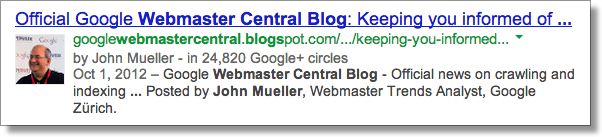
Authorship featured in search results from one of my favorite authors, John Mueller
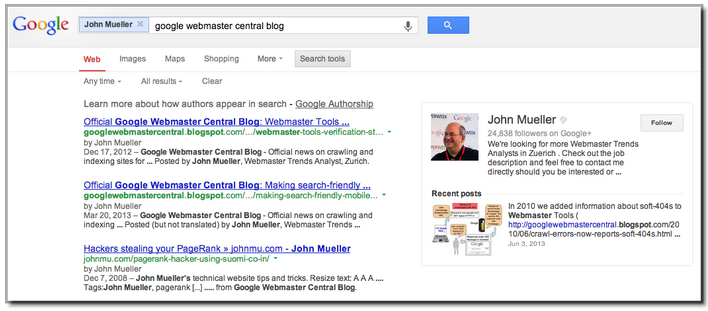
Clicking the author’s byline in search results can reveal more articles and a Google+ profile
Recent authorship questions
1. What kind of pages can be used with authorship?
Good question! You can increase the likelihood that we show authorship for your site by only using authorship markup on pages that meet these criteria:
- The URL/page contains a single article (or subsequent versions of the article) or single piece of content, by the same author. This means that the page isn’t a list of articles or an updating feed. If the author frequently switches on the page, then the annotation is no longer helpful to searchers and is less likely to be featured.
- The URL/page consists primarily of content written by the author.
- Showing a clear byline on the page, stating the author wrote the article and using the same name as used on their Google+ profile.
2. Can I use a company mascot as an author and have authorship annotation in search results? For my pest control business, I’d like to write as the “Pied Piper.”
You’re free to write articles in the manner you prefer — your users may really like the Pied Piper idea. However, for authorship annotation in search results, Google prefers to feature a human who wrote the content. By doing so, authorship annotation better indicates that a search result is the perspective of a person, and this helps add credibility for searchers.
Again, because currently we want to feature people, link authorship markup to an individual’s profile rather than linking to a company’s Google+ Page.
3. If I use authorship on articles available in different languages, such asexample.com/en/article1.html for English and example.com/fr/article1.html for the French translation,
should I link to two separate author/Google+ profiles written in each language?
In your scenario, both articles:
example.com/en/article1.html
andexample.com/fr/article1.html
should link to the same Google+ profile in the author’s language of choice.
4. Is it possible to add two authors for one article?
In the current search user interface, we only support one author per article, blog post, etc. We’re still experimenting to find the optimal outcome for searchers when more than one author is specified.
5. How can I prevent Google from showing authorship?
The fastest way to prevent authorship annotation is to make the author’s Google+ profile not discoverable in search results. Otherwise, if you still want to keep your profile in search results, then you can remove any profile or contributor links to the website, or remove the markup so that it no longer connects with your profile.
6. What’s the difference between rel=author vs rel=publisher?
rel=publisher helps a business create a shared identity by linking the business’ website (often from the homepage) to the business’ Google+ Page. rel=author helps individuals (authors!) associate their individual articles from a URL or website to their Google+ profile. While rel=author and rel=publisher are both link relationships, they’re actually completely independent of one another.
7. Can I use authorship on my site’s property listings or product pages since one of my employees has customized the description?
Authorship annotation is useful to searchers because it signals that a page conveys a real person’s perspective or analysis on a topic. Since property listings and product pages are less perspective/analysis oriented, we discourage using authorship in these cases. However, an article about products that provides helpful commentary, such as, “Camera X vs. Camera Y: Faceoff in the Arizona Desert” could have authorship.
If you have additional questions, don’t forget to check out (and even post your question if you don’t see it covered :) in the Webmaster Forum.
Written by Maile Ohye, Developer Programs Tech Lead

