Google Hits eBay With Manual Penalty In Search Results
What really happened to eBay dropping in Google’s search results this week? A source familiar with the situation tells Search Engine Land that Google hit eBay with a manual penalty this week. A manual penalty is when a human being at Google reviews a site and decides that it deserves some type of…
Please visit Search Engine Land for the full article.
SearchCap: Ripoff Report Returns In Yahoo, Google Shopping Campaigns, Bing Webmaster Roadshow
Below is what happened in search today, as reported on Search Engine Land and from other places across the web. From Search Engine Land: Bing Webmaster Roadshow 2014 Takes Search Experts On 4-City Tour This Summer Bing announced today it will be hostin…
Bing Webmaster Roadshow 2014 Takes Search Experts On 4-City Tour This Summer
Bing announced today it will be hosting the Bing Webmaster Roadshow 2014 starting next month, with stops in four cities including Chicago, Atlanta, Boston and Houston. In partnership with Inc. Magazine, the events will include panel discussions with Message Medium’s Maisha Walker, Bruce Clay…
Please visit Search Engine Land for the full article.
Google Webmaster Tools To Add JavaScript Debugging Tool
Google has announced on the Google Webmaster Central blog that in the “coming days” they will be releasing a new tool to help debug your site’s JavaScript issues. Specifically, Google is going to show you if they have issues crawling and indexing your site because of JavaScript…
Please visit Search Engine Land for the full article.
Understanding web pages better
In 1998 when our servers were running in Susan Wojcicki’s garage, we didn’t really have to worry about JavaScript or CSS. They weren’t used much, or, JavaScript was used to make page elements… blink! A lot has changed since then. The web is full of rich, dynamic, amazing websites that make heavy use of JavaScript. Today, we’ll talk about our capability to render richer websites — meaning we see your content more like modern Web browsers, include the external resources, execute JavaScript and apply CSS.
Traditionally, we were only looking at the raw textual content that we’d get in the HTTP response body and didn’t really interpret what a typical browser running JavaScript would see. When pages that have valuable content rendered by JavaScript started showing up, we weren’t able to let searchers know about it, which is a sad outcome for both searchers and webmasters.
In order to solve this problem, we decided to try to understand pages by executing JavaScript. It’s hard to do that at the scale of the current web, but we decided that it’s worth it. We have been gradually improving how we do this for some time. In the past few months, our indexing system has been rendering a substantial number of web pages more like an average user’s browser with JavaScript turned on.
Sometimes things don’t go perfectly during rendering, which may negatively impact search results for your site. Here are a few potential issues, and – where possible, – how you can help prevent them from occurring:
-
If resources like JavaScript or CSS in separate files are blocked (say, with robots.txt) so that Googlebot can’t retrieve them, our indexing systems won’t be able to see your site like an average user. We recommend allowing Googlebot to retrieve JavaScript and CSS so that your content can be indexed better. This is especially important for mobile websites, where external resources like CSS and JavaScript help our algorithms understand that the pages are optimized for mobile.
-
If your web server is unable to handle the volume of crawl requests for resources, it may have a negative impact on our capability to render your pages. If you’d like to ensure that your pages can be rendered by Google, make sure your servers are able to handle crawl requests for resources.
-
It’s always a good idea to have your site degrade gracefully. This will help users enjoy your content even if their browser doesn’t have compatible JavaScript implementations. It will also help visitors with JavaScript disabled or off, as well as search engines that can’t execute JavaScript yet.
-
Sometimes the JavaScript may be too complex or arcane for us to execute, in which case we can’t render the page fully and accurately.
-
Some JavaScript removes content from the page rather than adding, which prevents us from indexing the content.
To make things easier to debug, we’re currently working on a tool for helping webmasters better understand how Google renders their site. We look forward to making it to available for you in the coming days in Webmaster Tools.
If you have any questions, please feel free to visit our help forum.
Posted by Erik Hendriks and Michael Xu, Software Engineers, and Kazushi Nagayama, Webmaster Trends Analyst


Video Recap of Weekly Search Buzz :: May 23, 2014
This week in search, Google released their Panda 4.0 algorithm and it was big. I dig into that topic for a while. Googleâs spam algorithm was updated over the weekend as well. Googleâs algorithm was definitely in flux…
How SkyBox Satellite Imagery Might Aid Google’s Offline Conversion Tracking
There’s a report this morning that Google is close to buying satellite imaging company SkyBox. The purchase price is put at roughly $1 billion. The deal has yet to be confirmed. The article conjectures that Google wants the company for two potential reasons: More imagery for consumer maps…
Please visit Search Engine Land for the full article.
Study Finds Sweeping KPI Improvements With Switch To Google Shopping Campaigns
The August deadline for converting your Google product listing campaigns (PLA) to the new Shopping Campaigns structure — before Google does it for you — is just a few months away. A new study from CPC Strategy suggests it’s worth making the switch sooner rather than later. CPC…
Please visit Search Engine Land for the full article.
The New Emphasis On Link Building: What’s Behind It And How To React
There seems to be a fresh interest in link building. Why now? What do the search engines have to say? How should agencies and companies approach link building? Why The New Interest In Link Building? Why are search engine optimizers and agencies more in…
Easy Landing Page Testing Using DoubleClick Search
Landing page testing should be near the top of your list of optimization techniques. Here’s how to use DoubleClick Search to learn how users are reacting to your landing pages and tweak those pages to increase conversion rates in a few simple steps.
Search In Pics: Grayson Perry At Google, Red Bing Street View Car & I Danced At Google Shirt
In this week’s Search In Pictures, here are the latest images culled from the web, showing what people eat at the search engine companies, how they play, who they meet, where they speak, what toys they have, and more. Red Bing Street View Car: Source: Google+ Google Dublin’s New…
Please visit Search Engine Land for the full article.
Google Ads Everywhere: *Evil Laugh*
A few days ago, Google scared the world when the SEC report revealed Google that Google wants to place ads everywhere.
In fact, one of the items listed was placing ads in thermostats…
The Difference Between App to App and Web to App Advertising
Mobile devices – and the apps contained within them – are increasingly “always on.” This presents a perfect opportunity for advertisers to drive meaningful engagement where messages are an integrated and seamless part of the user experience.
Ripoff Report Is Back In Yahoo Australia’s Search Results, But Not Completely
After what we think was about a week of being de-indexed, the controversial Ripoff Report website is showing up again in search results on Yahoo’s Australian website. But a company spokesperson tells us that some URLs are still blocked. Late Wednesday night (May 21), we noticed that a…
Please visit Search Engine Land for the full article.
SEO vs. SEM Timelines: A Medical Analogy
How do you explain to your boss or client how SEO works and when to expect results? Use this doctors and medication analogy to help them realize the time and effort it takes to run a successful SEO campaign and avoid being inundated with questions.
Google Chrome Desktop Now With Okay Google Voice Detection
Google announced yesterday on Google+ that Chrome, Google’s popular browser, now supports the ability to say “Okay Google” to activate voice search by default from the Google search page…
Faces Go Missing From Google’s Search Results For About 75 Minutes
Yesterday, the SEO space got into a bit of a panic when Google suddenly dropped authorship images from their search results page.
Twitter Twitter and Google+ went made (I am just sharing one thread from each but there were tons)…
SEO: I Got Comfortable & It Resulted In Being Hit By Google’s Panda Filter
The ongoing thread about Google Panda 4.0 at WebmasterWorld has an interesting post from someone who was hit by Panda a while back and is slowly recovering.
In short, he blames himself. He said, he got comfortable and lazy and didn’t invest in his sit…
Please Remove My Link. Or Else.
Getting links removed is a tedious business.
It’s just as tedious for the site owner who must remove the links. Google’s annoying practice of “suggesting” webmasters jump through hoops in order to physically remove links that the webmaster suspects are bad, rather than Google simply ignoring the links that they’ve internally flagged, is causing frustration.
Is it a punitive punishment? If so, it’s doing nothing to endear Google to webmasters. Is it a smokescreen? i.e. they don’t know which links are bad, but by having webmasters declare them, this helps Google build up a more comprehensive database? Bit of both? It might also be adding costs to SEO in order to put SEO out of reach of small companies. Perhaps it’s a red herring to make people think links are more important than they actually are.
Hard to be sure.
Collateral Damage
SEOs are accustomed to search engines being coy, punitive and oblique. SEOs accept it as part of the game. However, it becomes rather interesting when webmasters who are not connected to SEO get caught up in the collateral damage:
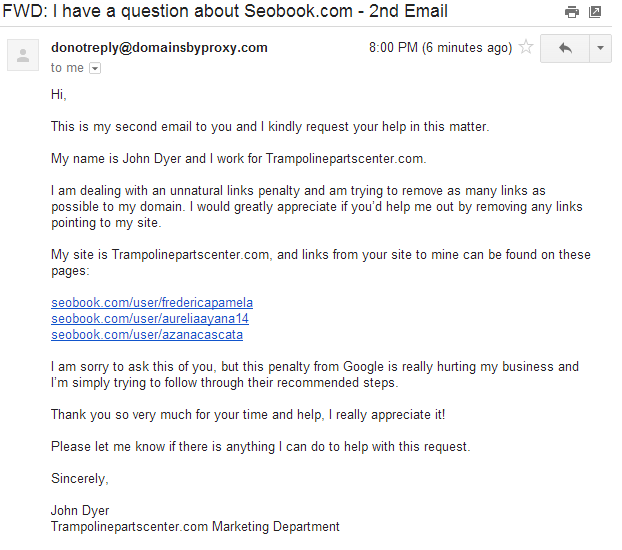
I received an interesting email the other day from a company we linked to from one of our websites. In short, the email was a request to remove links from our site to their site. We linked to this company on our own accord, with no prior solicitation, because we felt it would be useful to our site visitors, which is generally why people link to things on the Internet.
And check out the subsequent discussion on Hacker News. Matt Cutts first post is somewhat disingenuous:
Situation #1 is by far the most common. If a site gets dinged for linkspam and works to clean up their links, a lot of them send out a bunch of link removal requests on their own prerogative
Webmasters who receive the notification are encouraged by Google to clean up their backlinks, because if they don’t, then their rankings suffer.
But, essentially from our point of view when it comes to unnatural links to your website we want to see that you’ve taken significant steps to actually remove it from the web but if there are some links that you can’t remove yourself or there are some that require payment to be removed then having those in the disavow file is fine as well.
(Emphasis mine)
So, of course webmasters who have received a notification from Google are going to contact websites to get links removed. Google have stated they want to see that the webmaster has gone to considerable effort to remove them, rather than simply use the disavow tool.
The inevitable result is that a webmaster who links to anyone who has received a bad links notification may receive the latest form of email spam known as the “please remove my link” email. For some webmasters, this email has become more common that the “someone has left you millions in a Nigerian bank account” gambit, and is just as persistent and annoying.
From The Webmasters Perspective
Webmasters could justifiably add the phrase “please remove my link” and the word “disavow” to their spam filters.
Let’s assume this webmaster isn’t a bad neighbourhood and is simply caught in the cross-fire. The SEO assumes, perhaps incorrectly, the link is bad and requests a take-down. From the webmasters perspective, they incur a time cost dealing with the link removal requests. A lone request might take a few minutes to physically remove – but hang on a minute – how does the webmaster know this request is coming from the site owner and not from some dishonest competitor? Ownership takes time to verify. And why would the webmaster want to take down this link, anyway? Presumably, they put it up because they deemed it useful to their audience. Or, perhaps some bot put the link there – perhaps as a forum or blog comment link – against the webmasters wishes – and now, to add insult to injury, the SEO wants the webmaster to spend his time taking it down!
Even so, this might be okay if it’s only one link. It doesn’t take long to remove. But, for webmasters who own large sites, it quickly becomes a chore. For large sites with thousands of outbound links built up over years, removal requests can pile up. That’s when the spam filter kicks in.

Then come the veiled threats. “Thanks for linking to us. This is no reflection on you, but if you don’t remove my link I’ll be forced to disavow you and your site will look bad in Google. I don’t want to do this, but I may have to.”
What a guy.
How does the webmaster know the SEO won’t do that anyway? Isn’t that exactly what some SEO conference speakers have been telling other SEOs to do regardless of whether the webmaster takes the link down or not?
So, for a webmaster caught in the cross-fire, there’s not much incentive to remove links, especially if s/he’s read Matt’s suggestion:
higherpurpose, nowhere in the original article did it say that Google said the link was bad. This was a request from a random site (we don’t know which one, since the post dropped that detail), and the op can certainly ignore the link removal request.
In some cases Google does specify links:
We’ve reviewed the links to your site and we still believe that some of them are outside our quality guidelines.
Sample URLs:
ask.metafilter.com/194610/get-me-and-my-stuff-from-point-a-to-point-b-possibly-via-point-cPlease correct or remove all inorganic links, not limited to the samples provided above. This may involve contacting webmasters of the sites with the inorganic links on them.
And they make errors when they specify those links. They’ve flagged DMOZ & other similar links: “Every time I investigate these “unnatural link” claims, I find a comment by a longtime member of MetaFilter in good standing trying to help someone out, usually trying to identify something on Ask MetaFilter.”
Changing Behaviour
Then the webmaster starts thinking.
“Hmmm…maybe linking out will hurt me! Google might penalize me or, even worse, I’ll get flooded with more and more “please remove my link” spam in future.”
So what happens?
The webmaster becomes very wary about linking out. David Naylor mentioned an increasing number of sites adopting a “no linking” policy. Perhaps the webmaster no-follows everything as a precaution. Far from being the life-giving veins of the web, links are seen as potentially malignant. If all outbound links are made no-follow, perhaps the chance of being banned and flooded with “please remove my link”spam is reduced. Then again, even nofollowed links are getting removal requests.
As more webmasters start to see links as problematic, fewer legitimate sites receive links. Meanwhile, the blackhat, who sees their sites occasionally getting burned as a cost of doing business, will likely see their site rise as they’ll be the sites getting all the links, served up from their curated link networks.
A commenter notes:
The Google webspam team seems to prefer psychology over technology to solve the problem, especially recently. Nearly everything that’s come out of Matt Cutt’s mouth in the last 18 months or so has been a scare tactic.
IMO all this does is further encourage the development of “churn and burn” websites from blackhats who have being penalized in their business plan. So why should I risk all the time and effort it takes to generate quality web content when it could all come crashing down because an imperfect and overzealous algorithm thinks it’s spam? Or worse, some intern or non-google employee doing a manual review wrongly decides the site violates webmaster guidelines?
And what’s the point of providing great content when some competitor can just take you out with a dedicated negative SEO campaign, or if Google hits you with a false positive? If most of your traffic comes from Google, then the risk of the web publishing model increases.
Is Google broken? Or is your site broken? That’s the question any webmaster asks when she sees her Google click-throughs drop dramatically. It’s a question that Matt Haughey, founder of legendary Internet forum MetaFilter, has been asking himself for the last year and a half, as declining ad revenues have forced the long-running site to lay off several of its staff.
Then again, Google may just not want what MetaFilter has to offer anymore.
(In)Unintended Consequences
Could this be uncompetitive practice from Google? Are the sites getting hit with penalties predominantly commercial sites? It would be interesting to see how many of them are non-commercial. If so, is it a way to encourage commercial sites to use Adwords as it becomes harder and harder to get a link by organic means? If all it did was raise the cost of doing SEO, it would still be doing its job.
I have no idea, but you could see why people might ask that question.
Let’s say it’s benevolent and Google is simply working towards better results. The unintended consequence is that webmasters will think twice about linking out. And if that happens, then their linking behaviour will start to become more exclusive. When links become harder to get and become more problematic, then PPC and social-media is going to look that much more attractive.
Categories:
SearchCap: MetaFilter Filtered By Google, RetailMeNot Debates Panda Reports & Google Drops Authorship
Below is what happened in search today, as reported on Search Engine Land and from other places across the web. From Search Engine Land: Google Drops Authorship Rich Snippets From Search Results. A Bug? For the past 20 minutes, if you search anything o…