Facebook Ad Relevancy Score
Like Google AdWords quality score shows a 1 to 10 score to advertisers…
Google: Duplicate Titles Is Not A Panda Search Quality Issue
Google’s John Mueller said in a Google+ webmaster live hangout this morning that having duplicate title tags and meta descriptions would not lead to a search quality issue specifically around the Panda algorithm…
What Is Link-Building, and Why Does It Matter in 2015?
In 2015, if you want to grow your search presence, authority, and visibility, you need a link builder.
SearchCap: Google Search Impact Report, Expedia Buys Orbitz & AdWords Topics
Below is what happened in search today, as reported on Search Engine Land and from other places across the web.
The post SearchCap: Google Search Impact Report, Expedia Buys Orbitz & AdWords Topics appeared first on Search Engine Land.
Please visit Search Engine Land for the full article.
AdWords Success for 2015: Conversion Tips from Inside Experts
Is your AdWords campaign ready for success in 2015?
The post AdWords Success for 2015: Conversion Tips from Inside Experts appeared first on Search Engine Land.
Please visit Search Engine Land for the full article.
See The New Search Impact Reports In Google Webmaster Tools Over Here
As we covered, Google promised to test a new alpha version of the search queries report and that has now been released to the first set of alpha/beta testers this morning.
Google said this new report will be changing drastically over the testing period…
Google AdWords Editor Update Brings Performance & Reliability Improvements
Google announced on Google+ that they’ve released an update to their new version of AdWords Editor v 11, this new update is version 11.0.3…
Where’s My Sitelinks Search Box? Blame Google’s Algorithms.
Google’s Sitelinks Search box launched in September of last year and webmasters are still scratching their heads asking how can my site show the search box in the Google search results…
Google Analytics Data Drops Off On Monday, February 9th
There are dozens of complaints in the Google Analytics Help Forums, I just linked to a few, of webmasters reporting their data for February 9th, Monday, is completely missing from the reports…
10 WordPress SEO Questions That Took Me 10 Years To Answer!
Looking to implement WordPress for your website or blog? Let columnist Trond Lyngbø give you the run-down on the SEO implications with these frequently asked questions.
The post 10 WordPress SEO Questions That Took Me 10 Years To Answer! appeared first on Search Engine Land.
Please visit Search Engine Land for the full article.
Now It’s Expedia Vs. Priceline As Orbtiz Swallowed For $1.6 Billion
After buying Travelocity last month Expedia grabs Orbtiz in competitive bidding.
The post Now It’s Expedia Vs. Priceline As Orbtiz Swallowed For $1.6 Billion appeared first on Search Engine Land.
Please visit Search Engine Land for the full article.
Local Business Conversion Optimization: 3 Ad Personalization Rules to Live By
Employ all three of these tools and you will have a local marketing personalization WMP –Weapon of Mass Personalization – on your hands.
Google’s Search Impact Report Goes Live For Select Few Webmasters
Google releases the alpha version of their new search queries report in Google Webmaster Tools to a small number of Webmasters for feedback and testing. We have screen shots of the new tool.
The post Google’s Search Impact Report Goes Live For Select Few Webmasters appeared first on Search…
Please visit Search Engine Land for the full article.
AdWords Scripts Bulks Up With Bulk File Uploads
AdWords scripts now support bulk uploads to your accounts, and columnist Russell Savage shows how you can use this new functionality to create campaigns, modify accounts and more.
The post AdWords Scripts Bulks Up With Bulk File Uploads appeared first…
Link-Building Inspiration: Cookie Policy Information
Keeping track of the link profiles of inspirational website can provide a lot of link-building ideas. Here’s a great example.
You Can’t Copyright Facts
The Facts of Life
When Google introduced the knowledge graph one of their underlying messages behind it was “you can’t copyright facts.”
Facts are like domain names or links or pictures or anything else in terms of being a layer of information which can be highly valued or devalued through commoditization.
When you search for love quotes, Google pulls one into their site & then provides another “try again” link.
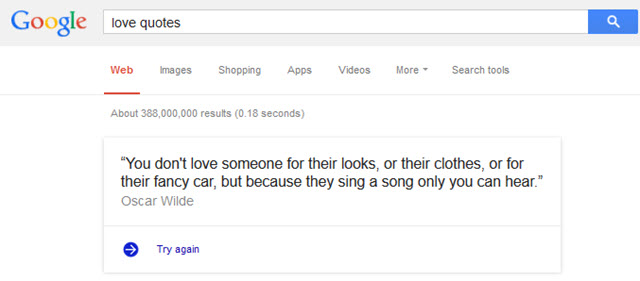
Since quotes mostly come from third parties they are not owned by BrainyQuotes and other similar sites. But here is the thing, if those other sites which pay to organize and verify such collections have their economics sufficiently undermined then they go away & then Google isn’t able to pull them into the search results either.
The same is true with song lyrics. If you are one of the few sites paying to license the lyrics & then Google puts lyrics above the search results, then the economics which justified the investment in licensing might not back out & you will likely go bankrupt. That bankruptcy wouldn’t be the result of being a spammer trying to work an angle, but rather because you had a higher cost structure from trying to do things the right way.
Never trust a corporation to do a librarian’s job.
What’s Behind Door Number One?
Google has also done the above quote-like “action item” types of onebox listings in other areas like software downloads
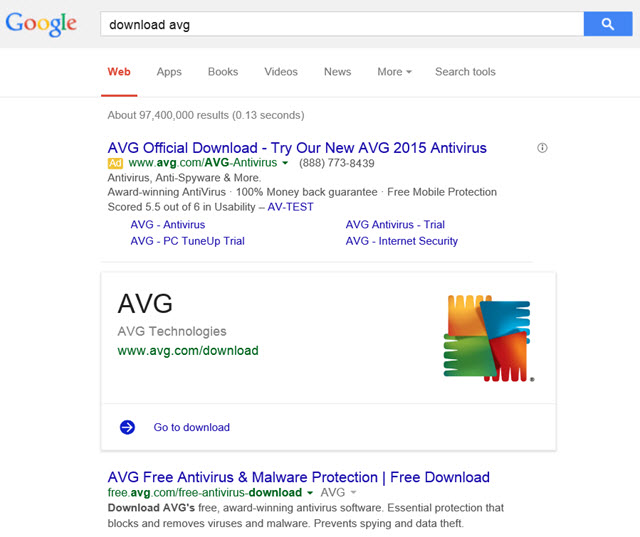
Where there are multiple versions of the software available, Google is arbitrarily selecting the download page, even though a software publisher might have a parallel SAAS option or other complex funnels based on a person’s location or status as a student or such.
Mix in Google allowing advertisers to advertise bundled adware, and it becomes quite easy for Google to gum up the sales process and undermine existing brand equity by sending users to the wrong location. Here’s a blog post from Malwarebytes referencing
- their software being advertised on their brand term in Google via AdWords ads, engaging in trademark infringement and bundled with adware.
- numerous user complaints they received about the bundleware
- required legal actions they took to take the bundler offline
Brands are forced to buy their own brand equity before, during & after the purchase, or Google partners with parasites to monetize the brand equity:
The company used this cash to build more business, spending more than $1 million through at least seven separate advertising accounts with Google.
…
The ads themselves said things like “McAfee Support – Call +1-855-[redacted US phone number]” and pointed to domains like mcafee-support.pccare247.com.
…
One PCCare247 ad account with Google produced 71.7 million impressions; another generated 12.4 million more. According to records obtained by the FTC, these combined campaigns generated 1.5 million clicks
Since Google requires Chrome extensions be installed from their own website it makes it hard (for anyone other than Google) to monetize them, which in turn makes it appealing for people to sell the ad-ons to malware bundlers. Android apps in the Google Play store are yet another “open” malware ecosystem.
FACT: This Isn’t About Facts
Google started the knowledge graph & onebox listings on some utterly banal topics which were easy for a computer to get right, though their ambitions vastly exceed the starting point. The starting point was done where it was because it was low-risk and easy.
When Google’s evolving search technology was recently covered on Medium by Steven Levy he shared that today the Knowledge Graph appears on roughly 25% of search queries and that…
Google is also trying to figure out how to deliver more complex results — to go beyond quick facts and deliver more subjective, fuzzier associations. “People aren’t interested in just facts,” she says. “They are interested in subjective things like whether or not the television shows are well-written. Things that could really help take the Knowledge Graph to the next level.”
Even as the people who routinely shill for Google parrot the “you can’t copyright facts” mantra, Google is telling you they have every intent of expanding far beyond it. “I see search as the interface to all computing,” says Singhal.
Even if You Have Copyright…
What makes the “you can’t copyright facts” line so particularly disingenuous was Google’s support of piracy when they purchased YouTube:
cofounder Jawed Karim favored “lax” copyright policy to make YouTube “huge” and hence “an excellent acquisition target.” YouTube at one point added a “report copyrighted content” button to let users report infringements, but removed the button when it realized how many users were reporting unauthorized videos. Meanwhile, YouTube managers intentionally retained infringing videos they knew were on the site, remarking “we should KEEP …. comedy clips (Conan, Leno, etc.) [and] music videos” despite having licenses for none of these. (In an email rebuke, cofounder Steve Chen admonished: “Jawed, please stop putting stolen videos on the site. We’re going to have a tough time defending the fact that we’re not liable for the copyrighted material on the site because we didn’t put it up when one of the co-founders is blatantly stealing content from other sites and trying to get everyone to see it.”)
To some, the separation of branding makes YouTube distinct and separate from Google search, but that wasn’t so much the case when many sites lost their video thumbnails and YouTube saw larger thumbnails on many of their listings in Google. In the above Steven Levy article he wrote: “one of the highest ranked general categories was a desire to know “how to” perform certain tasks. So Google made it easier to surface how-to videos from YouTube and other sources, featuring them more prominently in search.”
Altruism vs Disruption for the Sake of it
Whenever Google implements a new feature they can choose not to monetize it so as to claim they are benevolent and doing it for users without commercial interest. But that same unmonetized & for users claim was also used with their shopping search vertical until one day it went paid. Google claimed paid inclusion was evil right up until the day it claimed paid inclusion was a necessity to improve user experience.
There was literally no transition period.
Many of the “informational” knowledge block listings contain affiliate links pointing into Google Play or other sites. Those affiliate ads were only labeled as advertisements after the FTC complained about inconsistent ad labeling in search results.
Health is Wealth
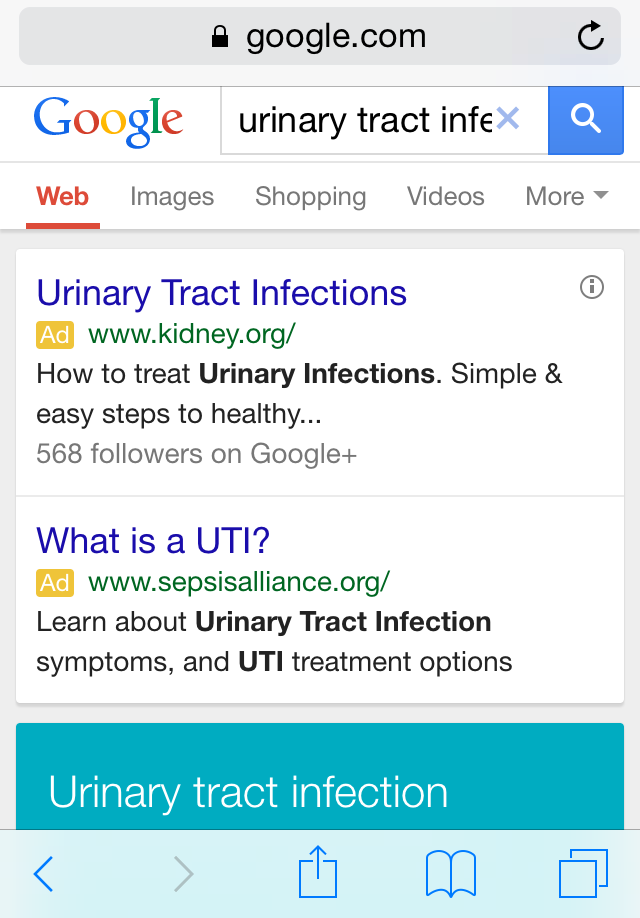
Google recently went big on the knowledge graph by jumping head first into the health vertical:
starting in the next few days, when you ask Google about common health conditions, you’ll start getting relevant medical facts right up front from the Knowledge Graph. We’ll show you typical symptoms and treatments, as well as details on how common the condition is—whether it’s critical, if it’s contagious, what ages it affects, and more. For some conditions you’ll also see high-quality illustrations from licensed medical illustrators. Once you get this basic info from Google, you should find it easier to do more research on other sites around the web, or know what questions to ask your doctor.

Google’s links to the Mayo Clinic in their knowledge graph are, once again, a light gray font.
In case you didn’t find enough background in Google’s announcement article, Greg Sterling shared more of Google’s views here. A couple notable quotes from Greg…
Cynics might say that Google is moving into yet another vertical content area and usurping third-party publishers. I don’t believe this is the case. Google isn’t going to be monetizing these queries; it appears to be genuinely motivated by a desire to show higher-quality health information and educate users accordingly.
- Google doesn’t need to directly monetize it to impact the economics of the industry. If they shift a greater share of clicks through AdWords then that will increase competition and ad prices in that category while lowering investment in SEO.
- If this is done out of benevolence, it will appear *above* the AdWords ads on the search results — unlike almost every type of onebox or knowledge graph result Google offers.
- If it is fair for him to label everyone who disagrees with his thesis as a cynic then it is of course fair for those “cynics” to label Greg Sterling as a shill.
Google told me that it hopes this initiative will help motivate the improvement of health content across the internet.
By defunding and displacing something they don’t improve its quality. Rather they force the associated entities to cut their costs to try to make the numbers work.
If their traffic drops and they don’t do more with less, then…
- their margins will fall
- growth slows (or they may even shrink)
- their stock price will tank
- management will get fired & replaced and/or they will get took private by private equity investors and/or they will need to do some “bet the company” moves to find growth elsewhere (and hope Google doesn’t enter that parallel area anytime soon)
When the numbers don’t work, publishers need to cut back or cut corners.
Things get monetized directly, monetized indirectly, or they disappear.
Some of the more hated aspects of online publishing (headline bait, idiotic correlations out of context, pagination, slideshows, popups, fly in ad units, auto play videos, full page ad wraps, huge ads eating most the above the fold real estate, integration of terrible native ad units promoting junk offers with shocking headline bait, content scraping answer farms, blending unvetted user generated content with house editorial, partnering with content farms to create subdomains on trusted blue chip sites, using Narrative Science or Automated Insights to auto-generate content, etc.) are not done because online publishers want to be jackasses, but because it is hard to make the numbers work in a competitive environment.
Publishers who were facing an “oh crap” moment when seeing print Dollars turn into digital dimes are having round number 2 when they see those digital dimes turn into mobile pennies:
At The New York Times, for instance, more than half its digital audience comes from mobile, yet just 10% of its digital-ad revenue is attributed to these devices.
If we lose some diversity in news it isn’t great, though it isn’t the end of the world. But what makes health such an important area is it is literally a matter of life & death.
Its importance & the amount of money flowing through the market ensures there is heavy investment in misinforming the general population. The corruption is so bad some people (who should know better) instead fault science.
@johnandrews @aaronwall it must be nice to say, you know what we’re keeping that traffic for ourselves, and nobody says a damn thing— Michael Gray (@graywolf) February 10, 2015
… and, only those who hate free speech, democracy & the country could possibly have anything negative to say about it. :D
Not to worry though. Any user trust built through the health knowledge graph can be monetized through a variety of other fantastic benevolent offers.
Once again, Google puts the user first.
Categories:
SearchCap: Udi Manber Leaves Google, Bing Ads Mom’s Day & No Panda & Penguin Whitelists
Below is what happened in search today, as reported on Search Engine Land and from other places across the web.
The post SearchCap: Udi Manber Leaves Google, Bing Ads Mom’s Day & No Panda & Penguin Whitelists appeared first on Search Engine Land.
Please visit Search Engine Land for the full article.
#SESLON: Consistency Is Key for Optimizing Marketing
Consistency can be achieved by having a clear brand voice and not confusing it with uniformity, according to a panel of executives from Facebook, Lego, Microsoft, and Mindshare.
Google Says There’s No Whitelist To Save You From Panda Or Penguin
Google’s John Mueller said there is no whitelist for the Penguin and Panda algorithms, like there is for the SafeSearch algorithm.
The post Google Says There’s No Whitelist To Save You From Panda Or Penguin appeared first on Search Engine Land.
Please visit Search Engine Land for the full article.
Facebook Can Now Track Online Searches Out of App
Update to privacy policy means social media can see your online searches.