SEO Homesteading 2016
Happy 2016 to the Die Hard SEOs
The 4 Fundamental Steps of Conversion Optimization

Once upon a time, I was sitting in my office looking over data for one our new clients and reviewing the conversion project roadmap. The phone rang and on the other end was the VP of marketing for a multi-billion-dollar company. It is very unusual to get an unannounced call from someone at his level, but he had an urgent problem to solve. A good number of his website visitors were not converting.
His problem did not surprise me. We deal with conversion rates optimization every day.
He invited me to meet with his team to discuss the problem further. The account would be a huge win for Invesp, so we agreed on a time that worked for both us. When the day came, our team went to the company’s location.
We started the discussion, and things did NOT go as I expected. The VP, who led the meeting, said, “we have a conversion problem.”
“First-time visitors to our website convert at a rate of 48%. Repeat visitors convert at 80%!”
I was puzzled.
Not sure what exactly puzzled me. Was it the high conversion numbers or was it the fact that the VP was not happy with them. He wanted more.
I thought he had his conversion numbers wrong. But nope. We looked at his analytics, and he was correct. The numbers were simply amazing by all standards. The VP, however, had a different mindset. The company runs thousands of stores around the US. When someone picks up the phone and calls them, they convert callers at a 90% rate. He was expecting the same conversion rate for his online store.
Let’s face it. A typical e-commerce store converts at an average of 3%. Few websites are able to get to anywhere from 10 to 18%. These are considered the stars of the world of conversion rates.
The sad truth about a website with 15% conversion rate is that 85% of the visitors simply leave without converting. Money left on the table, cash the store will not be able to capture. Whatever way you think about it, we can agree that there is a huge opportunity, but it is also a very difficult one to conquer.
The Problem with Conversion Optimization

Most companies jump into conversion optimization with a lot of excitement. As you talk to teams conducting conversion optimization, you notice a common thread. They take different pages of the website and run tests on them. Some tests produce results; others do not. After a while, the teams run out of ideas. The managers run out of excitement.
The approach of randomly running tests on different pages sees conversion rate optimization in a linear fashion. The real problem is that no one shops online in a linear fashion. We do not follow a linear path when we navigate from one area of the website to the next. Humans most of the time are random, or, at least, they appear random.
What does that mean?
The right approach to increase conversion rates needs to be systematical, because it deals with irrational and random human behavior.
So, how do you do this?
The Four Steps to Breaking to Double Digits Conversion Rates
After ten years of doing conversion optimization at Invesp, I can claim that we have a process that works for many online businesses. The truth is that it continues to be a work in progress.
These are the four steps you should follow to achieve your desired conversion rate:
Create Personas for Your Website
I could never stop talking about personas and the impact they have on your website. While most companies talk about their target market, personas help you translate your generalized and somewhat abstract target market data into a personalized experience that impacts your website design, copy and layout.
Let’s take the example of a consulting company that targets “e-commerce companies with a revenue of 10 million dollars or more.” There are two problems with this statement:
- The statement is too general about the target market (no verticals and no geography, for example)
- I am not sure how to translate this statement into actionable items on my website or marketing activity
You should first think about the actual person who would hire the services of this consulting company. Most likely, the sales take place to:
- A business owner for a company with annual revenue from 10 to 20 million dollars.
- A marketing director for a company with annual revenue from 20 to 50 million dollars.
- A VP of marketing for a company with annual revenue over 50 million dollars.
Now, translate each of these three different cases into a persona.
So, instead of talking about a business owner for a company that is generating annual revenue from 10 to 20 million dollars, we will talk about:
John Riley, 43 years old, completed his B.A. in physics from the University of Michigan-Ann Arbor. He is a happy father of three. He started the company in 2007 and financed it from his own pocket. His company generated 13.5 million dollars of revenue in 2014 and expects to see a modest 7% increase in sales in 2015. John is highly competitive, but he also cares about his customers and thinks of them as an extended family. He would like to find a way to increase this year’s revenue by 18%, but he is not sure how to do so. He is conservative when it comes to using new marketing techniques. In general, John does not trust consultants and thinks of them as overpaid.
This is an oversimplification of the persona creation process and its final product. But you get the picture. If you are the consulting company that targets John, then what type of website design, copy and visitor flow would you use to persuade him to do business with you?
What data points do you use to create personas for your website? I would start with this:
- Market research
- Demographical studies
- Usability studies
- Zip code analysis
- Existing customer surveys
- Competitive landscape
- AB and Multivariate testing data
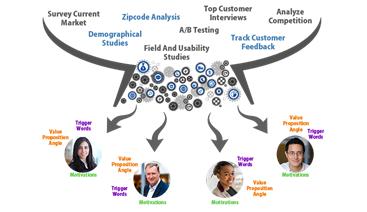
A website or a business should typically target four to seven personas.
Add Traffic Sources
So, you have the personas. These personas should impact your design, copy and visitor flow.
But how?
Let’s start by looking at analytics data. Look for a period of six months to one year and see the top traffic sources/mediums. If your website has been online for a while, then you will probably have hundreds of different sources. Start with your top 10 traffic sources/medium and create a matrix for each of the personas/traffic source/landing pages:
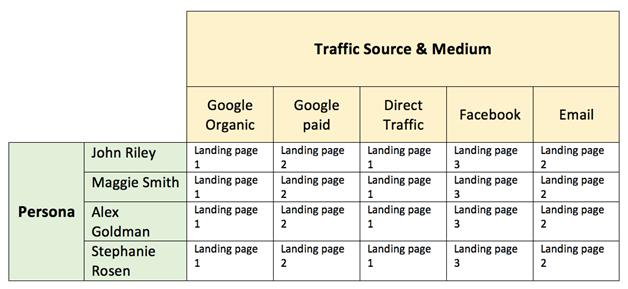
Now, your job is to evaluate each top landing page for each traffic source through the eyes of your website personas. For each page, you will answer eight questions.
The persona questions: Eight questions to ask

- What type of information would persona “x” need to see to click on to the next page on the website?
- What would be the top concerns persona “x” have looking at the page?
- What kind of copy does persona “x” need to see?
- What type of trigger words are important to include on the page for persona “x”?
- What words should I avoid for persona “x”?
- What kind of headline should I use to persuade persona “x” to stay on my website?
- What kind of images should I use to capture persona “x” attention?
- What elements on the page could distract persona “x”?
As you answer these questions for each of the personas, you will end up with a large set of answers and actions. The challenge and the art will be to combine all these and make the same landing page work for all different personas. This is not a small task, but this is where the fun begins.
Consider the Buying Stages
You thought the previous work was complex? Well, you haven’t seen anything just yet!
Not every visitor who lands on your website is ready to buy. Visitors come to your website in different buying stages, and only 15-20% are in the action stage. The sequential buying stages of a visitor are:
- Awareness stage (top of the sales funnel)
- Research stage
- Evaluating alternatives
- Action stage
- Post action
A typical buying funnel looks like this:
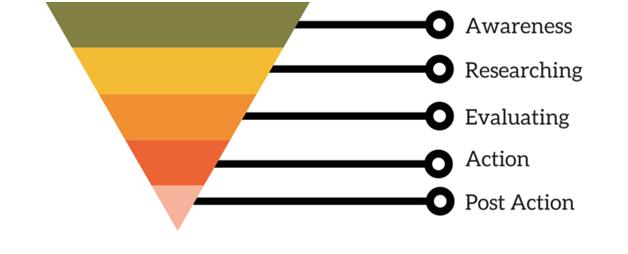
How does that translate into actionable items on your website?
In the previous exercise, we created a list of changes on different screens or sections of your website based on the different personas. Now, we are going to think about each persona landing on the website in one of the first four buying stages.
Instead of thinking of how to adjust a particular screen for John Riley, now you think of a new scenario:
Persona “x” is in the “evaluating alternatives” stage of the buying funnel. He lands on a particular landing page. What do I need to adjust in the website design and copy to persuade persona “x” to convert?
Our previous table looks like this now:
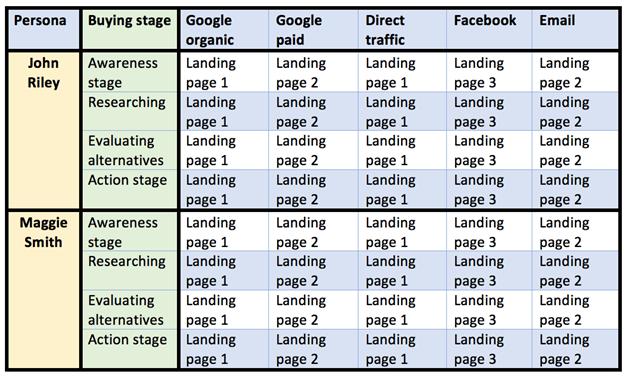
Next, answer all eight persona-questions again, based on the different buying stages.
Test your different scenarios
This goes without saying; you should NEVER introduce changes to your website without actually testing them. You can find plenty of blogs and books out there on how to conduct testing correctly if you are interested in learning more about AB testing and multivariate testing.
For a start, keep the five No’s of AB testing in mind:

1. No to “Large and complex tests”
Your goal is NOT to conduct large AB or multivariate tests. Your goal is to discover what elements on the page cause visitors to act a specific way. Break complex tests into smaller ones. The more you can isolate the changes to one or two elements, the easier it will be to understand the impact of different design and copy elements on visitors’ actions.
2. No to “Tests without a hypothesis”
I can never say it enough. A test without a good hypothesis is a gambling exercise. A hypothesis is a predictive statement about a problem or set of problems on your page and the impact of solving these problems on visitor behavior.
3. No to “Polluted data”
Do not run tests for less than seven days or longer than four weeks. In both scenarios, you are leaving yourself open to the chance of inconsistent and polluted data. When you run a test for less than seven days, website data inconsistencies you are not aware of may affect your results. So, give the test results a chance to stabilize. If you run a test for more than four weeks, you are allowing external factors to have a larger impact on your results.
4. No to “Quick fixes”
Human psychology is complex. Conversion optimization is about understanding visitor behavior and adjusting website design, copy and process to persuade these visitors to convert. Conversion optimization is not a light switch you turn on and off. It is a long-term commitment. Some tests will produce results and some will not. Increases in conversion rates are great but what you are looking for is a window to visitor behavior.
5. No to “Tests without marketing insights”
Call it whatever you like: forensic analysis, posttest analysis, test results assessment. You should learn actionable marketing insights from the test to deploy across channels and verticals. The real power of any testing program lays beyond the results.
If you follow the steps outlined in this blog, you will have a lot to do.
So, happy testing!
About the author: This guide was written by Khalid Saleh. He is the CEO of Invesp, a conversion optimization software and services firm with clients in 11 different countries.
Categories:
The 4 Fundamental Steps of Conversion Optimization
Once upon a time, I was sitting in my office looking over data for one our new clients and reviewing the conversion project roadmap. The phone rang and on the other end was the VP of marketing for a multi-billion-dollar company. It is very unusual to get an unannounced call from someone at his level, but he had an urgent problem to solve. A good number of his website visitors were not converting.
His problem did not surprise me. We deal with conversion rates optimization every day.
He invited me to meet with his team to discuss the problem further. The account would be a huge win for Invesp, so we agreed on a time that worked for both us. When the day came, our team went to the company’s location.
We started the discussion, and things did NOT go as I expected. The VP, who led the meeting, said, “we have a conversion problem.”
“First-time visitors to our website convert at a rate of 48%. Repeat visitors convert at 80%!”
I was puzzled.
Not sure what exactly puzzled me. Was it the high conversion numbers or was it the fact that the VP was not happy with them. He wanted more.
I thought he had his conversion numbers wrong. But nope. We looked at his analytics, and he was correct. The numbers were simply amazing by all standards. The VP, however, had a different mindset. The company runs thousands of stores around the US. When someone picks up the phone and calls them, they convert callers at a 90% rate. He was expecting the same conversion rate for his online store.
Let’s face it. A typical e-commerce store converts at an average of 3%. Few websites are able to get to anywhere from 10 to 18%. These are considered the stars of the world of conversion rates.
The sad truth about a website with 15% conversion rate is that 85% of the visitors simply leave without converting. Money left on the table, cash the store will not be able to capture. Whatever way you think about it, we can agree that there is a huge opportunity, but it is also a very difficult one to conquer.
The Problem with Conversion Optimization
Most companies jump into conversion optimization with a lot of excitement. As you talk to teams conducting conversion optimization, you notice a common thread. They take different pages of the website and run tests on them. Some tests produce results; others do not. After a while, the teams run out of ideas. The managers run out of excitement.
The approach of randomly running tests on different pages sees conversion rate optimization in a linear fashion. The real problem is that no one shops online in a linear fashion. We do not follow a linear path when we navigate from one area of the website to the next. Humans most of the time are random, or, at least, they appear random.
What does that mean?
The right approach to increase conversion rates needs to be systematical, because it deals with irrational and random human behavior.
So, how do you do this?
The Four Steps to Breaking to Double Digits Conversion Rates
After ten years of doing conversion optimization at Invesp, I can claim that we have a process that works for many online businesses. The truth is that it continues to be a work in progress.
These are the four steps you should follow to achieve your desired conversion rate:
Create Personas for Your Website
I could never stop talking about personas and the impact they have on your website. While most companies talk about their target market, personas help you translate your generalized and somewhat abstract target market data into a personalized experience that impacts your website design, copy and layout.
Let’s take the example of a consulting company that targets “e-commerce companies with a revenue of 10 million dollars or more.” There are two problems with this statement:
- The statement is too general about the target market (no verticals and no geography, for example)
- I am not sure how to translate this statement into actionable items on my website or marketing activity
You should first think about the actual person who would hire the services of this consulting company. Most likely, the sales take place to:
- A business owner for a company with annual revenue from 10 to 20 million dollars.
- A marketing director for a company with annual revenue from 20 to 50 million dollars.
- A VP of marketing for a company with annual revenue over 50 million dollars.
Now, translate each of these three different cases into a persona.
So, instead of talking about a business owner for a company that is generating annual revenue from 10 to 20 million dollars, we will talk about:
John Riley, 43 years old, completed his B.A. in physics from the University of Michigan-Ann Arbor. He is a happy father of three. He started the company in 2007 and financed it from his own pocket. His company generated 13.5 million dollars of revenue in 2014 and expects to see a modest 7% increase in sales in 2015. John is highly competitive, but he also cares about his customers and thinks of them as an extended family. He would like to find a way to increase this year’s revenue by 18%, but he is not sure how to do so. He is conservative when it comes to using new marketing techniques. In general, John does not trust consultants and thinks of them as overpaid.
This is an oversimplification of the persona creation process and its final product. But you get the picture. If you are the consulting company that targets John, then what type of website design, copy and visitor flow would you use to persuade him to do business with you?
What data points do you use to create personas for your website? I would start with this:
- Market research
- Demographical studies
- Usability studies
- Zip code analysis
- Existing customer surveys
- Competitive landscape
- AB and Multivariate testing data
A website or a business should typically target four to seven personas.
Add Traffic Sources
So, you have the personas. These personas should impact your design, copy and visitor flow.
But how?
Let’s start by looking at analytics data. Look for a period of six months to one year and see the top traffic sources/mediums. If your website has been online for a while, then you will probably have hundreds of different sources. Start with your top 10 traffic sources/medium and create a matrix for each of the personas/traffic source/landing pages:
Now, your job is to evaluate each top landing page for each traffic source through the eyes of your website personas. For each page, you will answer eight questions.
The persona questions: Eight questions to ask
- What type of information would persona “x” need to see to click on to the next page on the website?
- What would be the top concerns persona “x” have looking at the page?
- What kind of copy does persona “x” need to see?
- What type of trigger words are important to include on the page for persona “x”?
- What words should I avoid for persona “x”?
- What kind of headline should I use to persuade persona “x” to stay on my website?
- What kind of images should I use to capture persona “x” attention?
- What elements on the page could distract persona “x”?
As you answer these questions for each of the personas, you will end up with a large set of answers and actions. The challenge and the art will be to combine all these and make the same landing page work for all different personas. This is not a small task, but this is where the fun begins.
Consider the Buying Stages
You thought the previous work was complex? Well, you haven’t seen anything just yet!
Not every visitor who lands on your website is ready to buy. Visitors come to your website in different buying stages, and only 15-20% are in the action stage. The sequential buying stages of a visitor are:
- Awareness stage (top of the sales funnel)
- Research stage
- Evaluating alternatives
- Action stage
- Post action
A typical buying funnel looks like this:
How does that translate into actionable items on your website?
In the previous exercise, we created a list of changes on different screens or sections of your website based on the different personas. Now, we are going to think about each persona landing on the website in one of the first four buying stages.
Instead of thinking of how to adjust a particular screen for John Riley, now you think of a new scenario:
Persona “x” is in the “evaluating alternatives” stage of the buying funnel. He lands on a particular landing page. What do I need to adjust in the website design and copy to persuade persona “x” to convert?
Our previous table looks like this now:
Next, answer all eight persona-questions again, based on the different buying stages.
Test your different scenarios
This goes without saying; you should NEVER introduce changes to your website without actually testing them. You can find plenty of blogs and books out there on how to conduct testing correctly if you are interested in learning more about AB testing and multivariate testing.
For a start, keep the five No’s of AB testing in mind:
1. No to “Large and complex tests”
Your goal is NOT to conduct large AB or multivariate tests. Your goal is to discover what elements on the page cause visitors to act a specific way. Break complex tests into smaller ones. The more you can isolate the changes to one or two elements, the easier it will be to understand the impact of different design and copy elements on visitors’ actions.
2. No to “Tests without a hypothesis”
I can never say it enough. A test without a good hypothesis is a gambling exercise. A hypothesis is a predictive statement about a problem or set of problems on your page and the impact of solving these problems on visitor behavior.
3. No to “Polluted data”
Do not run tests for less than seven days or longer than four weeks. In both scenarios, you are leaving yourself open to the chance of inconsistent and polluted data. When you run a test for less than seven days, website data inconsistencies you are not aware of may affect your results. So, give the test results a chance to stabilize. If you run a test for more than four weeks, you are allowing external factors to have a larger impact on your results.
4. No to “Quick fixes”
Human psychology is complex. Conversion optimization is about understanding visitor behavior and adjusting website design, copy and process to persuade these visitors to convert. Conversion optimization is not a light switch you turn on and off. It is a long-term commitment. Some tests will produce results and some will not. Increases in conversion rates are great but what you are looking for is a window to visitor behavior.
5. No to “Tests without marketing insights”
Call it whatever you like: forensic analysis, posttest analysis, test results assessment. You should learn actionable marketing insights from the test to deploy across channels and verticals. The real power of any testing program lays beyond the results.
If you follow the steps outlined in this blog, you will have a lot to do.
So, happy testing!
About the author: This guide was written by Khalid Saleh. He is the CEO of Invesp, a conversion optimization software and services firm with clients in 11 different countries.
Categories:
How Fast Should A Website Load?
Some notes I keep updated on site speed and how it affects your website rankings in Google.
Read the full article here How Fast Should A Website Load?
Purchase A Complete Site Review
Here’s 8 reasons to buy a Hobo SEO audit today.
© Copyright 2006-2016 Hobo-Web LTD – ADDRESS: 24 Patrick Street, Greenock, Scotland, PA16 8NB, GB | TEL: 0845 094 0839 | FAX: 0845 868 8946
Restoring Firefox Extensions After The Firefox 43 Update
Firefox recently updated to version 43 & with that, they automatically disabled all extensions which are not signed, even if they were previously installed by a user and used for years.
If you go to the add ons screen after the update (by typing ab…
Restoring Firefox Extensions After The Firefox 43 Update
Update: Our extensions are now signed, so you should be able to download the most recent version of them & use them with the most recent version of Firefox without having to mess with the Firefox plugin option security settings.
Firefox recently up…
Indexing HTTPS pages by default
At Google, user security has always been a top priority. Over the years, we’ve worked hard to promote a more secure web and to provide a better browsing experience for users. Gmail, Google search, and YouTube have had secure connections for some time, and we also started giving a slight ranking boost to HTTPS URLs in search results last year. Browsing the web should be a private experience between the user and the website, and must not be subject to eavesdropping, man-in-the-middle attacks, or data modification. This is why we’ve been strongly promoting HTTPS everywhere.
As a natural continuation of this, today we’d like to announce that we’re adjusting our indexing system to look for more HTTPS pages. Specifically, we’ll start crawling HTTPS equivalents of HTTP pages, even when the former are not linked to from any page. When two URLs from the same domain appear to have the same content but are served over different protocol schemes, we’ll typically choose to index the HTTPS URL if:
- It doesn’t contain insecure dependencies.
- It isn’t blocked from crawling by robots.txt.
- It doesn’t redirect users to or through an insecure HTTP page.
- It doesn’t have a rel=”canonical” link to the HTTP page.
- It doesn’t contain a noindex robots meta tag.
- It doesn’t have on-host outlinks to HTTP URLs.
- The sitemaps lists the HTTPS URL, or doesn’t list the HTTP version of the URL
- The server has a valid TLS certificate.
Although our systems prefer the HTTPS version by default, you can also make this clearer for other search engines by redirecting your HTTP site to your HTTPS version and by implementing the HSTS header on your server.
We’re excited about taking another step forward in making the web more secure. By showing users HTTPS pages in our search results, we’re hoping to decrease the risk for users to browse a website over an insecure connection and making themselves vulnerable to content injection attacks. As usual, if you have any questions or comments, please let us know in the comments section below or in our webmaster help forums.
Posted by Zineb Ait Bahajji, WTA, and the Google Security and Indexing teams


Publisher Blocking: How the Web Was Lost
Streaming Apps

Google recently announced app streaming, where they can showcase & deep link into apps in the search results even if users do not have those apps installed. How it works is rather than users installing the app, Google has the app installed on a computer in their cloud & then shows users a video of the app. Click targets, ads, etc. remain the same.
In writing about the new feature, Danny Sullivan wrote a section on “How The Web Could Have Been Lost”
Imagine if, in order to use the web, you had to download an app for each website you wanted to visit. To find news from the New York Times, you had to install an app that let you access the site through your web browser. To purchase from Amazon, you first needed to install an Amazon app for your browser. To share on Facebook, installation of the Facebook app for your browser would be required. That would be a nightmare.
…
The web put an end to this. More specifically, the web browser did. The web browser became a universal app that let anyone open anything on the web.
To meaningfully participate on those sorts of sites you still need an account. You are not going to be able to buy on Amazon without registration. Any popular social network which allows third party IDs to take the place of first party IDs will quickly become a den of spam until they close that loophole.
In short, you still have to register with sites to get real value out of them if you are doing much beyond reading an article. Without registration it is hard for them to personalize your experience & recommend relevant content.
Desktop Friendly Design
App indexing & deep linking of apps is a step in the opposite direction of the open web. It is supporting proprietary non-web channels which don’t link out. Further, if you thought keyword (not provided) heavily obfuscated user data, how much will data be obfuscated if the user isn’t even using your site or app, but rather is interacting via a Google cloud computer?
- Who visited your app? Not sure. It was a Google cloud computer.
- Where were they located? Not sure. It was a Google cloud computer.
- Did they have problems using your app? Not sure. It was a Google cloud computer.
- What did they look at? Can you retarget them? Not sure. It was a Google cloud computer.
Is an app maker too lazy to create a web equivalent version of their content? If so, let them be at a strategic disadvantage to everyone who put in the extra effort to publish their content online.
If Google has their remote quality raters consider a site as not meeting users needs because they don’t publish a “mobile friendly” version of their site, how can one consider a publisher who creates “app only” content as an entity which is trying hard to meet end user needs?
We know Google hates app install interstitials (unless they are sold by Google), thus the only reason Google would have for wanting to promote these sorts of services would be to justify owning, controlling & monetizing the user experience.
App-solutely Not The Answer

Apps are sold as a way to lower channel risk & gain direct access to users, but the companies owning the app stores are firmly in control.
- Google is being investigated by regulators in multiple markets over their Android bundling contracts. And while bundling is a core feature of the OS, others who bundle are given the boot.
- Google Now on Tap embeds Google search in third party apps.
- The low pricepoints for consumer apps in app stores makes it hard for businesses to justify selling B2B apps for a high enough price to offset the smaller addressable audience.
- It has become harder to sell consumer apps as the app stores have saturated with competition.
2008 I’ll sell apps for $2.99 & make millions
2010 At $0.99 I’ll make $1000s
2012 Ads might cover my rent
2014 Kickstart my app
2015 Hire me— Nick Lockwood (@nicklockwood) August 3, 2015 - Exceptionally popular apps are disabled for interfering with business models of the platforms. Apps and extensions can be disabled at any time, even after the fact, due to violating guidelines or rule changes that turn what was once fine into a guideline violation. In some cases when they are disabled it is done with no option to re-enable.
- The Amazon app on iOS allows you to buy physical goods, but good luck buying an ebook in it. Even Amazon was removed from Google’s Play store after allowing digital purchases. Apple TV doesn’t support Amazon Prime Video. In turn, Amazon has stopped selling some streaming items from Apple and Google.
Everyone wants to “own” the user, but none of the platforms bother to ask if the user wants to be owned:
We’re rapidly moving from an internet where computers are ‘peers’ (equals) to one where there are consumers and ‘data owners’, silos of end user data that work as hard as they can to stop you from communicating with other, similar silos.
…
If the current trend persists we’re heading straight for AOL 2.0, only now with a slick user interface, a couple more features and more users.
You’ve Got AOL
The AOL analogy is widely used:
Katz of Gogobot says that “SEO is a dying field” as Google uses its “monopoly” power to turn the field of search into Google’s own walled garden like AOL did in the age of dial-up modems.
Almost 4 years ago a Google engineer described SEO as a bug. He suggested one shouldn’t be able to rank highly without paying.
It looks like he was right. Google’s aggressive ad placement on mobile SERPs “has broken the will of users who would have clicked on an organic link if they could find one at the top of the page but are instead just clicking ads because they don’t want to scroll down.”
In the years since then we’ve learned Google’s “algorithm” has concurrent ranking signals & other forms of home cooking which guarantees success for Google’s vertical search offerings. The “reasonable” barrier to entry which applies to third parties does not apply to any new Google offerings.
And “bugs” keep appearing in those “algorithms,” which deliver a steady stream of harm to competing businesses.
From Indy to Brand

The waves of algorithm updates have in effect increased the barrier to entry, along with the cost needed to maintain rankings. The stresses and financial impacts that puts on small businesses makes many of them not worth running. Look no further than MetaFilter’s founder seeing a psychologist, then quitting because he couldn’t handle the process.
When Google engineers are not focused on “breaking spirits” they emphasize the importance of happiness.
The ecosystem instability has made smaller sites effectively disappear while delivering a bland and soulless result set which is heavy on brand:
there’s no reason why the internet couldn’t keep on its present course for years to come. Under those circumstances, it would shed most of the features that make it popular with today’s avant-garde, and become one more centralized, regulated, vacuous mass medium, packed to the bursting point with corporate advertising and lowest-common-denominator content, with dissenting voices and alternative culture shut out or shoved into corners where nobody ever looks. That’s the normal trajectory of an information technology in today’s industrial civilization, after all; it’s what happened with radio and television in their day, as the gaudy and grandiose claims of the early years gave way to the crass commercial realities of the mature forms of each medium.
If you participate on the web daily, the change washes over you slowly, and the cumulative effects can be imperceptible. But if you were locked in an Iranian jail for years the change is hard to miss.
These sorts of problems not only impact search, but have an impact on all the major tech channels.
iPhone autocorrect inserted “showgirl” for “shows” and “POV” for “PPC”. This crowd sourcing of autocorrect is not welcomed.— john andrews (@searchsleuth998) November 10, 2015
If you live in Goole, these issues strike close to home.
And there are almost no counter-forces to the well established trend:
Eventually they might even symbolically close their websites, finishing the job they started when they all stopped paying attention to what their front pages looked like. Then, they will do a whole lot of what they already do, according to the demands of their new venues. They will report news and tell stories and post garbage and make mistakes. They will be given new metrics that are both more shallow and more urgent than ever before; they will adapt to them, all the while avoiding, as is tradition, honest discussions about the relationship between success and quality and self-respect.
…
If in five years I’m just watching NFL-endorsed ESPN clips through a syndication deal with a messaging app, and Vice is just an age-skewed Viacom with better audience data, and I’m looking up the same trivia on Genius instead of Wikipedia, and “publications” are just content agencies that solve temporary optimization issues for much larger platforms, what will have been point of the last twenty years of creating things for the web?
A Deal With the Devil
 As ad blocking has grown more pervasive, some publishers believe the solution to the problem is through gaining distribution through the channels which are exempt from the impacts of ad blocking. However those channels have no incentive to offer exceptional payouts. They make more by showing fewer ads within featured content from partners (where they must share ad revenues) and showing more ads elsewhere (where they keep all the ad revenues).
So far publishers have been underwhelmed with both Facebook Instant Articles and Apple News. The former for stringent ad restrictions, and the latter for providing limited user data. Google Now is also increasing the number of news stories they show. And next year Google will roll out their accelerated mobile pages offering.
The problem is if you don’t control the publishing you don’t control the monetization and you don’t control the data flow.
Your website helps make the knowledge graph (and other forms of vertical search) possible. But you are paid nothing when your content appears in the knowledge graph. And the knowledge graph now has a number of ad units embedded in it.
A decade ago, when Google pushed autolink to automatically insert links in publisher’s content, webmasters had enough leverage to “just say no.” But now? Not so much. Google considers in-text ad networks spam & embeds their own search in third party apps. As the terms of deals change, and what is considered “best for users” changes, content creators quietly accept, or quit.
Many video sites lost their rich snippets, while YouTube got larger snippets in the search results. Google pays YouTube content creators a far lower revenue share than even the default AdSense agreement offers. And those creators have restrictions which prevent them from using some forms of monetization while forces them to accept other types of bundling.
The most recent leaked Google rater documents suggested the justification for featured answers was to make mobile search quick, but if that were the extent of it then it still doesn’t explain why they also appear on desktop search results. It also doesn’t explain why the publisher credit links were originally a light gray.
With Google everything comes down to speed, speed, speed. But then they offer interstitial ad units, lock content behind surveys, and transform the user intent behind queries in a way that leads them astray.
As Google obfuscates more data & increasingly redirects and monetizes user intent, they promise to offer advertisers better integration of online to offline conversion data.
At the same time, as Google “speeds up” your site for you, they may break it with GoogleWebLight.
If you don’t host & control the user experience you are at the whim of (at best, morally agnostic) self-serving platforms which could care less if any individual publication dies.
It’s White Hat or Bust…

What was that old white hat SEO adage? I forget the precise wording, but I think it went something like…
Don’t buy links, it is too risky & too uncertain. Guarantee strong returns like Google does, by investing directly into undermining the political process by hiring lobbyists, heavy political donations, skirting political donation rules, regularly setting policy, inserting your agents in government, and sponsoring bogus “academic research” without disclosing the payments.
Focus on the user. Put them first. Right behind money.
Categories:
Publisher Blocking: How the Web Was Lost
Streaming Apps
Google recently announced app streaming, where they can showcase & deep link into apps in the search results even if users do not have those apps installed. How it works is rather than users installing the app, Google has the app installed on a computer in their cloud & then shows users a video of the app. Click targets, ads, etc. remain the same.
In writing about the new feature, Danny Sullivan wrote a section on “How The Web Could Have Been Lost”
Imagine if, in order to use the web, you had to download an app for each website you wanted to visit. To find news from the New York Times, you had to install an app that let you access the site through your web browser. To purchase from Amazon, you first needed to install an Amazon app for your browser. To share on Facebook, installation of the Facebook app for your browser would be required. That would be a nightmare.
…
The web put an end to this. More specifically, the web browser did. The web browser became a universal app that let anyone open anything on the web.
To meaningfully participate on those sorts of sites you still need an account. You are not going to be able to buy on Amazon without registration. Any popular social network which allows third party IDs to take the place of first party IDs will quickly become a den of spam until they close that loophole.
In short, you still have to register with sites to get real value out of them if you are doing much beyond reading an article. Without registration it is hard for them to personalize your experience & recommend relevant content.
Desktop Friendly Design
App indexing & deep linking of apps is a step in the opposite direction of the open web. It is supporting proprietary non-web channels which don’t link out. Further, if you thought keyword (not provided) heavily obfuscated user data, how much will data be obfuscated if the user isn’t even using your site or app, but rather is interacting via a Google cloud computer?
- Who visited your app? Not sure. It was a Google cloud computer.
- Where were they located? Not sure. It was a Google cloud computer.
- Did they have problems using your app? Not sure. It was a Google cloud computer.
- What did they look at? Can you retarget them? Not sure. It was a Google cloud computer.
Is an app maker too lazy to create a web equivalent version of their content? If so, let them be at a strategic disadvantage to everyone who put in the extra effort to publish their content online.
If Google has their remote quality raters consider a site as not meeting users needs because they don’t publish a “mobile friendly” version of their site, how can one consider a publisher who creates “app only” content as an entity which is trying hard to meet end user needs?
We know Google hates app install interstitials (unless they are sold by Google), thus the only reason Google would have for wanting to promote these sorts of services would be to justify owning, controlling & monetizing the user experience.
App-solutely Not The Answer
Apps are sold as a way to lower channel risk & gain direct access to users, but the companies owning the app stores are firmly in control.
- Google is being investigated by regulators in multiple markets over their Android bundling contracts. And while bundling is a core feature of the OS, others who bundle are given the boot.
- Google Now on Tap embeds Google search in third party apps.
- The low pricepoints for consumer apps in app stores makes it hard for businesses to justify selling B2B apps for a high enough price to offset the smaller addressable audience.
- It has become harder to sell consumer apps as the app stores have saturated with competition.
2008 I’ll sell apps for $2.99 & make millions
2010 At $0.99 I’ll make $1000s
2012 Ads might cover my rent
2014 Kickstart my app
2015 Hire me— Nick Lockwood (@nicklockwood) August 3, 2015 - Exceptionally popular apps are disabled for interfering with business models of the platforms. Apps and extensions can be disabled at any time, even after the fact, due to violating guidelines or rule changes that turn what was once fine into a guideline violation. In some cases when they are disabled it is done with no option to re-enable.
- The Amazon app on iOS allows you to buy physical goods, but good luck buying an ebook in it. Even Amazon was removed from Google’s Play store after allowing digital purchases. Apple TV doesn’t support Amazon Prime Video. In turn, Amazon has stopped selling some streaming items from Apple and Google.
Everyone wants to “own” the user, but none of the platforms bother to ask if the user wants to be owned:
We’re rapidly moving from an internet where computers are ‘peers’ (equals) to one where there are consumers and ‘data owners’, silos of end user data that work as hard as they can to stop you from communicating with other, similar silos.
…
If the current trend persists we’re heading straight for AOL 2.0, only now with a slick user interface, a couple more features and more users.
You’ve Got AOL
The AOL analogy is widely used:
Katz of Gogobot says that “SEO is a dying field” as Google uses its “monopoly” power to turn the field of search into Google’s own walled garden like AOL did in the age of dial-up modems.
Almost 4 years ago a Google engineer described SEO as a bug. He suggested one shouldn’t be able to rank highly without paying.
It looks like he was right. Google’s aggressive ad placement on mobile SERPs “has broken the will of users who would have clicked on an organic link if they could find one at the top of the page but are instead just clicking ads because they don’t want to scroll down.”
In the years since then we’ve learned Google’s “algorithm” has concurrent ranking signals & other forms of home cooking which guarantees success for Google’s vertical search offerings. The “reasonable” barrier to entry which applies to third parties does not apply to any new Google offerings.
And “bugs” keep appearing in those “algorithms,” which deliver a steady stream of harm to competing businesses.
From Indy to Brand
The waves of algorithm updates have in effect increased the barrier to entry, along with the cost needed to maintain rankings. The stresses and financial impacts that puts on small businesses makes many of them not worth running. Look no further than MetaFilter’s founder seeing a psychologist, then quitting because he couldn’t handle the process.
When Google engineers are not focused on “breaking spirits” they emphasize the importance of happiness.
The ecosystem instability has made smaller sites effectively disappear while delivering a bland and soulless result set which is heavy on brand:
there’s no reason why the internet couldn’t keep on its present course for years to come. Under those circumstances, it would shed most of the features that make it popular with today’s avant-garde, and become one more centralized, regulated, vacuous mass medium, packed to the bursting point with corporate advertising and lowest-common-denominator content, with dissenting voices and alternative culture shut out or shoved into corners where nobody ever looks. That’s the normal trajectory of an information technology in today’s industrial civilization, after all; it’s what happened with radio and television in their day, as the gaudy and grandiose claims of the early years gave way to the crass commercial realities of the mature forms of each medium.
If you participate on the web daily, the change washes over you slowly, and the cumulative effects can be imperceptible. But if you were locked in an Iranian jail for years the change is hard to miss.
These sorts of problems not only impact search, but have an impact on all the major tech channels.
iPhone autocorrect inserted “showgirl” for “shows” and “POV” for “PPC”. This crowd sourcing of autocorrect is not welcomed.— john andrews (@searchsleuth998) November 10, 2015
If you live in Goole, these issues strike close to home.
And there are almost no counter-forces to the well established trend:
Eventually they might even symbolically close their websites, finishing the job they started when they all stopped paying attention to what their front pages looked like. Then, they will do a whole lot of what they already do, according to the demands of their new venues. They will report news and tell stories and post garbage and make mistakes. They will be given new metrics that are both more shallow and more urgent than ever before; they will adapt to them, all the while avoiding, as is tradition, honest discussions about the relationship between success and quality and self-respect.
…
If in five years I’m just watching NFL-endorsed ESPN clips through a syndication deal with a messaging app, and Vice is just an age-skewed Viacom with better audience data, and I’m looking up the same trivia on Genius instead of Wikipedia, and “publications” are just content agencies that solve temporary optimization issues for much larger platforms, what will have been point of the last twenty years of creating things for the web?
A Deal With the Devil
As ad blocking has grown more pervasive, some publishers believe the solution to the problem is through gaining distribution through the channels which are exempt from the impacts of ad blocking. However those channels have no incentive to offer exceptional payouts. They make more by showing fewer ads within featured content from partners (where they must share ad revenues) and showing more ads elsewhere (where they keep all the ad revenues).
So far publishers have been underwhelmed with both Facebook Instant Articles and Apple News. The former for stringent ad restrictions, and the latter for providing limited user data. Google Now is also increasing the number of news stories they show. And next year Google will roll out their accelerated mobile pages offering.
The problem is if you don’t control the publishing you don’t control the monetization and you don’t control the data flow.
Your website helps make the knowledge graph (and other forms of vertical search) possible. But you are paid nothing when your content appears in the knowledge graph. And the knowledge graph now has a number of ad units embedded in it.
A decade ago, when Google pushed autolink to automatically insert links in publisher’s content, webmasters had enough leverage to “just say no.” But now? Not so much. Google considers in-text ad networks spam & embeds their own search in third party apps. As the terms of deals change, and what is considered “best for users” changes, content creators quietly accept, or quit.
Many video sites lost their rich snippets, while YouTube got larger snippets in the search results. Google pays YouTube content creators a far lower revenue share than even the default AdSense agreement offers. And those creators have restrictions which prevent them from using some forms of monetization while forces them to accept other types of bundling.
The most recent leaked Google rater documents suggested the justification for featured answers was to make mobile search quick, but if that were the extent of it then it still doesn’t explain why they also appear on desktop search results. It also doesn’t explain why the publisher credit links were originally a light gray.
With Google everything comes down to speed, speed, speed. But then they offer interstitial ad units, lock content behind surveys, and transform the user intent behind queries in a way that leads them astray.
As Google obfuscates more data & increasingly redirects and monetizes user intent, they promise to offer advertisers better integration of online to offline conversion data.
At the same time, as Google “speeds up” your site for you, they may break it with GoogleWebLight.
If you don’t host & control the user experience you are at the whim of (at best, morally agnostic) self-serving platforms which could care less if any individual publication dies.
It’s White Hat or Bust…
What was that old white hat SEO adage? I forget the precise wording, but I think it went something like…
Don’t buy links, it is too risky & too uncertain. Guarantee strong returns like Google does, by investing directly into undermining the political process by hiring lobbyists, heavy political donations, skirting political donation rules, regularly setting policy, inserting your agents in government, and sponsoring bogus “academic research” without disclosing the payments.
Focus on the user. Put them first. Right behind money.
Categories:
The Future: This is Not your Father’s SEO
While everyone left and right of me is either not really doing much SEO or is deeply engaged in hard-core SEO, the middle ground is an active battle field. That middle ground… which I refer to as Competitive Publishing, involves smart, strategic deployment of publishing (using technology) to achieve business goals (specific to search and […]
Updating Our Search Quality Rating Guidelines
Developing algorithmic changes to search involves a process of experimentation. Part of that experimentation is having evaluators—people who assess the quality of Google’s search results—give us feedback on our experiments. Ratings from evaluators do not determine individual site rankings, but are used help us understand our experiments. The evaluators base their ratings on guidelines we give them; the guidelines reflect what Google thinks search users want.
In 2013, we published our human rating guidelines to provide transparency on how Google works and to help webmasters understand what Google looks for in web pages. Since that time, a lot has changed: notably, more people have smartphones than ever before and more searches are done on mobile devices today than on computers.
We often make changes to the guidelines as our understanding of what users wants evolves, but we haven’t shared an update publicly since then. However, we recently completed a major revision of our rater guidelines to adapt to this mobile world, recognizing that people use search differently when they carry internet-connected devices with them all the time. You can find that update here (PDF).
This is not the final version of our rater guidelines. The guidelines will continue to evolve as search, and how people use it, changes. We won’t be updating the public document with every change, but we will try to publish big changes to the guidelines periodically.
We expect our phones and other devices to do a lot, and we want Google to continue giving users the answers they’re looking for—fast!
Posted by Mimi Underwood, Sr. Program Manager, Search Growth & Analysis

TC Summit 2015: Celebrating our Webmaster Top Contributors!
Two weeks ago, we were extremely lucky to host the 2015 edition of the Top Contributor Summit (#TCsummit), in San Francisco and on Google’s campus in Mountain View, California.
Google Top Contributors are an exceptional group of passionate Google product enthusiasts who share their expertise across our international help forums to support millions of Google users every year. Google’s Top Contributor Summit is an event organised every two years, to celebrate these amazing users. This year we had the pleasure to welcome 526 Top Contributors, from all around the world.
Under the motto “Learn, Connect, Celebrate”, Top Contributors had the chance to learn more about our products, get insights on the future of Google, connect with Googlers and Top Contributors from various products and, finally, to celebrate their positive impact on our products and users.
Footage of the 2015 Top Contributor Summit
We also had the chance to hold Webmaster-specific sessions, which gave Googlers the unique opportunity to meet 56 of our Webmaster Top Contributors, representing 20 countries and speaking 14 different languages.

Group photo of the Webmaster Top Contributor community and the Google Webmaster Relations team
Throughout the day, we had in-depth sessions about Google Webmaster guidelines, Search Console and Google Search. We discussed the most common issues that users are bringing up in our international webmaster forums, and listened to the Top Contributors’ feedback regarding our Search tools. We also talked about the Top Contributor program itself and additional opportunities for our users to benefit from both Google and the TCs’ support. Product managers, engineers and search quality Googlers attended the sessions to listen and bring the feedback given by Top Contributors and users on the forum back to their teams.

Webmaster Top Contributors during the in-depth sessions about Google Webmaster guidelines, Search Console and Google Search
At Google, we are grateful to have the incredible opportunity to meet and connect with some of the most insightful members of the webmaster community and get their feedback on such important topics. It helps us be sure that Google keeps focusing on what really matters to webmasters, content creators, and users.
To learn more about our Top Contributor Program, or to give us your own feedback, visit our Top Contributor homepage or join our Webmaster help forum.
Diogo Botelho and Roberta Remigi, Webmaster Relations team

It’s Your Move, SEO
It’s SEO time. Get busy.
Detect and get rid of unwanted sneaky mobile redirects
In many cases, it is OK to show slightly different content on different devices. For example, optimizing the smaller space of a smartphone screen can mean that some content, like images, will have to be modified. Or you might want to store your website’s menu in a navigation drawer (find documentation here) to make mobile browsing easier and more effective. When implemented properly, these user-centric modifications can be understood very well by Google.
The situation is similar when it comes to mobile-only redirect. Redirecting mobile users to improve their mobile experience (like redirecting mobile users from example.com/url1 to m.example.com/url1) is often beneficial to them. But redirecting mobile users sneakily to a different content is bad for user experience and is against Google’s webmaster guidelines.
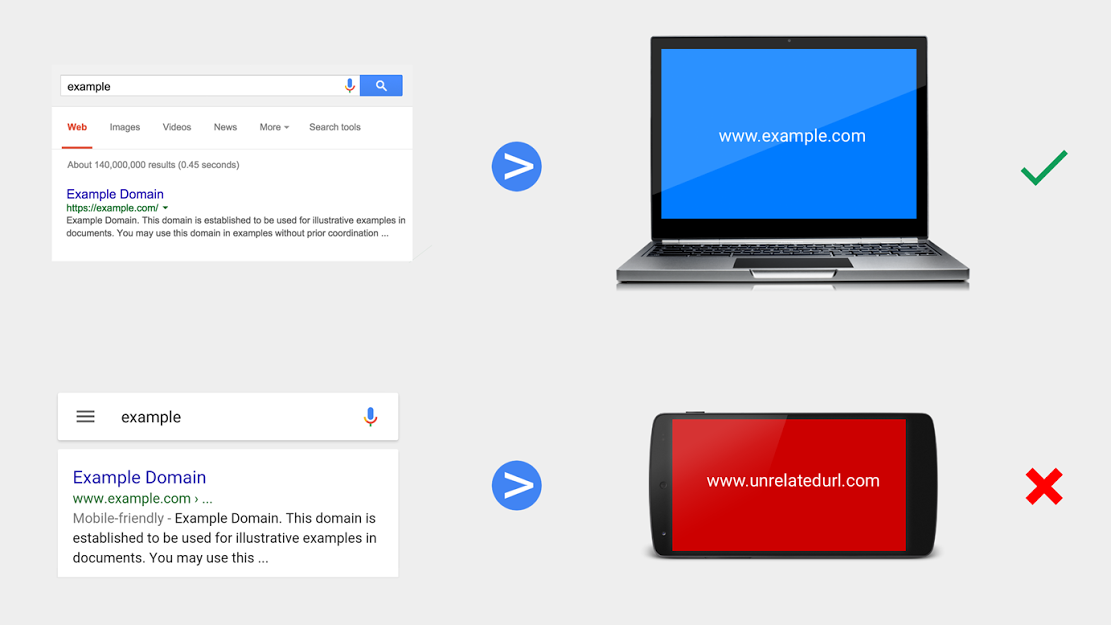
A frustrating experience: The same URL shows up in search results pages on desktop and on mobile. When a user clicks on this result on their desktop computer, the URL opens normally. However, when clicking on the same result on a smartphone, a redirect happens and an unrelated URL loads.
Who implements these mobile-only sneaky redirects?
There are cases where webmasters knowingly decide to put into place redirection rules for their mobile users. This is typically a webmaster guidelines violation, and we do take manual action against it when it harms Google users’ experience (see last section of this article).
But we’ve also observed situations where mobile-only sneaky redirects happen without site owners being aware of it:
- Advertising schemes that redirect mobile users specifically
A script/element installed to display ads and monetize content might be redirecting mobile users to a completely different site without the webmaster being aware of it.
- Mobile redirect as a result of the site being a target of hacking
In other cases, if your website has been hacked, a potential result can be redirects to spammy domains for mobile users only.
How do I detect if my site is doing sneaky mobile redirects?
- Check if you are redirected when you navigate to your site on your smartphone
We recommend you to check the mobile user experience of your site by visiting your pages from Google search results with a smartphone. When debugging, mobile emulation in desktop browsers is handy, mostly because you can test for many different devices. You can, for example, do it straight from your browser in Chrome, Firefox or Safari (for the latter, make sure you have enabled the “Show Develop menu in menu bar” feature).
- Listen to your users
Your users could see your site in a different way than you do. It’s always important to pay attention to user complaints, so you can hear of any issue related to mobile UX. - Monitor your users in your site’s analytics data
Unusual mobile user activity could be detected by looking at some of the data held in your website’s analytics data. For example, looking at the average time spent on your site by your mobile users could be a good signal to watch: if all of a sudden, your mobile users (and only them) start spending much less time on your site than they used to, there might be an issue related to mobile redirections.To be aware of wide changes in mobile user activity as soon as they happen, you can for example set up Google Analytics alerts. For example, you can set an alert to be warned in case of a sharp drop in average time spent on your site by mobile users, or a drop in mobile users (always take into account that big changes in those metrics are not a clear, direct signal that your site is doing mobile sneaky redirects).


I’ve detected sneaky redirects for my mobile users, and I did not set it up: what do I do?
- Make sure that your site is not hacked.
Check the Security Issues tool in the Search Console, if we have noticed any hack, you should get some information there.
Review our additional resources on typical symptoms of hacked sites, and our case studies on hacked sites. - Audit third-party scripts/elements on your site
If your site is not hacked, then we recommend you take the time to investigate if third-party scripts/elements are causing the redirects. You can follow these steps:
A. Remove one by one the third-party scripts/elements you do not control from the redirecting page(s).
B. Check your site on a mobile device or through emulation between each script/element removal, and see when the redirect stops.
C. If you think a particular script/element is responsible for the sneaky redirect, consider removing it from your site, and debugging the issue with the script/element provider.
Last Thoughts on Sneaky Mobile Redirects
It’s a violation of the Google Webmaster Guidelines to redirect a user to a page with the intent of displaying content other than what was made available to the search engine crawler (more information on sneaky redirects). To ensure quality search results for our users, the Google Search Quality team can take action on such sites, including removal of URLs from our index. When we take manual action, we send a message to the site owner via Search Console. Therefore, make sure you’ve set up a Search Console account.
Be sure to choose advertisers who are transparent on how they handle user traffic, to avoid unknowingly redirecting your own users. If you are interested in trust-building in the online advertising space, you may check out industry-wide best practices when participating in ad networks. For example, the Trustworthy Accountability Group’s (Interactive Advertising Bureau) Inventory Quality Guidelines are a good place to start. There are many ways to monetize your content with mobile solutions that provide a high quality user experience, be sure to use them.
If you have questions or comments about mobile-only redirects, join us in our Google Webmaster Support forum.
Written by Vincent Courson & Badr Salmi El Idrissi, Search Quality team

Bullish on SEO : RankBrain vs. SEOBrain
The battle between RankBrain and SEOBrain is heating up, as Google develops Artificial Intelligence to battle human innovation.
Ad Network Ménage à Trois: Bing, Yahoo!, Google
Yahoo! Tests Google Again
Back in July we noticed Yahoo! was testing Google-powered search results. From that post…
When Yahoo! recently renewed their search deal with Microsoft, Yahoo! was once again allowed to sell their own desktop search ads & they are only required to give 51% of the search volume to Bing. There has been significant speculation as to what Yahoo! would do with the carve out. Would they build their own search technology? Would they outsource to Google to increase search ad revenues? It appears they are doing a bit of everything – some Bing ads, some Yahoo! ads, some Google ads.
The Growth of Gemini
Since then Gemini has grown significantly:
Yahoo has moved quickly to bring search ad traffic under Gemini for advertisers that have adopted the platform. For some perspective, in September 2015, Yahoo.com produced a little over 50 percent of the clicks that took place across the Bing Ads and Gemini platforms. For advertisers adopting Gemini, Gemini produced 22 percent of combined Bing and Gemini clicks. Given the device breakdown of Yahoo’s traffic, this amounts to about two-thirds of the traffic it is able to control under the renegotiated agreement.
That growth has come at the expense of Bing ad clicks, which have fallen significantly: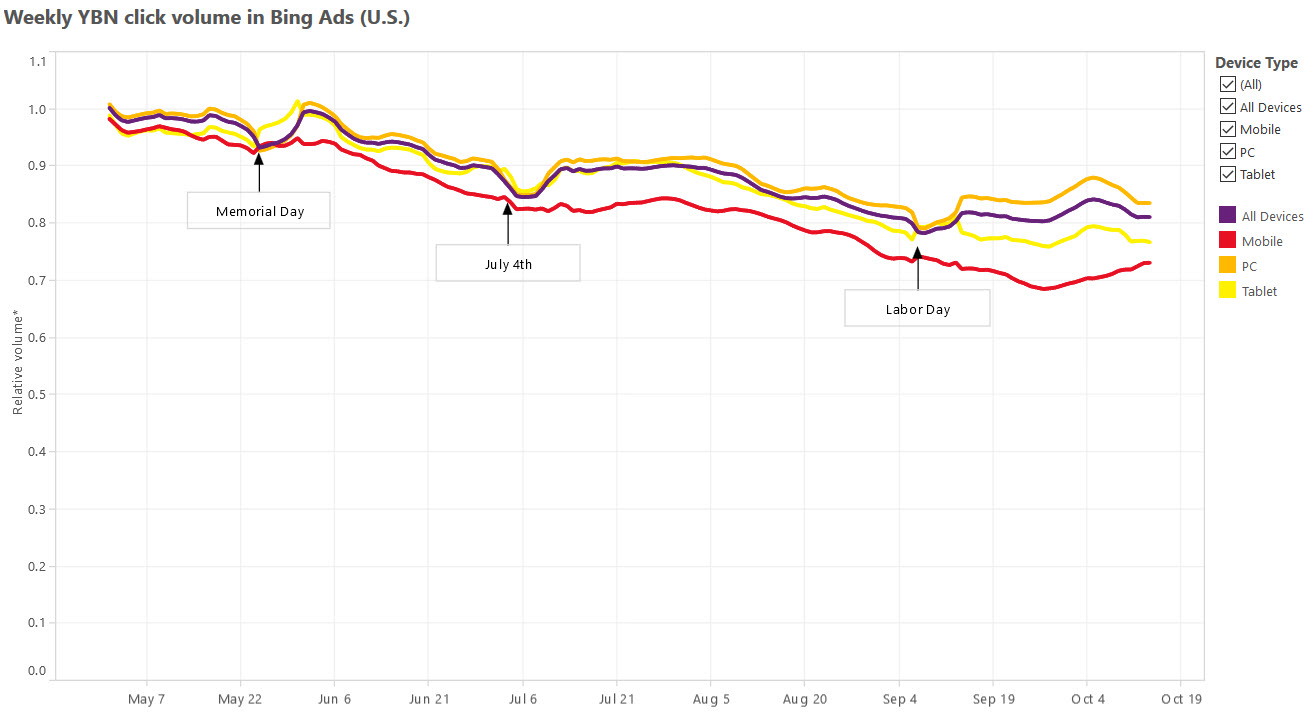
Shared Scale to Compete
Years ago Microsoft was partnered into the Yahoo!/Overture ad network to compete against Google. The idea was the companies together would have better scale to compete against Google in search & ads. Greater scale would lead to a more efficient marketplace, which would lead to better ad matching, higher advertiser bids, etc. This didn’t worked as well as anticipated. Originally under-monetization was blamed on poor ad matching. Yahoo! Panama was a major rewrite of their ad system which was supposed to fix the problem, but it didn’t.
Even if issues like bid jamming were fixed & ad matching was more relevant, it still didn’t fix issues with lower ad depth in emerging markets & arbitrage lowering the value of expensive keywords in the United States.
Understanding the Value of Search Clicks
When a person types a keyword into a search box they are expressing significant intent. When a person clicks a link to land on a page they may still have significant interest, but generally there is at least some level of fall off. If I search for a keyword the value of my click is $x, but if I click a link on a “top searches” box, the value of that click may perhaps only be 5% or 10% what the value of a hand typed search. There is less intent.
Here is a picture of the sort of “trending now” box which appears on the Yahoo! homepage.
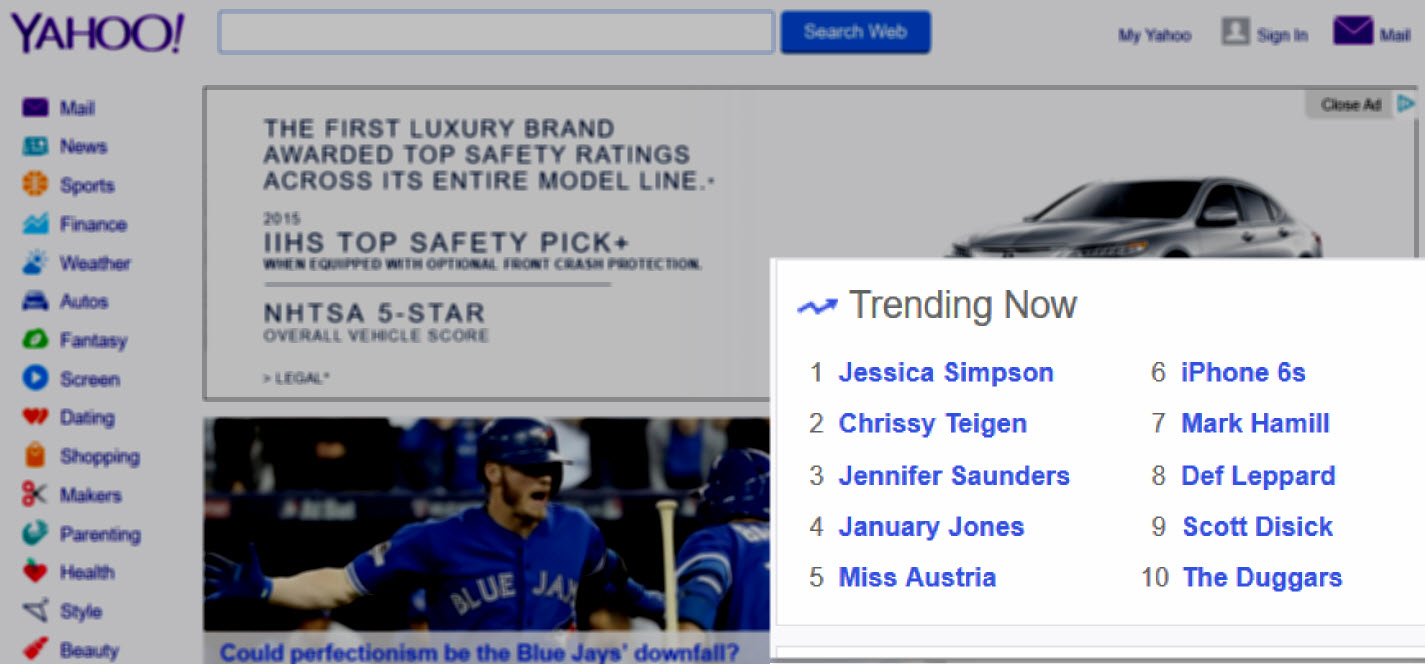
Typically those sorts of searches include a bunch of female celebrities, but then in any such box there will be one or two money terms added, like [lower blood pressure] or [iPhone 6s]. People who search for those terms might have $5 or $10 of intent, but people who click those links might only have a quarter or 50 cents of intent.
That difference in value can utterly screw an advertiser who gets their high-value keyword featured while they are sleeping or not actively monitoring & managing their ad campaign.
For what it is worth, even Google has tested some of these sort of these “search” traffic generation approaches during the last recession. On the Google AdSense network Google was buying banner ads telling people to search for [credit cards] & if they clicked on those banner ads they ended up on a search result page for [credit cards].

To this day many companies run contextual ads that drive search volume, but the difference between today & the Yahoo! which failed to monetize search is there is (at least currently) a greater focus on traffic quality.
Under-performance Due to Shady Traffic Partners
Yahoo! continued to under-perform in large part because Yahoo! had a lot of “search” partners with many lower quality traffic sources mixed in their traffic stream & they didn’t even allow advertisers to opt out of the partner network until after Yahoo! decided to exit the search market. As bad as the above sounds, it is actually worse, as some larger partners had access to advertiser information in a way that allowed them to aggressively arbitrage away the value of high advertiser bids wherever and whenever an advertiser overbid.
So you would bid thinking you were buying primarily search traffic based on the user intent of a person searching for something, but you might have been getting various layers of arbitrage of lower quality traffic, traffic from domain lander pages, or even some mix of robotic traffic from clickbots. Those $30 search ad clicks are a sure money loser if it is a clickbot software program doing the click.
And not only were some of Yahoo!’s partners driving down the value of clicks on Yahoo! itself, but Yahoo! was paying some of the larger partners in the high 80s to low 90s percent of revenue. Here is a (made up) example chart for illustration purposes, where the (made up) partner is getting a 90% TAC
| Advertiser Bid | Y! Search Clicks | Partner Clicks | Total Clicks | Total Revs | TAC | Rev after TAC | |
| No Partners | $30 | 3,000 | 0 | 3,000 | $90,000 | $0 | $90,000 |
| Bit of Arb | $25 | 3,000 | 1,000 | 4,000 | $100,000 | $22,500 | $77,500 |
| Heavy Arb | $10 | 3,000 | 6,000 | 9,000 | $90,000 | $54,000 | $36,000 |
Why did Yahoo! allow the above sort of behavior to go on? It is hard to believe they were completely unaware of what was going on, particularly when it was so obvious to outside observers. More likely it was that they were rapidly losing search share & wanted the topline revenue growth to make their quarterly number. By the time they realized what damage they had already done to their ecosystem, they were already too far down the path to correct it & were afraid to do anything which significantly hit revenues.
The rapid rise and fall of a large Yahoo! search partner named Geosign was detailed by the Canadian Financial Post, in an article which is now offline, but available via the Internet Archive Wayback Machine:
Companies fail all the time. Sometimes with little warning. But companies that are highly profitable and only weeks removed from a record-setting venture capital investment? Not so much. Yet in Geosign’s case, the cuts that began last May continued through the summer. Late last year, fewer than 100 employees remained. Today, Geosign itself no longer exists, its still-functioning website an empty reminder of its former promise. And while the national business media has, until now, overlooked the story – surprising, given the size of the investment and the fact that Google played a direct role in the outcome – within Canada’s technology and venture-capital communities, the $160-million investment is known as the deal “that didn’t go well.” When the collapse happened, even jaded industry watchers accustomed to financial debacles in the tech sector were stunned. “I’ve seen a lot of meltdowns,” says Duncan Stewart, a technology and investment analyst in Toronto. “But something happening like this, over just a few weeks, that’s unprecedented in my experience.”
Other traffic sources like domain parking have also sharply declined, due to a variety of factors like: web browsers replacing address bars with multi-purpose search boxes, shift of consumer internet traffic to mobile devices (which increases reliance on search over direct navigation & apps replace some segment of direct navigation), increased smart pricing, lower revenue sharing percentages, and Yahoo! no longer being able to offer a competitive bid against Google.
When Yahoo! shifted their search ads to Microsoft, Microsoft allowed advertisers to opt out of the partner network. Microsoft also clamped down on some of the lower quality traffic sources with smart pricing, which hit some of the arbitrage businesses hard & even forced Yahoo! to seek refunds from some of their partners for delivering low quality traffic.
Shared Scale to Compete
Microsoft launched their own algorithmic search results on Live Search & their own Microsoft adCenter search ads. Microsoft continued to lose share in search at least until they gave their search engine a memorable name in Bing. The Yahoo! Bing ad network seemed to be gaining momentum when Yahoo! signed a deal with Mozilla to become the default search provider for Firefox, but it appears Yahoo! overpaid for the deal as Yahoo! search revenues ex-TAC were off $60 million YoY in the most recent quarter.
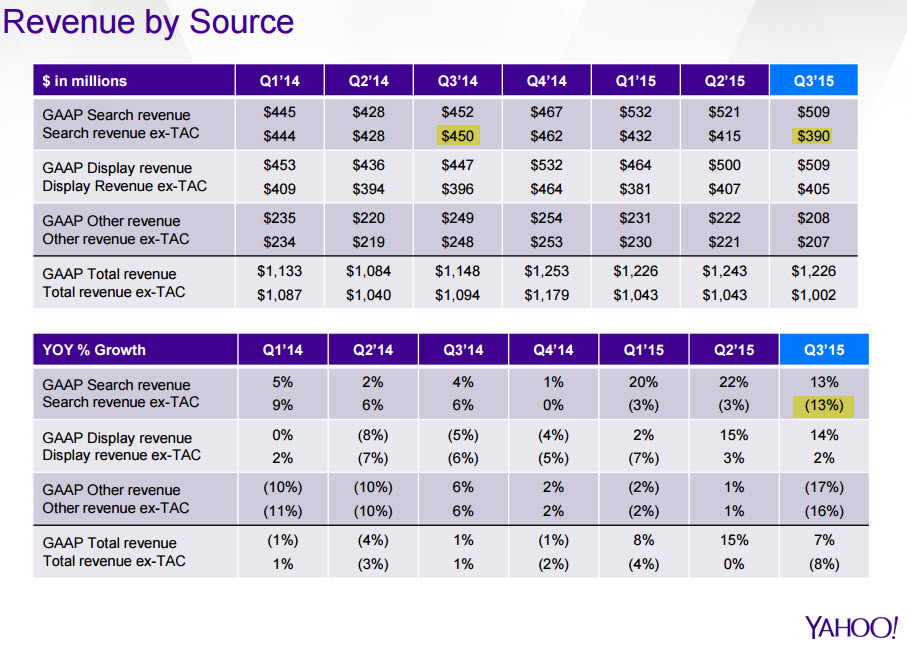
In spite of using an ad-heavy search interface Yahoo! has not grown search ad revenues as quickly as the search market has grown. Yahoo! has continually lost marketshare for years (up until the Mozilla Firefox deal). And even as Microsoft has followed Google in broadened their ad matching, a lot of the other “search” traffic partners Yahoo! once relied on to make their numbers are no longer in the marketplace to augment their data.
The Bing / Yahoo! network search traffic is now much cleaner than the Yahoo! “search” traffic quality of many years ago, but Yahoo! hasn’t replaced some of the old search partners which have died off.
Shared Scale No Longer Important?
Yahoo! increasing the share of their ad clicks which are powered by Gemini lowers the network efficiency of the Yahoo!/Bing ad network. All the talk of “synergy” driving value sort of goes up in smoke when Yahoo! shifts a significant share of their ad clicks away from the original network.
Yahoo! announced a new search deal with Google. Here’s the Tweet version…
$YHOO has signed a 3 year partnership with Google to bolster our search capabilities. This is in addition to our relationship with Microsoft— Yahoo Inc. (@YahooInc) October 20, 2015
…the underlying ethos…
“If you love something, set it free; if it comes backs it’s yours, if it doesn’t, it never was.”
…and the long version…
On October 19, 2015, Yahoo! Inc., a Delaware corporation (“Yahoo”), and Google Inc., a Delaware corporation (“Google”), entered into a Google Services Agreement (the “Services Agreement”). The Services Agreement is effective as of October 1, 2015 and expires on December 31, 2018. Pursuant to the Services Agreement, Google will provide Yahoo with search advertisements through Google’s AdSense for Search service (“AFS”), web algorithmic search services through Google’s Websearch Service, and image search services. The results provided by Google for these services will be available to Yahoo for display on both desktop and mobile platforms. Yahoo may use Google’s services on Yahoo’s owned and operated properties (“Yahoo Properties”) and on certain syndication partner properties (“Affiliate Sites”) in the United States (U.S.), Canada, Hong Kong, Taiwan, Singapore, Thailand, Vietnam, Philippines, Indonesia, Malaysia, India, Middle East, Africa, Mexico, Argentina, Brazil, Colombia, Chile, Venezuela, Peru, Australia and New Zealand.
Under the Services Agreement, Yahoo has discretion to select which search queries to send to Google and is not obligated to send any minimum number of search queries. The Services Agreement is non-exclusive and expressly permits Yahoo to use any other search advertising services, including its own service, the services of Microsoft Corporation or other third parties.
Google will pay Yahoo a percentage of the gross revenues from AFS ads displayed on Yahoo Properties or Affiliate Sites. The percentage will vary depending on whether the ads are displayed on U.S. desktop sites, non-U.S. desktop sites or on the tablet or mobile phone versions of the Yahoo Properties or its Affiliate Sites. Yahoo will pay Google fees for requests for image search results or web algorithmic search results.
Either party may terminate the Services Agreement (1) upon a material breach subject to certain limitations; (2) in the event of a change in control (as defined in the Services Agreement); (3) after first discussing with the other party in good faith its concerns and potential alternatives to termination (a) in its entirety or in the U.S. only, if it reasonably anticipates litigation or a regulatory proceeding brought by any U.S. federal or state agency to enjoin the parties from consummating, implementing or otherwise performing the Services Agreement, (b) in part, in a country other than the U.S., if either party reasonably anticipates litigation or a regulatory proceeding or reasonably anticipates that the continued performance under the Services Agreement in such country would have a material adverse impact on any ongoing antitrust proceeding in such country, (c) in its entirety if either party reasonably anticipates a filing by the European Commission to enjoin it from performing the Services Agreement or that continued performance of the Services Agreement would have a material adverse impact on any ongoing antitrust proceeding involving either party in Europe or India, or (d) in its entirety, on 60 days notice if the other party’s exercise of these termination rights in this clause (3) has collectively and materially diminished the economic value of the Services Agreement. Each party agrees to defend or settle any lawsuits or similar actions related to the Services Agreement unless doing so is not commercially reasonable (taking all factors into account, including without limitation effects on a party’s brand or business outside of the scope of the Services Agreement).
In addition, Google may suspend Yahoo’s use of services upon certain events and may terminate the Services Agreement if such events are not cured. Yahoo may terminate the Services Agreement if Google breaches certain service level and server latency specified in the Services Agreement.
In connection with the Services Agreement, Yahoo and Google have agreed to certain procedures with the Antitrust Division of the United States Department of Justice (the “DOJ”) to facilitate review of the Services Agreement by the DOJ, including delaying the implementation of the Services Agreement in the U.S. in order to provide the DOJ with a reasonable period of review.
Where Are We Headed?
Danny Sullivan mentioned the 51% of search share Yahoo! is required to deliver to Bing applies only to desktop traffic & Yahoo! has no such limit on mobile searches. In theory this could mean Yahoo! could quickly become a Google shop, with Microsoft as a backfill partner.
When asked about the future of Gemini on today’s investor conference call Marissa Mayer stated she expected Gemini to continue scaling more on mobile. She also stated she felt the Google deal would help Yahoo! refine their ad mix & give them additional opportunities in international markets. Yahoo! is increasingly reliant on the US & is unable to bid to win marketshare in foreign markets.
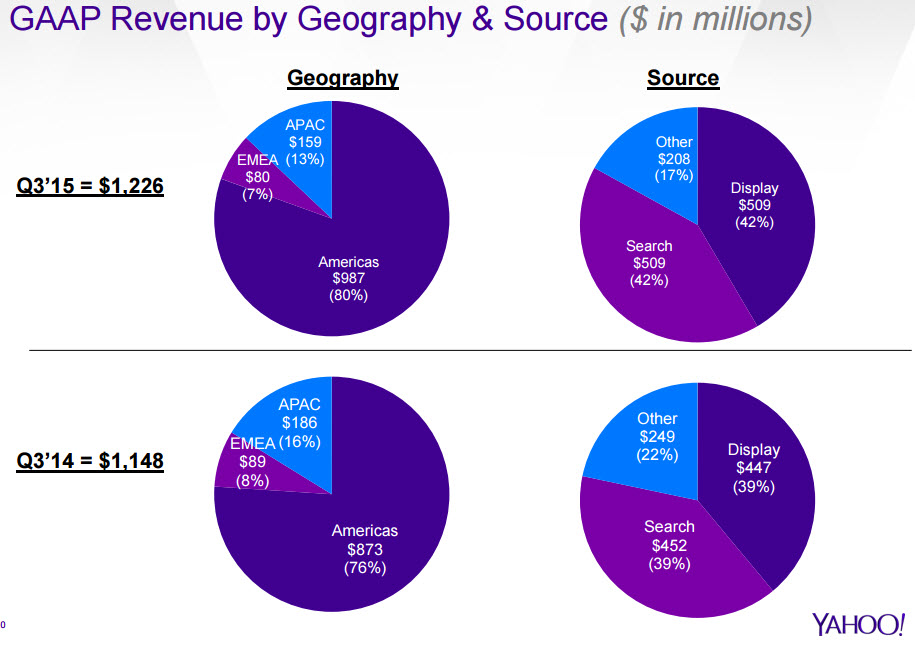
(Myopic) Learning Systems
Marissa Mayer sounded both insightful and myopic on today’s conference call. She mentioned how as they scale up Gemini the cost of that is reflected in foregone revenues from optimizing their learning systems and improving their ad relevancy. On its face, that sort of comment sounds totally reasonable.
An unsophisticated or utterly ignorant market participant might even cheer it on, without realizing the additional complexity, management cost & risk they are promoting.
Where the myopic quick win view falls flat is on the other side of the market.
Sure a large web platform can use big data to optimize their performance and squeeze out additional pennies of yield, but for an advertiser these blended networks can be a real struggle. How do they budget for any given network when a single company is arbitrarily mixing between 3 parallel networks? A small shift in Google AdWords ad spend might not be hard to manage, but what happens if an advertiser suddenly gets a bunch of [trending topic] search ad clicks? Or maybe they get a huge slug of mobile clicks which don’t work very well for their business. Do they disable the associated keyword in Yahoo! Gemini? Or Bing Ads? Or Google AdWords? All 3?’
Do they find that when they pause their ads in one network that quickly leads to the second (or third) network quickly carrying their ads across?
Even if you can track and manage it on a granular basis, the additional management time is non-trivial. One of the fundamental keys to a solid online advertising strategy is to have granular control so you can quickly alter distribution. But if you turn your ads off in one network only to find that leads your ads from the second network to get carried across that creates a bit of chaos. The more networks there are in parallel that bleed together the blurrier things get.
This sort of “overlap = bad” mindset is precisely why search engines suggest creating tight ad campaigns and ad groups. But you lose that control when things arbitrarily shift about.
To appreciate how expensive those sorts of costs can be, consider what has happened with programmatic ads:
Platforms that facilitate automated sales for media companies typically take 10% to 20% of the revenue that passes through their hands, according to the IAB report. Networks that service programmatic buys typically mark up inventory, citing the value that they add, by 30% to 50%. And then there are the essential data-management platforms, which take 10% to 15% of a buy, industry executives said.
If you are managing a client budget for paid search, how do you determine a pre-approved budget for each network when the traffic mix & quality might rapidly oscillate across the networks?
Don’t take my word for it though, read the Yahoo! Ads Twitter account
“Consumers and advertisers are overwhelmed by choice. Our industry needs solutions that eliminate fragmentation” @andrew_snyder #videonomics— YahooAds (@YahooAds) October 21, 2015
When Yahoo! tries to manage their yield they will not only be choosing among 3 parallel networks on their end, but they will also have individual advertisers making a wide variety of changes on the other end. And some of those advertisers will not only be influenced by the ad networks, but also the organic rankings which come with the ads.
If one search engine is ranking you well in the organic search results for an important keyword and another is not, then you should bid more aggressively on your ads on the search engine which is ranking your site, because by voting with your budget you may well be voting on which underlying relevancy algorithm is chosen to deliver the associated organic search results accompanying the ads.
That last point was important & I haven’t seen it mentioned anywhere yet, so it is worth repeating: your PPC ad bids may determine which search relevancy algorithm drives Yahoo! Search organic results.
Time to Quit Digging & Drop The Shovel
The other (BIG) issue is that as they give Google more search marketshare they give Google more granular data, which in turn means they
- make buying on their own network less worthy of the management cost & complexity
- make Google more of a “must buy”
- will never close the monetization gap with Google
Even today Google announced a new tool for offering advertisers granular localized search data. Search partners won’t directly benefit from those tools.
The old problem with Yahoo! was they were heavily reliant on search partners who drove down the traffic value. The future problem may well be if the marginally profitable Bing leaves the search market, Google will drive down the amount of revenue they share with Yahoo!.
If the Yahoo! Google search deal gets approved, Bing might shift back to losing money unless Microsoft buys Yahoo! after the Alibaba share spin out.
Ever track how Google’s TAC has shifted over the past decade?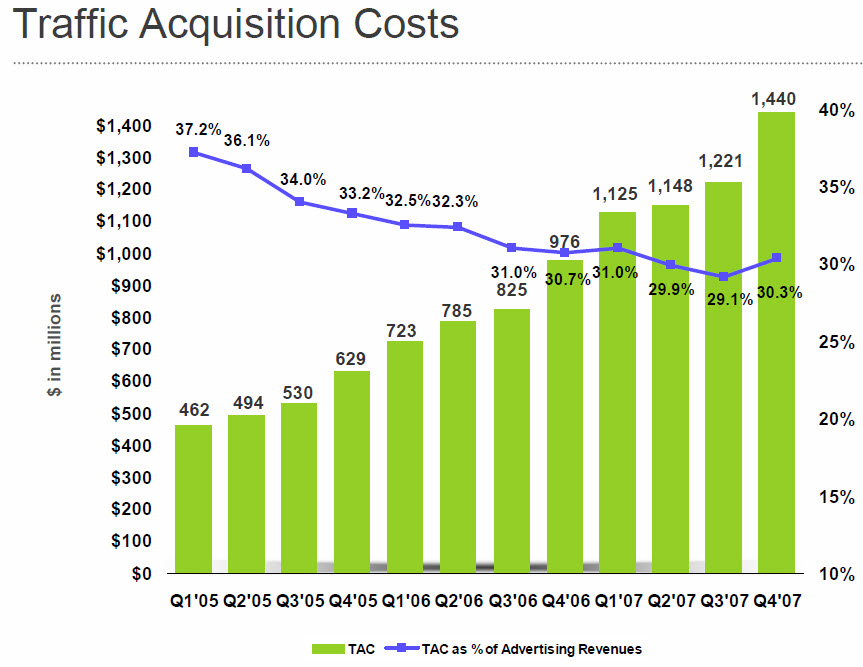
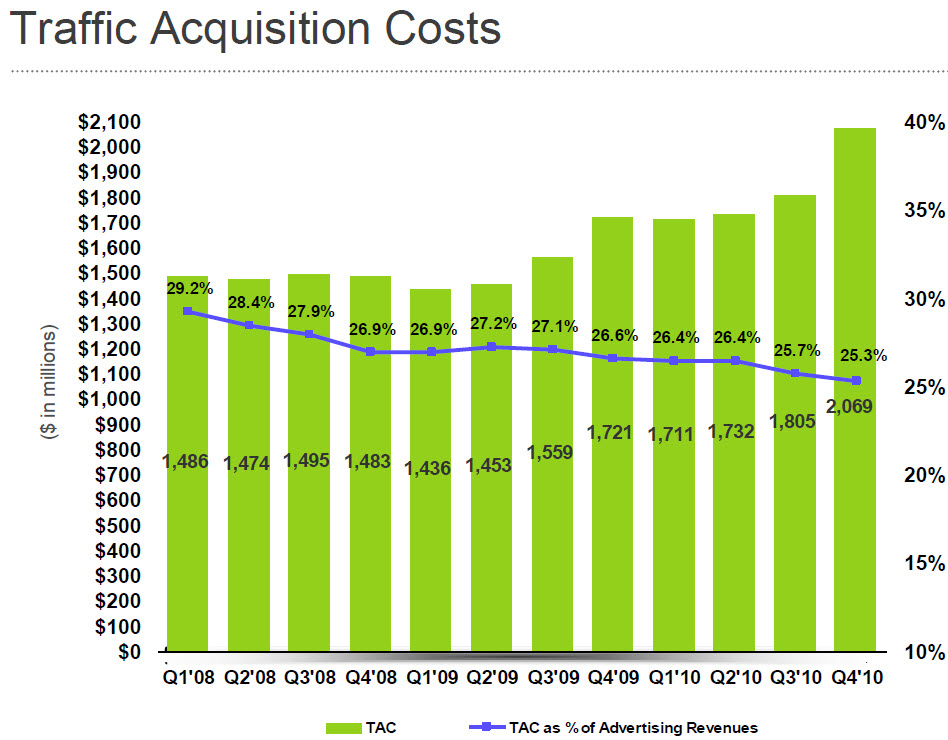
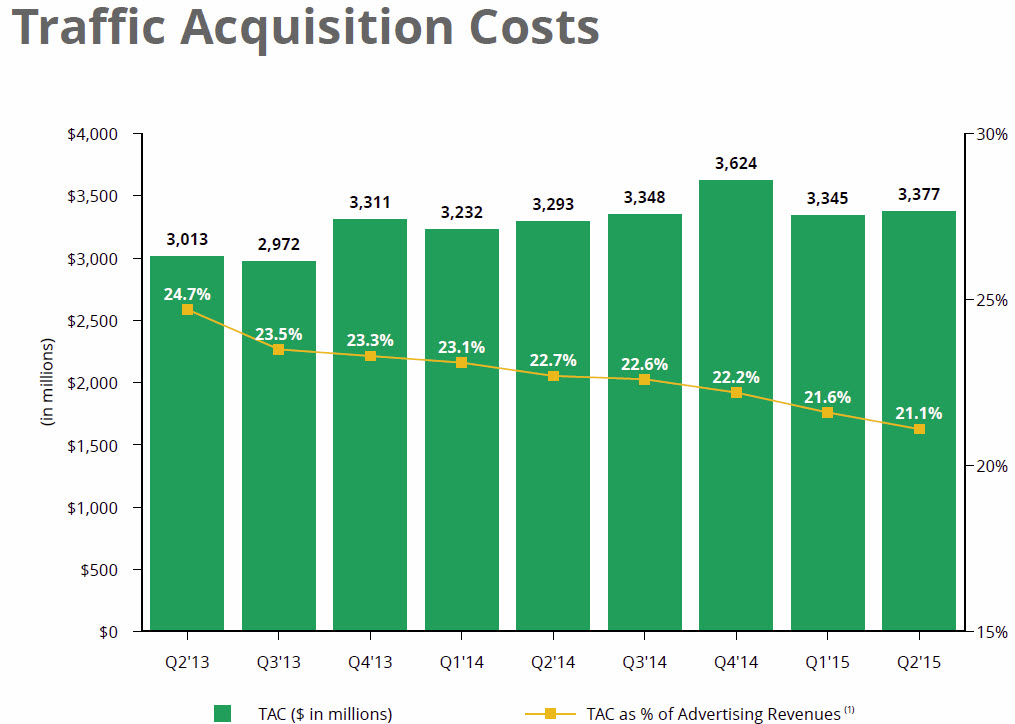
It has only been a decade so far, but MAYBE THIS TIME IS DIFFERENT.
Categories:
Ad Network Ménage à Trois: Bing, Yahoo!, Google
Yahoo! Tests Google Again
Back in July we noticed Yahoo! was testing Google-powered search results. From that post…
When Yahoo! recently renewed their search deal with Microsoft, Yahoo! was once again allowed to sell their own desktop search ads & they are only required to give 51% of the search volume to Bing. There has been significant speculation as to what Yahoo! would do with the carve out. Would they build their own search technology? Would they outsource to Google to increase search ad revenues? It appears they are doing a bit of everything – some Bing ads, some Yahoo! ads, some Google ads.
The Growth of Gemini
Since then Gemini has grown significantly:
Yahoo has moved quickly to bring search ad traffic under Gemini for advertisers that have adopted the platform. For some perspective, in September 2015, Yahoo.com produced a little over 50 percent of the clicks that took place across the Bing Ads and Gemini platforms. For advertisers adopting Gemini, Gemini produced 22 percent of combined Bing and Gemini clicks. Given the device breakdown of Yahoo’s traffic, this amounts to about two-thirds of the traffic it is able to control under the renegotiated agreement.
That growth has come at the expense of Bing ad clicks, which have fallen significantly:
Shared Scale to Compete
Years ago Microsoft was partnered into the Yahoo!/Overture ad network to compete against Google. The idea was the companies together would have better scale to compete against Google in search & ads. Greater scale would lead to a more efficient marketplace, which would lead to better ad matching, higher advertiser bids, etc. This didn’t worked as well as anticipated. Originally under-monetization was blamed on poor ad matching. Yahoo! Panama was a major rewrite of their ad system which was supposed to fix the problem, but it didn’t.
Even if issues like bid jamming were fixed & ad matching was more relevant, it still didn’t fix issues with lower ad depth in emerging markets & arbitrage lowering the value of expensive keywords in the United States.
Understanding the Value of Search Clicks
When a person types a keyword into a search box they are expressing significant intent. When a person clicks a link to land on a page they may still have significant interest, but generally there is at least some level of fall off. If I search for a keyword the value of my click is $x, but if I click a link on a “top searches” box, the value of that click may perhaps only be 5% or 10% what the value of a hand typed search. There is less intent.
Here is a picture of the sort of “trending now” box which appears on the Yahoo! homepage.
Typically those sorts of searches include a bunch of female celebrities, but then in any such box there will be one or two money terms added, like [lower blood pressure] or [iPhone 6s]. People who search for those terms might have $5 or $10 of intent, but people who click those links might only have a quarter or 50 cents of intent.
That difference in value can utterly screw an advertiser who gets their high-value keyword featured while they are sleeping or not actively monitoring & managing their ad campaign.
For what it is worth, even Google has tested some of these sort of these “search” traffic generation approaches during the last recession. On the Google AdSense network Google was buying banner ads telling people to search for [credit cards] & if they clicked on those banner ads they ended up on a search result page for [credit cards].
To this day many companies run contextual ads that drive search volume, but the difference between today & the Yahoo! which failed to monetize search is there is (at least currently) a greater focus on traffic quality.
Under-performance Due to Shady Traffic Partners
Yahoo! continued to under-perform in large part because Yahoo! had a lot of “search” partners with many lower quality traffic sources mixed in their traffic stream & they didn’t even allow advertisers to opt out of the partner network until after Yahoo! decided to exit the search market. As bad as the above sounds, it is actually worse, as some larger partners had access to advertiser information in a way that allowed them to aggressively arbitrage away the value of high advertiser bids wherever and whenever an advertiser overbid.
So you would bid thinking you were buying primarily search traffic based on the user intent of a person searching for something, but you might have been getting various layers of arbitrage of lower quality traffic, traffic from domain lander pages, or even some mix of robotic traffic from clickbots. Those $30 search ad clicks are a sure money loser if it is a clickbot software program doing the click.
And not only were some of Yahoo!’s partners driving down the value of clicks on Yahoo! itself, but Yahoo! was paying some of the larger partners in the high 80s to low 90s percent of revenue. Here is a (made up) example chart for illustration purposes, where the (made up) partner is getting a 90% TAC
| Advertiser Bid | Y! Search Clicks | Partner Clicks | Total Clicks | Total Revs | TAC | Rev after TAC | |
| No Partners | $30 | 3,000 | 0 | 3,000 | $90,000 | $0 | $90,000 |
| Bit of Arb | $25 | 3,000 | 1,000 | 4,000 | $100,000 | $22,500 | $77,500 |
| Heavy Arb | $10 | 3,000 | 6,000 | 9,000 | $90,000 | $54,000 | $36,000 |
Why did Yahoo! allow the above sort of behavior to go on? It is hard to believe they were completely unaware of what was going on, particularly when it was so obvious to outside observers. More likely it was that they were rapidly losing search share & wanted the topline revenue growth to make their quarterly number. By the time they realized what damage they had already done to their ecosystem, they were already too far down the path to correct it & were afraid to do anything which significantly hit revenues.
The rapid rise and fall of a large Yahoo! search partner named Geosign was detailed by the Canadian Financial Post, in an article which is now offline, but available via the Internet Archive Wayback Machine:
Companies fail all the time. Sometimes with little warning. But companies that are highly profitable and only weeks removed from a record-setting venture capital investment? Not so much. Yet in Geosign’s case, the cuts that began last May continued through the summer. Late last year, fewer than 100 employees remained. Today, Geosign itself no longer exists, its still-functioning website an empty reminder of its former promise. And while the national business media has, until now, overlooked the story – surprising, given the size of the investment and the fact that Google played a direct role in the outcome – within Canada’s technology and venture-capital communities, the $160-million investment is known as the deal “that didn’t go well.” When the collapse happened, even jaded industry watchers accustomed to financial debacles in the tech sector were stunned. “I’ve seen a lot of meltdowns,” says Duncan Stewart, a technology and investment analyst in Toronto. “But something happening like this, over just a few weeks, that’s unprecedented in my experience.”
Other traffic sources like domain parking have also sharply declined, due to a variety of factors like: web browsers replacing address bars with multi-purpose search boxes, shift of consumer internet traffic to mobile devices (which increases reliance on search over direct navigation & apps replace some segment of direct navigation), increased smart pricing, lower revenue sharing percentages, and Yahoo! no longer being able to offer a competitive bid against Google.
When Yahoo! shifted their search ads to Microsoft, Microsoft allowed advertisers to opt out of the partner network. Microsoft also clamped down on some of the lower quality traffic sources with smart pricing, which hit some of the arbitrage businesses hard & even forced Yahoo! to seek refunds from some of their partners for delivering low quality traffic.
Shared Scale to Compete
Microsoft launched their own algorithmic search results on Live Search & their own Microsoft adCenter search ads. Microsoft continued to lose share in search at least until they gave their search engine a memorable name in Bing. The Yahoo! Bing ad network seemed to be gaining momentum when Yahoo! signed a deal with Mozilla to become the default search provider for Firefox, but it appears Yahoo! overpaid for the deal as Yahoo! search revenues ex-TAC were off $60 million YoY in the most recent quarter.
In spite of using an ad-heavy search interface Yahoo! has not grown search ad revenues as quickly as the search market has grown. Yahoo! has continually lost marketshare for years (up until the Mozilla Firefox deal). And even as Microsoft has followed Google in broadened their ad matching, a lot of the other “search” traffic partners Yahoo! once relied on to make their numbers are no longer in the marketplace to augment their data.
The Bing / Yahoo! network search traffic is now much cleaner than the Yahoo! “search” traffic quality of many years ago, but Yahoo! hasn’t replaced some of the old search partners which have died off.
Shared Scale No Longer Important?
Yahoo! increasing the share of their ad clicks which are powered by Gemini lowers the network efficiency of the Yahoo!/Bing ad network. All the talk of “synergy” driving value sort of goes up in smoke when Yahoo! shifts a significant share of their ad clicks away from the original network.
Yahoo! announced a new search deal with Google. Here’s the Tweet version…
$YHOO has signed a 3 year partnership with Google to bolster our search capabilities. This is in addition to our relationship with Microsoft— Yahoo Inc. (@YahooInc) October 20, 2015
…the underlying ethos…
“If you love something, set it free; if it comes backs it’s yours, if it doesn’t, it never was.”
…and the long version…
On October 19, 2015, Yahoo! Inc., a Delaware corporation (“Yahoo”), and Google Inc., a Delaware corporation (“Google”), entered into a Google Services Agreement (the “Services Agreement”). The Services Agreement is effective as of October 1, 2015 and expires on December 31, 2018. Pursuant to the Services Agreement, Google will provide Yahoo with search advertisements through Google’s AdSense for Search service (“AFS”), web algorithmic search services through Google’s Websearch Service, and image search services. The results provided by Google for these services will be available to Yahoo for display on both desktop and mobile platforms. Yahoo may use Google’s services on Yahoo’s owned and operated properties (“Yahoo Properties”) and on certain syndication partner properties (“Affiliate Sites”) in the United States (U.S.), Canada, Hong Kong, Taiwan, Singapore, Thailand, Vietnam, Philippines, Indonesia, Malaysia, India, Middle East, Africa, Mexico, Argentina, Brazil, Colombia, Chile, Venezuela, Peru, Australia and New Zealand.
Under the Services Agreement, Yahoo has discretion to select which search queries to send to Google and is not obligated to send any minimum number of search queries. The Services Agreement is non-exclusive and expressly permits Yahoo to use any other search advertising services, including its own service, the services of Microsoft Corporation or other third parties.
Google will pay Yahoo a percentage of the gross revenues from AFS ads displayed on Yahoo Properties or Affiliate Sites. The percentage will vary depending on whether the ads are displayed on U.S. desktop sites, non-U.S. desktop sites or on the tablet or mobile phone versions of the Yahoo Properties or its Affiliate Sites. Yahoo will pay Google fees for requests for image search results or web algorithmic search results.
Either party may terminate the Services Agreement (1) upon a material breach subject to certain limitations; (2) in the event of a change in control (as defined in the Services Agreement); (3) after first discussing with the other party in good faith its concerns and potential alternatives to termination (a) in its entirety or in the U.S. only, if it reasonably anticipates litigation or a regulatory proceeding brought by any U.S. federal or state agency to enjoin the parties from consummating, implementing or otherwise performing the Services Agreement, (b) in part, in a country other than the U.S., if either party reasonably anticipates litigation or a regulatory proceeding or reasonably anticipates that the continued performance under the Services Agreement in such country would have a material adverse impact on any ongoing antitrust proceeding in such country, (c) in its entirety if either party reasonably anticipates a filing by the European Commission to enjoin it from performing the Services Agreement or that continued performance of the Services Agreement would have a material adverse impact on any ongoing antitrust proceeding involving either party in Europe or India, or (d) in its entirety, on 60 days notice if the other party’s exercise of these termination rights in this clause (3) has collectively and materially diminished the economic value of the Services Agreement. Each party agrees to defend or settle any lawsuits or similar actions related to the Services Agreement unless doing so is not commercially reasonable (taking all factors into account, including without limitation effects on a party’s brand or business outside of the scope of the Services Agreement).
In addition, Google may suspend Yahoo’s use of services upon certain events and may terminate the Services Agreement if such events are not cured. Yahoo may terminate the Services Agreement if Google breaches certain service level and server latency specified in the Services Agreement.
In connection with the Services Agreement, Yahoo and Google have agreed to certain procedures with the Antitrust Division of the United States Department of Justice (the “DOJ”) to facilitate review of the Services Agreement by the DOJ, including delaying the implementation of the Services Agreement in the U.S. in order to provide the DOJ with a reasonable period of review.
Where Are We Headed?
Danny Sullivan mentioned the 51% of search share Yahoo! is required to deliver to Bing applies only to desktop traffic & Yahoo! has no such limit on mobile searches. In theory this could mean Yahoo! could quickly become a Google shop, with Microsoft as a backfill partner.
When asked about the future of Gemini on today’s investor conference call Marissa Mayer stated she expected Gemini to continue scaling more on mobile. She also stated she felt the Google deal would help Yahoo! refine their ad mix & give them additional opportunities in international markets. Yahoo! is increasingly reliant on the US & is unable to bid to win marketshare in foreign markets.
(Myopic) Learning Systems
Marissa Mayer sounded both insightful and myopic on today’s conference call. She mentioned how as they scale up Gemini the cost of that is reflected in foregone revenues from optimizing their learning systems and improving their ad relevancy. On its face, that sort of comment sounds totally reasonable.
An unsophisticated or utterly ignorant market participant might even cheer it on, without realizing the additional complexity, management cost & risk they are promoting.
Where the myopic quick win view falls flat is on the other side of the market.
Sure a large web platform can use big data to optimize their performance and squeeze out additional pennies of yield, but for an advertiser these blended networks can be a real struggle. How do they budget for any given network when a single company is arbitrarily mixing between 3 parallel networks? A small shift in Google AdWords ad spend might not be hard to manage, but what happens if an advertiser suddenly gets a bunch of [trending topic] search ad clicks? Or maybe they get a huge slug of mobile clicks which don’t work very well for their business. Do they disable the associated keyword in Yahoo! Gemini? Or Bing Ads? Or Google AdWords? All 3?’
Do they find that when they pause their ads in one network that quickly leads to the second (or third) network quickly carrying their ads across?
Even if you can track and manage it on a granular basis, the additional management time is non-trivial. One of the fundamental keys to a solid online advertising strategy is to have granular control so you can quickly alter distribution. But if you turn your ads off in one network only to find that leads your ads from the second network to get carried across that creates a bit of chaos. The more networks there are in parallel that bleed together the blurrier things get.
This sort of “overlap = bad” mindset is precisely why search engines suggest creating tight ad campaigns and ad groups. But you lose that control when things arbitrarily shift about.
To appreciate how expensive those sorts of costs can be, consider what has happened with programmatic ads:
Platforms that facilitate automated sales for media companies typically take 10% to 20% of the revenue that passes through their hands, according to the IAB report. Networks that service programmatic buys typically mark up inventory, citing the value that they add, by 30% to 50%. And then there are the essential data-management platforms, which take 10% to 15% of a buy, industry executives said.
If you are managing a client budget for paid search, how do you determine a pre-approved budget for each network when the traffic mix & quality might rapidly oscillate across the networks?
Don’t take my word for it though, read the Yahoo! Ads Twitter account
“Consumers and advertisers are overwhelmed by choice. Our industry needs solutions that eliminate fragmentation” @andrew_snyder #videonomics— YahooAds (@YahooAds) October 21, 2015
When Yahoo! tries to manage their yield they will not only be choosing among 3 parallel networks on their end, but they will also have individual advertisers making a wide variety of changes on the other end. And some of those advertisers will not only be influenced by the ad networks, but also the organic rankings which come with the ads.
If one search engine is ranking you well in the organic search results for an important keyword and another is not, then you should bid more aggressively on your ads on the search engine which is ranking your site, because by voting with your budget you may well be voting on which underlying relevancy algorithm is chosen to deliver the associated organic search results accompanying the ads.
That last point was important & I haven’t seen it mentioned anywhere yet, so it is worth repeating: your PPC ad bids may determine which search relevancy algorithm drives Yahoo! Search organic results.
Time to Quit Digging & Drop The Shovel
The other (BIG) issue is that as they give Google more search marketshare they give Google more granular data, which in turn means they
- make buying on their own network less worthy of the management cost & complexity
- make Google more of a “must buy”
- will never close the monetization gap with Google
Even today Google announced a new tool for offering advertisers granular localized search data. Search partners won’t directly benefit from those tools.
The old problem with Yahoo! was they were heavily reliant on search partners who drove down the traffic value. The future problem may well be if the marginally profitable Bing leaves the search market, Google will drive down the amount of revenue they share with Yahoo!.
If the Yahoo! Google search deal gets approved, Bing might shift back to losing money unless Microsoft buys Yahoo! after the Alibaba share spin out.
Ever track how Google’s TAC has shifted over the past decade?
It has only been a decade so far, but MAYBE THIS TIME IS DIFFERENT.
Categories:
Deprecating our AJAX crawling scheme
tl;dr: We are no longer recommending the AJAX crawling proposal we made back in 2009.
In 2009, we made a proposal to make AJAX pages crawlable. Back then, our systems were not able to render and understand pages that use JavaScript to present content to users. Because “crawlers … [were] not able to see any content … created dynamically,” we proposed a set of practices that webmasters can follow in order to ensure that their AJAX-based applications are indexed by search engines.
Times have changed. Today, as long as you’re not blocking Googlebot from crawling your JavaScript or CSS files, we are generally able to render and understand your web pages like modern browsers. To reflect this improvement, we recently updated our technical Webmaster Guidelines to recommend against disallowing Googlebot from crawling your site’s CSS or JS files.
Since the assumptions for our 2009 proposal are no longer valid, we recommend following the principles of progressive enhancement. For example, you can use the History API pushState() to ensure accessibility for a wider range of browsers (and our systems).
Questions and answers
Q: My site currently follows your recommendation and supports _escaped_fragment_. Would my site stop getting indexed now that you’ve deprecated your recommendation?
A: No, the site would still be indexed. In general, however, we recommend you implement industry best practices when you’re making the next update for your site. Instead of the _escaped_fragment_ URLs, we’ll generally crawl, render, and index the #! URLs.
Q: Is moving away from the AJAX crawling proposal to industry best practices considered a site move? Do I need to implement redirects?
A: If your current setup is working fine, you should not have to immediately change anything. If you’re building a new site or restructuring an already existing site, simply avoid introducing _escaped_fragment_ urls. .
Q: I use a JavaScript framework and my webserver serves a pre-rendered page. Is that still ok?
A: In general, websites shouldn’t pre-render pages only for Google — we expect that you might pre-render pages for performance benefits for users and that you would follow progressive enhancement guidelines. If you pre-render pages, make sure that the content served to Googlebot matches the user’s experience, both how it looks and how it interacts. Serving Googlebot different content than a normal user would see is considered cloaking, and would be against our Webmaster Guidelines.
If you have any questions, feel free to post them here, or in the webmaster help forum.
Posted by Kazushi Nagayama, Search Quality Analyst

An update on how we tackle hacked spam
Recently we have started rolling out a series of algorithmic changes that aim to tackle hacked spam in our search results. A huge amount of legitimate sites are hacked by spammers and used to engage in abusive behavior, such as malware download, promotion of traffic to low quality sites, porn, and marketing of counterfeit goods or illegal pharmaceutical drugs, etc.
Website owners that don’t implement standard best practices for security can leave their websites vulnerable to being easily hacked. This can include government sites, universities, small business, company websites, restaurants, hobby organizations, conferences, etc. Spammers and cyber-criminals purposely seek out those sites and inject pages with malicious content in an attempt to gain rank and traffic in search engines.
We are aggressively targeting hacked spam in order to protect users and webmasters.
The algorithmic changes will eventually impact roughly 5% of queries, depending on the language. As we roll out the new algorithms, users might notice that for certain queries, only the most relevant results are shown, reducing the number of results shown:
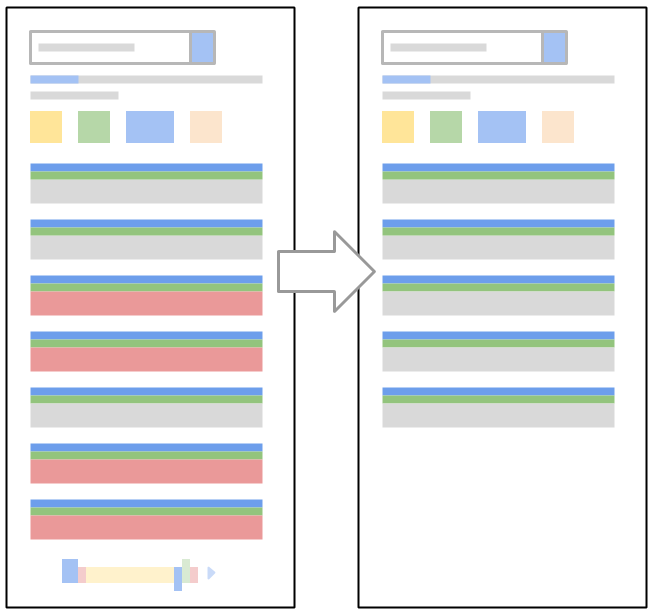
This is due to the large amount of hacked spam being removed, and should improve in the near future. We are continuing tuning our systems to weed out the bad content while retaining the organic, legitimate results. If you have any questions about these changes, or want to give us feedback on these algorithms, feel free to drop by our Webmaster Help Forums.
Posted by Ning Song, Software Engineer

First Click Free update
Around ten years ago when we introduced a policy called “First Click Free,” it was hard to imagine that the always-on, multi-screen, multiple device world we now live in would change content consumption so much and so fast. The spirit of the First Click Free effort was – and still is – to help users get access to high quality news with a minimum of effort, while also ensuring that publishers with a paid subscription model get discovered in Google Search and via Google News.
In 2009, we updated the FCF policy to allow a limit of five articles per day, in order to protect publishers who felt some users were abusing the spirit of this policy. Recently we have heard from publishers about the need to revisit these policies to reflect the mobile, multiple device world. Today we are announcing a change to the FCF limit to allow a limit of three articles a day. This change will be valid on both Google Search and Google News.
Google wants to play its part in connecting users to quality news and in connecting publishers to users. We believe the FCF is important in helping achieve that goal, and we will periodically review and update these policies as needed so they continue to benefit users and publishers alike. We are listening and always welcome feedback.
Questions and answers about First Click Free
Q: Do the rest of the old guidelines still apply?
A: Yes, please check the guidelines for Google News as well as the guidelines for Web Search and the associated blog post for more information.
Q: Can I apply First Click Free to only a section of my site / only for Google News (or only for Web Search)?
A: Sure! Just make sure that both Googlebot and users from the appropriate search results can view the content as required. Keep in mind that showing Googlebot the full content of a page while showing users a registration page would be considered cloaking.
Q: Do I have to sign up to use First Click Free?
A: Please let us know about your decision to use First Click Free if you are using it for Google News. There’s no need to inform us of the First Click Free status for Google Web Search.
Q: What is the preferred way to count a user’s accesses?
A: Since there are many different site architectures, we believe it’s best to leave this up to the publisher to decide.
(Please see our related blog post for more information on First Click Free for Google News.)
Posted by John Mueller, Google Switzerland
