A couple of time-saving keyword optimization techniques for you to try
If there’s one thing that almost all of us can agree on, it’s that no matter what changes in the world of digital marketing, there is one constant… there’s not enough time in the day.
Google: Content In aside Tag Treated Similarly To Other Content On Your Page
Google’s John Mueller confirmed on Twitter that content placed in the <aside> tag is treated similarly to other content on the page…
Google Local Guides Can Add Photos In Their Reviews
Did you know that starting a few weeks ago, the Google Local Guides unlocked a special feature in the Google Maps app that let’s them not just add reviews but also add photos to their reviews…
Is modern SEO more than the sum of independent parts?
Columnist Jayson DeMers asserts that what we think of as SEO is actually just a combination of different customer experience strategies woven together to create the best online presence possible.
The post Is modern SEO more than the sum of independent…
Google Posts are going to kill (at) local SEO
Columnist Andrew Shotland discusses the impact Google Local Business Cards may have on local businesses and local SEO. Will they help, or will they hurt?
The post Google Posts are going to kill (at) local SEO appeared first on Search Engine Land.
Ple…
Google asks bloggers to nofollow links for free gifts: expert view
Google’s advice is for bloggers to nofollow any links that they add to products they’ve received as ‘these links didn’t come about organically’. It may sound simple enough, but it raises a number of issues.
Bing launches March Madness search answers, brackets and predictions
Bing lays out their predictions for March Madness and gives you the schedule, teams and the live results for 2016.
The post Bing launches March Madness search answers, brackets and predictions appeared first on Search Engine Land.
Please visit Search…
Rob Kerry on the future of search: 2016 and beyond
At the inaugural Ayima Insights digital marketing conference, Ayima co-founder Rob Kerry gave us his insights into how the field of search is currently developing, and what the future may hold in 2016 and beyond.
SearchCap: Google warning to bloggers, SEO success, audits & more
Below is what happened in search today, as reported on Search Engine Land and from other places across the web.
The post SearchCap: Google warning to bloggers, SEO success, audits & more appeared first on Search Engine Land.
Please visit Search Engine Land for the full article.
Google issues guidelines on bloggers and links for freebies
The practice of brands engaging with popular bloggers seems to have caught Google’s attention, with the search engine offering some advice on … read more
Want to speak at SMX Advanced? Here’s how.
The agenda for our upcoming SMX Advanced show is live, and we’ve opened up our “speaking pitch” form for select sessions for the show, taking place June 22–23, 2016. To increase the odds of being selected, be sure to have read the agenda. Understand what the sessions are about….
Please visit Search Engine Land for the full article.
Coming: Google Search Console May Split Out Where Your Page Showed In The Search Results
Google’s John Mueller said in a Google+ hangout this morning at the 5:40 mark that Google may show where your page was shown in the search results page. Specifically if you were in the featured snippets box or AMP page carousel or something like that…..
Google On Why They Use DMOZ: I Have Absolutely No Clue
Sometimes Google will use DMOZ, the old old web directory, in their search results. They may use the DMOZ description of your web site for the search results snippet in Google. They use to use DMOZ as their web directory but killed it off in 2011…
…
Google: Why Google Doesn’t Go Over Every Ranking Factor For Webmasters
This morning in a Google Hangout on Google+, John Mueller said he is decided to skip a bunch of questions on the topic of being more transparent…
Video Recap of Weekly Search Buzz :: March 11, 2016
This week in search, I published the monthly Google Webmaster Report. Google has officially killed off Toolbar PageRank finally. Googleâs Paul Haahr said he doesnât fully…
How to amplify your already spectacular SEO to be super-crazy successful
You’ve done everything right with your SEO, but you’re still not getting the results you want — what gives? Columnist Stoney deGeyter discusses the ways amplification can help take your SEO efforts to the next level.
The post How to amplify your already spectacular SEO to be super-crazy successful…
Please visit Search Engine Land for the full article.
The ins and outs of an SEO audit
How should you perform a site audit? What tools should you use? And how can you best present your findings to attain buy-in? Columnist Janet Driscoll Miller recaps a presentation at SMX West that covered these questions and more.
The post The ins and …
How to get a bird’s-eye view of the Google SERPs
Columnist Stephan Spencer provides an overview of a new rank tracking tool that goes much deeper than the “10 blue links” mindset.
The post How to get a bird’s-eye view of the Google SERPs appeared first on Search Engine Land.
Please visit Search Engine Land for the full article.
Google’s Big Brand Shakedown
If you live outside of the United States it can be hard to appreciate just how ad heavy some of Google’s search results have become in key ad categories.
Inorganic SERPs
A few weeks back Google even introduced literally organic-free search results on mobile devices in the travel vertical. Google is now deepening that organic-free offering, announcing their new mobile travel guides would launch in 201 cities.
Plenty of Room in Hotel California
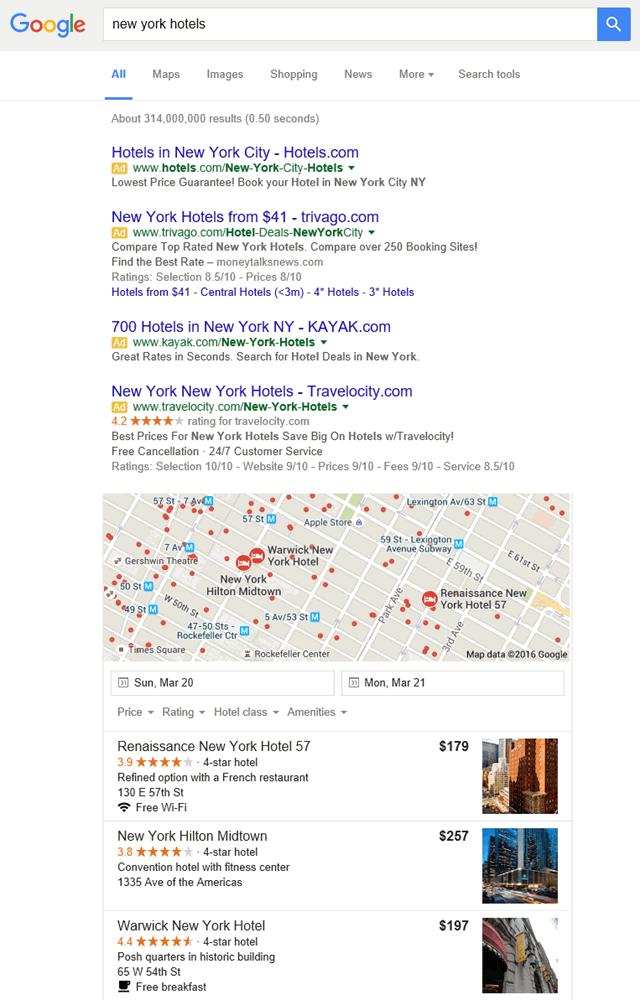
When Google rolled out the 4 AdWords ads above the organic results layout they mentioned it would mostly appear on highly commercial search terms like New York Hotels. Hotels are one of the most profitable keyword themes, because:
- the searches tend to be fairly late funnel
- the transactions are for hundreds of dollars
- OTAs and other intermediaries often get somewhere between 10% to 30% of the transaction
Google search results for hotels not only contain 4 AdWords ads, but they also have price ads on the “organic” local listings. That gives Google a second bite at the apple on monetizing the user.
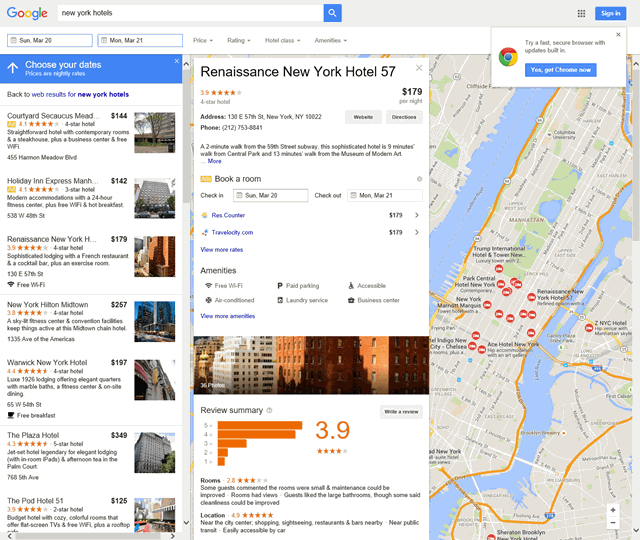
Click on any of those prices and you get sent to a beautiful(ly ugly) ad heavy click circus page like the following.
As Google has displaced those sorts of markets, portals like Yahoo! have announced the shutdown of some of their vertical offerings:
today we will begin phasing out the following Digital Magazines: Yahoo Food, Yahoo Health, Yahoo Parenting, Yahoo Makers, Yahoo Travel, Yahoo Autos and Yahoo Real Estate.
Direct Marketing Budgets vs Brand Ad Budgets
Google recently had another vertical search program which paralleled their hotel offering which focused on finance. It allowed users to compare things like credit cards, home loans, auto insurance policies, and other financial offers. They acquired BeatThatQuote, hard coded aggressive placements for themselves near the top of the search results, increased the size of these custom ad units – and then killed them off.
Why would Google invest hundreds of millions of Dollars in vertical search only to kill the offering?
It turns out the offering was too efficient from an advertiser perspective, so it didn’t drive enough yield for Google.
If it is a lead-based product the ad rates are set by rational lead values. There is no brand manager insisting on paying $120 a click because “we HAVE TO be #1 in Google for auto insurance.”
If Google does lead generation and sells the lead off exclusively they get paid precisely once for the consumer. Whereas if Google scrubs many aggregators from the market & allows searchers to click on one brand at a time they get to monetize the user many times over and take advantage of any irrational bidders in the ecosystem.
As long as Google is monetizing brand advertising budgets they can insert many layers of fat (really broad broad match, enhanced campaigns, mobile app clicks) into the ad stack.
Riding the Google Waves
Google’s vertical ad offerings may come and go, the biases behind the relevancy algorithms may shift, and the ecosystem constantly has some number false positives. As search engines test out various features & shift their editorial policies some companies get disrupted and are forced to change their business models, while other companies get disrupted and outright disappear.
Google’s move into auto insurance might have been part of the reason Bankrate decided to exit the business. But Google exiting the Google Compare business and adding a 4th text AdWords ad slot above the organic search results a few days before Bankrate reported results caused BankRate’s stock to slide by as much as 47%.
Brand Building to Lower Risk
Part of the SEO value of building a brand is the strength of the brand awareness helps you rank better across whatever portion of the search ecosystem Google has not yet eaten, while lowering your risk of becoming a false positive statistic. Branded-related searches should (in theory) also provide some baseline level of demand which insulates against ranking shifts on other keywords. And having a brand name rather than a generic business name allows one to go from one market to the next.
Just be Apple…
Computers.com won’t magically morph into MP3player.com then CellPhone.com then Tablet.com then Watch.com, but Apple was able to move from one market to the next with ease due to consumer familiarity and loyalty toward their brand.
Investing in building brand awareness is often quite expensive & typically requires many years of losses to eventually see positive returns. Trends come and go, and with them so do associated brands.
Heavily invest in the wrong trend & die.
Wait too long to invest in an important trend & die.
Few companies are able to succeed in field after field after field.
For every Apple-like example, there are dozens of losers. Look at how many computer companies shifted to an emphasis on higher margin laptops, then sold off their laptop divisions for almost nothing and chased cell phones for growth. While they outsourced everything and relied on a faux open source software provider they guaranteed their own death. Look at how some of the mobile companies are valued at almost nothing, or those that have been bought & gutted like Motorola or Nokia. There are only 3 somewhat strong mobile manufacturers:
- Apple – the source of the original iPhone which Google worked so hard to copy
- Samsung – the company which has remained profitable enough that Google publishes opposition research against them in spite of being a Google partner
- Xiaomi – a priced-to-perfection startup in the Chinese market where Google has been prohibited from competing in
Adding Apple management to another company does not guarantee success.
The Financial Crisis & Brand
When the financial crisis happened about 8 years ago Google saw both their revenue growth rate and their stock price crash. Direct marketers receded with the consumer, but many pre-approved brand ad campaigns continued to run. Google’s preferred custom shifted away from direct marketers toward large global brands.
When the economy started to recover, Google was quick to ban 30,000 affiliates from the AdWords auction.
When Trends Take Off
As trends become obvious & companies succeed wildly, competitors chase them.
The tricky part is the perception of success & lasting success are not one and the same.
Remember when Demand Media was allegedly profitable as hell? That was sales material for the pump-n-dump IPO & their stock has only corrected about 99% since then.
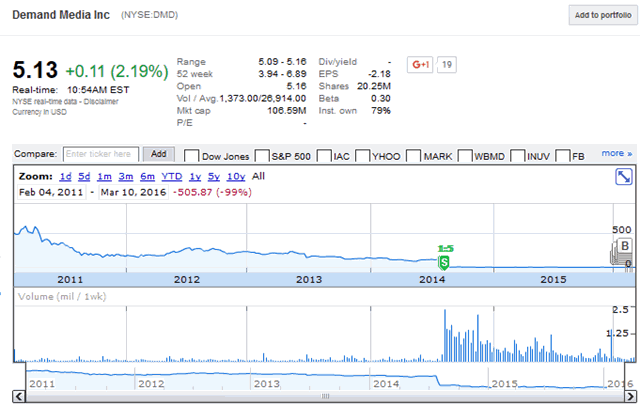
Since dumping that profitable as hell company on the public they’ve only had to invest in removing about 2.4 million articles from eHow.
The site is still torched by the Panda algorithm.
And they are still losing money. ;)
Companies like Mahalo which chased eHow also washed up on the rocks. They’ve since pivoted to YouTube, to mobile apps, to email & perhaps should re-brand to Pivot, Inc.
Groupon was another surefire trend. They’re off about 84% from their peak & most the Groupon clones have went under, while Groupon has divested of most of their acquisition-driven international expansion. Numerous other coupon & flash sale sites which haven’t yet went under laid off many people and are off significantly from their peaks or were sold for a song.
Trends come and go. Baseball cards are largely a thing of the past. So are Pet Rocks, Cabbage Patch Kids, and Beanie Babies.
Perhaps soon independent single author blogs and SEO-driven publishing business models will be added to the list. ;)
Copycats & Trademark Infringement
Some brands have a strong staying power. But even if those brands are highly valued, they still face competition from knock offs.
If you shop at big box stores in the United States you may have no awareness of the following product.
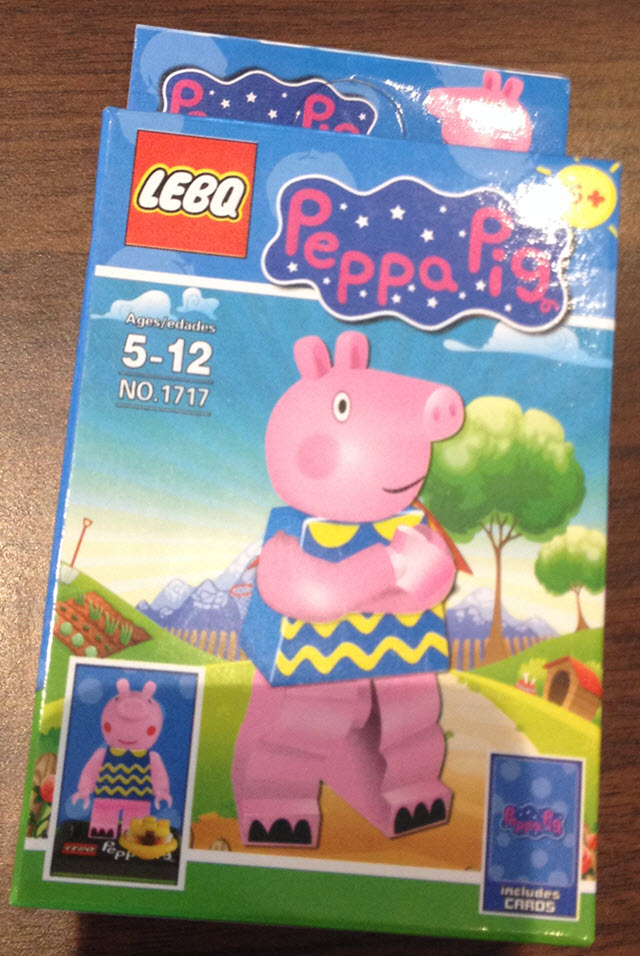
Look a bit closer at that image & you’ll see it wasn’t LEGO, but rather LEBQ.
Sale for Le Bao Quan are not sale for the core LEGO brand, the consumer gets acclimated to an artificially low price point, and imagine what sort of a traumatic impact it might have for a child if their first LEGO-like toy looks like a pig fresh from the butcher’s shop.

The key difference between that sort of stuff and gray areas monetized by the big online platforms is you may have to go to third world to find the sketchy physical products in the real world; whereas the big online platforms all have some number of sketchy globally accessible offers at any point in time. Here are just a few examples:
- Alibaba, generally
- eBay banning a whistleblower who highlighted counterfeit goods
- dangerous weapons on Amazon.co.uk
- Google pushing ads for illegal steroids, sketchy fake locksmiths, & fake product support services with trademark terms in the ad headlines
Monetizing Brand (Retailer)
At the core, all these platform plays are both brands unto themselves & places where third party brands get monetized.
The start up costs to have leverage to work with brands in an official partnership can be quite significant. Just look at how much Jet.com has raised and how much hustle they’ve used to get in the game, even with their massive burn rate.
Part of why Apple has such strong margins is their brand is so strong they can dictate terms and control the supply chain. Others are willing to give them the majority of the profits because carrying them completes the catalog and helps the retailers sell other, weaker goods where the retailers have higher profit margins.
And even then, when you get outside their core products, there are listings for fake OEM Apple stuff all over the web.
Luckily when fake products use spammy titles on Amazon the reviewers will quickly highlight if they are of inferior quality. But if they look authentic & work, it can be hard for the brands to know unless they proactively track everything. And as that demand gets filled, if there is a negative experience it may lead to customer complaints about the brand, whereas if there are no complaints & the product works it still leaves less money for the brand which is being arbitraged.
“The Internet doesn’t change everything. It doesn’t change supply and demand.” – Andy Grove
Other players with weaker brands and a roll reversal on who needs who can quickly find themselves in a pickle.
Monetizing Brand (Financeer)
Some companies die slowly, as accountants drive strategy & they outsource their key points of differentiation and become unremarkable. When Yahoo! turned their verticals into thin “me too” outsourced plays they made it easy for Google to offer something of a similar quality, which in turn left the Yahoo! vertical properties without much distribution.
As Yahoo! struggles, some investors want to buy the core Yahoo! business so Yahoo! can exit the web business while being a holding company for Alibaba and Yahoo! Japan stock.
In an age of declining interest rates, zero interest rates (or even negative rate) policies some investors look to buy brands, streamline operations (mass firings & outsourcing), lever them up on debt & then sell them back off. Some companies like Burger King have cycled through public and private ownership multiple times.
Brands can be purchased just like links. Everything has a price and a value which shifts with the market.
Monetizing Brand (Affiliate)
Some retailers have symbiotic relations with brands they sell, while other platforms may compete more aggressively with those whose products they sell. The same is true with affiliates. Affiliates can genuinely add value & drive new distribution for brands, or they can engage in lower value arbitrage, where they push the brand to pay for what was already owned by it through shady techniques like cookie stuffing.
One of the most one-sided and biased hate-filled perspectives I’ve ever seen about affiliates is Lori Weiman’s guest columns at Search Engine Land.
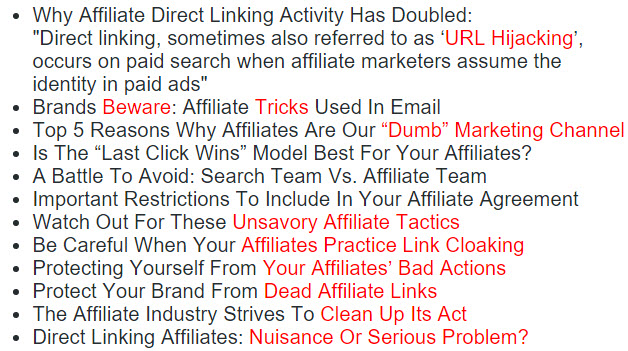
Just the same, some merchants treat affiliates honestly and fairly, while other merchants have a pattern of scamming their affiliates through lead shaving, adjusting revenue share without telling the affiliates, and a host of other sketchy behaviors.
Monetizing Brand (Search Engine)
Search engines allow competitors or resellers to bid on branded keywords, which creates an auction bidding environment for many branded terms. Typically Google offers the official site / brand clicks at a significant discount for these terms in order to encourage them to compete in the ad marketplace & to help shift some of the organic click mix over to paid clicks.
Google has also tried a number of other initiatives to boost their monetization of branded keywords. A partial list of such efforts includes:
- increasing the CPCs charged on branded terms, particularly when ad extensions are enabled
- a test of banner ads from brands which were merged with organic listings (though this effort was quickly dumped due to lack of driving revenues as it didn’t allow for auction dynamics to drive prices upward – similar to the reason Google Advisor was shut down)
- shifting branded traffic streams through to product listing ads
- displacing organic results with more ads on mobile devices & preferring house listings for vertical search efforts like local to drive the organic results below the fold
- adding other distracting eye candy to mobile results including the knowledge graph and “also searched for” links pointing at competing businesses
- allowing syndicated search partners to use harder to notice ad labeling
- allowing syndicated search partners to use more ads above their organic search results
Sophisticated vs Unsophisticated SEM
Many poorly managed AdWords accounts managed by large ad agency ultimately end up far more damaging to brands than the efforts from “shady” affiliates. The set up (which is far more common than most would care to believe) revolves around the ad agency arbitraging the client’s existing brand, falsely claiming the revenue generated by that spend to be completely incremental & then get a percent of spend management fee on that spend. The phantom profits which are generated from those efforts are further applied to bidding irrationally high on other terms, to once again pick up more percent of spend management fees.
Savvy search marketers separate the value of traffic from branded and unbranded terms to take a more accurate view of the interaction between investments in paid search and organic search.
Both eBay and Google have done studies on the incrementality of paid search clicks.
eBay being a large brand found they didn’t see much incrementality [PDF]. Search Google for eBay and they won’t run AdWords ads. eBay still participates in product listing ads / shopping search for other products they carry.
Google (of course) found much more incrementality with paid search ads. While they conducted their internal study and suggested it would be too hard or expensive for most advertisers to conduct such a study, they also failed to mention that the reason it would be expensive for an advertiser to perform such a test is because Google intentionally & explicitly decided against offering those features inside the AdWords platform. It is the same reason Google shut down Google Advisor / Google Compare – offering it doesn’t provide Google a guaranteed positive yield when compared against not offering it.
One thing Google did note about seeing higher rates of incremental clicks in their study was when there was increased space between the listings there tended to be a higher rate of incremental ad clicks. This is part of why we see AdWords ads getting larger with more extensions & there being so many features in mobile which push the organic results below the fold.
The same Lori Weiman who hates affiliates is currently running (literally) an 8-part series on why you should bid on your brand keywords.
If anyone other than a search engine monetizes brand that might be bad, but if the search engines do it then going along with the game is always the right call.
Owning the Supply Chain
“The true victory (the true ‘negation of the negation’) occurs when the enemy talks your language.” – Slovoj Zizek
The opposite is also true. If you are a brand who is being dictionary attacked by an ad network, the brand quickly shifts from an asset to a liability.
“The only thing that I’d rather own than Windows is English, because then I could charge you two hundred and forty-nine dollars for the right to speak it.” – Scott McNealy
Google owns English and Spanish and German and …
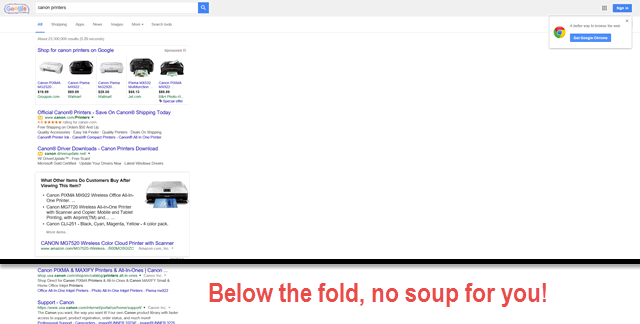
Canon is pushed below the fold for their own brand query — pic.twitter.com/Rx303fqn8d— Dr. Pete Meyers (@dr_pete) March 7, 2016
Is your control over the supply chain strong enough that you can afford to be below the fold for your own brand?
While you think about that, other pieces of the supply chain are merging in key verticals to better combat the strength of search ad networks.
- Expedia, Travelocity & Orbitz
- Zillow & Trulia
- Staples, OfficeMax & OfficeDepot
How much are you willing to pay Google for each click for a brand you already own?
When does that stop being worth it?
During the next recession many advertisers will find out.
Categories:
Google’s Big Brand Shakedown
Inorganic SERPs
A few weeks back Google introduced literally organic-free search results on mobile devices in the travel vertical. Google is now deepening that organic-free offering, announcing their new mobile travel guides would launch in 201 cities.
If you live outside of the United States it can be hard to appreciate just how ad heavy some of Google’s search results have become in key ad categories.
Plenty of Room in Hotel California
When Google rolled out the 4 AdWords ads above the organic results layout they mentioned it would mostly appear on highly commercial search terms like New York Hotels. Hotels are one of the most profitable keyword themes, because:
- the searches tend to be fairly late funnel
- the transactions are for hundreds of dollars
- OTAs and other intermediaries often get somewhere between 10% to 30% of the transaction
Google search results for hotels not only contain 4 AdWords ads, but they also have price ads on the “organic” local listings. That gives Google a second bite at the apple on monetizing the user.
Click on any of those prices and you get sent to a beautiful(ly ugly) ad heavy click circus page like the following.
As Google has displaced those sorts of markets, portals like Yahoo! have announced the shutdown of some of their vertical offerings:
today we will begin phasing out the following Digital Magazines: Yahoo Food, Yahoo Health, Yahoo Parenting, Yahoo Makers, Yahoo Travel, Yahoo Autos and Yahoo Real Estate.
Direct Marketing Budgets vs Brand Ad Budgets
Google recently had another vertical search program which paralleled their hotel offering which focused on finance. It allowed users to compare things like credit cards, home loans, auto insurance policies, and other financial offers. They acquired BeatThatQuote, hard coded aggressive placements for themselves near the top of the search results, increased the size of these custom ad units – and then killed them off.
Why would Google invest hundreds of millions of Dollars in vertical search only to kill the offering?
It turns out the offering was too efficient from an advertiser perspective, so it didn’t drive enough yield for Google.
If it is a lead-based product the ad rates are set by rational lead values. There is no brand manager insisting on paying $120 a click because “we HAVE TO be #1 in Google for auto insurance.”
If Google does lead generation and sells the lead off exclusively they get paid precisely once for the consumer. Whereas if Google scrubs many aggregators from the market & allows searchers to click on one brand at a time they get to monetize the user many times over and take advantage of any irrational bidders in the ecosystem.
As long as Google is monetizing brand advertising budgets they can insert many layers of fat into the ad stack.
(Really broad broad match, enhanced campaigns, fat-thumb mobile clicks, mobile app clicks, re-targeted ads for products which were already purchased, endless auto-play YouTube video streams with ads in them, etc.)
Riding the Google Waves
Google’s vertical ad offerings may come and go, the biases behind the relevancy algorithms may shift, and the ecosystem constantly has some number false positives. As search engines test out various features & shift their editorial policies some companies get disrupted and are forced to change their business models, while other companies get disrupted and outright disappear.
Google’s move into auto insurance might have been part of the reason Bankrate decided to exit the business. But Google exiting the Google Compare business and adding a 4th text AdWords ad slot above the organic search results a few days before Bankrate reported results caused BankRate’s stock to slide by as much as 47%.
Brand Building to Lower Risk
Part of the SEO value of building a brand is the strength of the brand awareness helps you rank better across whatever portion of the search ecosystem Google has not yet eaten, while lowering your risk of becoming a false positive statistic. Branded-related searches should (in theory) also provide some baseline level of demand which insulates against ranking shifts on other keywords. And having a brand name rather than a generic business name allows one to go from one market to the next.
Just be Apple…
Computers.com won’t magically morph into MP3player.com then CellPhone.com then Tablet.com then Watch.com, but Apple was able to move from one market to the next with ease due to consumer familiarity and loyalty toward their brand.
Investing in building brand awareness is often quite expensive & typically requires many years of losses to eventually see positive returns. Trends come and go, and with them so do associated brands.
Heavily invest in the wrong trend & die.
Wait too long to invest in an important trend & die.
Few companies are able to succeed in field after field after field.
For every Apple-like example, there are dozens of losers. Look at how many computer companies shifted to an emphasis on higher margin laptops, then sold off their laptop divisions for almost nothing and chased cell phones for growth. While they outsourced everything and relied on a faux open source software provider they guaranteed their own death. Look at how some of the mobile companies are valued at almost nothing, or those that have been bought & gutted like Motorola or Nokia. There are only 3 somewhat strong mobile manufacturers:
- Apple – the source of the original iPhone which Google worked so hard to copy
- Samsung – the company which has remained profitable enough that Google publishes opposition research against them in spite of being a Google partner
- Xiaomi – a priced-to-perfection startup in the Chinese market where Google has been prohibited from competing in
Adding Apple management to another company does not guarantee success.
The Financial Crisis & Brand
When the financial crisis happened about 8 years ago Google saw both their revenue growth rate and their stock price crash. Direct marketers receded with the consumer, but many pre-approved brand ad campaigns continued to run. Google’s preferred custom shifted away from direct marketers toward large global brands.
When the economy started to recover, Google was quick to ban 30,000 affiliates from the AdWords auction.
When Trends Take Off
As trends become obvious & companies succeed wildly, competitors chase them.
The tricky part is the perception of success & lasting success are not one and the same.
Remember when Demand Media was allegedly profitable as hell? That was sales material for the pump-n-dump IPO & their stock has only corrected about 99% since then.
Since dumping that profitable as hell company on the public they’ve only had to invest in removing about 2.4 million articles from eHow.
The site is still torched by the Panda algorithm.
And they are still losing money. ;)
Companies like Mahalo which chased eHow also washed up on the rocks. They’ve since pivoted to YouTube, to mobile apps, to email & perhaps should re-brand to Pivot, Inc.
Groupon was another surefire trend. They’re off about 84% from their peak & most the Groupon clones have went under, while Groupon has divested of most of their acquisition-driven international expansion. Numerous other coupon & flash sale sites which haven’t yet went under laid off many people and are off significantly from their peaks or were sold for a song.
Trends come and go. Baseball cards are largely a thing of the past. So are Pet Rocks, Cabbage Patch Kids, and Beanie Babies.
Perhaps soon independent single author blogs and SEO-driven publishing business models will be added to the list. ;)
Copycats & Trademark Infringement
Some brands have a strong staying power. But even if those brands are highly valued, they still face competition from knock offs.
If you shop at big box stores in the United States you may have no awareness of the following product.
Look a bit closer at that image & you’ll see it wasn’t LEGO, but rather LEBQ.
Sales for Le Bao Quan are not sales for the core LEGO brand, the consumer gets acclimated to an artificially low price point, and imagine what sort of a traumatic impact it might have for a child if their first LEGO-like toy looks like a pig fresh from the butcher’s shop.
The key difference between that sort of stuff and gray areas monetized by the big online platforms is you may have to go to third world to find the sketchy physical products in the real world; whereas the big online platforms all have some number of sketchy globally accessible offers at any point in time. Here are just a few examples:
- Alibaba, generally
- eBay banning a whistleblower who highlighted counterfeit goods
- dangerous weapons on Amazon.co.uk
- Google pushing ads for illegal steroids, sketchy fake locksmiths, & fake product support services with trademark terms in the ad headlines
Monetizing Brand (Retailer)
At the core, all these platform plays are both brands unto themselves & places where third party brands get monetized.
The start up costs to have leverage to work with brands in an official partnership can be quite significant. Just look at how much Jet.com has raised and how much hustle they’ve used to get in the game, even with their massive burn rate.
Part of why Apple has such strong margins is their brand is so strong they can dictate terms and control the supply chain. Others are willing to give them the majority of the profits because carrying them completes the catalog and helps the retailers sell other, weaker goods where the retailers have higher profit margins.
And even then, when you get outside their core products, there are listings for fake OEM Apple stuff all over the web.
Luckily when fake products use spammy titles on Amazon the reviewers will quickly highlight if they are of inferior quality. But if they look authentic & work, it can be hard for the brands to know unless they proactively track everything. And as that demand gets filled, if there is a negative experience it may lead to customer complaints about the brand, whereas if there are no complaints & the product works it still leaves less money for the brand which is being arbitraged.
“The Internet doesn’t change everything. It doesn’t change supply and demand.” – Andy Grove
Other players with weaker brands and a roll reversal on who needs who can quickly find themselves in a pickle.
Monetizing Brand (Financeer)
Some companies die slowly, as accountants drive strategy & they outsource their key points of differentiation and become unremarkable. When Yahoo! turned their verticals into thin “me too” outsourced plays they made it easy for Google to offer something of a similar quality, which in turn left the Yahoo! vertical properties without much distribution.
As Yahoo! struggles, some investors want to buy the core Yahoo! business so Yahoo! can exit the web business while being a holding company for Alibaba and Yahoo! Japan stock.
In an age of declining interest rates, zero interest rates (or even negative rate) policies some investors look to buy brands, streamline operations (mass firings & outsourcing), lever them up on debt & then sell them back off. Some companies like Burger King have cycled through public and private ownership multiple times.
Brands can be purchased just like links. Everything has a price and a value which shifts with the market.
Monetizing Brand (Affiliate)
Some retailers have symbiotic relations with brands they sell, while other platforms may compete more aggressively with those whose products they sell. The same is true with affiliates. Affiliates can genuinely add value & drive new distribution for brands, or they can engage in lower value arbitrage, where they push the brand to pay for what was already owned by it through shady techniques like cookie stuffing.
One of the most one-sided and biased hate-filled perspectives I’ve ever seen about affiliates is Lori Weiman’s guest columns at Search Engine Land.
Just the same, some merchants treat affiliates honestly and fairly, while other merchants have a pattern of scamming their affiliates through lead shaving, adjusting revenue share without telling the affiliates, and a host of other sketchy behaviors.
Monetizing Brand (Search Engine)
Search engines allow competitors or resellers to bid on branded keywords, which creates an auction bidding environment for many branded terms. Typically Google offers the official site / brand clicks at a significant discount for these terms in order to encourage them to compete in the ad marketplace & to help shift some of the organic click mix over to paid clicks.
Google has also tried a number of other initiatives to boost their monetization of branded keywords. A partial list of such efforts includes:
- increasing the CPCs charged on branded terms, particularly when ad extensions are enabled
- a test of banner ads from brands which were merged with organic listings (though this effort was quickly dumped due to lack of driving revenues as it didn’t allow for auction dynamics to drive prices upward – similar to the reason Google Advisor was shut down)
- shifting branded traffic streams through to product listing ads
- displacing organic results with more ads on mobile devices & preferring house listings for vertical search efforts like local to drive the organic results below the fold
- adding other distracting eye candy to mobile results including the knowledge graph and “also searched for” links pointing at competing businesses
- allowing syndicated search partners to use harder to notice ad labeling
- allowing syndicated search partners to use more ads above their organic search results
Sophisticated vs Unsophisticated SEM
Many poorly managed AdWords accounts managed by large ad agency ultimately end up far more damaging to brands than the efforts from “shady” affiliates. The set up (which is far more common than most would care to believe) revolves around the ad agency arbitraging the client’s existing brand, falsely claiming the revenue generated by that spend to be completely incremental & then get a percent of spend management fee on that spend. The phantom profits which are generated from those efforts are further applied to bidding irrationally high on other terms, to once again pick up more percent of spend management fees.
Savvy search marketers separate the value of traffic from branded and unbranded terms to take a more accurate view of the interaction between investments in paid search and organic search.
Both eBay and Google have done studies on the incrementality of paid search clicks.
eBay being a large brand found they didn’t see much incrementality [PDF]. Search Google for eBay and they won’t run AdWords ads. eBay still participates in product listing ads / shopping search for other products they carry.
Google (of course) found much more incrementality with paid search ads. While they conducted their internal study and suggested it would be too hard or expensive for most advertisers to conduct such a study, they also failed to mention that the reason it would be expensive for an advertiser to perform such a test is because Google intentionally & explicitly decided against offering those features inside the AdWords platform. It is the same reason Google shut down Google Advisor / Google Compare – offering it doesn’t provide Google a guaranteed positive yield when compared against not offering it.
One thing Google did note about seeing higher rates of incremental clicks in their study was when there was increased space between the listings there tended to be a higher rate of incremental ad clicks. This is part of why we see AdWords ads getting larger with more extensions & there being so many features in mobile which push the organic results below the fold.
The same Lori Weiman who hates affiliates is currently running (literally) an 8-part series on why you should bid on your brand keywords.
If anyone other than a search engine monetizes brand that might be bad, but if the search engines do it then going along with the game is always the right call.
Owning the Supply Chain
“The true victory (the true ‘negation of the negation’) occurs when the enemy talks your language.” – Slavoj Zizek
The opposite is also true. If you are a brand who is being dictionary attacked by an ad network, the brand quickly shifts from an asset to a liability.
“The only thing that I’d rather own than Windows is English, because then I could charge you two hundred and forty-nine dollars for the right to speak it.” – Scott McNealy
Google owns English and Spanish and German and …
Canon is pushed below the fold for their own brand query — pic.twitter.com/Rx303fqn8d— Dr. Pete Meyers (@dr_pete) March 7, 2016
Is your control over the supply chain strong enough that you can afford to be below the fold for your own brand?
While you think about that, other pieces of the supply chain are merging in key verticals to better combat the strength of search ad networks.
- Expedia, Travelocity & Orbitz
- Zillow & Trulia
- Staples, OfficeMax & OfficeDepot
How much are you willing to pay Google for each click for a brand you already own?
When does that stop being worth it?
During the next recession many advertisers will find out.
Added: Within days of writing the above post Google was once again found running ads promoting phishing campaigns, even though the ads arbitrage Google’s branded keyword terms.
@dr_pete See the first result. They are phishing information. This people are crazy! what you think? pic.twitter.com/DAIh31aQpV— Hiren vaghela (@Hirendream) March 17, 2016
Apparently that issue isn’t something new either.
@Hirendream @aaronwall @dr_pete Reported phishing in Adwords on this term to Google about one year ago…— C Byrne (@SEOTipsnTricks) March 18, 2016
Categories: