Bing Ads Makes Combined Tablet-Desktop Targeting Official
Desktop and tablets are now united across paid search — with one caveat. Bing Ads has officially combined tablet and PC targeting in search campaigns on the platform, following on Google’s move to do so last year with the introduction of Enhanced Campaigns. Bing Ads announced the…
Please visit Search Engine Land for the full article.
It Takes a Village – or at Least a Team – to Build Successful Websites and Apps
Professionals with ample cross-discipline expertise are as rare as unicorns with wings. It is more efficient and cost-effective to put a team in place with the skill sets needed to execute the process, in the correct sequence, from the beginning.
Why focus on long tail keywords?
While writing our book ‘Optimizing your WordPress website’ I worked closely together with Joost in creating a section on Search Engine Optimization. The first chapter — after the introduction in SEO — had to be keyword research. ‘Keyword research is the basis of all Search Engine Optimization,’ Joost explained to me, ‘without proper keyword research,…
This post first appeared on Yoast. Whoopity Doo!
Deal With the Big Rocks First
Before you spend time and money trying to optimize the small aspects of your website, deal with the big issues first.
How to Keep Your Knowlegde up-to-date for (almost) Free
Staying up-to-date with your knowledge is not easy when you have a low budget. But there’s a lot you can do to know as much as you can.
Post from Bas van den Beld on State of Digital
How to Keep Your Knowlegde up-to-date for (almost) Free
SEO considerations for discontinued products in ecommerce
There are three key considerations for this equation, which are:
- What can we do that provides the best user experience?
- What can we do to maintain the SEO value of that page?
- How can we avoid generating a huge number of 404 errors?
I believe that a lot of this is circumstantial and subjective, as it depends on the number of products being discontinued, the nature of the website (some websites only stock products for short periods) and a number of other factors.
I believe that redirecting a product back to a parent category with a message (explaining why they’re being redirected to the user), serving a custom 404 page (with recommendations) and maintaining the page and adding recommendations based on similar products (as per the Wiggled example below) are all viable options that offer a similar level of SEO value.
My initial recommendation for this specific example was to create a rule to redirect the product back to the parent category, which also worked in-line with the development issue that was causing them to change their existing solution.
In order to validate what I was saying, I decided to ask a few other experienced SEOs what they thought the best option (in relation to the site in question) was. Bare in mind that this would impact a lot of products and it happens regularly, so it needed to be automated.
I asked a number of people this question and here were some of the answers.
The first answer, from Rishi Lakhani, was a very good solution, but probably not suitable for a website as large as this one was.
Rishil suggested creating individual blog posts talking about each product, with the intention over upselling other products and spreading value via internal links within the blog posts. The original page would be redirected to the blog post.
This is a fairly good option for smaller retailers.
The second suggestion, was to 301 redirect each product to a closely related product whilst also displaying a message communicating why the user was being redirected. This is a good option as it means the value from the page will be passed on to the similar product, but it’s quite difficult to automate and, in this very specific scenario, similar products are also quite likely to be discontinued (because of the seasonality).
I do however think that adding the post-redirect messaging will help to aid user experience, as these kind of redirects can easily cause confusion.
Finally, Kristine suggested serving a custom 404 page that provided information on why the product is out of stock, along with guidance on finding similar products on the website.
This would provide a good user experience and would be fine from an SEO perspective, but it’s a fairly complex and time-consuming solution (both dev time and on-going maintenance). Again, I’d suggest that this would be a great solution for a smaller retailer.
So, to summarise, I’d say that the best solution (for this large website) would be a combination of the above, with an automated redirect back to the parent category and messaging to communicate the reason behind the redirect to the user.
This would help to avoid a confusing user-experience and also help to maintain SEO value of the products.
Here are a few examples of how other retailers deal with this issue:
Wiggle:

Wiggle keeps the page live, maintain the copy, imagery etc and then add an out of stock message, along with suggested alternative products.
Zalando:
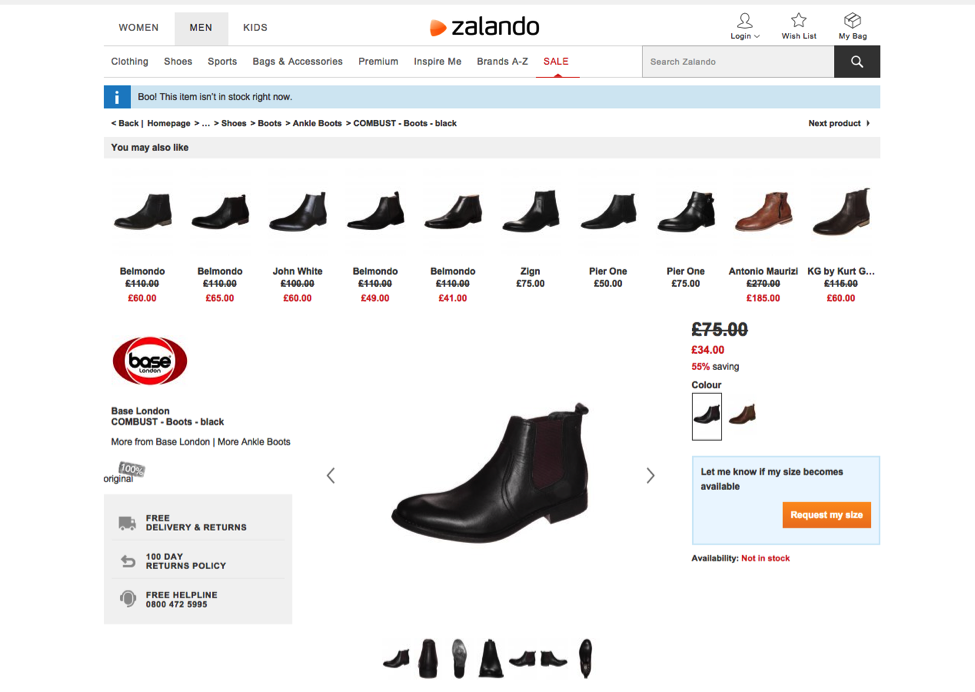
Zalando keep all of their discontinued pages live, with suggestions of similar products and a ‘request details’ button, just in case it’s coming back into stock.
If you have any questions about this or any alternative solutions – please feel free to leave them in the comments below.
Unlock (not provided) organic data and other quick Google Analytics tips
There are many differences between agency-side and client-side, not least the amount of sites worked on! However, there are also some shared resources that add value to both sides of the coin.
Data sources are an example of this and when we’re all fighting the same fight, it’s essential to have consistent pots of data to analyse and report on.
One such data source is, of course, Google Analytics. As a free tool, it is an essential resource for agencies and brands alike. I’m a daily user of GA as part of client reporting and helping our search and technical teams understand how sites are performing, both positively and negatively.
Google has made changes to GA, especially recently. Some of these changes, particularly around UX and usability, have really benefitted the user.
On the flip side, Google has given with one hand and taken away with the other, by making it more and more difficult to gain full access to data, especially in organic.
With this post I aim to go a little deeper by giving specific, actionable advice on how to further prove the value of organic for your business or clients.
(not provided)
The most infamous of GA’s restrictions is undoubtedly (not provided) keyword data, where Google restricts keyword data due to ‘security’ and protection of the searcher’s privacy.
If you are signed in to Google when you search, the keyword you search for is not passed on to the site owner. This began as a small percentage but has steadily grown until Google announced in late 2013 that all signed-in keyword data would be hidden indefinitely. In reality, from what we see everyday across our client portfolio, this equates to around 80-90% of organic keyword data being hidden.

This is just an example of some of GA’s niggling inconsistencies, and one I hope to resolve for you in this post, amongst others. So let’s begin with unlocking (not provided) data…
(not provided) – the bane of the SEO’s life! There are two main issues with (not provided) that I encounter on a daily basis – being unable to specify brand and non-brand traffic volumes, and the split of non-brand traffic between keywords. Let’s look at both of these issues and how we can resolve them…
Brand and non-brand
(not provided) makes our lives difficult, but it does leave us a sliver of data to work with. As mentioned above, this is usually around 15% of keyword data. The word of the day here is extrapolate. We need to take this 15% of available keyword data and apply its structure to the hidden remainder. Here is a step-by-step guide on how to do this, with an additional bonus download to help you.
The methodology:
If we can calculate the brand vs non-brand split of the available data, this gives us a % split we can then extrapolate. Firstly, we need to define “what is brand?” To do this, we must set up an advanced filter that removes all traffic coming in via a brand-related term.
Let’s say our brand is GA Tips and our site is GAtips.com – we need to tell GA what our branded keywords are. This is usually made up of variations of the brand name, for example GA tips, GAtips etc, and variations of the URL, for example GAtips.com, www.GAtips.com etc.
Start off by navigating to this page in GA: acquisition > keywords > organic, and ensure the primary dimension is set to ‘keyword’. Then click the ‘advanced’ button next to the search box below the trend.

This presents some options, which need to be set as follows:

In the text field, enter your brand variations in the following format:
GAtips|GA tips|www.gatips.com|gatips.com etc etc
You can be as accurate as like/need here. Some brands may also need to include product brand names. For example, Apple might include the term ‘iphone’ in this as a branded term. You can also dive into popular misspells to be super-accurate.
Once you’ve inputted all your brand variations, click Apply, then click the ‘Shortcut’ button at the top of the page:

You can then name your filter and save it to your shortcuts menu in the left nav, so you can easily access it in future.
What this achieves is removing all branded keywords from the organic keyword report, leaving us with just non-branded and (not provided).
If we take total organic traffic and subtract (not provided), this gives us our available data set. Then, take away (not provided) from the number supplied by our non-brand filter. We are then left with Total provided data and Non-branded provided data.
The difference between the two figures is the branded provided total. From this point it is simple to calculate the brand % and the non-brand % by subtracting non-branded provided from total provided and using a simple percentage calculation. Finally, apply the two percentages to our total organic traffic number to get the brand and non-brand volumes.
All of this is summarised and made easy for you in this downloadable Excel equation: click here to download – all you’ll need is the download, and three numbers: total organic traffic, (not provided) and non-brand organic (supplied by your new advance filter). The equation will do the rest for you.
Tracking this over time allows us to monitor increases and decreases in brand and non-brand, which can in turn indicate changes in brand awareness and/or non-brand rankings.
I also mentioned another issue with (not provided):
Restricted ability to track traffic from non-brand keywords
The key here is landing pages. Spend time looking at which pages rank for which keywords. Tools like SEMrush and Searchmetrics are great for this. Understanding this allows us to make informed decisions about increases and decreases for particular landing pages.
For our GAtips brand, let’s say we have identified that the page gatips.com/really-cool-analytics-hacks ranks for the search terms ‘GA hacks’ and ‘analytics hacks’.
We don’t know that those terms are sending traffic to that page in GA (although we can in Webmaster Tools) because of (not provided), but what we can do is react to changes in traffic to the page by checking positions for the terms we know to be ranking that page in Google. If we know our ranking for ‘GA hacks’ has dropped, then we can assign a landing page traffic drop to that.
I briefly mentioned Webmaster Tools and this is a really key data source for keyword data, although it can be a little vague and somewhat inaccurate. Use it in conjunction with your rankings>pages analysis to really understand how keyword traffic is behaving.
More Google Analytics work-arounds
Now we’ve tackled the big issue, here are a few quickfire solutions for things that you may have come across in your day-to-day use of Google Analytics:
Why does GA show one sessions figure for a particular date range, but a different one when I add in a comparison to a previous date range (this also applies to individual landing page numbers too)?
What Google doesn’t tell you is that, in most cases, GA data is a sample. This is especially true if you have an especially large amount of traffic.
The ultimate solution is to either go Premium (very expensive!) but in the real world, be consistent with your comparisons and the numbers you use.
Personally, I take the numbers from the date range alone, with no comparison, and then add the comparison to get the numbers for the previous date range. It’s a bit manual, but it works and is predictable.
UA code can also skew things, so make sure you have the most up to date code on your site.
A lot of my landing page traffic is being assigned to (not set) – why is this and how can I fix it?
If Google is unable to make a link between a session and a page, it is recorded as a session but the page is assigned as (not set). This can be caused by several things, including the user not completing the page load.
The server request is made but the page is not loaded.
The solution is to identify which pages are experiencing the (not set) assignations. This should be clear, as (not set) tends to target particular page types, e.g. those with events/conversions on them or pages within a certain category on your site, so you should see a pattern.
The total organic traffic for a date range will not be affected by (not set), but if you calculate (not set) as a percentage of total, then you can extrapolate this across all landing pages to give a truer view of sessions per page.
My rankings are flat vs prior week/month/year but my landing page traffic is dropping, why is this and how can I mitigate it?
This is not exclusively a GA issue, but GA provides the landing page traffic data, so it’s certainly a relevant issue to discuss. If rankings are flat, the drop is most likely market driven.
Use Google Trends to look at search demand for the terms in question over the appropriate timeframe and in the appropriate location. Export this as a CSV. Google assigns a number out of 100 per week within the date range, so each week is relative to those around it.
Also CSV export your weekly traffic numbers for the landing page in question and plot your Google Trends weekly numbers alongside. You should see a pattern between demand modulation and traffic behaviour.
Also check Google Keyword Planner for search volumes for the same month in prior year and the month before it. You may see a similar drop, which indicates a seasonality change.
There is a lot of talk in the industry around organic search traffic being wrongly labeled as Direct by GA, which skews true organic numbers. How do I deal with this?
Famously, Groupon undertook an experiment to understand the real impact of this, as it is understood to affect ALL Google Analytics profiles. It’s caused primarily by browsers failing to correctly report where traffic is coming from, with IE being the biggest culprit.
As a result, some organic traffic is ‘dumped’ into the vague Direct channel.
To understand the true impact, Groupon actually de-indexed itself from Google results for six hours to see how much the Direct channel reduced by. With no organic visits, this gave a true view of how much was actually Direct.
It uncovered the fact that approximately 50% of Direct channel traffic into long URLs, i.e. those beyond sub-folder level, dropped by around 50%. The end result is that organic is bigger than GA actually reports.
Moz also conducted a similar experiment. Its results were slightly different overall, however did share some consistencies with the Groupon investigation, in that Direct traffic to long URLs again dropped by around 50%.
Do some analysis of your Direct traffic to understand how much of it is into long URLs. Take that traffic, divide it by 2 (50%) and, according to the evidence we have from Moz and Groupon, that’s how much of your Direct traffic is organic.
There’s always more!
Whilst I know there are infinitely more niggles and foibles with GA, the issues discussed here are ones that I have encountered in my day-to-day GA usage and have had to formulate work-arounds to ensure consistency for our clients and also ensure my own sanity remains!
How Clarins is using WeChat, Baidu and Tmall to expand in China
Please explain your role at Clarins…
I recently became head of digital in APAC, covering China, Japan and Korea. We’re also contemplating moving into Taiwan and Australia in the New Year.
A big part of my job is to control the branding of the website, ensuring that all merchandising and communications is in line with the brand’s creative guidelines.
This involves working with the marketing and creative teams in the region to make sure we support our advertising campaigns.
In 2015 we want to maintain strong sales and profitability, while also expanding into new countries.
Clarins’ Chinese website

We also want to become more proficient in using eCRM features, improve conversion rates, and increase our share of voice on social.
And a big project which is now coming up is moving to an omnichannel model, which involves digitising our POS using tablet devices and different types of merchandising.
How does your distribution model differ in APAC compared to Europe?
It’s very different. In the West our products are sold through distributors, but in Asia we have our own counters in department stores, where the sales team are Clarins employees.
This accounts for about 90% of the business.
This means we have much more control over the POS and the customer database, which makes it easier to build a more seamless experience between online and offline channels.
What is WeChat’s role in bridging that gap between offline and online sales?
We are active on social networks across APAC and mainly focus Facebook, though we’re just trialling Instagram in Singapore.
The one exception is China where we use Weibo and WeChat. We first established an account on WeChat in June 2013 and have had really good traction so far.
Our WeChat fanbase grew very rapidly and it drives really good traffic to our ecommerce site as well. It’s actually one of the first times that we’ve seen a social site driving a large number of ecommerce sales.
We also use WeChat as an online acquisition tool to bring people into the stores.
At Clarins we do a lot of sampling, and we offer prospective customers the chance to try before they buy, so for each marketing campaign we do there is an online sampling initiative where we ask people to register with Clarins on WeChat and then they can collect a free sample at the store of their choice.
We can then explain to them how the products should be used, so they benefit from advice of the sales team.
Do you use Tmall?
Yes, we have an official flagship store. It’s important to have a presence on Tmall as it helps to establish wider visibility among Chinese shoppers.
When Chinese people are looking for a brand, they turn to either Taobao or Tmall ahead of search engines.
But as it’s not our own asset we are a bit cautious in the way we deal with the platform, and our own Clarins site is very important as we have more control over the content and CRM.
Clarins’ Tmall store

Looking at our Tmall campaigns, one thing we did there tied into Women’s Day, which is a very popular event in China.
Tmall users could register for a free sample that was redeemable if they went into a specific department store to buy a product.
This campaign created a huge increase in offline sales during the three-day event.
We’re trying to do more of these types of campaign, but I would say we are still at the beginning of the tests. We need to get to the stage where it is an ingrained process, rather than a one-off pilot that takes a lot of effort.
Tmall is owned by Alibaba. How do you think it has changed as a result of the IPO?
In the lead up to the IPO there was a big push to secure high-end brands to give more credibility to the platform.
There was also a bigger push to control the sale of fake goods.
If you go on Tmall you will see our official site, but also a number of other resellers. Many of these are unofficial, so there was a move to clean it up ahead of the IPO.
Now this being said, I’m really eager to see how it develops.
I think it’s going to become tougher for companies now the platform has more credibility and is more popular with high-end brands.
It could become a media-buy game, where the cost of media will increase very rapidly.
If you look at the mass market environment, some brands are already finding it a challenge to justify the amount they are being asked to pay on Tmall, and some are considering using that investment elsewhere.
Looking at search in China, as Tmall is so popular how much of your focus goes on Baidu?
We definitely focus on both, because Tmall is a closed environment. Its pages don’t even show up in Baidu.
Baidu is a no-brainer as it’s the biggest search engine in terms of marketshare, however the issue we have is that the cost inflation for Baidu PPC is crazy.
For me it’s not playing a smart game or considering the long-term relationship with brands.
Search results for Clarins on Baidu

The cost inflation we are seeing is higher than the comparative growth of the ecommerce market, so it’s almost impossible to sustain the same visibility as we had last year because to do so we would have to massively increase our investment.
Thankfully 360 is now taking a greater share of search traffic, I think it’s up to around 20%, and I hope that continues to grow and shake up the search market because it will create a more healthy environment.
One common question among brands expanding into China is whether they should recruit locally or transfer over their Western staff. Which approach did Clarins opt for?
For the first two years I was the only foreigner out of 80 people in Clarins’ Chinese subsidiary, however we have begun to recruit more from overseas to create a more mixed culture.
I’m now moving to Singapore and the person replacing me in China is Chinese, so we strongly believe we need local talent but this being said, we also believe that we need cultural diversity in our teams.
There is still a divide between Chinese people and foreigners in China, both professionally and socially, so it can be difficult to build something together.
So in terms of the approach we have when it comes to digital in China, we think it’s key to have strong local talent.
If you talk with platforms such as Tmall it’s 100% in Chinese, so even though I speak Mandarin I was limited to what I could achieve with them.
So though my role was to build our presence on these platforms, we now need someone who can create closer relationships.
In terms of agencies, we have a mix of both. Usually it’s a regional agency based outside of China, which is able to work in China and in other countries.
This is because Chinese companies often only work within their own country and nowhere else, with the exception of WeChat and Alibaba.
SEO Teaching: Should SEO Be Taught at Universities?
Posted by Carla_Dawson
This post was originally in YouMoz, and was promoted to the main blog because it provides great value and interest to our community. The author’s views are entirely his or her own and may not reflect the views of Moz, Inc.
SEO is a concept that has been around for years and some universities have incorporated it into the curricula. A while back, I posted
this question on Moz and noticed some very strong opinions on the idea that SEO should be part of formal education. Search Engine Journal also posted an article on the idea that SEO should not be taught in universities. We (I co-wrote this post with Aleksej Heinze, who also currently teaches SEO) obviously believe SEO should be taught in higher education and got together to discuss how it benefits the SEO industry and how SEO can be incorporated in higher education. Aleksej teaches SEO in the U.K.; I teach SEO in Argentina.

Before I get started with the pros and cons, I want to share with you some opinions from people in industry on the topic of SEO in universities.
Wil Reynolds (Founder – Seer Interactive)
1. Do you believe universities or higher education institutions should equip students with the skills to meet industry needs?
Yes, people take BIG loans to go to the university in the U.S.; we should at least make sure when they graduate they have the skills that are in…demand in the workplace.
2. Are SEO skills something you believe are lacking in industry?
Not sure. “SEO skills” is a broad phrase.
3. Do you think teaching SEO in universities gives credibility to the profession?
Not really, I think the profession has credibility. Teaching SEO in universities gives a student a great platform to learn and to be prepared for one of the industries that is in desperate need of talent.
4. Do you think teaching SEO in universities benefits the industry?
Yes, but I think SEO is too narrow, according to many definitions. If you think about it, SEO is as much about technical as it is about link building [or] keyword research. To teach the broad definition of SEO you’d need a pretty multi-disciplinary group to teach it. Maybe we’d just teach it as part of a digital marketing rotation.
Stephen Lock (Head of Content & Inbound Marketing, Linkdex.com)
1. Do you believe universities or higher education institutions should equip students with the skills to meet industry needs?
Yes, it makes sense that universities, where appropriate, offer courses that are based heavily on industry demands, especially if the course/institution has been marketed as…tailored for employers.
2. Are SEO skills something you believe are lacking in industry?
They definitely are. There is a real shortage, and due to the fast-moving nature of the field, knowledge is quickly outdated, meaning even experienced practitioners aren’t always great candidates.
3. Do you think teaching SEO in universities gives credibility to the profession?
I believe it does, although it is one of those fields where it’s common for people to…come from a broad range of backgrounds. The skills required are so diverse that it’s also understandable that people who have studied one field can adapt. From experience, employers are more interested in the person, their attitude and capacity to learn. However, SEO in universities can only be a good thing for the industry.
4. Do you think teaching SEO in universities benefits the industry?
Teaching SEO, I believe, would benefit the industry, as the skills shortage is so acute and it is so common for entry-level candidates to come from many different backgrounds. My final thoughts are that SEO is so broad as a discipline that calling it just SEO may not do it justice.
What we can see from these and other opinions we received for this article is views are still mixed since SEO education is not clearly defined. Where do you start with a subject area that touches such a broad range of disciplines, including technical, content and engagement? However, the vast majority of our respondents were
positive about the need to integrate SEO in higher education!
Pros to teaching SEO in universities
Eli Overbey wrote a great article on this topic
here, but me and Aleksej took some of the ideas one step further. Basically, we identified problems in industry and how teaching SEO in universities might help the industry.
How teaching SEO in universities may benefit the industry
| Industry Problem | How SEO in higher education might alive the problem? |
| Long sales cycles – Selling SEO is a lot about educating your potential client. |
Today’s student is tomorrow’s potential client. Students who learn SEO formally (and not just on the job) are likely to have a broader understanding of its benefits, and therefore, be able to “sell” it more effectively to clients. |
| Lack of Credibility – Most SEOs learned SEO on the job, or through reading great books like “The Art of SEO” and reading great articles on the internet. However, few formal institutions recognize it as a valid marketing technique. SEO is not taught in many marketing related programs. | Creating an educational standard for SEO increases the credibility of the field. Treating the discipline as if it was law, engineering, etc., would elevate SEO to a discipline seen as requiring a significant period of study before it can be practiced. |
| Everyone says they know SEO. | Without a recognized standard for the field of SEO, anyone and everyone can say they know SEO. |
|
Clients with bad experiences don’t trust SEO companies. |
Showing clients you have a certified person on your team may alleviate this situation. |
| Long recruiting cycles. Recruiters currently have to give SEO tests to verify that the job candidate in front of them really knows SEO. | A certification or a degree does not guarantee you know the subject (this is true for lots of fields), but it is an excellent filter and a great starting point. |
| SEO is constantly changing, making it hard to keep up. | Law, medicine and most other subject areas are also constantly changing, and content and concepts are updated accordingly. The same can be true for SEO in universities. |
| Clients challenge your techniques (ex. “Why don’t you use the keyword meta tag?” or “Why are you using parallax scrolling when it is not SEO-friendly?”) | This happens in all industries and being able to reference an independent institution and a high-quality article will probably reduce discussion time. |
| There is a high demand for SEO skills. Below you will find articles that mention demand for SEO skills in industry. |
Universities are in the business of creating professionals and satisfying workforce demands.Higher education institutions are often criticized for their lack of relevant educational courses that will equip students with the skills to meet specific industry needs.
SEO is relevant today and will be well into the foreseeable future. |
Cons to teaching SEO in universities
We do see some negatives to teaching SEO in universities, but we see them more as issues to be mitigated.
John Weber did a great job identifying the difficulties in teaching SEO in his article on searchenginejournal.com. We agree with several of the points in this article. However, we see them more as issues that can be alleviated through great program development.
| Obstacles | Potential Solutions |
| Google makes changes to its algorithm constantly. |
This exact topic should be brought up in the classroom. Students get that what they learn in school is somewhat “academic” and may be slightly out-of-date, but is still useful. (On a side note, laws change all the time, yet law is taught in school.) |
| SEO is complex. It requires analytical and creative skills. | Case studies are a great way to teach complex concepts and creativity. Law, perhaps, is similar to SEO in that it requires analytical and creative skills to be successful, and it is taught in universities. |
| No one absolutely knows “the magic formula.” | This exact topic should be brought up in the classroom. This is true with many professions. Medicine is not an exact science and continuously evolves. Physicians often prescribe differing treatments for the same diagnosis. |
Current flaws in academia
We also see lots of flaws within the academic world regarding SEO, specifically the fact that if the subject is taught, it is mostly taught as an extension (vocational) course or optional part of an MBA program.
Here are some universities that offer SEO:
- University of California San Diego, U.S – taught as an extension course
- City University London, U.K. – taught within a digital marketing program
- Georgetown University, U.S. – taught as a course within a public relations and communications program
- University of Salford, U.K. – taught as an extension course as part of BSc Business Information Technology, MSc Marketing and the Salford MBA course
- Universidad Católica de Córdoba, Argentina – taught as a course within a digital marketing program
- Universidad Blas Pascal, Argentina – taught as a course within a digital marketing program
- Universidad Siglo 21, Argentina – taught as a course within a digital communications and social media program and as a online course
- University of Sydney, Australia – taught as a course within a Joomla Framework
We feel SEO should be included as part of many other degree programs.
Please note that mentioning the concept and explaining it is not the same as teaching how to do SEO. In some cases, the concept should be mentioned and included, and in other cases, SEO should be fully taught. For example at Salford Business School, students are expected to plan, execute and evaluate live SEO campaigns and report on their results. This kind of SEO learning helps in job interviews where students can show their own artefacts and discuss what they have done and learned from their practical SEO experience.The academic world
has not incorporated the subject in a holistic manner.
How could SEO be incorporated into higher education?
| Degree focus | SEO Concept (not to be confused with course) to be incorporated in program | Comments |
| Master of Business Administration (MBA) | How to use SEO as a business strategy for long term sustainability of business? | Not many MBA courses recognize SEO as a strategic tool for developing value for their business. Hence a number of businesses are missing growth opportunities in the online world. |
| Advertising |
How to use SEO with viral marketing and word of mouth as an advertising technique? Is Inbound Marketing an advertising technique? |
Television ads are no longer as effective as those created for YouTube with viral sharing in mind. |
| Web design/ computer science | Designing for Search Engines – Is SEO part of web design? | SEO is not taught in many web design or computer science schools. This has major issues/benefits for agencies that try to turn a non-SEO-friendly website into one that can be crawled by search engines. |
| Marketing | Organic search engine results are an important marketing channel, and this concept does not have visibility in the educational system. |
Many marketing programs talk about SEO as if it is something that’s useful to someone else. We are all individual brands who can learn and use SEO (e.g., integration of keyword research allows for better digital consumer profiling and learning about the digital personas to be engaged with in marketing mix). |
| Public Relations (PR) | Synergies of online PR with content development strategies and long-term link building | Many PR ignore the benefits of SEO and miss out on the mutual benefits that an integration of SEO and online PR could provide. |
| Journalism | Writing text for online readability and scanability (e.g., using headings, bullet points, etc.) | Many journalism courses are still based on great headlines and catchy first paragraph, but these are great techniques when combined with SEO, too. Not thinking about the online audience means you miss a lot of reach with articles that are “thrown” onto the web without much consideration. |
We argue for wider adoption of SEO at university teaching because of these three reasons:
Shaping the SEO industry
Starting with understanding SEO principles at the university-level, we are shaping the digital marketing professionals of the future. Recognizing the growing range of opportunities that digital marketing creates as a consequence of good SEO practices offers an invitation to the industry for new talent. Offering SEO at universities will not stop cowboy SEO practices, but at least it will reduce the use of such practices out of incompetence.
SEO is no longer a “dark art”
By demystifying the process of SEO, companies will be more likely to employ SEO professionals by recognizing and better appreciating the value they create. SEO is no longer perceived as a “black box” or “dark art” and individuals who might be supervising others will be more able to expect higher standards and discern whether someone is using unwelcome practices.

Good SEO practices will make our industry sustainable
By integrating SEO into wider advertising, digital marketing, journalism, web design, PR and MBA courses, we are able to create a better long-term future for SEO as a profession. Having SEO skills applies to many disciplines, and business would be prepared to pay for these skills as soon as they recognise the return on investment that good SEO can create. By teaching SEO in higher education, SEO will appear more professional, which will lead to long-term sustainability.
Is there demand in the industry for SEO skills?
Universities have often been criticized for offering courses not relevant to industry needs. Students invest in higher education to broaden their horizons, but also to obtain skills that equip them better for their chosen profession. The underlying principle is that universities have to offer “universal knowledge and skills” to improve innovation and skills of the world we live in. So if an industry demands SEO skills, then perhaps it is time for higher education to respond? Here are some articles that show workforce demand related to SEO.
2012 – Conductor –
Demand for SEO Professionals Has Never Been Greater [Study]
2013 – Bruce Clay –
Studies Reveal SEO Analysts are in High Demand
2013 – Search Engine Land –
SEO Talent In High Demand — How To Hire An SEO
Here are some great stats from the articles above.
- Studies show a 112 percent year-over-year increase in demand for SEO professionals, with salaries as high as $94,000, as reported by Conductor, an SEO technology company based in New York.
- Search Engine Land surveyed the SEO industry and found that 93 percent of respondents expected their SEO business to grow by the end of 2013. It makes sense, then, that 82 percent of respondents also reported plans to hire additional SEO staff this year.
- Digital Journal proclaimed “there is no doubt that a career in an SEO agency as an SEO professional can be an exciting and rewarding one. Stress levels would match the lows found in other online positions, while the employment opportunities in such a fast growing business are obvious … Mid-level strategist and management roles can earn from $60,000, while senior marketing directors can expect to approach six-figure sums.”
First-hand experience – Aleksej Heinze
Salford Business School is currently leading a European project, a Joint European Masters in Digital and Social Media Marketing (
JEMSS). This project aims to develop the digital marketeers of the future. JEMSS is a partnership between five European Universities and two commercial organizations, one of which is a digital marketing recruitment agency based in Manchester, the UK.
As part of this project, an extensive consultation with digital agencies and in-house teams has been conducted across five European countries. This multi-stage research project started with a brainstorming session that included ten UK-based agencies in December 2013. They were looking at the top
10 digital marketing skills for international business. The key skill identified as part of this focus group was Search Engine Optimization.
The views from the UK-based agencies were also inline with the online survey results from students and potential students regarding digital marketing courses. The list of 25 skills was developed through the initial focus group with industry practitioners. We can clearly see that SEO tops the table of skills needed when developing knowledge and skills in the area of digital marketing. This online survey was completed by 712 respondents across several countries. We were interested to look at five countries taking part in the JEMSS project: Bulgaria, Greece, Lithuania, Poland and the UK. At least 50 respondents for each of these counties were collected to have a representative sample group.

Do people want to learn SEO?
Looking at the generic searches related to learning SEO/SEO courses in various parts of the world we see some interesting trends:

This Google Trends screenshot shows some of the main terms related to the popularity of SEO courses. We can see there is a major difference between “SEO training” and “SEO courses.” This can mean most people are seeing SEO as a vocational skill and not an academic course. It is also interesting to note that the location for those interested in “SEO courses” tends to be in India, the U.K. and the U.S. More research should be done in to identify additional hot spots throughout the world.
First hand experience – Carla Dawson
My students are eager to learn about SEO. Many of them make comments like “Carla, we have been waiting for this class” or “This is the best class [in the] program.” In the SEO class, I notice that students pay closer attention than they do in other classes. Multiple requests have been made by my students to “offer a second course or a seminar” so they can learn more about SEO. It almost seems as if the SEO course has more value than some of the other courses. In class, I get questions like “where can we learn more about SEO?” “What sources are reliable?” etc.
Conclusion
Long gone are the days gone where
universities were run by nuns and monks and the main courses included Latin, metaphysics and theology. Most universities are becoming businesses that develop educational products, research and sell them.
If you believe that universities or higher education institutions should equip students with the skills to meet specific industry needs, then perhaps SEO or better yet “Search Marketing” is ideal for universities?
SEO touches so many fields and in our opinion it should be incorporated in various degrees not just offered as an extension course. We would love to hear the communities opinion on this topic so please comment below!
This article was co-authored with Aleksej Heinze from the University of Salford Manchester . You can find more information about Aleksej here.
Sign up for The Moz Top 10, a semimonthly mailer updating you on the top ten hottest pieces of SEO news, tips, and rad links uncovered by the Moz team. Think of it as your exclusive digest of stuff you don’t have time to hunt down but want to read!
SearchCap: Google UX Ranking, Google Bill Reminders & Noki Here Maps
Below is what happened in search today, as reported on Search Engine Land and from other places across the web. From Search Engine Land: Nokia’s Here Maps Come To Android Phones (Sort Of) Nokia’s Here Maps, which power maps on Windows Phones, has released a beta version for Samsung Galaxy Android…
Please visit Search Engine Land for the full article.
Nokia’s Here Maps Come To Android Phones (Sort Of)
Nokia’s Here Maps, which power maps on Windows Phones, has released a beta version for Samsung Galaxy Android phones. It’s not available through Google Play, though presumably it will be in time. Nokia’s hardware/handset division was sold to Microsoft but Nokia retained the Here…
Please visit Search Engine Land for the full article.
Programming Note: Offline Stories Thursday & Friday
Tonight is the holiday of Sukkot and I am offline, completely offline, Thursday and Friday for it.
Since I am Jewish and observant…
Google Adjusts Standards for Newsworthy Material
Reddit, as well as additional nontraditional “news” sources, have been appearing in Google’s “In the News” results.
Google (Now) Beats Siri And Cortana For Direct Answers — Study
Stone Temple Consulting (STC) published a study in which it compared mobile answers to “3086 different queries” on Siri, Google and Cortana to determine how each performed relative to the others. Google was the winner with more direct answers and more complete information. Eric Enge who…
Please visit Search Engine Land for the full article.
Apple Watch and Local Search
Aside from the new Apple Watch cool features like the sports tracker, Siri, the heart rate monitor, and my favorite, Apple TV navigation, how much of an im
read more
Does Homepage SEO exist at all?
It’s clear that a homepage serves a number of different purposes. Among others, it is your welcoming page and your main user guide for your website. I promise to devote another post to that. There is however one purpose that I feel a homepage does not have, and that is ranking for keywords other than your business name or…
This post first appeared on Yoast. Whoopity Doo!
Google Local Pack And Carousel Tests Continue
Last week Dr. Pete from Moz shared a new type of carousel replacement that was starting to show in some browsers. It was seen yesterday as well by Daniel Klotz of YDOP and by Max Minzer. It is similar to the test of the carousel replacement from early August but with the Map missing. Darren […]
Why SEOs Need To Stop Automating Email Outreach For Links
Link building is a time-consuming process, so it may be tempting to take shortcuts. But email outreach is one area where you should always invest the time.
The post Why SEOs Need To Stop Automating Email Outreach For Links appeared first on Search Eng…
Penguin Recovery: Should You Be Removing Links or Just Disavowing?
If you’ve been hit by Penguin, do you need to remove all your unnatural links, or is it enough to use Google’s disavow tool?
Google May Add Mobile User Experience To Their Ranking Algorithm
At Search Marketing Expo East, Google engineer, Gary Illyes talked a lot of user experience and that webmasters really need to focus on that. Over the past week or so, I asked Google about this and tried to understand why Google stressed this point so …