Apple Maps’ Business Data Quality Strategy
 Last week, when we uncovered that Apple Maps had cut deals with at least ten new companies (e.g. Yext, Location3, Yodle, etc.) to provide business listings data, I got a few emails asking what the big deal was. Here’s what I see is going on: Apple has come to realize that organizing the world’s local […]
The post Apple Maps’ Business Data Quality Strategy appeared first on Local SEO Guide.
Writing a blog: obtaining an attractive writing style!
A few months ago, I wrote a post containing 10 tips for an awesome and SEO friendly blog post. Since then, I have been thinking and reading a lot about writing and blogging. After the success of our first eBook, we are actually working very hard on a second ebook about content SEO at Yoast.…
This post first appeared on Yoast. Whoopity Doo!
Bing: Our Home Page Is Pretty & In HD Quality
Bing announced that you should go to Bing.com because they have a new format for their home page – HD quality images.
Bing has for a long time had beautiful and fluid imagery on a daily basis on their home page…
Don’t Be a PPC Turkey: Last-Minute Tips for Your Campaigns
Before you leave the office to celebrate, take a few minutes to make sure your PPC campaigns are ready for the top three spending days of the year: Thanksgiving Day, Black Friday, and C…
Don’t Be a PPC Turkey: Last-Minute Tips for Your Campaigns
Before you leave the office to celebrate, take a few minutes to make sure your PPC campaigns are ready for the top three spending days of the year: Thanksgiving Day, Black Friday, and Cyber Monday.
UK searches for Black Friday are up: Are retailers prepared?
But don’t let logic stand in the way of consumerism. Retailers are obviously happy to get behind any event that encourages people to spend more money in the run up to Christmas.
And it does appear that searches for ‘Black Friday’ are beginning to spike again as the day approaches, so we might have finally reached a tipping point.

If you look at the paid search results it seems that UK retailers are certainly gearing up for a big Black Friday.
The likes of Very.co.uk, Amazon and ASOS are bidding on the term ‘Black Friday’, while others have setup hub pages to host their special offers.
However it still feels a bit half-hearted compared to the all-guns-blazing approach we see from US retailers.
For example, Very.co.uk’s PPC landing page doesn’t even mention Black Friday, it just displays all sale items.

Even those retailers with Black Friday hub pages don’t appear to have any way of navigating to them other than via Google.
Here’s a look at some of the retailers that surfaced in a Google search for Black Friday in both organic and paid results.
Argos
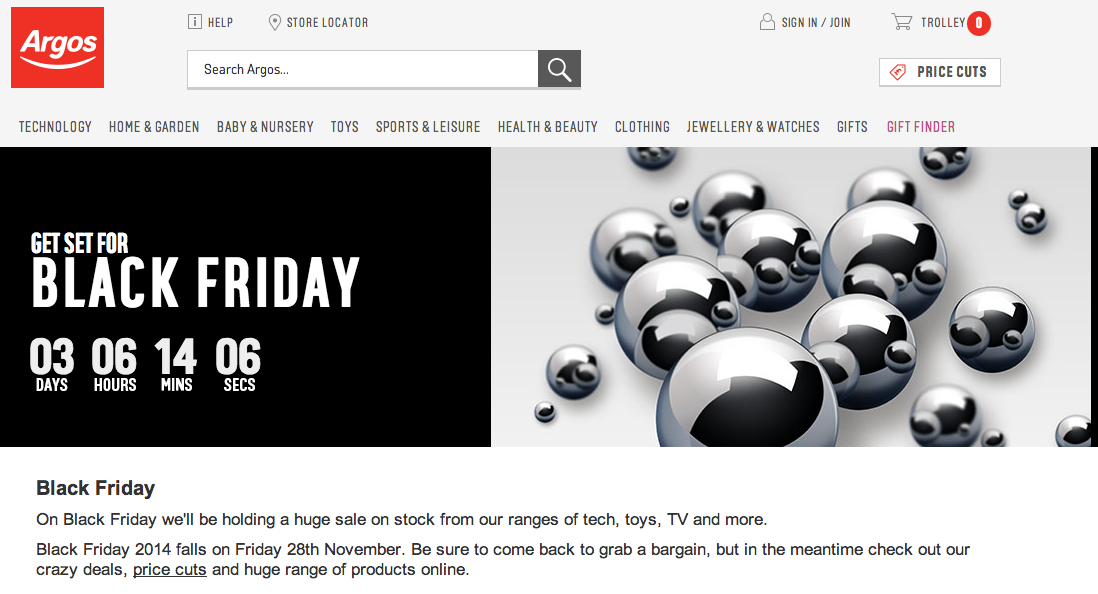
Argos has this countdown clock to get people excited about the amazing bargains, but it’s basically impossible to find other than via organic and paid search.
It also fails to give any indication of what the deals might be, so shoppers just have to trust that it’ll be worth coming back on Friday to find out.
John Lewis
John Lewis boldly states: “IF OUR COMPETITORS HAVE A SALE WE HAVE A SALE.”
But again I couldn’t find any way of navigating to this page via the John Lewis site, I could only find it in Google organic search results.
It even takes the time to explain to its customers exactly what Black Friday is and why it’s relevant.

John Lewis will open its stores early and match the sale prices offered by its competitors. It’s a bold promise and one that might be put to the test should other retailers slash their prices too far.
On Black Friday last year traffic to John Lewis’ site peaked between 7am and 8am at levels 14 times higher than anything the retailer had seen before.
It also broke previous records for a single day’s online trade.
Amazon
Amazon has Black Friday deals plastered all over its website, but then it is an American company so it has more experience of this seasonal shopping bonanza.
It has new deals every 10 minutes, with each accompanied by a countdown clock to drive a sense of urgency.
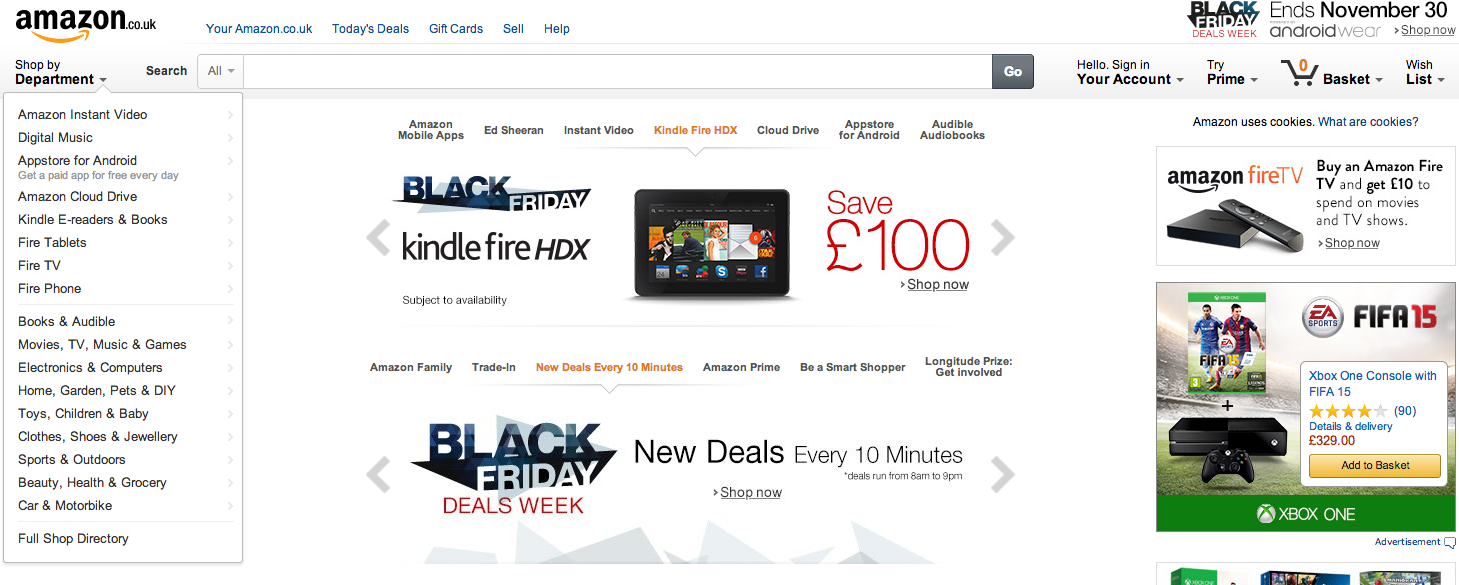
Shoppers can even browse upcoming deals so they can schedule in a 10-minute shopping frenzy. There will be 3,000 different offers this year, 10 times more than Amazon laid on in 2010.
Due to the sheer number of deals most of the products are what I’d describe as ‘useless crap’, but Amazon occasionally throws in a TV or some headphones as well.

ASOS
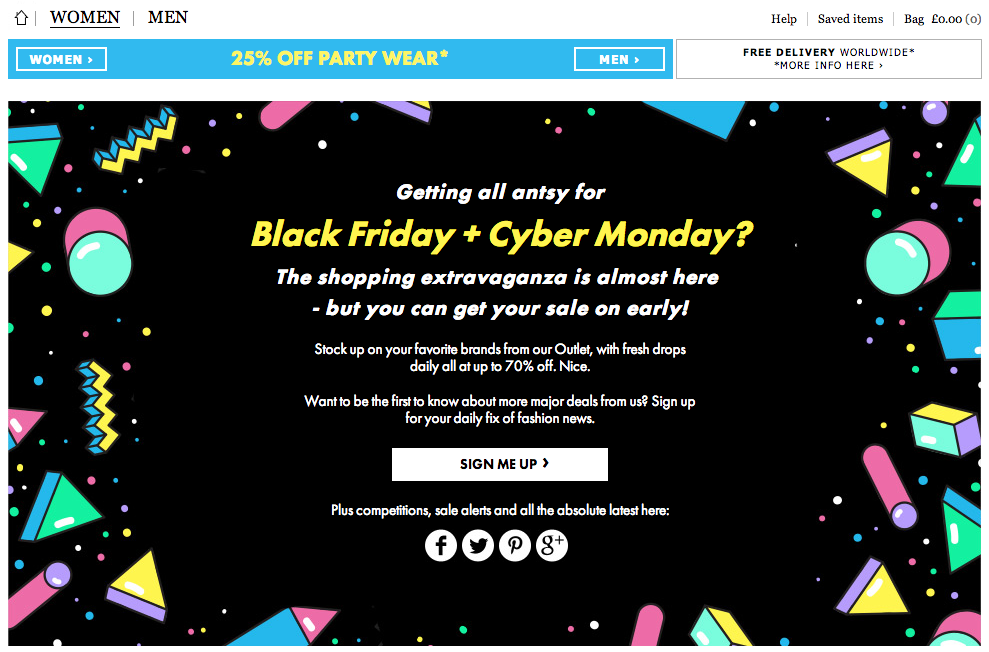
ASOS’s paid search ads lead to this Black Friday/Cyber Monday landing page, but it’s essentially a data capture form for the retailer’s existing Outlet store.
As yet there don’t appear to be any deals that are specifically available for Black Friday, this page is just to take advantage of consumer interest in the annual shopping event.
Currys
Currys has a small Black Friday banner on its homepage, which leads to a tantalising countdown clock…

There’s also a form where shoppers can sign up to receive news of Currys’ Black Friday deals, however it requires your name, phone number and home address, before forcing you to complete a CAPTCHA field.
Interestingly, this page also explains what Black Friday is, which gives an indication of the level of interest among UK shoppers. It says:
Shops open early and there are big savings online and in-store in time-limited deals – it’s the perfect time to get your Christmas shopping started. It’s also followed by Cyber Monday, another day of big online discounts.
Clearly UK brands are hoping to artificially generate some excitement around Black Friday so they can enjoy the same level of shopping that occurs over in the US.
It’ll be interesting to see whether people in the UK take the bait.
Jones Bootmaker
Jones Bootmaker is running a PPC campaign for Black Friday, but its landing page is for a generic sale.
Instead it’s relying on shoppers to read the ad copy closely to find out that a new sale will begin at midday on Friday.

Asda
Asda didn’t show up in Google and its Black Friday deals are only available in-store, but its hub page is worth further investigation.
The retailer has a homepage ad for its Black Friday offers which leads to a responsive landing page with a store locator, preview of the offers and a social aggregator for all mentions of #asdablackfriday.
Clearly Black Friday is a big deal at Asda (which is owned by Walmart), but only if you’re willing to fight the crowds in-store.

In conclusion…
UK retailers are obviously keen to make the most of any consumer interest in Black Friday, but other than Amazon none appear to have fully embraced the event.
It’s understandable that UK shoppers wouldn’t be particularly interested in a sales event that coincides with a public holiday we don’t even celebrate, but it’s also understandable that retailers would want to try and artificially create an annual event dedicated to shopping.
Though interest is picking up it’s quite telling that few sites have Black Friday banners on their homepages or within their nav menus.
Some of those that are spending on paid search haven’t really bothered to optimise their landing pages, while the likes of John Lewis and Currys have actually taken the time to explain exactly what Black Friday is and why people should care.
Therefore it seems that Black Friday is something of a slow burn for retailers and shoppers in the UK, but it may yet become an annual fixture.
Let’s just hope we don’t start to see that shameful display of people queuing in the street from midnight to secure the best deals.
3 Common Challenges Facing All SEO Managers
Anyone managing an SEO program, either in-house or for a client, knows there are a multitude of challenges. In fact, at SMX East back in October, Mark Munroe gave us this hilarious quote applying Murphy’s Law to SEO: It’s true! Just when you think everything is perfect and things couldn’t be…
Please visit Search Engine Land for the full article.
Google Drops Results In European Settlement But Watch The Penguin Drive By…
Google Settles UK “Defamation” Suit, Agreeing To Remove Malicious Links by Greg Sterling sums up the actual settlement pretty well but for those who read this site, I bet you’ll find it ironic that during a live BBC TV news report, the bus drove by out…
Google Mobile Shopping Adds More Details, 360 Views & Local Inventory
Google announced they have added new features to the mobile search results around shopping ads to bring more detailed product data in the search interface…
Google: Your Content In Tabs & Click To Expand May Not Be Indexed Or Ranked
The other day, I covered a thread around click to expand content not being indexed or ranked by Google. So I decided to ask John Mueller of Google that question in a live hangout on Google+ about a week ago and I was a bit surprised by his response……
Create Your 2015 Holiday SEO and Content List – Think Next Year Now!
In this post we take a look at holiday marketing trends year-over-year and what to watch going into 2015, so you can put ideas on your holiday marketing list for next year, right now. …
Create Your 2015 Holiday SEO and Content List – Think Next Year Now!
In this post we take a look at holiday marketing trends year-over-year and what to watch going into 2015, so you can put ideas on your holiday marketing list for next year, right now.
Stop Using the Wrong Metrics to Measure Content
Too often the value of content is judged purely on its social shares. Yet we need to measure the true added value to your business, as Andy Miller explains.
Post from Andy Miller
How To Select The Perfect Clients
Posted by Bill.Sebald

I truly believe in the power of partnerships. There have been some incredible partnerships that changed the fabric of our culture. Larry Page and Sergey Brin. William Procter and James Gamble. The Olson Twins.
Good partnerships provide support, motivation, and complementary skills, often allowing you to overcome hurdles faster and create some truly marvelous things. In consulting or any agency work, the concept of “partnership” should be the backbone of your relationship. Like a puzzle piece, sometimes the fit is initially difficult to find – if available at all. The truth is, you’re only secure if your clients are walking in the same direction as the flow of your service. If they’re walking against the current, you have what I believe to be the most detrimental predicament a service provider can have –
a rift. That’s a truly offensive four-letter word.
What kind of rift are we talking about? Let’s do a little calculating.
First think about what you or your agency is really good at. Think about the components you have the most success with; this may actually be different than where you’re most experienced. Think about what you should be selling versus not (even if those items are currently on your menu – let’s be candid here, a lot of us casually promote services we
believe we should be selling even though it’s not a fully baked product or core competency). Think about the amount of time you really spent challenging a given service to make sure it’s truly impactful to a client versus your own bottom line.
Next, think about your past client debacles (if you haven’t stopped to perform a postmortem, you should). Chances are these led to events that cost you a lot of time, pain, and possibly money. They are the memories that make you shudder. Those are the days that made you dust off your resume and think about a career change.
Finally, how many of these past clients should have never been signed in the first place? How many simply weren’t a fit from the start? How many simply never had a shot at being successful with you – and vice-versa? This computation really needs serious consideration. Have you wasted everyone’s time?
There can be a costly fallout. I’ve seen talented team members quit over clients that simply could not be managed. I’ve seen my colleagues go so far as to cry or start seeking therapy (in part) because of overwhelming clients who were not getting what they expected and a parent company who wasn’t providing any relief. Sometimes these clients were bound to an annual contract which only made them more desperate and angry. Rifts like this can kill your business.
This should never happen.
Client/agency relationships are marriages, but marriages start with dating
I really like this 2011 post from A List Apart called
Marry Your Clients. A few years old, but nothing has changed. However, my post is going to talk about the courting part before the honeymoon.
My post also assumes you make more money on longer consulting relationships. If you’ve somehow built your model through routinely hunting new business with the expectation you’re going to get fired, then that’s a different story. For most of us however, on-boarding a client is a lot of work, both in terms of hours (which is money) and brainpower. If you “hit it off” with your client, you begin to know their business more intimately, as well as their goals and KPIs. The strategies get easier to build; they also tend to be more successful as you become aware of what their tastes and limitations are. You find you have things in common (perhaps you both enjoy long walks to the bank). You often become true partners with your clients, who in turn promote your ideas to their bosses. These are your most profitable engagements, as well as your most rewarding. They tend to last years, sometimes following your point-of-contact to their next jobs as well.
But you don’t get this way simply because both parties signed a legally-bounding document.
The truth is not all parties can work together. A lot of client/agency relationships end in divorce. Like in romance, sometimes you just aren’t compatible.
A different kind of online dating
After my first marriage went kaput, I’ll admit I went to Match.com. For those who never tried online dating, it’s really an exercise in personal marketing. You upload your most attractive pictures. You sell yourself above everyone else. You send communications back and forth to the interested parties where you work to craft the “perfect” response; as well as ask qualifying questions. I found it works pretty well – the online process saved me from potentially bad dates. Don’t get me wrong, I still have some awkward online dating stories…

Photo from Chuck Woolery’s
Twitter profile
With consulting, if we’re supposed to ultimately marry our clients, we should obviously be allowed to see if there’s a love connection. We should all be our own Chuck Woolery. I tend to think this stage is crucial, but often rushed by agencies or managed by a department outside of your own.
Some agencies seem to have a “no dating” policy. For some, it’s not uncommon to come in to work and have an email from a higher-up with the subject, “congratulations – you’re now married to a new client!” Whether it’s a client development department, or an add-on from an existing client, your marketing department is suddenly forced into an arranged marriage where you can only hope to live up to their expectations.
This is a recipe for disaster. I don’t like to run a business on luck and risk, so clearly this makes no sense to me.
But I’ve been there. I once worked for an agency that handed me a signed contract for a major underwear brand – but I didn’t even know we were even speaking to them. Before I had a chance to get the details, the VP of digital marketing called me. I did my best to understand what they were promised in terms of SEO goals without admitting I really had no clue about their business. The promises were unrealistic, but being somewhat timid and naïve back in the day, I went with it. Truth is, their expectations did not fit into our model, philosophies, or workflow. Ultimately I failed to deliver to their expectations. The contract ended early and I vowed to never let that happen again. Not just for the stress and anxiety it brought upon my team and me, but for the blatant neglect to the client as well.
With this being something I never forgot, I would occasionally bring this story up with others I met at networking events or conventions. I quickly learned this is far from an isolated incident occurring only to me. This is how some agencies build their business development departments.
Once again, this should never happen.
How to qualify a client
Let’s assume by now I have successfully inspired a few things:
- A client/agency relationship should truly be a partnership akin to a good marriage.
- A client should never be thrown into a model that doesn’t make sense for their business (i.e., your style of SEO services), and process should be in place for putting all the parties in the same room before a deal is signed.
Now we’re up to number 3:
- Not all relationships work, so all parties should try to truly connect before there is a proposal. Don’t rush the signature!
Here are some of the things we do at Greenlane to really qualify a client. Before I continue, though, I’m proud to brag a little. With these practices in place, our close rate – that is, the companies we really want to work with – is 90% in our favor. Our retainment is also very high. Once we started being prudent with our intake, we’ve only lost a few companies due to funding issues or a change in their business model – not out of performance. I should also add that these tips work with all sizes of clients. While some of our 20+ clients are smaller businesses, we also have household brands and public companies, all of which could attest to going through this process with us.
It’s all in the details
Your website is your Match.com profile. Your website is your personality. If you’re vague or promotional or full of hype, only to get someone on the phone to which your “car salesman” gear kicks in, I don’t think you’re using the website to the best of its ability. People want to use the website to learn more about you before the reach out.
Our “about us” page is our third most visited page next to the homepage and pricing (outside of the blog). You can see an example from a
Hotjar heatmap:

The truth is, I’m always tweaking (and A/B testing) our message on the about us page. This page is currently part of a funnel that we careful put together. The “about us” page is a quick but powerful overview putting our team front and center and highlighting our experience (including some past clients).
I believe the website’s more than a brochure. It’s a communication device. Don’t hide or muddle who you are. When I get a prospect email through our form, I always lead them to our “Are We The Right Fit” page. That’s right – I actually ask them to consider choosing wisely. Now at first glance, this might go against a conversion funnel that heats up the prospect and only encourages momentum, but this page has really been a strong asset. It’s crafted to transparently present our differentiators, values, and even our pricing. It’s also crafted to discourage those who aren’t a good fit. You can find this page
here. Even our URL provides the “Are We The Right Fit” question.
We want prospects to make a good decision. We care so much about companies doing great that we’d rather you find someone else if our model isn’t perfect. Sure, sometimes after pointing someone to that link, they never return. That’s OK. Just like a dating profile, this page is designed to target a certain kind of interest. Time is a commodity in agency life – no sense in wasting it on a conversation that isn’t qualified. When we do catch a prospect after reviewing the page and hear, “we went with another firm who better suits our needs,” it actually doesn’t feel like a loss at all.
Everyone who comes back goes into our pipeline. At this stage they all get followed up on with a phone call. If they aren’t a good fit from the get go we actually try to introduce them to other SEO companies or consultants who would be a better fit for them. But 9 times out of 10, it’s an amazing conversation.
Never drop the transparency
There are a few things I try to tell all the prospects I ultimately speak with. One, I openly admit I’m not a salesman. I couldn’t sell ice water to people in hell. But I’m good at being really candid about our strengths and experiences.
Now this one tends to surprise some, especially in the larger agency setting. We admit that we are really choosy about the clients we take on. For our model, we need clients who are flexible, fast moving, interested in brand building, and interested in long-term relationships. We want clients who think in terms of strategy and will let us work with their existing marketing team and vendors. We audit them for their understanding of SEO services and tell them how we’re either alike or different.
I don’t think a prospect call goes by without me saying, “while you’re checking us out to see if we’re a good fit, we’re doing the same for you.” Then, if the call goes great, I let them know we’d like a follow up call to continue (a second date if you will). This follow up call has been where the real decision gets made.
Ask the right questions
I’ve vetted the opportunity, now my partner – who naturally has a different way of approaching opportunities and relationships – asks a different set of questions. This adds a whole different dimension and works to catch the questions I may not have asked. We’ve had companies ready to sign on the first call, to which I’ve had to divert any signatures until the next conversation. This too may seem counter-intuitive to traditional business development, but we find it extremely valuable. It’s true that we could have more clients in our current book of business, but I can proudly state that every current client is exactly who we want to be with; this is very much because of everything you’ve read so far.
On each call we have a list of qualifying questions that we ask. Most are “must answer” questions, while others can roll into a needs analysis questionnaire that we give to each signed client. The purpose of the needs analysis is to get more granular into business items (such as seasonal trends, industry intelligence, etc.) for the intention of developing strategies. With so much to ask, it’s important to be respectful of the prospects’ time. At this point they’ve usually already indicated they’ve read our website, can afford our prices, and feel like we’re a good fit.
Many times prospects start with their introduction and answer some of our questions. While they speak, I intently listen and take many notes.
These are 13 questions from my list that I always make sure get answered on a call, with some rationale:
Questions for the prospect:
1. Can you describe your business model and products/services?
- What do you sell?
- B2B or B2C
- Retail or lead generation?
Rationale
: sometimes when reviewing the website it’s not immediately clear what kind of business they’re in. Perhaps the site just does a bad job, or sometimes their real money making services are deeper in the site and easily missed by a fast scan. One of our clients works with the government and seems to have an obvious model, but the real profit is from a by-product, something we would have never picked up on during our initial review of the website. It’s important to find out exactly what the company does. Is it interesting? Can you stay engaged? Is it a sound model that you believe in? Is it a space you have experience in?
2. What has been your experience with [YOUR SERVICE] in the past?
Rationale: Many times, especially if your model is different, a prospect may have a preconceived notion of what you actually do. Let’s take SEO as an example – there are several different styles of SEO services. If they had a link building company in the past, and you’re a more holistic SEO consulting practice, their point of reference may only be with what they’ve experienced. They may even have a bad taste in their mouth from a previous engagement, which gives you a chance to air it out and see how you compare. This is also a chance to know if you’re potentially playing with a penalized site.
3. What are your [PPC/SEO/etc.] goals?
Rationale: Do they have realistic goals, or lofty, impossible goals? Be candid – tell them if you don’t think you can reach the goals on the budget they have, or if you think they should choose other goals. Don’t align yourself with goals you can’t hit. This is where many conversations could end.
4. What’s your mission or positioning statement?
Rationale: If you’re going to do more than just pump up their rankings, you probably want to know the full story. This should provide a glimpse into other marketing the prospect is executing.
5. How do you stand out?
Rationale: Sometimes this is answered with the question above. If not, really dig up the differentiators. Those are typically the key items to build campaigns on. Whether they are trying to create a new market segment or have a redundant offering, this can help you set timeline and success expectations.
6. Are you comfortable with an agency that may challenge your plans and ideas?
Rationale: This is one of my favorite questions. There are many who hire an agency and expect “yes-men.” Personally I believe an agency or consultant should be partners; that is, not afraid to fight for what they know is right for the benefit of the client. You shouldn’t be afraid of injury:

7. Who are your competitors?
Rationale: Not only do you want this for competitive benchmarking, but this can often help you understand more about the prospect. Not to mention, how big a hill you might have to climb to start competing on head terms.
8. What is your business reach? (local, national, international)?
Rationale: An international client is going to need more work than a domestic client. A local client is going to need an expertise in local search. Knowing the scope of the company can help you align your skills with their targets.
9. What CMS are you on?
Rationale:
This is a big one. It tells you how much flexibility you will have. Wordpress? Great – you’ll probably have a lot of access to files and templates. A proprietary CMS or enterprise solution? Uh-oh. That probably means tickets and project queues. Are you OK with that?
10. What does your internal team look like?
Rationale:
Another important question. Who will you be working with? What skill sets? Will you be able to sit at the table with other vendors too? If you’re being hired to fill in the gaps, make sure you have the skills to do so. I ask about copywriters, developers, designers, and link builders at a minimum.
11. What do you use for analytics?
Rationale:
A tool like Wappalyzer can probably tell you, but sometimes bigger companies have their own custom analytics through their host. Sometimes it’s bigger than Google Analytics, like Omniture. Will you be allowed to have direct access to it? You’d be surprised how often we hear no.
12. How big is your site? Do you have other properties?
Rationale:
It’s surprising how often a prospect forgets to mention those 30+ subdomains and microsites. If the prospect envisions it as part of the deal, you should at least be aware of how far the core website extends.
13. What is your budget, preferred start time, and end date?
Rationale:
The biggest question of all. Do they even meet your fee requirements? Are you staffed and ready to take on the work? Sure, talking money can be tough, but if you post your rates firm, the prospect is generally more open to talk budget. They don’t feel like a negotiation is going to happen.
Conclusion
While these are the core questions we use, I’m sure the list will eventually grow. I don’t think you should copy our list, or the order. You should ultimately create your own. Every agency or consultant has different requirements, and interviewing your prospect is as important as allowing them to interview you. But remember, you don’t have to have all the business. Just the right kind of business. You will grow organically from your positive experiences. We all hear about “those other agencies” and how they consistently fail to meet client expectations. Next to “do great work,” this is one powerful way to keep off that list.
Sign up for The Moz Top 10, a semimonthly mailer updating you on the top ten hottest pieces of SEO news, tips, and rad links uncovered by the Moz team. Think of it as your exclusive digest of stuff you don’t have time to hunt down but want to read!
Energize Your Content Strategy with Buyer Personas & Buyer Journeys – December 4 Webcast
Killer content is only “killer” if you know your audience. Your content needs to relate to your buyers in meaningful and lasting ways. Join us Thursday, December 4th for this Digital Marketing Depot webcast with Bryan Eisenberg. He’ll discuss why it’s essential to develop the right…
Please visit Search Engine Land for the full article.
SearchCap: Google Poland Penalty, Break Up Google & Black Friday Shopping
Below is what happened in search today, as reported on Search Engine Land and from other places across the web. From Search Engine Land: 3 Proven Ways To Write Ads That Deliver More Conversions Now you know you need to change your paid search creative …
Google: pay $ monthly and in return see an ad-free web on participating sites
Google has announced launching
read more
Google Contributor Lets Users Pay to Remove Ads From Websites
Google is running an ad-free Internet experiment that could challenge its own ad-funded business model.
Google Contributor Lets Users Pay to Remove Ads From Websites
Google is running an ad-free Internet experiment that could challenge its own ad-funded business model.
Google to be ‘Broken Up’ in Europe in Bid to End Search Monopoly
Google could face drastic measures being taken against it in Europe in order for competition online to be “restored”.