Publisher Blocking: How the Web Was Lost
Streaming Apps

Google recently announced app streaming, where they can showcase & deep link into apps in the search results even if users do not have those apps installed. How it works is rather than users installing the app, Google has the app installed on a computer in their cloud & then shows users a video of the app. Click targets, ads, etc. remain the same.
In writing about the new feature, Danny Sullivan wrote a section on “How The Web Could Have Been Lost”
Imagine if, in order to use the web, you had to download an app for each website you wanted to visit. To find news from the New York Times, you had to install an app that let you access the site through your web browser. To purchase from Amazon, you first needed to install an Amazon app for your browser. To share on Facebook, installation of the Facebook app for your browser would be required. That would be a nightmare.
…
The web put an end to this. More specifically, the web browser did. The web browser became a universal app that let anyone open anything on the web.
To meaningfully participate on those sorts of sites you still need an account. You are not going to be able to buy on Amazon without registration. Any popular social network which allows third party IDs to take the place of first party IDs will quickly become a den of spam until they close that loophole.
In short, you still have to register with sites to get real value out of them if you are doing much beyond reading an article. Without registration it is hard for them to personalize your experience & recommend relevant content.
Desktop Friendly Design
App indexing & deep linking of apps is a step in the opposite direction of the open web. It is supporting proprietary non-web channels which don’t link out. Further, if you thought keyword (not provided) heavily obfuscated user data, how much will data be obfuscated if the user isn’t even using your site or app, but rather is interacting via a Google cloud computer?
- Who visited your app? Not sure. It was a Google cloud computer.
- Where were they located? Not sure. It was a Google cloud computer.
- Did they have problems using your app? Not sure. It was a Google cloud computer.
- What did they look at? Can you retarget them? Not sure. It was a Google cloud computer.
Is an app maker too lazy to create a web equivalent version of their content? If so, let them be at a strategic disadvantage to everyone who put in the extra effort to publish their content online.
If Google has their remote quality raters consider a site as not meeting users needs because they don’t publish a “mobile friendly” version of their site, how can one consider a publisher who creates “app only” content as an entity which is trying hard to meet end user needs?
We know Google hates app install interstitials (unless they are sold by Google), thus the only reason Google would have for wanting to promote these sorts of services would be to justify owning, controlling & monetizing the user experience.
App-solutely Not The Answer

Apps are sold as a way to lower channel risk & gain direct access to users, but the companies owning the app stores are firmly in control.
- Google is being investigated by regulators in multiple markets over their Android bundling contracts. And while bundling is a core feature of the OS, others who bundle are given the boot.
- Google Now on Tap embeds Google search in third party apps.
- The low pricepoints for consumer apps in app stores makes it hard for businesses to justify selling B2B apps for a high enough price to offset the smaller addressable audience.
- It has become harder to sell consumer apps as the app stores have saturated with competition.
2008 I’ll sell apps for $2.99 & make millions
2010 At $0.99 I’ll make $1000s
2012 Ads might cover my rent
2014 Kickstart my app
2015 Hire me— Nick Lockwood (@nicklockwood) August 3, 2015 - Exceptionally popular apps are disabled for interfering with business models of the platforms. Apps and extensions can be disabled at any time, even after the fact, due to violating guidelines or rule changes that turn what was once fine into a guideline violation. In some cases when they are disabled it is done with no option to re-enable.
- The Amazon app on iOS allows you to buy physical goods, but good luck buying an ebook in it. Even Amazon was removed from Google’s Play store after allowing digital purchases. Apple TV doesn’t support Amazon Prime Video. In turn, Amazon has stopped selling some streaming items from Apple and Google.
Everyone wants to “own” the user, but none of the platforms bother to ask if the user wants to be owned:
We’re rapidly moving from an internet where computers are ‘peers’ (equals) to one where there are consumers and ‘data owners’, silos of end user data that work as hard as they can to stop you from communicating with other, similar silos.
…
If the current trend persists we’re heading straight for AOL 2.0, only now with a slick user interface, a couple more features and more users.
You’ve Got AOL
The AOL analogy is widely used:
Katz of Gogobot says that “SEO is a dying field” as Google uses its “monopoly” power to turn the field of search into Google’s own walled garden like AOL did in the age of dial-up modems.
Almost 4 years ago a Google engineer described SEO as a bug. He suggested one shouldn’t be able to rank highly without paying.
It looks like he was right. Google’s aggressive ad placement on mobile SERPs “has broken the will of users who would have clicked on an organic link if they could find one at the top of the page but are instead just clicking ads because they don’t want to scroll down.”
In the years since then we’ve learned Google’s “algorithm” has concurrent ranking signals & other forms of home cooking which guarantees success for Google’s vertical search offerings. The “reasonable” barrier to entry which applies to third parties does not apply to any new Google offerings.
And “bugs” keep appearing in those “algorithms,” which deliver a steady stream of harm to competing businesses.
From Indy to Brand

The waves of algorithm updates have in effect increased the barrier to entry, along with the cost needed to maintain rankings. The stresses and financial impacts that puts on small businesses makes many of them not worth running. Look no further than MetaFilter’s founder seeing a psychologist, then quitting because he couldn’t handle the process.
When Google engineers are not focused on “breaking spirits” they emphasize the importance of happiness.
The ecosystem instability has made smaller sites effectively disappear while delivering a bland and soulless result set which is heavy on brand:
there’s no reason why the internet couldn’t keep on its present course for years to come. Under those circumstances, it would shed most of the features that make it popular with today’s avant-garde, and become one more centralized, regulated, vacuous mass medium, packed to the bursting point with corporate advertising and lowest-common-denominator content, with dissenting voices and alternative culture shut out or shoved into corners where nobody ever looks. That’s the normal trajectory of an information technology in today’s industrial civilization, after all; it’s what happened with radio and television in their day, as the gaudy and grandiose claims of the early years gave way to the crass commercial realities of the mature forms of each medium.
If you participate on the web daily, the change washes over you slowly, and the cumulative effects can be imperceptible. But if you were locked in an Iranian jail for years the change is hard to miss.
These sorts of problems not only impact search, but have an impact on all the major tech channels.
iPhone autocorrect inserted “showgirl” for “shows” and “POV” for “PPC”. This crowd sourcing of autocorrect is not welcomed.— john andrews (@searchsleuth998) November 10, 2015
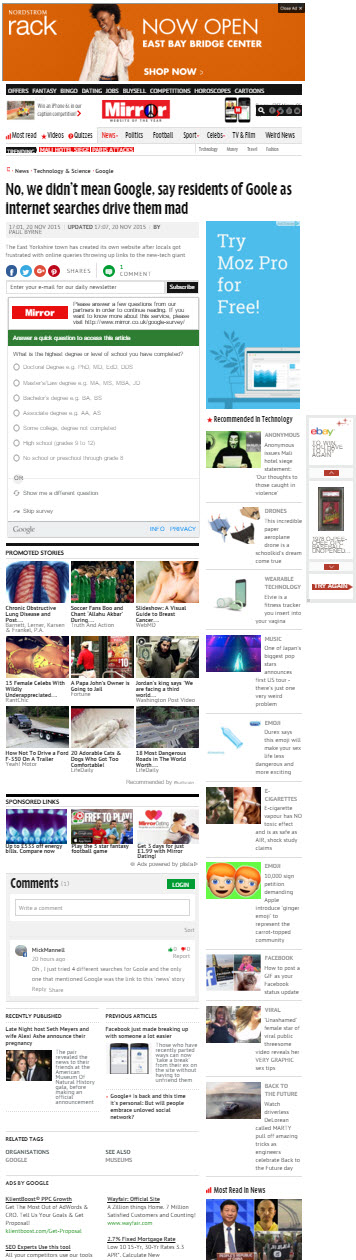
If you live in Goole, these issues strike close to home.
And there are almost no counter-forces to the well established trend:
Eventually they might even symbolically close their websites, finishing the job they started when they all stopped paying attention to what their front pages looked like. Then, they will do a whole lot of what they already do, according to the demands of their new venues. They will report news and tell stories and post garbage and make mistakes. They will be given new metrics that are both more shallow and more urgent than ever before; they will adapt to them, all the while avoiding, as is tradition, honest discussions about the relationship between success and quality and self-respect.
…
If in five years I’m just watching NFL-endorsed ESPN clips through a syndication deal with a messaging app, and Vice is just an age-skewed Viacom with better audience data, and I’m looking up the same trivia on Genius instead of Wikipedia, and “publications” are just content agencies that solve temporary optimization issues for much larger platforms, what will have been point of the last twenty years of creating things for the web?
A Deal With the Devil
 As ad blocking has grown more pervasive, some publishers believe the solution to the problem is through gaining distribution through the channels which are exempt from the impacts of ad blocking. However those channels have no incentive to offer exceptional payouts. They make more by showing fewer ads within featured content from partners (where they must share ad revenues) and showing more ads elsewhere (where they keep all the ad revenues).
So far publishers have been underwhelmed with both Facebook Instant Articles and Apple News. The former for stringent ad restrictions, and the latter for providing limited user data. Google Now is also increasing the number of news stories they show. And next year Google will roll out their accelerated mobile pages offering.
The problem is if you don’t control the publishing you don’t control the monetization and you don’t control the data flow.
Your website helps make the knowledge graph (and other forms of vertical search) possible. But you are paid nothing when your content appears in the knowledge graph. And the knowledge graph now has a number of ad units embedded in it.
A decade ago, when Google pushed autolink to automatically insert links in publisher’s content, webmasters had enough leverage to “just say no.” But now? Not so much. Google considers in-text ad networks spam & embeds their own search in third party apps. As the terms of deals change, and what is considered “best for users” changes, content creators quietly accept, or quit.
Many video sites lost their rich snippets, while YouTube got larger snippets in the search results. Google pays YouTube content creators a far lower revenue share than even the default AdSense agreement offers. And those creators have restrictions which prevent them from using some forms of monetization while forces them to accept other types of bundling.
The most recent leaked Google rater documents suggested the justification for featured answers was to make mobile search quick, but if that were the extent of it then it still doesn’t explain why they also appear on desktop search results. It also doesn’t explain why the publisher credit links were originally a light gray.
With Google everything comes down to speed, speed, speed. But then they offer interstitial ad units, lock content behind surveys, and transform the user intent behind queries in a way that leads them astray.
As Google obfuscates more data & increasingly redirects and monetizes user intent, they promise to offer advertisers better integration of online to offline conversion data.
At the same time, as Google “speeds up” your site for you, they may break it with GoogleWebLight.
If you don’t host & control the user experience you are at the whim of (at best, morally agnostic) self-serving platforms which could care less if any individual publication dies.
It’s White Hat or Bust…

What was that old white hat SEO adage? I forget the precise wording, but I think it went something like…
Don’t buy links, it is too risky & too uncertain. Guarantee strong returns like Google does, by investing directly into undermining the political process by hiring lobbyists, heavy political donations, skirting political donation rules, regularly setting policy, inserting your agents in government, and sponsoring bogus “academic research” without disclosing the payments.
Focus on the user. Put them first. Right behind money.
Categories:
Publisher Blocking: How the Web Was Lost
Streaming Apps
Google recently announced app streaming, where they can showcase & deep link into apps in the search results even if users do not have those apps installed. How it works is rather than users installing the app, Google has the app installed on a computer in their cloud & then shows users a video of the app. Click targets, ads, etc. remain the same.
In writing about the new feature, Danny Sullivan wrote a section on “How The Web Could Have Been Lost”
Imagine if, in order to use the web, you had to download an app for each website you wanted to visit. To find news from the New York Times, you had to install an app that let you access the site through your web browser. To purchase from Amazon, you first needed to install an Amazon app for your browser. To share on Facebook, installation of the Facebook app for your browser would be required. That would be a nightmare.
…
The web put an end to this. More specifically, the web browser did. The web browser became a universal app that let anyone open anything on the web.
To meaningfully participate on those sorts of sites you still need an account. You are not going to be able to buy on Amazon without registration. Any popular social network which allows third party IDs to take the place of first party IDs will quickly become a den of spam until they close that loophole.
In short, you still have to register with sites to get real value out of them if you are doing much beyond reading an article. Without registration it is hard for them to personalize your experience & recommend relevant content.
Desktop Friendly Design
App indexing & deep linking of apps is a step in the opposite direction of the open web. It is supporting proprietary non-web channels which don’t link out. Further, if you thought keyword (not provided) heavily obfuscated user data, how much will data be obfuscated if the user isn’t even using your site or app, but rather is interacting via a Google cloud computer?
- Who visited your app? Not sure. It was a Google cloud computer.
- Where were they located? Not sure. It was a Google cloud computer.
- Did they have problems using your app? Not sure. It was a Google cloud computer.
- What did they look at? Can you retarget them? Not sure. It was a Google cloud computer.
Is an app maker too lazy to create a web equivalent version of their content? If so, let them be at a strategic disadvantage to everyone who put in the extra effort to publish their content online.
If Google has their remote quality raters consider a site as not meeting users needs because they don’t publish a “mobile friendly” version of their site, how can one consider a publisher who creates “app only” content as an entity which is trying hard to meet end user needs?
We know Google hates app install interstitials (unless they are sold by Google), thus the only reason Google would have for wanting to promote these sorts of services would be to justify owning, controlling & monetizing the user experience.
App-solutely Not The Answer
Apps are sold as a way to lower channel risk & gain direct access to users, but the companies owning the app stores are firmly in control.
- Google is being investigated by regulators in multiple markets over their Android bundling contracts. And while bundling is a core feature of the OS, others who bundle are given the boot.
- Google Now on Tap embeds Google search in third party apps.
- The low pricepoints for consumer apps in app stores makes it hard for businesses to justify selling B2B apps for a high enough price to offset the smaller addressable audience.
- It has become harder to sell consumer apps as the app stores have saturated with competition.
2008 I’ll sell apps for $2.99 & make millions
2010 At $0.99 I’ll make $1000s
2012 Ads might cover my rent
2014 Kickstart my app
2015 Hire me— Nick Lockwood (@nicklockwood) August 3, 2015 - Exceptionally popular apps are disabled for interfering with business models of the platforms. Apps and extensions can be disabled at any time, even after the fact, due to violating guidelines or rule changes that turn what was once fine into a guideline violation. In some cases when they are disabled it is done with no option to re-enable.
- The Amazon app on iOS allows you to buy physical goods, but good luck buying an ebook in it. Even Amazon was removed from Google’s Play store after allowing digital purchases. Apple TV doesn’t support Amazon Prime Video. In turn, Amazon has stopped selling some streaming items from Apple and Google.
Everyone wants to “own” the user, but none of the platforms bother to ask if the user wants to be owned:
We’re rapidly moving from an internet where computers are ‘peers’ (equals) to one where there are consumers and ‘data owners’, silos of end user data that work as hard as they can to stop you from communicating with other, similar silos.
…
If the current trend persists we’re heading straight for AOL 2.0, only now with a slick user interface, a couple more features and more users.
You’ve Got AOL
The AOL analogy is widely used:
Katz of Gogobot says that “SEO is a dying field” as Google uses its “monopoly” power to turn the field of search into Google’s own walled garden like AOL did in the age of dial-up modems.
Almost 4 years ago a Google engineer described SEO as a bug. He suggested one shouldn’t be able to rank highly without paying.
It looks like he was right. Google’s aggressive ad placement on mobile SERPs “has broken the will of users who would have clicked on an organic link if they could find one at the top of the page but are instead just clicking ads because they don’t want to scroll down.”
In the years since then we’ve learned Google’s “algorithm” has concurrent ranking signals & other forms of home cooking which guarantees success for Google’s vertical search offerings. The “reasonable” barrier to entry which applies to third parties does not apply to any new Google offerings.
And “bugs” keep appearing in those “algorithms,” which deliver a steady stream of harm to competing businesses.
From Indy to Brand
The waves of algorithm updates have in effect increased the barrier to entry, along with the cost needed to maintain rankings. The stresses and financial impacts that puts on small businesses makes many of them not worth running. Look no further than MetaFilter’s founder seeing a psychologist, then quitting because he couldn’t handle the process.
When Google engineers are not focused on “breaking spirits” they emphasize the importance of happiness.
The ecosystem instability has made smaller sites effectively disappear while delivering a bland and soulless result set which is heavy on brand:
there’s no reason why the internet couldn’t keep on its present course for years to come. Under those circumstances, it would shed most of the features that make it popular with today’s avant-garde, and become one more centralized, regulated, vacuous mass medium, packed to the bursting point with corporate advertising and lowest-common-denominator content, with dissenting voices and alternative culture shut out or shoved into corners where nobody ever looks. That’s the normal trajectory of an information technology in today’s industrial civilization, after all; it’s what happened with radio and television in their day, as the gaudy and grandiose claims of the early years gave way to the crass commercial realities of the mature forms of each medium.
If you participate on the web daily, the change washes over you slowly, and the cumulative effects can be imperceptible. But if you were locked in an Iranian jail for years the change is hard to miss.
These sorts of problems not only impact search, but have an impact on all the major tech channels.
iPhone autocorrect inserted “showgirl” for “shows” and “POV” for “PPC”. This crowd sourcing of autocorrect is not welcomed.— john andrews (@searchsleuth998) November 10, 2015
If you live in Goole, these issues strike close to home.
And there are almost no counter-forces to the well established trend:
Eventually they might even symbolically close their websites, finishing the job they started when they all stopped paying attention to what their front pages looked like. Then, they will do a whole lot of what they already do, according to the demands of their new venues. They will report news and tell stories and post garbage and make mistakes. They will be given new metrics that are both more shallow and more urgent than ever before; they will adapt to them, all the while avoiding, as is tradition, honest discussions about the relationship between success and quality and self-respect.
…
If in five years I’m just watching NFL-endorsed ESPN clips through a syndication deal with a messaging app, and Vice is just an age-skewed Viacom with better audience data, and I’m looking up the same trivia on Genius instead of Wikipedia, and “publications” are just content agencies that solve temporary optimization issues for much larger platforms, what will have been point of the last twenty years of creating things for the web?
A Deal With the Devil
As ad blocking has grown more pervasive, some publishers believe the solution to the problem is through gaining distribution through the channels which are exempt from the impacts of ad blocking. However those channels have no incentive to offer exceptional payouts. They make more by showing fewer ads within featured content from partners (where they must share ad revenues) and showing more ads elsewhere (where they keep all the ad revenues).
So far publishers have been underwhelmed with both Facebook Instant Articles and Apple News. The former for stringent ad restrictions, and the latter for providing limited user data. Google Now is also increasing the number of news stories they show. And next year Google will roll out their accelerated mobile pages offering.
The problem is if you don’t control the publishing you don’t control the monetization and you don’t control the data flow.
Your website helps make the knowledge graph (and other forms of vertical search) possible. But you are paid nothing when your content appears in the knowledge graph. And the knowledge graph now has a number of ad units embedded in it.
A decade ago, when Google pushed autolink to automatically insert links in publisher’s content, webmasters had enough leverage to “just say no.” But now? Not so much. Google considers in-text ad networks spam & embeds their own search in third party apps. As the terms of deals change, and what is considered “best for users” changes, content creators quietly accept, or quit.
Many video sites lost their rich snippets, while YouTube got larger snippets in the search results. Google pays YouTube content creators a far lower revenue share than even the default AdSense agreement offers. And those creators have restrictions which prevent them from using some forms of monetization while forces them to accept other types of bundling.
The most recent leaked Google rater documents suggested the justification for featured answers was to make mobile search quick, but if that were the extent of it then it still doesn’t explain why they also appear on desktop search results. It also doesn’t explain why the publisher credit links were originally a light gray.
With Google everything comes down to speed, speed, speed. But then they offer interstitial ad units, lock content behind surveys, and transform the user intent behind queries in a way that leads them astray.
As Google obfuscates more data & increasingly redirects and monetizes user intent, they promise to offer advertisers better integration of online to offline conversion data.
At the same time, as Google “speeds up” your site for you, they may break it with GoogleWebLight.
If you don’t host & control the user experience you are at the whim of (at best, morally agnostic) self-serving platforms which could care less if any individual publication dies.
It’s White Hat or Bust…
What was that old white hat SEO adage? I forget the precise wording, but I think it went something like…
Don’t buy links, it is too risky & too uncertain. Guarantee strong returns like Google does, by investing directly into undermining the political process by hiring lobbyists, heavy political donations, skirting political donation rules, regularly setting policy, inserting your agents in government, and sponsoring bogus “academic research” without disclosing the payments.
Focus on the user. Put them first. Right behind money.
Categories:
Will Google Start Reading Text in Images on the Web Soon?
Googlebot Doesn’t Read Pictures of Text During Web Crawls When I was an Administrator at Cre8asiteforums (2002-2007), one of my favorite forums on the site was one called the Website Hospital. People would come with their sites and questions about how they could improve them. One problem that often appeared was people having problems being … Continue reading Will Google Start Reading Text in Images on the Web Soon? →
The post Will Google Start Reading Text in Images on the Web Soon? appeared first on SEO by the Sea.
The Future: This is Not your Father’s SEO
While everyone left and right of me is either not really doing much SEO or is deeply engaged in hard-core SEO, the middle ground is an active battle field. That middle ground… which I refer to as Competitive Publishing, involves smart, strategic deployment of publishing (using technology) to achieve business goals (specific to search and […]
Prerender and You: a Case Study in AJAX Crawlability
The story
This year I had the opportunity to work on an interesting technical SEO project for a client: they had a great web-app that prioritized performance and usability, built entirely with AJAX.
12 Provably False Ideas Your SEO Should Not Be Telling You
Because the SEO industry has never adopted standards there is no way for the average business decision-maker to know whether their in-house SEO expert or SEO consultant is telling them something reliable. This is the problem that we all have…
Updating Our Search Quality Rating Guidelines
Developing algorithmic changes to search involves a process of experimentation. Part of that experimentation is having evaluators—people who assess the quality of Google’s search results—give us feedback on our experiments. Ratings from evaluators do not determine individual site rankings, but are used help us understand our experiments. The evaluators base their ratings on guidelines we give them; the guidelines reflect what Google thinks search users want.
In 2013, we published our human rating guidelines to provide transparency on how Google works and to help webmasters understand what Google looks for in web pages. Since that time, a lot has changed: notably, more people have smartphones than ever before and more searches are done on mobile devices today than on computers.
We often make changes to the guidelines as our understanding of what users wants evolves, but we haven’t shared an update publicly since then. However, we recently completed a major revision of our rater guidelines to adapt to this mobile world, recognizing that people use search differently when they carry internet-connected devices with them all the time. You can find that update here (PDF).
This is not the final version of our rater guidelines. The guidelines will continue to evolve as search, and how people use it, changes. We won’t be updating the public document with every change, but we will try to publish big changes to the guidelines periodically.
We expect our phones and other devices to do a lot, and we want Google to continue giving users the answers they’re looking for—fast!
Posted by Mimi Underwood, Sr. Program Manager, Search Growth & Analysis


Hide and Seek with Facebook Ads
Advertising on Facebook over the last few years has continued to explode, particularly on mobile devices, with Facebook seeing a 72 per cent year-on-year growth in advertising on smartphones and tablets to $3.3bn.
Recalculating PageRank
A Google patent was granted on October 20th, 2015 titled Producing a ranking for pages using distances in a Web-link graph. It presents some changes to Google’s original PageRank. I wrote about the very first PageRank patent in my post The First PageRank Patent and the Newest, where I posted a link to the original … Continue reading Recalculating PageRank →
The post Recalculating PageRank appeared first on SEO by the Sea.

TC Summit 2015: Celebrating our Webmaster Top Contributors!
Two weeks ago, we were extremely lucky to host the 2015 edition of the Top Contributor Summit (#TCsummit), in San Francisco and on Google’s campus in Mountain View, California.
Google Top Contributors are an exceptional group of passionate Google product enthusiasts who share their expertise across our international help forums to support millions of Google users every year. Google’s Top Contributor Summit is an event organised every two years, to celebrate these amazing users. This year we had the pleasure to welcome 526 Top Contributors, from all around the world.
Under the motto “Learn, Connect, Celebrate”, Top Contributors had the chance to learn more about our products, get insights on the future of Google, connect with Googlers and Top Contributors from various products and, finally, to celebrate their positive impact on our products and users.
Footage of the 2015 Top Contributor Summit
We also had the chance to hold Webmaster-specific sessions, which gave Googlers the unique opportunity to meet 56 of our Webmaster Top Contributors, representing 20 countries and speaking 14 different languages.
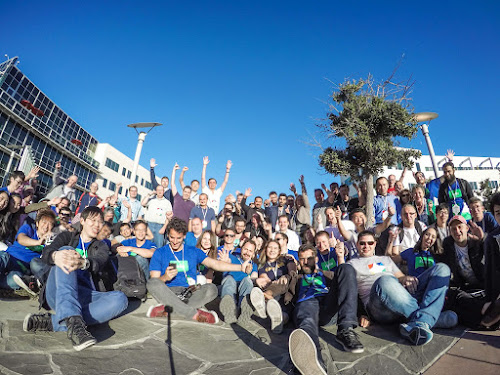
Group photo of the Webmaster Top Contributor community and the Google Webmaster Relations team
Throughout the day, we had in-depth sessions about Google Webmaster guidelines, Search Console and Google Search. We discussed the most common issues that users are bringing up in our international webmaster forums, and listened to the Top Contributors’ feedback regarding our Search tools. We also talked about the Top Contributor program itself and additional opportunities for our users to benefit from both Google and the TCs’ support. Product managers, engineers and search quality Googlers attended the sessions to listen and bring the feedback given by Top Contributors and users on the forum back to their teams.

Webmaster Top Contributors during the in-depth sessions about Google Webmaster guidelines, Search Console and Google Search
At Google, we are grateful to have the incredible opportunity to meet and connect with some of the most insightful members of the webmaster community and get their feedback on such important topics. It helps us be sure that Google keeps focusing on what really matters to webmasters, content creators, and users.
To learn more about our Top Contributor Program, or to give us your own feedback, visit our Top Contributor homepage or join our Webmaster help forum.
Diogo Botelho and Roberta Remigi, Webmaster Relations team

Getting Started with .htaccess: a Guide for SEOs

As an SEO, you’ll almost definitely have strayed upon an Apache configuration or .htaccess file at some point.
Google Files Patent for Drone Delivery Platform
If you’ve been keeping an eye on the news, you may have seen a Reuters article about Google planning for the use of Drones titled Google aims to begin drone package deliveries in 2017 You may also have seen another article from Time Magazine that tells us it might be a while till we see … Continue reading Google Files Patent for Drone Delivery Platform →
The post Google Files Patent for Drone Delivery Platform appeared first on SEO by the Sea.
How To Suck At Social Media: An Indispensable Guide For Businesses
Facebook, at last count, has 1.5 billion monthly active users. YouTube has 1.2 billion users (watching 6 billion hours of videos!). Instagram has an estimated 400 million users. Those are some big gigantic numbers! [Sidebar] I’m experimenting with sharing short stories via an insightful newsletter. I’d love for you to sign up: The Marketing Analytics […]
How To Suck At Social Media: An Indispensable Guide For Businesses is a post from: Occam’s Razor by Avinash Kaushik
That Time I Had Cancer
(This is a highly personal post so if that isn’t your thing then you should move on.) On Friday, October 23 I breathed a sigh of relief as my oncologist told me that my six month PET/CT scan was clear. I am cancer free! High Noon It’s an odd thing to sit on that thin […]
Penguin is Coming! The Penguin is Coming!
A new post from www.davidnaylor.co.uk. BAZINGA!
The post Penguin is Coming! The Penguin is Coming! appeared first on UK SEO Blog by Dave Naylor – SEO Tools, Tips & News.
It’s Your Move, SEO
It’s SEO time. Get busy.
CTR Manipulation Myths vs Reality
CTR has been turning into an increasingly more powerful ranking factor in Google over the last few years so naturally, people started trying to gamble it. Consequently, Google started trying to fight the manipulation. Hence, I will try to post …
Detect and get rid of unwanted sneaky mobile redirects
In many cases, it is OK to show slightly different content on different devices. For example, optimizing the smaller space of a smartphone screen can mean that some content, like images, will have to be modified. Or you might want to store your website’s menu in a navigation drawer (find documentation here) to make mobile browsing easier and more effective. When implemented properly, these user-centric modifications can be understood very well by Google.
The situation is similar when it comes to mobile-only redirect. Redirecting mobile users to improve their mobile experience (like redirecting mobile users from example.com/url1 to m.example.com/url1) is often beneficial to them. But redirecting mobile users sneakily to a different content is bad for user experience and is against Google’s webmaster guidelines.
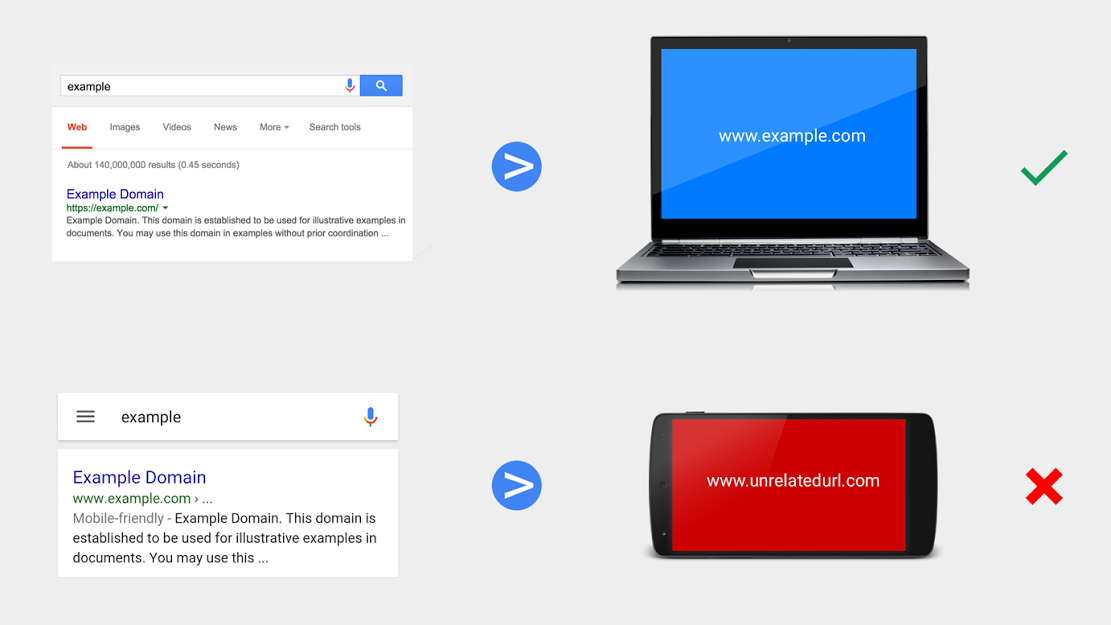
A frustrating experience: The same URL shows up in search results pages on desktop and on mobile. When a user clicks on this result on their desktop computer, the URL opens normally. However, when clicking on the same result on a smartphone, a redirect happens and an unrelated URL loads.
Who implements these mobile-only sneaky redirects?
There are cases where webmasters knowingly decide to put into place redirection rules for their mobile users. This is typically a webmaster guidelines violation, and we do take manual action against it when it harms Google users’ experience (see last section of this article).
But we’ve also observed situations where mobile-only sneaky redirects happen without site owners being aware of it:
- Advertising schemes that redirect mobile users specifically
A script/element installed to display ads and monetize content might be redirecting mobile users to a completely different site without the webmaster being aware of it.
- Mobile redirect as a result of the site being a target of hacking
In other cases, if your website has been hacked, a potential result can be redirects to spammy domains for mobile users only.
How do I detect if my site is doing sneaky mobile redirects?
- Check if you are redirected when you navigate to your site on your smartphone
We recommend you to check the mobile user experience of your site by visiting your pages from Google search results with a smartphone. When debugging, mobile emulation in desktop browsers is handy, mostly because you can test for many different devices. You can, for example, do it straight from your browser in Chrome, Firefox or Safari (for the latter, make sure you have enabled the “Show Develop menu in menu bar” feature).
- Listen to your users
Your users could see your site in a different way than you do. It’s always important to pay attention to user complaints, so you can hear of any issue related to mobile UX. - Monitor your users in your site’s analytics data
Unusual mobile user activity could be detected by looking at some of the data held in your website’s analytics data. For example, looking at the average time spent on your site by your mobile users could be a good signal to watch: if all of a sudden, your mobile users (and only them) start spending much less time on your site than they used to, there might be an issue related to mobile redirections.To be aware of wide changes in mobile user activity as soon as they happen, you can for example set up Google Analytics alerts. For example, you can set an alert to be warned in case of a sharp drop in average time spent on your site by mobile users, or a drop in mobile users (always take into account that big changes in those metrics are not a clear, direct signal that your site is doing mobile sneaky redirects).


I’ve detected sneaky redirects for my mobile users, and I did not set it up: what do I do?
- Make sure that your site is not hacked.
Check the Security Issues tool in the Search Console, if we have noticed any hack, you should get some information there.
Review our additional resources on typical symptoms of hacked sites, and our case studies on hacked sites. - Audit third-party scripts/elements on your site
If your site is not hacked, then we recommend you take the time to investigate if third-party scripts/elements are causing the redirects. You can follow these steps:
A. Remove one by one the third-party scripts/elements you do not control from the redirecting page(s).
B. Check your site on a mobile device or through emulation between each script/element removal, and see when the redirect stops.
C. If you think a particular script/element is responsible for the sneaky redirect, consider removing it from your site, and debugging the issue with the script/element provider.
Last Thoughts on Sneaky Mobile Redirects
It’s a violation of the Google Webmaster Guidelines to redirect a user to a page with the intent of displaying content other than what was made available to the search engine crawler (more information on sneaky redirects). To ensure quality search results for our users, the Google Search Quality team can take action on such sites, including removal of URLs from our index. When we take manual action, we send a message to the site owner via Search Console. Therefore, make sure you’ve set up a Search Console account.
Be sure to choose advertisers who are transparent on how they handle user traffic, to avoid unknowingly redirecting your own users. If you are interested in trust-building in the online advertising space, you may check out industry-wide best practices when participating in ad networks. For example, the Trustworthy Accountability Group’s (Interactive Advertising Bureau) Inventory Quality Guidelines are a good place to start. There are many ways to monetize your content with mobile solutions that provide a high quality user experience, be sure to use them.
If you have questions or comments about mobile-only redirects, join us in our Google Webmaster Support forum.
Written by Vincent Courson & Badr Salmi El Idrissi, Search Quality team

It’s Not Too Late to Avoid Upcoming Google Penguin Update
A new post from www.davidnaylor.co.uk. BAZINGA!
The post It’s Not Too Late to Avoid Upcoming Google Penguin Update appeared first on UK SEO Blog by Dave Naylor – SEO Tools, Tips & News.