Google Search Console updated the Search Analytics report & adds knowledge graph, local & rich snippets
Google updated the Search Analytics report in the Search Console, added an update line and explained what changes you may see in the report.
The post Google Search Console updated the Search Analytics report & adds knowledge graph, local & rich snippets appeared first on Search Engine…
Please visit Search Engine Land for the full article.
How Nordstrom strategically beat Zappos in Google Search
Five years ago, in April 2011, Zappos’ market share in Google was more than three times as large as Nordstrom‘s. Today, Nordstrom has twice the market share on Google as Zappos.
Why Every Brand Needs to Migrate to HTTP/2 & How To Do It
Google, Microsoft, Mozilla and Apple are desperate to encourage all brands to ensure their website is compatible with the relatively new HTTP/2 protocol which is now supported by each of their web browsers – Chrome, Edge, Firefox and Safari. HTTP/2 is the new version of the HTTP protocol that underpins the web and revolutionises how […]
Post from Pete Campbell
Keyword Research in 2016: Going Beyond Guesswork
Posted by Dr-Pete
When we do keyword research, we tend to focus on discovery. We take a short list of keywords we think matter, brainstorm wildly, paste the resulting list into a dozen tools, paste the results back into Excel, and measure our success by how often our spreadsheet crashes. Then, we throw it all away when our tax attorney client tells us he only cares about ranking #1 for “taylor swift downloads,” because he heard that gets a lot of traffic.
Maybe I’m exaggerating. Keyword discovery is a critical process, but what we’re left with at the end is a long and often rambling list to prioritize, and typically we prioritize either by our own gut feelings or by the black box of AdWords global volume. What if there were a better way?

When we were building Keyword Explorer, we wanted to solve the deeper problem — how do we pick the best keywords to start with, given the complexity of Google SERPs and our competition in modern SEO? Which keywords really balance potential traffic with ROI?
Over the course of many months, we created four metrics:
- Keyword Difficulty (V2)
- Keyword Opportunity
- Importance (user-defined)
- Keyword Potential
Today, I want to explain the philosophy of these metrics, some of the math behind them, and how you can use these ideas to reinvent your approach to keyword research. Stepping outside of our product, I’m going to try and translate these metrics into questions that are relevant to anyone, regardless of which tools you use.
1. How difficult is the keyword to rank for?
All else being equal, we’d rather rank #1 on a keyword that gets a ton of traffic. In the real world, though, all else is rarely equal. High-volume keywords are often highly competitive, which translates directly into more ranking difficulty. More difficulty means more time and/or more money.
A few years ago, we developed a Keyword Difficulty metric based on our authority metrics (Domain Authority and Page Authority). Page Authority (PA) is a constantly evolving metric that is designed to correlate with a page’s ability to rank on Google, based in large part on the page’s link profile. Keyword Difficulty (V1) used Page Authority in the middle-top of SERPs (the median PA, more or less) for a given keyword to approximate how hard that keyword would be to rank on.
Our updated Keyword Difficulty (V2) score uses a more complex, click-through rate (CTR) weighted model of Page Authority across the first page of a SERP, reflecting more of the competitive landscape, and adapts to today’s irregular organic result counts. V2 also does a better job of filling in gaps when PA metrics are missing for one or more results. Finally, V2 scales scores to fill more of the 0–100 range and provide better granularity.
If you want to cheat and build your own proxy for Keyword Difficulty, I’m going to risk a few sales and let you in on a secret. Install the MozBar SEO toolbar (it’s free), run your Google search, and grab the PA from result #4:

Why #4? That’s a rough approximation of the median difficulty of the page, slightly adjusted for the prevalence of SERPs with less than 10 results. You can pull similar data (although in a couple more steps) from Open Site Explorer (also free). Again, it’s a rough approximation, and Keyword Difficulty V2 adds quite a bit, but it’s a start. You’ve got one more column in your spreadsheet.
2. How much organic opportunity is there?
The days of 10 blue links are gone, and today’s SERPs are a complicated mix of paid results, organic results, vertical results, and Knowledge Graph features. Traditional keyword research assumes a mythical page of nothing but blue links and 100% click-through potential.
Let’s look at a modern SERP, a result for the brand “Forever 21” in Portland, Oregon:

While there are many potential opportunities on this page, the only traditional SEO opportunities that a company other than Forever 21 can realistically compete on are the three in green. The first position is naturally dominated by the brand, the two rows of site-links beneath it each occupy one row of organic results, there are two verticals (Twitter and News), a local pack, and the three results at the bottom are a pack of In-depth Articles and not subject to the same algorithm as core organic results. Plus, there’s a Knowledge Panel on the right that has the potential to draw away clicks.
From a traditional SEO standpoint, there is very little organic opportunity available on this page. Our Keyword Opportunity metric attempts to measure this phenomenon. It starts with the assumption of 100% CTR (that’s idealized, of course, but it makes the scale go from 0–100), and then begins subtracting clicks based on non-organic features, including ads. Ads and Knowledge Graph features take away clicks and re-shift the CTR curve. Verticals occupy an organic position and remove the CTR of that position, etc. If the #1 position has site-links, we assume that position has “dominant intent” (to use Google’s vernacular) and probably isn’t in play.
The Keyword Opportunity model gets complicated and it necessarily makes many assumptions, but the goal is to subtract out all of the non-organic elements and try to figure out what’s left. We hope to enhance and evolve this model as time goes by and we gather more data about how features impact CTR.
You don’t have to use Keyword Explorer or build your own, equally complicated model, but I think it’s very important to look at SERPs in a browser as a real searcher and understand the available opportunity. Even if you do keyword research by hand, give that opportunity a score (1–5 is a good start). Some of the most attractive, highest-volume keywords also have the least available opportunity.
3. How important is the keyword to you?
We’ve all got stories about clueless clients, but their experience does matter and some keywords have more business relevance than others. The trick is not to let it become too subjective. Put a number against it. Make your client, boss, or team prioritize. Everything can’t be a 10, so create a column and force them to pick a value. Quantify your intuition and put it to work.
In Keyword Explorer, we wanted to allow customers to adjust keywords up and down to reflect insights and intuitions our models may not have. Importance is essentially a multiplier, and it ranges from 1–10. We default Importance to a value of 3. That may seem like an unusual choice, but it allows you to easily shift a keyword by roughly a factor of 3 in either direction (1 = 1/3X, 9 = 3X). It also gives you a bit more granularity for upward adjustments than downward. Our assumption is that most people will tend to focus importance adjustments on critical keywords that are essential to their business.
4. Which keywords have the most potential?
So now you’ve got a mountain of data, which is great in theory but a bit overwhelming for many of us in reality. We thought it was important that people have the raw metrics — many of you are advanced SEOs and want to slice-and-dice the data into your own models. However, we also thought it was important to provide guidance and help make sense of it all. Perhaps the toughest question at the end of the keyword research process is “Where do I start?”
Counting keyword Volume, we have the following metrics (or variables):
- Volume (V)
- Keyword Difficulty (KD)
- Keyword Opportunity (KO)
- Importance (I)
Keyword Potential (KP) combines all of these metrics, creating a weighted score (also 0–100). Volume is a real number that carries meaning by itself. You can think of both Keyword Difficulty and Keyword Opportunity as multipliers. Higher Difficulty reduces Potential, while higher Opportunity increases Potential. Likewise, Importance is a direct multiplier. Our formula for Keyword Potential looks something like this:
KP = sqrt(V) * (1 – KD / 100) * (KO / 100) * I
We use the square root of Volume so that high-volume keywords don’t automatically overwhelm all of the other metrics, but very high-volume keywords still naturally carry a lot of potential. The resulting value is re-scaled in Keyword Explorer to a 0–100 score, but that math gets a bit tricky and is somewhat unique to our own internal metrics and the ranges of data we historically encounter.
Even if you do keyword research by hand or in a semi-automated fashion, there are many ways to adapt this basic concept and create a useful meta-metric. Obviously, one metric can never convey all of the complexity of rich data, but it’s important to remember that this is not an either/or situation. You can use a meta-metric for sorting and prioritization, while still keeping all of its original components for deeper insights.
Richer metrics for a richer world
No metrics are perfect, but the Google landscape is richer and more complex than ever, and it’s important that our metrics and tactics evolve as SERPs evolve. Whether or not you use Keyword Explorer, keyword research is still a fundamental building block of a strong SEO campaign, and that research has to reflect modern SEO realities. Understanding the interplay of volume, difficulty, opportunity, and your own intuition of importance is an important next step, and those concepts extend far beyond any single product. If you end up adapting any of these ideas, I’d love to hear about it. Extra credit for Excel spreadsheets, especially ones that crash my computer.
Sign up for The Moz Top 10, a semimonthly mailer updating you on the top ten hottest pieces of SEO news, tips, and rad links uncovered by the Moz team. Think of it as your exclusive digest of stuff you don’t have time to hunt down but want to read!
The (Hollow) Soul of Technology
The Daily Obituary
As far as being an investable business goes, news is horrible.
And it is getting worse by the day.
Look at these top performers.
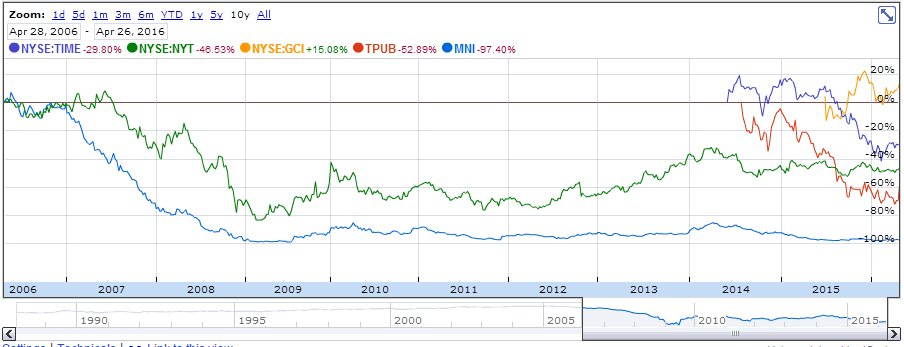
The above chart looks ugly, but in reality it puts an optimistic spin on things…
- it has survivorship bias
- the Tribune Company has already went through bankruptcy
- the broader stock market is up huge over the past decade after many rounds of quantitative easing and zero (or even negative) interest rate policy
- the debt carrying costs of the news companies are also artificially low due to the central banking bond market manipulation
- the Tribune Company recently got a pop on a buy out offer
Selling The Story
Almost all the solutions to the problems faced by the mainstream media are incomplete and ultimately will fail.
That doesn’t stop the market from selling magic push button solutions. The worse the fundamentals get, the more incentive (need) there is to sell the dream.
Video
Video will save us.
No it won’t.
Video is expensive to do well and almost nobody at any sort of scale on YouTube has an enviable profit margin. Even the successful individuals who are held up as the examples of success are being squeezed out and Google is trying to push to make the site more like TV. As they get buy in from big players they’ll further squeeze out the indy players – just like general web search.
Even if TV shifts to the web, along with chunks of the associated ad budget, most of the profits will be kept by Google & ad tech management rather than flowing to publishers.
Some of the recent acquisitions are more about having more scale on an alternative platform or driving offline commerce rather than hoping for online ad revenue growth.
Expand Internationally
The New York times is cutting back on their operations in Paris.
Spread Across Topics
What impact does it have on Marketwatch’s brand if you go there for stocks information and they advise you on weight loss tips?
And, once again, when everyone starts doing that it is no longer a competitive advantage.
There have also been cases where newspapers like The New York Times acquired About.com only to later sell it for a loss. And now even About.com is unbundling itself.
@glenngabe They’re doing good work over there. Worth noting that they 301’d all the https://t.co/sF2JMe8lU5 health content to verywell.— Jesse Semchuck (@jessesem) April 26, 2016
Native Ads
The more companies who do them & the more places they are seen, the lower the rates go, the less novel they will seem, and the greater the likelihood a high-spending advertiser decides to publish it on their own site & then drive the audience directly to their site.
When it is rare or unique it stands out and is special, justifying the extra incremental cost. But when it is a scaled process it is no longer unique enough to justify the vastly higher cost.
Further, as it gets more pervasive it will lead to questions of editorial integrity.
Get Into Affiliate Marketing
It won’t scale across all the big publishers. It only works well at scale in select verticals and as more entities test it they’ll fill up the search results and end up competing for a smaller slice of attention. Further, each new affiliate means every other affiliate’s cookie lasts for a shorter duration.
It is unlikely news companies will be able to create commercially oriented review content at scale while having the depth of Wirecutter.
“We move as much product as a place 10 times bigger than us in terms of audience,” Lam said in an interview. “That’s because people trust us. We earn that trust by having such deeply-researched articles.”
Further, as it gets more pervasive it will lead to questions of editorial integrity.
Charging People to Comment
It won’t work, as it undermines the social proof of value the site would otherwise have from having many comments on it.
Meal Delivery Kits
Absurd. And a sign of extreme desperation.
Trust Tech Monopolies
Here is Doug Edwards on Larry Page:
He wondered how Google could become like a better version of the RIAA – not just a mediator of digital music licensing – but a marketplace for fair distribution of all forms of digitized content. I left that meeting with a sense that Larry was thinking far more deeply about the future than I was, and I was convinced he would play a large role in shaping it.
If we just give Google or Facebook greater control, they will save us.
No they won’t.
You are probably better off selling meal kits.
As time passes, Google and Facebook keep getting a larger share of the pie, growing their rake faster than the pie is growing.
Here is the RIAA’s Cary Sherman on Google & Facebook:
Just look at Silicon Valley. They’ve done an extraordinary job, and their market cap is worth gazillions of dollars. Look at the creative industries — not just the music industry, but all of them. All of them have suffered.
Over time media sites are becoming more reliant on platforms for distribution, with visitors having fleeting interest: “bounce rates on media sites having gone from 20% of visitors in the early 2000s to well over 70% of visitors today.”
Accelerated Mobile Pages and Instant Articles?
These are not solutions. They are only a further acceleration of the problem.
How will giving greater control to monopolies that are displacing you (while investing in AI) lead to a more sustainable future for copyright holders? If they host your content and you are no longer even a destination, what is your point of differentiation?
If someone else hosts your content & you are depended on them for distribution you are competing against yourself with an entity that can arbitrarily shift the terms on you whenever they feel like it.
“The cracks are beginning to show, the dependence on platforms has meant they are losing their core identity,” said Rafat Ali “If you are just a brand in the feed, as opposed to a brand that users come to, that will catch up to you sometime.”
Do you think you gain leverage over time as they become more dominant in your vertical? Not likely. Look at how Google’s redesigned image search shunted traffic away from the photographers. Google’s remote rater guidelines even mentioned giving lower ratings to images with watermaks on them. So if you protect your works you are punished & if you don’t, good luck negotiating with a monopoly. You’ll probably need the EU to see any remedy there.
When something is an embarrassment to Google & can harm their PR fixing it becomes a priority, otherwise most the costs of rights management fall on the creative industry & Google will go out of their way to add cost to that process. Facebook is, of course, playing the same game with video freebooting.
Algorithms are not neutral and platforms change what they promote to suit their own needs.
As the platforms aim to expand into new verticals they create new opportunities, but those opportunities are temporal.
Whatever happened to Zynga?
Even Buzzfeed, the current example of success on Facebook, missed their revenue target badly, even as they become more dependent on the Facebook feed.
“One more implication of aggregation-based monopolies is that once competitors die the aggregators become monopsonies — i.e. the only buyer for modularized suppliers. And this, by extension, turns the virtuous cycle on its head: instead of more consumers leading to more suppliers, a dominant hold over suppliers means that consumers can never leave, rendering a superior user experience less important than a monopoly that looks an awful lot like the ones our antitrust laws were designed to eliminate.” – Ben Thompson
Long after benefit stops passing to the creative person the platform still gets to re-use the work. The Supreme Court only recentlyrefused to hear the ebook scanning case & Google is already running stories about using romance novels to train their AI. How long until Google places their own AI driven news rewrites in front of users?
Who then will fund journalism?
Dumb it Down

Remember how Panda was going to fix crap content for the web? eHow has removed literally millions of articles from their site & still has not recovered in Google. Demand Media’s bolt-on articles published on newspaper sites still rank great in Google, but that will at some point get saturated and stop being a growth opportunity, shifting from growth to zero sum to a negative sum market, particularly as Google keeps growing their knowledge scraper graph.
.@mattcutts I think I have spotted one, Matt. Note the similarities in the content text: pic.twitter.com/uHux3rK57f— dan barker (@danbarker) February 27, 2014
Now maybe if you dumb it down with celebrity garbage you get quick clicks from other channels and longterm SEO traffic doesn’t matter as much.
But if everyone is pumping the same crap into the feed it is hard to stand out. When everyone starts doing it the strategy is no longer a competitive advantage. Further, if you build a business that is algorithmically optimized for short-term clicks is also optimizing for its own longterm irrelevancy.
Yahoo’s journalists used to joke amongst themselves about the extensive variety of Kind bars provided, but now the snacks aren’t being replenished. Instead, employees frequently remind each other that there is little reason to bother creating quality work within Yahoo’s vast eco-system of middle-brow content. “You are competing against Kim Kardashian’s ass,” goes a common refrain.
…
Yahoo’s billion-person-a-month home page is run by an algorithm, with a spare editorial staff, that pulls in the best-performing content from across the site. Yahoo engineers generally believed that these big names should have been able to support themselves, garner their own large audiences, and shouldn’t have relied on placement on the home page to achieve large audiences. As a result, they were expected to sink or swim on their own.
…
“Yahoo is reverting to its natural form,” a former staffer told me, “a crap home page for the Midwest.”
That is why Yahoo! ultimately had to shut down almost all their verticals. They were optimized algorithmically for short term wins rather than building things with longterm resonance.
Death by bean counter.
The above also has an incredibly damaging knock on effect on society.
People miss the key news. “what articles got the most views, and thus “clicks.” Put bluntly, it was never the articles on my catching Bernanke pulling system liquidity into the maw of the collapse in 2008, while he maintained to Congress he had done the opposite.” – Karl Denninger
The other issue is PR is outright displacing journalism. As bad as that is at creating general disinformation, it gets worse when people presume diversity of coverage means a diversity of thought process, a diversity of work, and a diversity of sources. Even people inside the current presidential administration state how horrible this trend is on society:
“All these newspapers used to have foreign bureaus,” he said. “Now they don’t. They call us to explain to them what’s happening in Moscow and Cairo. Most of the outlets are reporting on world events from Washington. The average reporter we talk to is 27 years old, and their only reporting experience consists of being around political campaigns. That’s a sea change. They literally know nothing.” … “We created an echo chamber,” he told the magazine. “They [the seemingly independent experts] were saying things that validated what we had given them to say.”
That is basically the government complaining to the press about it being “too easy” to manipulate the press.
Adding Echo to the Echo
Much of what “seems” like an algorithm on the tech platforms is actually a bunch of lowly paid humans pretending to be an algorithm.
When I worked curating Facebook Paper’s tech section (remember that?) they told me to just rip off Techmeme https://t.co/LJ6O3coFMy— (@kifleswing) May 3, 2016
This goes back to the problem of the limited diversity in original sources and rise of thin “take” pieces. Stories with an inconvenient truth can get suppressed, but “newsworthy” stories with multiple sources covering them may all use the same biased source.
After doing a tour in Facebook’s news trenches, almost all of them came to believe that they were there not to work, but to serve as training modules for Facebook’s algorithm. … A topic was often blacklisted if it didn’t have at least three traditional news sources covering it
As algorithms take over more aspects of our lives and eat more of the media ecosystem, the sources they feed upon will consistently lose quality until some sort of major reset happens.
The strategy to keep sacrificing the long term to hit the short term numbers can seem popular. And then, suddenly, death.
You can say the soul is gone
And the feeling is just not there
Not like it was so long ago.
– Neil Young, Stringman
Micropayments & Paywalls
It is getting cheap enough that just about anyone can run a paid membership site, but it is quite hard to create something worth paying for on a recurring basis.
There are a few big issues with paywalls:
- If you have something unique and don’t market it aggressively then nobody will know about it. And, in fact, in some businesses your paying customers may have no interest in sharing your content because they view it as one of their competitive advantages. This was one of the big reasons I ultimately had to shut down our membership site.
- If you do market something well enough to create demand then some other free sites will make free derivatives, and it is hard to keep having new things to write worth paying for in many markets. Eventually you exhaust the market or get burned out or stop resonating with it. Even free websites have churn. Paid websites have to bring in new members to offset old members leaving.
- In most markets worth being in there is going to be plenty of free sites in the vertical which dominate the broader conversation. Thus you likely need to publish a significant amount of information for free which leads into an eventual sale. But knowing where to put the free line & how to move it over time isn’t easy. Over the past year or two I blogged far less than I should have if I was going to keep running our site as a paid membership site.
- And the last big issue is that a paywall is basically counter to all the other sort of above business models the mainstream media is trying. You need deeper content, better content, content that is not off topic, etc. Many of the easy wins for ad funded media become easy losses for paid membership sites. And just like it is hard for newspapers to ween themselves off of print ad revenues, it can be hard to undo many of the quick win ad revenue boosters if one wants to change their business model drastically. Regaining you sou takes time, and often, death.

“It’s only after we’ve lost everything that we’re free to do anything.” ― Chuck Palahniuk, Fight Club
Categories:
The (Hollow) Soul of Technology
The Daily Obituary
As far as being an investable business goes, news is horrible.
And it is getting worse by the day.
Look at these top performers.
The above chart looks ugly, but in reality it puts an optimistic spin on things…
- it has survivorship bias
- the Tribune Company has already went through bankruptcy
- the broader stock market is up huge over the past decade after many rounds of quantitative easing and zero (or even negative) interest rate policy
- the debt carrying costs of the news companies are also artificially low due to the central banking bond market manipulation
- the Tribune Company recently got a pop on a buy out offer
Selling The Story
Almost all the solutions to the problems faced by the mainstream media are incomplete and ultimately will fail.
That doesn’t stop the market from selling magic push button solutions. The worse the fundamentals get, the more incentive (need) there is to sell the dream.
Video
Video will save us.
No it won’t.
Video is expensive to do well and almost nobody at any sort of scale on YouTube has an enviable profit margin. Even the successful individuals who are held up as the examples of success are being squeezed out and Google is trying to push to make the site more like TV. As they get buy in from big players they’ll further squeeze out the indy players – just like general web search.
Even if TV shifts to the web, along with chunks of the associated ad budget, most of the profits will be kept by Google & ad tech management rather than flowing to publishers.
Some of the recent acquisitions are more about having more scale on an alternative platform or driving offline commerce rather than hoping for online ad revenue growth.
Expand Internationally
The New York times is cutting back on their operations in Paris.
Spread Across Topics
What impact does it have on Marketwatch’s brand if you go there for stocks information and they advise you on weight loss tips?
And, once again, when everyone starts doing that it is no longer a competitive advantage.
There have also been cases where newspapers like The New York Times acquired About.com only to later sell it for a loss. And now even About.com is unbundling itself.
@glenngabe They’re doing good work over there. Worth noting that they 301’d all the https://t.co/sF2JMe8lU5 health content to verywell.— Jesse Semchuck (@jessesem) April 26, 2016
Native Ads
The more companies who do them & the more places they are seen, the lower the rates go, the less novel they will seem, and the greater the likelihood a high-spending advertiser decides to publish it on their own site & then drive the audience directly to their site.
When it is rare or unique it stands out and is special, justifying the extra incremental cost. But when it is a scaled process it is no longer unique enough to justify the vastly higher cost.
Further, as it gets more pervasive it will lead to questions of editorial integrity.
Get Into Affiliate Marketing
It won’t scale across all the big publishers. It only works well at scale in select verticals and as more entities test it they’ll fill up the search results and end up competing for a smaller slice of attention. Further, each new affiliate means every other affiliate’s cookie lasts for a shorter duration.
It is unlikely news companies will be able to create commercially oriented review content at scale while having the depth of Wirecutter.
“We move as much product as a place 10 times bigger than us in terms of audience,” Lam said in an interview. “That’s because people trust us. We earn that trust by having such deeply-researched articles.”
Further, as it gets more pervasive it will lead to questions of editorial integrity.
Charging People to Comment
It won’t work, as it undermines the social proof of value the site would otherwise have from having many comments on it.
Meal Delivery Kits
Absurd. And a sign of extreme desperation.
Trust Tech Monopolies
Here is Doug Edwards on Larry Page:
He wondered how Google could become like a better version of the RIAA – not just a mediator of digital music licensing – but a marketplace for fair distribution of all forms of digitized content. I left that meeting with a sense that Larry was thinking far more deeply about the future than I was, and I was convinced he would play a large role in shaping it.
If we just give Google or Facebook greater control, they will save us.
No they won’t.
You are probably better off selling meal kits.
As time passes, Google and Facebook keep getting a larger share of the pie, growing their rake faster than the pie is growing.
Here is the RIAA’s Cary Sherman on Google & Facebook:
Just look at Silicon Valley. They’ve done an extraordinary job, and their market cap is worth gazillions of dollars. Look at the creative industries — not just the music industry, but all of them. All of them have suffered.
Over time media sites are becoming more reliant on platforms for distribution, with visitors having fleeting interest: “bounce rates on media sites having gone from 20% of visitors in the early 2000s to well over 70% of visitors today.”
Accelerated Mobile Pages and Instant Articles?
These are not solutions. They are only a further acceleration of the problem.
How will giving greater control to monopolies that are displacing you (while investing in AI) lead to a more sustainable future for copyright holders? If they host your content and you are no longer even a destination, what is your point of differentiation?
If someone else hosts your content & you are depended on them for distribution you are competing against yourself with an entity that can arbitrarily shift the terms on you whenever they feel like it.
“The cracks are beginning to show, the dependence on platforms has meant they are losing their core identity,” said Rafat Ali “If you are just a brand in the feed, as opposed to a brand that users come to, that will catch up to you sometime.”
Do you think you gain leverage over time as they become more dominant in your vertical? Not likely. Look at how Google’s redesigned image search shunted traffic away from the photographers. Google’s remote rater guidelines even mentioned giving lower ratings to images with watermaks on them. So if you protect your works you are punished & if you don’t, good luck negotiating with a monopoly. You’ll probably need the EU to see any remedy there.
When something is an embarrassment to Google & can harm their PR fixing it becomes a priority, otherwise most the costs of rights management fall on the creative industry & Google will go out of their way to add cost to that process. Facebook is, of course, playing the same game with video freebooting.
Algorithms are not neutral and platforms change what they promote to suit their own needs.
As the platforms aim to expand into new verticals they create new opportunities, but those opportunities are temporal.
Whatever happened to Zynga?
Even Buzzfeed, the current example of success on Facebook, missed their revenue target badly, even as they become more dependent on the Facebook feed.
“One more implication of aggregation-based monopolies is that once competitors die the aggregators become monopsonies — i.e. the only buyer for modularized suppliers. And this, by extension, turns the virtuous cycle on its head: instead of more consumers leading to more suppliers, a dominant hold over suppliers means that consumers can never leave, rendering a superior user experience less important than a monopoly that looks an awful lot like the ones our antitrust laws were designed to eliminate.” – Ben Thompson
Long after benefit stops passing to the creative person the platform still gets to re-use the work. The Supreme Court only recentlyrefused to hear the ebook scanning case & Google is already running stories about using romance novels to train their AI. How long until Google places their own AI driven news rewrites in front of users?
Who then will fund journalism?
Dumb it Down
Remember how Panda was going to fix crap content for the web? eHow has removed literally millions of articles from their site & still has not recovered in Google. Demand Media’s bolt-on articles published on newspaper sites still rank great in Google, but that will at some point get saturated and stop being a growth opportunity, shifting from growth to zero sum to a negative sum market, particularly as Google keeps growing their knowledge scraper graph.
.@mattcutts I think I have spotted one, Matt. Note the similarities in the content text: pic.twitter.com/uHux3rK57f— dan barker (@danbarker) February 27, 2014
Now maybe if you dumb it down with celebrity garbage you get quick clicks from other channels and longterm SEO traffic doesn’t matter as much.
But if everyone is pumping the same crap into the feed it is hard to stand out. When everyone starts doing it the strategy is no longer a competitive advantage. Further, if you build a business that is algorithmically optimized for short-term clicks is also optimizing for its own longterm irrelevancy.
Yahoo’s journalists used to joke amongst themselves about the extensive variety of Kind bars provided, but now the snacks aren’t being replenished. Instead, employees frequently remind each other that there is little reason to bother creating quality work within Yahoo’s vast eco-system of middle-brow content. “You are competing against Kim Kardashian’s ass,” goes a common refrain.
…
Yahoo’s billion-person-a-month home page is run by an algorithm, with a spare editorial staff, that pulls in the best-performing content from across the site. Yahoo engineers generally believed that these big names should have been able to support themselves, garner their own large audiences, and shouldn’t have relied on placement on the home page to achieve large audiences. As a result, they were expected to sink or swim on their own.
…
“Yahoo is reverting to its natural form,” a former staffer told me, “a crap home page for the Midwest.”
That is why Yahoo! ultimately had to shut down almost all their verticals. They were optimized algorithmically for short term wins rather than building things with longterm resonance.
Death by bean counter.
The above also has an incredibly damaging knock on effect on society.
People miss the key news. “what articles got the most views, and thus “clicks.” Put bluntly, it was never the articles on my catching Bernanke pulling system liquidity into the maw of the collapse in 2008, while he maintained to Congress he had done the opposite.” – Karl Denninger
The other issue is PR is outright displacing journalism. As bad as that is at creating general disinformation, it gets worse when people presume diversity of coverage means a diversity of thought process, a diversity of work, and a diversity of sources. Even people inside the current presidential administration state how horrible this trend is on society:
“All these newspapers used to have foreign bureaus,” he said. “Now they don’t. They call us to explain to them what’s happening in Moscow and Cairo. Most of the outlets are reporting on world events from Washington. The average reporter we talk to is 27 years old, and their only reporting experience consists of being around political campaigns. That’s a sea change. They literally know nothing.” … “We created an echo chamber,” he told the magazine. “They [the seemingly independent experts] were saying things that validated what we had given them to say.”
That is basically the government complaining to the press about it being “too easy” to manipulate the press.
Adding Echo to the Echo
Much of what “seems” like an algorithm on the tech platforms is actually a bunch of lowly paid humans pretending to be an algorithm.
When I worked curating Facebook Paper’s tech section (remember that?) they told me to just rip off Techmeme https://t.co/LJ6O3coFMy— (@kifleswing) May 3, 2016
This goes back to the problem of the limited diversity in original sources and rise of thin “take” pieces. Stories with an inconvenient truth can get suppressed, but “newsworthy” stories with multiple sources covering them may all use the same biased source.
After doing a tour in Facebook’s news trenches, almost all of them came to believe that they were there not to work, but to serve as training modules for Facebook’s algorithm. … A topic was often blacklisted if it didn’t have at least three traditional news sources covering it
As algorithms take over more aspects of our lives and eat more of the media ecosystem, the sources they feed upon will consistently lose quality until some sort of major reset happens.
The strategy to keep sacrificing the long term to hit the short term numbers can seem popular. And then, suddenly, death.
You can say the soul is gone
And the feeling is just not there
Not like it was so long ago.
– Neil Young, Stringman
Micropayments & Paywalls
It is getting cheap enough that just about anyone can run a paid membership site, but it is quite hard to create something worth paying for on a recurring basis.
There are a few big issues with paywalls:
- If you have something unique and don’t market it aggressively then nobody will know about it. And, in fact, in some businesses your paying customers may have no interest in sharing your content because they view it as one of their competitive advantages. This was one of the big reasons I ultimately had to shut down our membership site.
- If you do market something well enough to create demand then some other free sites will make free derivatives, and it is hard to keep having new things to write worth paying for in many markets. Eventually you exhaust the market or get burned out or stop resonating with it. Even free websites have churn. Paid websites have to bring in new members to offset old members leaving.
- In most markets worth being in there is going to be plenty of free sites in the vertical which dominate the broader conversation. Thus you likely need to publish a significant amount of information for free which leads into an eventual sale. But knowing where to put the free line & how to move it over time isn’t easy. Over the past year or two I blogged far less than I should have if I was going to keep running our site as a paid membership site.
- And the last big issue is that a paywall is basically counter to all the other sort of above business models the mainstream media is trying. You need deeper content, better content, content that is not off topic, etc. Many of the easy wins for ad funded media become easy losses for paid membership sites. And just like it is hard for newspapers to ween themselves off of print ad revenues, it can be hard to undo many of the quick win ad revenue boosters if one wants to change their business model drastically. Regaining you sou takes time, and often, death.
“It’s only after we’ve lost everything that we’re free to do anything.” ― Chuck Palahniuk, Fight Club
Categories:
Yahoo Gemini launches retargeting for search and native ads in US
Audience retargeting capabilities include site visitors and app customers.
The post Yahoo Gemini launches retargeting for search and native ads in US appeared first on Search Engine Land.
Please visit Search Engine Land for the full article.
SearchCap: Google black & blue links, voice search tracking & Bing Twitter results
Below is what happened in search today, as reported on Search Engine Land and from other places across the web.
The post SearchCap: Google black & blue links, voice search tracking & Bing Twitter results appeared first on Search Engine Land.
Please visit Search Engine Land for the full article.
Bing confirms testing Twitter results in search results listings
Bing is testing a partnership with Twitter to show tweets in their search results listing pages, similar to how Google displays them.
The post Bing confirms testing Twitter results in search results listings appeared first on Search Engine Land.
Plea…
AdWords Express now shows Google Analytics goal results
Small businesses can see how their ads convert from the AdWords Express dashboard.
The post AdWords Express now shows Google Analytics goal results appeared first on Search Engine Land.
Please visit Search Engine Land for the full article.
Act now: SMX Advanced early bird rates expire next week
Nearly 75% of the tickets for Search Engine Land’s SMX Advanced are sold and rates increase next week. Don’t miss your only opportunity this year to attend this unique event experience, which has sold out each of the last 10 years! Register now and save $400 off on-site rates. Here’s what you get:…
Please visit Search Engine Land for the full article.
The Interactive Advertising Bureau is Planning a New Ad Scoring System to Fight Ad Blockers
They call it the L.E.A.N. system because ads clearly need to go on a diet. That stands for “Light, Encrypted, AdChoice supported, and Non-invasive advertising”.
read more
How to effectively prioritize and amplify SEO content
We all know that high-quality content is crucial for SEO, and columnist Winston Burton discusses how to prioritize content creation and promotion efforts.
The post How to effectively prioritize and amplify SEO content appeared first on Search Engine L…
The SEO industry is worth $65 billion; will it ever stop growing?
SEO spend has been steadily growing since the early days of search engines, but is there an end in sight? Columnist Jayson DeMers looks at what factors might impact the growth of SEO in the near future.
The post The SEO industry is worth $65 billion; …
Search marketing in China: the rise of so.com
An estimated 507 million Chinese use search engines. This is an enormous marketplace for companies who want to grow overseas and engage with new prospective customers.
Voice search reporting coming to Google Search Console’s Search Analytics report
Google may bring voice query reporting to the Google Search Console’s Search Analytics report; when is unclear.
The post Voice search reporting coming to Google Search Console’s Search Analytics report appeared first on Search Engine Land.
Please visit Search Engine Land for the full article.
Google News adds local source tag to expandable news box to promote major local news stories
With expanded local source tag support, local news is now more important to Google.
The post Google News adds local source tag to expandable news box to promote major local news stories appeared first on Search Engine Land.
Please visit Search Engine…
Google Search Console: a complete overview
The Search Console (or Google Webmaster Tools as it used to be known) is a completely free and indispensably useful service offered by Google to all webmasters to help optimise their sites for search.
Google widely testing the title links in black, instead of the traditional blue hyperlink color
Google testing going from blue hyperlinks to black hyperlinks, and searchers don’t seem to be happy with the change.
The post Google widely testing the title links in black, instead of the traditional blue hyperlink color appeared first on Search Engi…
Bing Testing Twitter Carousel In Search Results
@rgomezric spotted Bing testing tweets, similar to how Google shows them…