Why you NEED to raise organic CTR’s (and how to do it)
Does organic click-through rate (CTR) data impact page rankings on Google? This has been a huge topic of speculation for years within the search industry.
Reinventing SEO
Back in the Day…
If you are new to SEO it is hard to appreciate how easy SEO was say 6 to 8 years ago.
Almost everything worked quickly, cheaply, and predictably.
Go back a few years earlier and you could rank a site without even looking at it. :D
Links, links, links.
Meritocracy to Something Different
Back then sharing SEO information acted like a meritocracy. If you had something fantastic to share & it worked great you were rewarded. Sure you gave away some of your competitive advantage by sharing it publicly, but you would get links and mentions and recommendations.
These days most of the best minds in SEO don’t blog often. And some of the authors who frequently publish literally everywhere are a series of ghostwriters.
Further, most of the sharing has shifted to channels like Twitter, where the half-life of the share is maybe a couple hours.
Yet if you share something which causes search engineers to change their relevancy algorithms in response the half-life of that algorithm shift can last years or maybe even decades.
Investing Big
These days breaking in can be much harder. I see some sites with over 1,000 high quality links that are 3 or 4 months old which have clearly invested deep into 6 figures which appear to be getting about 80 organic search visitors a month.
From a short enough timeframe it appears nothing works, even if you are using a system which has worked, should work, and is currently working on other existing & trusted projects.
Time delays have an amazing impact on our perceptions and how our reward circuitry is wired.
Most the types of people who have the confidence and knowledge to invest deep into 6 figures on a brand new project aren’t creating “how to” SEO information and giving it away free. Doing so would only harm their earnings and lower their competitive advantage.
Derivatives, Amplifications & Omissions
Most of the info created about SEO today is derivative (people who write about SEO but don’t practice it) or people overstating the risks and claiming x and y and z don’t work, can’t work, and will never work.
And then from there you get the derivative amplifications of don’t, can’t, won’t.
And then there are people who read and old blog post about how things were x years ago and write as though everything is still the same.
Measuring the Risks
If you are using lagging knowledge from derivative “experts” to drive strategy you are most likely going to lose money.
- First, if you are investing in conventional wisdom then there is little competitive advantage to that investment.
- Secondly, as techniques become more widespread and widely advocated Google is more likely to step in and punish those who use those strategies.
- It is when the strategy is most widely used and seems safest that both the risk is at its peak while the rewards are de minimus.
With all the misinformation, how do you find out what works?
Testing
You can pay for good advice. But most people don’t want to do that, they’d rather lose. ;)
The other option is to do your own testing. Then when you find out somewhere where conventional wisdom is wrong, invest aggressively.
“To invent you have to experiment, and if you know in advance that it’s going to work, it’s not an experiment. Most large organizations embrace the idea of invention, but are not willing to suffer the string of failed experiments necessary to get there. Outsized returns often come from betting against conventional wisdom, and conventional wisdom is usually right.” – Jeff Bezos
That doesn’t mean you should try to go against consensus view everywhere, but wherever you are investing the most it makes sense to invest in something that is either hard for others to do or something others wouldn’t consider doing. That is how you stand out & differentiate.
But to do your own testing you need to have a number of sites. If you have one site that means everything to you and you get wildly experimental then the first time one of those tests goes astray you’re hosed.
False Positives
And, even if you do nothing wrong, if you don’t build up a stash of savings you can still get screwed by a false positive. Even having a connection in Google may not be enough to overcome a false positive.
Cutts said, “Oh yeah, I think you’re ensnared in this update. I see a couple weird things. But sit tight, and in a month or two we’ll re-index you and everything will be fine.” Then like an idiot, I made some changes but just waited and waited. I didn’t want to bother him because he’s kind of a famous person to me and I didn’t want to waste his time. At the time Google paid someone to answer his email. Crazy, right? He just got thousands and thousands of messages a day.
I kept waiting. For a year and a half, I waited. The revenues kept trickling down. It was this long terrible process, losing half overnight but then also roughly 3% a month for a year and a half after. It got to the point where we couldn’t pay our bills. That’s when I reached out again to Matt Cutts, “Things never got better.” He was like, “What, really? I’m sorry.” He looked into it and was like, “Oh yeah, it never reversed. It should have. You were accidentally put in the bad pile.”
“How did you go bankrupt?”
Two ways. Gradually, then suddenly.”
― Ernest Hemingway, The Sun Also Rises
True Positives
A lot of SEMrush charts look like the following

What happened there?
Well, obviously that site stopped ranking.
But why?
You can’t be certain why without doing some investigation. And even then you can never be 100% certain, because you are dealing with a black box.
That said, there are constant shifts in the algorithms across regions and across time.
Paraphrasing quite a bit here, but in this video Search Quality Senior Strategist at Google Andrey Lipattsev suggested…
He also explained the hole Google has in their Arabic index, with spam being much more effective there due to there being little useful content to index and rank & Google modeling their ranking algorithms largely based on publishing strategies in the western world. Fixing many of these holes is also less of a priority because they view evolving with mobile friendly, AMP, etc. as being a higher priority. They algorithmically ignore many localized issues & try to clean up some aspects of that manually. But even whoever is winning by the spam stuff at the moment might not only lose due to an algorithm update or manual clean up, but once Google has something great to rank there it will eventually win, displacing some of the older spam on a near permanent basis. The new entrant raises the barrier to entry for the lower-quality stuff that was winning via sketchy means.
Over time the relevancy algorithms shift. As new ingredients get added to the algorithms & old ingredients get used in new ways it doesn’t mean that a site which once ranked
- deserved to rank
- will keep on ranking
In fact, sites which don’t get a constant stream of effort & investment are more likely to slide than have their rankings sustained.
The above SEMrush chart is for a site which uses the following as their header graphic

When there is literally no competition and the algorithms are weak, something like that can rank.
But if Google looks at how well people respond to what is in the result set, a site as ugly as that is going nowhere fast.
Further, a site like that would struggle to get any quality inbound links or shares.
If nobody reads it then nobody will share it.
The content on the page could be Pulitzer prize level writing and few would take it seriously.
With that design, death is certain in many markets.
Many Ways to Become Outmoded
The above ugly header design with no taste and a really dumb condescending image is one way to lose. But there are also many other ways.
Excessive keyword repetition like the footer with the phrase repeated 100 times.
Excessive focus on monetization to where most visitors quickly bounce back to the search results to click on a different listing.
Ignoring the growing impact of mobile.
Blowing out the content footprint with pagination and tons of lower quality backfill content.
Stale content full of outdated information and broken links.
A lack of investment in new content creation AND promotion.
Aggressive link anchor text combined with low quality links.
Investing in Other Channels
The harder & more expensive Google makes it to enter the search channel the greater incentive there is to spend elsewhere.
Why is Facebook doing so well? In part because Google did the search equivalent to what Yahoo! did with their web portal. The rich diversity in the tail was sacrificed to send users down well worn paths. If Google doesn’t want to rank smaller sites, their associated algorithmic biases mean Facebook and Amazon.com rank better, thus perhaps it makes more sense to play on those platforms & get Google traffic as a free throw-in.
Of course aggregate stats are useless and what really matters is what works for your business. Some may find Snapchat, Instagram, Pinterest or even long forgotten StumbleUpon as solid traffic drivers. Other sites might do well with an email newsletter and exposure on Twitter.
Each bit of exposure (anywhere) leads to further awareness. Which can in turn bleed into aggregate search performance.
People can’t explicitly look for you in a differentiated way unless they are already aware you exist.
Some amount of remarketing can make sense because it helps elevate the perceived status of the site, so long as it is not overdone. However if you are selling a product the customer already bought or you are marketing to marketers there is a good chance such investments will be money wasted while you alienate pas
Years ago people complained about an SEO site being far too aggressive with ad retargeting. And while surfing today I saw that same site running retargeting ads to where you can’t scroll down the page enough to have their ad disappear before seeing their ad once again.
If you don’t have awareness in channels other than search it is easy to get hit by an algorithm update if you rank in competitive markets, particularly if you managed to do so via some means which is the equivalent of, erm, stuffing the ballot box.
And if you get hit and then immediately run off to do disavows and link removals, and then only market your business in ways that are passively driven & tied to SEO you’ll likely stay penalized in a long, long time.
While waiting for an update, you may find you are Waiting for Godot.

Categories:
Reinventing SEO
Back in the Day…
If you are new to SEO it is hard to appreciate how easy SEO was say 6 to 8 years ago.
Almost everything worked quickly, cheaply, and predictably.
Go back a few years earlier and you could rank a site without even looking at it. :D
Links, links, links.
Meritocracy to Something Different
Back then sharing SEO information acted like a meritocracy. If you had something fantastic to share & it worked great you were rewarded. Sure you gave away some of your competitive advantage by sharing it publicly, but you would get links and mentions and recommendations.
These days most of the best minds in SEO don’t blog often. And some of the authors who frequently publish literally everywhere are a series of ghostwriters.
Further, most of the sharing has shifted to channels like Twitter, where the half-life of the share is maybe a couple hours.
Yet if you share something which causes search engineers to change their relevancy algorithms in response the half-life of that algorithm shift can last years or maybe even decades.
Investing Big
These days breaking in can be much harder. I see some sites with over 1,000 high quality links that are 3 or 4 months old which have clearly invested deep into 6 figures which appear to be getting about 80 organic search visitors a month.
From a short enough timeframe it appears nothing works, even if you are using a system which has worked, should work, and is currently working on other existing & trusted projects.
Time delays have an amazing impact on our perceptions and how our reward circuitry is wired.
Most the types of people who have the confidence and knowledge to invest deep into 6 figures on a brand new project aren’t creating “how to” SEO information and giving it away free. Doing so would only harm their earnings and lower their competitive advantage.
Derivatives, Amplifications & Omissions
Most of the info created about SEO today is derivative (people who write about SEO but don’t practice it) or people overstating the risks and claiming x and y and z don’t work, can’t work, and will never work.
And then from there you get the derivative amplifications of don’t, can’t, won’t.
And then there are people who read and old blog post about how things were x years ago and write as though everything is still the same.
Measuring the Risks
If you are using lagging knowledge from derivative “experts” to drive strategy you are most likely going to lose money.
- First, if you are investing in conventional wisdom then there is little competitive advantage to that investment.
- Secondly, as techniques become more widespread and widely advocated Google is more likely to step in and punish those who use those strategies.
- It is when the strategy is most widely used and seems safest that both the risk is at its peak while the rewards are de minimus.
With all the misinformation, how do you find out what works?
Testing
You can pay for good advice. But most people don’t want to do that, they’d rather lose. ;)
The other option is to do your own testing. Then when you find out somewhere where conventional wisdom is wrong, invest aggressively.
“To invent you have to experiment, and if you know in advance that it’s going to work, it’s not an experiment. Most large organizations embrace the idea of invention, but are not willing to suffer the string of failed experiments necessary to get there. Outsized returns often come from betting against conventional wisdom, and conventional wisdom is usually right.” – Jeff Bezos
That doesn’t mean you should try to go against consensus view everywhere, but wherever you are investing the most it makes sense to invest in something that is either hard for others to do or something others wouldn’t consider doing. That is how you stand out & differentiate.
But to do your own testing you need to have a number of sites. If you have one site that means everything to you and you get wildly experimental then the first time one of those tests goes astray you’re hosed.
False Positives
And, even if you do nothing wrong, if you don’t build up a stash of savings you can still get screwed by a false positive. Even having a connection in Google may not be enough to overcome a false positive.
Cutts said, “Oh yeah, I think you’re ensnared in this update. I see a couple weird things. But sit tight, and in a month or two we’ll re-index you and everything will be fine.” Then like an idiot, I made some changes but just waited and waited. I didn’t want to bother him because he’s kind of a famous person to me and I didn’t want to waste his time. At the time Google paid someone to answer his email. Crazy, right? He just got thousands and thousands of messages a day.
I kept waiting. For a year and a half, I waited. The revenues kept trickling down. It was this long terrible process, losing half overnight but then also roughly 3% a month for a year and a half after. It got to the point where we couldn’t pay our bills. That’s when I reached out again to Matt Cutts, “Things never got better.” He was like, “What, really? I’m sorry.” He looked into it and was like, “Oh yeah, it never reversed. It should have. You were accidentally put in the bad pile.”
“How did you go bankrupt?”
Two ways. Gradually, then suddenly.”
― Ernest Hemingway, The Sun Also Rises
True Positives
A lot of SEMrush charts look like the following
What happened there?
Well, obviously that site stopped ranking.
But why?
You can’t be certain why without doing some investigation. And even then you can never be 100% certain, because you are dealing with a black box.
That said, there are constant shifts in the algorithms across regions and across time.
Paraphrasing quite a bit here, but in this video Search Quality Senior Strategist at Google Andrey Lipattsev suggested…
He also explained the hole Google has in their Arabic index, with spam being much more effective there due to there being little useful content to index and rank & Google modeling their ranking algorithms largely based on publishing strategies in the western world. Fixing many of these holes is also less of a priority because they view evolving with mobile friendly, AMP, etc. as being a higher priority. They algorithmically ignore many localized issues & try to clean up some aspects of that manually. But even whoever is winning by the spam stuff at the moment might not only lose due to an algorithm update or manual clean up, but once Google has something great to rank there it will eventually win, displacing some of the older spam on a near permanent basis. The new entrant raises the barrier to entry for the lower-quality stuff that was winning via sketchy means.
Over time the relevancy algorithms shift. As new ingredients get added to the algorithms & old ingredients get used in new ways it doesn’t mean that a site which once ranked
- deserved to rank
- will keep on ranking
In fact, sites which don’t get a constant stream of effort & investment are more likely to slide than have their rankings sustained.
The above SEMchart is for a site which uses the following as their header graphic
When there is literally no competition and the algorithms are weak, something like that can rank.
But if Google looks at how well people respond to what is in the result set, a site as ugly as that is going nowhere fast.
Further, a site like that would struggle to get any quality inbound links or shares.
If nobody reads it then nobody will share it.
The content on the page could be Pulitzer prize level writing and few would take it seriously.
With that design, death is certain in many markets.
Many Ways to Become Outmoded
The above ugly header design with no taste and a really dumb condescending image is one way to lose. But there are also many other ways.
Excessive keyword repetition like the footer with the phrase repeated 100 times.
Excessive focus on monetization to where most visitors quickly bounce back to the search results to click on a different listing.
Ignoring the growing impact of mobile.
Blowing out the content footprint with pagination and tons of lower quality backfill content.
Stale content full of outdated information and broken links.
A lack of investment in new content creation AND promotion.
Aggressive link anchor text combined with low quality links.
Investing in Other Channels
The harder & more expensive Google makes it to enter the search channel the greater incentive there is to spend elsewhere.
Why is Facebook doing so well? In part because Google did the search equivalent to what Yahoo! did with their web portal. The rich diversity in the tail was sacrificed to send users down well worn paths. If Google doesn’t want to rank smaller sites, their associated algorithmic biases mean Facebook and Amazon.com rank better, thus perhaps it makes more sense to play on those platforms & get Google traffic as a free throw-in.
Of course aggregate stats are useless and what really matters is what works for your business. Some may find Snapchat, Instagram, Pinterest or even long forgotten StumbleUpon as solid traffic drivers. Other sites might do well with an email newsletter and exposure on Twitter.
Each bit of exposure (anywhere) leads to further awareness. Which can in turn bleed into aggregate search performance.
People can’t explicitly look for you in a differentiated way unless they are already aware you exist.
Some amount of remarketing can make sense because it helps elevate the perceived status of the site, so long as it is not overdone. However if you are selling a product the customer already bought or you are marketing to marketers there is a good chance such investments will be money wasted while you alienate pas
Years ago people complained about an SEO site being far too aggressive with ad retargeting. And while surfing today I saw that same site running retargeting ads to where you can’t scroll down the page enough to have their ad disappear before seeing their ad once again.
If you don’t have awareness in channels other than search it is easy to get hit by an algorithm update if you rank in competitive markets, particularly if you managed to do so via some means which is the equivalent of, erm, stuffing the ballot box.
And if you get hit and then immediately run off to do disavows and link removals, and then only market your business in ways that are passively driven & tied to SEO you’ll likely stay penalized in a long, long time.
While waiting for an update, you may find you are Waiting for Godot.
Categories:
36 Authoritative Outreach Tips for Digital PR Specialists
Posted by CosetteJarrett
This post was originally in YouMoz, and was promoted to the main blog because it provides great value and interest to our community. The author’s views are entirely his or her own and may not reflect the views of Moz, Inc.
[Estimated read time: 12 minutes]
Whether you’ve been in the digital PR biz for years, or you’re a recent grad starting your first job, you stand to benefit from a few tips for building and maintaining valuable relationships with influencers at target publications.
That’s why I’ve teamed up with my digital PR team at Clearlink to compile a list of our favorite outreach tactics.
Finding an email address
1. Share prospect lists via BuzzStream
BuzzStream allows you to share prospect lists with fellow digital PR specialists to view one another’s notes on specific publications and their staff. You can use this tool to see which email templates have worked for your coworkers in the past and which contacts they’ve found that you haven’t. Knowing the history of communication between that publication and your colleagues is essential.
2. Use Rapportive to narrow down your guesses
Can’t find an email? Rapportive might be your answer. This Gmail plugin helps you pull up email addresses for your target editors and journalists, based on guesses you enter into the “recipient” line of a new email. You can make up to five guesses at a time. When you find a winner, you’ll see the full name and image connected to the recipient’s LinkedIn profile pop up to the right of your screen.
3. Use Twitter to search for email addresses
If Rapportive turns up dry, try taking your search to Twitter. Simply search your target’s full name plus the word “email” to see if they’ve tweeted it back to others who have requested it before. For example, to find mine you could search “Cosette Jarrett email” to see if it turns up.
4. Check annual reports
If you’re looking for the contact info of higher-ups at a company or publication, annual reports could be a great place to look. Search Google for the reports, then scroll to the bottom to see if they’ve included contact info.
5. Search for your target on YouTube
Some journalists and bloggers have YouTube channels where they publish additional work. My team has found contact info in the “about” pages for our targets’ YouTube channels.
6. Use the Datanyze Insider Chrome extension
This Chrome extension helps you find the right email address for a given journalist in a process that is a bit simpler than Rapportive’s process. Once you’ve signed up and downloaded the extension, you can highlight the names of your target journalists, editors, and bloggers to get their name in the proper email address format for their publication.
In my example below, I highlighted my own name and right-clicked to run it through Datanyze for this publication. Although I don’t have a Tech.co email address, it did pull up the correct email format for staff at the publication.

7. Check their Facebook profile’s “about” section
Often, companies will provide their email address in the “about” section of their profile pages. If the email listed is not for the department you’re trying to reach, ask them to put you in touch with your desired contact.
8. Check LinkedIn
LinkedIn is a fantastic place to look for contact info for journalists and editors. Once you’ve found the person you’re looking for using a search like “Editor in Chief at CNET,” click to view his or her profile. Even if you’re not connected, it is possible that they’ve listed their email publicly under the “Contact Info” tab below the profile picture.
9. Check the Google+ page “about” section
Another place to look for the proper email for your target is his or her Google+ page. If they have an email address listed, it will be under the “about” section next to “posts.” If it’s not there, look at all of the publications he or she has contributed to (also on this page) and try to find an email address at each of those sites under their author bio.
10. Run the email address though MailTester
To test an email address to make sure it’s still active, you can run it through MailTester. This will give you a green result if the email is in use, and a red result if it’s not. The example below shows a correct match.

Personalizing your pitch
11. Check your target’s Twitter feed
Generic pitches don’t work anymore. If you want to build relationships at your target publications, you have to get personal. A great way to do this is to check the Twitter feeds of the journalists/editors you plan to pitch. What’s important to them? What have they written recently? How could you tie these things into your pitch to let them know you’ve done your research?
12. Search for a personal website
Another great way to get to know the person you plan to pitch is to check out his or her personal website. This will likely come up when you search their name on Google, but it’s also commonly listed on their Twitter profile. Their website will help you answer questions such as: “What are they interested in?” “What topics do they like to write about?” “What makes them tick?” You might also find solid contact info on their personal site, too.
13. Scope out Pinterest
If you’re looking for a blogger’s interests to personalize your pitch, perhaps one of the best places to look outside of their blog is their Pinterest board. Scope out their boards to see if you share any common interests that you could bring up in your pitch.
14. Google a writer’s byline
Another important part of getting to know the person you’re pitching is researching what they like to write about. When you search a target journalist or blogger’s byline, you can see where they’ve written outside of their current place of employment. Maybe you’ve written for some of the same publications and could bring that up in your introduction. Perhaps you could learn more about their writing beat based on what they’ve written elsewhere.
15. Identify alma mater alumni
Run a LinkedIn search to find others who graduated from your college or university. Start by searching your target publication’s name in the search bar, then scroll down to find the spot to filter by school on the left side of the results. Chances are, you’ll find at least a few who work at your target publications. Discussing your shared alma mater could help you break the ice before your “ask.”

16. Find current interns
I’ve used LinkedIn/Twitter/Facebook to find people who interned for a target company/blog network, and then I emailed them to ask for advice on how best to pitch current editors.
17. Look for portfolio profiles
Many journalists have portfolio profiles on sites like clippings.me. They will often post their favorite/best performing articles there. This can be a good indicator of what type of pitches they will like and what issues are important to them.
18. Reach out to bloggers where they’re most comfortable
For a lot of home and family bloggers, Pinterest is home. Think about how you can establish genuine connections through their posts. Once you’ve introduced yourself by interacting with their boards, reach out from your personal account with an “ask” that’s tailored to the blogger’s beat and interests.
19. Match your tone to your target
Check out your target’s tweets and articles. How do they write? Casually? Formally? Match your tone to the journalist’s most frequently used tone to make your pitch more appealing.
20. Pay attention to time zones
It’s important to keep time zones in mind before you send your pitch. Find out what city the journalist or editor lives in and adjust your sending time accordingly. In most cases, Twitter, Facebook, and LinkedIn can help you find the correct city of residence. Try not to pitch before or after they start or end their workday.
Building valuable relationships
21. Make sure a journalist is still employed at your target publication
Before you spend your time investing in a relationship with a journalist at a major publication, it’s worthwhile to make sure he or she is still writing there. You can run a site search to find their most recent article to figure this out. For example, below I’ve searched my own name on a publication I regularly write for to find my most recent article.

22. Conduct an Instagram search
At the very least, the person on the receiving end of your pitch wants to know you’re not a robot. If you’ve got an appropriate Instagram, try finding your target reporters and editors there. Follow them for a bit and like the pictures you actually find interesting and fun. This will help you introduce yourself in a unique way, so your pitch isn’t completely cold when you send it later.
23. Ask questions in the comments below a target’s most recent article
A great way to show that you’re genuinely interested in a reporter or blogger’s work is to comment on their recent articles, ask questions, and share your opinions.
24. Reach out via Facebook
Once again, the person on the receiving end of your pitch wants to know that you are, in fact, a human. Sometimes reaching out via Facebook can help you establish this. Reaching out via Messenger is a great idea if you can’t track down a proper email address.
25. Connect on LinkedIn
Perhaps one of the best ways to build a relationship with a journalist or editor is to send a connection request on LinkedIn. This keeps things professional and allows them to check out your writing credentials.
26. Form a Twitter bond
A great way to start engaging with a journalist before you pitch is to attempt to spark a Twitter bond. Find common interests and strike up Twitter conversations from their recent tweets that interest you. Don’t simply tweet generic comments or a link to your most recent project, though. They already get a lot of that. Be real and treat them like a friend, rather than a potential business opportunity.
27. Check Twitter hashtags for influencers
Go through Twitter hashtags to find influencers within your area of expertise. For example, I work with tech brands, so I was active in the #CES feed throughout the event. Find posts that are meaningful to you, and engage with those who published them. You’ll learn more about your industry while making valuable connections.
28. Use HARO in reverse
The best way to get something is to give first. For your next article, seek expert advice from others in your industry on HARO. Once you’ve got a few responses, keep the relationship going beyond the piece’s publication date. Most respondents are PR people who will offer additional opportunities for coverage and even story ideas later.
29. Plan an “accidental” run-in
Check out your target journalists’ social media feeds (especially Twitter) to find out which events they’re attending next. Plan to attend the same events — not only to learn more about your industry, but to plan a potential opportunity to meet your target journalists in person.
Guaranteeing success following initial outreach
30. Always follow up! Always!
If you feel insecure about following up after a person or publication has not responded to your email, don’t.
Follow-up is an essential component in any successful outreach plan. You’d be surprised at how many publications really did miss your first email or forgot to respond.
31. Follow up on HARO opportunities, too
HARO is a fantastic tool for landing brand mentions and quality links. You should be following up after every initial pitch. Find the personal email of a journalist you recently pitched and send a quick follow-up to make sure the pitch you sent via HARO made it to his or her inbox.
32. Use Yesware for email tracking
The sad truth is that most of the outreach emails you send will yield little to no response. Although none of us can completely control whether or not the editor or journalist on the other end will respond, Yesware email tracking can at least tell us if and when our emails were opened. This helps with timing follow-up emails and lets you know if the potential problem was the subject line or the pitch itself.

33. Use BuzzStream tracking for mass outreach
This is similar to Yesware tracking. However, it allows you to track the emails you send via BuzzStream. This is a great new feature that allows you to track the mass outreach you conduct through BuzzStream as you would track the smaller outreach efforts you send through your email account.
34. Use Boomerang to schedule follow-ups
Boomerang facilitates your outreach game by allowing you to schedule follow-ups for contacts who haven’t responded. This helps you get the first touch communication you need for effective outreach.
35. Don’t stop at one location
Most large publications have multiple offices — one in New York, one in London, one in Australia, etc. If Australia doesn’t answer, contact London. If London doesn’t answer, pitch New York.
Lexi Mills (a.k.a. the Outreach Goddess) said she once did this with a large publication. After being denied by the first office, she contacted another. The second office she pitched ended up running her story. Even better? The story was wildly successful!
36. Maintain your relationships
After you’ve taken the time to build a valuable relationship with an editor, journalist, PR specialist, or blogger, it’s important to stay in touch. If you’ve connected with them via your social channels, continue to engage with them on a regular basis. Maybe even send a quick email to give kudos when you come across an awesome post of theirs. Being a person who is genuinely interested in their work (even after they’ve done what you wanted them to) shows that you are a solid go-to for future projects.
These tried-and-true tips have helped my team drum up killer links and brand mentions on sites for various well-known publications like Mashable, Elle Décor, Fast Company, Huffington Post, USA Today, and Daily Mail. Hopefully these tips will help you establish solid digital press coverage for your client or brand, as well.
As one final closing tip, I recommend you continue to learn all that you can from industry influencers to keep up as the field continues to evolve and present new challenges. One of the best ways to do this is to follow digital PR/content marketing innovators like Lexi Mills, Ross Hudgens, and Larry Kim.
What are some outreach tips your team has used successfully?
Sign up for The Moz Top 10, a semimonthly mailer updating you on the top ten hottest pieces of SEO news, tips, and rad links uncovered by the Moz team. Think of it as your exclusive digest of stuff you don’t have time to hunt down but want to read!
SearchCap: Google bans payday loan ads, Alexa works with Kayak & More
Below is what happened in search today, as reported on Search Engine Land and from other places across the web.
The post SearchCap: Google bans payday loan ads, Alexa works with Kayak & More appeared first on Search Engine Land.
Please visit Search Engine Land for the full article.
Google Rethinking Payday Loans & Doorway Pages?
Nov 12, 2013 WSJ: Google Ventures Backs LendUp to Rethink Payday Loans
Google Ventures Partner Blake Byers joined LendUp’s board of directors with his firm’s investment. The investor said he expects LendUp to make short-term lending reasonable and favorable for the “80 million people banks won’t give credit cards to,” and help reshape what had been “a pretty terrible industry.”
What sort of strategy is helping to drive that industry transformation?
How about doorway pages.
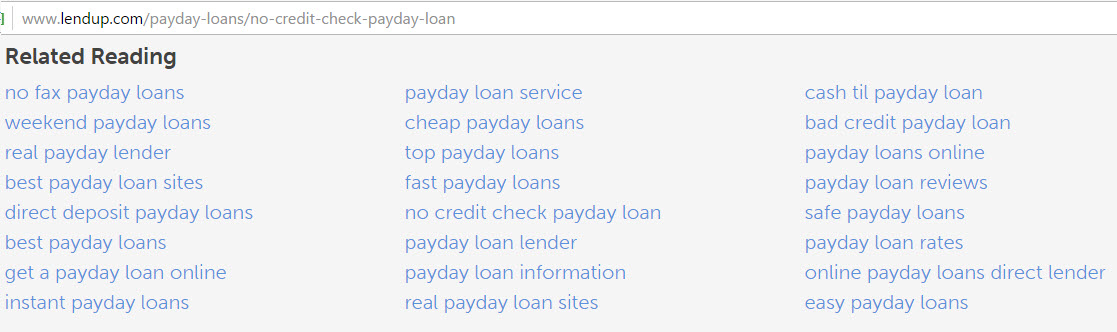
That in spite of last year Google going out of their way to say they were going to kill those sorts of strategies.
March 16, 2015 Google To Launch New Doorway Page Penalty Algorithm
Google does not want to rank doorway pages in their search results. The purpose behind many of these doorway pages is to maximize their search footprint by creating pages both externally on the web or internally on their existing web site, with the goal of ranking multiple pages in the search results, all leading to the same destination.
These sorts of doorway pages are still live to this day.
Simply look at the footer area of lendup.com/payday-loans
But the pages existing doesn’t mean they rank.
For that let’s head over to SEMrush and search for LendUp.com
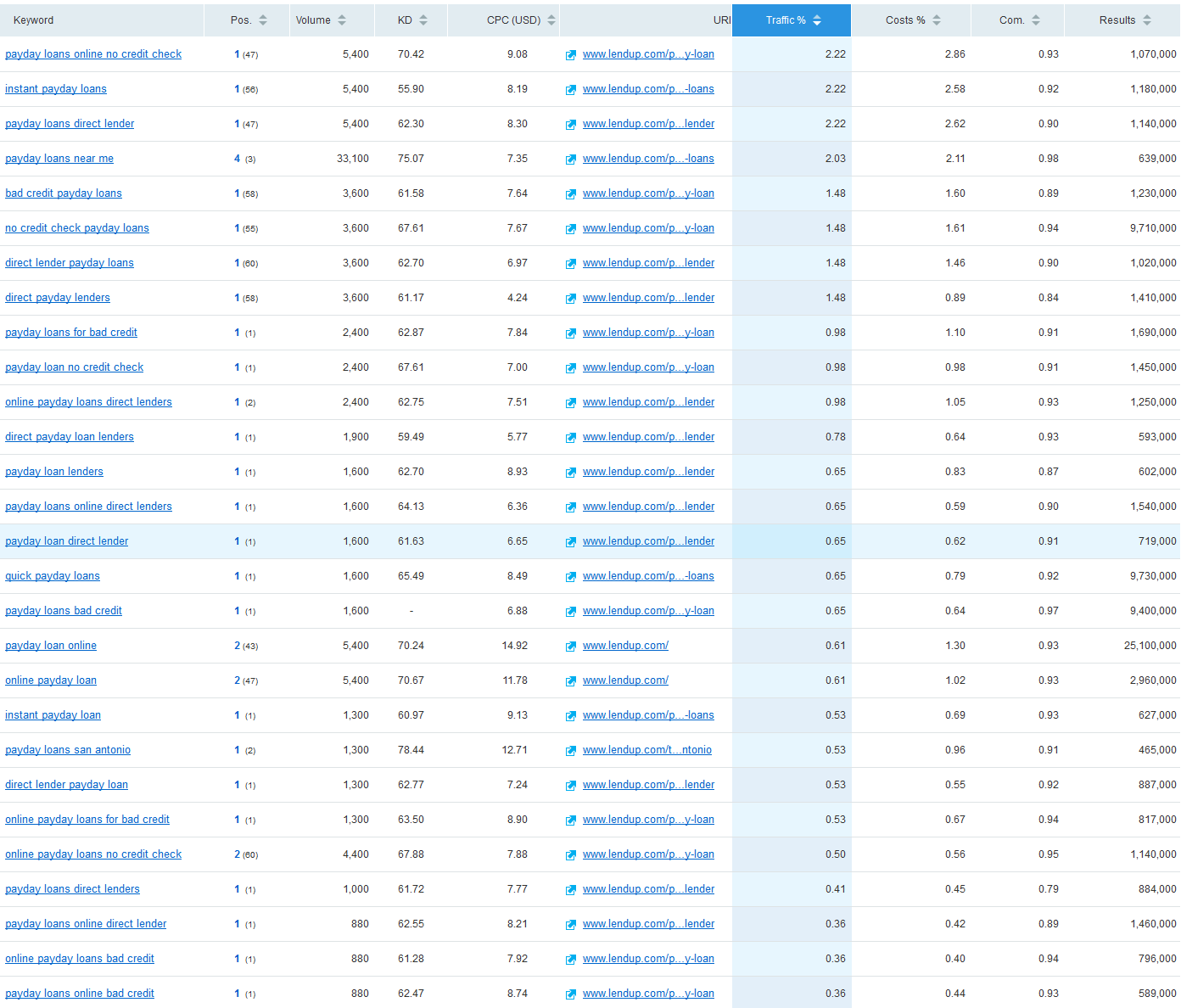
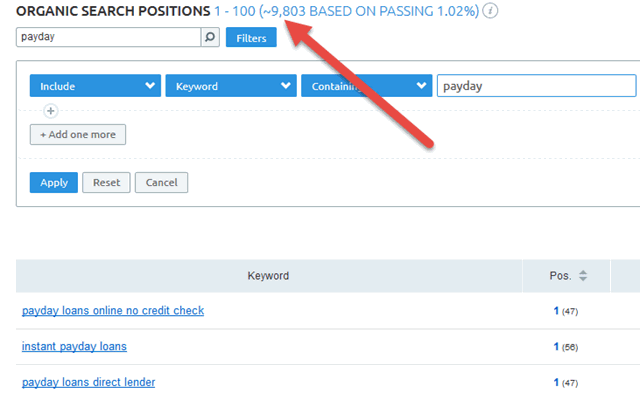
Hot damn, they rank for about 10,000 “payday” keywords.
And you know their search traffic is only going to increase now that competitors are getting scrubbed from the marketplace.

Today we get journalists conduits for Google’s public relations efforts writing headlines like: Google: Payday Loans Are Too Harmful to Advertise.
Today those sorts of stories are literally everywhere.
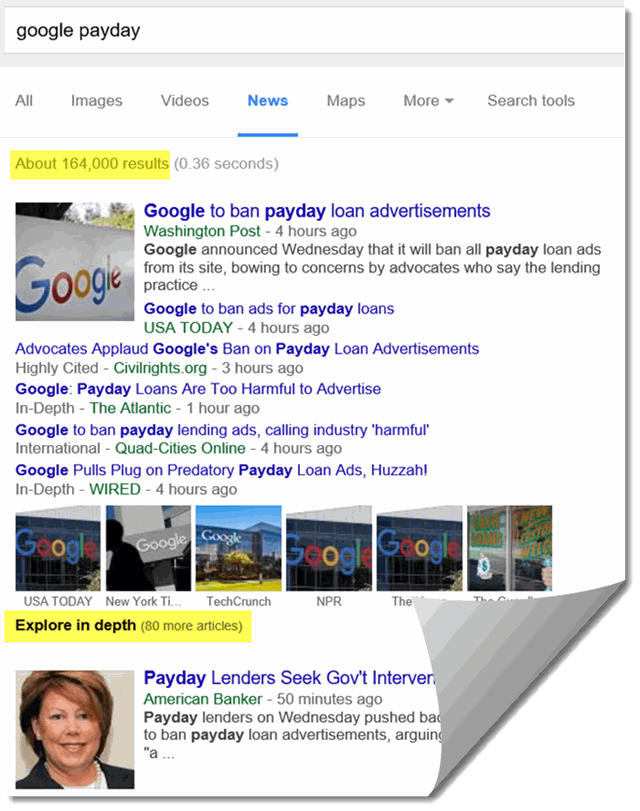
Tomorrow the story will be over.
And when it is.
Precisely zero journalists will have covered the above contrasting behaviors.
As they weren’t in the press release.
Best yet, not only does Google maintain their investment in payday loans via LendUp, but there is also a bubble in the personal loans space, so Google will be able to show effectively the same ads for effectively the same service & by the time the P2P loan bubble pops some of the payday lenders will have followed LendUp’s lead in re-branding their offers as being something else in name.
A user comment on Google’s announcement blog post gets right to the point…
Are you disgusted by Google’s backing of LendUp, which lends money at rates of ~ 395% for short periods of time? Check it out. GV (formerly known as Google Ventures) has an investment in LendUp. They currently hold that position.
Oh, the former CIO and VP of Engineering of Google is the CEO of Zest Finance and Zest Cash. Zest Cash lends at an APR of 390%.
Meanwhile, off to revolutionize the next industry by claiming everyone else is greedy and scummy and there is a wholesome way to do the same thing leveraging new technology, when in reality the primary difference between the business models is simply a thin veneer of tech utopian PR misinformation.
Don’t expect to see a link to this blog post on TechCrunch.
There you’ll read some hard-hitting cutting edge tech news like:
Banks are so greedy that LendUp can undercut them, help people avoid debt, and still make a profit on its payday loans and credit card.
#MomentOfZeroTruth #ZMOT
Update: Kudos to the Google Public Relations team, as it turns out the CFPB is clamping down on payday lenders, so all the positive PR Google got on this front was simply them front running a known regulatory issue in the near future & turning it into a public relations bonanza. Further, absolutely NOBODY (other than the above post) mentioned the doorway page issue, which remains in place to this day & is driving fantastic rankings for their LendUp investment.
Update 2: Record keeping requirements do not improve things if a company still intentionally violates the rules, knowing they will only have to pay a token slap on the wrist fine if and when they are finally caught. All it really does is drive the local businesses under.
The massive record-keeping and data requirements that Mr. Corday is foisting on the industry will have another effect: It will drive out the small, local players who have dominated the industry in favor of big firms and consolidators who can afford the regulatory overhead. It will also favor companies that can substitute big data for local knowledge like LendUp, the Google-backed venture that issued a statement Thursday applauding the CFPB rules. Google’s self-interest has become a recurrent theme in Obama policy making
Those records (along with the Google duplicity on doorway pages) however confirm that LendUp are not the good guys! They were outright scamming & over-charing their customers:
Onine lending start-up LendUp, which has billed itself as a better and more affordable alternative to traditional payday lenders, will pay $6.3 million in refunds and penalties after regulators uncovered widespread rule-breaking at the company.
Categories:
Google Rethinking Payday Loans & Doorway Pages?
Nov 12, 2013 WSJ: Google Ventures Backs LendUp to Rethink Payday Loans
Google Ventures Partner Blake Byers joined LendUp’s board of directors with his firm’s investment. The investor said he expects LendUp to make short-term lending reasonable and favorable for the “80 million people banks won’t give credit cards to,” and help reshape what had been “a pretty terrible industry.”
What sort of strategy is helping to drive that industry transformation?
How about doorway pages.
These sorts of doorway pages are still live to this day. Simply look at the footer area of lendup.com/payday-loans
This in spite of last year Google going out of their way to say they were going to kill those sorts of strategies.
March 16, 2015 Google To Launch New Doorway Page Penalty Algorithm
Google does not want to rank doorway pages in their search results. The purpose behind many of these doorway pages is to maximize their search footprint by creating pages both externally on the web or internally on their existing web site, with the goal of ranking multiple pages in the search results, all leading to the same destination.
Today we get journalists conduits for Google’s public relations efforts writing headlines like: Google: Payday Loans Are Too Harmful to Advertise.
Today those sorts of stories are literally everywhere.
Tomorrow the story will be over.
And when it is.
Precisely zero journalists will have covered the above contrasting behaviors.
As they weren’t in the press release.
Best yet, not only does Google maintain their investment in payday loans via LendUp, but there is also a bubble in the personal loans space, so Google will be able to show effectively the same ads for effectively the same service & by the time the P2P loan bubble pops some of the payday lenders will have followed LendUp’s lead in re-branding their offers as being something else in name.
Meanwhile, off to revolutionize the next industry by claiming everyone else is greedy and scummy and there is a wholesome way to do the same thing leveraging new technology, when in reality the primary difference between the business models is simply a thin veneer of tech utopian PR misinformation.
Don’t expect to see a link to this blog post on TechCrunch.
There you’ll read some hard-hitting cutting edge tech news like:
Banks are so greedy that LendUp can undercut them, help people avoid debt, and still make a profit on its payday loans and credit card.
#MomentOfZeroTruth #ZMOT
Categories:
A Nail in the Coffin For Payday and High Interest Loan Ads
Beginning July 13 of this year, Google will stop accepting and displaying ads for a specific slice of payday and high interest loans.
read more
A script for getting granular AdWords account anomaly alerts
Columnist Frederick Vallaeys shares a highly customizable script that can help detect anomalies within an AdWords account, improving upon Google’s Account Anomaly Detector.
The post A script for getting granular AdWords account anomaly alerts appeared…
Soon, assign whatever attribution model you want for each conversion type in AdWords
Data-driven attribution will be among the models available for high-volume conversion types.
The post Soon, assign whatever attribution model you want for each conversion type in AdWords appeared first on Search Engine Land.
Please visit Search Engi…
With help from Alexa, Kayak debuts voice-enabled travel search on Amazon Echo
Users can search for flight, hotel and rental car information — but not yet book.
The post With help from Alexa, Kayak debuts voice-enabled travel search on Amazon Echo appeared first on Search Engine Land.
Please visit Search Engine Land for the f…
The SEO risks & rewards of buying multi-location companies
SEO value is rarely considered in acquisition deals. Using Sports Authority as an example, columnist Andrew Shotland discusses how a website’s SEO should factor into these discussions.
The post The SEO risks & rewards of buying multi-location comp…
What The Block? An Exploration of the Future of Digital Advertising in an Ad Block Climate

Why the fuss over ad blocking?
Ad blocking is one of the topics Distilled covered in Searchscape (which showcases our predictions for the future of search) late last year, defining it as one of the most poignant topics in search for 2016.
Virtual Reality: Bring Your Content Marketing to Life
What do McDonald’s, Star Wars, and Michelle Obama have in common? Answer: they’re all pioneers in the world of virtual reality. Virtual reality, just in case you’re unfamiliar with this trend, is a 3D computer generated world that allows users to explore and interact with their environment. Videos shot in 360° and VR video games […]
The post Virtual Reality: Bring Your Content Marketing to Life appeared first on Builtvisible.
Google Dismisses Any Recent Major Algorithm Update
Over the past few days or so, the various Google search results tracking tools have been pretty wild. Tools like Mozcast have been showing stormy weather, so has SERP Metrics, Advanced Web Rankings, Accuranker and RankRanger all show lots of volatilit…
Google Feedburner Stats & Emails Stop Working For Days
Google runs a product named FeedBurner, it helps publishers manage their RSS feeds including distribution services, analytics and more around RSS. I use it here but when Google acquired them in 2007, I was nervous. Since then it has been working pret…
Bing Ads Adds Copy & Paste Ads & Keywords
Bing announced you can now copy and paste your ads or keywords from campaign to campaign within the Bing Ads console…
Google: Here Is How Webmaster Forums Escalation Works
In a Google Hangout with John Mueller earlier this month on Google+, John explained how it works when a thread in the help forums gets escalated to a Googler…
Bing Webmaster Outreach Nonexistent
Last week, I noticed a public post by Duane Forrester, the former Bing webmaster outreach person, on Facebook sharing his disappointment with the current state of Bing’s webmaster outreach efforts…
Google bans ads for payday and high interest loans
As of July 13, the ads will no longer be accepted in AdWords.
The post Google bans ads for payday and high interest loans appeared first on Search Engine Land.
Please visit Search Engine Land for the full article.