On-Page SEO in 2016: The 8 Principles for Success – Whiteboard Friday
Posted by randfish
On-page SEO is no longer a simple matter of checking things off a list. There’s more complexity to this process in 2016 than ever before, and the idea of “optimization” both includes and builds upon traditional page elements. In this Whiteboard Friday, Rand explores the eight principles you’ll need for on-page SEO success going forward.

Click on the whiteboard image above to open a high resolution version in a new tab!
Video Transcription
Howdy, Moz fans, and welcome to another edition of Whiteboard Friday. This week we’re going to chat about on-page SEO, keyword targeting but beyond keyword targeting into all the realms of the things that we need to optimize on an individual URL in order to have the best chance of success in the search engines in 2016.
So what does that involve? Well look, we could spend a tremendous amount of time on any one of these, but I’m going to share eight principles that are behind all of the tactical work that you would put into optimizing that page for that keyword term, phrase, or set of phrases. Most likely, in 2016, it is a set of phrases that you’re targeting rather than just a single keyword term.

1. Fulfill the searcher’s goal and satisfy their intent
What we are trying to do is fulfill the searcher’s goal and satisfy their intent. So there’s an intent behind every search query. I’m seeking some information. I’m seeking to accomplish a task. Oftentimes, that initial intent is different from the final goal that someone might have.
I’ll give you an example. When someone searches for types of wedding formal wear, we might infer from that query that, right now, their specific intent behind this search is they want to see different kinds of potential formalwear that they could wear to a wedding, maybe as a guest or as a bride or a groom. But their ultimate goal is probably going to be to decide on one of those specific things and then potentially purchase that item or take something from their wardrobe and add it in there.
But this means that we need to try and serve both intents. It’s actually going to be really tough if we’re an ecommerce player to say, “Hey, you know what, I want a rank for types of wedding formal wear, and I want to rank for it with a page that tells people to buy this particular tuxedo.”
That’s tough for a bunch of reasons. You don’t know whether that formalwear is going to be necessarily black tie in the United States, which is tuxedo. You don’t know whether that person is a male or a female when they’re performing the search. A woman, well, they might buy a tuxedo but probably not, at least statistically speaking, they’re probably not going to. They’re probably going to buy a dress. You might have much more success with a piece of content like 20 suits and tuxes men look great in at a wedding. Especially if I’m targeting men or if this is types of men’s wedding formalwear, that’s probably going to be the piece of content that has a great chance of serving the searcher’s intent and fulfilling their goals, especially if we then take that content and link off to the places where you can buy or accessorize all those different pieces. So we’re trying to do both of these items in number one.

2. Speed, speed, & more speed
This is very simplistic, but the idea is really easy here. We know that user satisfaction is a signal that Google interprets in some ways directly and in many, many ways indirectly. We also know that abandonment rates are very high, even higher on mobile for longer-loading pages. We know that pages that have fast load times earn more links and amplification. We know that pages that earn more links earn more engagement on them. We know that all of these things including speed itself is positively correlated with rankings, and we know that Google has made page load speed a small, albeit small, but a ranking signal inside their algorithm directly. So critically important.

3. Create trust & engagement through UI, UX, and branding
Related to number two is number three, which is creating trust and engagement through UI, UX, and branding. Speed is certainly a big part of the user experience. This is also critical because these two both touch on being mobile friendly, having that multi-device friendliness so that it’s capable on any device. UI, UX, and branding though go into some different areas. So if I have my website, I’m really looking for a few different aspects of it from the SEO point of view.
This is frustrating because it touches on a lot of things that historically have been outside the control of search engine optimization professionals. Thankfully, as SEO becomes more multidisciplinary inside a marketing team, hopefully we have more ability to influence these things, stuff like:
- Have people actually heard of your domain?
- Do they know you, like you, and trust you?
- Do you have UI and visual elements that make them perceive you as being trustworthy, even if this is the first time they’ve ever heard of you? That can be things like the images on the page. It can be the navigation. It can be the color scheme. It can be the UI library that you might be using or how you’ve done the visual layout of things. All of those pieces go into that “Do you look trustworthy?” That’s certainly a consideration that a lot of folks have when they’re looking at searches.
- Are you intuitive to access? I mean intuitive both from a navigation standpoint and from the consumption of the content on the page as well.
- Hopefully, you have some external validation signals to indicate that the content you have and the brand that you are is trustworthy. Those can be things like testimonials. They can also mean things like references or citations for the data or information that you’re providing or links out, all that kind of stuff.

4. Avoid elements that dissuade visitors
You want to avoid elements that distract searchers or dissuade them from visiting you either at this time or in the future. The most common ones of these that we like to talk about a lot are ones that interfere with the content consumption experience. That’s things like overlays. “Do you want to stay married? If so, download our guide.” Then you have to say, “Yes, of course I want to stay married,” or “No, I’m a terrible person and I will not click on your popup,” and then another popup will come up.
Those types of overlays obviously have negative impacts, and you can see them in your user and usage data, your engagement data. You can determine how much of a sacrifice you’re willing to make in exchange for, “Well, we did get some email addresses out of this, or we got some conversion rate and so we’re willing to make that sacrifice,” versus “No, we’re not willing to make these sacrifices.” You have to choose what types of engagement-dissuading apparatuses you’re willing to put on your site.
But be aware, pogo sticking is a ranking signal. It’s something that they judge indirectly for sure and directly potentially as well. Pogo sticking meaning a searcher clicked on your listing in the results, they went to your site, and then they clicked the “Back” button and chose someone else from the results. Google interprets that and Bing interprets that very poorly for you.

5. Keyword targeting
Keyword targeting, classic on-page ranking signal, still true today. I know that many of us still see or are starting to see a lot more entrants into the search results that don’t do very particular keyword targeting, at least don’t do it the way we’ve historically perceived it, where it’s very keyword-driven. But it’s still incredibly smart to do this if and when you can. You just need to balance it out with all these other aspects.
Title element
Places that I would start. In fact, this is basically in order of importance. Title element, I would place the keyword term or phrase, the most important term or phrase that you’re targeting in the title element in the headline of the page. That can be the H1 tag, but it doesn’t need to be it. It could be just the bold, big headline at the top. That should match the page title generally speaking or be very close, because what you don’t want is you don’t want a searcher who clicked on one title element and then landed on a page that had a different headline and they perceived that mismatch, and so they clicked the “Back” button. That’s dangerous.
Page content, external anchor links, alt attributes, and URL
You want it obviously in the page content. If you can, when you can control it, you want it in external anchor links to the page. So if, for example, I have my home page about weddings and I am interviewed for something, I might put in my bio something about the wedding styles website that I own and control, and I would link back to that in that external anchor text. I want it potentially in the alt attribute of any images or photos or visuals that I’ve got on the page. I want it in the URL. Again, if I can control it and the URL is less important, so we’re going in decreasing order of importance here.
Image file name
I want it in the image name. Especially if I’m trying to rank in Google image search, image name, the file name of the actual image does matter and is important.
Internal links
Finally, I want it in internal links to the degree that it’s intelligent and balanced and doesn’t look spammy.
Do all these items, you’ve got your keyword targeting down. But this is not like the past, where just nailing keyword targeting is going to take my rankings to where they need to be. I’ve got to do all these other seven things too, including number six, related topics targeting.

6. Related topics targeting
So related topics is basically this concept that Google has a huge graph of lexical combinations and semantic analysis. They can essentially say, “Hey, when we see wedding formalwear, we often also see these terms and phrases, terms like tuxedo, tux, wedding dress, bowtie, vest.” In the United Kingdom, almost certainly we would see waistcoat, which is what we call a vest here in the United States, or a wedding suit, which is what is traditionally worn in weddings in the U.K. versus a tuxedo here in the United States.
Now, given that Google sees these terms and phrases very commonly associated with this one, they’ve essentially started to build up this graph between these, and so these topics they would say are very important to this search term. If someone’s looking for wedding formalwear, it’s unusual for them to find a page that has high relevance for users that doesn’t also include these types of words and phrases.
Therefore, as a search marketer, as a content creator, we need to think about: What are those terms and phrases that are related here, and how do I make sure to include them in my content? If I don’t, my ranking opportunity may decrease compared to my competitors who’ve intelligently used those terms and phrases.

7. Snippet optimization
With a page, we’re not just trying to drive the ranking. We’re also trying to drive the click. So ranking number four and earning a 6% click-through rate, that might not be great, especially if the average is more like 11%. Then we’re earning half the average for our ranking position. That seems a little funny. Those percentages are not precise, but you get the idea.
We want to have the best-optimized snippet that we possibly can in the SERP. So you can see here I’ve got this, “what to wear to a formal wedding,” “a guide from randsfashion.com” and it’s mobile-friendly. It’s published on May 10, 2016. Then it has this nice meta description, the snippet there. This is essentially my advertisement to searchers saying, “Please click on my link. I want your click.”
On-page elements
Bunch of elements that go into this: the title, obviously, the meta description. The URL format, this randsfashion.com, very simple on home pages, gets much more complex when we have pages that are internal because Google starts to assign categories if you have messy URL parameters or inconsistent categories, tagging systems that can get nasty.
Publication date
Publication date matters quite a bit, especially for searches that have a fresh component. So if people are searching for types of wedding formalwear, well, you might not need to worry too much. But what if lots of people who search for this search for types of wedding formalwear 2016? Well, now you really need that fresh publication date. In fact, if Google sees lots of people search for that, they might actually take it as an intent signal that types of wedding formalwear alone deserves that date in there and that they should be ranking fresher content higher up because lots of people are looking for more recent, modern stuff.
Use of schema
Whenever there’s an opportunity, for example, if you’re in the recipe space, there are schema markups specifically for recipes. If you’re in the news space, there are opportunities for news. If you do video, Google doesn’t really obey it very much, except with YouTube, but there are video opportunities for schema markup. There are all sorts of other kinds depending on what you’re in, certainly local and maps and a bunch of other ones.
Domain name
That is something to consider. In fact, when you’re registering a domain name and building out a site, you should be thinking about how people want to click on it, the brandability, the snippet optimization, all that.
Content format
Content format is particularly important because Google, especially when there’s a more question-based search query, they’ve started showing those longer meta descriptions. So if you can encapsulate what you know is essentially the critical piece of content that answers the user’s question, chances are you might be able to get that larger space, vertical space in the SERP, and that might mean that you can draw more clicks in as well.
This works really well with lists. It works nicely with forums and discussions, threads. It works nicely with elements where you have a bunch of specific how-to, step-by-step process, those types of things. Same story with instant answer possibilities that you want to appear at the top of that Google SERP with an instant answer if you can. We know that that actually doesn’t take away click-through rate. It actually drives more of it. In fact, the real estate there means that you often get more clicks than organic position one, which is pretty great. Of course, all the different kinds of SERP feature opportunities like we talked about — images, maps, local, news, what have you.

8. Unique value + amplification
This is the final piece of things that we’re thinking about as we do on-page optimization in 2016. That is I need to be thinking about: What bar do I need to reach in order to have a chance to rank, rank well, and rank consistently?
This is tough. So if the difficulty of ranking is very easy, the bar that I need to cross is probably somewhere between classic, good, unique content, like this content is good, it’s unique, and it exists. That’s all it needs. That’s a very, very low bar. Even for easy rankings, I would not suggest making that your bar.
I’d put it somewhere between there and twice as good as anyone else in the competition, but essentially targeting the same types of things. You’re doing the same kind of content. You just feel like you’re better than anything else in the top 10. That might be a reasonable enough bar for an easy ranking.
If it gets moderate, if it gets tough, I need to go up to uniquely valuable. Uniquely valuable, by that, we’ve had a whole Whiteboard Friday on it, which we can refer to, but uniquely valuable being this idea that I provide a value that no one else in the search results provides. So it’s not simply that I’m doing a better job. I’m also doing a unique job of providing information or data or visuals, whatever it is that is more and different value than anybody else.
Then finally, what we’ve called 10x content. If you have an insane difficulty of ranking, that might be the minimum bar that you need to hit, and we’ll link over the 10x video as well.
Basically, the questions that I’m asking when I’m talking about providing unique value and being worthy of amplification, which is something that our content needs to consider too, is: What makes this better than what already ranks? Do you have a great answer to that question? If you don’t, you should probably get one before you try targeting those keywords and producing that content.
Why will this be difficult or impossible for others to replicate? What’s the barrier to entry that your content provides, that all the other content providers can’t just look and go, “Oh, well I see that Rand’s done a very nice job ranking there. I’ll just take that and do it. That should be easy.” You need a barrier to entry. What value does this page provide that no other page in the SERPs provides? That goes to our unique value question.
The last one, who. Who will help amplify this piece of content and why? If you don’t have a great answer to who and why, it’s going to be incredibly difficult to get that amplification. If you can’t get the amplification, it’s going to be really, really hard to rank, because as much as on-page optimization does matte — and all of these eight principles matter for rankings — SEO in 2016 is not merely about on-page but about off-page as well, just as it’s been the last decade, 15 years. So, as we’re creating content, we need to think about that amplification process too.
All right everyone, look forward to your thoughts, and we’ll see you again next week for another edition of Whiteboard Friday. Take care.
Video transcription by Speechpad.com
Sign up for The Moz Top 10, a semimonthly mailer updating you on the top ten hottest pieces of SEO news, tips, and rad links uncovered by the Moz team. Think of it as your exclusive digest of stuff you don’t have time to hunt down but want to read!
Report: 2 years in, 75 percent of Right to Be Forgotten asks denied by Google
More than 50 percent of requests come from Germany and the UK.
The post Report: 2 years in, 75 percent of Right to Be Forgotten asks denied by Google appeared first on Search Engine Land.
Please visit Search Engine Land for the full article.
SearchCap: Google mobile friendly, Search Console update & Bing Ads bans
Below is what happened in search today, as reported on Search Engine Land and from other places across the web.
The post SearchCap: Google mobile friendly, Search Console update & Bing Ads bans appeared first on Search Engine Land.
Please visit Search Engine Land for the full article.
Marin Software & SMX Launch 8th Annual Biggest Search Geek Contest
Enter the 8th Annual SMX Biggest Search Geek Contest! The challenging quiz-based contest is where the world’s brightest search marketers compete to outsmart fellow search geeks from across the globe. The contestant who answers the most questions correctly in the shortest amount of time will…
Please visit Search Engine Land for the full article.
Google’s ban on payday loans estimated to cost millions in lost ad revenue
Still, the estimated losses account for just .05 percent of Google’s annual ad revenue last year.
The post Google’s ban on payday loans estimated to cost millions in lost ad revenue appeared first on Search Engine Land.
Please visit Search Engine Land for the full article.
Deeper Integration of Search Console in Google Analytics
(Cross-posted from the Google Analytics Blog.)
Google Analytics helps brands optimize their websites and marketing efforts for all sources of traffic, and Search Console is where website owners manage how they appear in Google organic search results. Today, we are introducing the ability to display Search Console metrics alongside Google Analytics metrics, in the same reports, side by side – giving you a full view of how your site shows up and performs in organic search results.
For years, users of both Search Console and Google Analytics have been able to link the two properties (instructions) and see Search Console statistics in Google Analytics, in isolation. But to gain a fuller picture of your website’s performance in organic search, it’s beneficial to see how visitors reached your site and what they did once they got there.
With this update, you’ll be able to see your Search Console metrics and your Google Analytics metrics in the same reports, in parallel. By combining data from both sources at the landing page level, we’re able to show you a full range of Acquisition, Behavior and Conversion metrics for your organic search traffic. This feature out is rolling out over the coming few weeks, so not everyone will see it immediately.
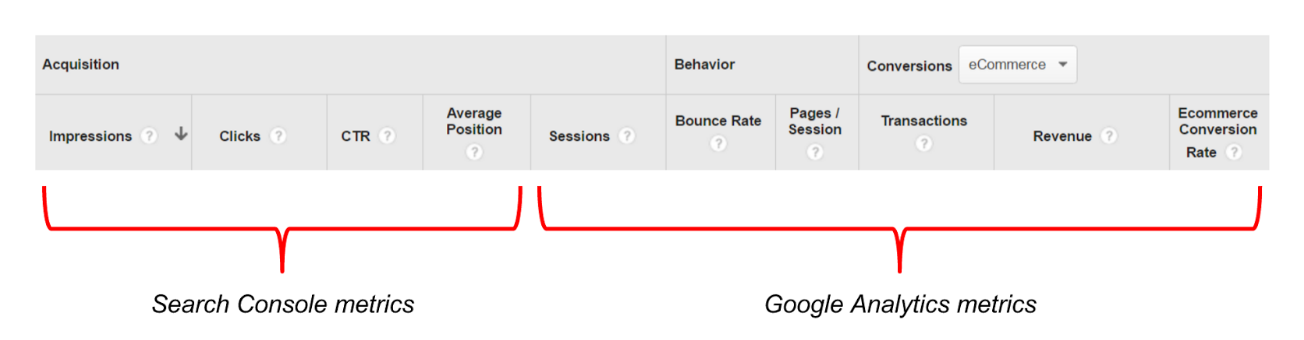
 New Search Console reports combine Search Console and Google Analytics metrics
New Insights
The new reports allow you to examine your organic search data end-to-end and discover unique and actionable insights. Your Acquisition metrics from Search Console, such as impressions and average position, are now available in relation to your Behavior and Conversion metrics from Google Analytics, like bounce rate and pages per session.
Below are some new capabilities resulting from this improved integration:
• Find landing pages that are attracting many users through Google organic search (e.g., high impressions and high click through rate) but where users are not engaging with the website. In this case, you should consider improving your landing pages.
• Find landing pages that have high site engagement but are not successfully attracting users from Google organic search (e.g., have low click through rate). In this case, you might benefit from improving titles and descriptions shown in search.
• Learn which queries are ranking well for each organic landing page.
• Segment organic performance by device category (desktop, tablet, mobile) in the new Devices report.


New Landing Page report showing Search Console and Google Analytics metrics
Additional Information
Each of these new reports will display how your organic search traffic performs. As data is joined at the landing page level, Landing Pages, Countries and Devices will show both Search Console and Google Analytics data, while the Queries report will only show Search Console data for individual queries. The same search queries will display in Google Analytics as you see in Search Console today.
As mentioned in our Search Console Help Center, some data may not be displayed, to protect user privacy. For example, Search Console may not track some infrequent queries, and will not display those that include personal or sensitive information.
Also, while the data is displayed in parallel, not all Google Analytics features are available for Search Console data – including segmentation. Any segment that is applied to the new combined reports will only apply to Google Analytics data. You may also see that clicks from Search Console may differ from total sessions in Google Analytics.
To experience the new combined reports from Search Console and Google Analytics, make sure your properties are linked, and then navigate to the new section “Search Console”, which should appear under “Acquisition” in the left-hand navigation in Google Analytics.
Posted by Joan Arensman, Product Manager, and Daniel Waisberg, Analytics Advocate


SEM ad copy tips that you may find scary
Trying new things can sometimes be frightening for paid search marketers, but columnist Brett Middleton argues that leaving your comfort zone is the key to differentiating your brand and obtaining qualified traffic.
The post SEM ad copy tips that you …
Google Search Console metrics now deeply integrated into Google Analytics
Google Analytics is replacing the Search Engine Optimization report with the Search Console report and adds behavior and conversion metrics into the mix.
The post Google Search Console metrics now deeply integrated into Google Analytics appeared first…
Pull Google Maps traffic data into AdWords with this script library
Columnist Russell Savage shows how you can use the Google Maps Distance Matrix API to get traffic data and use this information to customize your paid search ads.
The post Pull Google Maps traffic data into AdWords with this script library appeared fi…
Google Mobile SERPs Update Coming in May
Google has announced a mobile SERPs update coming in May which will mean that mobile-friendly sites are likely to get a bigger boost.
read more
The true value of technical SEOs
While many view technical SEO as a simple matter of implementing best practices on a website, columnist Patrick Stox argues that the best practitioners are doing cutting-edge work that will shape the industry’s future.
The post The true value of techn…
Everything you always wanted to know about programmatic but were too afraid to ask
One of the biggest challenges to programmatic adoption is that people are afraid of it.
Google Fully Launches The New Mobile Friendly Update
A few months ago we reported that Google will be updating their mobile friendly algorithm in May 2016.
Google’s John Mueller today confirmed on Twitter that this algorithm has now been fully rolled out and is live in the mobile Google search result…
Google Japan Holding Their Own Google Dance
Google announced on the Webmaster channel on Google+ that the Google Tokyo office is holding their very own version of the Google Dance…
Google AdWords Bans Payday Loans & Other Risky Loan Ads
Google announced yesterday that they are banning high risk and high interest loan ads from their AdWords network. That means…
Google AdWords Adds Last Click Attribution Bidding
Google announced that advertisers using AdWords will soon be able to adjust their bids based on a last click attribution model. Google said advertisers will be able to select from six different attribution models…
Google launches iOS keyboard that lets you search in any app & more
Gboard, a new keyword for iOS was launched today by Google to enable searching directly in your iOS keyboard – without leaving the app.
The post Google launches iOS keyboard that lets you search in any app & more appeared first on Search Engine Land.
Please visit Search Engine Land for the full article.
Google Ad 4-pack now shown for 23% of all online search topics
Brand new research out today reveals that, since Google AdWords removed its right-hand side ads and brought in an occasional fourth paid ad position for ‘highly commercial’ search terms, this fourth ad appears for nearly one-quarter of all search topics.
Keyword research for your webshop
When you start an online shop, keyword strategy might seem less important. You’re selling products, right? So the product names are your keywords. While that might be true in a few cases, in most cases you need to focus on the keywords that describe the problem you/your products are solving for your customer. Selling sun […]
Bing Ads bans ads from third-party tech support services
Citing “serious quality issues,” Microsoft updates the Bing Ads global ad policy to disallow all ads from third-party tech support providers.
The post Bing Ads bans ads from third-party tech support services appeared first on Search Engine Land.
Plea…