5 essential aspects of technical SEO you cannot neglect
The art of SEO lies in helping customers find your relevant, helpful content when it would benefit them and then creating a pleasant experience for them while they visit your website. Hence, it is vital that marketers do not neglect their technical SEO. There are a few strategies in particular that we believe brands should be paying close attention to to get their site in front of their competitors.
Link building with Dixon Jones (Majestic)
“If nobody writes about it, then the content is a tree falling in the forest without anyone there to listen.” That’s how Dixon Jones, Marketing Director of Majestic, illustrates the importance of getting the right links to your content. We proudly announce that Dixon will be speaking at YoastCon 2017 on November 2! Learn link building […]
Optimizing Sites for Featured Snippets with Q&A Content [Case Study]
Posted by NickRebuildGroup
Ranking near the top of the SERPs for short-tail keywords in competitive business verticals can be extremely difficult. Wikipedia, Dictionary.com, and similar sites have the market cornered on ranking at the top of search results. Even if you manage to rank in the first position, there are featured snippets, ads, map packs, and other SERP layouts that are dominating the space as well.
Because short-tail keywords have such broad search intents, it’s in the search engine’s best interest to try and answer questions directly in SERPs. That is the intent of featured snippets. If a search engine is able to answer a user’s query without them leaving the results page, they believe that delivers the best result. And the proliferation of featured snippets is only beginning. According to Search Engine Land, 19.45% of queries will display rich answers (a form of featured snippets) in Google.
A search for “what is orthodontics” in an incognito Google Chrome window displayed the following featured snippet:

This search result satisfies at least one large search intent: “What is orthodontics?” I use this as an example because my agency and I had been trying to get a client to rank for this keyword for some time. They were a dental practice with locations across the US that offered both orthodontic and general dental procedures. We had optimized their locations for their orthodontic procedures, but we wanted to get their non-localized service pages to rank as well in order to draw new patients that may be in the beginning stages of looking for a new orthodontist. But without a local qualifier, it was difficult to get the pages to rank for the short-tail searches.
After a year and change of writing, optimizing, re-writing, and re-optimizing the content — all while building links — we weren’t getting any movement with our organic rankings. It seemed that business websites were not meant to rank for these short-tail keywords. Content creators have long lamented that featured snippets don’t attribute where the content in the SERP comes from, thus leaching traffic away from the site.
We believed that rich snippets in SERPs would become more prominent — especially with mobile and voice search on the rise — and that, even without proper attribution, it would benefit our client to appear in these types of search results, especially if we were able to rank in long-tail, question-oriented searches. If we could rank in a featured snippet, where a potential consumer was asking a question about a service that we provide, it would benefit us to answer that question for them. Not only would we achieve the coveted “zero position,” we would position our client as authorities in their vertical, potentially increasing conversions.
With this in mind, we began developing the strategy that would ultimately lead us to ranking in featured snippet searches.
Q&A content
Question and answer content on websites is fairly standard. Many companies will place Frequently Asked Questions (FAQ) content on their sites to help users with any questions they may have instead of answering them directly. Noting the prevalence of featured snippets in SERPs, we used the Q&A format to create new content to find out: a) could we rank for these queries? and b) would it benefit our client to rank in these queries?
Research & content creation
Using SEMRush, we conducted keyword research to find long-tail keywords with high monthly search volumes. Some of the phrases we decided to create the content around were “how long does it take to put on braces,” “how much does Invisalign cost without insurance,” and other similar queries. We also asked our client’s call team and Livechat correspondents to send us the most-asked questions they receive about orthodontics. The questions that the internal teams provided were primarily about pricing and insurance. This information was vital for our new Q&A content, as it allowed us to create answers we knew our users were looking for.
While researching current featured snippets, we gleaned that the content must emphasize the answer, not the answerer. Meaning, the content needed to be straightforward and answer the query without any marketing fluff. We ensured that our headers included the targeted keyword, along with the title tags. Once the content was created, we placed each question in the main navigation bar on the site, with each one leading to a separate landing page.
Link building
As most SEOs will tell you, backlinks are still a very important ranking factor. It was our belief that building links to our new Q&A content would be essential in ensuring that it ranked well. We built links exclusively via sites like Quora and Reddit, the idea being that these are places where people are already asking questions that we can answer as experts, while linking back to our site. In order to avoid spamming, we limited the number of links that we built per month.
Results
After a year of collecting data, we can confidently say that not only were we successful in getting the site to rank for a featured snippet, but traffic to the orthodontics content increased by 46.10%, conversions from the content increased by 235%, and the conversion rate increased by 129.30%.

Organic sessions to the orthodontic Q&A content

Organic conversions from orthodontic Q&A content

Organic conversion rate from orthodontic Q&A content
The results were even more striking on mobile, where traffic increased by 91.46%, conversions increased by 322.22%, and conversion rate increased by 120.53%.

Mobile organic sessions to the orthodontic Q&A content

Mobile organic conversions from orthodontic Q&A content

Mobile organic conversion rate from orthodontic Q&A content
Measurement method
For this study we only looked at organic and mobile organic traffic. We also only looked at traffic that landed on our site via the orthodontics content (meaning we only measured users that entered the site via one of the orthodontics pages from an organic source).
Attention metrics
It should be noted that this implementation was not successful in every facet. One of the most important goals for new content is making sure that users engage with it. And at Rebuild Group, we normally measure content engagement through attention metrics: pages/session, average time on site, bounce rate, etc.
Upon collecting the data, we noticed that all attention metrics decreased year over year. Our hypothesis is that because the content is both meant to answer a question and is easily digestible, users were more likely to leave the site after their question was answered. It explains why traffic, conversions, and conversion rate increased so much year over year and attention metrics decreased.
Rankings
Most important to this experiment, we were able to have our site rank in the first position — or zero position — in search results for the query “how long do you wear invisalign a day,” while also ranking on the first page (though not the first position) for other Q&A orthodontic terms.

We started ranking in the first position for this term in mid-January, though we lost the ranking shortly thereafter. We began to consistently rank in the first position in March and are still ranked there as of this writing.
Our belief is that by simply answering the question and including the keyword in crawlable parts of the content, we were able to rank in the first position for one of our targeted Q&A phrases, resulting in a featured snippet.
Conversions
Conversions were measured as the number of contact form submissions sent during sessions where a user entered the site via the orthodontic content. As mentioned above, conversions and conversion rates for all organic and mobile organic traffic increased greatly year over year. However, the effects were not seen until 9 months into the experiment.
When the traffic was measured at 90 and 180 days, organic traffic to the new content was steadily increasing overall and via mobile devices, but conversions and conversion rate had not gone up compared to the previous year. It wasn’t until 270 days in, when we first ranked in the featured snippet SERP, that conversions began to increase.

Organic traffic to the orthodontic Q&A content

Organic conversions from orthodontic Q&A content
Once we were consistently ranking in the first position for a featured snippet SERP, while also ranking on the first page of SERPs for other queries, our conversions and conversion rates began to greatly increase.
Google Home
As stated earlier, voice search is on the rise. Once we were able to rank as a featured snippet in a targeted SERP, we wanted to see if that featured snippet would affect how Google Home provided an answer to the targeted query:
*Note: This video was recorded on my phone, so the quality is not the best. You may need to turn up your volume to hear the question and answer.
As you can see, Google Home clearly attributes the answer to our client, answers the question, and then sends the user to the Home App, where the answer is again shown:

From there they can click through to the site on their mobile device:

In the end we drew a strong correlation between the implementation of the Q&A orthodontics content, ranking highly in rich snippet SERPs, and increased conversions and conversion rates. But like all things SEO, there are no definites when implementing this kind of strategy. We implemented content that drove users to a site that offered services they were looking for. Someone searching “how to boil water” is not likely looking to buy new pots and pans. Ultimately, it’s important to know what your users are looking for and cater to their searches. Once you’re able to answer their questions with simple, to-the-point content, the rest is easy.
Sign up for The Moz Top 10, a semimonthly mailer updating you on the top ten hottest pieces of SEO news, tips, and rad links uncovered by the Moz team. Think of it as your exclusive digest of stuff you don’t have time to hunt down but want to read!
SearchCap: YouTube redirects, Bing search ad growth & expanded text ads
Below is what happened in search today, as reported on Search Engine Land and from other places across the web.
The post SearchCap: YouTube redirects, Bing search ad growth & expanded text ads appeared first on Search Engine Land.
Please visit Search Engine Land for the full article.
After Windows 10 bump & Yahoo deal, Microsoft’s search revenue growth looks stagnant
Search ad revenues are growing, but the rate has been slowing. LinkedIn sessions were up more than 20 percent from the prior quarter.
The post After Windows 10 bump & Yahoo deal, Microsoft’s search revenue growth looks stagnant appeared first on Search Engine Land.
Please visit Search Engine Land for the full article.
SEO Radar Is The Prozac of SEO Tools
 It’s a bit awkward to write about a company we have an investment in without sounding like a total salesman, but I am going to give it a try. Even if we had no interest in SEO Radar (full disclosure: we do), I’d like to think I’d still be writing this. Cause it saved my […]
The post SEO Radar Is The Prozac of SEO Tools appeared first on Local SEO Guide.
How to navigate the somewhat rocky transition to expanded text ads
Still avoiding the switch to expanded text ads? Columnist Ted Ives has some advice to easing your way into Google’s new AdWords ad format.
The post How to navigate the somewhat rocky transition to expanded text ads appeared first on Search Engine Land…
YouTube using Redirect Method technology to fight terrorist video content in search results
The new technology will surface playlists with content that aims to disprove extremist video propaganda attached to certain search terms.
The post YouTube using Redirect Method technology to fight terrorist video content in search results appeared fir…
SEO Industry Update: Mobile First
3 Steps Every Digital Marketer with a Dynamic Serving or Mobile Site Needs to Take
Remind me: What is this Mobile First Index all about, again?
In October 2016, Gary Illyes announced that Google will be creating a new mobile index that will become the…
Developing content for the customer journey
Columnist Bobby Lyons explains why SEOs must move away from “SEO content” and start thinking about content that meets users’ needs throughout the buyer journey.
The post Developing content for the customer journey appeared first on Search Engine Land….
Search in Pics: Google future London office, teaBOT & interesting ceiling
In this week’s Search In Pictures, here are the latest images culled from the web, showing what people eat at the search engine companies, how they play, who they meet, where they speak, what toys they have and more. Relaxing spot at Google’s Belgium office: Source: Instagram a TeaBot…
Please visit Search Engine Land for the full article.
Marshall McLuhan, Canadian Media Theorists, Gets A Google Logo
Today on the Google home page is a special Google logo, aka Doodle, for Marshall McLuhan. Marshall McLuhan was a well-known Canadian professor, philosopher…
Gary Illyes Favorite Google Offices: Zurich, Tel Aviv & Tokyo
Gary Illyes, one of our favorite Googlers, has revealed on Twitter which are his favorite Google offices. If you know Gary, he travels a lot for both business and pleasure – both on land…
YouTube Video Editor Going Offline On September 20, 2017
So Google decided to kill off the YouTube Video Editor and also the Photo slideshows within YouTube as of September 20…
Google Search Console Adds Job Listings & Details Filters To The Search Analytics Report
Google announced on Twitter that there is a new filter available within Google Search Console’s Search Analytics report under the search appearance section for both “job listings” and “job details…
Search Buzz Video Recap: Google Search Console News, Google User Interface Changes & AdWords Report Editor
This week in search, we saw a preview of the new Google Search Console that is in beta. Google also changed how they report in Search Analytics the impressions and average…
Marshall McLuhan Google doodle pays tribute to ‘The medium is the message’ media theorist
In his 1962 book “Understanding Media,” McLuhan argued that the way people receive information is more important than the information being received.
The post Marshall McLuhan Google doodle pays tribute to ‘The medium is the message’ media theorist appeared first on Search Engine Land.
Please visit Search Engine Land for the full article.
What do we know so far about Google’s new homepage?
Google has released a new, feed-based mobile homepage in the US, in perhaps the most drastic and significant update of its homepage since 1996. We take a look at what the relaunch entails, and how it might change things for marketers.
Is the New, Most Powerful Ranking Factor "Searcher Task Accomplishment?" – Whiteboard Friday
Posted by randfish
Move over, links, content, and RankBrain — there’s a new ranking factor in town, and it’s a doozy. All kidding aside, the idea of searcher task accomplishment is a compelling argument for how we should be optimizing our sites. Are they actually solving the problems searchers seek answers for? In today’s Whiteboard Friday, Rand explains how searcher task accomplishment is what Google ultimately looks for, and how you can keep up.
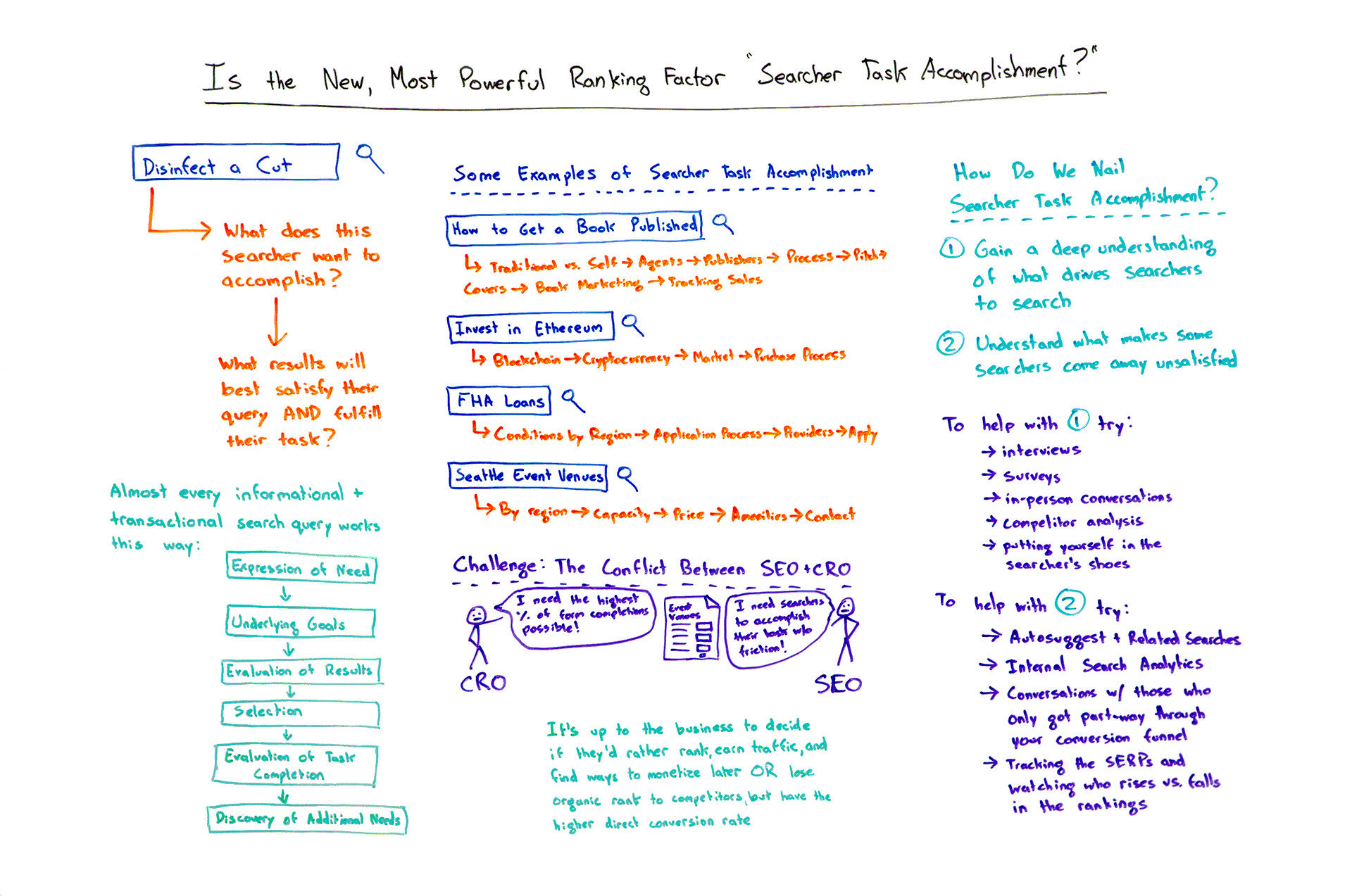
Click on the whiteboard image above to open a high-resolution version in a new tab!
Video Transcription
Howdy, Moz fans, and welcome to another edition of Whiteboard Friday. This week, we’re chatting about a new Google ranking factor.
Now, I want to be clear. This is not something that’s directly in Google’s algorithm for sure. It’s just that they’re measuring a lot of things that lead us to this conclusion. This is essentially what Google is optimizing toward with all of their ranking signals, and therefore it’s what SEOs nowadays have to think about optimizing for with our content. And that is searcher task accomplishment.
 So what do I mean by this? Well, look, when someone does a search like “disinfect a cut,” they’re trying to actually accomplish something. In fact, no matter what someone is searching for, it’s not just that they want a set of results. They’re actually trying to solve a problem. For Google, the results that solve that problem fastest and best and with the most quality are the ones that they want to rank.
In the past, they’ve had to do all sorts of algorithms to try and get at this from obtuse angles. But now, with a lot of the work that they’re doing around measuring engagement and with all of the data that’s coming to them through Chrome and through Android, they’re able to get much, much closer to what is truly accomplishing the searcher’s task. That’s because they really want results that satisfy the query and fulfill the searcher’s task.

So pretty much every — I’m excluding navigational searches — but every informational and transactional type of search — I mean, navigational, they just want to go to that website — but informational and transactional search query is basically this. It’s I have an expression of need. That’s what I’m telling Google. But behind that, there’s a bunch of underlying goals, things that I want to do. I want to know information. I want to accomplish something. I want to complete an activity.
When I do that, when I perform my search, I have this sort of evaluation of results. Is this going to help me do what I want? Then I choose one, and then I figure out whether that result actually helps me complete my task. If it does, I might have discovery of additional needs around that, like once you’ve answered my disinfect a cut, now it’s, okay, now I kind of want to know how to prevent an infection, because you described using disinfectant and then you said infections are real scary. So let me go look up how do I prevent that from happening. So there’s that discovery of additional needs. Or you decide, hey, this did not help me complete my task. I’m going to go back to evaluation of results, or I’m going to go back to my expression of need in the form of a different search query.
That’s what gives Google the information to say, “Yes, this result helped the searcher accomplish their task,” or, “No, this result did not help them do it.”
Some examples of searcher task accomplishment
This is true for a bunch of things. I’ll walk you through some examples.

If I search for how to get a book published, that’s an expression of need. But underlying that is a bunch of different goals like, well, you’re going to be asking about like traditional versus self-publishing, and then you’re going to want to know about agents and publishers and the publishing process and the pitch process, which is very involved. Then you’re going to get into things like covers and book marketing and tracking sales and all this different stuff, because once you reach your evaluation down here and you get into discovery of additional needs, you find all these other things that you need to know.

If I search for “invest in Ethereum,” well maybe I know enough to start investing right away, but probably, especially recently because there’s been a ton of search activity around it, I probably need to understand: What the heck is the blockchain and what is cryptocurrency, this blockchain-powered currency system, and what’s the market for that like, and what has it been doing lately, and what’s my purchase process, and where can I actually go to buy it, and what do I have to do to complete that transaction?

If I search for something like “FHA loans,” well that might mean I’m in the mindset of thinking about real estate. I’m buying usually my first house for an FHA loan, and that means that I need to know things about conditions by region and the application process and what are the providers in my area and how can I go apply, all of these different things.

If I do a search for “Seattle event venues,” well that means I’m probably looking for a list of multiple event venues, and then I need to narrow down my selection by the criteria I care about, like region, capacity, the price, the amenities. Then once I have all that, I need contact information so that I can go to them.
In all of these scenarios, Google is going to reward the results that help me accomplish the task, discover the additional needs, and solve those additional needs as well, rather than the ones that maybe provide a slice of what I need and then make me go back to the search results and choose something else or change my query to figure out more.
Google is also going to reward, and you can see this in all these results, they’re going to reward ones that give me all the information I need, that help me accomplish my task before they ask for something in return. The ones that are basically just a landing page that say, “Oh yeah, Seattle event venues, enter your email address and all this other information, and we’ll be in touch with a list of venues that are right for you.” Yeah, guess what? It doesn’t matter how many links you have, you are not ranking, my friends.
That is so different from how it used to be. It used to be that you could have that contact form. You could have that on there. You could not solve the searcher’s query. You could basically be very conversion rate-focused on your page, and so long as you could get the right links and the right anchor text and use the right keywords on the page, guess what? You could rank. Those days are ending. I’m not going to say they’re gone, but they are ending, and this new era of searcher task accomplishment is here.
Challenge: The conflict between SEO & CRO

There’s a challenge. I want to be totally up front that there is a real challenge and a problem between this world of optimizing for searcher task accomplishment and the classic world of we want our conversions. So the CRO in your organization, which might be your director of marketing or it might be your CEO, or maybe if your team is big enough, you might have a CRO specialist, conversation rate optimization specialist, on hand. They’re thinking, “Hey, I need the highest percent of form completions possible.”
So when someone lands on this page, I’m trying to get from two percent to four percent. How do we get four percent of people visiting this page to complete the form? That means removing distractions. That means not providing information up front. That means having a great teaser that says like, “Hey, we can give this to you, and here are testimonials that say we can provide this information. But let’s not give it right up front. Don’t give away the golden goose, my friend. We want these conversions. We need to get our qualified leads into the funnel,” versus the SEO, who today has to think about, “How do I get searchers to accomplish their task without friction?” This lead capture form, that’s friction.
So every organization, I think, needs to decide which way they’re going to go. Are they going to go for basically long-term SEO, which is I’m going to solve the searcher’s task, and then I’m going to figure out ways later to monetize and to capture value? Or am I going to basically lose out in the search results to people who are willing to do this and go this route instead and drive traffic from other sources? Maybe I’ll rank with different pages and I’ll send some people here, or maybe I will pay for my traffic, or I’ll try and do some barnacle SEO and get links from people who do rank up top there, but I won’t do it directly myself. This is a choice we all have.
How do we nail searcher task accomplishment?
All right. So how do you do this? Let’s say you’ve gone the SEO path. You’ve decided, “Yes, Rand, I’m in. I want to help the searcher accomplish their task. I recognize that I’m going to have to be willing to sacrifice some conversion rate optimization.” Well, there are two things here.
1. Gain a deep understanding of what drives searchers to search.
2. What makes some searchers come away unsatisfied.
Once they’ve performed this query, why do they click the back button? Why do they choose a different result? Why do they change their query to something else? There are ways we can figure out both of these.
To help with number 1 try:
Some of the best things that you can do are talk to people who actually have those problems and who are actually performing those searches or have performed them through…
- Interviews
- Surveys
I will provide you with a link to a document that I did around specifically how to get a book published. I did a survey that I ran that looked at searcher task accomplishment and what people hoped that content would have for them, and you can see the results are quite remarkable. I’ll actually embed my presentation on searcher task accomplishment in this Whiteboard Friday and make sure to link to that as well.
- In-person conversations, and powerful things can come out of those that you wouldn’t get through remote or through email.
- You can certainly look at competitors. So check out what your competitors are saying and what they’re doing that you may not have considered yet.
- You can try putting yourself in your searcher’s shoes.
What if I searched for disinfect a cut? What would I want to know? What if I searched for FHA loans? I’m buying a house for the first time, what am I thinking about? Well, I’m thinking about a bunch of things. I’m thinking about price and neighborhood and all this. Okay, how do I accomplish all that in my content, or at least how do I provide navigation so that people can accomplish all that without having to go back to the search results?
To help with number 2 try:
Understanding what makes those searchers come away unsatisfied.
- Auto-suggest and related searches are great. In fact, related searches, which are at the very bottom of the page in a set of search results, are usually searches people performed after they performed the initial search. I say usually because there can be some other things in there. But usually someone who searched for FHA loans then searches for jumbo loans or 30-year fixed loans or mortgage rates or those kinds of things. That’s the next step. So you can say, “You know what? I know what you want next. Let me go help you.” Auto-suggest related searches, those are great for that.
- Internal search analytics for people who landed on a page and performed a site search or clicked on a Next link on your site. What did they want to do? Where did they want to go next? That helps tell you what those people need.
- Having conversations with those who only got partway through your funnel. So if you have a lead capture at some point or you collect email at some point, you can reach out to people who initially came to you for a solution but didn’t get all the way through that process and talk to them.
- Tracking the SERPs and watching who rises vs falls in the rankings. Finally, if you track the search results, generally speaking what we see here at Moz, what I see for almost all the results I’m tracking is that more and more people who do a great job of this, of searcher task accomplishment, are rising in the rankings, and the folks who are not are falling.
So over time, if you watch those in your spaces and do some rank tracking competitively, you can see what types of content is helping people accomplish those tasks and what Google is rewarding.
That said, I look forward to your comments. We’ll see you again next week for another edition of Whiteboard Friday. Take care.
Why We Can’t Do SEO WIthout CRO from Rand Fishkin
Video transcription by Speechpad.com
Sign up for The Moz Top 10, a semimonthly mailer updating you on the top ten hottest pieces of SEO news, tips, and rad links uncovered by the Moz team. Think of it as your exclusive digest of stuff you don’t have time to hunt down but want to read!
It’s time to embrace new strategies for apparel: Broadening tactics through user intent
Clothing retailers, listen up! Columnist Thomas Stern explains why apparel brands must evolve their strategies and measurement beyond just conversions.
The post It’s time to embrace new strategies for apparel: Broadening tactics through user intent appeared first on Search Engine Land.
Please visit Search Engine Land for the full article.