What exactly is a PR hook, and how do you know when you have one?
When playing tennis, if you can’t hit the ball over the net then you won’t get the point. Journalists receive hundreds, sometimes thousands, of emails a day, and so making sure your email gets seen can feel a bit like playing for the break point. Advertising allows you to serve your own message, meaning you […]
The post What exactly is a PR hook, and how do you know when you have one? appeared first on Builtvisible.
Yoast SEO 5.7
We’ve just hit ‘publish’ on the next release of Yoast SEO. Yoast SEO 5.7 isn’t so much about killer new features, but more about ironing out some kinks to make sure we’re offering you the best possible experience with the plugin. In this release, among other things, we’re adding some new notifications and improvements to […]
The post Yoast SEO 5.7 appeared first on Yoast.
Google announces new online-to-offline features on the cusp of the holiday shopping season
The announcements are aimed at giving brick-and-mortar retailers greater visibility on Google search properties.
The post Google announces new online-to-offline features on the cusp of the holiday shopping season appeared first on Search Engine Land.
…
Google: Content Within Tabs, SEO Advice for Mobile First Index Updated by John Mueller
We’re all thinking about the Mobile First index at Google and welcome information such as this from Google’s John Mueller.
read more
Google: Content Within Tabs, SEO Advice for Mobile First Index Updated by John Mueller
We’re all thinking about the Mobile First index at Google and welcome information such as this from Google’s John Mueller.
read more
Tangential Content Earns More Links and Social Shares in Boring Industries [New Research]
Posted by kerryjones
Many companies still don’t see the benefit of creating content that isn’t directly about their products or brand. But unless you have a universally interesting brand, you’ll be hard-pressed to attract much of an audience if all you do is publish brand-centric content.
Content marketing is meant to solve this dilemma. By offering genuinely useful content to your target customers, rather than selling to them, you earn their attention and over time gain their trust.
And yet, I find myself explaining the value of non-branded content all too often. I frequently hear grumblings from fellow marketers that clients and bosses refuse to stray from sales-focused content. I see companies publishing what are essentially advertorials and calling it content marketing.

In addition to turning off customers, branded content can be extremely challenging for building links or earning PR mentions. If you’ve ever done outreach for branded content, you’ve probably gotten a lot of pushback from the editors and writers you’ve pitched. Why? Most publishers bristle at content that feels like a brand endorsement pretending not to be a brand endorsement (and expect you to pay big bucks for a sponsored content or native advertising spot).
Fortunately, there’s a type of content that can earn your target customers’ attention, build high-quality links, and increase brand awareness…
Tangential content: The cure for a boring niche
At Fractl, we refer to content on a topic that’s related to (but not directly about) the brand that created it as “tangential content.”
Some hypothetical examples of tangential content would be:
- A pool installation company creating content about summer safety tips and barbeque recipes.
- A luggage retailer publishing country-specific travel guides.
- An auto insurance broker offering car maintenance advice.
While there’s a time for branded content further down the sales funnel, tangential content might be right for you if you want to:
- Reach a wide audience and gain top-of-funnel awareness. Not a lot of raving fans in your “boring” brand niche? Tangential topics can get you in front of the masses.
- Target a greater number of publishers during outreach to increase your link building and PR mention potential. Tangential topics work well for outreach because you can expand your pool of publishers (larger niches vs. a small niche with only a few dedicated sites).
- Create more emotional content that resonates with your audience. In an analysis of more than 300 client campaigns, we found the content that received more than 200 media mentions was more likely than low-performing campaigns to have a strong emotional hook. If your brand niche doesn’t naturally tug on the heartstrings, tangential content is one way to create an emotional reaction.
- Build a more diverse content library and not be limited to creating content around one topic. If you’ve maxed out on publishing content about your niche, broadening your content repertoire to tangential topics can reinvigorate your content strategy (and your motivation).
Comparison of tangential vs. on-brand content performance
In our experience at Fractl, tangential content has been highly effective for link building campaigns, especially in narrow client niches that lack broad appeal. While we’ve assumed this is true based on our observations, we now have the data to back up our assumption.
We recently categorized 835 Fractl client campaigns as either “tangential” or “on-brand,” then compared the average number of pickups (links and press mentions) and number of social shares for each group. Our hunch was right: The tangential campaigns earned 30% more media mentions and 77% more social shares on average than the brand-focused campaigns.

So what exactly does a tangential campaign look like? Below are some real examples of our client campaigns that illustrate how tangential topics can yield stellar results.
Most Hateful/Most Politically Correct Places

- Client niche: Apartment listing site
- Campaign topic: Which states and cities use the most prejudiced/racist language based on geo-tagged Twitter data
- Results: 67,000+ social shares and 620 media pickups, including features on CNET, Slate, Business Insider, AOL, Yahoo, Mic, The Daily Beast, and Adweek
Why it worked
After a string of on-brand campaigns for this client yielded average results, we knew capitalizing on a hot-button, current issue would attract tons of attention. This topic still ties back into the client’s main objective of helping people find a home since the community and location of that home are important factors in one’s decisions. Check out the full case study of this campaign for more insights into why it was successful.
Most Instagrammed Locations

- Client niche: Bus fare comparison and booking tool
- Campaign topic: Points of interest where people post the most Instagram photos in North America
- Results: 40,000+ social shares and more than 300 pickups, including TIME, NBC News, Business Insider, Today, Yahoo!, AOL, Fast Company, and The Daily Mail
Why it worked
Our client’s niche, bus travel, had a limited audience, so we chose a topic that was of interest to anyone who enjoys traveling, regardless of the mode of transportation they use to get there. By incorporating data from a popular social network and using an idea with a strong geographic focus, we could target a lot of different groups — the campaign appealed to travel enthusiasts, Instagram users, and regional and city news outlets (including TV stations). For more details about our thought process behind this idea, see the campaign case study.
Most Attractive NFL Players and Teams

Client niche: Sports apparel retailer
Campaign topic: Survey that rates the most attractive NFL players
Results: 45,000+ social shares and 247 media pickups, including CBS Sports, USA Today, Fox Sports, and NFL.com
Why it worked
Since diehard fans want to show off that their favorite player is the best, even if it’s just in the looks department, we were confident this lighthearted campaign would pique fan interest. But fans weren’t the only ones hitting the share button — the campaign also grabbed the attention of the featured teams and players, with many sharing on their social media profiles, which helped drive exposure.

On-brand content works best in certain verticals
Tangential content isn’t always necessary for earning top-of-funnel awareness. So, how do you know if your brand-centric topics will garner lots of interest? A few things to consider:
- Is your brand topic interesting or useful to the general population?
- Are there multiple publishers that specifically cover your niche? Do these publishers have large readerships?
- Are you already publishing on-brand content that is achieving your goals/expectations?
We’ve seen several industry verticals perform very well using branded content. When we broke down our campaign data by vertical, we found our top performing on-brand campaign topics were technology, drugs and alcohol, and marketing.

Some examples of our successful on-brand campaign topics include:
- “Growth of SaaS” for a B2B software comparison website
- “Influencers on Instagram” for an influencer marketplace
- “Global Drug Treatment Trends” for an addiction recovery client
- “The Tech Job Network” for a tech career website
Coming up with tangential content ideas
Once you free yourself from only brainstorming brand-centric ideas, you might find it easy to dream up tangential concepts. If you need a little help, here are a few tips to get you started:
Review your buyer personas.
In order to know which tangential topics to choose, you need to understand your target audience’s interests and where your niche intersects with those interests. The best way to find this information? Buyer personas. If you don’t already have detailed buyer personas built out, Mike King’s epic Moz post from a few years ago remains the bible on personas in my opinion.
Find topics your audience cares about with Facebook Audience Insights.
Using its arsenal of user data, this Facebook ads tool gives you a peek into the interests and lifestyles of your target audience. These insights can supplement and inform your buyer personas. See the incredibly actionable post “How to Create Buyer Personas on a Budget Using Facebook Audience Insights” for more help with leveraging this tool.
Consider how trending news topics are tangential to your brand.
Pay attention to themes that keep popping up in the news and how your brand relates back to these stories (this is how the most racist/bigoted states and cities campaign I mentioned earlier in this post came to be). Also anticipate seasonal or event-based topics that are tangential to your brand. For example, a tire manufacturer may want to create content on protecting your car from flooding and storm damage during hurricane season.
Test tangential concepts on social media.
Not sure if a tangential topic will go over well? Before moving forward with a big content initiative, test it out by sharing content related to the topic on your brand’s social media accounts. Does it get a good reaction? Pro tip: spend a little bit of money promoting these as sponsored posts to ensure they get in front of your followers.
Have you had success creating content outside of your brand niche? I’d love to hear about your tangential content examples and the results you achieved, please share in the comments!
Sign up for The Moz Top 10, a semimonthly mailer updating you on the top ten hottest pieces of SEO news, tips, and rad links uncovered by the Moz team. Think of it as your exclusive digest of stuff you don’t have time to hunt down but want to read!
SearchCap: Google booking features, SEO facts & paid search health
Below is what happened in search today, as reported on Search Engine Land and from other places across the web.
The post SearchCap: Google booking features, SEO facts & paid search health appeared first on Search Engine Land.
Please visit Search Engine Land for the full article.
Google Index Coverage Report
Google’s new Index Coverage report lets you “Fix problems that prevent your URLs from being optimally indexed by Google Search.” As it stands the report delivers a huge increase in visibility, creates a host of new metrics to track and requires new sitemap configurations. But the real treasures are what you learn when you dig into the […]
19 technical SEO facts for beginners
Want to dip your toes into techncial SEO? Columnist John Lincoln shares some fun tidbits for those just starting out.
The post 19 technical SEO facts for beginners appeared first on Search Engine Land.
Please visit Search Engine Land for the full art…
The nitty-gritty paid search account health check: Part 2
In Part 2 of her two-part series, columnist Amy Bishop continues sharing tips that will help you uncover optimization opportunities within your PPC accounts.
The post The nitty-gritty paid search account health check: Part 2 appeared first on Search E…
Google Q&A Feature Rolling Out On Desktop?
Last week, we reported Google was testing the local question and answer feature on the desktop search results for the local panel. Well, on Friday, everyone was able to see it from what I could tell. Now…
Google Tests Single AMP Icon In Search Results Again
A month ago we caught Google testing a somewhat awkward layout for showing the AMP icon without the AMP text next to it. Shortly after that Google tested the AMP logo in blue with the word Instant next to it…
Google Disables AdSense Accounts: Bug Or Cleaning House?
There are many complaints in the Google AdSense Help forums of mass AdSense account disabling over the weekend. Most, if not all…
Stop Messaging Danny Sullivan With Your Google Questions, He Is Not Ready Yet.
We all know that Danny Sullivan joined Google in part to help with communication issues with Google internally and the outside world. But that doesn’t mean Danny is yet ready to respond to questions.
Danny already shared stuff no one outside of Googl…
Don’t Break The Google Guidelines Even If Someone Recommends You Do
Sometimes I don’t get how people can simply ask Google questions about how to spam Google…
How to create SEO-friendly copy in a foreign language
If you want to grow your audience, it could be a great strategy to focus on a different language. Creating content in a foreign language can be quite a challenge though. In this post, I’ll discuss three ways to create content in a foreign language. I’ll also share some useful tips on how to write in […]
The post How to create SEO-friendly copy in a foreign language appeared first on Yoast.
What are the best free SEO resources online?
Whether you are a fresh-faced SEO newbie just starting to learn the ropes, or an SEO veteran who can recite the ins and outs of every Google update ever, SEO is a complex subject. In this post, we share our pick of the best free SEO resources available online.
Businesses can now sign up to add booking buttons to their Google local results
After many questions, Google finally adds a feature to let you easily add a “book online” button to your local business on Google Maps or Google Search.
The post Businesses can now sign up to add booking buttons to their Google local results appeared …
NEW in Keyword Explorer: See Who Ranks & How Much with Keywords by Site
Posted by randfish
For many years now, Moz’s customers and so, so many of my friends and colleagues in the SEO world have had one big feature request from our toolset: “GIVE ME KEYWORDS BY SITE!”
Today, we’re answering that long-standing request with that precise data inside Keyword Explorer:

This data is likely familiar to folks who’ve used tools like SEMRush, KeywordSpy, Spyfu, or others, and we have a few areas we think are stronger than these competitors, and a few known areas of weakness (I’ll get to both in a minute). For those who aren’t familiar with this type of data, it offers a few big, valuable solutions for marketers and SEOs of all kinds. You can:
- Get a picture of how many (and which) keywords your site is currently ranking for, in which positions, even if you haven’t been directly rank-tracking.
- See which keywords your competitors rank for as well, giving you new potential keyword targets.
- Run comparisons to see how many keywords any given set of websites share rankings for, or hold exclusively.
- Discover new keyword opportunities at the intersection of your own site’s rankings with others, or the intersection of multiple sites in your space.
- Order keywords any site ranks for by volume, by ranking position, or by difficulty
- Build lists or add to your keyword lists right from the chart showing a site’s ranking keywords
- Choose to see keywords by root domain (e.g. *.redfin.com including all subdomains), subdomain (e.g. just “www.redfin.com” or just “press.redfin.com”), or URL (e.g. just “https://www.redfin.com/blog/2017/10/migration-patterns-show-more-people-leaving-politically-blue-counties.html”)
- Export any list of ranking keywords to a CSV, along with the columns of volume, difficulty, and ranking data
My top favorite features in this new release are:
#1 – The clear, useful comparison data between sites or pages

Comparing the volume of a site’s ranking keywords is a really powerful way to show how, even when there’s a strong site in a space (like Sleepopolis in the mattress reviews world), they are often losing out in the mid-long tail of rankings, possibly because they haven’t targeted the quantity of keywords that their competitors have.
This type of crystal-clear interface (powerful enough to be used by experts, but easily understandable to anyone) really impressed me when I saw it. Bravo to Moz’s UI folks for nailing it.
#2 – The killer Venn diagram showing keyword overlaps

Aww yeah! I love this interactive venn diagram of the ranking keywords, and the ability to see the quantity of keywords for each intersection at a glance. I know I’ll be including screenshots like this in a lot of the analyses I do for friends, startups, and non-profits I help with SEO.
#3 – The accuracy & recency of the ranking, volume, & difficulty data

As you’ll see in the comparison below, Moz’s keyword universe is technically smaller than some others. But I love the trustworthiness of the data in this tool. We refresh not only rankings, but keyword volume data multiple times every month (no dig on competitors, but when volume or rankings data is out of date, it’s incredibly frustrating, and lessens the tool’s value for me). That means I can use and rely on the metrics and the keyword list — when I go to verify manually, the numbers and the rankings match. That’s huge.
Caveat: Any rankings that are personalized or geo-biased tend to have some ranking position changes or differences. If you’re doing a lot of geographically sensitive rankings research, it’s still best to use a rank tracking solution like the one in Moz Pro Campaigns (or, at an enterprise level, a tool like STAT).
How does Moz’s keyword universe stack up to the competition? We’re certainly the newest player in this particular space, but we have some advantages over the other players (and, to be fair, some drawbacks too). Moz’s Russ Jones put together this data to help compare:
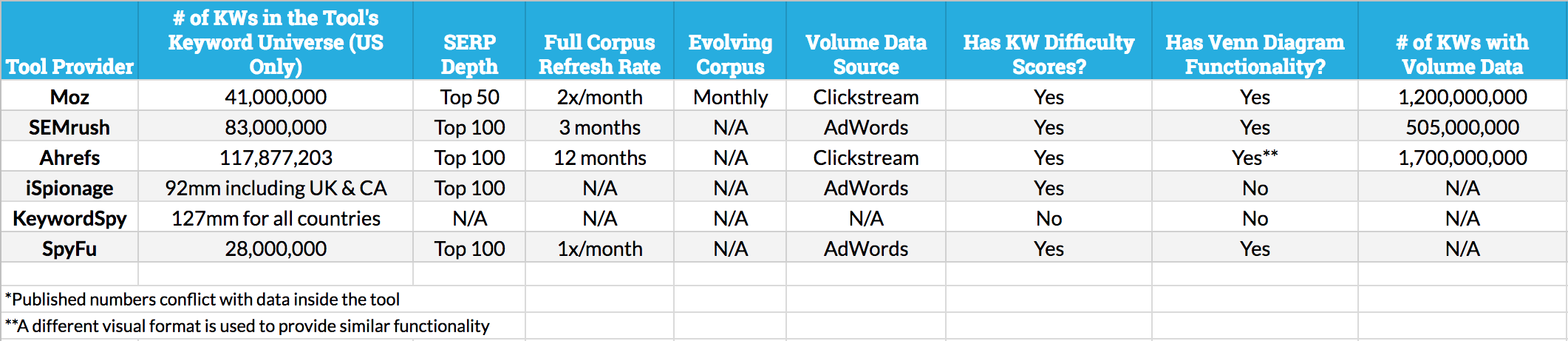
Click the image for a larger version
Obviously, we’ve made the decision to be generally smaller, but fresher, than most of our competitors. We do this because:
- A) We believe the most-trafficked keywords matter more when comparing the overlaps than getting too far into the long tail (this is particularly important because once you get into the longer tail of search demand, an unevenness in keyword representation is nearly unavoidable and can be very misleading)
- B) Accuracy matters a lot with these types of analyses, and keyword rankings data that’s more than 3–4 weeks out of date can create false impressions. It’s also very tough to do useful comparisons when some keyword rankings have been recently refreshed and others are weeks or months behind.
- C) We chose an evolving corpus that uses clickstream-fed data from Jumpshot to cycle in popular keywords and cycle out others that have lost popularity. In this fashion, we feel we can provide the truest, most representational form of the keyword universe being used by US searchers right now.
Over time, we hope to grow our corpus (so long as we can maintain accuracy and freshness, which provide the advantages above), and extend to other geographies as well.
If you’re a Moz Pro subscriber and haven’t tried out this feature yet, give it a spin. To explore keywords by site, simply enter a root domain, subdomain, or exact page into the universal search bar in Keyword Explorer. Use the drop if you need to modify your search (for example, researching a root domain as a keyword).
There’s immense value to be had here, and a wealth of powerful, accurate, timely rankings data that can help boost your SEO targeting and competitive research efforts. I’m looking forward to your comments, questions, and feedback!
Need some extra guidance? Sign up for our upcoming webinar on either Thursday, October 26th or Monday, October 30th.
Sign up for The Moz Top 10, a semimonthly mailer updating you on the top ten hottest pieces of SEO news, tips, and rad links uncovered by the Moz team. Think of it as your exclusive digest of stuff you don’t have time to hunt down but want to read!
Google AdWords Rolling Out Support For Parallel Tracking
Google announced they have begun rolling out support for what is called parallel tracking…