Search in Pics: Google top contributor summit, nautilus door lock & Android security figurine
In this week’s Search In Pictures, here are the latest images culled from the web, showing what people eat at the search engine companies, how they play, who they meet, where they speak, what toys they have and more. Google’s 2017 top contributor summit: Source: Google+ A Google door…
Please visit Search Engine Land for the full article.
Ask Yoast: adding testimonials to your site
Would you buy a product or service from a website that doesn’t look trustworthy? Probably not. So you understand how important it is to gain the trust of your visitors if you own a business. Adding testimonials to your site can help you with this. They give potential customers some idea of the experiences of […]
The post Ask Yoast: adding testimonials to your site appeared first on Yoast.
What factors should you consider before choosing a web crawler tool?
SEO is a many-headed beast. From off-page elements to on-page elements, covering all aspects of SEO can easily become a Herculean task, especially when dealing with large websites. That is why a tool that crawls your website on a regular basis and brings back reports on what needs to be fixed is a must-have. What are the key features that you should look for in a web crawler?
Analytics basics: Which posts and pages perform best
Picture this, you have an excellent website with nice pages and posts, but you have no clue how these pages perform. Sound familiar? How do you know if people like the posts you’re writing? Where do you find out if your pages convert visitors into newsletter subscribers or customers? The answer lies in the data […]
The post Analytics basics: Which posts and pages perform best appeared first on Yoast.
Semantic Keyword Research and Topic Models
I went to the Pubcon 2017 Conference this week in Las Vegas Nevada, and gave a presentation about Semaantic Search topics based upon white papers and patents from Google. My focus was upon things such as Context Vectors and Phrase Based Indexing. I promised in social media that I would post the presentation on my […]
The post Semantic Keyword Research and Topic Models appeared first on SEO by the Sea ⚓.
How Google Gives Us insight into Searcher Intent Through the Results – Whiteboard Friday
Posted by randfish
When Google isn’t quite sure what a searcher means just by their search query, the results (appropriately) cater to multiple possible meanings. Those SERPs, if we examine them carefully, are full of useful information. In this episode of Whiteboard Friday, Rand offers some real-world examples of what we can glean just by skimming the kinds of things Google decides are relevant.
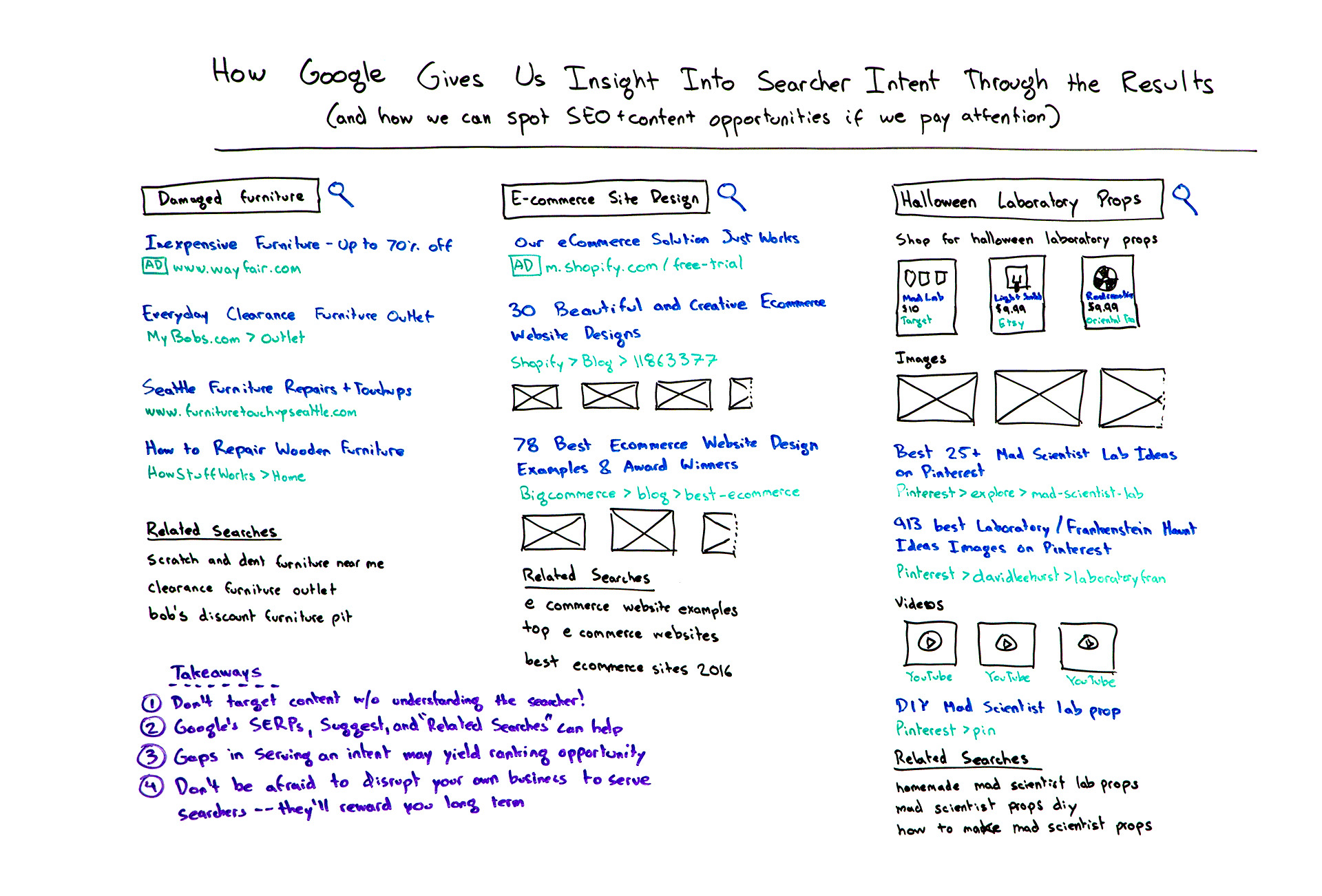
Click on the whiteboard image above to open a high resolution version in a new tab!
Video Transcription
Howdy, Moz fans, and welcome to another edition of Whiteboard Friday. This week we’re going to chat about how Google is giving us insight through their search results, their suggested searches, and their related searches into the intent that searchers have when they perform their query and how if we’re smart enough and we look closely and study well, we can actually get SEO and content opportunities out of this analysis.
So the way I thought I’d run this Whiteboard Friday is a little bit different than usual. Rather than being purely prescriptive, I thought I’d try and illustrate some actual results. I’ve pared them down a bit and removed the descriptions and taken some out, but to try and show the process of that.
Query 1: Damaged furniture

So here’s a query for damaged furniture. If I am trying to reach searchers for this query — let’s assume that I’m in the furniture business — I might see here that there are some ads up at the top, like this one from Wayfair, inexpensive furniture up to 70% off. I scroll through the organic results — Everyday Clearance Furniture Outlet, MyBobs.com, okay, that’s a local place here in Seattle, Seattle Furniture Repairs and Touchups. Okay, this is interesting. This is a different type of result, or it’s serving a different searcher intent. This is, “We will repair your furniture,” not, “We will sell you cheap, damaged furniture,” which these two are. Then How Stuff Works, which is saying, “We will show you how to repair wooden furniture.”

Now I scroll down even further and I get to the related searches — scratch and dent furniture near me, which suggests one of the intents absolutely behind this query is what Wayfair and My Bob’s are serving, which is cheap furniture, inexpensive furniture that’s been previously damaged in some way. Clearance Furniture Outlet, similar intent, Bob’s Discount Furniture Pit, I’m not totally sure about the pit naming convention, and then there are some queries that are similar to these other ones.
So here’s what’s happening. When you see search results like this, what you should pay close attention to is the intent to position ratio. Let’s say…
Intent A: I want to buy furniture
Intent B: I am looking to touch up or repair my furniture
Intent C: Show me how to do it myself
If you see more A’s ranking near the top, not in the advertising results, because those don’t need a very high click-through rate in order to exist. They can be at 1% or 2% and still do fine here. But if you see these higher up here, that is an indication that a higher percent of Google searchers are preferring or looking for this A intent stuff. You can apply this to any search that you look at.
Thus, if you are doing SEO or creating content to try and target a query, but the content you’re creating or the purpose you’re trying to serve is in the lower ranked stuff, you might be trapped in a world where you can’t rise any higher. Position four, maybe position three is the best you’re going to do because Google is always going to be serving the different intent, the intent that more of the searchers for this query are seeking out.
What’s also nice about this is if you perform this and you see a single intent being served throughout and a single intent in the related searches, you can guess that it’s probably going to be very difficult to change the searcher intent or to serve an entirely different searcher intent with that same query. You might need to look at different ones.
Query 2: E-commerce site design

All right. Next up, e-commerce site design. So an ad up here, again, from Shopify. This one is “Our e-commerce solution just works.” They’re trying to sell something. I’m going to go with they’re trying to sell you e-commerce site design.
Intent A: They are trying to sell you ecommerce design
Intent B: I am looking for successful e-commerce design inspiration/ideas
30 Beautiful and Creative E-commerce Website Designs, this is also from Shopify, because they just took my advice, well, okay, obviously they took my advice long before this Whiteboard Friday. But they’re ranking with exactly what we talked about in intent B, which was essentially, “Hey, I am looking for inspiration. I’m looking for ideas. I’m trying to figure out what my e-commerce website should look like or what designs are successful.” You can see that again — intent B. So what’s ranking higher here? It’s not the serve the purchase intent. It’s serve the examples intent.

When we get to related searches, you see that again, e-commerce website examples, top e-commerce websites, best e-commerce sites 2016, these are all intent B. If you’re trying to serve intent A, you better advertise, because ranking in the top results here is just not going to happen. That’s not what searchers are seeking. It’s going to be very, very tough.
Slight side note:
Whenever you see this, this late in the year, we’re in October right now as we’re filming this Whiteboard Friday. I did this search today, and I saw Best E-commerce Sites 2016 still in here. That suggests to me that there were a lot more people searching for it last year than there are this year. You will see there’s like the same thing for 2017 down below, but it’s lower in the related searches. It doesn’t have as much volume. Again, that suggests to me it’s on a downward trend. You can double-check that in Google trends, but good to pay attention to. Okay, side note over.
Query 3: Halloween laboratory props

Let’s move on to our last example here, Halloween laboratory props. So Halloween is coming up. Lots and lots of people looking for laboratory props and props and costumes and decorations of all kinds. There’s a huge business around this, especially in the United States and emerging in the United Kingdom and Australia and other places.
So, up at the top, Google is showing us ads. They are showing us the shopping ads, shop for Halloween laboratory props, and they’ve got some chemistry sets and a Frankenstein-style light switch that you can buy and some radioactive props and that kind of thing from Target, Etsy, and Oriental Trading Company.
Then they show images, which is not surprising. But hot tip, if you see images ranking in the top of the organic results, you should absolutely be doing image SEO. This is a clear indication that a lot of the searchers want images. That means Google Images is probably getting a significant portion of the search volume. When I see this up here, my guess is always it’s going to be 20% plus of searchers are going to the image results rather than the organic search results, and ranking here is often way easier than ranking here.
More interesting things happening next. This result is from Pinterest, “Best 25 Mad Scientist Lab Ideas on Pinterest,” “913 Best Laboratory, Frankenstein, Haunt Ideas Images on Pinterest,” “DIY Mad Scientist Lab Prop on Pinterest.” By the way, there’s a video segment in here, which is all YouTube. This happens quite a bit when there is heavy, heavy visual content. You essentially see the domain crowding single-domain domination of search results. What does that mean? Don’t do SEO on your site, or fine, do it on your site, but also do it on Pinterest and also do it on YouTube.
If you’re creating content like these guys are over here, BigCommerce and Shopify created these great pieces for beautiful ecommerce designs, they’ve put together a ton of images, wonderful. You can apply that same strategy for this. But then what should you do? Go to Pinterest, upload all those images, create a board, try and get your images shared, do some Pinterest SEO essentially. Do the same thing on YouTube. Have a bunch of examples in a short video that shows all the stuff that you’re creating and then upload that to YouTube. Preferably have a channel. Preferably have a few videos so that you can potentially rank multiple times in here, because you know that many people are going here. This is pretty far down. So this is probably less than 10% of searchers make it here, but still a ton of opportunity. Very different type of search intent than what we saw in these previous two.
 Look at the related searches — homemade mad scientist lab props, mad scientist props DIY, do it yourself, how to make mad scientist props. These intents are, generally speaking, not being served by any of these results yet. If you scroll far enough in the YouTube videos here, there’s actually one video that is a how-to, but most of these are just showing stuff off. That to me is a content opportunity. You could make your Pinterest board potentially using some of these, DIY homemade, how to make, make that your Pinterest board, and probably, I’m going to guess that you will have a very good chance of pushing these other Pinterest results out of here and dominating those.
So a few takeaways, just some short ones before we end here.
- In the SEO world, don’t target content without first understanding the searcher. We can be very misled by just looking at keywords. If we look at the search results first, we can get inside the searcher’s head a little bit. Hopefully, we can have some real conversations with those folks too.
- Second, Google SERPs, search suggest, related searches, they can all help with problem number one.
- Three, gaps in serving intent can yield ranking opportunity, like we showed in a few of these examples.
- Finally, don’t be afraid to disrupt your own business or your own content or your own selfish interest in order to serve searchers. In the long term, it will be better for you.
You can see that exemplified here by Shopify saying, “We’re going to show off a bunch of beautiful ecommerce designs even though some of them are not from Shopify.” BigCommerce did the same thing. Even though some of them are not using BigCommerce’s platform, they basically are willing to sacrifice some of that in order to serve searchers and build their brand, because they know if they don’t, somebody else clearly will.
All right, everyone. Hope you’ve enjoyed this edition of Whiteboard Friday. I would love to hear your examples in the comments about how you’ve done search intent interpretation through looking at search results. We’ll see you again next week. Take care.
Video transcription by Speechpad.com
Sign up for The Moz Top 10, a semimonthly mailer updating you on the top ten hottest pieces of SEO news, tips, and rad links uncovered by the Moz team. Think of it as your exclusive digest of stuff you don’t have time to hunt down but want to read!
SearchCap: TripAvisor labels risky hotels, paid search trends & more
Below is what happened in search today, as reported on Search Engine Land and from other places across the web.
The post SearchCap: TripAvisor labels risky hotels, paid search trends & more appeared first on Search Engine Land.
Please visit Search Engine Land for the full article.
Choosing a call analytics platform
Thanks to the ubiquity of the smartphone, phone calls are finally getting the respect they deserve as an integral part of the customer journey. Mobile calls now account for 60 percent of inbound calls to businesses, according to BIA/Kelsey, which proje…
Ranking in Organic Search is the #1 Local Ranking Factor
 Do I have your attention now? Sweet! I’m happy to announce that we just updated our Local SEO Ranking Factors! This year we really expanded the data set of the study. We looked at the 150 largest metro’s in the US and doubled the number of keywords we were looking at. This means the data […]
The post Ranking in Organic Search is the #1 Local Ranking Factor appeared first on Local SEO Guide.
Google Tests PDF & File Type Label In Search Results Snippets
Google seems to be testing a file type label in the search results snippets. Sergio Redondo posted a screen shot on Twitter of him being shown a PDF label icon in the Google search results on a snippet…
Four key holiday paid search trends to keep an eye on
Columnist Andy Taylor shares data that can help predict trends in the e-commerce and retail space this holiday season. Advertisers, take note!
The post Four key holiday paid search trends to keep an eye on appeared first on Search Engine Land.
Please…
Removal of hotel review reporting rape creates crisis of confidence for TripAdvisor content
The site had scrubbed first-person reviews and content about rape and sexual assault at a Mexican resort.
The post Removal of hotel review reporting rape creates crisis of confidence for TripAdvisor content appeared first on Search Engine Land.
Plea…
YoastCon 2017: 10 takeaways to improve your SEO
It’s been a week since the SEO conference YoastCon and we’re still processing all the cool stuff we’ve heard and seen. In a few days, you’ll be able to watch the talks on video and make your own to-do list to make your rankings skyrocket. To give you an idea of the story arc of […]
The post YoastCon 2017: 10 takeaways to improve your SEO appeared first on Yoast.
Image optimization 101: How to rank higher in image search
Optimizing images to rank well in search is a must for an increasingly visual web: a good logo or some eye-catching graphics can be as effective at attracting visitors to your website as your written content. But even if you’re highly familiar with optimizing written content for search, you may not know where to begin with images. Here’s how to ensure your images rank well in search.
Brett Tabke Buys WebmasterWorld Back After 5 Years
About five years ago, Jim Boykin as his company, acquired WebmasterWorld forums, DevShed properties, Cre8asite and a bunch of other properties. Well, five years later, Brett Tabke, the founder of WebmasterWorld, has bought it back from Jim Boykin…
…
Google AdSense Ad Balance Tool Officially Back For Good
Earlier this year, Google AdSense launched the Ad Balance tool which let publishers use controls, a slider, to help you reduce the number of ads you show to users, specifically the ads that earn you the least revenue, and see how it affects your earnin…
New Google My Business Selection Attributes For Business Descriptions
Google quietly announced on the new features page that they now support what they call “selection attributes.” Selection attributes require selection of exactly one of several predefined choices…
Google: Sites Not Ready For Mobile First Indexing Not Being Moved Yet
There isn’t much new yet with the mobile first index at Google outside of what I reported out of SMX East but at PubCon yesterday…
SEO Consultation Services In The UK
If you need help with your SEO efforts and have an English-language-based website, I can assist. You do not have to be in the UK. We work with clients all over the world and have clients based in Scotland, Wales, Ireland and England.
Read the full article here SEO Consultation Services In The UK
© Copyright 2006-2017 Shaun Anderson http://www.hobo-web.co.uk/
SearchCap: Google news knowledge graph, fake reviews & info operator
Below is what happened in search today, as reported on Search Engine Land and from other places across the web.
The post SearchCap: Google news knowledge graph, fake reviews & info operator appeared first on Search Engine Land.
Please visit Search Engine Land for the full article.