Already doing SEO? Add these two things to optimize for voice search
Not sure how to optimize your webpages for voice search? Contributor Bryson Meunier lists 12 ‘how-to’ tactics and suggests two of them are the real workhorses in driving traffic to your site.
The post Already doing SEO? Add these two things to optimiz…
Google goo.gl URL Shortener Shutting Down On March 30, 2019
Google announced that they are shutting down, closing, their URL shortener service on March 30, 2019. Google first launched it in December 2009, and less than ten years later Google is going to shut it down…
Search Buzz Video Recap: Google Structured Data, A/B Testing, Bing Ads, Ben Gomes & April Fools
This week, I posted the monthly Google webmaster report, it was a busy month…
Writing with Gutenberg
Gutenberg is coming. It’s a really big thing in the world of WordPress. At Yoast, we are really busy making sure our Yoast SEO plugin integrates nicely with the new editor. So we talk and think and a lot about Gutenberg. But as a writer, I didn’t really use Gutenberg yet. And this made me […]
The post Writing with Gutenberg appeared first on Yoast.
5 ways to make your website stand out in the SERPs
Today’s SERPs are a far cry from the humble list of ten results and handful of sponsored links that Google started out with. So how can we ensure our content is best suited to Google’s ever-more intuitive results pages? And how can we make it stand out there?
Ask Yoast: Preparing for the General Data Protection Regulation (GDPR)
Maintaining a website is hard work, and to do it right, you have to be skilled in many things: writing, editing, SEO, marketing (if you own a business) and perhaps even a bit of coding, to name but a few. But that’s not all. If you handle and collect the data of your site’s visitors, […]
The post Ask Yoast: Preparing for the General Data Protection Regulation (GDPR) appeared first on Yoast.
Marc Poirer – The Search Community Honors You
This is part of the say something nice about an SEO/SEM series – feel free to nominate someone over here.
Marc Poirer is 48 years old, lives in the Montreal…
Meet Gary Illyes Of Google In Australia Next Week
Gary Illyes, one of our favorite Googlers, will be in be in both Sydney and Melbourne, Australia next week and you can meet up with him. Here is where you can meet him on April 11th in Sydney and April 13th in Melbourne…
Google Is Able To Index CSS Grid Layouts
Google said even though Chrome 41, how GoogleBot sees the web, doesn’t support CSS Grid Layouts, Google is still able to index the content on those pages…
The Pro Marketer’s Product Launch Checklist for 2018 – Whiteboard Friday
Posted by randfish
What goes into a truly exceptional product launch? To give your new product a feature the best chance at success, it’s important to wrangle all the many moving pieces involved in pulling off a seamless marketing launch. From listing audience members and influencers to having the right success metrics to having a rollback plan, Rand shares his best advice in the form of an actionable checklist in this Whiteboard Friday. And make sure to check out the last item — it may be the best one to start with!
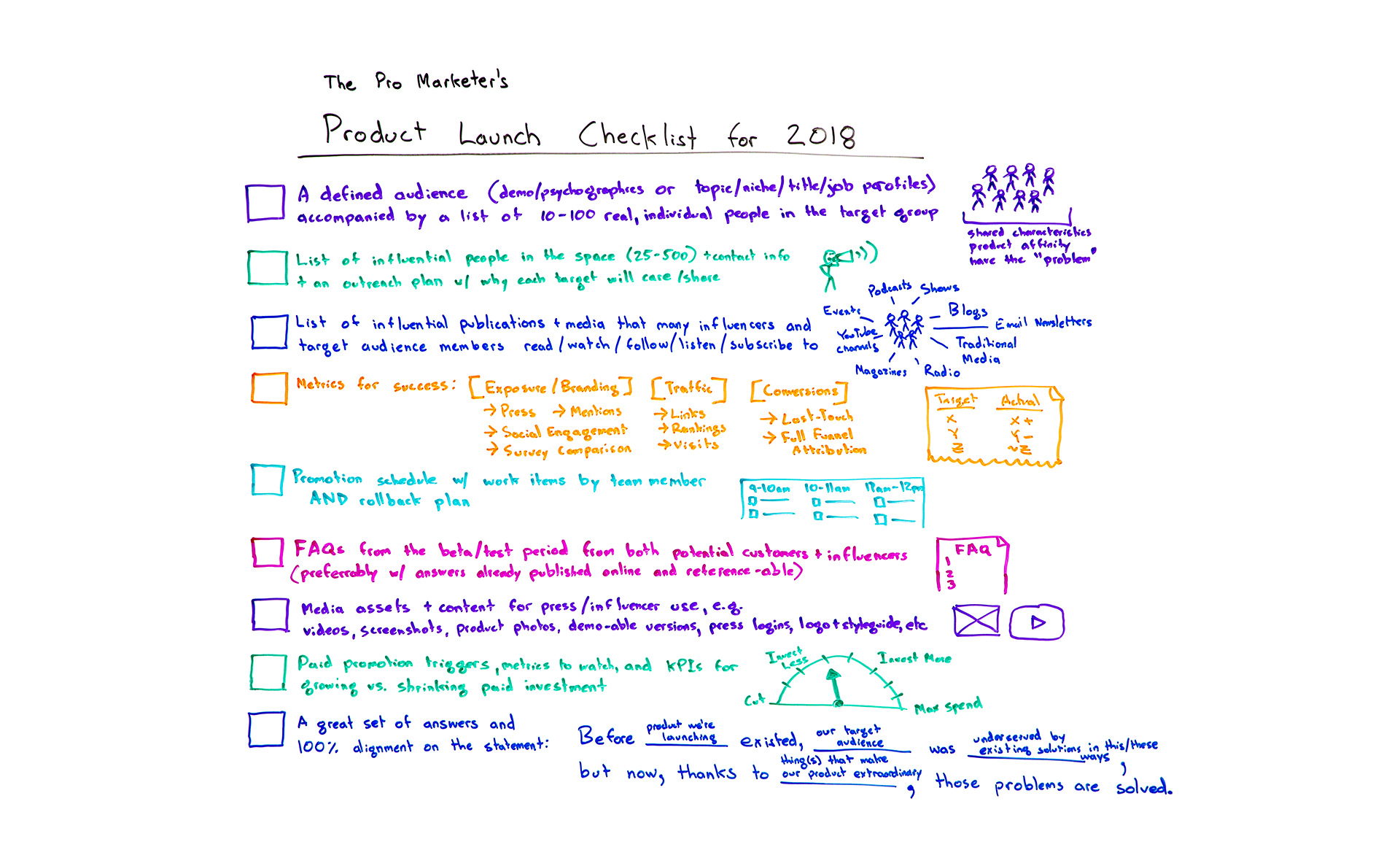
Click on the whiteboard image above to open a high-resolution version in a new tab!
<span id=”selection-marker-1″ class=”redactor-selection-marker”></span>
Video Transcription
Howdy, Moz fans, and welcome to another edition of Whiteboard Friday. This week we are chatting about crafting a professional marketer’s product launch checklist for 2018.
So many of you are undoubtedly in the business of doing things around SEO and around web marketing, around content marketing, around social media marketing in service of a product that you are launching or a feature that you are launching or multiple products. I think it pays for us to examine what goes into a very successful product launch.
Of course, I’ve been a part of many of these at Moz, as part of many of the startups and other companies that I advise, and there are some shared characteristics, particularly from the marketing perspective. I won’t focus on the product and engineering perspectives. We’ll talk about marketing product launches today.
☑ A defined audience, accompanied by a list of 10–100 real, individual people in the target group

So to start with, very first, top of our list, a defined audience. That can be a demographic or a psychographic set of characteristics that define your audience or a topic, a niche, a job title or job function type of characteristics that comprise the profile of who’s in your group. That should be accompanied by a list of 10 to 100 real people.
I know that many marketers out there love using personas, and I think it’s fine to use personas to help define this audience. But I’m going to urge you strongly to have that real list. Those could be:
- Customers that you know you’re targeting,
- People who have bought from you in the past and you’re hoping will buy again,
- People who maybe you’ve lost and are hoping to recapture, maybe they use a competitor’s product today or they’re notable in some way.
As long as they fit your characteristics, I want you to have that list of those real people.
The problem with personas is you can’t talk to them. You can’t ask them real questions, or you can, but only in your own mind and your imagination fills in the details. These are real people that you can talk to, email, ask questions, show the product to, show the launch plan to and get real feedback. They should have shared characteristics. They should have an affinity for the product that you’re building or launching, hopefully, and they should share the problem.
Whatever the problem, almost every product, in fact, hopefully every product is actually trying to solve a problem better than the thing that came before it or the many things that came before it. Your audience should share whatever that problem is that you’re trying to solve.
☑ List of 25–500 influential people in the space, + contact info and an outreach plan

Okay. We’ll give this a nice check mark. Next, list of influential people in the space. That could be 25 to even hundreds or thousands of people potentially, plus their contact information and an outreach plan. That outreach plan should include why each target is going to care about the problem, about the solution, and why they’re going to share. Why will they amplify?
This is in answer to the question: Who will help amplify this and why? If you don’t have a great answer to that, your product launch will almost certainly fall flat from a marketing perspective. If you can build a successful one of these, that list, especially if before you even launch, you know that 20 of these 500 people have said, “Yes, I’m going to amplify. Here’s why I care about this. I can’t wait until you give me permission to share it or release this thing or send me the version of it.” That’s an awesome, awesome step.
☑ List of influential publications and media that influencers and target audience members consume

Next, similarly, just like we have a list of influential people, we want a list of influential publications and media that many influencers and many of your target audience members read, watch, subscribe to, listen to, follow, etc. So it’s basically these two groups should be paying attention to the media, to the publications that we’re trying to list out here. Essentially, that could be events that these people go to. It could be podcasts they listen to. It could be shows they watch, blogs or email newsletters they subscribe to. It could be traditional media, magazines, radio, YouTube channel. Whatever those publications are, all of them are the ones we’re trying to build a list of here.
That is going to be part of our outreach target. We might have these influential people, and some of these could overlap. Some of these influential people may work for or at these influential publications and that’s fine. I just worry that too much influencer marketing is focused on individuals and not on publications when, in fact, both are critical to a product launch success.
☑ Metrics for success

Metrics, yes, marketers need metrics for success. Those should be in three buckets — exposure and branding, which include things like press and mentions and social engagement, maybe a survey comparison of before and after. We ran an anonymous survey to a group of our target audience before and after and we measured brand awareness differential. Traffic, so links, rankings, visits, time on site, etc., and conversions. That could be measured through last touch or through preferably full-funnel attribution.

☑ Promotional schedule with work items by team member and rollback plan

A promotion schedule. So this means we actually know what we’re doing and in what order as the launch rolls out. That could be before launch we’re doing a bunch of things around private beta or around sharing with some of these influential people and publications. Or we haven’t defined the audience yet. We need to do that. We have that schedule and work items by each team member, and we’re going to need a rollback plan. So if at any point along the way, the person who owns the product process says, “This is not good enough,” or, “We have a fundamental error,” or, “The flamethrower we’re building shoots ice instead of fire,” we should probably either rename and rebrand it or roll it back. We have that structure set up.
☑ FAQ from the beta/test period, from both potential customers and influencers

Next, frequently asked questions. This is where a beta or test period and test users come in super handy, because they will have asked us a bunch of questions. They’ll have asked as they’re playing with or observing or using the product. We should be able to take all of those questions from both potential customers and from influencers, and we should have those answers set up for our customer service and help teams and for people who are interfacing with the press and with influencers in case they reach out.
In an ideal world, we would also publish these online. We would have a place where we could reference them. They’re already published. This is particularly handy when press and influencers cover a launch and they link to a, “Oh, here’s how the ice thrower,” I’m assuming, “that we’re building is meant to work, and here’s at what temperatures it’s safe to operate,” etc.
☑ Media assets & content for press/influencer use

Next up, media assets and content for those press and publications and influencer use. For example:
- Videos of people using the product and playing with it
- Screencasts, screenshots if it’s a digital or software product
- Photos
- Demo-able versions if you want to give people login access to something special
- Guidelines for press usage and citations, as well as things like logo and style guide
All of those types of things. Trust me, if your product launch goes well, people will ask you for this, or they will just use things that they steal from your site. You would much prefer to be able to control these assets and to control where the links and citations point, especially from an SEO perspective.
☑ Paid promotion triggers, metrics to watch, and KPIs

Next up, penultimate on our checklist, paid promotion triggers. So most of the time, when you’re doing a product launch, there will also be some component that is non-organic, i.e., paid such as paid content. It could be pay-per-click ads. It could be Facebook advertising. It could be web advertising. It could be retargeting and remarketing. It could be broadcast advertising. All of those kinds of things.
You will want with each of those triggers, triggers that essentially say, “Okay, we’ve reached the point where we are now ready. We executed along our schedule, so we are now ready to turn on the paid promotion, and channel X is going to be the start of that, then channel Y and then channel Z.”
Then we should have KPIs, key performance indicators, that tell us whether we’re going to grow or shrink that spend, something like this. So we know, hey, the product launch is going this well, so we’re going to keep our current level investment. But if we tick up over here, we’re going to invest more. If we get to here, we’re going to max out our spend. We know that our maximum spend is X. Versus it goes the other way and over here, we’re going to cut. We’re going to cut all spend if we fall below metric Z.
☑ A great set of answers and 100% alignment on the following statement:

Last but not least on our checklist, this should exist even prior to a product design process. In fact, if you’re doing this at the end of a product launch checklist, the rest of this is not going to go so well. But if you start product design with this in mind and then maintain it all the way through launch, through messaging, through all the marketing that you do, you’re going to be in good shape. That is a great set of answers and 100% alignment, meaning everyone on the team, who’s working on this, agrees that this is how we’re going to position this on this statement.
Before the product we’re launching existed, our target audience, the group of people up here, was underserved in these ways or by previous solutions or because of these problems. But now, thanks to the thing that we’ve done, the thing that we’ve created and what is extraordinary about this product, these problems or this problem is solved.
If you design in this fashion and then you roll out in this fashion, you get this wonderful alignment and connection between how you’re branding and marketing the product and how the product was conceived and built. The problem and its solution become clear throughout. That tends to do very, very well for product building and product launching.
All right, everyone, if you have additions to this checklist, I hope you leave them in the comments below. We’ll see you again next week for another edition of Whiteboard Friday. Take care.
Video transcription by Speechpad.com
Sign up for The Moz Top 10, a semimonthly mailer updating you on the top ten hottest pieces of SEO news, tips, and rad links uncovered by the Moz team. Think of it as your exclusive digest of stuff you don’t have time to hunt down but want to read!
Daniel Richardson – The Search Community Honors You
This is part of the say something nice about an SEO/SEM series – feel free to nominate someone over here.
Daniel Richardson is 30 years old, lives in Liverpool…
Programming Note: Offline Tomorrow, April 6th For Passover 5778
This is a programming note that I will be 100% offline tomorrow, Friday April 5th…
SearchCap: Google SEO patents & Search Engine Land Awards
Below is what happened in search today, as reported on Search Engine Land and from other places across the web.
The post SearchCap: Google SEO patents & Search Engine Land Awards appeared first on Search Engine Land.
Please visit Search Engine Land for the full article.
Google patent on related entities and what it means for SEO
Contributor Dave Davies pulls key points from a newly awarded Google patent on related entities and points out the ranking benefits of strengthening entity associations in your SEO and link-building efforts.
The post Google patent on related entities …
Bing Ads Price Extensions
Bing announced they launched new ad extensions named Price Extensions. Bing Ads Price Extensions are a pay-per-click extension that display your products or services, along with their corresponding prices…
Google Uses Many Signals To Know What & If To Show Dates In Search Snippets
We’ve have our issues with Google showing the wrong date or false dates in the search results snippets…
SEO: Does Google Treat Content With Quotes Or Brackets Differently?
So let’s say you are a big fan of writing content with quotes or brackets but all of a sudden you learn about this thing called SEO [search engine optimization] and you become paranoid that your “SEO” won’t be “optimal” if you use brackets a lot of quo…
Google SEO Snippets Video: Multiple Sitemap Files
Here is another SEO Snippets video, this one on the basic topic of submitting more than 50,000 URLs via your sitemap file to Google…
April 2018 Google Webmaster Report
A core algorithm update, the mobile-first indexing rollout begins, zero search results tested, image search captions…
.png)