WordStream Sells To Gannett For $150 Million
As I covered at Search Engine Land, we got big industry news, the company Larry Kim founded in 2007 named WordStream has been acquired for $150 million. WordStream is a software service that helps digital marketers manage their Google AdWords campaign…
Google: We Process rel=canonicals On Initial Fetch, Not Rendered Version
Google’s John Mueller said on Twitter that GoogleBot currently will process the rel=canonical attribute on the initial fetch…
Two Google I/O Sessions On Search You Should Watch
Google gave really only two SEO focused sessions at I/O this year, although, Google published all the sessions they thought SEOs and webmasters would care about…
Google Can Treat 308 Redirects As 301s
Google can treat 308 redirects the same as they treat 301 redirects, says Google’s John Mueller. That is, of course…
Search Buzz Video Recap: Google I/O, Search Questions, Image Guidelines, JavaScript Upgrades, AdWords & More
It was a super busy week, mostly because a lot that came out of Google I/O but also busy outside of that. I summed up Googleâs I/O keynote in tweets, so check that out. Google is testing letting searchers submit questions they want content for in the search results…
SearchCap: PPC training and search pictures
Below is what happened in search today, as reported on Search Engine Land and from other places across the web.
Please visit Search Engine Land for the full article.
Please visit Search Engine Land for the full article.
What We Learned in April 2018: The Digital Marketing Month in a Minute

John Giannandrea, chief of search at Google hired by Apple
In a move that is being seen as a victory for Apple, the tech giant has appointed John Giannandrea, the now former chief of search and artificial intelligence at Google, to lead its AI efforts.
The best digital marketing stats we’ve seen this week
Let’s get to it.
18% of ecommerce backlinks do not send users where they expect to go
New research by WooRank has uncovered the extent to which bad links are impacting ecommerce sites. In a study of 1,000 ecommerce sites with Alexa ranks between 150,000 and 200,000 (as well as 1,000-1,500 product pages) it found that 12.2% of backlinks sent users to a 404 page.
Meanwhile, 4.6% of links redirected users to the site’s homepage, taking the total amount of backlinks not matching user’s expectations to 18%.
As a consequence of these links, it is estimated that retailers could be losing $0.71 per click, based on average Google Shopping CPC.
To help combat the issue, WooRank emphasises the importance of error pages returning a 404 status (so that it does not show up in search results), as well as not using the homepage as a redirect.

Related reading:
- What Google’s memory loss means for content and SEO strategy
- SEO considerations for discontinued products in ecommerce
Adidas named as the most visible online brand
Bandwatch’s 2018 Brand Visibility report has analysed 250 million images (published on Twitter and Instagram) to identify the 100 most visible brands online.
The two biggest global sports brands top the list – Nike and Adidas. The latter wins by a reasonable margin, however, with its logo appearing 6,664,170 per month compared to Nike’s showing up 5,134,017 times.
Google has been named as the third most visible brand, with its image appearing 3,888,432 times per month, while Emirates comes in fourth, appearing 2,841,215.
See the top ten brands below, or check out the full list here.

More on Adidas & Nike:
- Why Nike’s refreshed product pages improve CX (& beat Adidas)
- Nike vs. adidas vs. Under Armour: Email signup & welcome
Building local audiences cited as location data’s most valuable use
A new report by Location Sciences explores the challenges and opportunities presented by location data for UK retailers.
From a survey of 157 retail professionals, it found that accurate location-based audiences is thought to be the most valuable insight gained by location data – cited by 36% of respondents. This refers to engaged audiences around a specific location, e.g. regular cinema visitors or in-store shoppers.
This is closely followed by footfall tracking as the data’s most valuable use, which was also cited by 28% of professionals. Interestingly, there was a big drop off in all other categories after this, including measurement of ad effectiveness, which is currently only being used by the most forward-thinking brands.
However, the report suggests that – as confidence in the accuracy of location data grows – uses cases will expand to include this, as well as other strategies like optimisation of cross-channel media spend.

More on location-based data:
- Waze opens up location-based advertising to SMEs
- How retailers are using geofencing to improve in-store CX
- A day in the life of… a location intelligence expert
77% of global consumers expect to see more personalised content in future
The Content Connect II report – based on a new global survey of 752 Reuters.com users – has revealed that there is a growing demand for personalisation in branded content.
77% of respondents said they expect to see more personalised content in future, with 63% of agreeing that personally relevant content improves how they feel about the associated brand. Similarly, 58% see brands in a more positive light if they provide them with content that matches their individual interests.
The research also identifies the attributes consumers consider most appealing in branded content. 64% of global consumers consider sponsored content more appealing if it is thought provoking, 58% say the same for imaginative content, while 55% do for humorous content.
Lastly, the report highlights the importance of style and tone in branded content, revealing how specific content topics appeal to different personalities. For example, the top personality type for business and finance content is ‘ambitious’, whereas arts and culture is ‘creative’, politics is ‘outspoken’ and travel is ‘spontaneous’.

Related reading:
- How to build a personalisation strategy for your content website
- How will Snapchat’s redesign affect branded content?

Users now almost as likely to use social to follow news as they are to keep in touch with friends
GlobalWebIndex’s latest social report has revealed that the role social media plays in the lives of users has evolved.
Now, 40% of digital consumers say they use social to follow the news, just shy of the 41% who identify social as a platform for keeping in touch with friends. This comes from a survey of 350,000 internet users aged 16 to 64.
Interestingly, this behaviour looks to be more prevalent amongst older users, with 47% of 16 to 24 year olds saying they use social media to fill up spare time, and 45% saying they use it find funny or entertaining content.
Lastly, the report also highlights how social media platforms are also becoming music hubs, with users of Facebook, Snapchat, Twitter and Instagram all spending longer on music streaming services per day on average than non-users.

Related reading:
- The impact of technology and social media on the music industry
- Spotify UX vs. Apple Music UX: How do they compare?
Q1 2018 sees 66% rise in purchase growth rate on smartphones in UK compared to previous quarter
Criteo’s Q1 Global Commerce Review has revealed that there has been a rapid increase in the use of smartphones for retail purchases in the UK this quarter.
In Q1 2018, there was a 66% increase in online purchase growth rate on smartphone compared to Q4 2017, highlighting the increasing speed at which shoppers are adopting mobile as their primary platform.
The report – which comes from the analysis of over 5,000 retailers in more than 80 countries – also states that mobile devices accounted for 54% of retail transactions in the UK, while European retailers who have a dedicated app saw mobile account for 25% more of their transactions than those who don’t.
Meanwhile, in-app transactions have increased by 22% year-over-year globally, and in North America, the conversion rate on shopping apps is now more than three-times higher than on mobile web.

Related reading:
The big picture: what’s next for image and voice search?
Voice search and image search are increasingly becoming more prominent in our society. Wajid Ali from Forward3D investigates how far the technology has advanced and how it will be used in the future.
Ask Yoast: Canonical for PDF magazine
There are many occassions when you may want to put a PDF on your site. For example, when you’ve made an online magazine, when an article you wrote was featured in a book or magazine, or when you’ve written detailed instructions for a DIY project. So far, so good. But things can get a bit […]
The post Ask Yoast: Canonical for PDF magazine appeared first on Yoast.
Stay sharp and relevant with ongoing PPC training
Contributor Jeff Baum recommends ongoing technical and soft skills training for your PPC team.
Please visit Search Engine Land for the full article.
Please visit Search Engine Land for the full article.
Search in Pics: Google I/O photos and May 4th images
Please visit Search Engine Land for the full article.
Please visit Search Engine Land for the full article.
Monitoring Featured Snippets – Whiteboard Friday
Posted by BritneyMuller
We’ve covered finding featured snippet opportunities. We’ve covered the process of targeting featured snippets you want to win. Now it’s time for the third and final piece of the puzzle: how to monitor and measure the effectiveness of all your efforts thus far. In this episode of Whiteboard Friday, Britney shares three pro tips on how to make sure your featured snippet strategy is working.
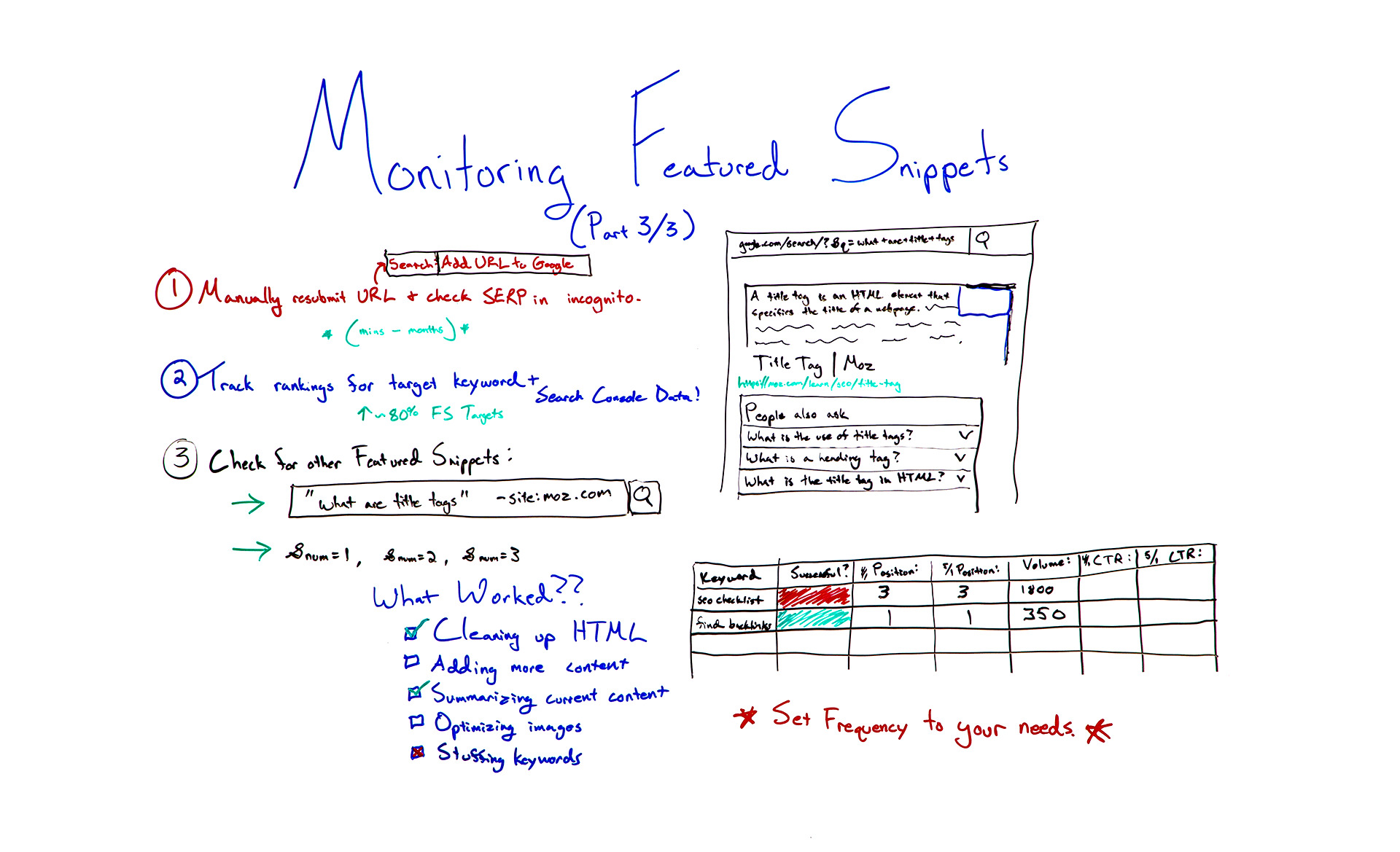
Click on the whiteboard image above to open a high-resolution version in a new tab!
Video Transcription
Hey, Moz fans. Welcome to another edition of Whiteboard Friday. Today we are going over part three of our three-part series all about featured snippets. So part one was about how to discover those featured snippet opportunities, part two was about how to target those, and this final one is how to properly monitor and measure the effectiveness of your targeting.
So we’ll jump right in. So there are a couple different steps and things you can do to go through this.
I. Manually resubmit URL and check SERP in incognito
First is just to manually resubmit a URL after you have tweaked that page to target that featured snippet. Super easy to do. All you do is go to Google and you type in “add URL to Google.” You will see a box pop up where you can submit that URL. You can also go through Search Console and submit it manually there. But this just sort of helps Google to crawl it a little faster and hopefully get it reprioritized to, potentially, a featured snippet.
From there, you can start to check for the keyword in an incognito window. So, in Chrome, you go to File > New Incognito. It tends to be a little bit more unbiased than your regular browser page when you’re doing a search. So this way, you’d start to get an idea of whether or not you’re moving up in that search result. So this can be anywhere from, I kid you not, a couple of minutes to months.
So Google tends to test different featured snippets over a long period of time, but occasionally I’ve had experience and I know a lot of you watching have had different experiences where you submit that URL to Google and boom — you’re in that featured snippet. So it really just depends, but you can keep an eye on things this way.

II. Track rankings for target keyword and Search Console data!
But you also want to keep in mind that you want to start also tracking for rankings for your target keyword as well as Search Console data. So what does that click-through rate look like? How are the impressions? Is there an upward trend in you trying to target that snippet?
So, in my test set, I have seen an average of around 80% increase in those keywords, just in rankings alone. So that’s a good sign that we’re improving these pages and hopefully helping to get us more featured snippets.
III. Check for other featured snippets

Then this last kind of pro tip here is to check for other instances of featured snippets. This is a really fun thing to do. So if you do just a basic search for “what are title tags,” you’re going to see Moz in the featured snippet. Then if you do “what are title tags” and then you do a -site:Moz.com, you’re going to see another featured snippet that Google is pulling is from a different page, that is not on Moz.com. So really interesting to sort of evaluate the types of content that they are testing and pulling for featured snippets.
Another trick that you can do is to append this ampersand, &num=1, &num=2 and so forth. What this is doing is you put this at the end of your Google URL for a search. So, typically, you do a search for “what are title tags,” and you’re going to see Google.com/search/? that typical markup. You can do a close-up on this, and then you’re just going to append it to pull in only three results, only two results, only four results, or else you can go longer and you can see if Google is pulling different featured snippets from that different quota of results. It’s really, really interesting, and you start to see what they’re testing and all that great stuff. So definitely play around with these two hacks right here.

Then lastly, you really just want to set the frequency of your monitoring to meet your needs. So hopefully, you have all of this information in a spreadsheet somewhere. You might have the keywords that you’re targeting as well as are they successful yet, yes or no. What’s the position? Is that going up or down?

Then you can start to prioritize. If you’re doing hundreds, you’re trying to target hundreds of featured snippets, maybe you check the really, really important ones once a week. Some of the others maybe are monthly checks.
From there, you really just need to keep track of, “Okay, well, what did I do to make that change? What was the improvement to that page to get it in the featured snippet?” That’s where you also want to keep detailed notes on what’s working for you and in your space and what’s not.
So I hope this helps. I look forward to hearing all of your featured snippet targeting stories. I’ve gotten some really awesome emails and look forward to hearing more about your journey down below in the comments. Feel free to ask me any questions and I look forward to seeing you on our next edition of Whiteboard Friday. Thanks.
Video transcription by Speechpad.com
Sign up for The Moz Top 10, a semimonthly mailer updating you on the top ten hottest pieces of SEO news, tips, and rad links uncovered by the Moz team. Think of it as your exclusive digest of stuff you don’t have time to hunt down but want to read!
Our goal: helping webmasters and content creators
Great websites are the result of the hard work of website owners who make their content and services accessible to the world. Even though it’s simpler now to run a website than it was years ago, it can still feel like a complex undertaking. This is why we invest a lot of time and effort in improving Google Search so that website owners can spend more time focusing on building the most useful content for their users, while we take care of helping users find that content.
Most website owners find they don’t have to worry much about what Google is doing—they post their content, and then Googlebot discovers, crawls, indexes and understands that content, to point users to relevant pages on those sites. However, sometimes the technical details still matter, and sometimes a great deal.
For those times when site owners would like a bit of help from someone at Google, or an explanation for why something works a particular way, or why things appear in a particular way, or how to fix what looks like a technical glitch, we have a global team dedicated to making sure there are many places for a website owner to get help from Google and knowledgeable members of the community.
The first place to start for help is Google Webmasters, a place where all of our support resources (many of which are available in 40 languages) are within easy reach:
- Google Web Fundamentals: Provides technical guidance on building a modern website that takes advantage of open web standards.
- Google Search developer documentation: Describes how Google crawls and indexes a website. Includes authoritative guidance on building a site that is optimized for Google Search.
- Search Console Help Center: Provides detailed information on how to use and take advantage of Search Console, the best way for a website owner to understand how Google sees their site.
- The Search Engine Optimization (SEO) Starter Guide: Provides a complete overview of the basics of SEO according to our recommended best practices.
- Google webmaster guidelines: Describes policies and practices that may lead to a site being removed entirely from the Google index or otherwise affected by an algorithmic or manual spam action that can negatively affect their Search appearance.
- Google Webmasters YouTube Channel
Our second path to getting help is through our Google Webmaster Central Help Forums. We have forums in 16 languages—in English, Spanish, Hindi, French, Italian, Portuguese, Japanese, German, Russian, Turkish, Polish, Bahasa Indonesia, Thai, Vietnamese, Chinese and Korean. The forums are staffed with dedicated Googlers who are there to make sure your questions get answered. Aside from the Googlers who monitor the forums, there is an amazing group of Product Experts who generously offer their time to help other members of the community—many times providing greater detail and analysis for a particular website’s content than we could. The forums allow for both a public discussion and, if the case requires it, for private follow-up replies in the forum.
A third path for support to website owners is our series of Online Webmaster Office Hours — in English, German, Japanese, Turkish, Hindi and French. Anyone who joins these is welcome to ask us questions about website appearance in Google Search, which we will answer to the best of our abilities. All of our team members think that one of the best parts of speaking at conferences and events is the opportunity to answer questions from the audience, and the online office hours format creates that opportunity for many more people who might not be able to travel to a specialized event. You can always check out the Google Webmaster calendar for upcoming webmaster officer hours and live events.
While how a website behaves on the web is openly visible to all who can see it, we know that some website owners prefer not to make it known their website has a problem in a public forum. There’s no shame in asking for support, but if you have an issue for your website that seems sensitive—for which you don’t think you can share all the details publicly—you can call out that you would prefer to share necessary details only with someone experienced and who is willing to help, using the forum’s “Private Reply” feature.
Are there other things you think we should be doing that would help your website get the most out of search? Please let us know — in our forums, our office hours, or via Twitter @googlewmc.
Posted by Juan Felipe Rincón from Google’s Webmaster Outreach & Support team


Google Duplex
 At college, after getting demolished in squash against, Mike, a hyper-competitive pre-med, he asked me what I planned to do for a career. I told him I wanted to get into television. He sneeringly countered how he was going to become a surgeon and extend his patients’ lives by many years. The implication being I […]
The post Google Duplex appeared first on Local SEO Guide.
Danny Richman – The Search Community Honors You
This is part of the say something nice about an SEO/SEM series – feel free to nominate someone over here.
Danny Richman is 55 years old and lives in Crouch End, North London with his family…
SearchCap: Google Lens, WordStream acquired & IAB report
Below is what happened in search today, as reported on Search Engine Land and from other places across the web.
Please visit Search Engine Land for the full article.
Please visit Search Engine Land for the full article.
Common mistakes and quick fixes to improve poky page speed
Contributor Janet Driscoll Miller points out three page load speed issues and provides simple but effective workarounds that will enable web pages to load faster and gain favor with Google.
Please visit Search Engine Land for the full article.
Please …
Ten SEO aspects for web designers to master
Search engines are playing an increasingly important role in the future of the internet, and it’s important for web designers as well as SEOs to be able to keep up. Amanda DiSilvestro shares 10 aspects of SEO to master as a starting point.
Search marketing software company WordStream acquired by Gannett for $150M
Founded in 2007, the popular PPC management tool has been sold.
The post Search marketing software company WordStream acquired by Gannett for $150M appeared first on Search Engine Land.
Please visit Search Engine Land for the full article.