How to boost organic search traffic for large ecommerce sites (seven strategies & tactics)
While there are literally hundreds of technical ways to optimize your site’s SEO (at a minimum), here are seven of the most common SEO issues ecommerce sites face, and how to solve them.
(P.S. Econsultancy subscribers can download the SEO Best Practice Guide for more info)
1. Optimizing for long tail keywords
One opportunity ecommerce sites frequently miss is long tail keyword optimization for category, subcategory, and product pages.
For those who don’t know, long tail keywords are relatively rare keywords that don’t earn much traffic in isolation, but make up the bulk of search engine traffic in aggregate.
For example, the keyword “t-shirt” might be searched for a million times each month, far more than “spiderman t-shirt” which sees about 10,000 searches a month. Here, “spiderman t-shirt” is the long tail keyword, and “t-shirt” is the fat head keyword. But ranking for “t-shirt” is nearly impossible, while ranking for “spiderman t-shirt” is far more plausible.
More importantly, in aggregate, all possible long tail phrases related to t-shirts absolutely dwarf the amount of searches simply for the phrase “t-shirt.” You will very easily pick up more traffic targeting these long tail phrases with a large number of pages than if you simply chase the phrase “t-shirt,” even if you eventually do rank for it.
To illustrate the value of long tail, let’s take a look at the page that currently ranks in the top position for “spiderman t-shirt,” a page on Hot Topic’s site:

According to SEMrush, this page brings in an estimated 5.7k from organic search traffic:

That might not seem like much in comparison to what TeePublic is pulling (40.4k) with their t-shirt page, which ranks #1 for “t-shirts.”

But what about the sites as a whole? TeePublic is pulling in an impressive 1.3 million in search traffic:

But, overall, Hot Topic has them beat in estimated search traffic (2.7 million):

I’m not claiming TeePublic is using a failed SEO strategy or anything like that; the numbers prove they are also leveraging the long tail. But this comparison should make it clear that vanity rankings for the fat head keywords aren’t worth chasing as much as accumulating search traffic from the long tail.
When it comes to your ecommerce site, odds are you already have an enormous number of long tail variations to work with. If you sell clothes, for example, odds are you have different colors and sizes for each item, and each of those will have a different long tail keyword associated with it.
Using dynamic rules, you can create titles and meta descriptions that capture these opportunities.
The page that ranks #1 for “blue t-shirts,” for example, is a page with a dynamically generated title tag and meta description at Target:

While I would actually recommend some alterations to this dynamic title, specifically some capitalization and more natural language, it’s clearly working for them.
In aggregate, dynamically generated pages such as these can generate a lot of traffic, so long as the content on each page is unique enough to be a good fit for somebody searching for that phrase. More on this last point later.
2. Out-of-stock product pages redirection
A large site with thousands of product pages is almost certain to have products going out of stock, and many site owners simply take these pages down. The problem with this is it creates a 404 page that can damage your performance in the search results. This is because any PageRank that was previously sent to the page by backlinks, both external and internal to your domain, instead vanishes.
Use a crawler such as ScreamingFrog to identify any internal links on your site that point to 404 pages. You can and should also use the Crawl Errors Report in the Google Search Console to identify 404 pages based on links from other sites.
Do not simply implement a rule in .htaccess that automatically redirects these pages to the homepage. This is considered a “soft 404” by Google, where Google would actually prefer that a missing page render appropriately as a “real” 404.
Instead, redirect the URL to the next most relevant page, such as one containing most of the same keywords, or the category or subcategory page one step up the folder hierarchy.
If the product is only temporarily out of stock, do not use a permanent (301) redirect. Use a 302 redirect instead, to tell Google that the out of stock page should remain in the index.
If the product page will never return, use a 301 redirect.
Additionally, if at all possible, if the page will never return, any links on your own site to the redirected page should be updated so that they link to the new page, or the links should be removed. The reason for this is that every time a link passes through a redirect, it passes through Google’s damping factor, reducing the PageRank carried by the link.
3. Optimize new product pages
Big ecommerce sites add new products as often as old ones go out of stock. When a new page is added, it needs to be properly optimized.
Here’s a checklist of the main points to address with every new product page:
- The title tag and meta description should include long tail keywords
- Images should include an alt tag that describes the image, including keywords. Bear in mind that the alt tag isn’t just intended for search engines, but also for visually impaired users and browsers that have trouble displaying the image, so make sure your alt tag is useful for humans.
- Include an H1 heading tag to make the meaning of the page clear to them, including long tail keywords.
- Include unique content if at all possible, meaning content that isn’t just boilerplate from the manufacturer, or else it is unlikely to rank ahead of other sites using the same manufacturer copy.
- The page should be easily reachable from the site navigation through links in an intuitive way, or Google may not be able to index it. Even if Google can index it from, say, your XML sitemap, it needs links from your site navigation in order to inherent any PageRank, which is generally necessary for it to turn up in search results. A logical navigational structure also gives the search engines semantic context so that they can display it for relevant search queries.
4. Optimizing product pages with user generated content
On ecommerce sites with thousands of pages, while you can and should put in the effort to customize content as much as possible, some boilerplate content is inevitable.
To combat this and give your site’s product pages unique value to users and hence more appeal to the search engines, take advantage of user generated content wherever possible.
Amazon, for example, owes much of its success to the user reviews, which make up the bulk of the content about the product for many pages. Up to 90% of buyers admit reviews influence their purchase decision, so including them is also a big CRO boost.
To automate this process, use a tool like TrustPilot to collect the reviews and take advantage of their widgets to display them. Review platforms like this automatically ask customers for reviews after they make a purchase, and plugins are available for ecommerce platforms like Magento and Shopify. Make sure any review platform you use either has a plugin for your ecommerce platform or an API that your developers can integrate with your shopping cart system.
5. Keeping your technology updated
There isn’t much to say about this one that isn’t incredibly specific to the platform you’re using, but it’s important to stay updated and this is often neglected. Every cart, CMS platform, and plugin you use should be updated regularly to include the latest updates and security patches. Failure to do this can negatively affect Google indexing and rankings, in addition to the other obviously negative implications.
6. Avoiding duplicate product descriptions
We’ve mentioned above that boilerplate manufacturer content is both somewhat inevitable and problematic for SEO. We recommended keeping the content as unique as possible given your resources, but it’s worth expanding on that point with a bit more detail.
When you’re running a marketplace-style ecommerce site with a large number of pages, your best strategy is to focus on customizing your top-level category pages as well as your most important product pages first. Start with the pages on your site that are already earning a significant amount of traffic. You can identify these pages easily in the Content section of Google Analytics:

As we mentioned in the fourth point above, it’s also very useful to include user generated reviews on your product pages in order to keep the content unique.
While it would be unwise to remove any product pages that are already bringing in significant organic search traffic, it is smart to use the “noindex” tag on any product pages that aren’t bringing in significant search traffic and that you have no plans of adding unique content to, especially if there is no user review capability. Too many such pages can lead to demotions in the search engines as a result of algorithms like Panda.
7. Avoiding duplicated on-site content (using rel=canonical appropriately)
Reusing manufacturer product descriptions isn’t the only way you can end up with duplicate content.
Another issue is reproducing different versions of your own product pages as a result of situations such as:
- product pages that are reachable from multiple categories,
- URL query string versions of the page that merely filter or sort the content, such as versions of the page that sort the prices differently but otherwise display the same content,
- URL tags for campaign tracking or similar uses,
- pagination that splits the content across pages and leads to duplication (use lazy loading to address this particular issue).
These situations create multiple versions of the same page at different URLs. In extreme cases this can lead to an algorithmic penalty such as Panda. More likely but still problematic is the issue of keyword cannibalization. When you have multiple pages featuring the same content, you spread the authority across each of those pages so that none of them has enough authority to rank well.
If the issues above cannot be fixed directly, use the rel=canonical tag to tell the search engines which version of the page should be indexed. The proper code should be included on all versions of the page, including both the canonical and all the non-canonical versions. The search engines will assign all of the authority to the canonical page, and remove the others from the index.
Conclusion
While the seven issues we’ve discussed here certainly aren’t an exhaustive list of things you can do to keep your ecommerce site optimized for the search engines, staying on top of these issues will give you an important edge over your competitors. These issues are so common that tackling them head on can make an important difference.
How to create an ROI-based management approach for paid search success
Contributor Megan Taggart explains how to incorporate a long-term ROI management approach strategy when inheriting, creating or optimizing a paid search account.
Please visit Search Engine Land for the full article.
The ultimate guide to meta tags: why they matter and how to optimize them for impact
Meta tags are essential for creating or optimizing a webpage for SEO. Johann Godey reviews the most common meta tags and how they are best used.
Google launches Indexing API for job posting URLs
Check out the new Google Indexing API. Will the uses for this API eventually be expanded or will it always be reserved for job search only?
Please visit Search Engine Land for the full article.
Google Tests Hotel Search Filters Using Highlight Icons
As you know, Google has been using these hotel highlight icons to display hotel amenities in a more graphical manner. Well now Google is testing using these icons in the hotel search filters…
Seer’s What You Missed: An Inside Look at “Lost and Founder” With Rand Fishkin

Ever wonder what it’s like to be the founder of a successful startup?
In his new book “Lost and Founder,” Rand Fishkin, former CEO and Co-Founder of Moz gives you his honest, sometimes humorous look at what it’s like to build a company from the ground up.…
The post Seer’s What You Missed: An Inside Look at “Lost and Founder” With Rand Fishkin appeared first on Seer Interactive.
How to Rock MozCon 2018 Like the Marketing Superhero You Are
Posted by FeliciaCrawford
MozCon is just around the corner, meaning it’s time to share one of our absolute favorite posts of the year: the semi-official MozCon Guide to Seattle!
For those of you following the yellow brick road of I-5 into the heart of the Emerald City to spend three days absorbing all the SEO insight you can hold, this should help you plan both how you spend your time at the conference and outside of it. For those watching on the sidelines, scroll along and you’ll find a treasure trove of fun Seattle ideas and resources for future cons or trips you might make to this fair city by the sea.

And if you’ve been waffling on whether or not to take the plunge (to attend the conference — I wouldn’t recommend plunging into the Puget Sound, it’s quite cold), there may still be time:
We’re now over 99% sold out, so act fast if you’ve got your heart set on MozCon 2018!
Official MozCon activities:
We know you’re here for a conference, but that’s only part of your day. After you’ve stuffed every inch of space in your brain with cutting-edge SEO insights, you’re going to want to give yourself a break — and that’s exactly why we’ve put together an assortment of events, activities, suggestions, and Seattle insider pro tips for how to fill your time outside of MozCon.
The MozCon kickoff party!

With day one behind you, we’re guessing you’ll be some mix of energized, inspired, and ready to relax just a bit. Celebrate the first day of MozCon at our Monday night kickoff party with a night of networking, custom cocktails, and good music at beautiful Block 41 in Belltown.
Meet with fellow marketers and the Mozzers that keep your SEO software shiny while you unwind after your first full day of conferencing. It’s our privilege and delight to bring our community together on this special night.
Our famously fun MozCon Bash
There ain’t no party like a MozCon party! We invite all MozCon attendees and Mozzers to join us on Wednesday night at the Garage Billiards in Seattle’s Capitol Hill neighborhood. From karaoke to photobooth, from billiards to shuffleboard, and peppered liberally with snacks and libations, the Wednesday Night MozCon Bash is designed to celebrate the completion of three days of jam-packed learning. This is the industry party of the year — you won’t want to miss it!

Birds of a Feather lunch tables
In between bites of the most delicious lunch you’ll find in the conference circuit, you’ll have the opportunity to connect with your fellow community members around the professional topics that matter most to you. Each day there will be seven-plus tables with different topics and facilitators; find one with a sign noting the topic and join the conversation to share advice, learn new tips and tricks, and discover new friends with similar interests.
Monday, July 9th
- Google Analytics & Tag Management hosted by Ruth Burr Reedy at UpBuild
- Content-Driven Link Building hosted by Paddy Moogan at Aira
- Mobile App Growth hosted by Emily Grossman at Skyscanner
- Content Marketing hosted by Casie Gillette at KoMarketing
- Local SEO hosted by Mike Ramsey at Nifty Marketing
- Podcasting hosted by Heidi Noonan-Mejicanos at Moz
- Workflow Optimization hosted by Juan Parra at Accelo
Tuesday, July 10th
- SEO A/B Testing hosted by Will Critchlow at Distilled
- Community Speaker Connection hosted by Sha Menz at Moz
- PPC + SEO Integration hosted by Jonathon Emery at Distilled
- Meet Your Help Team hosted by Kristina Keyser at Moz
- Agency Collaboration hosted by Yosef Silver at Fusion Inbound
- Site Speed hosted by Jono Alderson at Yoast
- Featured Snippets hosted by Rob Bucci at STAT Search Analytics
- Voice Search hosted by Dr. Pete Meyers at Moz
Wednesday, July 11th
- Content Marketing Q&A hosted by Kane Jamison at Content Harmony
- Paid Search Marketing for High-Cost Keywords hosted by Trenton Greener at the Apex Training
- SEO A/B Testing hosted by Will Critchlow at Distilled
- Team Hiring, Retention, & Growth hosted by Heather Physioc at VML
- Local Search hosted by Darren Shaw at Whitespark
- Machine Learning & Advanced SEO by Britney Muller at Moz
- Reporting Q&A hosted by Dana DiTomaso at Kick Point
The delight is in the details
MozCon is literally brimming with things to do and ways to support our attendees when they need it. Aside from our hosted events and three days’ worth of talks, we’ve got things to fill in the cracks and make sure your MozCon experience is everything you’ve ever wanted from a conference.

Photobooth with Roger: Admit it — you see that cute, googly-eyed robot face and you just want to hug it forever. At MozCon, you can do just that — and memorialize the moment with a picture at the photobooth! Roger’s a busy bot, but his photobooth schedule will be posted so you can plan your hugs accordingly.
Ping pong play sesh: Don your sweat bands and knee-high socks and keep your paddle arm limber! During breaks, we’ll have ping pong tables available to burn some excess energy and invite a little casual competition.
The world map of MozCon: Ever play pin the tail on the donkey? Well, this is sort of like that, but the donkey is a world map and (thankfully) there’s no blindfold. You’ll place a pin from wherever in the world you traveled from. It’s amazing to see how far some folks come for the conference!
Local snacks galore: Starbucks, Piroshky Piroshky, Ellenos Yogurt, and Top Pot Donuts will happily make themselves acquainted with your tastebuds! Carefully chosen from local Seattle businesses, our snacks will definitely please your local taste pallet and, if past feedback is to be believed, possibly tempt you to move here.
Stay charged: Pining for power? Panicking at that battery level of 15% at 10am? Find our charging sofas to fuel up your mobile device.
MozCon is for everyone
We want marketers of all stripes to feel comfortable and supported at our conference. Being “for everyone” means we’re working hard to make MozCon more accessible in many different ways. The Washington State Convention Center is fully ADA compliant, as are our other networking event venues. But it’s important for us to get even better, and we welcome your feedback and ideas.
Here are a few of the ways we’ve worked to make MozCon a welcoming event for everyone:
- A ramp on the stage
- Live closed captioning of the main event
- Walkways for traffic flow
- Menus featuring options or special meals (that actually taste good) for dietary restrictions
- A nursing room
- Gender-neutral bathroom options
- Lots of signage
- T-shirts that fit different body types
- Visible staff to help make everyone’s experience the best possible
- A proud partnership with 50/50 Pledge, furthering our commitment to better representation of women on stage
- Strict enforcement of our Code of Conduct and TAGFEE
Bespoke city exploration — Get to know Seattle!
In years past, Tuesday nights were reserved for our MozCon Ignite event, where brave folks from myriad backgrounds would share stories in lighting-fast Ignite-style talks of five minutes each — the only rule being it can’t be about marketing!

While MozCon Ignite has always been a much-loved and highly anticipated event, we’ve also listened closely to your feedback about wanting more time to network on your own, plan client dinners, go on outings with your team, and in general just catch your breath — without missing a thing. That’s why this year, we’re folding Ignite into the official MozCon schedule so everyone can benefit from the tales shared and enjoy a fun five-minute break between SEO talks.
Wondering about what topics will be covered at Ignite this year?:
- The Ninja Kit to NOT Get Sick While Traveling by Dana Weber at Seer Interactive
- My Everest: How 10 Years of Chasing Tornadoes Came Down to One Moment by Tom Romero at Uncommon Goods
- Baseball Made Me a Better Engineer by Tom Layson at Moz
- Trailblazer: How Reading One Book Changed My Life for Good by Lina Soliman at OSUWMC
- Drag Queen Warlocks, Skateboarding Sorcerers, & Other Folks by Jay Ricciardi at Tableau
- Voice Dialogue Therapy: Listening to the Voices Inside Your Head by Kayla Walker at Distilled
We’re opening up Tuesday night as your chance to explore the Emerald City. We’ll have a travel team onsite at the conference on Tuesday to help you and your friends plan an exciting Seattle adventure. Perhaps you’ve met a fantastic group of like-minded folks at a Birds of a Feather lunch table and would love to talk featured snippets over fresh fish n’ chips at the Pike Place Market. Maybe you’ve always wanted to catch the view at the top of the Space Needle (recently renovated and reopened to provide even better views!). Or perhaps a quiet sunset picnic overlooking the water at Gasworks Park seems like the perfect way to relax after a long day of learning and networking. Regardless of whatever floats your boat, we encourage you to plan local meetups, invite your newfound and long-standing friends, and forge a few irreplaceable Seattle memories.
Wondering what there is to do, drink, eat, and see in Seattle?
Well, who better to ask than us Seattleites? Using tons of real suggestions from real Mozzers, we’ve put together a Google Map you can use to guide your exploration outside the confines of the event venue — check it out below!
Seattle’s got more to offer than we can name — get out there and discover the renowned Emerald City quirks and quaintness we’re famous for!
Travel options:
Seattle’s got a pretty solid transit system that can get you where you need to go, whether you’re traveling by bus or train. The city also has its share of rideshare services, as well as taxis, bikes, ferries, and water taxis, depending on where you’re headed.
Public transportation
- King County Metro Trip Planner: Traverse the city by bus! You can also download an app to get real-time bus info (I like the One Bus Away app, developed here in Seattle by University of Washington grads)
- Light Rail: Connecting the north end to the south, the Light Rail can move you across Seattle quickly (and even drop you off right at SeaTac for your flight home!)
- Water taxis and ferries can float you right across the Sound (and offer a lovely view while they’re at it)
- A Transit Go ticket or ORCA card will happily power your public transit excursions
- Bikeshare programs: As you wander the city, you may notice brightly colored bicycles patiently awaiting riders on the sidewalks. That rider could be you! If you’re feeling athletic, take advantage of the city’s bikeshare programs and see Seattle on two wheels.
Rideshares and taxis
- Uber & Lyft can get you where you need to go
- Moovn is a Seattle startup rideshare company
- Two taxi services, Seattle Yellow Cab and Orange Cab, allow for online booking via their apps (or you can call ‘em the old-fashioned way!)
Are you ready to rock MozCon?!
If you’re already MozCon-bound come this July, make sure to join our Facebook group and download the app (must be on mobile) to maximize your networking opportunities, get to know fellow attendees, and stay up-to-date on conference news and activities.
To download our MozCon 2018 app, head to the Google Play or iTunes store. Download the Bizzabo app and verify your registration with the email you signed up with for MozCon. Once you’ve verified registration via your mobile browser, you’ll be ready and rarin’ to go!

If you’re thinking about grabbing a ticket last-minute, we still have a few left:
And whether you’re going to be large, in charge, and live at the conference or just following along at home and eagerly waiting the video release, follow along with the #MozCon hashtag on Twitter to indulge in the juicy tidbits and takeaways attendees will undoubtedly share.
Sign up for The Moz Top 10, a semimonthly mailer updating you on the top ten hottest pieces of SEO news, tips, and rad links uncovered by the Moz team. Think of it as your exclusive digest of stuff you don’t have time to hunt down but want to read!
.png)
SearchCap: Bing Ads app updated, Google Search Console releases URL tool & more
Below is what happened in search today, as reported on Search Engine Land and from other places across the web.
Please visit Search Engine Land for the full article.
Parsing pages: Is it better to update or remove thin content?
There are three basic strategies for dealing with thin content: update, redirect or noindex. Contributor Kristopher Jones looks at each and says to always keep the purpose of the content in mind when making any change.
Please visit Search Engine Land …
Annelieke’s Analytics: Users Flow in Google Analytics
Don’t you ever just wonder which pages people look at after they land on your site? How do people click through your website? How do they navigate? Questions like these can be answered with the use of Google Analytics. In this post, I want to show you a very cool feature called: Users Flow. What is […]
The post Annelieke’s Analytics: Users Flow in Google Analytics appeared first on Yoast.
Enterprise Call Analytics Platforms: A Marketer’s Guide — updated for 2018
Completely updated with the latest industry statistics, developing market trends, vendor profiles, and product updates.
Please visit Search Engine Land for the full article.
New Google Search Console URL Inspection Tool
Google just announced a new feature in the beta Google Search Console called the URL inspection tool. This tool basically gives you insight into a specific single URL on how Google indexed that version of that a specific page…
The Google Project Beacon – Did You Get Your Beacon?
A couple weeks ago, I received a package in the mail from Project Beacon with the Google’s Mountain View, California address on it. When I opened it up, I found a beacon and some instructions on how to set it up. I did not yet set it up…
Get Google Knowledge Panel Verification
Late Friday, Google announced they’ve opened up verification of the knowledge panels to more and more people. In fact, I was able to even verify my own Google knowledge panel within a matter of a minute or so…
Danny Sullivan Profiled In His New Role At Google By CNBC
Everyone who reads here knows I am a huge fan of Danny Sullivan, I’ve worked with him for over a decade and I’ve got to know him so well over the years that I just respect and value the man so much…
New URL inspection tool & more in Search Console
A few months ago, we introduced the new Search Console. Here are some updates on how it’s progressing.
Welcome “URL inspection” tool
One of our most common user requests in Search Console is for more details on how Google Search sees a specific URL. We listened, and today we’ve started launching a new tool, “URL inspection,” to provide these details so Search becomes more transparent. The URL Inspection tool provides detailed crawl, index, and serving information about your pages, directly from the Google index.
Enter a URL that you own to learn the last crawl date and status, any crawling or indexing errors, and the canonical URL for that page. If the page was successfully indexed, you can see information and status about any enhancements we found on the page, such as linked AMP version or rich results like Recipes and Jobs.
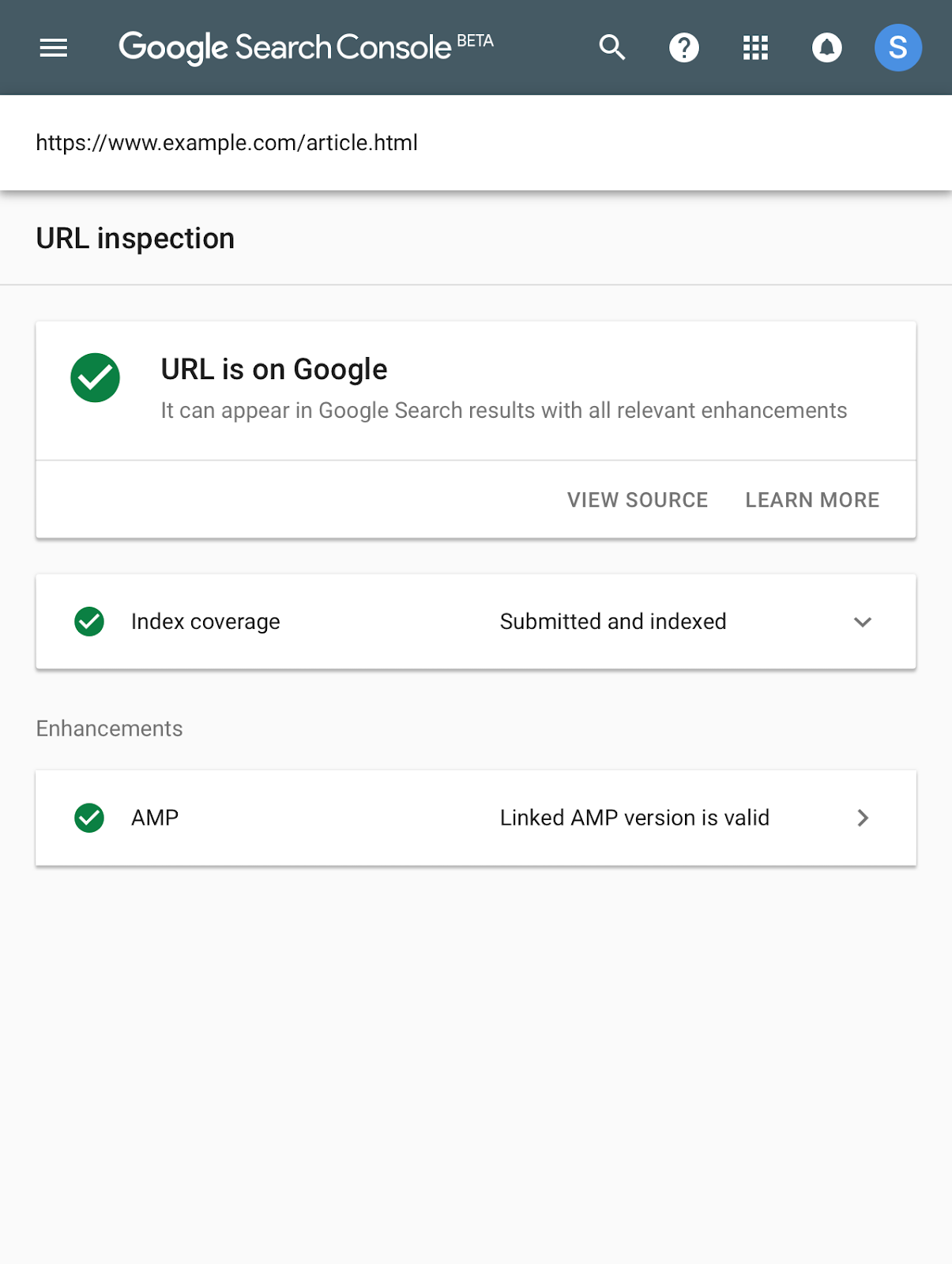
URL is indexed with valid AMP enhancement
If a page isn’t indexed, you can learn why. The new report includes information about noindex robots meta tags and Google’s canonical URL for the page.
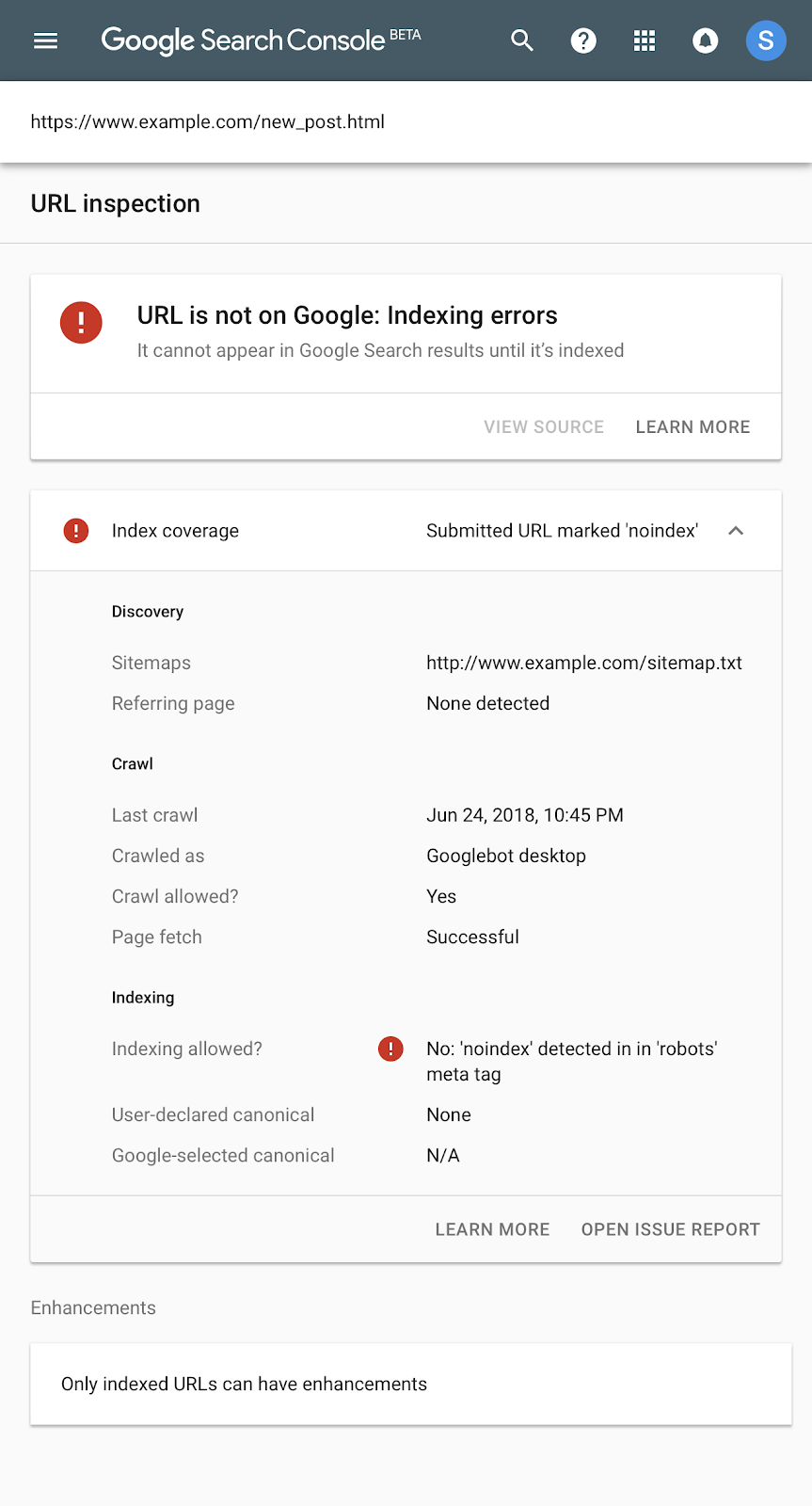
URL is not indexed due to ‘noindex’ meta tag in the HTML
A single click can take you to the issue report showing all other pages affected by the same issue to help you track down and fix common bugs.
We hope that the URL Inspection tool will help you debug issues with new or existing pages in the Google Index. We began rolling it out today; it will become available to all users in the coming weeks.
More exciting updates
In addition to the launch of URL inspection, we have a few more features and reports we recently launched to the new Search Console:
- Sixteen months of traffic data: The Search Analytics API now returns 16 months of data, just like the Performance report.
- Recipe report: The Recipe report help you fix structured data issues affecting recipes rich results. Use our task-oriented interface to test and validate your fixes; we will keep you informed on your progress using messages.
- New Search Appearance filters in Search Analytics: The performance report now gives you more visibility on new search appearance results, including Web Light and Google Play Instant results.
Thank you for your feedback
We are constantly reading your feedback, conducting surveys, and monitoring usage statistics of the new Search Console. We are happy to see so many of you using the new issue validation flow in Index Coverage and the AMP report. We notice that issues tend to get fixed quicker when you use these tools. We also see that you appreciate the updates on the validation process that we provide by email or on the validation details page.
We want to thank everyone who provided feedback: it has helped us improve our flows and fix bugs on our side.
More to come
The new Search Console is still beta, but it’s adding features and reports every month. Please keep sharing your feedback through the various channels and let us know how we’re doing.
Posted by Roman Kecher and Sion Schori – Search Console engineers


How to take advantage of strategic PPC audience targeting
Contributor Amy Bishop shows us how to use audiences within paid search campaigns to target and convert prospects more effectively.
Please visit Search Engine Land for the full article.
Five AdWords optimizations you can implement quickly
As performance marketers (and, frankly, as humans), we all lead busy lives. While we don’t have the magic formula for bending the space-time continuum, there are a few things that we’ve picked up along our way that have helped us get back some of that precious time.…
The post Five AdWords optimizations you can implement quickly appeared first on Seer Interactive.
Bing Ads app gets multi-user access to toggle between accounts & ability to add funds
Quickly navigate between multiple accounts, get actionable insights and add funds to prepay accounts on the go.
Please visit Search Engine Land for the full article.