Poll: Most SEOs Don’t Offer Guaranteed Success
You hire an SEO to typically improve how much qualified traffic your web site gets. With the aim of driving more conversions and revenue for your business. But do SEOs give guarantees on such performance? The answer is typically no.
Google: We Can Detect Automated Link Dropping
With all the chatter around links, negative SEO, the tools, etc – Google’s John Mueller said that the tools used to do automated link drops are “old school” and thus, Google has probably seen this behavior before. He basically said, Google is good at …
Poll: SEOs Like The Old Over The New Google Search Console
Most people, by nature, do not like change. I love new tools and playing with new things, but I like consistency and big changes I try to avoid. But also, change can bring really big opportunities. So when I saw the results around most SEOs liking the…
Google Mobile-First Indexing Now Used For Over Half Of Google’s Search Results
Just about two years after Google announced their mobile-first indexing initiative, to crawl the web as a mobile device first versus crawling the web as a desktop device, Google hit a major mile stone. Over 50% of the search results Google returns glo…
SearchCap: Google mobile first indexing rolling, YouTube ads & Google Home for local
Below is what happened in search today, as reported on Search Engine Land and from other places across the web.
Please visit Search Engine Land for the full article.
Year in Search: the top Google Search trends for 2018
A closer look at the top Google Search trends for 2018 shows that queries are more direct, specific, personal and even conversational.
The post Year in Search: the top Google Search trends for 2018 appeared first on Search Engine Watch.
Mobile-First indexing, structured data, images, and your site
It’s been two years since we started working on “mobile-first indexing” – crawling the web with smartphone Googlebot, similar to how most users access it. We’ve seen websites across the world embrace the mobile web, making fantastic websites that work on all kinds of devices. There’s still a lot to do, but today, we’re happy to announce that we now use mobile-first indexing for over half of the pages shown in search results globally.
Checking for mobile-first indexing
In general, we move sites to mobile-first indexing when our tests assure us that they’re ready. When we move sites over, we notify the site owner through a message in Search Console. It’s possible to confirm this by checking the server logs, where a majority of the requests should be from Googlebot Smartphone. Even easier, the URL inspection tool allows a site owner to check how a URL from the site (it’s usually enough to check the homepage) was last crawled and indexed.
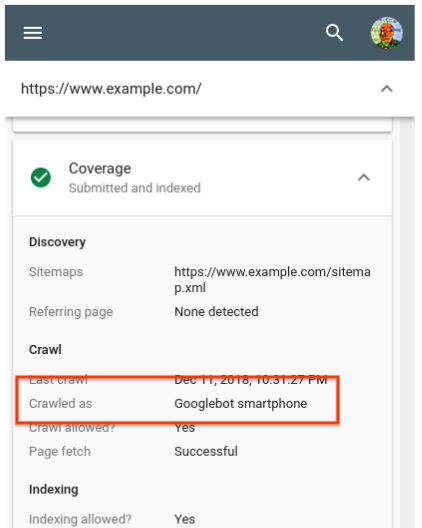
If your site uses responsive design techniques, you should be all set! For sites that aren’t using responsive web design, we’ve seen two kinds of issues come up more frequently in our evaluations:
Missing structured data on mobile pages
Structured data is very helpful to better understand the content on your pages, and allows us to highlight your pages in fancy ways in the search results. If you use structured data on the desktop versions of your pages, you should have the same structured data on the mobile versions of the pages. This is important because with mobile-first indexing, we’ll only use the mobile version of your page for indexing, and will otherwise miss the structured data.
Testing your pages in this regard can be tricky. We suggest testing for structured data in general, and then comparing that to the mobile version of the page. For the mobile version, check the source code when you simulate a mobile device, or use the HTML generated with the mobile-friendly testing tool. Note that a page does not need to be mobile-friendly in order to be considered for mobile-first indexing.
Missing alt-text for images on mobile pages
The value of alt-attributes on images (“alt-text”) is a great way to describe images to users with screen-readers (which are used on mobile too!), and to search engine crawlers. Without alt-text for images, it’s a lot harder for Google Images to understand the context of images that you use on your pages.
Check “img” tags in the source code of the mobile version for representative pages of your website. As above, the source of the mobile version can be seen by either using the browser to simulate a mobile device, or by using the Mobile-Friendly test to check the Googlebot rendered version. Search the source code for “img” tags, and double-check that your page is providing appropriate alt-attributes for any that you want to have findable in Google Images.
For example, that might look like this:
With alt-text (good!):<img src="cute-puppies.png" alt="A photo of cute puppies on a blanket">
Without alt-text:<img src="sad-puppies.png">
It’s fantastic to see so many great websites that work well on mobile! We’re looking forward to being able to index more and more of the web using mobile-first indexing, helping more users to search the web in the same way that they access it: with a smartphone. We’ll continue to monitor and evaluate this change carefully. If you have any questions, please drop by our Webmaster forums or our public events.
Posted by John Mueller, wearer of many socks, Google Switzerland


3 prospecting features for Google Display campaigns
These relatively new features are aimed at reaching new customers with Display campaigns.
Please visit Search Engine Land for the full article.
YouTube ad campaigns target ‘TV screens’ by default, coming to AdWords API in Jan.
For YouTube TrueView and bumper ad campaigns, TV screens targeting is enabled as a device type in the UI and can soon be reported via the API as well.
Please visit Search Engine Land for the full article.
Out now: Yoast SEO for WordPress plugin training for the block editor!
Yoast Academy has just released a new training course: the Yoast SEO for WordPress plugin training for the new block editor! The block editor is part of WordPress 5.0 and was previously known as Gutenberg. If you want to find out how to best use Yoast SEO in this new editor this training is for you! […]
The post Out now: Yoast SEO for WordPress plugin training for the block editor! appeared first on Yoast.
How a physician review site recovered from Google’s ‘medic’ update
A website in the healthcare niche saw improvement after removing the Google auto-translate plugin and rating schema from their translated pages.
Please visit Search Engine Land for the full article.
Case study: Recovering from Google’s medic update
A website in the healthcare niche saw improvement after removing the Google auto-translate plugin and rating schema from their translated pages.
Please visit Search Engine Land for the full article.
Google’s mobile-first indexing now powers over half of Google’s search results
Google issued an update on the status of its mobile-first indexing initiative.
Please visit Search Engine Land for the full article.
Google “Red Bridge” Logo For Paul Klee 139th Birthday
Today on Google’s home page is a special logo for the 139th birthday of Paul Klee. Paul Klee is a Swiss German artist who was known for his painting, drawing, watercolor, and printmaking. He was born on December 18, 1879 in Switzerland and passed on …
Google: Linking To Your Media Mentions Is Fine
There is so much paranoia around linking in the SEO community that some questions seems a bit overboard to me. For example, someone asked if it is okay to create a page showing the company’s media mentions and link to them or will Google frown on that…
Google: If A Random Tool Can Find Bad Links Then Google Probably Ignores Those Links Already
It looks like Google is taking a jab now at third-party link audit tools now. John Mueller from Google said on Twitter that if a random tool can figure out if a link is a bad link, then Google’s own algorithms can probably detect these bad links and th…
Google Tests Black URL/Breadcrumbs At Top Of Search Result Snippets
Google is always testing new search results user interfaces, here is yet another test I’ve been noticing being reported over the past few days. Google is using a black URL or breadcrumb above the title in the search results snippet.
Google Feature Snippet: Pyramids Are 85 Years Old
Every now and then I like to highlight when Google gets it wrong with their featured snippets. It is really a daily occurrence but here is a funny one. If you ask Google how old are the pyramids, Google will tell you they are 85 years old.
Will Google Home Hub ever become a useful local search tool?
Just a few modest improvements would make Home and Home Hub more effective for local search.
Please visit Search Engine Land for the full article.
5 schema markup values to use in local SEO
Put your business on the SERP map with these five key schema markup values for local SEO. Includes code to use and screenshots of schema in action.
The post 5 schema markup values to use in local SEO appeared first on Search Engine Watch.