A Darker Shade of Gray
Google’s original breakthrough in search was placing weight on links & using them to approximate the behavior of web users.
The abstract of
The PageRank Citation Ranking: Bringing Order to the Web reads
The importance of a Web page is an inherently subjective matter, which depends on the readers interests, knowledge and attitudes. But there is still much that can be said objectively about the relative importance of Web pages. This paper describes PageRank, a method for rating Web pages objectively and mechanically, effectively measuring the human interest and attention devoted to them. We compare PageRank to an idealized random Web surfer. We show how to efficiently compute PageRank for large numbers of pages. And, we show how to apply PageRank to search and to user navigation.
Back when I got started in the search game if you wanted to rank better you simply threw more links at whatever you wanted to rank & used the anchor text you wanted to rank for. A friend (who will remain nameless here!) used to rank websites for one-word search queries in major industries without even looking at them. :D
Suffice it to say, as more people read about PageRank & learned the influence of anchor text, Google had to advance their algorithms in order to counteract efforts to manipulate them.
Over the years as Google has grown more dominant they have been able to create many other signals. Some signals might be easy to understand & explain, while signals that approximate abstract concepts (like brand) might be a bit more convoluted to understand or attempt to explain.
Google owns the most widely used web browser (Chrome) & the most popular mobile operating system (Android). Owning those gives Google unique insights to where they do not need to place as much weight on a links-driven approximation of a random web user. They can see what users actually do & model their algorithms based on that.
Google considers the user experience an important part of their ranking algorithms. That was a big part of the heavy push for making mobile responsive web designs.
On your money or your life topics Google considers the experience so important they have an acronym covering the categories (YMYL) and place greater emphasis on the reliability of the user experience.
Nobody wants to die from a junk piece of medical advice or a matching service which invites predators into their homes.
The Wall Street Journal publishes original reporting which is so influential they almost act as the missing regulator in many instances.
Last Friday the WSJ covered the business practices of Care.com, a company which counts Alphabet’s Capital G as its biggest shareholder.
Behind Care.com’s appeal is a pledge to “help families make informed hiring decisions” about caregivers, as it has said on its website. Still, Care.com largely leaves it to families to figure out whether the caregivers it lists are trustworthy. … In about 9 instances over the past six years, caregivers in the U.S. who had police records were listed on Care.com and later were accused of committing crimes while caring for customers’ children or elderly relatives … Alleged crimes included theft, child abuse, sexual assault and murder. The Journal also found hundreds of instances in which day-care centers listed on Care.com as state-licensed didn’t appear to be. … Care.com states on listings that it doesn’t verify licenses, in small gray type at the bottom … A spokeswoman said that Care.com, like other companies, adds listings found in “publicly available data,” and that most day-care centers on its site didn’t pay for their listings. She said in the next few years Care.com will begin a program in which it vets day-care centers.
By Monday Care.com’s stock was sliding, which led to prompt corrective actions:
Previously the company warned users in small grey type at the bottom of a day-care center listing that it didn’t verify credentials or licensing information. Care.com said Monday it “has made more prominent” that notice.
To this day, Care.com’s homepage states…
“Care.com does not employ any care provider or care seeker nor is it responsible for the conduct of any care provider or care seeker. … The information contained in member profiles, job posts and applications are supplied by care providers and care seekers themselves and is not information generated or verified by Care.com.”
…in an ever so slightly darker shade of gray.
So far it appears to have worked for them.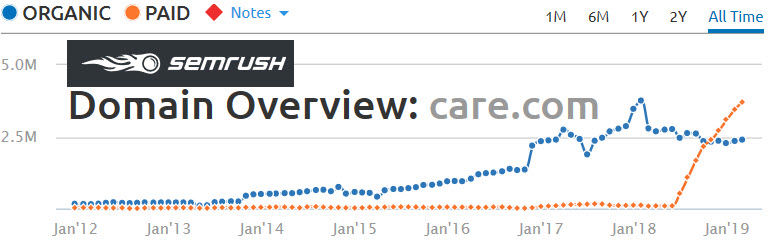
What’s your favorite color?
Categories:
What’s going on with In-depth Articles on Google?
Google said there was a coding change but that it still shows high-quality, evergreen content. Close watchers say they’ve seen big shifts.
Please visit Search Engine Land for the full article.
5 Reasons Legacy Brands Struggle With SEO (and What to Do About Them)
Posted by Tom.Capper
Given the increasing importance of brand in SEO, it seems a cruel irony that many household name-brands seem to struggle with managing the channel. Yet, in my time at Distilled, I’ve seen just that: numerous name-brand sites in various states of stagnation and even more frustrated SEO managers attempting to prevent said stagnation.
Despite global brand recognition and other established advantages that ought to drive growth, the reality is that having a household name doesn’t ensure SEO success. In this post, I’m going to explore why large, well-known brands can run into difficulties with organic performance, the patterns I’ve noticed, and some of the recommended tactics to address those challenges.
What we talk about when we talk about a legacy brand
For the purposes of this post, the term “legacy brand” applies to companies that have a very strong association with the product they sell, and may well have, in the past, been the ubiquitous provider for that product. This could mean that they were household names in the 20th century, or it could be that they pioneered and dominated their field in the early days of mass consumer web usage. A few varied examples (that Distilled has never worked with or been contacted by) include:
- Wells Fargo (US)
- Craigslist (US)
- Tesco (UK)
These are cherry-picked, potentially extreme examples of legacy brands, but all three of the above, and most that fit this description have shown a marked decline in the last five years, in terms of organic visibility (confirmed by Sistrix, my tool of choice — your tool-of-choice may vary). It’s a common issue for large, well-established sites — peaking in 2013 and 2014 and never again reaching those highs.
It’s worth noting that stagnation is not the only possible state — sometimes brands can even be growing, but simply at a level far beneath the potential, you would expect from their offline ubiquity.
The question is: why does it keep happening?
Reason 1: Brand
Quite possibly the biggest hurdle standing in the way of a brand’s performance is the brand itself. This may seem like a bit of an odd one — we’d already established that the companies we’re talking about are big, recognized, household names. That in and of itself should help them in SEO, right?
The thing is, though, a lot of these big household names are recognized, but they’re not the one-stop shops that they used to be.
Here’s how the above name-brand examples are performing on search:

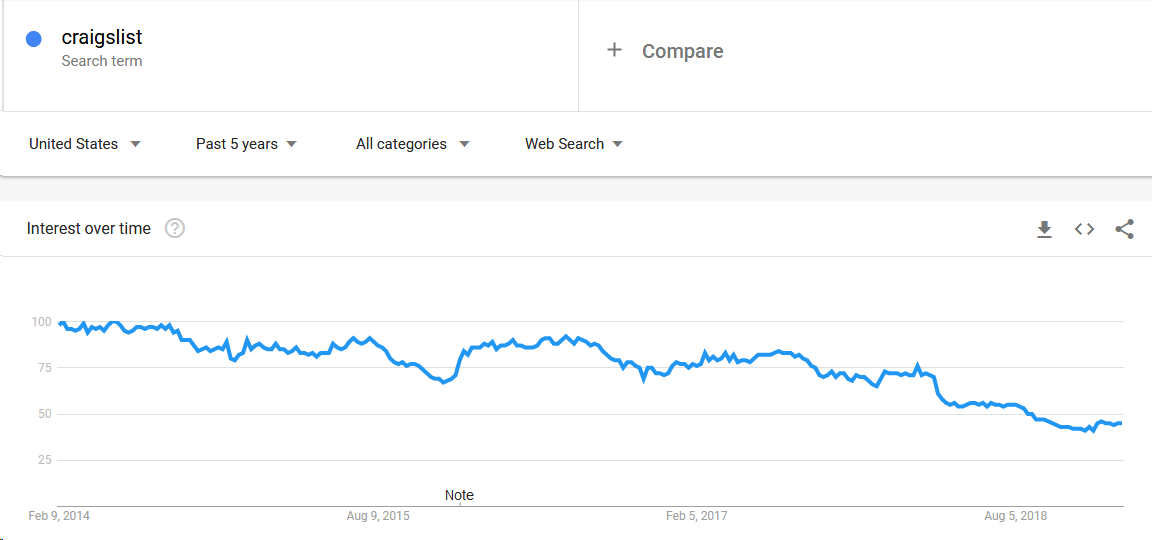

Other dominant, clearly vertical-leading brands in the UK, in general, are also not doing so well in branded search:
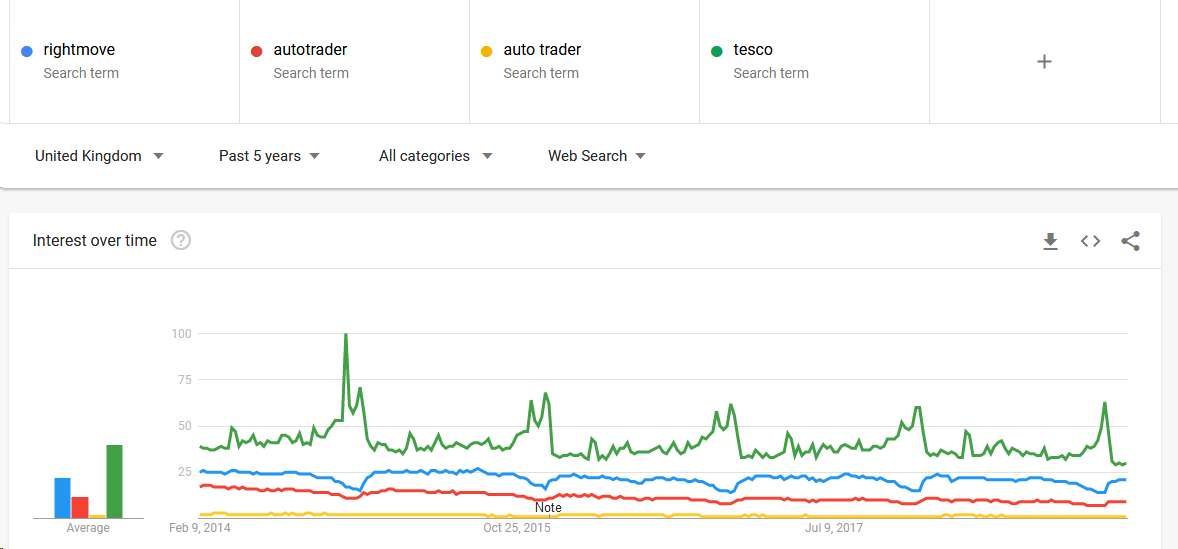
There’s a lot of potential reasons for why this may be — and we’ll even address some of them later — but a few notable ones include:
- Complacency — particularly for brands that were early juggernauts of the web, they may have forgotten the need to reinforce their brand image and recognition.
- More and more credible competitors. When you’re the only competent operator, as many of these brands once were, you had the whole pie. Now, you have to share it.
- People trust search engines. In a lot of cases, ubiquitous brands decline, while the generic term is on the rise.
Check out this for the real estate example in the UK:
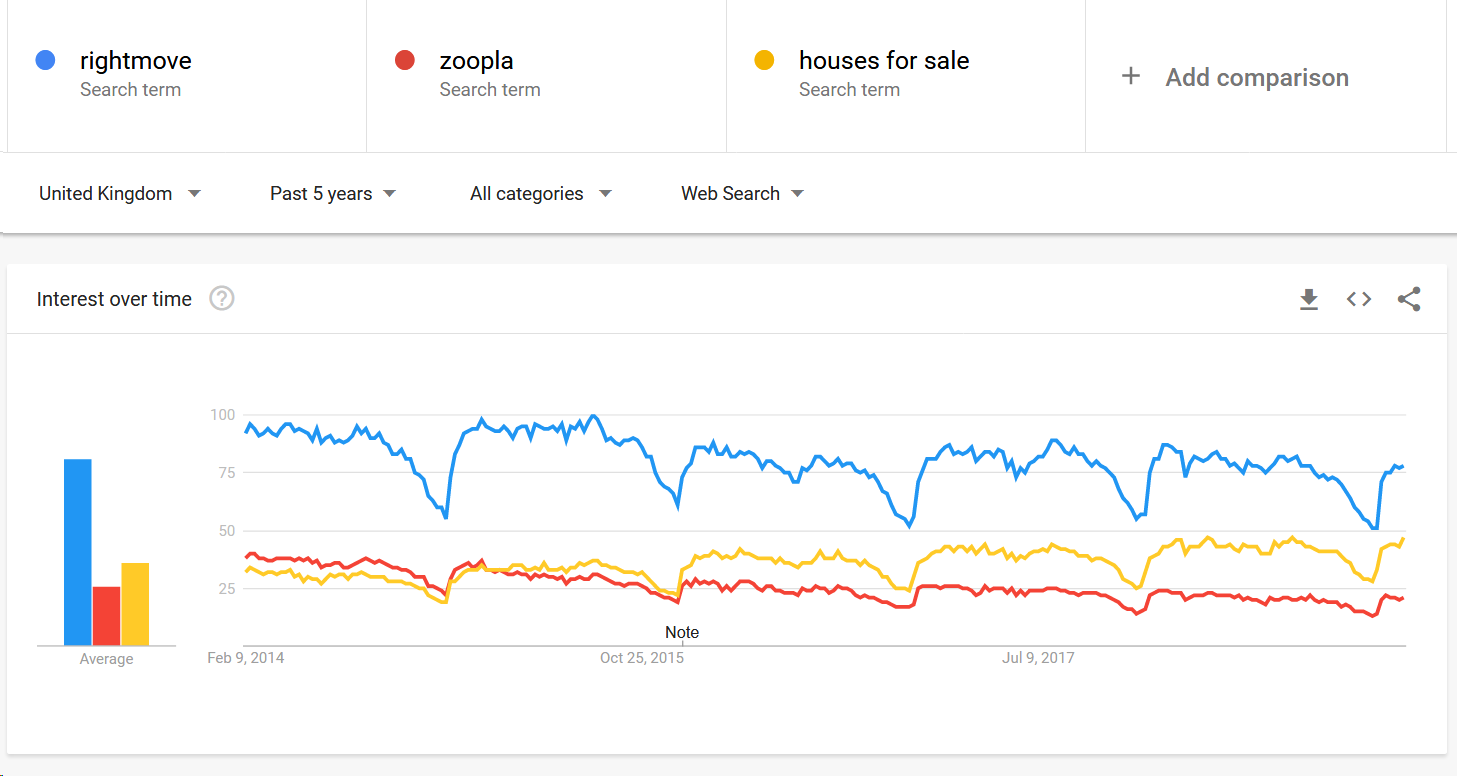
Rightmove and Zoopla are the two biggest brands in this space and have been for some time. There’s only one line there that’s trending upwards, though, and it’s the generic term, “houses for sale.”
What can I do about this?
Basically, get a move on! A lot of incumbents have been very slow to take action on things like top-of-funnel content, or only produce low-effort, exceptionally dry social media posts (I’ve posted before about some of these tactics here.) In fairness, it’s easy to see why — these channels and approaches likely have the least measurable returns. However, leaving a vacuum higher in your funnel is playing with fire, especially when you’re a recognized name. It opens an opportunity for smaller players to close the gap in recognition — at almost no cost.
Reason 2: Tech debt
I’m sure many people reading this will have experienced how hard it can be to get technical changes — particularly higher effort ones — implemented by larger, older organizations. This can stem from complex bureaucracy, aging and highly bespoke platforms, risk aversion, and, particularly for SEO, an inability to get senior buy-in for what can often be fairly abstract changes with little guaranteed reward.
What can I do about this?
At Distilled, we run into these challenges fairly often. I’ve seen dev queues that span, literally, for years. I’ve also seen organizations that are completely unable to change the most basic information on their sites, such as opening times or title tags. In fact, it was this exact issue that prompted the development of our ODN platform a few years ago as a way to circumvent technical limitations and prove the benefits when we did so.
There are less heavy-duty options available — GTM can be used for a range of changes as the last resort, albeit without the measurement component. CDN-level solutions like Cloudflare’s edge workers are also starting to gain traction within the SEO community.
Eventually, though, it’s necessary to tackle the problem at the source — by making headway within the politics of the organization. There’s a whole other post to be had there, if not several, but basically, it comes down to making yourself heard without undermining anyone. I’ve found that focusing on the downside is actually the most effective angle within big, risk-averse bureaucracies — essentially preying on the risk-aversion itself — as well as shouting loudly about any successes, however small.
Reason 3: Not updating tactics due to long-standing, ingrained practices
In a way, this comes back to risk aversion and politics — after all, legacy brands have a lot to lose. One particular manifestation I’ve often noticed in larger organizations is ongoing campaigns and tactics that haven’t been linked to improved rankings or revenue in years.
One conversation with a senior SEO at a major brand left me quite confused. I recall he said to me something along the lines of “we know this campaign isn’t right for us strategically, but we can’t get buy-in for anything else, so it’s this or lose the budget”. Fantastic.
This type of scenario can become commonplace when senior decision-makers don’t trust their staff — often, it’s a CMO, or similar executive leader, that hasn’t dipped their toe in SEO for a decade or more. When they do, they are unpleasantly surprised to discover that their SEO team isn’t buying any links this week and, actually, hasn’t for quite some time. Their reaction, then, is predictable: “No wonder the results are so poor!”
What can I do about this?
Unfortunately, you may have to humor this behavior in the short term. That doesn’t mean you should start (or continue) buying links, but it might be a good idea to ensure there’s similar-sounding activity in your strategy while you work on proving the ROI of your projects.
Medium-term, if you can get senior stakeholders out to conferences (I highly recommend SearchLove, though I may be biased), softly share articles and content “they may find interesting”, and drown them in news of the success of whatever other programs you’ve managed to get headway with, you can start to move them in the right direction.
Reason 4: Race to the bottom
It’s fair to say that, over time, it’s only become easier to launch an online business with a reasonably well-sorted site. I’ve observed in the past that new entrants don’t necessarily have to match tenured juggernauts like-for-like on factors like Domain Authority to hit the top spots.
As a result, it’s become common-place to see plucky, younger businesses rising quickly, and, at the very least, increasing the apparent level of choice where historically a legacy business might have had a monopoly on basic competence.
This is even more complicated when price is involved. Most SEOs agree that SERP behavior factors into rankings, so it’s easy to imagine legacy businesses, which disproportionately have a premium angle, struggling for clicks vs. attractively priced competitors. Google does not understand or care that you have a premium proposition — they’ll throw you in with the businesses competing purely on price all the same.
What can I do about this?
As I see it, there are two main approaches. One is abusing your size to crowd out smaller players (for instance, disproportionately targeting the keywords where they’ve managed to find a gap in your armor), and the second is, essentially, Conversion Rate Optimization.
Simple tactics like sorting a landing page by default by price (ascending), having clicky titles with a value-focused USP (e.g. free delivery), or well targeted (and not overdone) post-sales retention emails — all go a long way to mitigating the temptation of a cheaper or hackier competitor.
Reason 5: Super-aggregators (Amazon, Google)
In a lot of verticals, the pie is getting smaller, so it stands to reason the dominant players will be facing a diminishing slice.
A few obvious examples:
- Local packs eroding local landing pages
- Google Flights, Google Jobs, etc. eroding specialist sites
- Amazon taking a huge chunk of e-commerce search
What can I do about this?
Again, there are two separate angles here, and one is a lot harder than the other. The first is similar to some of what I’ve mentioned above — move further up the funnel and lock in business before this ever comes to your prospective client Googling your head term and seeing Amazon and/or Google above you. This is only a mitigating tactic, however.
The second, which will be impossible for many or most businesses, is to jump into bed with the devil. If you ever do have the opportunity to be a data partner behind a Google or Amazon product, you may do well to swallow your pride and take it. You may be the only one of your competitors left in a few years, and if you don’t, it’ll be someone else.
Wrapping up
While a lot of the issues relate to complacency, and a lot of my suggested solutions relate to reinvesting as if you weren’t a dominant brand that might win by accident, I do think it’s worth exploring the mechanisms by which this translates into poorer performance.
This topic is unavoidably very tinted by my own experiences and opinions, so I’d love to hear your thoughts in the comments below. Similarly, I’m conscious that any one of my five reasons could have been a post in its own right — which ones would you like to see more fleshed out?
Sign up for The Moz Top 10, a semimonthly mailer updating you on the top ten hottest pieces of SEO news, tips, and rad links uncovered by the Moz team. Think of it as your exclusive digest of stuff you don’t have time to hunt down but want to read!
World Wide Web Google Logo For 30th Anniversary
Today on Google’s home page is a Doodle, a special Google logo, to celebrate the 30th anniversary of the World Wide Web. You have a pixelated Google logo with an old fashion desktop computer from 30 years ago as the Doodle.
Google Tests Portrait Mode Tall Top Stories Layout
Google seems to be testing a portrait mode, i.e. taller mode, for the top stories in the mobile search results. Valentin Pletzer shared some screen shots with me on Twitter and you can see, some are videos and some are just tall images as opposed to s…
Google Increases Number Of Image Thumbnails In Mobile Search Results
It appears that Google has increased the number of times they are showing image thumbnails in the mobile search results snippets. A report by RankRanger, which I covered yesterday at Search Engine Land, shows that 75% of the search results they track …
Google: We Want To Do Better With Dates In Snippets
Yesterday, as we covered, Google posted helpful information around how, when and why Google shows dates in the search results snippets. They provided best practices and tips. But Danny Sullivan of Google came in later to explain they didn’t simply po…
Google My Business Dashboard Unlock Your Plan & Complete Your Tasks To Reach Your Goals
A few weeks ago I spotted a thread at the Local Search Forums where someone shared a new user interface for the Google My Business Dashboard or a newsih business being verified in GMB. Now Google kind of gamifies the process of completing your Google …
Semantic search for Google Ads: What it is and why it matters
Understanding match types is key if you want to benefit from semantic search. How to craft your Google Ads’ strategy to target the right searchers.
The post Semantic search for Google Ads: What it is and why it matters appeared first on Search Engine Watch.
What will Google Hotels mean for online booking sites?
The new site mirrors the UI of Google Flights and could have a similar affect on the hotel booking market.
Please visit Search Engine Land for the full article.
How to Cut Costs as a Digital Marketing Agency
If your marketing budget is consistently in the red, try making smaller changes before draconian cuts to staff and resources.
Post from Morgen Henderson
DuckDuckGo CEO testifies: Privacy legislation isn’t ‘anti-advertising’
Gabriel Weinberg also believes that privacy legislation can make the internet more competitive.
Please visit Search Engine Land for the full article.
Bing Ads brings 3D ads to Search with Samsung
Users can interact with the desktop ad format to inspect product features and details.
Please visit Search Engine Land for the full article.
Google Ads rolling out Budget Planner forecasting tool
Designed to show how changes in spend could impact campaign performance.
Please visit Search Engine Land for the full article.
Empathy: the unsung hero of high client retention
It’s tough out there for both clients and agencies right now. Budgets are getting smaller, competition is fierce, and change is constantly afoot. All of this has a direct impact on our day-to-day lives. During uncertain times, staying positive and showing kindness becomes increasingly difficult, often overtaken by worry and stress. But exercising compassion – […]
The post Empathy: the unsung hero of high client retention appeared first on Builtvisible.
Eight tips to getting your videos ranked on YouTube in 2019
With 400 hours of video content uploaded every minute, how do you ensure yours stands out and attracts viewers? This article will help you crack the code.
The post Eight tips to getting your videos ranked on YouTube in 2019 appeared first on Search Engine Watch.
Book your SMX Advanced pass by Saturday for up to $900 in savings
Don’t miss your chance to unlock actionable tactics with a community of SEO and SEM experts.
Please visit Search Engine Land for the full article.
Back to Basics: App optimization and Firebase indexation
With the vast number of apps available, your marketing strategy needs to focus on optimizing so consumers can find your app.
Please visit Search Engine Land for the full article.
Yoast SEO 10.0: Meet the new SEO analysis
It’s been in production for many months, capped off with two months of beta testing, and now it’s finally here: Yoast SEO 10.0! Yoast SEO 10.0 features a new SEO analysis, based on thorough research and fine-tuned with your feedback. More than 100.000 people helped us test this release to make it our best yet. […]
The post Yoast SEO 10.0: Meet the new SEO analysis appeared first on Yoast.
The stale cornerstone content filter: keep your core content fresh!
Sometimes it’s the little things that count. The new SEO analysis introduced in Yoast SEO 10.0 also comes with a new feature for Premium users: the stale cornerstone content filter. This handy little tool monitors the posts you’ve marked as cornerstone content and warns you if they haven’t been updated for six months. As you […]
The post The stale cornerstone content filter: keep your core content fresh! appeared first on Yoast.