Common technical SEO issues and fixes for aggregators and finance brands
Simple technical SEO issues on reliable comparison sites can hamper customer experiences. Here are six of the most common issues and their solutions.
The post Common technical SEO issues and fixes for aggregators and finance brands appeared first on Search Engine Watch.
How does Google understand text?
On Yoast.com, we talk a lot about writing and readability. We consider it a very important part of good SEO. Your text needs to satisfy your users’ needs. This, in turn, will help your rankings. However, we rarely talk about how Google and other search engines read and understand texts. In this post, we’ll explore […]
The post How does Google understand text? appeared first on Yoast.
SMX Overtime: Enterprise SEOs explain tactical approaches for large implementations
Senior Director of SEO at Apartments.com offers advice about managing taxonomy changes, keyword research, event tracking and the importance of industry collaboration.
Please visit Search Engine Land for the full article.
Where Google got more inventory to show Responsive Search Ads ads may surprise you
RSAs use machine learning to match the best ad variation with each search using data from ad performance segmented by query. To get this data, you need to delve into the scripts and Ads API reports.
Please visit Search Engine Land for the full article…
Let’s clear things up: Google’s ‘Florida 2’ algorithm update is not related to original Florida update
Here is why some folks are calling this the Florida 2 update but don’t let the name confuse you.
Please visit Search Engine Land for the full article.
Google took down 2.3 billion bad ads, 1 million ad accounts in 2018
The number of removed ads was down, but banned advertiser accounts nearly doubled from 2017.
Please visit Search Engine Land for the full article.
Google launching Policy manager in Google Ads
Coming in April, Policy manager will be the central spot to manage policy violations.
Please visit Search Engine Land for the full article.
Google Search Quality Raters Don’t Directly Impact Rankings
I must have covered this topic a few times but here we go again, Google has said numerous times that the search quality raters they hire as consultants do not directly influence their search rankings. An article was highlighted yesterday but some folk…
Google: No Exceptions Broken & Unclean Headers With Hreflang
Google’s John Mueller said on Twitter that if you cannot have a clean header in your source code where Google can fully interpret the hreflang, then you are out of luck. Google said either fix the issue with your header or you really cannot depend on …
Google Testing New Simple Black Ad Label
Google looks to be testing changing the ad label in their search results once again. The last time they changed it was in February 2017, when they went with a green outline ad label. This new test shows small black text labeled as “Ad” and that is it….
Google Search Ranking Algorithm Update On March 12 & 13th
I am seeing plenty of signs from the SEO community, the tracking tools and so on that there was and is a Google algorithm update going on right now. It started on March 12th, yesterday and is continuing on today.
Using Python to recover SEO site traffic (Part two)
In this edition, we dive deeper into how your SEO site traffic can recover from a site migration using Python, resourceful code snippets and tools.
The post Using Python to recover SEO site traffic (Part two) appeared first on Search Engine Watch.
Faceted navigation in ecommerce: How it helps customers and SEO
80% of users admit that a poor search experience can make them leave a web store. How faceted navigation in ecommerce can make or break their experience.
The post Faceted navigation in ecommerce: How it helps customers and SEO appeared first on Search Engine Watch.
DuckDuckGo a new ‘default search’ option for Chrome, is it time to start paying attention?
The upstart search engine’s visibility has been growing.
Please visit Search Engine Land for the full article.
Goodbye green? Google testing black “Ad” label in Search
Google appears to be looking to switch up the way it labels text ads again.
Please visit Search Engine Land for the full article.
Regression analysis to improve Google Ads performance
Using advanced techniques to make better predictions can help you stand out. Here’s a step-by-step guide to learning how to do a regression analysis.
Please visit Search Engine Land for the full article.
Are you wasting money on Google Ads?
Eliminate wasted spend and maximize ROAS on Google Ads in 5 simple steps.
Please visit Search Engine Land for the full article.
Google released a broad core search algorithm on March 12
A rare Google confirmation came related to a Google search algorithm update this week. Google restated previous advice that there is no fix if your site was negatively impacted.
Please visit Search Engine Land for the full article.
What Does it Take to Create a Content Strategy for a Small Business?
I’m a content strategist but I work mainly with small businesses, so while I’d love to be able to recommend […]
Post from Joana Veiga Ferreira
A Darker Shade of Gray
Google’s original breakthrough in search was placing weight on links & using them to approximate the behavior of web users.
The abstract of
The PageRank Citation Ranking: Bringing Order to the Web reads
The importance of a Web page is an inherently subjective matter, which depends on the readers interests, knowledge and attitudes. But there is still much that can be said objectively about the relative importance of Web pages. This paper describes PageRank, a method for rating Web pages objectively and mechanically, effectively measuring the human interest and attention devoted to them. We compare PageRank to an idealized random Web surfer. We show how to efficiently compute PageRank for large numbers of pages. And, we show how to apply PageRank to search and to user navigation.
Back when I got started in the search game if you wanted to rank better you simply threw more links at whatever you wanted to rank & used the anchor text you wanted to rank for. A friend (who will remain nameless here!) used to rank websites for one-word search queries in major industries without even looking at them. :D
Suffice it to say, as more people read about PageRank & learned the influence of anchor text, Google had to advance their algorithms in order to counteract efforts to manipulate them.
Over the years as Google has grown more dominant they have been able to create many other signals. Some signals might be easy to understand & explain, while signals that approximate abstract concepts (like brand) might be a bit more convoluted to understand or attempt to explain.
Google owns the most widely used web browser (Chrome) & the most popular mobile operating system (Android). Owning those gives Google unique insights to where they do not need to place as much weight on a links-driven approximation of a random web user. They can see what users actually do & model their algorithms based on that.
Google considers the user experience an important part of their ranking algorithms. That was a big part of the heavy push for making mobile responsive web designs.
On your money or your life topics Google considers the experience so important they have an acronym covering the categories (YMYL) and place greater emphasis on the reliability of the user experience.
Nobody wants to die from a junk piece of medical advice or a matching service which invites predators into their homes.
The Wall Street Journal publishes original reporting which is so influential they almost act as the missing regulator in many instances.
Last Friday the WSJ covered the business practices of Care.com, a company which counts Alphabet’s Capital G as its biggest shareholder.
Behind Care.com’s appeal is a pledge to “help families make informed hiring decisions” about caregivers, as it has said on its website. Still, Care.com largely leaves it to families to figure out whether the caregivers it lists are trustworthy. … In about 9 instances over the past six years, caregivers in the U.S. who had police records were listed on Care.com and later were accused of committing crimes while caring for customers’ children or elderly relatives … Alleged crimes included theft, child abuse, sexual assault and murder. The Journal also found hundreds of instances in which day-care centers listed on Care.com as state-licensed didn’t appear to be. … Care.com states on listings that it doesn’t verify licenses, in small gray type at the bottom … A spokeswoman said that Care.com, like other companies, adds listings found in “publicly available data,” and that most day-care centers on its site didn’t pay for their listings. She said in the next few years Care.com will begin a program in which it vets day-care centers.
By Monday Care.com’s stock was sliding, which led to prompt corrective actions:
Previously the company warned users in small grey type at the bottom of a day-care center listing that it didn’t verify credentials or licensing information. Care.com said Monday it “has made more prominent” that notice.
To this day, Care.com’s homepage states…
“Care.com does not employ any care provider or care seeker nor is it responsible for the conduct of any care provider or care seeker. … The information contained in member profiles, job posts and applications are supplied by care providers and care seekers themselves and is not information generated or verified by Care.com.”
…in an ever so slightly darker shade of gray.
So far it appears to have worked for them.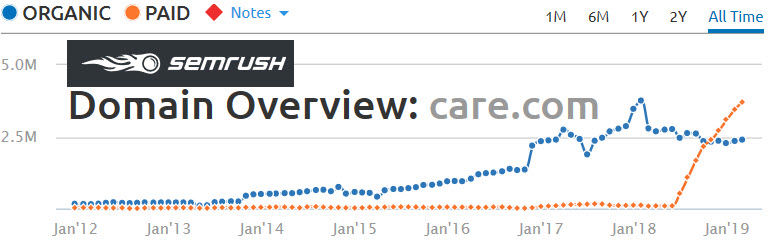
What’s your favorite color?
Categories: