Google Shortens Title Length In Search By ~5 Characters On Average
The folks at RankRanger are showing data that on average, the title tag length shown in the Google desktop search results have gone down from 55.3 characters to 50.9 characters on average.
Google Product Grid & Expandable Shopping Ads
To be honest, I am not sure if this is new, but I am being told this is new. The first is what looks like an organic product grid, where Google shows product selections for a query in a new grid like format. The second are paid Google shopping ads th…
Google Search Ranking Algorithm Update Signs Heating Up More
On Friday, yes, Friday the 13th (hence the graphic), I reported on signals of a possible Google update. As an update, these signals are still there, the chatter is still ongoing through this morning, and the tracking tools are also showing changes even…
Making Review Rich Results more helpful
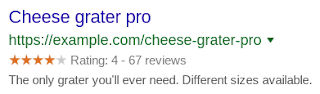
Search results that are enhanced by review rich results can be extremely helpful when searching for products or services (the scores and/or “stars” you sometimes see alongside search results).
Add the

To make them more helpful and meaningful, we are now introducing algorithmic updates to reviews in rich results. This also addresses some of the invalid or misleading implementations webmasters have flagged to us.
Focus on schema types that lend themselves to reviews
While, technically, you can attach review markup to any schema type, for many types displaying star reviews does not add much value for the user. With this change, we’re limiting the pool of schema types that can potentially trigger review rich results in search. Specifically, we’ll only display reviews with those types (and their respective subtypes):
- schema.org/Book
- schema.org/Course
- schema.org/CreativeWorkSeason
- schema.org/CreativeWorkSeries
- schema.org/Episode
- schema.org/Event
- schema.org/Game
- schema.org/HowTo
- schema.org/LocalBusiness
- schema.org/MediaObject
- schema.org/Movie
- schema.org/MusicPlaylist
- schema.org/MusicRecording
- schema.org/Organization
- schema.org/Product
- schema.org/Recipe
- schema.org/SoftwareApplication
Self-serving reviews aren’t allowed
Reviews that can be perceived as “self-serving” aren’t in the best interest of users. We call reviews “self-serving” when a review about entity A is placed on the website of entity A – either directly in their markup or via an embedded 3rd party widget. That’s why, with this change, we’re not going to display review rich results anymore for the schema types localBusiness and Organization (and their subtypes) in cases when the entity being reviewed controls the reviews themselves.
Add the name of the item that’s being reviewed
With this update, the name property is now required, so you’ll want to make sure that you specify the name of the item that’s being reviewed.
This update will help deliver a much more meaningful review experience for users, while requiring little to no changes on the part of most webmasters. You can find all those updates documented in our developer documentation. If you have any questions, feel free to come to our webmaster forums!
Posted by Yuxin Cao, Software Engineer & Sven Naumann, Trust & Safety Search


Report alleges Amazon manipulating search results to boost its products, profit
The company said to give its own products “preferential treatment in search.”
Please visit Search Engine Land for the full article.
Google Search Console adds Datasets to enhancement reports section
Check out this new report within Google Search Console and if you don’t see it, do not panic.
Please visit Search Engine Land for the full article.
Gutenberg block editor improvements, and integrating plugins
Today’s WordPress Watch has a strong focus on the Gutenberg block editor. Two different tweets prompted me to focus on what you can do with the editor a bit more. We’ll discuss improvements to the editor, as well as useful plugins that integrate with the block editor, so I hope you enjoy this edition. Don’t […]
The post Gutenberg block editor improvements, and integrating plugins appeared first on Yoast.
Google cracks down on some review rich results
If your review rich results in Google search disappear, here is maybe why.
Please visit Search Engine Land for the full article.
10 Takeaways from the state of SEO survey
We explore the top 10 takeaways from the survey data – think of it as a TLDR version of data collection from hundreds and hundreds of interested parties.
The post 10 Takeaways from the state of SEO survey appeared first on Search Engine Watch.
Google tests “in this video” search feature
How cool is this new Google search feature that breaks down the sections of the video you are watching.
Please visit Search Engine Land for the full article.
Here’s a script to spice up your Facebook demographics reporting
This script pulls a Facebook demographic report and generates a pyramid chart for age/gender performance analysis.
Please visit Search Engine Land for the full article.
10 Link Building Lies You Must Ignore
Posted by David_Farkas
Even though link building has been a trade for more than a decade, it’s clear that there is still an enormous amount of confusion around it.
Every so often, there is a large kerfuffle. Some of these controversies and arguments arise simply from a necessity to fill a content void, but some of them arise from genuine concern and confusion:
“Don’t ask for links!”
“Stick a fork in it, guest posting is done!”
“Try to avoid link building!”
SEO is an everchanging industry; what worked yesterday might not work today. Google’s personnel doesn’t always help the cause. In fact, they often add fuel to the fire. That’s why I want to play the role of “link building myth-buster” today. I’ve spent over ten years in link building, and I’ve seen it all.
I was around for Penguin, and every iteration since. I was around for the launch of Hummingbird. And I was even around for the Matt Cutts videos.

So, if you’re still confused about link building, read through to have ten of the biggest myths in the business dispelled.
1. If you build it, they will come
There is a notion among many digital marketers and SEOs that if you simply create great content and valuable resources, the users will come to you. If you’re already a widely-recognized brand/website, this can be a true statement. If, however, you are like the vast majority of websites — on the outside looking in — this could be a fatal mindset.
In order to get people to find you, you have to build the roads that will lead them to where you want. This is where link building comes in.
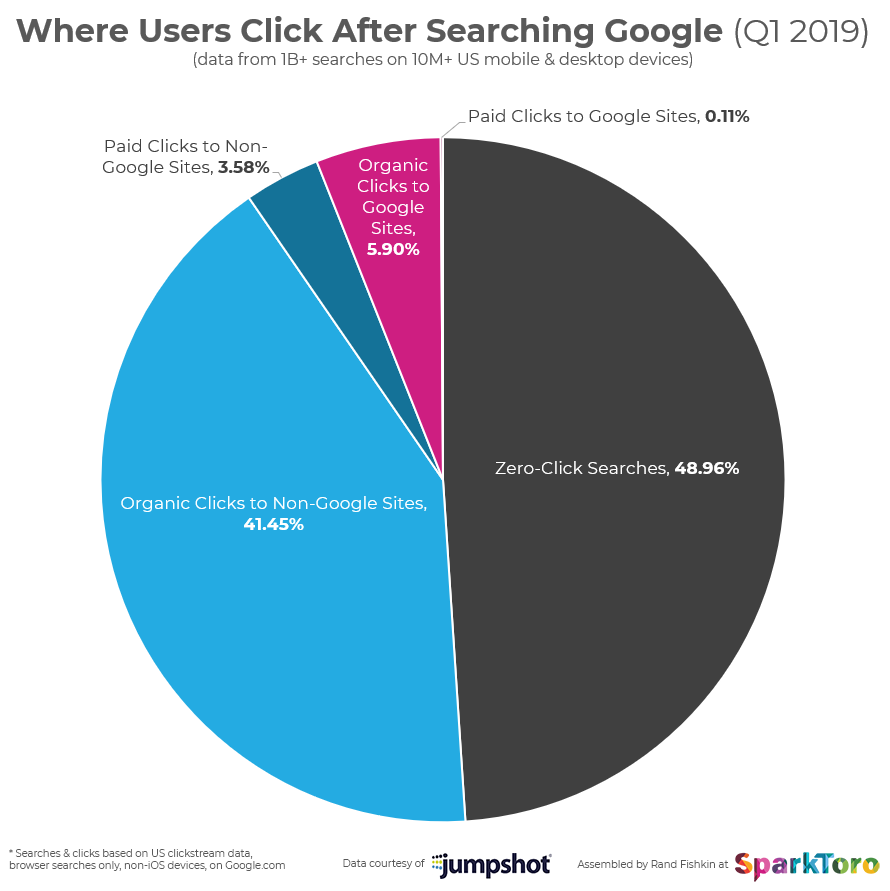
A majority of people searching Google end up clicking on organic results. In fact, for every click on a paid result in Google, there are 11.6 clicks to organic results!
And in order to build your rankings in search engines, you need links.
Which brings me to our second myth around links.
2. You don’t need links to rank
I can’t believe that there are still people who think this in 2019, but there are. That’s why I recently published a case study regarding a project I was working on.
To sum it up briefly, the more authoritative, relevant backlinks I was able to build, the higher the site ranked for its target keywords. This isn’t to say that links are the only factor in Google’s algorithm that matters, but there’s no doubt that a robust and relevant backlink profile goes a long way.
3. Only links with high domain authority matter
As a link builder, you should definitely seek target sites with high metrics. However, they aren’t the only prospects that should matter to you.
Sometimes a low domain authority (DA) might just be an indication that it is a new site. But forget about the metrics for one moment. Along with authority, relevancy matters. If a link prospect is perfectly relevant to your website, but it has a low DA, you should still target it. In fact, most sites that will be so relevant to yours will likely not have the most eye-popping metrics, and that is precisely because they are so niche. But more often than not, relevancy is more important than DA.
When you focus solely on metrics, you will lose out on highly relevant opportunities. A link that sends trust signals is more valuable than a link that has been deemed important by metrics devised by entities other than Google.
Another reason why is because Google’s algorithm looks for diversity in your backlink profile. You might think that a profile with over 100 links, all of which have a 90+ DA would be the aspiration. In fact, Google will look at it as suspect. So while you should absolutely target high DA sites, don’t neglect the “little guys.”
4. You need to build links to your money pages
When I say “money pages,” I mean the pages where you are specifically looking to convert, whether its users into leads or leads into sales.
You would think that if you’re going to put in the effort to build the digital highways that will lead traffic to your website, you would want all of that traffic to find these money pages, right?
In reality, though, you should take the exact opposite approach. First off, approaching sites that are in your niche and asking them to link to your money pages will come off as really spammy/aggressive. You’re shooting yourself in the foot.
But most importantly, these money pages are usually not pages that have the most valuable information. Webmasters are much more likely to link to a page with resourceful information or exquisitely created content, not a page displaying your products or services.
Building links to your linkable assets (more on that in a second) will increase your chances of success and will ultimately raise the profile of your money pages in the long run as well.
5. You have to create the best, most informative linkable asset
If you’re unfamiliar with what a linkable asset is exactly, it’s a page on your website designed specifically to attract links/social shares. Assets can come in many forms: resource pages, funny videos, games, etc.
Of course, linkable assets don’t grow on trees, and the process of coming up with an idea for a valuable linkable asset won’t be easy. This is why some people rely on “the skyscraper technique.” This is when you look at the linkable assets your competitors have created, you choose one, and you simply try to outdo it with something bigger and better.
This isn’t a completely ineffective technique, but you shouldn’t feel like you have to do this.
Linkable assets don’t need to be word-heavy “ultimate guides” or heavily-researched reports. Instead of building something that really only beats your competitor’s word count, do your own research and focus on building an authoritative resource that people in your niche will be interested in.
The value of a linkable asset has much more to do with finding the right angle and the accuracy of the information you’re providing than the amount.
6. The more emails you send, the more links you will get
I know several SEOs who like to cast a wide net — they send out emails to anyone and every one that even has the tiniest bit of relevancy of authority within their niche. It’s an old sales principle: The idea that more conversations will lead to more purchases/conversions. And indeed in sales, this is usually going to be the case.
In link building? Not so much.
This is because, in link building, your chances of getting someone to link to you are increased when the outreach you send is more thoughtful/personalized. Webmasters pore over emails on top of emails on top of emails, so much so that it’s easy to pass over the generic ones.
They need to be effectively persuaded as to the value of linking to your site. If you choose to send emails to any site with a pulse, you won’t have time to create specific outreach for each valuable target site.
7. The only benefit of link building is algorithmic
As I mentioned earlier, links are fundamental to Google’s algorithm. The more quality backlinks you build, the more likely you are to rank for your target keywords in Google.
This is the modus operandi for link building. But it is not the only reason to build links. In fact, there are several non-algorithmic benefits which link building can provide.
First off, there’s brand visibility. Link building will make you visible not only to Google in the long term but to users in the immediate term. When a user comes upon a resource list with your link, they aren’t thinking about how it benefits your ranking in Google; they just might click your link right then and there.
Link building can also lead to relationship building. Because of link building’s very nature, you will end up conversing with many potential influencers and authority figures within your niche. These conversations don’t have to end as soon as they place your link.
In fact, if the conversations do end there every time, you’re doing marketing wrong. Take advantage of the fact that you have their attention and see what else you can do for each other.
8. You should only pursue exact match anchors
Not all myths are born out of complete and utter fiction. Some myths persist because they have an element of truth to them or they used to be true. The use of exact match anchor text is such a myth.
In the old days of SEO/link building, one of the best ways to get ahead was to use your target keywords/brand name as the anchor text for your backlinks. Keyword stuffing and cloaking were particularly effective as well.
But times have changed in SEO, and I would argue mostly for the better. When Google sees a backlink profile that uses only a couple of variations of anchor text, you are now open to a penalty. It’s now considered spammy. To Google, it does not look like a natural backlink profile.
As such, it’s important to note now that the quality of the link itself is far more important than the anchor text that comes with it.
It really should be out of your hands anyway. When you’re link building the right way, you are working in conjunction with the webmasters who are publishing your link. You do not have 100 percent control of the situation, and the webmaster will frequently end up using the anchor text of their choice.
So sure, you should optimize your internal links with optimized anchor text when possible, but keep in mind that it is best to have diverse anchor text distribution.
9. Link building requires technical abilities
Along with being a link builder, I am also an employer. When hiring other link builders, one skepticism I frequently come across relates to technical skills. Many people who are unfamiliar with link building think that it requires coding or web development ability.
While having such abilities certainly won’t hurt you in your link building endeavors, I’m here to tell you that they aren’t at all necessary. Link building is more about creativity, communication, and strategy than it is knowing how to write a for loop in javascript.
If you have the ability to effectively persuade, create valuable content, or identify trends, you can build links.
10. All follow links provide equal value
Not all links are created equally, and I’m not even talking about the difference between follow links and no-follow links. Indeed, there are distinctions to be made among just follow links.
Let’s take .edu links, for example. These links are some of the most sought after for link builders, as they are thought to carry inordinate power. Let’s say you have two links from the same .edu website. They are both on the same domain, same authority, but they are on different pages. One is on the scholarship page, the other is on a professor’s resource page which has been carefully curated.
They are both do-follow links, so naturally, they should both carry the same weight, right?
Fail. Search engines are smart enough to know the difference between a hard-earned link and a link that just about anyone can submit to.
Along with this, the placement of a link on a page matters. Even if two links are on the exact same page (not just the same domain) a link that is above-the-fold (a link you can see without scrolling) will carry more weight.
Conclusion
Link building and SEO are not rocket science. There’s a lot of confusion out there, thanks mainly to the fact that Google’s standards change rapidly and old habits die hard, and the answers and strategies you seek aren’t always obvious.
That said, the above points are some of the biggest and most pervasive myths in the industry. Hopefully, I was able to clear them up for you.
Sign up for The Moz Top 10, a semimonthly mailer updating you on the top ten hottest pieces of SEO news, tips, and rad links uncovered by the Moz team. Think of it as your exclusive digest of stuff you don’t have time to hunt down but want to read!
New Keyword Tool
Our keyword tool is updated periodically. We recently updated it once more.
For comparison sake, the old keyword tool looked like this
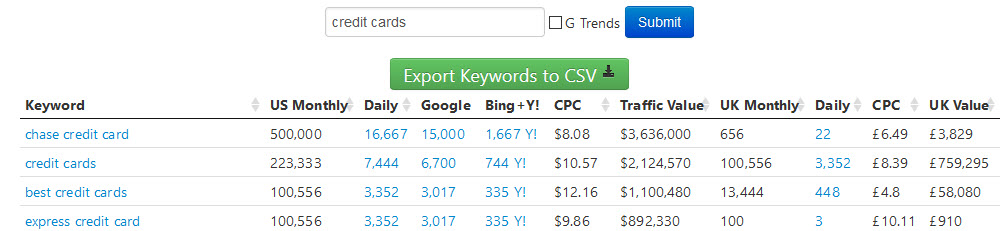
Whereas the new keyword tool looks like this

The upsides of the new keyword tool are:
- fresher data from this year
- more granular data on ad bids vs click prices
- lists ad clickthrough rate
- more granular estimates of Google AdWords advertiser ad bids
- more emphasis on commercial oriented keywords
With the new columns of [ad spend] and [traffic value] here is how we estimate those.
- paid search ad spend: search ad clicks * CPC
- organic search traffic value: ad impressions * 0.5 * (100% – ad CTR) * CPC
The first of those two is rather self explanatory. The second is a bit more complex. It starts with the assumption that about half of all searches do not get any clicks, then it subtracts the paid clicks from the total remaining pool of clicks & multiplies that by the cost per click.
The new data also has some drawbacks:
- Rather than listing search counts specifically it lists relative ranges like low, very high, etc.
- Since it tends to tilt more toward keywords with ad impressions, it may not have coverage for some longer tail informational keywords.
For any keyword where there is insufficient coverage we re-query the old keyword database for data & merge it across. You will know if data came from the new database if the first column says something like low or high & the data came from the older database if there are specific search counts in the first column
For a limited time we are still allowing access to both keyword tools, though we anticipate removing access to the old keyword tool in the future once we have collected plenty of feedback on the new keyword tool. Please feel free to leave your feedback in the below comments.
One of the cool features of the new keyword tools worth highlighting further is the difference between estimated bid prices & estimated click prices. In the following screenshot you can see how Amazon is estimated as having a much higher bid price than actual click price, largely because due to low keyword relevancy entities other than the official brand being arbitraged by Google require much higher bids to appear on competing popular trademark terms.

Historically, this difference between bid price & click price was a big source of noise on lists of the most valuable keywords.
Recently some advertisers have started complaining about the “Google shakedown” from how many brand-driven searches are simply leaving the .com part off of a web address in Chrome & then being forced to pay Google for their own pre-existing brand equity.
When Google puts 4 paid ads ahead of the first organic result for your own brand name, you’re forced to pay up if you want to be found. It’s a shakedown. It’s ransom. But at least we can have fun with it. Search for Basecamp and you may see this attached ad. pic.twitter.com/c0oYaBuahL
— Jason Fried (@jasonfried) September 3, 2019
Categories:
New Keyword Tool
Our keyword tool is updated periodically. We recently updated it once more.
For comparison sake, the old keyword tool looked like this
Whereas the new keyword tool looks like this
The upsides of the new keyword tool are:
- fresher data from this year
- more granular data on ad bids vs click prices
- lists ad clickthrough rate
- more granular estimates of Google AdWords advertiser ad bids
- more emphasis on commercial oriented keywords
With the new columns of [ad spend] and [traffic value] here is how we estimate those.
- paid search ad spend: search ad clicks * CPC
- organic search traffic value: ad impressions * 0.5 * (100% – ad CTR) * CPC
The first of those two is rather self explanatory. The second is a bit more complex. It starts with the assumption that about half of all searches do not get any clicks, then it subtracts the paid clicks from the total remaining pool of clicks & multiplies that by the cost per click.
The new data also has some drawbacks:
- Rather than listing search counts specifically it lists relative ranges like low, very high, etc.
- Since it tends to tilt more toward keywords with ad impressions, it may not have coverage for some longer tail informational keywords.
For any keyword where there is insufficient coverage we re-query the old keyword database for data & merge it across. You will know if data came from the new database if the first column says something like low or high & the data came from the older database if there are specific search counts in the first column
For a limited time we are still allowing access to both keyword tools, though we anticipate removing access to the old keyword tool in the future once we have collected plenty of feedback on the new keyword tool. Please feel free to leave your feedback in the below comments.
One of the cool features of the new keyword tools worth highlighting further is the difference between estimated bid prices & estimated click prices. In the following screenshot you can see how Amazon is estimated as having a much higher bid price than actual click price, largely because due to low keyword relevancy entities other than the official brand being arbitraged by Google require much higher bids to appear on competing popular trademark terms.
Historically, this difference between bid price & click price was a big source of noise on lists of the most valuable keywords.
Recently some advertisers have started complaining about the “Google shakedown” from how many brand-driven searches are simply leaving the .com part off of a web address in Chrome & then being forced to pay Google for their own pre-existing brand equity.
When Google puts 4 paid ads ahead of the first organic result for your own brand name, you’re forced to pay up if you want to be found. It’s a shakedown. It’s ransom. But at least we can have fun with it. Search for Basecamp and you may see this attached ad. pic.twitter.com/c0oYaBuahL
— Jason Fried (@jasonfried) September 3, 2019
Categories:
Google: Correctly Counting Links On The Web Is Technically Impossible
John Mueller from Google said on Twitter “counting links on the web correctly is technically impossible, and everyone just makes different approximations & assumptions.” This is in response to third-party link tools not matching up or looking inaccurate.
Local RankFlux – A Google Local Ranking Algorithm Tracking Tool
So we have a dozen or so Google web search rank checking tools that tell us if they pick up on Google algorithm or ranking fluctuations. But we don’t have much when it comes to local ranking changes. BrightLocal has just released a tool it named Local…
Is Google Showing More Videos In List View Vs Carousel View?
Eric Hedekar from Moz, formerly STAT, said that now about half of the videos shown in the Google mobile results have changed in terms of how they are displayed. Instead of the carousel video format, Google is showing more of a list view according to Er…
Google: Our Newer Search Algorithms Have Been Promoting Original Reporting In Search
Yesterday Google announced an algorithmic update it made to the search results a few months ago have been doing a better job at promoting original reporting. Not only promoting it in terms of ranking but keeping that original reporting up in the top s…
Friday The 13th Google Search Ranking Algorithm Update Chatter
I am seeing some early chatter of a Google search ranking algorithm update today on Friday the 13th, September 13, 2019. The chatter is super early but I am seeing it not just across WebmasterWorld, but also Black Hat World and social media. Some of …
Search Buzz Video Recap: Google Algorithm Updates, Promoting Original Reporting, Search Quality Raters, Nofollow Link Attribute Changes & More
I hope you like the new introduction style, it gives you a quick preview of the topics I am going to cover before I get into it, let me know in the comments and subscribe and smash that like button. :) I covered chatter and signs around a Google searc…