Could Wi-Fi Marketing Grow Your Business?
The free wi-fi you offer is also a marketing opportunity. Here’s how you can use wifi to build your list, gather customer information, and improve customer service.
Post from Mary Aldoseri
Could Wi-Fi Marketing Grow Your Business?
The free wi-fi you offer is also a marketing opportunity. Here’s how you can use wifi to build your list, gather customer information, and improve customer service.
Post from Mary Aldoseri
Google Ads Editor v1.2 Adds New Campaign Types & Cross-Account Features
Google released Google Ads Editor version 1.2 yesterday. This release has a lot of new features including support for new campaign types and updates to multi-account management. Version 1.1 was released in July, so it has been a while since Google ca…
Google BigQuery FAQs Answered
Written By: Erin Jordan, Jonah Ortiz, & Sean Pinto.
Frequently Asked Questions
What is BigQuery?
BigQuery was introduced by Google as a scalable solution to data warehousing to give enterprises more flexibility with their data. BigQuery is a serverless cloud data warehouse that allows users to query and join various datasets in a user-friendly interface at a low cost.…
The post Google BigQuery FAQs Answered appeared first on Seer Interactive.
Google: Do Not Use Robots.txt To Block Indexing Of URLs With Parameters
Google’s John Mueller said you should absolutely not “use robots.txt to block indexing of URLs with parameters.” He said if you do that then Google “cannot canonicalize the URLs, and you lose all of the value from links to those pages.” Instead use r…
Google: It Is A Bad Sign If Your Robots.txt Or Sitemap File Is Ranking For Normal Queries
We had a slew of tweets triggered by Gary Illyes of Google and then followed up by John Mueller of Google around robots.txt and XML sitemap files ranking in Google. In short, if they rank for normal queries, John Mueller said “that’s usually a sign th…
Google: SEOs Use “No” As A Way To Confirm Their Theories
Earlier this week, I wrote how yet another Googler once again said Google does not use user behavior signals for rankings. But what happens is people don’t believe Google and they come up with theories on how Google does use user behavior as a ranking…
Search Buzz Video Recap: Bing Spam Penalties, Google Local Ranking Update, Speed Reports & More
This week in search I posted the big monthly Google Webmaster report, so catch up there quickly. Bing announced a boat load of new search spam penalties that is rolling out. Google may have done a local search algorithm update this week. Google….
…
5 Things I Learned About SEO as an Intern
In the summer of 2019, I interned at Seer Interactive in the San Diego office. During my internship, I learned a ton about SEO, PPC, and Analytics. Below are five key tips and lessons that I learned throughout my internship that made executing SEO tact…
Brands vs Ads
Brand, Brand, Brand
About 7 years ago I wrote about how the search relevancy algorithms were placing heavy weighting on brand-related signals after Vince & Panda on the (half correct!) presumption that this would lead to excessive industry consolidation which in turn would force Google to turn the dials in the other direction.
My thesis was Google would need to increasingly promote some smaller niche sites to make general web search differentiated from other web channels & minimize the market power of vertical leading providers.
The reason my thesis was only half correct (and ultimately led to the absolutely wrong conclusion) is Google has the ability to provide the illusion of diversity while using sort of eye candy displacement efforts to shift an increasing share of searches from organic to paid results.
Shallow Verticals With a Shill Bid
As long as any market has at least 2 competitors in it Google can create a “me too” offering that they hard code front & center and force the other 2 players (along with other players along the value chain) to bid for marketshare. If competitors are likely to complain about the thinness of the me too offering & it being built upon scraping other websites, Google can buy out a brand like Zagat or a data supplier like ITA Software to undermine criticism until the artificially promoted vertical service has enough usage that it is nearly on par with other players in the ecosystem.
Google need not win every market. They only need to ensure there are at least 2 competing bids left in the marketplace while dialing back SEO exposure. They can then run other services to redirect user flow and force the ad buy. They can insert their own bid as a sort of shill floor bid in their auction. If you bid below that amount they’ll collect the profit through serving the customer directly, if you bid above that they’ll let you buy the customer vs doing a direct booking.
Adding Volatility to Economies of Scale
Where this gets more than a bit tricky is if you are a supplier of third party goods & services where you buy in bulk to get preferential pricing for resale. If you buy 100 rooms a night from a particular hotel based on the presumption of prior market performance & certain channels effectively disappear you have to bid above market to sell some portion of the rooms because getting anything for them is better than leaving them unsold.
“Well I am not in hotels, so thankfully this won’t impact me” is an incomplete thought. Google Ads now offer a lead generation extension.
Dipping a bit back into history here, but after Groupon said no to Google’s acquisition offer Google promptly partnered with players 2 through n to ensure Groupon did not have a lasting competitive advantage. In the fullness of time most those companies died, LivingSocial was acquired by Groupon for nothing & Groupon is today worth less than the amount they raised in VC & IPO funding.
Markets Naturally Evolve Toward Promoting Brands
When a vertical is new a player can compete just by showing up. Then over time as the verticals become established consumers develop habits, brands beat out generics & the markets get consolidated down to being heavily influenced & controlled by a couple strong players.
In the offline world of atoms there are real world costs tied to local regulations, shipping, sourcing, supply chains, inventory management, etc. The structure of the web & the lack of marginal distribution cost causes online markets to be even more consolidated than their offline analogs.
When Travelocity outsourced their backend infrastructure to Expedia most people visiting their website were unaware of the change. After Expedia acquired the site, longtime Travelocity customers likely remained unaware. In some businesses the only significant difference in the user experience is the logo at the top of the page.
Most large markets will ultimately consolidate down to a couple players (e.g. Booking vs Expedia) while smaller players lack the scale needed to have the economic leverage to pay Google’s increasing rents.
This sort of consolidation was happening even when the search results were mostly organic & relevancy was driven primarily by links. As Google has folded in usage data & increased ad load on the search results it becomes harder for a generically descriptive domain name to build brand-related signals.
Re-sorting the Markets Once More
It is not only generically descriptive sorts of sites that have faded though. Many brand investments turned out to be money losers after the search result set was displaced by more ads (& many brand-related search result pages also carry ads above the organic results).
The ill informed might write something like this:
Since the Motorola debacle, it was Google’s largest acquisition after the $676 million purchase of ITA Software, which became Google Flights. (Uh, remember that? Does anyone use that instead of Travelocity or one of the many others? Neither do I.)
The reality is brands lose value as the organic result set is displaced. To make the margins work they might desperately outsource just about everything but marketing to a competitor / partner, which will then latter acquire them for a song.
Travelocity had roughly 3,000 people on the payroll globally as recently as a couple of years ago, but the Travelocity workforce has been whittled to around 50 employees in North America with many based in the Dallas area.
The best relevancy algorithm in the world is trumped by preferential placement of inferior results which bypasses the algorithm. If inferior results are hard coded in placements which violate net neutrality for an extended period of time, they can starve other players in the market from the vital user data & revenues needed to reinvest into growth and differentiation.
Value plays see their stocks crash as growth slows or goes in reverse. With the exception of startups funded by Softbank, growth plays are locked out of receiving further investment rounds as their growth rate slides.
Startups like Hipmunk disappear. Even an Orbitz or Travelocity become bolt on acquisitions.
The viability of TripAdvisor as a stand alone business becomes questioned, leading them to partner with Ctrip.
TripAdvisor has one of the best link profiles of any commercially oriented website outside of perhaps Amazon.com. But ranking #1 doesn’t count for much if that #1 ranking is below the fold. Or, even worse, if Google literally hides the organic search results.
TripAdvisor shifted their business model to allow direct booking to better monetize mobile web users, but as Google has ate screen real estate and grew Google Travel into a $100 billion business other players have seen their stocks sag.
Top of The Funnel
Google sits at the top of the funnel & all other parts of the value chain are compliments to be commoditized.
- Buy premium domain names? Google’s SERPs test replacing domain names with words & make the words associated with the domain name gray.
- Improve conversion rates? Your competitor almost certainly did as well, now you both can bid more & hand over an increasing economic rent to Google.
- Invest in brand awareness? Google shows ads for competitors on your brand terms, forcing you to buy to protect the brand equity you paid to build.
Search Metrics mentioned Hotels.com was one of the biggest losers during the recent algorithm updates: “I’m going to keep on this same theme there, and I’m not going to say overall numbers, the biggest loser, but for my loser I’m going to pick Hotels.com, because they were literally like neck and neck, like one and two with Booking, as far as how close together they were, and the last four weeks, they’ve really increased that separation.”
As Google ate the travel category the value of hotel-related domain names has fallen through the floor.
Most of the top selling hotel-related domain names were sold about a decade ago: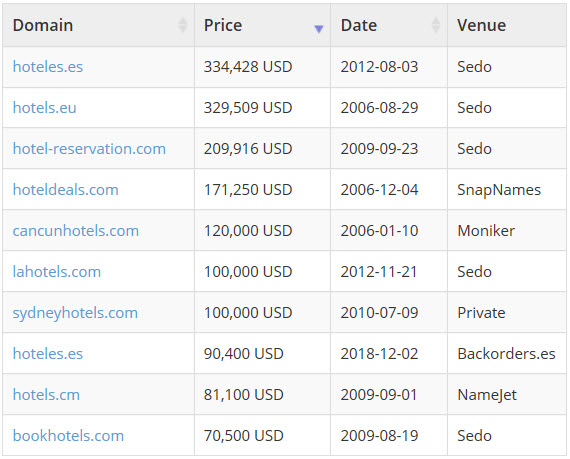
On August 8th HongKongHotels.com sold for $4,038. A decade ago that name likely would have sold for around $100,000.
And the new buyer may have overpaid for it!
Growing Faster Than the Market
Google consistently grows their ad revenues 20% a year in a global economy growing at under 4%.
There are only about 6 ways they can do that
- growth of web usage (though many of those who are getting online today have a far lower disposable income than those who got on a decade or two ago did)
- gain marketshare (very hard in search, given that they effectively are the market in most markets outside of a few countries like China & Russia)
- create new inventory (new ad types on image search results, Google Maps & YouTube)
- charge more for clicks
- improve at targeting through better surveillance of web users (getting harder after GDPR & similar efforts from some states in the next year or two)
- shift click streams away from organic toward paid channels (through larger ads, more interactive ad units, less appealing organic result formatting, pushing organic results below the fold, hiding organic results, etc.)
Six of One, Half-dozen of the Other
Wednesday both Expedia and TripAdvisor reported earnings after hours & both fell off a cliff: “Both Okerstrom and Kaufer complained that their organic, or free, links are ending up further down the page in Google search results as Google prioritizes its own travel businesses.”
Losing 20% to 25% of your market cap in a single day is an extreme move for a company worth billions of dollars.
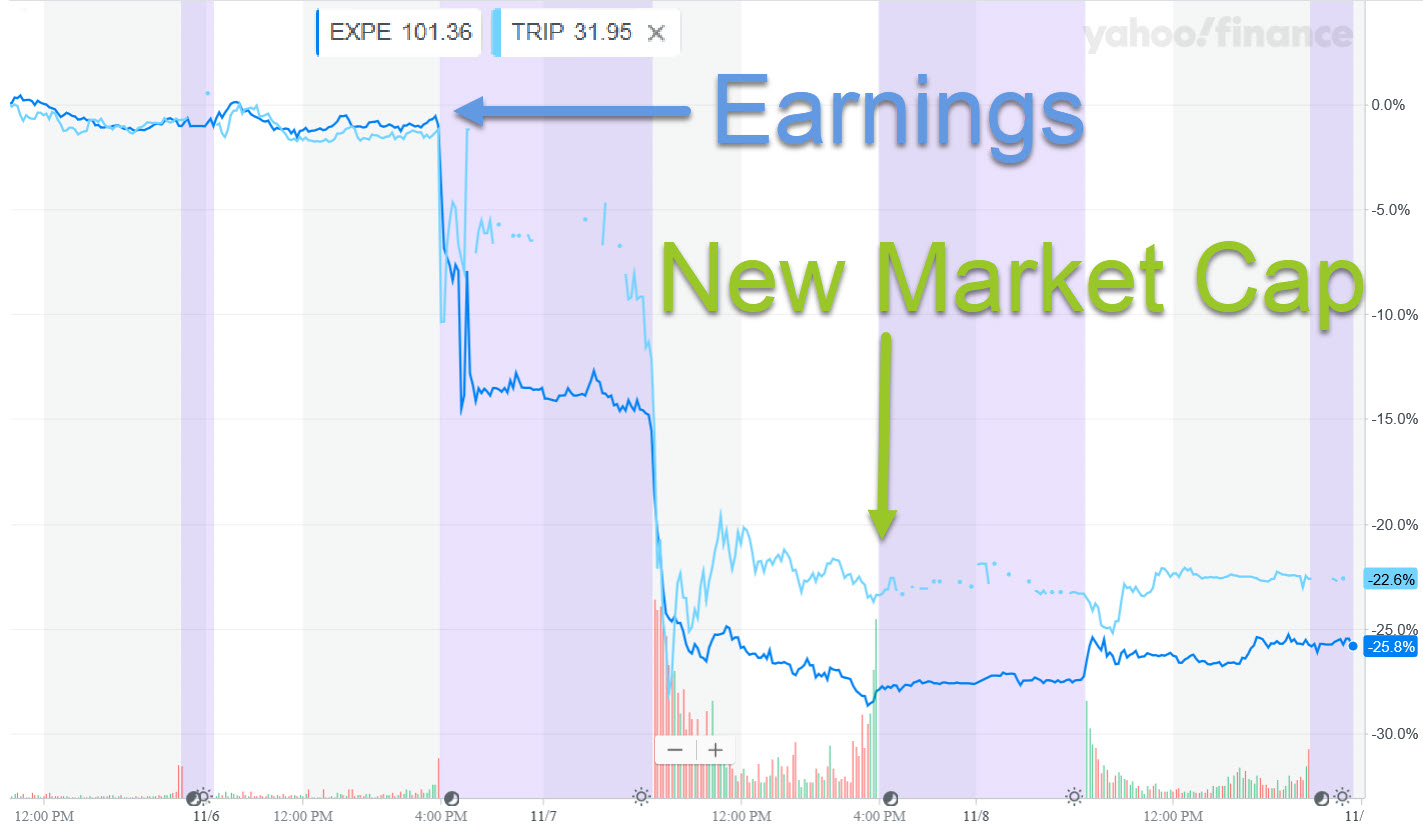
Thursday Google hit fresh all time highs.
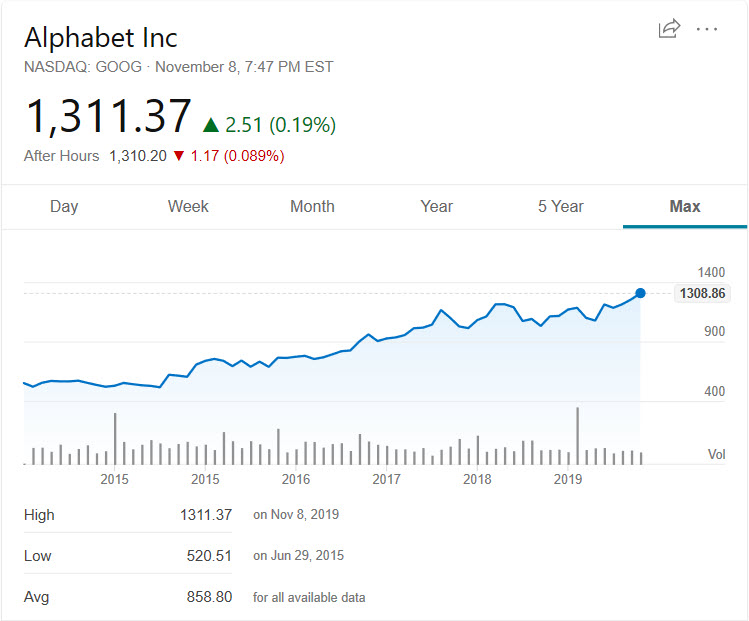
“Google’s old motto was ‘Don’t Be Evil’, but you can’t be this big and profitable and not be evil. Evil and all-time highs pretty much go hand in hand.” – Howard Lindzon
Booking held up much better than TripAdvisor & Expedia as they have a bigger footprint in Europe (where antitrust is a thing) and they have a higher reliance on paid search versus organic.
Frozen in Fear vs Fearless
The broader SEO industry is to some degree frozen by fear. Roughly half of SEOs claim to have not bought *ANY* links in a half-decade.
Anonymous survey: have you (or your company) purchased backlinks – of ANY quality – for your own site, or any of your clients’ sites, at any point in the past ~5 years?— Lily Ray (@lilyraynyc) October 24, 2019
Long after most of the industry has stopped buying links some people still run the “paid links are a potential FTC violation guideline” line as though it is insightful and/or useful.
Some people may be violating FTC rules by purchasing links that are not labeled as sponsored. This includes “content marketers” who publish articles with paid links on sites they curate.
It’s a ticking time bomb because it’s illegal.— Roger Montti (@martinibuster) October 24, 2019
Ask the people carrying Google’s water what they think of the official FTC guidance on poor ad labeling in search results and you will hear the beautiful sound of crickets chirping.
Where is the ad labeling in this unit?
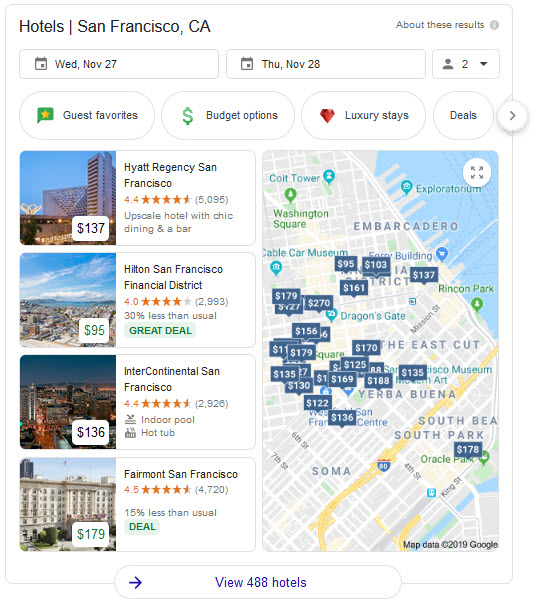
Does small gray text in the upper right corner stating “about these results” count as legitimate ad labeling?
And then when you scroll over that gray text and click on it you get “Some of these hotel search results may be personalized based on your browsing activity and recent searches on Google, as well as travel confirmations sent to your Gmail. Hotel prices come from Google’s partners.”
Ads, Scroll, Ads, Scroll, Ads…
Zooming out a bit further on the above ad unit to look at the entire search result page, we can now see the following:
- 4 text ad units above the map
- huge map which segments demand by price tier, current sales, luxury, average review, geographic location
- organic results below the above wall of ads, and the number of organic search results has been reduced from 10 to 7
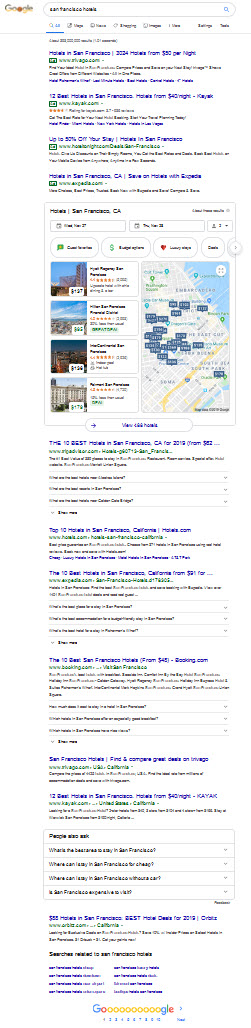
How many scrolls does one need to do to get past the above wall of ads?
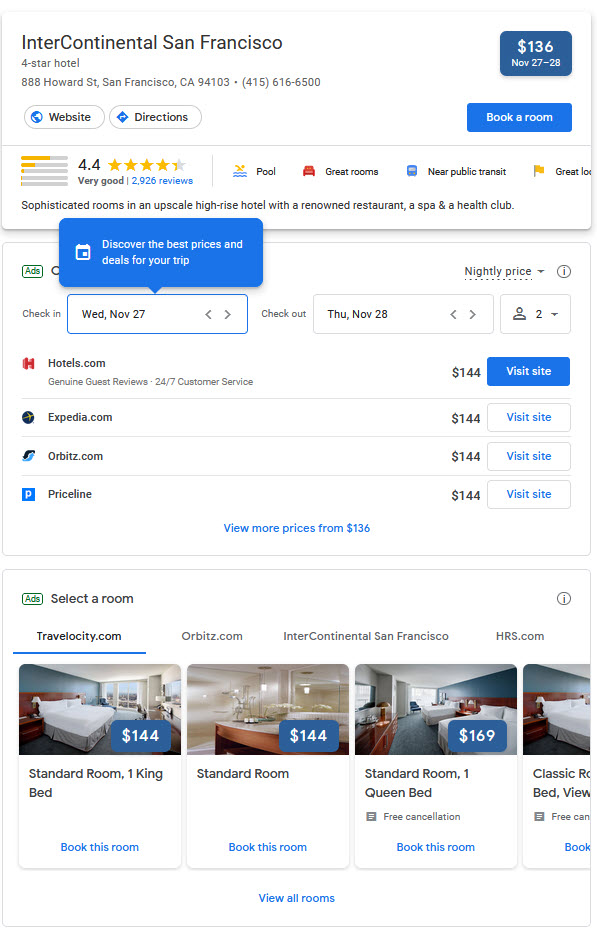
If one clicks on one of the hotel prices the follow up page is … more ads.
Check out how the ad label is visually overwhelmed by a bright blue pop over.
Defund
It is worth noting Google Chrome has a built-in ad blocking feature which allows them to strip all ads from displaying on third party websites if they follow Google’s best practices layout used in the search results.
You won’t see ads on websites that have poor ad experiences, like:
- Too many ads
- Annoying ads with flashing graphics or autoplaying audio
- Ad walls before you can see content
When these ads are blocked, you’ll see an “Intrusive ads blocked” message. Intrusive ads will be removed from the page.
The following 4 are all true:
- Google buys entire businesses, guts them & sells them for parts.
- Google’s core business model is selling paid links with ever lighter disclosure.
- Some SEOs suggest selling links or exposure is beneath them.
- Ex-Google employees leverage their past gains to buy well linked sites like Money.com.
And, as a bonus, to some paid links are a crime but Google can sponsor academic conferences for market regulators while requesting the payments not be disclosed.
Excessive Profits = Spam
Hotels have been at the forefront of SEO for many years. They drive massive revenues & were perhaps the only vertical ever referenced in the Google rater guidelines which explicitly stated all affiliate sites should be labeled as spam even if they are helpful to users.
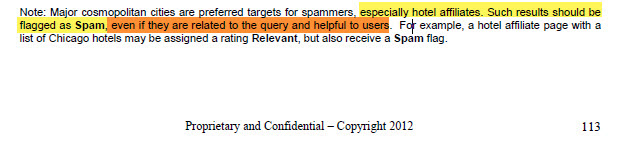
Google has won most of the profits in the travel market & so they’ll need to eat other markets to continue their 20% annual growth.
As they grow, other markets disappear.
“It’s a bug that you could rank highly in Google without buying ads, and Google is trying to fix the bug.” – Googler John Rockway, January 31, 2012
Some people who market themselves as SEO experts not only recognize this trend but even encourage this sort of behavior:
Zoopla, Rightmove and On The Market are all dominant players in the industry, and many of their house and apartment listings are duplicated across the different property portals. This represents a very real reason for Google to step in and create a more streamlined service that will help users make a more informed decision. … The launch of Google Jobs should not have come as a surprise to anyone, and neither should its potential foray into real estate. Google will want to diversify its revenue channels as much as possible, and any market that allows it to do so will be in its sights. It is no longer a matter of if they succeed, but when.
If nobody is serving a market that is justification for entering it. If a market has many diverse players that is justification for entering it. If a market is dominated by a few strong players that is justification for entering it. All roads lead to the pile of money. :)
Extracting information from the ecosystem & diverting attention from other players while charging rising rents does not make the ecosystem stronger. Doing so does not help users make a more informed decision.
Information as a Vertical
The dominance Google has in core profitable vertical markets also exists in the news & general publishing categories. Some publishers get more traffic from Google Discover than from Google search. Publishers which try to turn off Google’s programmatic ads find their display ad revenues fall off a cliff:
“Nexstar Media Group Inc., the largest local news company in the U.S., recently tested what would happen if it stopped using Google’s technology to place ads on its websites. Over several days, the company’s video ad sales plummeted. “That’s a huge revenue hit,” said Tony Katsur, senior vice president at Nexstar. After its brief test, Nexstar switched back to Google.” … “Regulators who approved that $3.1 billion deal warned they would step in if the company tied together its offerings in anticompetitive ways. In interviews, dozens of publishing and advertising executives said Google is doing just that with an array of interwoven products.”
News is operating like many other (broken) markets. The Salt Lake Tribune converted to a nonprofit organization.
Many local markets have been consolidated down to ownership by a couple private equity shop roll ups looking to further consolidate the market. Gatehouse Media acquired Gannett & has a $1.8 billion mountain of debt to pay off.
McClatchy – the second largest domestic newspaper chain – may soon file for bankruptcy:
there’s some nuance in this new drama — one of many to come from the past decade’s conversion of news companies into financial instruments stripped of civic responsibility by waves of outside money men. After all, when we talk about newspaper companies, we typically use their corporate names — Gannett, GateHouse, McClatchy, MNG, Lee. But it’s at least as appropriate to use the names of the hedge funds, private equity companies, and other investment vehicles that own and control them.
The Washington Post – owned by Amazon’s Jeff Bezos – is creating an ad tech stack which serves other publishers & brands, though they also believe a reliance on advertiser & subscription revenue is unsustainable: “We are too beholden to just advertiser and subscriber revenue, and we’re completely out of our minds if we think that’s what’s going to be what carries us through the next generation of publishing. That’s very clear.”
Future Prospects
We are nearing inflection points in many markets where markets that seemed somewhat disconnected from search will still end up being dominated by Google. Gmail, Android, Web Analytics, Play Store, YouTube, Maps, Waze … are all additional points of leverage beyond the core search & ads products.
If all roads lead to money one can’t skip healthcare – now roughly 20% of the United States GDP.
Google scrubbed many alternative health sites from the search results. Some of them may have deserved it. Others were perhaps false positives.
Google wants to get into the healthcare market in a meaningful way. Google bought Fitbit and partnered with Ascension on a secret project gathering health information on over 50 million Americans.
Google is investing heavily in quantum computing. Google Fiber was a nothingburger to force competing ISPs into accelerating expensive network upgrades, but beaming in internet services from satellites will allow Google to bypass local politics, local regulations & heavy network infrastructure construction costs. A startup named Kepler recently provided high-bandwidth connectivity to the Arctic. When Google launches a free ISP there will be many knock on effects causing partners to long for the day where Google was only as predatory as they are today.
“Capitalism is an efficient system for surfacing and addressing the needs of consumers. But once it veers toward control over markets by a single entity, those benefits disappear.” – Seth Godin
Categories:
Brands vs Ads
About 7 years ago I wrote about how the search relevancy algorithms were placing heavy weighting on brand-related signals after Vince & Panda on the (half correct!) presumption that this would lead to excessive industry consolidation which in turn would force Google to turn the dials in the other direction.
My thesis was Google would need to increasingly promote some smaller niche sites to make general web search differentiated from other web channels & minimize the market power of vertical leading providers.
The reason my thesis was only half correct (and ultimately led to the absolutely wrong conclusion) is Google has the ability to provide the illusion of diversity while using sort of eye candy displacement efforts to shift an increasing share of searches from organic to paid results.
As long as any market has at least 2 competitors in it Google can create a “me too” offering that they hard code front & center and force the other 2 players (along with other players along the value chain) to bid for marketshare. If competitors are likely to complain about the thinness of the me too offering & it being built upon scraping other websites, Google can buy out a brand like Zagat or a data supplier like ITA Software to undermine criticism until the artificially promoted vertical service has enough usage that it is nearly on par with other players in the ecosystem.
Google need not win every market. They only need to ensure there are at least 2 competing bids left in the marketplace while dialing back SEO exposure. They can then run other services to redirect user flow and force the ad buy. They can insert their own bid as a sort of shill floor bid in their auction. If you bid below that amount they’ll collect the profit through serving the customer directly, if you bid above that they’ll let you buy the customer vs doing a direct booking.
Where this gets more than a bit tricky is if you are a supplier of third party goods & services where you buy in bulk to get preferential pricing for resale. If you buy 100 rooms a night from a particular hotel based on the presumption of prior market performance & certain channels effectively disappear you have to bid above market to sell some portion of the rooms because getting anything for them is better than leaving them unsold.
Dipping a bit back into history here, but after Groupon said no to Google’s acquisition offer Google promptly partnered with players 2 through n to ensure Groupon did not have a lasting competitive advantage. In the fullness of time most those companies died, LivingSocial was acquired by Groupon for nothing & Groupon is today worth less than the amount they raised in VC & IPO funding.
Most large markets will ultimately consolidate down to a couple players (e.g. Booking vs Expedia) while smaller players lack the scale needed to have the economic leverage to pay Google’s increasing rents.
This sort of consolidation was happening even when the search results were mostly organic & relevancy was driven primarily by links. As Google has folded in usage data & increased ad load on the search results it becomes harder for a generically descriptive domain name to build brand-related signals.
It is not only generically descriptive sorts of sites that have faded though. Many brand investments turned out to be money losers after the search result set was displaced by more ads (& many brand-related search result pages also carry ads above the organic results).
The ill informed might write something like this:
Since the Motorola debacle, it was Google’s largest acquisition after the $676 million purchase of ITA Software, which became Google Flights. (Uh, remember that? Does anyone use that instead of Travelocity or one of the many others? Neither do I.)
The reality is brands lose value as the organic result set is displaced. To make the margins work they might desperately outsource just about everything but marketing to a competitor / partner, which will then latter acquire them for a song.
Travelocity had roughly 3,000 people on the payroll globally as recently as a couple of years ago, but the Travelocity workforce has been whittled to around 50 employees in North America with many based in the Dallas area.
The best relevancy algorithm in the world is trumped by preferential placement of inferior results which bypasses the algorithm. If inferior results are hard coded in placements which violate net neutrality for an extended period of time, they can starve other players in the market from the vital user data & revenues needed to reinvest into growth and differentiation.
Value plays see their stocks crash as growth slows or goes in reverse. With the exception of startups frunded by Softbank, growth plays are locked out of receiving further investment rounds as their growth rate slides.
Startups like Hipmunk disappear. Even an Orbitz or Travelocity become bolt on acquisitions.
The viability of TripAdvisor as a stand alone business becomes questioned, leading them to partner with Ctrip.
TripAdvisor has one of the best link profiles of any commercially oriented website outside of perhaps Amazon.com. But ranking #1 doesn’t count for much if that #1 ranking is below the fold.
TripAdvisor shifted their business model to allow direct booking to better monetize mobile web users, but as Google has ate screen real estate and grew Google Travel into a $100 billion business other players have seen their stocks sag.
Google sits at the top of the funnel & all other parts of the value chain are compliments to be commoditized.
- Buy premium domain names? Google’s SERPs test replacing domain names with words & make the domain name gray.
- Improve conversion rates? Your competitor almost certainly did as well, now you both can bid more & hand over an increasing economic rent to Google.
- Invest in brand awareness? Google shows ads for competitors on your brand terms, forcing you to buy to protect the brand equity you paid to build.
Search Metrics mentioned Hotels.com was one of the biggest losers during the recent algorithm updates: “I’m going to keep on this same theme there, and I’m not going to say overall numbers, the biggest loser, but for my loser I’m going to pick Hotels.com, because they were literally like neck and neck, like one and two with Booking, as far as how close together they were, and the last four weeks, they’ve really increased that separation.”
As Google ate the travel category the value of hotel-related domain names has fallen through the floor.
Most of the top selling hotel-related domain names were sold about a decade ago:
On August 8th HongKongHotels.com sold for $4,038. And the buyer may have overpaid for it!
Google consistently grows their ad revenues 20% a year in a global economy growing at under 4%.
There are only about 6 ways they can do that
- growth of web usage (though many of those who are getting online today have a far lower disposable income than those who got on a decade or two ago did)
- gain marketshare (very hard in search given that they effectively are the market in most markets outside of China & Russia)
- create new inventory (new ad types on Google Maps & YouTube)
- charge more for clicks
- improve at targeting by better surveillance of web users (getting harder after GDPR & similar efforts from some states in the next year or two)
- shift click streams away from organic toward paid channels (through larger ads, more interactive ad units, less appealing organic result formatting, etc.)
Wednesday both Expedia and TripAdvisor reported earnings after hours & both fell off a cliff: “Both Okerstrom and Kaufer complained that their organic, or free, links are ending up further down the page in Google search results as Google prioritizes its own travel businesses.”
Losing 20% to 25% of your market cap in a single day is an extreme move for a company worth billions of dollars.
Thursday Google hit fresh all time highs.
“Google’s old motto was ‘Don’t Be Evil’, but you can’t be this big and profitable and not be evil. Evil and all-time highs pretty much go hand in hand.” – Howard Lindzon
Booking held up much better than TripAdvisor & Expedia as they have a bigger footprint in Europe (where antitrust is a thing) and they have a higher reliance on paid search versus organic.
The broader SEO industry is to some degree frozen by fear. Roughly half of SEOs claim to have not bought *ANY* links in a half-decade.
Anonymous survey: have you (or your company) purchased backlinks – of ANY quality – for your own site, or any of your clients’ sites, at any point in the past ~5 years?— Lily Ray (@lilyraynyc) October 24, 2019
Long after most of the industry has stopped buying links some people still run the “paid links are a potential FTC violation guideline” line as though it is insightful and/or useful.
Some people may be violating FTC rules by purchasing links that are not labeled as sponsored. This includes “content marketers” who publish articles with paid links on sites they curate. It’s a ticking time bomb because it’s illegal.— Roger Montti (@martinibuster) October 24, 2019
Ask the people carrying Google’s water what they think of the official FTC guidance on poor ad labeling in search results and you will hear the beautiful sound of crickets chirping.
Where is the ad labeling in this unit?
Does small gray text in the upper right corner stating “about these results” count as legitimate ad labeling?
And then when you scroll over that gray text and click on it you get “Some of these hotel search results may be personalized based on your browsing activity and recent searches on Google, as well as travel confirmations sent to your Gmail. Hotel prices come from Google’s partners.”
Zooming out a bit further on the above ad unit to look at the entire search result page, we can now see the following:
- 4 text ad units above the map
- huge map which segments demand by price tier, current sales, luxury, average review, geographic location
- organic results below the above wall of ads, and the number of organic search results has been reduced from 10 to 7
How many scrolls does one need to do to get past the above wall of ads?
If one clicks on one of the hotel prices the follow up page is … more ads.
Check out how the ad label is visually overwhelmed by a bright blue pop over.
Worth noting Google Chrome has a built-in ad blocking feature which allows them to strip all ads from displaying on third party websites if they follow Google’s best practices layout used in the search results.
You won’t see ads on websites that have poor ad experiences, like:
- Too many ads
- Annoying ads with flashing graphics or autoplaying audio
- Ad walls before you can see content
When these ads are blocked, you’ll see an “Intrusive ads blocked” message. Intrusive ads will be removed from the page.
The following 4 are all true:
- Google buys entire businesses, guts them & sells them for parts.
- Google’s core business model is selling paid links with ever lighter disclosure.
- Some SEOs suggest selling links or exposure is beneath them.
- Ex-Google employees leverage their past gains to buy well linked sites like Money.com.
And, as a bonus, to some paid links are a crime but Google can sponsor academic conferences for market regulators while requesting the payments not be disclosed.
Hotels have been at the forefront of SEO for many years. They drive massive revenues & were perhaps the only vertical ever referenced in the Google rater guidelines which stated all affiliate sites should be labeled as spam even if they are helpful to users.
Google has won most of the profits in the travel market & so they’ll need to eat other markets to continue their 20% annual growth.
Some people who market themselves as SEO experts not only recognize this trend but even encourage this sort of behavior:
Zoopla, Rightmove and On The Market are all dominant players in the industry, and many of their house and apartment listings are duplicated across the different property portals. This represents a very real reason for Google to step in and create a more streamlined service that will help users make a more informed decision. … The launch of Google Jobs should not have come as a surprise to anyone, and neither should its potential foray into real estate. Google will want to diversify its revenue channels as much as possible, and any market that allows it to do so will be in its sights. It is no longer a matter of if they succeed, but when.
The dominance Google has in core profitable vertical markets also exists in the news & general publishing categories. Some publishers get more traffic from Google Discover than from Google search. Inclusion in Google Discover requires using Google’s proprietary AMP format.
Publishers which try to turn off Google’s programmatic ads find their display ad revenues fall off a cliff:
“Nexstar Media Group Inc., the largest local news company in the U.S., recently tested what would happen if it stopped using Google’s technology to place ads on its websites. Over several days, the company’s video ad sales plummeted. “That’s a huge revenue hit,” said Tony Katsur, senior vice president at Nexstar. After its brief test, Nexstar switched back to Google.” … “Regulators who approved that $3.1 billion deal warned they would step in if the company tied together its offerings in anticompetitive ways. In interviews, dozens of publishing and advertising executives said Google is doing just that with an array of interwoven products.”
News is operating like many other (broken) markets. The Salt Lake Tribune converted to a nonprofit organization.
Many local markets have been consolidated down to ownership by a couple private equity shop roll ups looking to further consolidate the market. Gatehouse Media is acquiring Gannett.
The Washington Post – owned by Amazon’s Jeff Bezos – is creating an ad tech stack which serves other publishers & brands, though they also believe a reliance on advertiser & subscription revenue is unsustainable: “We are too beholden to just advertiser and subscriber revenue, and we’re completely out of our minds if we think that’s what’s going to be what carries us through the next generation of publishing. That’s very clear.”
We are nearing many inflection points in many markets where markets that seemed somewhat disconnected from search will still end up being dominated by Google. Gmail, Android, Web Analytics, Play Store, YouTube, Maps, Waze … are all additional points of leverage beyond the core search & ads products.
Google is investing heavily in quantum computing. Google Fiber was a nothingburger to force competing ISPs into accelerating expensive network upgrades, but beaming in internet services from satellites will allow Google to bypass local politics, local regulations & heavy network infrastructure construction costs. A startup named Kepler recently provided high-bandwidth connectivity to the Arctic. When Google launches a free ISP there will be many knock on effects causing partners to long for the day where Google was only as predatory as they are today.
Categories:
How to recognize a lost cause in SEO projects and request for proposals (RFPs)
Without giving away specific details in a proposal, here are some key indicators to assess if a client’s team will actually support your recommendations.
Please visit Search Engine Land for the full article.
Want to reduce your bounce rate, but what does that actually mean?
Marketers have misconceptions about bounce rate, confusing it for “exit rate” or something else. A quick-fire guide to become a bounce rate aficionado.
The post Want to reduce your bounce rate, but what does that actually mean? appeared first on Search Engine Watch.
What You Need to Know About Google’s New Maximize Conversions Bidding Strategy
Updated By: Forrest Schaffer
In May 2017, Google had an exclusive beta kept under wraps for select accounts at Seer. At the time, this beta was a new bidding strategy called Maximize Conversions.

What is Google Ads Maximize Conversions Bidding Strategy?
…
The post What You Need to Know About Google’s New Maximize Conversions Bidding Strategy appeared first on Seer Interactive.
What Is BERT? – Whiteboard Friday
Posted by BritneyMuller
There’s a lot of hype and misinformation about the new Google algorithm update. What actually is BERT, how does it work, and why does it matter to our work as SEOs? Join our own machine learning and natural language processing expert Britney Muller as she breaks down exactly what BERT is and what it means for the search industry.

Click on the whiteboard image above to open a high-resolution version in a new tab!
Video Transcription
Hey, Moz fans. Welcome to another edition of Whiteboard Friday. Today we are talking about all things BERT and I’m super excited to attempt to really break this down for everyone. I don’t claim to be a BERT expert. I have just done lots and lots of research. I’ve been able to interview some experts in the field and my goal is to try to be a catalyst for this information to be a little bit easier to understand.
There is a ton of commotion going on right now in the industry about you can’t optimize for BERT. While that is absolutely true, you cannot, you just need to be writing really good content for your users, I still think many of us got into this space because we are curious by nature. If you are curious to learn a little bit more about BERT and be able to explain it a little bit better to clients or have better conversations around the context of BERT, then I hope you enjoy this video. If not, and this isn’t for you, that’s fine too.
Word of caution: Don’t over-hype BERT!
I’m so excited to jump right in. The first thing I do want to mention is I was able to sit down with Allyson Ettinger, who is a Natural Language Processing researcher. She is a professor at the University of Chicago. When I got to speak with her, the main takeaway was that it’s very, very important to not over-hype BERT. There is a lot of commotion going on right now, but it’s still far away from understanding language and context in the same way that we humans can understand it. So I think that’s important to keep in mind that we are not overemphasizing what this model can do, but it’s still really exciting and it’s a pretty monumental moment in NLP and machine learning. Without further ado, let’s jump right in.
Where did BERT come from?
I wanted to give everyone a wider context to where BERT came from and where it’s going. I think a lot of times these announcements are kind of bombs dropped on the industry and it’s essentially a still frame in a series of a movie and we don’t get the full before and after movie bits. We just get this one still frame. So we get this BERT announcement, but let’s go back in time a little bit.
Natural language processing
Traditionally computers have had an impossible time understanding language. They can store text, we can enter text, but understanding language has always been incredibly difficult for computers. So along comes natural language processing (NLP), the field in which researchers were developing specific models to solve for various types of language understanding. A couple of examples are named entity recognition, classification. We see sentiment, question answering. All of these things have traditionally been sold by individual NLP models and so it looks a little bit like your kitchen.

If you think about the individual models like utensils that you use in your kitchen, they all have a very specific task that they do very well. But when along came BERT, it was sort of the be-all end-all of kitchen utensils. It was the one kitchen utensil that does ten-plus or eleven natural language processing solutions really, really well after it’s fine tuned. This is a really exciting differentiation in the space. That’s why people got really excited about it, because no longer do they have all these one-off things. They can use BERT to solve for all of this stuff, which makes sense in that Google would incorporate it into their algorithm. Super, super exciting.
Where is BERT going?
Where is this heading? Where is this going? Allyson had said,
“I think we’ll be heading on the same trajectory for a while building bigger and better variants of BERT that are stronger in the ways that BERT is strong and probably with the same fundamental limitations.”
There are already tons of different versions of BERT out there and we are going to continue to see more and more of that. It will be interesting to see where this space is heading.
How did BERT get so smart?
How about we take a look at a very oversimplified view of how BERT got so smart? I find this stuff fascinating. It is quite amazing that Google was able to do this. Google took Wikipedia text and a lot of money for computational power TPUs in which they put together in a V3 pod, so huge computer system that can power these models. And they used an unsupervised neural network. What’s interesting about how it learns and how it gets smarter is it takes any arbitrary length of text, which is good because language is quite arbitrary in the way that we speak, in the length of texts, and it transcribes it into a vector.
It will take a length of text and code it into a vector, which is a fixed string of numbers to help sort of translate it to the machine. This happens in a really wild and dimensional space that we can’t even really imagine. But what it does is it puts context and different things within our language in the same areas together. Similar to Word2vec, it uses this trick called masking.

So it will take different sentences that it’s training on and it will mask a word. It uses this bi-directional model to look at the words before and after it to predict what the masked word is. It does this over and over and over again until it’s extremely powerful. And then it can further be fine-tuned to do all of these natural language processing tasks. Really, really exciting and a fun time to be in this space.
In a nutshell, BERT is the first deeply bi-directional. All that means is it’s just looking at the words before and after entities and context, unsupervised language representation, pre-trained on Wikipedia. So it’s this really beautiful pre-trained model that can be used in all sorts of ways.
What are some things BERT cannot do?
Allyson Ettinger wrote this really great research paper called What BERT Can’t Do. There is a Bitly link that you can use to go directly to that. The most surprising takeaway from her research was this area of negation diagnostics, meaning that BERT isn’t very good at understanding negation.

For example, when inputted with a Robin is a… It predicted bird, which is right, that’s great. But when entered a Robin is not a… It also predicted bird. So in cases where BERT hasn’t seen negation examples or context, it will still have a hard time understanding that. There are a ton more really interesting takeaways. I highly suggest you check that out, really good stuff.
How do you optimize for BERT? (You can’t!)
Finally, how do you optimize for BERT? Again, you can’t. The only way to improve your website with this update is to write really great content for your users and fulfill the intent that they are seeking. And so you can’t, but one thing I just have to mention because I honestly cannot get this out of my head, is there is a YouTube video where Jeff Dean, we will link to it, it’s a keynote by Jeff Dean where he speaking about BERT and he goes into natural questions and natural question understanding. The big takeaway for me was this example around, okay, let’s say someone asked the question, can you make and receive calls in airplane mode? The block of text in which Google’s natural language translation layer is trying to understand all this text. It’s a ton of words. It’s kind of very technical, hard to understand.
With these layers, leveraging things like BERT, they were able to just answer no out of all of this very complex, long, confusing language. It’s really, really powerful in our space. Consider things like featured snippets; consider things like just general SERP features. I mean, this can start to have a huge impact in our space. So I think it’s important to sort of have a pulse on where it’s all heading and what’s going on in this field.
I really hope you enjoyed this version of Whiteboard Friday. Please let me know if you have any questions or comments down below and I look forward to seeing you all again next time. Thanks so much.
Video transcription by Speechpad.com
Sign up for The Moz Top 10, a semimonthly mailer updating you on the top ten hottest pieces of SEO news, tips, and rad links uncovered by the Moz team. Think of it as your exclusive digest of stuff you don’t have time to hunt down but want to read!
European antitrust chief says Google’s auction-based shopping remedy not working
Margrethe Vestager may require Google to make additional changes in the SERP.
Please visit Search Engine Land for the full article.
10 Steps to Set Up Microsoft Advertising (Formerly Bing) Shopping Ads
Updated By: Vanessa Rodriguez
Google Shopping has been an integral part of strategy for my eCommerce clients by driving Non-Brand equity and providing opportunity for continued expansion. In fact, I have a client where Google Shopping alone accounted…
Finding Ideas for a Video Series or Podcast – Whiteboard Friday
Posted by PhilNottingham
Video and podcasts are only growing in popularity, proving to be an engaging way to reach your audience and find ways to talk about your industry or product. But it’s a crowded market out there, and finding a good idea is only half the battle. Join video marketing extraordinaire Phil Nottingham from Wistia as he explores how we can both uncover great ideas for a podcast or video series and follow through on them in this week’s episode of Whiteboard Friday.

Click on the whiteboard image above to open a high resolution version in a new tab!
Video Transcription
Howdy, Moz fans. My name is Phil Nottingham, and welcome to another edition of Whiteboard Friday. Today we’re going to talk about how to come up with a great idea for your video series or podcast. I think a lot of businesses out there understand that there’s just this great opportunity now to do a longer form series, a show in podcast or video form, but really struggle with that moment of finding what kind of idea could take them to the next level and help them stand out.
1. Audience
I think the most common error that businesses make is to start with the worst idea in the world, which is interviewing our customers about how they use our product. I’m sure many of you have accidentally fallen down this trap, where you’ve thought, “Ah, maybe that will be a good idea.” But the thing is even if you’re Ferrari or Christian Louboutin or the most desirable product in the world, it’s never going to be interesting for someone to sit there and just listen to your customers talking about your product.

The problem is that your customers are not a unique group of people, aside from the fact that they use your product. Usually there isn’t anything else that brings them together. For this kind of content, for a video series and podcast to really stand out and to grow in terms of their audience, we need to harness word of mouth. Word of mouth doesn’t grow through the way we often think about audience growth in marketing.
Many of us, particularly in the performance marketing space, are used to thinking about funnels. So we get more and more traffic into the funnel, get more people in there, and ultimately some of them convert. But the way word of mouth works is that a small group of people start communicating to another group of people who start communicating to another group of people. You have these ever-expanding circles of communication that ultimately allow you to grow your audience.
How to find a niche audience
But that means you need to start with a group of people who are talking to one another. Invariably, your customers are not talking to each other as a kind of rule of thumb. So what you need to do is find a group of people, an audience who are talking to each other, and that really means a subculture, a community, or maybe an interest group. So find your group of customers and work out what is a subset of customers, what kind of community, wider culture they’re part of, a group of people who you could actually speak to.
The way you might find this is using things like Reddit. If there’s a subculture, there’s going to be a subreddit. A tool like SparkToro will allow you to discover other topics that your customer base might be interested in. Slack communities can be a great source of this. Blogs, there’s often any sort of topic or a niche audience have a blog. Hashtags as well on social media and perhaps meetup groups as well.
So spend some time finding who this audience is for your show, a real group of people who are communicating with one another and who ultimately are someone who you could speak to in a meaningful way.
2. Insight
Once you’ve got your audience, you then need to think about the insight. What the insight is, is this gap between desire and outcome. So what you normally find is that when you’re speaking to groups of people, they will have something they want to achieve, but there is a barrier in the way of them doing it.

This might be something to do with tools or hardware/software. It could be just to do with professional experience. It could be to do with emotional problems. It could be anything really. So you need to kind of discover what that might be. The essential way to do that is just through good, old-fashioned talking to people.
- Focus groups,
- Surveys,
- Social media interactions,
- Conversations,
- Data that you have from search, like using Google Search Console,
- Internal site search,
- Search volume
That kind of thing might tell you exactly what sort of topics, what problems people are having that they really try to solve in this interest group.
Solve for the barrier
So what we need to do is find this particular little nugget of wisdom, this gold that’s going to give us the insight that allows us to come up with a really good idea to try and solve this barrier, whatever that might be, that makes a difference between desire and outcome for this audience. Once we’ve got that, you might see a show idea starting to emerge. So let’s take a couple of examples.
A few examples
Let’s assume that we are working for like a DIY supplies company. Maybe we’re doing just sort of piping. We will discover that a subset of our customers are plumbers, and there’s a community there of plumbing professionals. Now what might we find about plumbers? Well, maybe it’s true that all plumbers are kind of really into cars, and one of the challenges they have is making sure that their car or their van is up to the job for their work.
Okay, so we now have an interesting insight there, that there’s something to do with improving cars that we could hook up for plumbers. Or let’s say we are doing a furniture company and we’re creating furniture for people. We might discover that a subset of our audience are actually amateur carpenters who really love wooden furniture. Their desire is to become professional.
But maybe the barrier is they don’t have the skills or the experience or the belief that they could actually do that with their lives and their career. So we see these sort of very personal problems that we can start to emerge an idea for a show that we might have.
3. Format

So once we’ve got that, we can then take inspiration from existing TV and media. I think the mistake that a lot of us make is thinking about the format that we might be doing with a show in a very broad sense.
Don’t think about the format in a broad sense — get specific
So like we’re doing an interview show. We’re doing a talk show. We’re doing a documentary. We’re doing a talent show. Whatever it might be. But actually, if we think about the great history of TV and radio the last hundred years or so, all these really smart formats have emerged. So within talk show, there’s “Inside the Actors Studio,” a very sort of serious, long, in-depth interview with one person about their practice.
There’s “The Tonight Show Starring Jimmy Fallon,” which has got lots of kind of set pieces and sketches and things that intermingle with the interview. There’s “Ellen,” where multiple people are interviewed in one show. If we think about documentaries, there’s like fly-on-the-wall stuff, just run and gun with a camera, like “Diners, Drive-Ins and Dives.” Carrying on the food thing, there’s “Chef’s Table,” where it’s very planned and meticulously shot and is an exposé of one particular chef.
Or something like “Ugly Delicious,” which is a bit more like a kind of exploratory piece of documentary, where there’s kind of one protagonist going around the world and they piece it together at the end. So you can think about all these different formats and try to find an idea that maybe has been done before in TV in some format and find your way through that.
A few more examples
So let’s think about our plumber example. Plumbers who love cars, well, we could do “Pimp My Ride for Tradesmen.”
That’s an interesting idea for a talk. Or let’s say we’re going after like amateur carpenters who would love to be professional. We could easily do “American Idol for Lumberjacks or Carpenters.” So we can start to see this idea emerge. Or let’s take a kind of B2B example. Maybe we are a marketing agency, as I’m sure many of you are. If you’re a marketing agency, maybe you know that some of your customers are in startups, and there’s this startup community.
One of the real problems that startups have is getting their product ready for market. So you could kind of think, well, the barrier is getting the product ready for market. We could then do “Queer Eye for Product Teams and Startups,”and we’ll bring in five specialists in different areas to kind of get their product ready and sort of iron out the details and make sure they’re ready to go to market and support marketing.
So you can start to see by having a clear niche audience and an insight into the problems that they’re having, then pulling together a whole list of different show ideas how you can bring together an idea for a potential, interesting TV show, video series, or podcast that could really make your business stand out. But remember that great ideas are kind of 10 a penny, and the really hard thing is finding the right one and making sure that it works for you.
So spend a lot of time coming up with lots and lots of different executions, trying them out, doing kind of little pilots before you work out and commit to the idea that works for you. The most important thing is to keep going and keep trying and teasing out those ideas rather than just settling on the first thing that comes to mind, because usually it’s not going to be the right answer. So I hope that was very useful, and we will see you again on another episode of Whiteboard Friday.
Take care.
Video transcription by Speechpad.com
Sign up for The Moz Top 10, a semimonthly mailer updating you on the top ten hottest pieces of SEO news, tips, and rad links uncovered by the Moz team. Think of it as your exclusive digest of stuff you don’t have time to hunt down but want to read!
Google My Business Local Listing Update This Week
For the past couple of days I have been noticing changes to the local pack rankings in Google. The Google My Business local results are changing but the forums are pretty quiet about it. But Austin Holdsworth posted on Twitter about it and the Local…
Google Merchant Center Gets Multi-Country Feed Support & Redesign
Google has added some new features to the Google Merchant Center. First Google added multi-country feeds, which allow you to target multiple countries that share the same language by using a single feed in that language. Google also redesigned the in…