16 Years Covering The Search Industry
Today is the 16th anniversary of this website, the Search Engine Roundtable, and thus my sweet 16 for writing about search, SEO and of course Google. It is hard to imagine I’ve been writing about this topic for so long and still, every day, find a hand…
December 2019 Google Webmaster Report
This past month we had a bunch of tremors and somewhat unconfirmed and semi-confirmed Google search algorithmic updates. We also had a big Google Local and Maps update that seems to be about relevancy, not proximity. It was not an insane month of news…
More EU antitrust heat for Google (and Facebook) over data collection
In a separate matter, 41 shopping comparison sites want the European Commission to further penalize Google in shopping search.
Please visit Search Engine Land for the full article.
Voice search ascending: Three areas that require your attention right now
Here are three concrete steps that can be taken right now to better position brands for the voice-dominated future.
The post Voice search ascending: Three areas that require your attention right now appeared first on Search Engine Watch.
Google confirms Nov. 2019 Local Search Update
Google added neural matching in local search, which is why many are seeing local ranking changes in the past month.
Please visit Search Engine Land for the full article.
Oh yes, Cyber Monday deals at Yoast!
Wow! You’ve probably been shopping since Friday and FedEx and UPS have been scheduling your deliveries all weekend. Busy times. But I’m sure you saved an additional 301 US dollars just in case. If you’d buy the Apple AirPods Pro for the regular $249, that would leave you enough bucks for a Yoast SEO Premium […]
The post Oh yes, Cyber Monday deals at Yoast! appeared first on Yoast.
How to manage search terms in the new match type world
A look by Brad Geddes at the impact of close variants updates and the analysis and workflow necessary to maintain control and conversions.
Please visit Search Engine Land for the full article.
Simple Spam Fighting: The Easiest Local Rankings You’ll Ever Earn
Posted by MiriamEllis

Image credit: Visit Lakeland
Reporting fake and duplicate listings to Google sounds hard. Sometimes it can be. But very often, it’s as easy as falling off a log, takes only a modest session of spam fighting and can yield significant local ranking improvements.
If your local business/the local brands your agency markets aren’t using spam fighting as a ranking tactic because you feel you lack the time or skills, please sit down with me for a sec.
What if I told you I spent about an hour yesterday doing something that moved a Home Depot location up 3 spots in a competitive market in Google’s local rankings less than 24 hours later? What if, for you, moving up a spot or two would get you out of Google’s local finder limbo and into the actual local pack limelight?
Today I’m going to show you exactly what I did to fight spam, how fast and easy it was to sweep out junk listings, and how rewarding it can be to see results transform in favor of the legitimate businesses you market.
Washing up the shady world of window blinds

Image credit: Aqua Mechanical
Who knew that shopping for window coverings would lead me into a den of spammers throwing shade all over Google?
The story of Google My Business spam is now more than a decade in the making, with scandalous examples like fake listings for locksmiths and addiction treatment centers proving how unsafe and unacceptable local business platforms can become when left unguarded.
But even in non-YMYL industries, spam listings deceive the public, waste consumers’ time, inhibit legitimate businesses from being discovered, and erode trust in the spam-hosting platform. I saw all of this in action when I was shopping to replace some broken blinds in my home, and it was such a hassle trying to find an actual vendor amid the chaff of broken, duplicate, and lead gen listings, I decided to do something about it.
I selected an SF Bay area branch of Home Depot as my hypothetical “client.” I knew they had a legitimate location in the city of Vallejo, CA — a place I don’t live but sometimes travel to, thereby excluding the influence of proximity from my study. I knew that they were only earning an 8th place ranking in Google’s Local Finder, pushed down by spam. I wanted to see how quickly I could impact Home Depot’s surprisingly bad ranking.
I took the following steps, and encourage you to take them for any local business you’re marketing, too:
Step 1: Search

While located at the place of business you’re marketing, perform a Google search (or have your client perform it) for the keyword phrase for which you most desire improved local rankings. Of course, if you’re already ranking well as you want to for the searchers nearest you, you can still follow this process for investigating somewhat more distant areas within your potential reach where you want to increase visibility.
In the results from your search, click on the “more businesses” link at the bottom of the local pack, and you’ll be taken to the interface commonly called the “Local Finder.”
The Local Finder isn’t typically 100% identical to the local pack in exact ranking order, but it’s the best place I know of to see how things stand beyond the first 3 results that make up Google’s local packs, telling a business which companies they need to surpass to move up towards local pack inclusion.
Step 2: Copy my spreadsheet

Find yourself in the local finder. In my case, the Home Depot location was at position 8. I hope you’re somewhere within the first set of 20 results Google typically gives, but if you’re not, keep paging through until you locate your listing. If you don’t find yourself at all, you may need to troubleshoot whether an eligibility issue, suspension, or filter is at play. But, hopefully that’s not you today.
Next, create a custom spreadsheet to record your findings. Or, much easier, just make a copy of mine!
Populate the spreadsheet by cutting and pasting the basic NAP (name, address, phone) for every competitor ranking above you, and include your own listing, too, of course! If you work for an agency, you’ll need to get the client to help you with this step by filling the spreadsheet out based on their search from their place of business.
In my case, I recorded everything in the first 20 results of the Local Finder, because I saw spam both above and below my “client,” and wanted to see the total movement resulting from my work in that result set.
Step 3: Identify obvious spam

We want to catch the easy fish today. You can go down rabbit holes another day, trying to ferret out weirdly woven webs of lead gen sites spanning the nation, but today, we’re just looking to weed out listings that clearly, blatantly don’t belong in the Local Finder.
Go through these five easy steps:
- Look at the Google Streetview image for each business outranking you.
Do you see a business with signage that matches the name on the listing? Move on. But if you see a house, an empty parking lot, or Google is marking the listing as “location approximate”, jot that down in the Notes section of your spreadsheet. For example, I saw a supposed window coverings showroom that Streetview was locating in an empty lot on a military base. Big red flag there. - Make note of any businesses that share an address, phone number, or very similar name.
Make note of anything with an overly long name that seems more like a string of keywords than a brand. For example, a listing in my set was called: Custom Window Treatments in Fairfield, CA Hunter Douglas Dealer. - For every business you noted down in steps one and two, get on the phone.
Is the number a working number? If someone answers, do they answer with the name of the business? Note it down. Say, “Hi, where is your shop located?” If the answer is that it’s not a shop, it’s a mobile business, note that down. Finally, If anything seems off, check the Guidelines for representing your business on Google to see what’s allowed in the industry you’re investigating. For example, it’s perfectly okay for a window blinds dealer to operate out of their home, but if they’re operating out of 5 homes in the same city, it’s likely a violation. In my case, just a couple of minutes on the phone identified multiple listings with phone numbers that were no longer in service. - Visit the iffy websites.
Now that you’re narrowing your spreadsheet down to a set of businesses that are either obviously legitimate or “iffy,” visit the websites of the iffy ones. Does the name on the listing match the name on the website? Does anything else look odd? Note it down. - Highlight businesses that are clearly spammy.
Your dive hasn’t been deep, but by now, it may have identified one or more listings that you strongly believe don’t belong because they have spammy names, fake addresses, or out-of-service phone numbers. My lightning-quick pass through my data set showed that six of the twenty listings were clearly junk. That’s 30% of Google’s info being worthless! I suggest marking these in red text in your spreadsheet to make the next step fast and easy.
Step 4: Report it!
If you want to become a spam-fighting ace later, you’ll need to become familiar with Google’s Business Redressal Complaint Form which gives you lots of room for sharing your documentation of why a listing should be removed. In fact, if an aggravating spammer remains in the Local Finder despite what we’re doing in this session, this form is where you’d head next for a more concerted effort.
But, today, I promised the easiness of falling off a log, so our first effort at impacting the results will simply focus on the “suggest an edit” function you’ll see on each listing you’re trying to get rid of. This is how you do it:

After you click the “suggest an edit” button on the listing, a popup will appear. If you’re reporting something like a spammy name, click the “change name or other details” option and fill out the form. If you’ve determined a listing represents a non-existent, closed, unreachable, or duplicate entity, choose the “remove this place” option and then select the dropdown entry that most closely matches the problem. You can add a screenshot or other image if you like, but in my quick pass through the data, I didn’t bother.
Record the exact action you took for each spam listing in the “Actions” column of the spreadsheet. In my case, I was reporting a mixture or non-existent buildings, out-of-service phone numbers, and one duplicate listing with a spammy name.
Finally, hit the “send” button and you’re done.
Step 5: Record the results
Within an hour of filing my reports with Google, I received an email like this for 5 of the 6 entries I had flagged:

The only entry I received no email for was the duplicate listing with the spammy name. But I didn’t let this worry me. I went about the rest of my day and checked back in the morning.
I’m not fond of calling out businesses in public. Sometimes, there are good folks who are honestly confused about what’s allowed and what isn’t. Also, I sometimes find screenshots of the local finder overwhelmingly cluttered and endlessly long to look at. Instead, I created a bare-bones representational schematic of the total outcome of my hour of spam-fighting work.
The red markers are legit businesses. The grey ones are spam. The green one is the Home Depot I was trying to positively impact. I attributed a letter of the alphabet to each listing, to better help me see how the order changed from day one to day two. The lines show the movement over the course of the 24 hours.

The results were that:
- A stayed the same, and B and C swapping positions was unlikely due to my work; local rankings can fluctuate like this from hour to hour.
- Five out of six spam listings I reported disappeared. The keyword-stuffed duplicate listing which was initially at position K was replaced by the brand’s legitimate listing one spot lower than it had been.
- The majority of the legitimate businesses enjoyed upward movement, with the exception of position I which went down, and M and R which disappeared. Perhaps new businesses moving into the Local Finder triggered a filter, or perhaps it was just the endless tide of position changes and they’ll be back tomorrow.
- Seven new listings made it into the top 20. Unfortunately, at a glance, it looked to me like 3 of these new listings were new spam. Dang, Google!
- Most rewardingly, my hypothetical client, Home Depot, moved up 3 spots. What a super easy win!
Fill out the final column in your spreadsheet with your results.
What we’ve learned

You battle upstream every day for your business or clients. You twist yourself like a paperclip complying with Google’s guidelines, seeking new link and unstructured citation opportunities, straining your brain to shake out new content, monitoring reviews like a chef trying to keep a cream sauce from separating. You do all this in the struggle for better, broader visibility, hoping that each effort will incrementally improve reputation, rankings, traffic, and conversions.
Catch your breath. Not everything in life has to be so hard. The river of work ahead is always wide, but don’t overlook the simplest stepping stones. Saunter past the spam listings without breaking a sweat and enjoy the easy upward progress!
I’d like to close today with three meditations:
1. Google is in over their heads with spam
Google is in over their heads with spam. My single local search for a single keyword phrase yielded 30% worthless data in their top local results. Google says they process 63,000 searches per second and that as much as 50% of mobile queries have a local intent. I don’t know any other way to look at Google than as having become an under-regulated public utility at this point.
Expert local SEOs can spot spam listings in query after query, industry after industry, but Google has yet to staff a workforce or design an algorithm sufficient to address bad data that has direct, real-world impacts on businesses and customers. I don’t know if they lack the skills or the will to take responsibility for this enormous problem they’ve created, but the problem is plain. Until Google steps up, my best advice is to do the smart and civic work of watchdogging the results that most affect the local community you serve. It’s a positive not just for your brand, but for every legitimate business and every neighbor near you.
2. You may get in over your head with spam
You may get in over your head with spam. Today’s session was as simple as possible, but GMB spam can stem from complex, global networks. The Home Depot location I randomly rewarded with a 3-place jump in Local Finder rankings clearly isn’t dedicating sufficient resources to spam fighting or they would’ve done this work themselves.
But the extent of spam is severe. If your market is one that’s heavily spammed, you can quickly become overwhelmed by the problem. In such cases, I recommend that you:
- Read this excellent recent article by Jessie Low on the many forms spam can take, plus some great tips for more strenuous fighting than we’ve covered today.
- Follow Joy Hawkins, Mike Blumenthal, and Jason Brown, all of whom publish ongoing information on this subject. If you wade into a spam network, I recommend reporting it to one or more of these experts on Twitter, and, if you wish to become a skilled spam fighter yourself, you will learn a lot from what these three have published.
- If you don’t want to fight spam yourself, hire an agency that has the smarts to be offering this as a service.
- You can also report listing spam to the Google My Business Community Forum, but it’s a crowded place and it can sometimes be hard to get your issue seen.
- Finally, if the effect of spam in your market is egregious enough, your ability to publicize it may be your greatest hope. Major media have now repeatedly featured broadcasts and stories on this topic, and shame will sometimes move Google to action when no other motivation appears to.
3. Try to build a local anti-spam movement
What if you built a local movement? What if you and your friendlier competitors joined forces to knock spam out of Google together? Imagine all of the florists, hair salons, or medical practitioners in a town coming together to watch the local SERPs in shifts so that everyone in their market could benefit from bad actors being reported.
Maybe you’re already in a local business association with many hands that could lighten the work of protecting a whole community from unethical business practices. Maybe your town could then join up with the nearest major city, and that city could begin putting pressure on legislators. Maybe legislators would begin to realize the extent of the impacts when legitimate businesses face competition from fake entities and illegal practices. Maybe new anti-trust and communications regulations would ensue.
Now, I promised you “simple,” and this isn’t it, is it? But every time I see a fake listing, I know I’m looking at a single pebble and I’m beginning to think it may take an avalanche to bring about change great enough to protect both local brands and consumers. Google is now 15 years into this dynamic with no serious commitment in sight to resolve it.
At least in your own backyard, in your own community, you can be one small part of the solution with the easy tactics I’ve shared today, but maybe it’s time for local commerce to begin both doing more and expecting more in the way of protections.
I’m ready for that. And you?
Sign up for The Moz Top 10, a semimonthly mailer updating you on the top ten hottest pieces of SEO news, tips, and rad links uncovered by the Moz team. Think of it as your exclusive digest of stuff you don’t have time to hunt down but want to read!
Search Buzz Video Recap: Google November Update, Recipe Bug During Thanksgiving, Google Ads Overreporting & The Best SEO At Google
This week we covered more rumors around the Google November update and how John Mueller of Google downplayed the links portion of it. Google’s recipe image bug remained an issue through the Thanksgiving cooking season. Google said your robots…
…
The finite era of “actionable insights”
A day will soon arrive when actionable insights will seem like a quaint notion from simpler times. Synup’s SVP of Products and Partnerships discusses their fate.
The post The finite era of “actionable insights” appeared first on Search Engine Watch.
Google Tests More Spacious Search Result Snippets
The eagle-eyed Sergey Alakov spotted Google testing a taller, more spacious, Google mobile search results user interface. There is simple more vertical space between the search results. Here is a side by side comparison so you can see yourself.
…
Google My Business Adds Job Types For Services With Services Editor
Google launched yesterday, I believe, on Thanksgiving, a new feature in Google My Business for job types for services. This is where services businesses in the US can choose from suggested types of services. This includes things like “repair toilets” …
Google: Robot.txt Blank Vs Allow Is No Difference
John Mueller from Google said in a Reddit thread that using a blank robots.txt file or just stating all is allowed in that file is the same thing, it doesn’t matter which you use. He said “Doesn’t matter” when he was asked Is there a difference? I’ve …
Survey Says: The Best SEO At Google Is John Mueller
It is the Friday after Thanksgiving, so let’s have some fun. I ran a very scientific, statistically accurate, and unequivocally clear survey on Twitter (sarcasm) asking which Googler would win an SEO contest. The winner of the poll was John Mueller!
…
All About Fraggles (Fragment + Handle) – Whiteboard Friday
Posted by Suzzicks
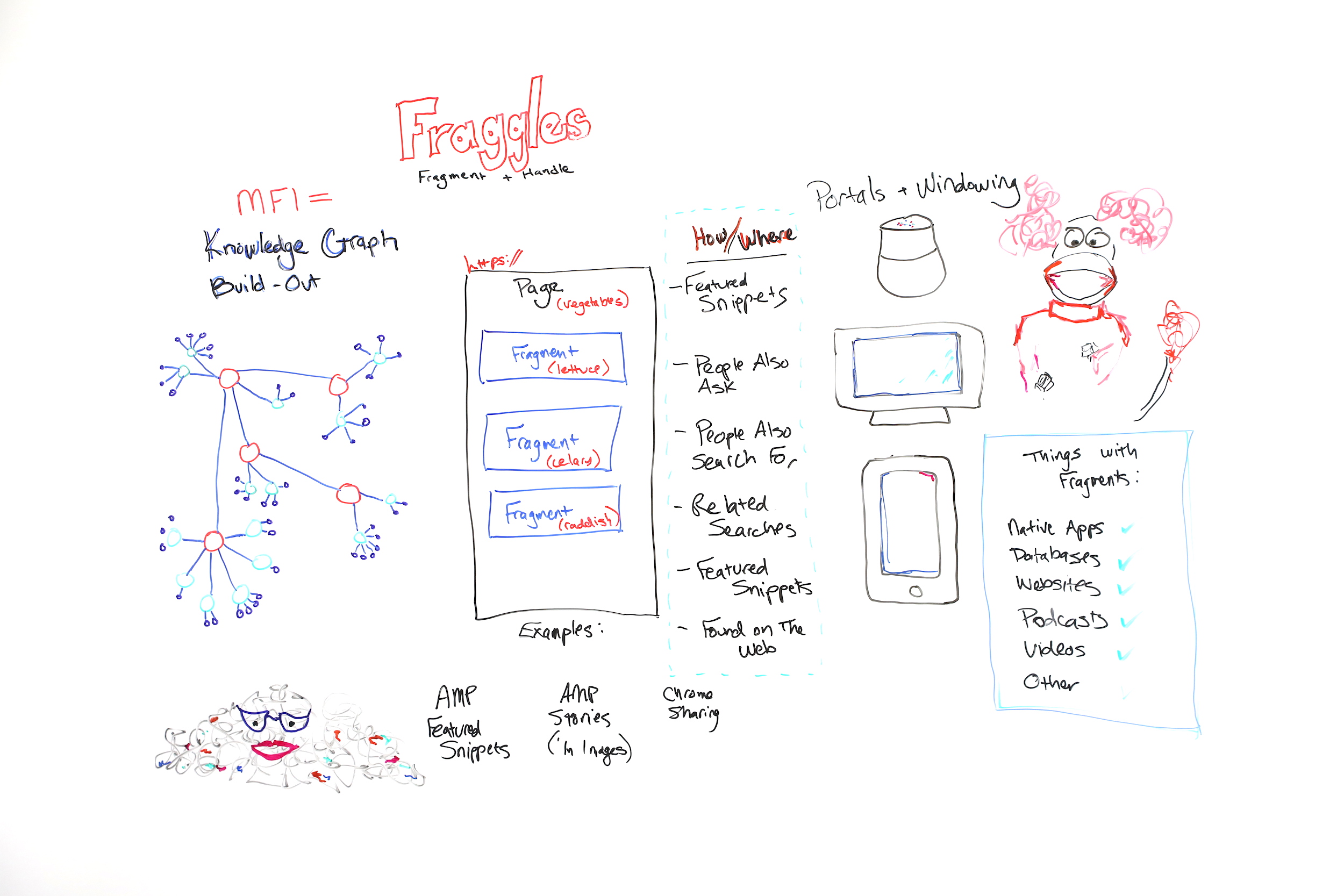
What are “fraggles” in SEO and how do they relate to mobile-first indexing, entities, the Knowledge Graph, and your day-to-day work? In this glimpse into her 2019 MozCon talk, Cindy Krum explains everything you need to understand about fraggles in this edition of Whiteboard Friday.
Video Transcription
Hi, Moz fans. My name is Cindy Krum, and I’m the CEO of MobileMoxie, based in Denver, Colorado. We do mobile SEO and ASO consulting. I’m here in Seattle, speaking at MozCon, but also recording this Whiteboard Friday for you today, and we are talking about fraggles.

So fraggles are obviously a name that I’m borrowing from Jim Henson, who created “Fraggle Rock.” But it’s a combination of words. It’s a combination of fragment and handle. I talk about fraggles as a new way or a new element or thing that Google is indexing.
Fraggles and mobile-first indexing
Let’s start with the idea of mobile-first indexing, because you have to kind of understand that before you can go on to understand fraggles. So I believe mobile-first indexing is about a little bit more than what Google says. Google says that mobile-first indexing was just a change of the crawler.
They had a desktop crawler that was primarily crawling and indexing, and now they have a mobile crawler that’s doing the heavy lifting for crawling and indexing. While I think that’s true, I think there’s more going on behind the scenes that they’re not talking about, and we’ve seen a lot of evidence of this. So what I believe is that mobile-first indexing was also about indexing, hence the name.
Knowledge Graph and entities
So I think that Google has reorganized their index around entities or around specifically entities in the Knowledge Graph. So this is kind of my rough diagram of a very simplified Knowledge Graph. But Knowledge Graph is all about person, place, thing, or idea.

Nouns are entities. Knowledge Graph has nodes for all of the major person, place, thing, or idea entities out there. But it also indexes or it also organizes the relationships of this idea to this idea or this thing to this thing. What’s useful for that to Google is that these things, these concepts, these relationships stay true in all languages, and that’s how entities work, because entities happen before keywords.
This can be a hard concept for SEOs to wrap their brain around because we’re so used to dealing with keywords. But if you think about an entity as something that’s described by a keyword and can be language agnostic, that’s how Google thinks about entities, because entities in the Knowledge Graph are not written up per se or their the unique identifier isn’t a word, it’s a number and numbers are language agnostic.
But if we think about an entity like mother, mother is a concept that exists in all languages, but we have different words to describe it. But regardless of what language you’re speaking, mother is related to father, is related to daughter, is related to grandfather, all in the same ways, even if we’re speaking different languages. So if Google can use what they call the “topic layer”and entities as a way to filter in information and understand the world, then they can do it in languages where they’re strong and say, “We know that this is true absolutely 100% all of the time.”
Then they can apply that understanding to languages that they have a harder time indexing or understanding, they’re just not as strong or the algorithm isn’t built to understand things like complexities of language, like German where they make really long words or other languages where they have lots of short words to mean different things or to modify different words.
Languages all work differently. But if they can use their translation API and their natural language APIs to build out the Knowledge Graph in places where they’re strong, then they can use it with machine learning to also build it and do a better job of answering questions in places or languages where they’re weak. So when you understand that, then it’s easy to think about mobile-first indexing as a massive Knowledge Graph build-out.
We’ve seen this happening statistically. There are more Knowledge Graph results and more other things that seem to be related to Knowledge Graph results, like people also ask, people also search for, related searches. Those are all describing different elements or different nodes on the Knowledge Graph. So when you see those things in the search, I want you to think, hey, this is the Knowledge Graph showing me how this topic is related to other topics.
So when Google launched mobile-first indexing, I think this is the reason it took two and a half years is because they were reindexing the entire web and organizing it around the Knowledge Graph. If you think back to the AMA that John Mueller did right about the time that Knowledge Graph was launching, he answered a lot of questions that were about JavaScript and href lang.
When you put this in that context, it makes more sense. He wants the entity understanding, or he knows that the entity understanding is really important, so the href lang is also really important. So that’s enough of that. Now let’s talk about fraggles.
Fraggles = fragment + handle
So fraggles, as I said, are a fragment plus a handle. It’s important to know that fraggles — let me go over here —fraggles and fragments, there are lots of things out there that have fragments. So you can think of native apps, databases, websites, podcasts, and videos. Those can all be fragmented.

Even though they don’t have a URL, they might be useful content, because Google says its goal is to organize the world’s information, not to organize the world’s websites. I think that, historically, Google has kind of been locked into this crawling and indexing of websites and that that’s bothered it, that it wants to be able to show other stuff, but it couldn’t do that because they all needed URLs.
But with fragments, potentially they don’t have to have a URL. So keep these things in mind — apps, databases and stuff like that — and then look at this.

So this is a traditional page. If you think about a page, Google has kind of been forced, historically by their infrastructure, to surface pages and to rank pages. But pages sometimes struggle to rank if they have too many topics on them.
So for instance, what I’ve shown you here is a page about vegetables. This page may be the best page about vegetables, and it may have the best information about lettuce, celery, and radishes. But because it’s got those topics and maybe more topics on it, they all kind of dilute each other, and this great page may struggle to rank because it’s not focused on the one topic, on one thing at a time.
Google wants to rank the best things. But historically they’ve kind of pushed us to put the best things on one page at a time and to break them out. So what that’s created is this “content is king, I need more content, build more pages” mentality in SEO. The problem is everyone can be building more and more pages for every keyword that they want to rank for or every keyword group that they want to rank for, but only one is going to rank number one.

Google still has to crawl all of those pages that it told us to build, and that creates this character over here, I think, Marjory the Trash Heap, which if you remember the Fraggles, Marjory the Trash Heap was the all-knowing oracle. But when we’re all creating kind of low- to mid-quality content just to have a separate page for every topic, then that makes Google’s life harder, and that of course makes our life harder.
So why are we doing all of this work? The answer is because Google can only index pages, and if the page is too long or too many topics, Google gets confused. So we’ve been enabling Google to do this. But let’s pretend, go with me on this, because this is a theory, I can’t prove it. But if Google didn’t have to index a full page or wasn’t locked into that and could just index a piece of a page, then that makes it easier for Google to understand the relationships of different topics to one page, but also to organize the bits of the page to different pieces of the Knowledge Graph.
So this page about vegetables could be indexed and organized under the vegetable node of the Knowledge Graph. But that doesn’t mean that the lettuce part of the page couldn’t be indexed separately under the lettuce portion of the Knowledge Graph and so on, celery to celery and radish to radish. Now I know this is novel, and it’s hard to think about if you’ve been doing SEO for a long time.
But let’s think about why Google would want to do this. Google has been moving towards all of these new kinds of search experiences where we have voice search, we have the Google Home Hub kind of situation with a screen, or we have mobile searches. If you think about what Google has been doing, we’ve seen the increase in people also ask, and we’ve seen the increase in featured snippets.
They’ve actually been kind of, sort of making fragments for a long time or indexing fragments and showing them in featured snippets. The difference between that and fraggles is that when you click through on a fraggle, when it ranks in a search result, Google scrolls to that portion of the page automatically. That’s the handle portion.
So handles you may have heard of before. They’re kind of old-school web building. We call them bookmarks, anchor links, anchor jump links, stuff like that. It’s when it automatically scrolls to the right portion of the page. But what we’ve seen with fraggles is Google is lifting bits of text, and when you click on it, they’re scrolling directly to that piece of text on a page.
So we see this already happening in some results. What’s interesting is Google is overlaying the link. You don’t have to program the jump link in there. Google actually finds it and puts it there for you. So Google is already doing this, especially with AMP featured snippets. If you have a AMP featured snippet, so a featured snippet that’s lifted from an AMP page, when you click through, Google is actually scrolling and highlighting the featured snippet so that you could read it in context on the page.
But it’s also happening in other kind of more nuanced situations, especially with forums and conversations where they can pick a best answer. The difference between a fraggle and something like a jump link is that Google is overlaying the scrolling portion. The difference between a fraggle and a site link is site links link to other pages, and fraggles, they’re linking to multiple pieces of the same long page.
So we want to avoid continuing to build up low-quality or mid-quality pages that might go to Marjory the Trash Heap. We want to start thinking in terms of can Google find and identify the right portion of the page about a specific topic, and are these topics related enough that they’ll be understood when indexing them towards the Knowledge Graph.
Knowledge Graph build-out into different areas
So I personally think that we’re seeing the build-out of the Knowledge Graph in a lot of different things. I think featured snippets are kind of facts or ideas that are looking for a home or validation in the Knowledge Graph. People also ask seem to be the related nodes. People also search for, same thing. Related searches, same thing. Featured snippets, oh, they’re on there twice, two featured snippets. Found on the web, which is another way where Google is putting expanders by topic and then giving you a carousel of featured snippets to click through on.

So we’re seeing all of those things, and some SEOs are getting kind of upset that Google is lifting so much content and putting it in the search results and that you’re not getting the click. We know that 61% of mobile searches don’t get a click anymore, and it’s because people are finding the information that they want directly in a SERP.
That’s tough for SEOs, but great for Google because it means Google is providing exactly what the user wants. So they’re probably going to continue to do this. I think that SEOs are going to change their minds and they’re going to want to be in those windowed content, in the lifted content, because when Google starts doing this kind of thing for the native apps, databases, and other content, websites, podcasts, stuff like that, then those are new competitors that you didn’t have to deal with when it was only websites ranking, but those are going to be more engaging kinds of content that Google will be showing or lifting and showing in a SERP even if they don’t have to have URLs, because Google can just window them and show them.
So you’d rather be lifted than not shown at all. So that’s it for me and featured snippets. I’d love to answer your questions in the comments, and thanks very much. I hope you like the theory about fraggles.
Video transcription by Speechpad.com
Sign up for The Moz Top 10, a semimonthly mailer updating you on the top ten hottest pieces of SEO news, tips, and rad links uncovered by the Moz team. Think of it as your exclusive digest of stuff you don’t have time to hunt down but want to read!
How Do I Make My Site Rank For a Keyword?

In my experience, the most common reasons a website doesn’t rank for a specific keyword are:
Eight things you should know before starting SEO work for a brand
Starting an SEO campaign on a brand new site requires a good knowledge of the brand, industry and website history. So what do you do if you don’t have this insight already?
Post from Helen Pollitt
Google & Bing Thanksgiving 2019 Logos
Happy Thanksgiving everyone! Today is a holiday in the United States and I will just post this recap of some of the logos from Google and Bing for the holiday. Google has “hand turkeys” and Bing goes with some fierce looking turkeys on its home page.
…
Black Friday: Biggest discount ever!
We’re not kidding. It’s time for Black Friday, the one time a year we clean up the attic at Yoast. With our whopping 30% discount on everything, we top every sale we ever had. Get your SEO package TODAY Yes, when we say everything, we mean everything. Our subscriptions are cheaper than ever. With 30% […]
The post Black Friday: Biggest discount ever! appeared first on Yoast.
Top five SEO tools to generate more leads in 2020
Both lead generation and CRO forms an integral part of a comprehensive SEO strategy. Make the most with SEO tools to generate quality leads in 2020.
The post Top five SEO tools to generate more leads in 2020 appeared first on Search Engine Watch.