Search Buzz Video Recap: Google Search Algorithm Update, Google Shopping Is Free, Question Hub & Search Tips For COVID-19
Today is the 8th anniversary of the Google Penguin update and we have a special theme at the Search Engine Roundtable. In the news, there looks like there was a Google search algorithm ranking update on April 16th. Google Shopping is now free…
…
Increasing Time on Site
Changing User Intents
Google’s search quality rater document highlights how the intent of searches can change over time for a specific keyword.
A generic search for [iPhone] is likely to be related to the most recent model. A search for [President Bush] likely was related to the 41st president until his son was elected & then it was most likely to be related to 43.
Faster Ranking Shifts
About 17 years ago when Google was young they did monthly updates where most of any ranking signal shift that would happen would get folded into the rankings. The web today is much faster in terms of the rate of change, amount of news consumption, increasing political polarization, social media channels that amplify outrage and how quickly any cultural snippet can be taken out of context.
Yesterday President Trump had some interesting stuff to say about bleach. In spite of there being an anime series by the same name, news coverage of the presser has driven great interest in the topic.
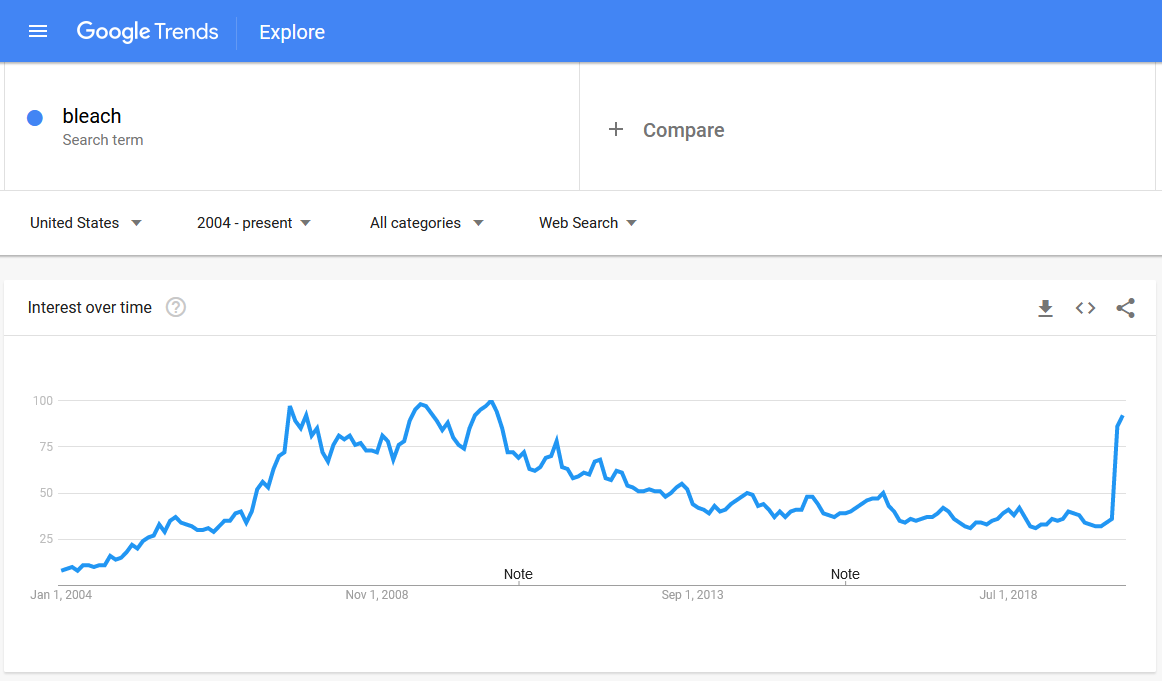
And that interest is already folded into the organic search results through Google News insertion, Twitter tweet insertion, and the query deserves freshness (QDF) algorithm driving insertion of news stories in other organic search ranking slots.
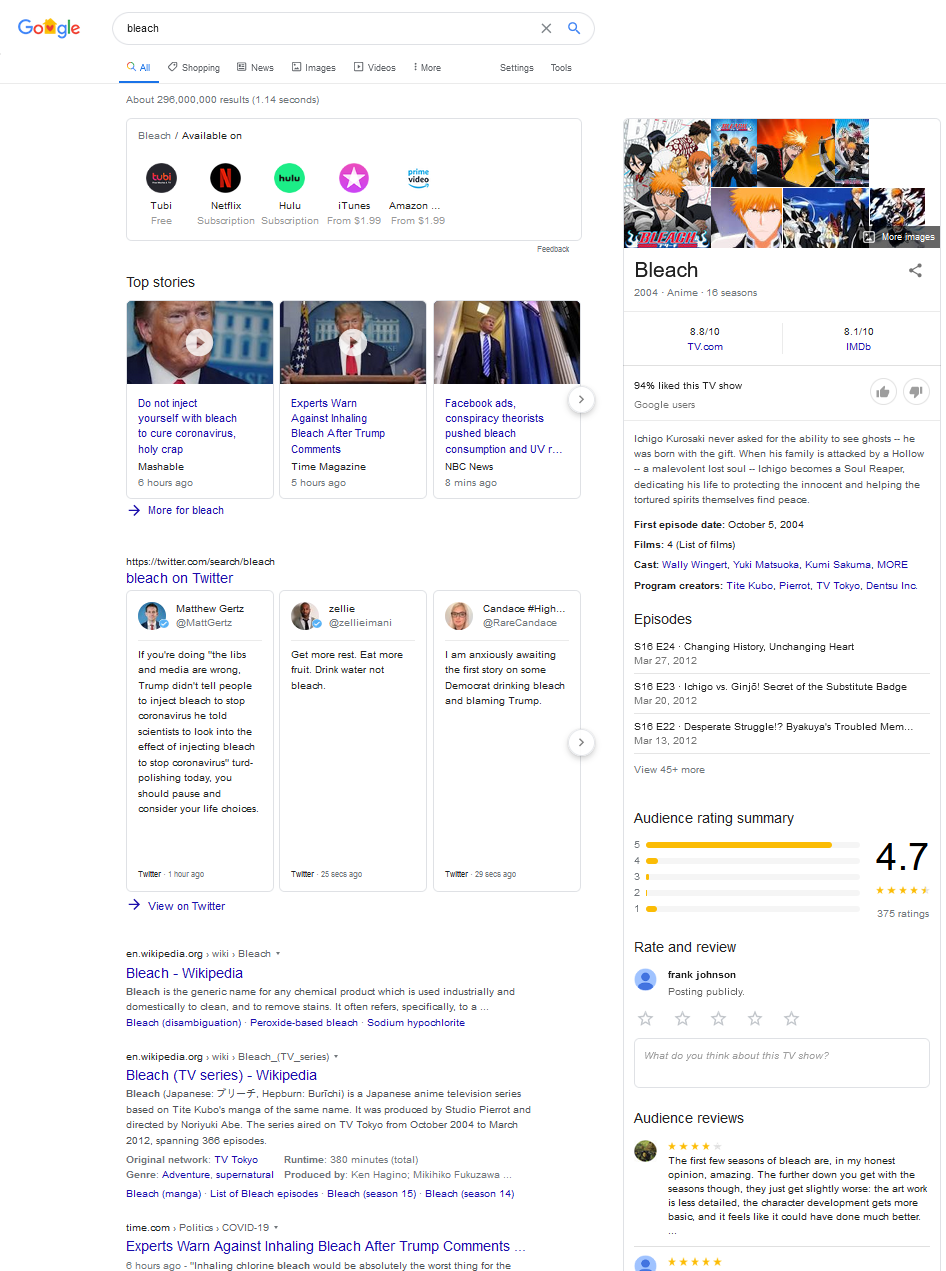
If a lot of people are searching for something and many trusted news organizations are publishing information about a topic then there is little risk in folding fresh information into the result set.
Temporary Versus Permanent Change
When the intent of a keyword changes sometimes the change is transitory & sometimes it is not.
One of the most common ad-driven business models online is to take something that was once paid, make it free, and then layer ads or some other premium features on top to monetize a different part of the value chain. TripAdvisor democratized hotel reviews. Zillow made foreclosure information easily accessible for free, etc.
The success of remote working & communication services like Skype, Zoom, Basecamp, Slack, Trello, and the ongoing remote work experiment the world is going through will permanently change some consumer behaviors & how businesses operate.
A Pew survey mentioned 43% of Americans stated someone in their house recently lost their job, had their hours reduced, and/or took pay cuts. Hundreds of thousands of people are applying to work in Amazon’s grueling fulfillment centers.
To many of these people a lone wolf online job would be a dream come true.
If you had a two hour daily commute and were just as efficient working at home most days would you be in a rush to head back to the office?
How many former fulltime employees are going to become freelancers building their own small businesses they work on directly while augmenting it with platform work on other services like Uber, Lyft, DoorDash, Upwork, Fiverr, 99 Designs, or even influencer platforms like Intellifluence?
If big publishers are getting disintermediated by monopoly platforms & ad networks are offering crumbs of crumbs there’s no harm in selling custom ads directly or having your early publishing efforts subsidized through custom side deals as you build market awareness and invest into building other products and services to sell.
Wordpress keeps adding more features. Many technology services like Shopify, Stripe & Twilio are making most parts of the tech stack outside of marketing cheaper & easier to scale.
Some universities are preparing for the fall semester being entirely online. As technology improves, we spend more time online, more activities happen online, and more work becomes remote. All this leads to the distinction between online and offline losing meaning other than perhaps in terms of cost structure & likelihood of bankruptcy.
Before Panda / After Panda

Before the Panda update each additional page which was created was another lotto ticket and a chance to win. If users had a crappy user experience on a page or site maybe you didn’t make the sale, but if the goal of the page was to have the content so crappy that ads were more appealing that could lead to fantastic monetization while it lasted.
That strategy worked well for eHow, fueling the pump-n-dump Demand Media IPO.
Demand Media had to analyze eHow and pay to delete over a million articles which they deemed to have a negative economic value in the post-Panda world.
After the Panda update having many thin pages laying around and creating more thin pages was layering risk on top of risk. It made sense to shift to a smaller, tighter, deeper & more differentiated publishing model.
Entropy & Decay
The web goes through a constant state of reinvention.
Old YouTube Flash embeds break.
HTTP content calls in sites that were upgraded to HTTPS break.
Software which is not updated has security exploits.
If you have a large website and do not regularly update where you are linking to your site is almost certainly linking to porn and malware sites somewhere.
As users shifted to mobile websites that ignored mobile interfaces became relatively less appealing.
Changing web browser behaviors can break website logins and how data is shared across websites dependent on third party services.
Competition improves.
Algorithms change.
Ads eat a growing share of real estate on dominant platforms while organic reach slides.
Everything on the web is constantly dying as competition improves, technology changes and language gets redefined.
Staying Relevant
Even if a change in user intent is transitory, in some cases it can make sense to re-work a page to address a sudden surge of interest to improve time on site, user engagement metrics & make the content on your page more citation-worthy. If news writers are still chasing a trend then having an in-depth background piece of content with more depth gives them something they may want to link at.
Since the Covid-19 implosion of the global economy came into effect I’ve seen two different clients have a sort of sudden surge in traffic which would make little to no sense unless one considered currently spreading news stories.
News coverage creates interest in topics, shapes perspectives of topics, and creates demand for solutions.
If you read the right people on Twitter sometimes you can be days, weeks or even months ahead of the broader news narrative. Some people are great at spotting the second, third and fourth order effects of changes. You can spot stories bubbling up and participate in the trends.
An Accelerating Rate of Change
When the web was slower & easier you could find an affiliate niche and succeed in it sometimes for years before solid competition would arrive. One of the things I was most floored about this year from a marketing perspective was how quickly spammers ramped up a full court press amplifying the fear the news media was pitching. I think I get something like a hundred spam emails a day pitching facemasks and other COVID-19 solutions. I probably see 50+ other daily ads from services like Outbrain & similar.
The web moves so much faster that the SEC is already taking COVID-19 related actions against dozens of companies. Google banned advertising protective masks and recently announced they are rolling out advertiser ID verification to increase transparency.
If Google is looking at their advertisers with a greater degree of suspicion even into an economic downturn when Expedia is pulling $4 billion from their ad budget & Amazon is cutting back on their Google ad budget and Google decides to freeze hiring then it makes far more sense to keep reinvesting into improving any page which is getting a solid stream of organic search traffic.
Company Town
After Amazon cut their Google ad budget in March Google decided to expand Google Shopping to include free listings. When any of the platforms is losing badly they can afford to subsidize that area and operate it at a loss to try to gain marketshare while making the dominant player in that category look more extreme.
When a player is dominant in a category they can squeeze down on partners. Amazon once again cut affiliate payouts and the Wall Street Journal published an article citing 20 current and former Amazon insiders who stated Amazon uses third party merchant sales data to determine which products to clone:
Amazon employees accessed documents and data about a bestselling car-trunk organizer sold by a third-party vendor. The information included total sales, how much the vendor paid Amazon for marketing and shipping, and how much Amazon made on each sale. Amazon’s private-label arm later introduced its own car-trunk organizers. … Amazon’s private-label business encompasses more than 45 brands with some 243,000 products, from AmazonBasics batteries to Stone & Beam furniture. Amazon says those brands account for 1% of its $158 billion in annual retail sales, not counting Amazon’s devices such as its Echo speakers, Kindle e-readers and Ring doorbell cameras.
Amazon does not even need to sell their private label products to shift their economics. As Amazon clones products they force the branded ad buy for a company to show up for their own branded terms, taking another bite out of the partner: “Fortem spends as much as $60,000 a month on Amazon advertisements for its items to come up at the top of searches, said Mr. Maslakou.”
Amazon has grown so dominant they’ve not only cut their affiliate & search advertising while hiring hundreds of thousands of employees, but they’ve also dramatically slowed down shipping times while pulling back on their on-site people also purchase promotions to get users to order less.
While they are growing stronger department stores and other legacy retailers are careening toward bankruptcy.
Multiple Ways to Improve
If you have a page which is ranking that gets a sudden spike in traffic it makes a lot of sense to consider current news & try to consider if the intent of the searcher has changed. If it has, address it as best you can in the most relevant way possible, even if the change is temporary, then consider switching back to the old version of the page or reorganizing your content if/when/as the trend has passed.
One of the pages mentioned above was a pre-Panda “me too” type page which was suddenly flooded with thousands of user visitors. A quality inbound link can easily cost $100 to multiples of that. If a page is already getting thousands of visitors, why not invest a couple hundred dollars into dramatically improving it, knowing that some of those drive by users will likely eventually share it? Make the page an in-depth guide with great graphics and some of those 10,000’s of visitors will eventually link to it, as they were already interested in the topic, the page already gets a great stream of traffic, and the content quality is solid.
Last week a client had a big spike from a news topic that changed the intent of a keyword. Their time on site from those visitors was under a minute. After the page was re-created to reflect changing consumer intent their time on site jumped to over 3 minutes for users entering that page. Those users had a far lower bounce rate, a far better user experience, are going to be more likely to trust the site enough to seek it out again, and this sends a signal to Google that the site is still maintained & relevant to the modern search market.
There are many ways to chase the traffic stream
- create new content on new pages
- gut the old page & publish entirely new content
- re-arrange the old page while publishing new relevant breaking news at the top
In general I think the third option is often the best approach because you are aligning the page which already sees the traffic stream with the content they are looking for, while also ensuring any users from the prior intent can still access what they are looking for.
If the trend is huge, or the change in intent is permanent then you could also move the old content to a legacy URL archived page while making the high-traffic page focus on the spiking news topic.
The above advice applies to pages which rank for keywords that change in intent, but it can also apply to any web page which has a strong flow of user traffic. Keep improving the things people see most because improvements there have the biggest returns. How can you make a page deeper, better, more differentiated from the rest of the web?
Does Usage Data Matter?
Objectively, if people visit your website and do not find what they were looking for they are going to click the back button and be done with you.
Outdated content that has become irrelevant due to changing user tastes is only marginally better than outright spam.
While Google suggests they largely do not use bounce rate or user data in their rankings, they have also claimed end user data was the best way they could determine if the user was satisfied with a particular search result. Five years ago Bill Slawski wrote a blog post about long clicks which quoted Steven Levy’s In The Plex book:
“On the most basic level, Google could see how satisfied users were. To paraphrase Tolstoy, happy users were all the same. The best sign of their happiness was the “Long Click” — This occurred when someone went to a search result, ideally the top one, and did not return. That meant Google has successfully fulfilled the query.”
Think of how many people use the Chrome web browser or have Android tracking devices on them all hours of the day. There is no way Google would be able to track those billions of users every single day without finding a whole lot of signal in the noise.
Categories:
Increasing Time on Site
Changing User Intents
Google’s search quality rater document highlights how the intent of searches can change over time for a specific keyword.
A generic search for [iPhone] is likely to be related to the most recent model. A search for [President Bush] likely was related to the 41st president until his son was elected & then it was most likely to be related to 43.
Faster Ranking Shifts
About 17 years ago when Google was young they did monthly updates where most of any ranking signal shift that would happen would get folded into the rankings. The web today is much faster in terms of the rate of change, amount of news consumption, increasing political polarization, social media channels that amplify outrage and how quickly any cultural snippet can be taken out of context.
Yesterday President Trump had some interesting stuff to say about bleach. In spite of there being an anime series by the same name, news coverage of the presser has driven great interest in the topic.
And that interest is already folded into the organic search results through Google News insertion, Twitter tweet insertion, and the query deserves freshness (QDF) algorithm driving insertion of news stories in other organic search ranking slots.
If a lot of people are searching for something and many trusted news organizations are publishing information about a topic then there is little risk in folding fresh information into the result set.
Temporary Versus Permanent Change
When the intent of a keyword changes sometimes the change is transitory & sometimes it is not.
One of the most common ad-driven business models online is to take something that was once paid, make it free, and then layer ads or some other premium features on top to monetize a different part of the value chain. TripAdvisor democratized hotel reviews. Zillow made foreclosure information easily accessible for free, etc.
The success of remote working & communication services like Skype, Zoom, Basecamp, Slack, Trello, and the ongoing remote work experiment the world is going through will permanently change some consumer behaviors & how businesses operate.
A Pew survey mentioned 43% of Americans stated someone in their house recently lost their job, had their hours reduced, and/or took pay cuts. Hundreds of thousands of people are applying to work in Amazon’s grueling fulfillment centers.
To many of these people a lone wolf online job would be a dream come true.
If you had a two hour daily commute and were just as efficient working at home most days would you be in a rush to head back to the office?
How many former fulltime employees are going to become freelancers building their own small businesses they work on directly while augmenting it with platform work on other services like Uber, Lyft, DoorDash, Upwork, Fiverr, 99 Designs, or even influencer platforms like Intellifluence?
If big publishers are getting disintermediated by monopoly platforms & ad networks are offering crumbs of crumbs there’s no harm in selling custom ads directly or having your early publishing efforts subsidized through custom side deals as you build market awareness and invest into building other products and services to sell.
Wordpress keeps adding more features. Many technology services like Shopify, Stripe & Twilio are making most parts of the tech stack outside of marketing cheaper & easier to scale.
Some universities are preparing for the fall semester being entirely online. As technology improves, we spend more time online, more activities happen online, and more work becomes remote. All this leads to the distinction between online and offline losing meaning other than perhaps in terms of cost structure & likelihood of bankruptcy.
Before Panda / After Panda
Before the Panda update each additional page which was created was another lotto ticket and a chance to win. If users had a crappy user experience on a page or site maybe you didn’t make the sale, but if the goal of the page was to have the content so crappy that ads were more appealing that could lead to fantastic monetization while it lasted.
That strategy worked well for eHow, fueling the pump-n-dump Demand Media IPO.
Demand Media had to analyze eHow and pay to delete over a million articles which they deemed to have a negative economic value in the post-Panda world.
After the Panda update having many thin pages laying around and creating more thin pages was layering risk on top of risk. It made sense to shift to a smaller, tighter, deeper & more differentiated publishing model.
Entropy & Decay
The web goes through a constant state of reinvention.
Old YouTube Flash embeds break.
HTTP content calls in sites that were upgraded to HTTPS break.
Software which is not updated has security exploits.
If you have a large website and do not regularly update where you are linking to your site is almost certainly linking to porn and malware sites somewhere.
As users shifted to mobile websites that ignored mobile interfaces became relatively less appealing.
Changing web browser behaviors can break website logins and how data is shared across websites dependent on third party services.
Competition improves.
Algorithms change.
Ads eat a growing share of real estate on dominant platforms while organic reach slides.
Everything on the web is constantly dying as competition improves, technology changes and language gets redefined.
Staying Relevant
Even if a change in user intent is transitory, in some cases it can make sense to re-work a page to address a sudden surge of interest to improve time on site, user engagement metrics & make the content on your page more citation-worthy. If news writers are still chasing a trend then having an in-depth background piece of content with more depth gives them something they may want to link at.
Since the Covid-19 implosion of the global economy came into effect I’ve seen two different clients have a sort of sudden surge in traffic which would make little to no sense unless one considered currently spreading news stories.
News coverage creates interest in topics, shapes perspectives of topics, and creates demand for solutions.
If you read the right people on Twitter sometimes you can be days, weeks or even months ahead of the broader news narrative. Some people are great at spotting the second, third and fourth order effects of changes. You can spot stories bubbling up and participate in the trends.
An Accelerating Rate of Change
When the web was slower & easier you could find an affiliate niche and succeed in it sometimes for years before solid competition would arrive. One of the things I was most floored about this year from a marketing perspective was how quickly spammers ramped up a full court press amplifying the fear the news media was pitching. I think I get something like a hundred spam emails a day pitching facemasks and other COVID-19 solutions. I probably see 50+ other daily ads from services like Outbrain & similar.
The web moves so much faster that the SEC is already taking COVID-19 related actions against dozens of companies. Google banned advertising protective masks and recently announced they are rolling out advertiser ID verification to increase transparency.
If Google is looking at their advertisers with a greater degree of suspicion even into an economic downturn when Expedia is pulling $4 billion from their ad budget & Amazon is cutting back on their Google ad budget and Google decides to freeze hiring then it makes far more sense to keep reinvesting into improving any page which is getting a solid stream of organic search traffic.
Company Town
After Amazon cut their Google ad budget in March Google decided to expand Google Shopping to include free listings. When any of the platforms is losing badly they can afford to subsidize that area and operate it at a loss to try to gain marketshare while making the dominant player in that category look more extreme.
When a player is dominant in a category they can squeeze down on partners. Amazon once again cut affiliate payouts and the Wall Street Journal published an article citing 20 current and former Amazon insiders who stated Amazon uses third party merchant sales data to determine which products to clone:
Amazon employees accessed documents and data about a bestselling car-trunk organizer sold by a third-party vendor. The information included total sales, how much the vendor paid Amazon for marketing and shipping, and how much Amazon made on each sale. Amazon’s private-label arm later introduced its own car-trunk organizers. … Amazon’s private-label business encompasses more than 45 brands with some 243,000 products, from AmazonBasics batteries to Stone & Beam furniture. Amazon says those brands account for 1% of its $158 billion in annual retail sales, not counting Amazon’s devices such as its Echo speakers, Kindle e-readers and Ring doorbell cameras.
Amazon does not even need to sell their private label products to shift their economics. As Amazon clones products they force the branded ad buy for a company to show up for their own branded terms, taking another bite out of the partner: “Fortem spends as much as $60,000 a month on Amazon advertisements for its items to come up at the top of searches, said Mr. Maslakou.”
Amazon has grown so dominant they’ve not only cut their affiliate & search advertising while hiring hundreds of thousands of employees, but they’ve also dramatically slowed down shipping times while pulling back on their on-site people also purchase promotions to get users to order less.
While they are growing stronger department stores and other legacy retailers are careening toward bankruptcy.
Multiple Ways to Improve
If you have a page which is ranking that gets a sudden spike in traffic it makes a lot of sense to consider current news & try to consider if the intent of the searcher has changed. If it has, address it as best you can in the most relevant way possible, even if the change is temporary, then consider switching back to the old version of the page or reorganizing your content if/when/as the trend has passed.
One of the pages mentioned above was a pre-Panda “me too” type page which was suddenly flooded with thousands of user visitors. A quality inbound link can easily cost $100 to multiples of that. If a page is already getting thousands of visitors, why not invest a couple hundred dollars into dramatically improving it, knowing that some of those drive by users will likely eventually share it? Make the page an in-depth guide with great graphics and some of those 10,000’s of visitors will eventually link to it, as they were already interested in the topic, the page already gets a great stream of traffic, and the content quality is solid.
Last week a client had a big spike from a news topic that changed the intent of a keyword. Their time on site from those visitors was under a minute. After the page was re-created to reflect changing consumer intent their time on site jumped to over 3 minutes for users entering that page. Those users had a far lower bounce rate, a far better user experience, are going to be more likely to trust the site enough to seek it out again, and this sends a signal to Google that the site is still maintained & relevant to the modern search market.
There are many ways to chase the traffic stream
- create new content on new pages
- gut the old page & publish entirely new content
- re-arrange the old page while publishing new relevant breaking news at the top
In general I think the third option is often the best approach because you are aligning the page which already sees the traffic stream with the content they are looking for, while also ensuring any users from the prior intent can still access what they are looking for.
If the trend is huge, or the change in intent is permanent then you could also move the old content to a legacy URL archived page while making the high-traffic page focus on the spiking news topic.
The above advice applies to pages which rank for keywords that change in intent, but it can also apply to any web page which has a strong flow of user traffic. Keep improving the things people see most because improvements there have the biggest returns. How can you make a page deeper, better, more differentiated from the rest of the web?
Does Usage Data Matter?
Objectively, if people visit your website and do not find what they were looking for they are going to click the back button and be done with you.
Outdated content that has become irrelevant due to changing user tastes is only marginally better than outright spam.
While Google suggests they largely do not use bounce rate or user data in their rankings, they have also claimed end user data was the best way they could determine if the user was satisfied with a particular search result. Five years ago Bill Slawski wrote a blog post about long clicks which quoted Steven Levy’s In The Plex book:
“On the most basic level, Google could see how satisfied users were. To paraphrase Tolstoy, happy users were all the same. The best sign of their happiness was the “Long Click” — This occurred when someone went to a search result, ideally the top one, and did not return. That meant Google has successfully fulfilled the query.”
Think of how many people use the Chrome web browser or have Android tracking devices on them all hours of the day. There is no way Google would be able to track those billions of users every single day without finding a whole lot of signal in the noise.
Categories:
Replay: Pros discuss content marketing during COVID-19
We will dive into what brands should be communicating and ways to stand out with your content while respecting the current pandemic.
Please visit Search Engine Land for the full article.
To beat Amazon, Google needs to be more than the ‘Bing of e-commerce’
The elements are there, now all Google needs is near flawless execution.
Please visit Search Engine Land for the full article.
New free version of Google Shopping rolling out now
It is now rolling out and should be fully live in the US by early next week.
Please visit Search Engine Land for the full article.
Paid Search Association Online Conference 2020 on May 12-13-14
Paid Search Association Conference 2020 is intended to give all PPC professionals a free occasion of high level support and update during one of the most critical periods mankind has ever faced.
Post from Gianpaolo Lorusso
Tips for Effective SEO Project Management

Project management and SEO, what do they have to do with each other? Isn’t SEO just about some geeky technical magic that will get your site more traffic?
Content Authority: Potential Measures of Authoritative Content – Whiteboard Friday
Posted by rjonesx.
When it boils down to it, every idea in SEO can be understood as a set of measurements we use to rank one page over another. And that means that when it comes to measuring a concept like the authoritativeness of your content, there are almost certainly factors that you can analyze and tweak to improve it.
But if Google were to use a measure of content authority, what might go into it? Against what yardstick should SEOs be measuring their content’s E-A-T? In this episode of Whiteboard Friday, Russ Jones walks us through a thought experiment as to what exactly might constitute a “content authority” score and how you can begin to understand your content’s expertise like Google.

Click on the whiteboard image above to open a high-resolution version in a new tab!
Video Transcription
Hey, folks, this is Russ Jones here with another Whiteboard Friday, and today we’re going to have fun. Well, at least fun for me, because this is completely speculative. We’re going to be talking about this concept of content authority and just some ideas around ways in which we might be able to measure it.
Maybe Google uses these ways to measure it, maybe not. But at the same time, hopefully what we’ll be able to do is come up with a better concept of metrics we can use to get at content authority.
Now, we know there’s a lot of controversy around this. Google has said quite clearly that expertise, authority, and trustworthiness are very important parts of their Quality Rater Guidelines, but the information has been pretty flimsy on exactly what part of the algorithm helps determine exactly this type of content.
We do know that they aren’t using the quality rater data to train the algorithm, but they are using it to reject algorithm changes that don’t actually meet these standards.
How do we measure the authoritativeness of content?
So how can we go about measuring content authority? Ultimately, any kind of idea that we talk about in search engine optimization has to boil down in some way, shape, or form to a set of measurements that are being made and in somehow shape or form being used to rank one page over another.
Now sometimes it makes sense just to kind of feel it, like if you’re writing for humans, be a human. But authoritative content is a little bit more difficult than that. It’s a little harder to just off the top of your head know that this content is authoritative and this isn’t. In fact, the Quality Rater Guidelines are really clear in some of the examples of what would be considered really highly authoritative content, like, for example, in the News section they mention that it’s written by a Pulitzer Prize winning author.
Well, I don’t know how many of you have Pulitzer Prize winning authors on your staff or whose clients have Pulitzer Prize winning authors. So I don’t exactly see how that’s particularly helpful to individuals like ourselves who are trying to produce authoritative content from a position of not being an award-winning writer.
So today I want to just go through a whole bunch of ideas, that have been running through my head with the help of people from the community who’ve given me some ideas and bounced things off, that we might be able to use to do a better job of understanding authoritative content. All right.
1. ALBERT
So these are what I would consider some of the potential measures of authoritative content. The first one, and this is just going to open up a whole rat’s nest I’m sure, but okay, ALBERT. We’ve talked about the use of BERT for understanding language by Google. Well, ALBERT, which stands for “a lighter BERT,” is a similar model used by Google, and it’s actually been trained in specific circumstances for the goal of answering questions.

Now that might not seem like a particularly big deal. We’ve been doing question answering for a whole long time. Featured snippets are exactly that. But ALBERT has jumped on the scene in such a dominant fashion as to have eclipsed anything we’ve really seen in this kind of NLP problem.
So if you were to go to the SQuAD dataset competition, which is Stanford’s Question Answering competition, where they’ve got these giant set of questions and giant set of documents and then they had humans go in and find the answers in the documents and say which documents don’t have answers and which do, and then all sorts of different organizations have produced models to try and automatically find the answers.
Well, this competition has just been going back and forth and back and forth for a really long time between a bunch of heavy hitters, like Google, Baidu, multiple Microsoft teams. We’re talking the smartest people in the world, the Allen Institute, all fighting back and forth.
Well, right now, ALBERT or variations thereof have the top 5 positions and 9 of the top 10 positions, and all of them perform better than humans. That is dominance. So we’ve got right here this incredible technology for answering questions.
Well, what does this have to do with content authority? Why in the world would this matter? Well, if you think about a document, any kind of piece of content that we produce, the intention is that we’re going to be answering the questions that our customers want answered. So any topic we start with, let’s say the topic we started with was data science, well, there are probably a lot of questions people want to know about that topic.
They might want to know: What is a data scientist? How much money do they make? What kind of things do you need to know to be a data scientist? Well, this is where something like ALBERT could come in and be extremely valuable for measuring the authoritativeness of the content. You see, what if one of the measures of the authoritative content is how well that content answers all of the related questions to the topic?
So you could imagine Google looking at all of the pages that rank for data science, and they know the top 10 questions that are asked about it, and then seeing which piece of content answers those 10 questions best. If they were able to do that, that would be a pretty awesome metric for determining how thorough and how significant and valuable and useful and authoritative that content is.
So I think this one, the ALBERT algorithm really has a lot of potential. But let’s move on from that. There are all sorts of other things that might have to do with content authority.
2. Information density
One that I really like is this idea of information density. So a lot of times when we’re writing content, especially when we’re not familiar with the topic, we end up writing a lot of fluff.
We kind of are just putting words in there to meet the word length that is expected by the contract, even though we know deep down that the number of words on the page really doesn’t determine whether or not it’s going to rank. So one of the ways that you can get at whether a piece of content is actually valuable or not or at least is providing important information is using natural language programs to extract information.
ReVerb + OpenIE
Well, the probably most popular NLP open source or at least openly available technology started as a project called ReVerb and now has merged into the Open IE project. But essentially, you can give it a piece of content, and it will extract out all of the factual claims made by that content.
So if I gave it a paragraph that said tennis is a sport that’s played with a racket and a ball and today I’m having a lot of fun, something of that sort, it would be able to identify the factual claim, what tennis is, that it’s a sport played with a racket and a ball.
But it would ignore the claim that I’m having a lot of fun today, because that’s not really a piece of information, a factual claim that we’re making. So the concept of information density would be the number of facts that can be extracted from a document versus the total number of words. All right.

If we had that measurement, then we could pretty easily sift through content that is just written for length versus content that is really information rich. Just imagine a Wikipedia article, how dense the information is in there relative to the type of content that most of us produce. So what are some other things?
3. Content style
Let’s talk about content style.

This would be a really easy metric. We could talk about the use of in-line citations, which Wikipedia does, in which after stating a fact they then link to the bottom of the page where it shows you the citation, just like you would do if you were writing a paper in college or a thesis, something that would be authoritative. Or the use of fact lists or tables of contents, like Wikipedia does, or using datelines accurately or AP style formatting.
These are all really simple metrics that, if you think about it, the types of sites that are more trustworthy more often use. If that’s the case, then they might be hints to Google that the content that you’re producing is authoritative. So those aren’t the only easy ones that we could look at.
4. Writing quality
There are a lot of other ones that are pretty straightforward, like dealing with writing quality.

How easy is it to make sure you are using correct spelling and correct grammar? But have you ever looked at the reading level? Has it ever occurred to you to make sure that the content that you’re writing isn’t written at a level so difficult that no one can understand it, or is written at a level so low as to be certainly not thorough and not authoritative? If your content is written at a third-grade level and the page is about some health issue, I imagine Google could use that metric pretty quickly to exclude your site.
There are also things like sentence length, which deals with readability, the uniqueness of the content, and also the word usage. This is a pretty straightforward one. Imagine that once again we’re looking at data science, and Google looks at the words you use on your page. Then maybe instead of looking at all sites that mention data science, Google only looks at edu sites or Google only looks at published papers and then compares the language usage there.
That would be a pretty easy way for Google to identify a piece of content that’s meant for consumers that is authoritative versus one that’s meant for consumers and isn’t.
5. Media styles
Another thing we can look at is media styles. This is something that is a little bit more difficult to understand how Google might actually be able to take advantage of.

But at the same time, I think that these are measurable and easy for search engine optimizers, like ourselves, to use.
Annotated graphs
One would be annotated graphs. I think we should move away from graph images and move more towards using open source graphing libraries. That way the actual factual information, the numbers can be provided to Google in the source code.
Unique imagery
Unique imagery is obviously something that we would care about. In fact, it’s actually listed in the Quality Rater Guidelines.
Accessibility
Then finally, accessibility matters. I know that accessibility doesn’t make content authoritative, but it does say something about the degree to which a person has cared about the details of the site and of the page. There’s a really famous story about, and I can’t remember what the band’s name was, but they wrote into their contracts that for every concert they needed to have a bowl of M&Ms, with all of the brown M&Ms removed, waiting for them in the room.
Now it wasn’t because they had a problem with the brown M&Ms or they really liked M&Ms or anything of that sort. It was just to make sure that they read the contract. Accessibility is kind of one of those things of where they can tell if you sweat the details or not.
6. Clickbait titles, author quality, and Google Scholar
Now finally, there are a couple of others that I think are interesting and really have to be talked about. The first is clickbait titles.
Clickbait titles
This is explicitly identified as something that Google looks at or at least the quality raters look at in order to determine that content is not authoritative. Make your titles say what they mean, not try to exaggerate to get a click.
Author quality
Another thing they say specifically is do you mention your author qualifications. Sure, you don’t have a Pulitzer Prize writer, but your writer has some sort of qualifications, at least hopefully, and those qualifications are going to be important for Google in assessing whether or not the author actually knows what they’re talking about.
Google Scholar
Another thing that I think we really ought to start looking at is Google Scholar. How much money do you think Google makes off of Google Scholar? Probably not very much. What’s the point of having a giant database of academic information when you don’t run ads on any of the pages? Well, maybe that academic information can be mined in a way so that they can judge the content that is made for consumers as to whether or not it is in line with, whether we’re talking about facts or language or authoritativeness, with what academia is saying about that same topic.

Now, course, all of these ideas are just ideas. We’ve got a giant question mark sitting out there about exactly how Google gets at content authority. That doesn’t mean we should ignore it. So hopefully these ideas will help you come up with some ideas to improve your own content, and maybe you could give me some more ideas in the comment section.
That would be great and we could talk more about how those might be measured. I’m looking forward to it. Thanks again.
Video transcription by Speechpad.com
Sign up for The Moz Top 10, a semimonthly mailer updating you on the top ten hottest pieces of SEO news, tips, and rad links uncovered by the Moz team. Think of it as your exclusive digest of stuff you don’t have time to hunt down but want to read!
Need to Update Your Users? Google Optimize Launches New Website Banner
Using Google Optimize to Communicate Timely Changes to Your Business
As COVID-19 continues to impact our way of living, it’s important to provide up-to-date communications on your website and share any areas of your business that are being impacted with your users.…
The post Need to Update Your Users? Google Optimize Launches New Website Banner appeared first on Seer Interactive.
Google adds website links to ‘Call Ads’
The optional link relieves call-volume pressure and can result in ‘fewer accidental calls and more qualified leads’ says the company.
Please visit Search Engine Land for the full article.
Bing: Noindexing Your XML Sitemap Won’t Hurt Bing From Discovering Those URLs
Frédéric Dubut from Bing said on Twitter that if you noindex your sitemap (not that you can technically do that), it still won’t prevent Bing or other search engines from discovering your URLs. This is similar to Google and how other search engines work.
Google Search Console Inviting Publishers Into Question Hub
Yesterday we reported how Google launched a pilot in the US to expand the question hub feature. This is a feature where searchers can say the search results do not answer my query, let me type in my question manually for a content creator to look at a…
Google Has Free COVID-19 Posters For Your Business
Google is now offering free printable posters for your local business with messages related to COVID-19. The posters can be hung in your business door window and they range from messages about takeout and delivery and no contact delivery.
Google Easter Egg Scrolls Number Of Search Results – Marquee Tag
If you search for [marquee tag] in Google, you will see a new easter egg. The section that shows the number of results will scroll like a marquee board.
Google Can’t Help Its Internal SEO Team With Search Questions
Google’s John Mueller said in a recent published video that he is not able or allowed to help Google’s internal SEO team with SEO questions. In fact, he said he wasn’t able to help answer a redirect question that the Google SEO team wanted an answer on…
Volvo’s Trevor Hettesheimer talks about how COVID-19 has changed automotive business
Volvo’s Trevor Hettesheimer presents insights on the impact of COVID-19 on the automotive sector and how they’re adjusting their marketing approach accordingly.
The post Volvo’s Trevor Hettesheimer talks about how COVID-19 has changed automotive business appeared first on Search Engine Watch.
COVID-19 upheaval is actually speeding up some PPC campaigns [Video]
Less red tape and shifting priorities have resulted in much shorter buying cycles for some B2B businesses, PPC experts say in this clip from Live with Search Engine Land.
Please visit Search Engine Land for the full article.
How Instagram hiding likes affected influencer marketing
Despite removing the “Likes” influencer marketing on Instagram has still remained one of the best ways for marketing even in the COVID-19 situation. So how have Instagram influencers managed?
The post How Instagram hiding likes affected influencer marketing appeared first on Search Engine Watch.
When your Google My Business listing becomes your lifeline
During coronavirus, we see how GMB can be a business’s lifeline during a time of disruption. Here are some lessons learned.
Please visit Search Engine Land for the full article.