Search Buzz Video Recap: Google May Core Update, LinkedIn’s Google Mistake & News Changes
It was a busy week because Google released a big core ranking update named the Google May 2020 Core Update. This update was big, really big and many are reporting major changes to their sites. Google Discover traffic, like with any core update, may hav…
Five digital marketing tips for freelancers
As freelancers, it’s up to you to promote your freelance business. Digital marketing tips to help you handle it like a pro.
The post Five digital marketing tips for freelancers appeared first on Search Engine Watch.
Now, Shopify merchants can quickly turn their catalogs into shoppable Pins
The new Pinterest app on Shopify is now available in the U.S. and Canada.
Please visit Search Engine Land for the full article.
Pro Tip: What it takes to build high-quality links
You have to invest real time into earning links from high-authority sites by doing your own research and digital public relations.
Please visit Search Engine Land for the full article.
How to Create and Submit a XML Sitemap
Building and submitting a sitemap is one of the best ways to ensure all of the valuable content on your site can be found by search engines. A sitemap is not the only way search engines can discover pages on your site but it is your “direct line” for telling Google what is important.…
The post How to Create and Submit a XML Sitemap appeared first on Seer Interactive.
Complete beginner’s guide to SEO
The first step in every content SEO strategy should be executing keyword research. In this ultimate guide we’ll teach you how to do that.
The post Complete beginner’s guide to SEO appeared first on Yoast.
Here Is Why LinkedIn Search Results Returned So Quickly In Google
Yesterday was a fun day in the SEO space, at the expense of LinkedIn. LinkedIn’s www.linkedin.com pages dropped out of the Google search results for about 10 hours. But when it came back, it all came back really quickly. The SEO community is asking h…
Reminder: Google Core Updates Impact Google Discover Results
This is just a gentle reminder that when Google does a core update, that it does not only impact the rankings in the main Google search results. Core updates do impact Google Discover results as well. We knew this already but it is worth reminding eve…
A Must-have Keyword Research Process for Winning SEO – Whiteboard Friday
Posted by Cyrus-Shepard
Smart keyword research forms the basis of all successful SEO. In today’s Whiteboard Friday, Cyrus Shepard shares the basics of a winning keyword research process that you can learn and master in a short amount of time.
Bonus: Be sure not to miss Cyrus’s upcoming webinar, Build a Winning Keyword Strategy: Start-to-Finish on May 21, 2020 at 10am PST:
You’ll walk through his keyword research process start-to-finish with real keywords, topics, and websites to create a complete keyword research strategy. It’s a great follow-up to this Whiteboard Friday!
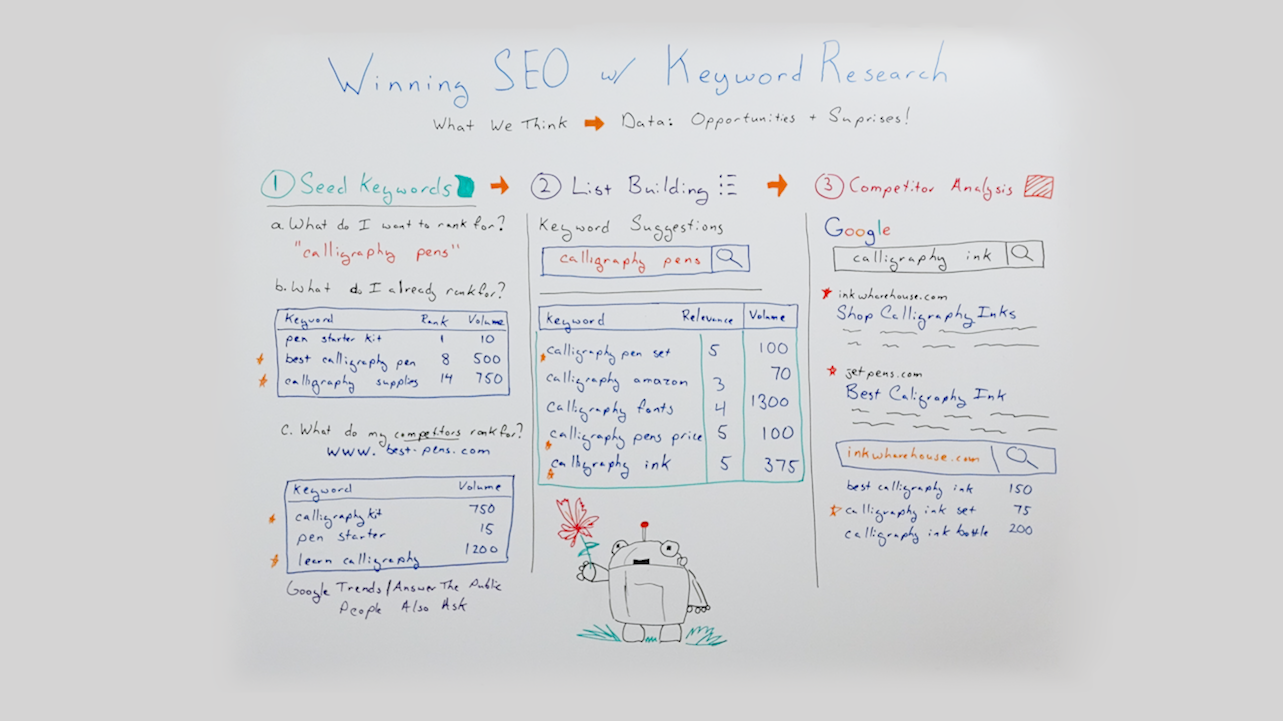
Click on the whiteboard image above to open a high-resolution version in a new tab!
Video Transcription
Howdy, Moz fans. Welcome to a very special edition of Whiteboard Friday talking about keyword research today. Now keyword research, you know how important it is, and it forms the basis of all successful SEO. People who are good at keyword research and having a good research strategy, that often makes the difference between winning and having an SEO campaign that just goes nowhere.
I love keyword research because we all have an idea of what we think we want to rank for, right, but when you use keyword research, you can use data to find opportunities and surprises that you didn’t even know existed. So I want to dispel a myth about keyword research. A lot of people think it’s about finding the right tool, and you enter the keyword into a tool and you get a list.
Technically, that is keyword research, and that’s a fine starting point. But it’s not so much about the tool. It’s about a process. It’s about a process of creating a strategy for your entire website and finding those winning keywords that you can rank for and getting traffic from that are relevant to your business. So it’s more than just a tool.
It’s a process. There are entire guides and webinars about this. But I think we can simplify it. In the next few minutes, I want to show you the basics of a winning keyword research process that I think you can start to master in just a few minutes and get the fundamentals. In fact, I did write a guide about this. We’ll talk about it at the end of the video. It’s completely available.
But I want to go over the basics so you can start to get an understanding of the process that will help you win with keyword research.
1. Seed keywords
So first of all, a concept that you are probably familiar with is the idea of seed keywords. We call them seeds because they help grow your keyword list and expand it. Seed keywords are more important than people think, and I’ll tell you why you in just a second.
So many tools will give you seed keywords. But I want to dismiss the idea of thinking in terms of tools for just a second. When researching seed keywords, I propose that you think of it in terms of questions, questions that you want to ask yourself.
a. What do I want to rank for?
The first is simply, “What do I want to rank for?” In this hypothetical example, our client sells calligraphy pens.
They’re like, “Cyrus, I want to rank for calligraphy pens.” That’s great. That will be your starting point, your first seed keyword.
b. What do I already rank for?
So a second question you can ask is, “What do I already rank for?” Well, let’s say the client has an existing website. They sell some pens. Maybe they do well, maybe they don’t.

So we want to dig into the data of what is already sending them traffic, and we can do this with a lot of keyword research tools — Moz, Ahrefs, SEMrush. I prefer Moz, 500 million keywords, it’s a great set. But you can use whatever you want. So you want to search keywords by site or keywords by URL. We can enter our client’s site and see that, oh, they rank for “pen starter kit.”
Their rank is number one. It only receives 10 visits a month, so maybe that’s not such a good seed keyword. But “best calligraphy pen,” they rank number 8, 500 visits a month. “Calligraphy supplies,” 14th, 750 visits a month. Those are excellent seed keywords. So we’re going to make note of those and use them a little later in the process.
You can also get this data from Google Search Console, rank and volume. Wherever you get it from, these are what you want to search for great keywords that you already rank for, but maybe not number one, with good search volume.
c. What do my competitors rank for?
Finally, let’s say you don’t have an existing website, or you’re starting a new project from scratch.

You don’t have a lot of existing data. You want to ask, “What do my competitors rank for or the top ranking sites?” So I might Google “calligraphy pens” and see who ranks number one. Pop it into Keyword Explorer and see all their ranking keywords here and start to find the good seed keywords. So I can see that they rank for “calligraphy kit” — that sounds pretty relevant — 750 visits a month.
“Pen starter,” not so much. I’d probably throw that one out. “Learn calligraphy,” that’s a great seed keyword. I’m going to make note of that, 1,200 visits a month. You can get seed keywords from literally any keyword tool. Some of our favorites, beyond Keyword Explorer:
Anywhere you want to get your seed keywords, that’s where you form the basis of your list.
2. List building
So next we’re going to start building our list. Seed keywords move into list building. So this is where we want to use a robust keyword research tool, such as Moz, Ahrefs, or whatever you want. We’re entering our seed keywords “calligraphy pens.”

We’re going to get a list of keywords, sorted by relevance and volume. Now there are many metrics in keyword research, such as keyword difficulty, click-through rate, importance, things like that. For right now, we only want to be concerned with two metrics — relevance and volume.

You can concern yourself with the other metrics a little later when we’re sorting and filtering. But right now, we want to find more seed keywords. That’s the key difference here in this process. We’re not just finding related keywords. We’re finding more seed keywords. We’re reiterating. So “calligraphy pen set,” highly relevant.
Five means highly relevant. Volume of 100. All right, we’re going to mark that. That becomes a new seed. “Calligraphy Amazon,” okay, that only has a three relevance score. Unless you’re Amazon, that’s probably not the most relevant keyword. We’re going to cross it off the list.
“Calligraphy fonts.” “Calligraphy pens price,” well, that’s great. “Calligraphy ink,” great with high volume. So what we have done now is we have collected more seeds, and we’re going to throw those seeds back in and discover even more related keywords, more seeds. In other words, we’re going to start building out our list.
That’s the process. Not just get a list of related keywords, but you’re finding more seeds. When you find more seeds, continually do this, these become new pages of your site or a new entire content section. So we could have a section on calligraphy ink. We could have a page on price. We’re going to group these in our spreadsheets together, and every time we find a new seed, it can become a new topic, a new page, a new idea.
The idea is you want to find as many seeds as possible.
3. Competitor analysis
So when we get these seeds, we’re going to reinsert them back, but we’re also going to do one final step that a lot of people forget or just don’t realize, and that is the competitive analysis. The keyword tool is going to find a lot. Moz Keyword Explorer does a particularly excellent, excellent job of this.
But if you’re not using Keyword Explorer, one thing I like to do is I’ll take my seed keyword, “calligraphy ink,” and I’ll put it into Google and I’ll see who’s ranking in the top 1, 2, 3, 4, or 5 positions. I’ll look specifically for sites that specialize in this. I might throw out Amazon or things like that.

But Ink Warehouse, Shop Calligraphy Inks, I’ll take this page and I’ll put it in Keyword Explorer, keywords by site or URL, and I’ll get all the other keywords that this page or site ranks for, because they’ve undoubtedly tried a lot of content. They know what works, what doesn’t work.
I’ll find new seeds that way. So I can see that Ink Warehouse ranks for “best calligraphy ink,” and that’s a good one. “Calligraphy ink set,” great new seed keyword. “Calligraphy ink bottle,” another great seed keyword. So then, we have new seeds, new pages, new topics. We can take these and start the process again, and we do this over and over and over again until we have a complete set of keywords for every page, every conceivable ranking position, and we can start to build a strategy out from that.
After this, we can start to sort and filter by keyword volume and difficulty and things like that. But that’s a process for another time. So I’ve documented this strategy and so much more in a brand-new keyword research guide, “The Master Guide to Keyword Research.” We just released it. It’s available free. It covers this topic in depth, and we try to make these concepts as easy as possible to help you win SEO. We’re going to link to it below. You can download it and let me know what you think.
So I hope you learned something today. If you liked this video, please share it with anybody that you can. It would be a great favor to me. Okay. Until next time, thanks, everybody.
Best of luck with your SEO.
Video transcription by Speechpad.com
Sign up for The Moz Top 10, a semimonthly mailer updating you on the top ten hottest pieces of SEO news, tips, and rad links uncovered by the Moz team. Think of it as your exclusive digest of stuff you don’t have time to hunt down but want to read!
Google Local Panel Can Show COVID Testing Center Details
Google can now show if a specific location, pharmacy, etc, is a COVID-19 testing center and what requirements there are to be tested. Mike Blumenthal shared a screen shot of a Walmart store that has this testing set up and that in this one, you do need…
New Google My Business COVID-19 Responder Policy For Hotels
Google has added a new feature to Google My Business for hotels. This is a new feature lets hotels add if they offer free or discounted rooms for COVID-19 responders. Many hotels are being used to house COVID-19 responders so these responders do not p…
May 2020 Google Webmaster Report
The past thirty-days in the Google organic universe was pretty busy, not just with COVID-19 changes to Google search but well beyond that. We had the May 2020 core update released just a few days ago (it was big), there were unconfirmed updates as wel…
Data Studio Template for Monitoring Cross-Channel Regional Trends
This post was written by Chanton Phan & Claire Dabney
In the past ~two months since the national stay-at-home order was declared, we’ve seen businesses scramble to adapt to rapidly changing customer demands and behavior in the ‘new normal’. But if businesses are not fueling their evolution with their own data, these efforts are very much a best-guess.…
The post Data Studio Template for Monitoring Cross-Channel Regional Trends appeared first on Seer Interactive.
Starting a Local SEO Strategy in 7 Steps
How To Get Started With a Local SEO Strategy
In order to make sure you lay the foundation for any successful Local SEO strategy, it’s important to remember three things:
- Proper tracking
- NAP consistency
- Get the right tools
Using Proper Tracking for all Local Tactics
When we say tracking, we mean making sure that anything that can be tracked, IS tracked.…
The post Starting a Local SEO Strategy in 7 Steps appeared first on Seer Interactive.
6 Client Retention Red Flags All Agencies Should Know
In today’s world of digital marketing, our clients have endless choices when it comes to their marketing agency. Client retention is one of the most important aspects of running a successful digital marketing agency. It’s our job to not only deliver results to our clients but to become a trusted consultant and advisor for their future marketing efforts.…
The post 6 Client Retention Red Flags All Agencies Should Know appeared first on Seer Interactive.
Google’s got a new Shopping ad test — and it’s a weird one
A Shopping ad is accompanied by a clickable text unit.
Please visit Search Engine Land for the full article.
Why we love WordPress: User-friendliness
At Yoast we love WordPress for multiple reasons. That’s why we decided to make a series of articles about the reasons we love WordPress, starting with an important one: user-friendliness. I’ve tried my share of closed and open-source content management systems. From simple text file based systems 20 years ago to in-house developed closed source […]
The post Why we love WordPress: User-friendliness appeared first on Yoast.
For better SEO, don’t put all your eggs in the SEO basket
Your target audiences don’t limit themselves to one channel, so neither should your business.
Please visit Search Engine Land for the full article.
Google’s May 2020 core update was big and broad, search data tools show
This update was an “absolute monster” said Mordy Oberstein from RankRanger.
Please visit Search Engine Land for the full article.
Wings Up Or Down – A Guide To The Best Landing Page Builders
If you wan your website to succeed, you need strong landing pages. Milosz Krasinski takes a look at some of the top landing page builders available right now.
Post from Milosz Krasinski