How to increase online sales in three easy steps through PPC ads
Inna Yatsyna guides you through the most common errors in contextual advertising with practical recommendations on setting up effective PPC ads.
The post How to increase online sales in three easy steps through PPC ads appeared first on Search Engine Watch.
What are enterprise workflow and project management tools and how do they help marketers?
Accountability and transparency are two of the benefits these solutions offer.
Please visit Search Engine Land for the full article.
We Analyzed 331K Display Placements and Found 165K to Negate
With the economic downturn brought on by business shutdowns and social distancing efforts — marketing budgets are one of the first places companies are cutting in order to stay afloat.
There are plenty of opportunities to make your marketing budgets more efficient by cutting out areas of hidden wasted spend.…
The post We Analyzed 331K Display Placements and Found 165K to Negate appeared first on Seer Interactive.
Many marketers unlikely to attend in-person conferences until COVID-19 vaccine
Overall, respondents said there was just a 4-out-of-10 chance they would attend a conference through the rest of the year.
Please visit Search Engine Land for the full article.
Don’t try to reinvent the SEO wheel, says Google’s Martin Splitt
Splitt addresses the most common indexing and JavaScript mistakes, why he doesn’t take ranking questions and shares why Google’s communications aren’t always as proactive as we’d like.
Please visit Search Engine Land for the full article.
This crisis just tore up your marketing strategy. Where do data-driven marketers go from here?
As a result of the current crisis, not only have our lives changed almost beyond recognition, but so too have the business norms we’ve become accustomed to. Our carefully crafted dashboards have become red walls of negativity and workflows based on even well-tested hypotheses are no longer bearing the fruit they once did. Most businesses […]
The post This crisis just tore up your marketing strategy. Where do data-driven marketers go from here? appeared first on Builtvisible.
This crisis just tore up your marketing strategy. Where do data-driven marketers go from here?
Defining the strategy Probably the biggest challenge with building a strategy in a crisis is understanding what you’re solving for – your customer’s new needs – especially when the situation is as unparalleled as this one. But there is a wealth of information at our disposal, which often doesn’t get as much love as it […]
The post This crisis just tore up your marketing strategy. Where do data-driven marketers go from here? appeared first on Builtvisible.
The time for a website migration is now
Each migration type has its level of risk but with proper planning, it is manageable and will set your site up for future growth.
Please visit Search Engine Land for the full article.
Google tests ‘Curbside Pickup’ badge for local Shopping ads
Local Inventory Ads gain prominence with “In store” mobile experience and “Curbside pickup” option.
Please visit Search Engine Land for the full article.
The return of retail stores: If you reopen will they come?
Surveys say consumers will be cautious, but foot traffic from Georgia suggests the novelty of offline shopping may lure some people back into stores.
Please visit Search Engine Land for the full article.
Video: Limor Barenholtz on how SEO has changed over the years
Coder, hacker, web site tinker who loves SEO and Google algorithms.
Please visit Search Engine Land for the full article.
Managing Algorithmic Volatility
Upon the recently announced Google update I’ve seen some people Tweet things like
- if you are afraid of algorithm updates, you must be a crappy SEO
- if you are technically perfect in your SEO, updates will only help you
I read those sorts of lines and cringe.
Here’s why…
Fragility
Different businesses, business models, and business structures have varying degrees of fragility.
If your business is almost entirely based on serving clients then no matter what you do there is going to be a diverse range of outcomes for clients on any major update.
Let’s say 40% of your clients are utterly unaffected by an update & of those who saw any noticeable impact there was a 2:1 ratio in your favor, with twice as many clients improving as falling.
Is that a good update? Does that work well for you?
If you do nothing other than client services as your entire business model, then that update will likely suck for you even though the net client impact was positive.
Why?
Many businesses are hurting after the Covid-19 crisis. Entire categories have been gutted & many people are looking for any reason possible to pull back on budget. Some of the clients who won big on the update might end up cutting their SEO budget figuring they had already won big and that problem was already sorted.
Some of the clients that fell hard are also likely to either cut their budget or call endlessly asking for updates and stressing the hell out of your team.
Capacity Utilization Impacts Profit Margins
Your capacity utilization depends on how high you can keep your steady state load relative to what your load looks like at peaks. When there are big updates management or founders can decide to work double shifts and do other things to temporarily deal with increased loads at the peak, but that can still be stressful as hell & eat away at your mental and physical health as sleep and exercise are curtailed while diet gets worse. The stress can be immense if clients want results almost immediately & the next big algorithm update which reflects your current work may not happen for another quarter year.
How many clients want to be told that their investments went sour but the problem was they needed to double their investment while cashflow is tight and wait a season or two while holding on to hope?
Category-based Fragility
Businesses which appear to be diversified often are not.
- Everything in hospitality was clipped by Covid-19.
- 40% of small businesses across the United States have stopped making rent payments.
- When restaurants massively close that’s going to hit Yelp’s business hard.
- Auto sales are off sharply.
Likewise there can be other commonalities in sites which get hit during an update. Not only could it include business category, but it could also be business size, promotional strategies, etc.
Sustained profits either come from brand strength, creative differentiation, or systemization. Many prospective clients do not have the budget to build a strong brand nor the willingness to create something that is truly differentiated. That leaves systemization. Systemization can leave footprints which act as statistical outliers that can be easily neutralized.
Sharp changes can happen at any point in time.
For years Google was funding absolute garbage like Mahalo autogenerated spam and eHow with each month being a new record. It is very hard to say “we are doing it wrong” or “we need to change everything” when it works month after month after month.
Then an update happens and poof.
- Was eHow decent back in the first Internet bubble? Sure. But it lost money.
- Was it decent after it got bought out for a song and had the paywall dropped in favor of using the new Google AdSense program? Sure.
- Was it decent the day Demand Media acquired it? Sure.
- Was it decent on the day of the Demand Media IPO? Almost certainly not. But there was a lag between that day and getting penalized.
Panda Trivia
The first Panda update missed eHow because journalists were so outraged by the narrative associated with the pump-n-dump IPO. They feared their jobs going away and being displaced by that low level garbage, particularly as the market cap of Demand Media eclipsed the New York Times.
Journalist coverage of the pump-n-dump IPO added credence to it from an algorithmic perspective. By constantly writing hate about eHow they made eHow look like a popular brand, generating algorithmic signals that carried the site until Google created an extension which allowed journalists and other webmasters to vote against the site they had been voting for through all their outrage coverage.
Algorithms & the Very Visible Hand
And all algorithmic channels like organic search, the Facebook news feed, or Amazon’s product pages go through large shifts across time. If they don’t, they get gamed, repetitive, and lose relevance as consumer tastes change and upstarts like Tiktok emerge.
Consolidation by the Attention Merchants
Frequent product updates, cloning of upstarts, or outright acquisitions are required to maintain control of distribution:
“The startups of the Rebellion benefited tremendously from 2009 to 2012. But from 2013 on, the spoils of smartphone growth went to an entirely different group: the Empire. … A network effect to engage your users, AND preferred distribution channels to grow, AND the best resources to build products? Oh my! It’s no wonder why the Empire has captured so much smartphone value and created a dark time for the Rebellion. … Now startups are fighting for only 5% of the top spots as the Top Free Apps list is dominated by incumbents. Facebook (4 apps), Google (6 apps), and Amazon (4 apps) EACH have as many apps in the Top 100 list as all the new startups combined.”
Apple & Amazon
Emojis are popular, so those features got copied, those apps got blocked & then apps using the official emojis also got blocked from distribution. The same thing happens with products on Amazon.com in terms of getting undercut by a house brand which was funded by using the vendor’s sales data. Re-buy your brand or else.
Before the Facebook IPO some thought buying Zynga shares was a backdoor way to invest into Facebook because gaming was such a large part of the ecosystem. That turned out to be a dumb thesis and horrible trade. At times other things trended including quizzes, videos, live videos, news, self hosted Instant Articles, etc.
Over time the general trend was edge rank of professional publishers fell as a greater share of inventory went to content from friends & advertisers. The metrics associated with the ads often overstated their contribution to sales due to bogus math and selection bias.
Internet-first publishers like CollegeHumor struggled to keep up with the changes & influencers waiting for a Facebook deal had to monetize using third parties:
“I did 1.8 billion views last year,” [Ryan Hamilton] said. “I made no money from Facebook. Not even a dollar.” … “While waiting for Facebook to invite them into a revenue-sharing program, some influencers struck deals with viral publishers such as Diply and LittleThings, which paid the creators to share links on their pages. Those publishers paid top influencers around $500 per link, often with multiple links being posted per day, according to a person who reached such deals.”
YouTube
YouTube had a Panda-like update back in 2012 to favor watch time over raw view counts. They also adjust the ranking algorithms on breaking news topics to favor large & trusted channels over conspiracy theorist content, alternative health advice, hate speech & ridiculous memes like the Tide pod challenge.
All unproven channels need to start somewhat open to gain usage, feedback & marketshare. Once they become real businesses they clamp down. Some of the clamp down can be editorial, forced by regulators, or simply anticompetitive monpolistic abuse.
Kid videos were a huge area on YouTube (perhaps still are) but that area got cleaned up after autogenerated junk videos were covered & the FTC clipped YouTube for delivering targeted ads on channels which primarily catered to children.
Dominant channels can enforce tying & bundling to wipe out competitors:
“Google’s response to the threat from AppNexus was that of a classic monopolist. They announced that YouTube would no longer allow third-party advertising technology. This was a devastating move for AppNexus and other independent ad technology companies. YouTube was (and is) the largest ad-supported video publisher, with more than 50% market share in most major markets. … Over the next few months, Google’s ad technology team went to each of our clients and told them that, regardless of how much they liked working with AppNexus, they would have to also use Google’s ad technology products to continue buying YouTube. This is the definition of bundling, and we had no recourse. Even WPP, our largest customer and largest investors, had no choice but to start using Google’s technology. AppNexus growth slowed, and we were forced to lay off 100 employees in 2016.”
Everyone Else
Every moderately large platform like eBay, Etsy, Zillow, TripAdvisor or the above sorts of companies runs into these sorts of issues with changing distribution & how they charge for distribution.

Building Anti-fragility Into Your Business Model
Growing as fast as you can until the economy craters or an algorithm clips you almost guarantees a hard fall along with an inability to deal with it.
Markets ebb and flow. And that would be true even if the above algorithmic platforms did not make large, sudden shifts.
Build Optionality Into Your Business Model
If your business primarily relies on publishing your own websites or you have a mix of a few clients and your own sites then you have a bit more optionality to your approach in dealing with updates.
Even if you only have one site and your business goes to crap maybe you at least temporarily take on a few more consulting clients or do other gig work to make ends meet.
Focus on What is Working
If you have a number of websites you can pour more resources into whatever sites reacted positively to the update while (at least temporarily) ignoring any site that was burned to a crisp.
Ignore the Dead Projects
The holding cost of many websites is close to zero unless they use proprietary and complex content management systems. Waiting out a penalty until you run out of obvious improvements on your winning sites is not a bad strategy. Plus, if you think the burned site is going to be perpetually burned to a crisp (alternative health anyone?) then you could sell links off it or generate other alternative revenue streams not directly reliant on search rankings.
Build a Cushion
If you have cash savings maybe you guy out and buy some websites or domain names from other people who are scared of the volatility or got clipped for issues you think you could easily fix.
When the tide goes out debt leverage limits your optionality. Savings gives you optionality. Having slack in your schedule also gives you optionality.
The person with a lot of experience & savings would love to see highly volatile search markets because those will wash out some of the competition, curtail investments from existing players, and make other potential competitors more hesitant to enter the market.
Categories:
Managing Algorithimc Volatility
Upon the recently announced Google update I’ve seen some people Tweet things like
- if you are afraid of algorithm updates, you must be a crappy SEO
- if you are technically perfect in your SEO, updates will only help you
I read those sorts of lines and cringe.
Here’s why…
Fragility
Different businesses, business models, and business structures have varying degrees of fragility.
If your business is almost entirely based on serving clients then no matter what you do there is going to be a diverse range of outcomes for clients on any major update.
Let’s say 40% of your clients are utterly unaffected by an update & of those who saw any noticeable impact there was a 2:1 ratio in your favor, with twice as many clients improving as falling.
Is that a good update? Does that work well for you?
If you do nothing other than client services as your entire business model, then that update will likely suck for you even though the net client impact was positive.
Why?
Many businesses are hurting after the Covid-19 crisis. Entire categories have been gutted & many people are looking for any reason possible to pull back on budget. Some of the clients who won big on the update might end up cutting their SEO budget figuring they had already won big and that problem was already sorted.
Some of the clients that fell hard are also likely to either cut their budget or call endlessly asking for updates and stressing the hell out of your team.
Capacity Utilization Impacts Profit Margins
Your capacity utilization depends on how high you can keep your steady state load relative to what your load looks like at peaks. When there are big updates management or founders can decide to work double shifts and do other things to temporarily deal with increased loads at the peak, but that can still be stressful as hell & eat away at your mental and physical health as sleep and exercise are curtailed while diet gets worse. The stress can be immense if clients want results almost immediately & the next big algorithm update which reflects your current work may not happen for another quarter year.
How many clients want to be told that their investments went sour but the problem was they needed to double their investment while cashflow is tight and wait a season or two while holding on to hope?
Category-based Fragility
Businesses which appear to be diversified often are not.
- Everything in hospitality was clipped by Covid-19.
- 40% of small businesses across the United States have stopped making rent payments.
- When restaurants massively close that’s going to hit Yelp’s business hard.
- Auto sales are off sharply.
Likewise there can be other commonalities in sites which get hit during an update. Not only could it include business category, but it could also be business size, promotional strategies, etc.
Sustained profits either come from brand strength, creative differentiation, or systemization. Many prospective clients do not have the budget to build a strong brand nor the willingness to create something that is truly differentiated. That leaves systemization. Systemization can leave footprints which act as statistical outliers that can be easily neutralized.
Sharp changes can happen at any point in time.
For years Google was funding absolute garbage like Mahalo autogenerated spam and eHow with each month being a new record. It is very hard to say “we are doing it wrong” or “we need to change everything” when it works month after month after month.
Then an update happens and poof.
- Was eHow decent back in the first Internet bubble? Sure. But it lost money.
- Was it decent after it got bought out for a song and had the paywall dropped in favor of using the new Google AdSense program? Sure.
- Was it decent the day Demand Media acquired it? Sure.
- Was it decent on the day of the Demand Media IPO? Almost certainly not. But there was a lag between that day and getting penalized.
Panda Trivia
The first Panda update missed eHow because journalists were so outraged by the narrative associated with the pump-n-dump IPO. They feared their jobs going away and being displaced by that low level garbage, particularly as the market cap of Demand Media eclipsed the New York Times.
Journalist coverage of the pump-n-dump IPO added credence to it from an algorithmic perspective. By constantly writing hate about eHow they made eHow look like a popular brand, generating algorithmic signals that carried the site until Google created an extension which allowed journalists and other webmasters to vote against the site they had been voting for through all their outrage coverage.
Algorithms & the Very Visible Hand
And all algorithmic channels like organic search, the Facebook news feed, or Amazon’s product pages go through large shifts across time. If they don’t, they get gamed, repetitive, and lose relevance as consumer tastes change and upstarts like Tiktok emerge.
Consolidation by the Attention Merchants
Frequent product updates, cloning of upstarts, or outright acquisitions are required to maintain control of distribution:
“The startups of the Rebellion benefited tremendously from 2009 to 2012. But from 2013 on, the spoils of smartphone growth went to an entirely different group: the Empire. … A network effect to engage your users, AND preferred distribution channels to grow, AND the best resources to build products? Oh my! It’s no wonder why the Empire has captured so much smartphone value and created a dark time for the Rebellion. … Now startups are fighting for only 5% of the top spots as the Top Free Apps list is dominated by incumbents. Facebook (4 apps), Google (6 apps), and Amazon (4 apps) EACH have as many apps in the Top 100 list as all the new startups combined.”
Apple & Amazon
Emojis are popular, so those features got copied, those apps got blocked & then apps using the official emojis also got blocked from distribution. The same thing happens with products on Amazon.com in terms of getting undercut by a house brand which was funded by using the vendor’s sales data. Re-buy your brand or else.
Before the Facebook IPO some thought buying Zynga shares was a backdoor way to invest into Facebook because gaming was such a large part of the ecosystem. That turned out to be a dumb thesis and horrible trade. At times other things trended including quizzes, videos, live videos, news, self hosted Instant Articles, etc.
Over time the general trend was edge rank of professional publishers fell as a greater share of inventory went to content from friends & advertisers. The metrics associated with the ads often overstated their contribution to sales due to bogus math and selection bias.
Internet-first publishers like CollegeHumor struggled to keep up with the changes & influencers waiting for a Facebook deal had to monetize using third parties:
“I did 1.8 billion views last year,” [Ryan Hamilton] said. “I made no money from Facebook. Not even a dollar.” … “While waiting for Facebook to invite them into a revenue-sharing program, some influencers struck deals with viral publishers such as Diply and LittleThings, which paid the creators to share links on their pages. Those publishers paid top influencers around $500 per link, often with multiple links being posted per day, according to a person who reached such deals.”
YouTube
YouTube had a Panda-like update back in 2012 to favor watch time over raw view counts. They also adjust the ranking algorithms on breaking news topics to favor large & trusted channels over conspiracy theorist content, alternative health advice, hate speech & ridiculous memes like the Tide pod challenge.
All unproven channels need to start somewhat open to gain usage, feedback & marketshare. Once they become real businesses they clamp down. Some of the clamp down can be editorial, forced by regulators, or simply anticompetitive monpolistic abuse.
Kid videos were a huge area on YouTube (perhaps still are) but that area got cleaned up after autogenerated junk videos were covered & the FTC clipped YouTube for delivering targeted ads on channels which primarily catered to children.
Dominant channels can enforce tying & bundling to wipe out competitors:
“Google’s response to the threat from AppNexus was that of a classic monopolist. They announced that YouTube would no longer allow third-party advertising technology. This was a devastating move for AppNexus and other independent ad technology companies. YouTube was (and is) the largest ad-supported video publisher, with more than 50% market share in most major markets. … Over the next few months, Google’s ad technology team went to each of our clients and told them that, regardless of how much they liked working with AppNexus, they would have to also use Google’s ad technology products to continue buying YouTube. This is the definition of bundling, and we had no recourse. Even WPP, our largest customer and largest investors, had no choice but to start using Google’s technology. AppNexus growth slowed, and we were forced to lay off 100 employees in 2016.”
Everyone Else
Every moderately large platform like eBay, Etsy, Zillow, TripAdvisor or the above sorts of companies runs into these sorts of issues with changing distribution & how they charge for distribution.
Building Anti-fragility Into Your Business Model
Growing as fast as you can until the economy craters or an algorithm clips you almost guarantees a hard fall along with an inability to deal with it.
Markets ebb and flow. And that would be true even if the above algorithmic platforms did not make large, sudden shifts.
Build Optionality Into Your Business Model
If your business primarily relies on publishing your own websites or you have a mix of a few clients and your own sites then you have a bit more optionality to your approach in dealing with updates.
Even if you only have one site and your business goes to crap maybe you at least temporarily take on a few more consulting clients or do other gig work to make ends meet.
Focus on What is Working
If you have a number of websites you can pour more resources into whatever sites reacted positively to the update while (at least temporarily) ignoring any site that was burned to a crisp.
Ignore the Dead Projects
The holding cost of many websites is close to zero unless they use proprietary and complex content management systems. Waiting out a penalty until you run out of obvious improvements on your winning sites is not a bad strategy. Plus, if you think the burned site is going to be perpetually burned to a crisp (alternative health anyone?) then you could sell links off it or generate other alternative revenue streams not directly reliant on search rankings.
Build a Cushion
If you have cash savings maybe you guy out and buy some websites or domain names from other people who are scared of the volatility or got clipped for issues you think you could easily fix.
When the tide goes out debt leverage limits your optionality. Savings gives you optionality. Having slack in your schedule also gives you optionality.
The person with a lot of experience & savings would love to see highly volatile search markets because those will wash out some of the competition, curtail investments from existing players, and make other potential competitors more hesitant to enter the market.
Categories:
How to Stay Creative With an SEO-Driven Content Strategy
Posted by Caroline-Forsey
When I first joined HubSpot’s blogging team in January 2018, I loved our writing process. Once a month, we all met in a conference room with a list of ideas on Google Docs which were pitched one-by-one (intricate, I know).
The process was extremely creative, iterative, and collaborative. Of course, it was also often a matter of guess-and-check. Plus, brainstorming can be a bit of a selfish process. The ideas I pitched in those meetings, I pitched in part because I wanted to write them and because I was interested in them as a reader. I could only hope our audience would be interested as well.
While we developed a pulse for understanding what our readers liked from reviewing top viewed posts from the past, our process didn’t enable us to develop content that matched what our potential readers wanted from us.
So, just a few months into 2018, our team pivoted and created a brand new SEO-driven content strategy to address our inability to move forward. Take a look at the organic growth we’ve seen as a result of that strategy over the past two years:

How did we do it? To start, the blogging team partnered with the SEO team. The SEO team now delivers a fresh Search Insights Report (what we’ve come to affectionately call the “SIR”) to us every quarter, which are packed with blog topics vetted for search potential. We diligently move down the list, assigning individual blog topics to be written or updated by writers on the team. From the graph above, you can see the almost immediate growth we expereinced as a result of this new strategy. Within two years, we more than doubled the keywords for which we rank on page one.
As Editor of HubSpot’s Marketing Blog, this left me with a bit of a void. I was thrilled to see the results of the SIRs and recognized how they helped us reach new audiences and rekindle our organic traffic, but, from a personal perspective, I missed the creativity that came with pitching big-risk ideas and watching them pay off. (Believe it or not, articles like “What Is Semi-Structured Data?” wasn’t exactly what I dreamt about publishing when obtaining my English degree.)
However, I’ve learned over the past year that there are ways to remain creative even within a grander, primarily SEO-driven strategy. Here, let’s dive into six tips to ensure you don’t have to sacrifice your own creative freedom for the sake of organic growth.
1. Enlist the help of experts to spark creativity while ensuring posts are still keyword-driven.
A few months ago, I tackled the topic of first versus third party APIs. While I am confident in writing about our product line, “Force quit” is about the extent of my software knowledge (option+command+esc, for those wondering), so I dreaded writing the post. It was both daunting and not particularly inspiring to me as a writer.
Of course, I could’ve written this post the way I’ve written about plenty of other dry topics — by sludging through it, chugging copious amounts of coffee, and listening to Spotify to make it a little more “fun”.
However, when I began writing the post, I wasn’t impressed with my work. Since I didn’t fully grasp the concept, it was surface-level and ambiguous. If a marketer stumbled across it, they wouldn’t learn much.
To solve for this issue, I reached out to a few IT specialists at HubSpot and ended up speaking to two developer support specialists. I even met with one of them via Zoom to further discuss the intricacies of APIs, and recorded the meeting to transcribe later on.
Suddenly, I felt like an investigative reporter. I collected quotes from experts in the field, drafted up a new post that made sense to both myself and the developer support specialists, and published it. I was incredibly proud of the piece because I felt I’d worked as a liaison between the developer world and the marketing world, making the whole concept of APIs a little clearer to my team while ensuring it remained accurate and tactical.
If you’re feeling frustrated by a topic you don’t feel comfortable writing about, don’t hesitate to reach out to experts — even within your own company. Their passion for the subject will fuel your desire to write the piece from a more human angle. Remember, keyword-driven content still leaves plenty of room to angle the piece in a number of interesting directions, as long as the insight you’re providing aligns with the intent of the keyword you’re targeting.
2. Interview leaders in various industries and tell their stories.
Over the past year, I’ve spoken to happiness researcher and speaker Shawn Achor on how happiness leads to success, Harvard professor Amy Edmondson on psychological safety in the workplace, and leadership consultant Simon Hazeldine on using performance psychology to get ahead in the workplace, among many others.

These posts, which enabled me to synthesize complex psychological issues and translate them into tactical strategies for marketers, allowed me to exercise my creative muscle. I interviewed experts via email or on the phone, and used their responses to craft meaningful, coherent narratives. Ultimately, I never felt more “in the flow” than I did when writing these posts.
Your industry undoubtedly has leaders that interest you. If you’re a marketer in the catering or hospitality industries, consider speaking to top chefs in the area. Alternatively, if you’re a marketer for an e-commerce website, try reaching out to e-commerce consultants to get quotes about the future of the industry.
It’s not impossible to align your own interests with business impact, even if those interests are outside the scope of traditional marketing. As someone who’s personally interested in psychology, for instance, I was able to find the intersection between psychology and workplace performance, which helps our readers grow in their own roles.
Including feedback from experts can also give you a competitive advantage in the SERPs. For instance, we published “HubSpot Marketers Give 6 Tips for Fighting Burnout”, on January 20, 2020, and within one month, it already had over 5,000 views. This piece, over time, will likely perform better than a more generic “how to fight burnout” piece without the expert angle.
Ultimately, it’s important to consider who you’re interested in speaking with and how that expert’s experience might align with your audience’s interests, and brainstorm ideas from there.
3. Find the human connection.
As marketers, we’re often tasked with writing about less-than-thrilling topics, particularly if these topics are part of a keyword-driven strategy. For example, take a quick glimpse at some of the pieces we’ve seen on our SIR in the past:

These titles are helpful for our readers, but presenting the information in a creative way becomes difficult. I often tell new writers on the team that you can find an interesting human angle to any topic, no matter how boring it may seem, which makes writing about the topic more exciting and offers more ways for readers to connect with the piece.
The easiest way to find the human angle is to consider the reader’s point of view when searching a topic on Google. Start by asking yourself, “why would I ever search for this topic?”
Searches don’t happen in silos. Nowadays, Google is increasingly trying to continue a “searcher’s journey” through People Also Ask boxes, People Also Search For panels, and Related Search links at the bottom of most SERPs. These features enable searchers to rethink their search and find similar, relevant answers to other questions they might have.
Ultimately, anyone searching for one keyword is searching for that keyword as part of a larger marketing and business strategy. As a content creator, it’s critical you find the bigger picture element and use these new SERP features to tell more creative, holistic stories around the topic at hand.
For instance, recently I wrote a post on how to embed videos in emails. The body of the post itself, I knew, allowed for little creativity — it was essentially a brief step-by-step guide to embedding video. However, I could still find space for creativity in my introduction, and I knew that meant developing empathy for my reader.
I started by imagining the motivation behind any marketer searching “how to embed video in email”. They are likely someone who’s struggling to increase CTR or email subscriptions, so I introduced the topic with a brief, big-picture overview on why email is important for a business’s bottom line (in case you wanted to know, it’s because 87% of businesses use video in their marketing tactics).
Then, I empathize with the reader, acknowledging that sprucing up your emails isn’t always easy, and neither is embedding videos — particularly since major email clients don’t support video embeds.
Suddenly, a topic I’d initially found boring became exciting to me because I could sense the urgency and real-world impact that publishing the piece and answering the reader’s query would have. In essence, what they’re really asking is “How can I continue creating engaging content for my audience?”
That’s a human angle to which I think we can all relate.
4. Use multimedia to freshen up old content.
If you’re struggling with a particularly dry topic, you might evoke creativity by adding multimedia elements like podcasts, YouTube videos, images, or graphs — all of which open up new traffic opportunities since you can generate image traffic through the SERPs as well.
These designs can help you stay engaged when writing the piece, and can also help your post rank on Google, since search engines prefer multimedia components such as images or video.
For instance, we embedded a video in “How to Create An Incredibly Well-Written Executive Summary [+ Example]”. Readers have the option of reading my post, but alternatively, they can watch the discussion take place on-screen.

Of course, multimedia depends on your budget. We aren’t able to add a video to every post we produce. However, there are plenty of simpler forms of multimedia that are free, such as embedded images and graphs.
Additionally, if you’re interested in other aspects of marketing besides writing, this is a good chance to expand your professional portfolio and learn a new skill as well.
5. Frame your content from a unique angle that differentiates it from other search results.
It’s important to note: not all posts need to agree with what’s already on the SERPs for you to rank.
For instance, my colleague Lestraundra wrote “10 Reasons Why You Don’t Need a CRM“. This article currently ranks on page one for the search query “you don’t need a CRM” … but the article actually explains why you do need a CRM, in a playfully sarcastic way.
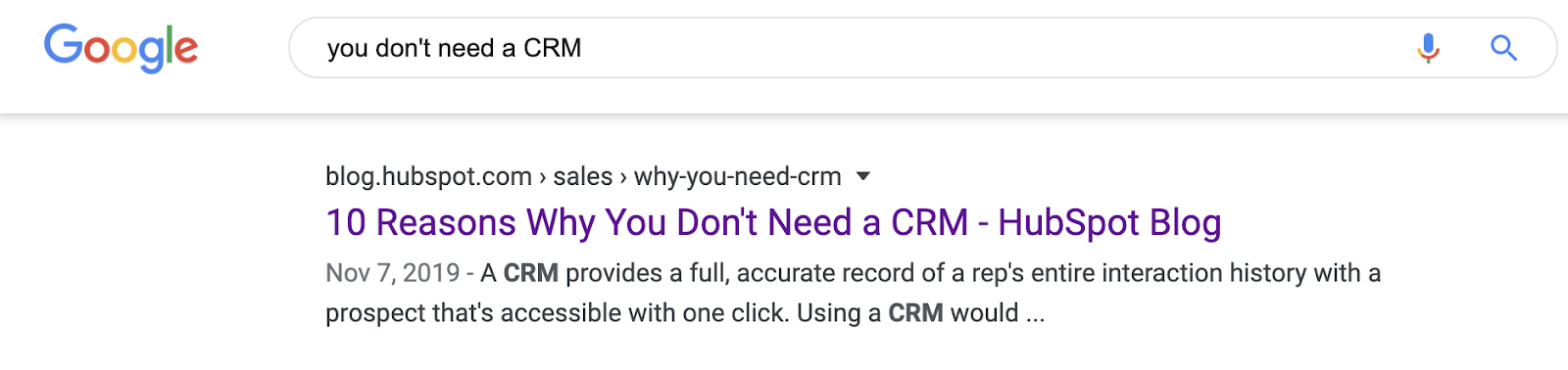
We managed to rank well while also giving readers something they weren’t expecting. You might consider similar provocative arguments you can make, as the uniqueness (and sometimes controversy) of your writing will enable you to rise up the ranks on the SERPs while providing fresh, interesting content to your audience.
6. Engage with your readers in real life whenever possible.
On one particularly uninspiring day, I set up a 30-minute chat with a customer to learn more about her personal marketing challenges.
As we spoke, I realized how out-of-touch I’d become with some of our readers’ primary struggles. For instance, she was a team of one, which meant while she understood the importance of blogging, she didn’t always have time to develop an in-depth strategy since she was juggling content creation for social media, email marketing, and PR for her small business.
When I got back to my desk, I had no problem writing my assigned post about free social media analytics tools, because I understood the real-world importance of this post for that reader’s daily life. Ultimately, she didn’t have time to research the pros and cons of various tools, and she didn’t have a budget for anything fancy. The inspiration and creativity I felt that day derived from my in-person interaction with my reader.
Of course, it’s not always possible to set up a call with a customer, but there are plenty of other options for engaging with readers. For instance, you might consider creating a poll for your social media audience, engaging with readers in a Twitter chat, or sending a survey to your readers in an email newsletter to learn more about what they want from your brand.
Conclusion
Ultimately, it can be difficult to stay creative when your department is primarily focused on using technical SEO to achieve major goals. And, of course, you’d never want to entirely forgo SEO for the sake of creativity, since that prevents you from reaching a larger audience and ensuring your content is useful and actionable for your readers.
Nonetheless, if there’s anything I’ve learned over the past two years as a result of our new strategy, it’s that analytics and creativity can, indeed, work hand-in-hand. Ideally, with these six tips, you’ll be able to inspire some creativity in your daily process. Feel free to comment below with your own thoughts — I’d love to hear them!
Sign up for The Moz Top 10, a semimonthly mailer updating you on the top ten hottest pieces of SEO news, tips, and rad links uncovered by the Moz team. Think of it as your exclusive digest of stuff you don’t have time to hunt down but want to read!
Replay: Google’s Martin Splitt gets technical on Live with Search Engine Land
If you are having indexing issues with your HTML or JavaScript-based website, then you won’t want to miss this chat.
Please visit Search Engine Land for the full article.
Google: International Targeting Won’t Affect Other Regions
Google Search Console, in the old version, has a feature for international targeting. It lets you communicate to Google that your site is more relevant in a specific region. Gary Illyes from Google said on Reddit that this is a strong hint that “may…
Should Google Remove The URL Parameters Tool From Search Console?
Gary Illyes from Google hinted he might consider deprecating the URL parameters tools in Google Search Console. He said on Twitter “maybe we should deprecate that cannon” when Glenn Gabe asked him “you said to be careful with the url params tool in GS…
Google AdSense Ad Balance Tool Going Away On May 20th
Google announced it is retiring the Ad Balance slider tool from Google AdSense. This tool that launched in January 2017 is going away on May 20, 2020. Google said “based on feedback from our publishers, we’ve decided to retire the ad balance feature. …
Google Product Listings Ad Mixed With Organic Listing?
SEMRush shared a screen shot of a Google Product Listing Ads unit that has with it an organic snippet listing right below it. It is unusual, might be a bug, might be some sort of Google user interface test. I just wanted to share this with you all.
…
Google: Core Updates & Search Console Reporting Lags Are Unrelated
There has been some speculation that whenever there is a Google core update that Search Console’s reporting and data begin to lag and slow. I have not seen too many theories floating around like this but even so, John Mueller of Google said that any d…