Make the licensing information for your images visible on Google Images
For the last few years, we’ve collaborated with the image licensing industry to raise awareness of licensing requirements for content found through Google Images. In 2018, we began supporting IPTC Image Rights metadata; in February 2020 we announced a new metadata framework through Schema.org and IPTC for licensable images. Since then, we’ve seen widespread adoption of this new standard by websites, image platforms and agencies of all sizes. Today, we’re launching new features on Google Images which will highlight licensing information for images, and make it easier for users to understand how to use images responsibly.
What is it?
Images that include licensing information will be labeled with a “Licensable” badge on the results page. When a user opens the image viewer (the window that appears when they select an image), we will show a link to the license details and/or terms page provided by the content owner or licensor. If available, we’ll also show an additional link that directs users to a page from the content owner or licensor where the user can acquire the image.

Left: Images result page with the Licensable badge
Right: Images Viewer showing licensable image, with the new fields Get the image on and License details
We’re also making it easier to find images with licensing metadata. We’ve enhanced the usage rights drop-down menu in Google Images to support filtering for Creative Commons licenses, as well as those that have commercial or other licenses.

Updated Usage Rights filter
What are the benefits to image licensors?
- As noted earlier, if licensing metadata is provided from the image licensor, then the licensable badge, license details page and image acquisition page will be surfaced in the images viewer, making it easier for users to purchase or license the image from the licensor
- If an image resides on a page that isn’t set up to let a user acquire it (e.g. a portfolio, article, or gallery page), image licensors can link to a new URL from Google Images which takes the user directly to the page where they can purchase or license the image
- For image licensors, the metadata can also be applied by publishers who have purchased your images, enabling your licensing details to be visible with your images when they’re used by your customers. (This requires your customers to not remove or alter the IPTC metadata that you provide them.)
We believe this is a step towards helping people better understand the nature of the content they’re looking at on Google Images and how they can use it responsibly.
How do I participate?
To learn more about these features, how you can implement them and troubleshoot issues, visit the Google developer help page and our common FAQs page.
To provide feedback on these features, please use the feedback tools available on the developer page for the licensable images features, the Google Webmaster Forum, and stay tuned for upcoming virtual office hours where we will review common questions.
What do image licensors say about these features?
“A collaboration between Google and CEPIC, which started some four years ago, has ensured that authors and rights holders are identified on Google Images. Now, the last link of the chain, determining which images are licensable, has been implemented thanks to our fruitful collaboration with Google. We are thrilled at the window of opportunities that are opening up for photography agencies and the wider image industry due to this collaboration. Thanks, Google.”
– Alfonso Gutierrez, President of CEPIC
“As a result of a multi-year collaboration between IPTC and Google, when an image containing embedded IPTC Photo Metadata is re-used on a popular website, Google Images will now direct an interested user back to the supplier of the image,” said Michael Steidl, Lead of the IPTC Photo Metadata Working Group. “This is a huge benefit for image suppliers and an incentive to add IPTC metadata to image files.”
– Michael Steidl, Lead of the IPTC Photo Metadata Working Group
“Google’s licensable image features are a great step forward in making it easier for users to quickly identify and license visual content. Google has worked closely with DMLA and its members during the features’ development, sharing tools and details while simultaneously gathering feedback and addressing our members’ questions or concerns. We look forward to continuing this collaboration as the features deploy globally.”
– Leslie Hughes, President of the Digital Media Licensing Association
“We live in a dynamic and changing media landscape where imagery is an integral component of online storytelling and communication for more and more people. This means that it is crucial that people understand the importance of licensing their images from proper sources for their own protection, and to ensure the investment required to create these images continues. We are hopeful Google’s approach will bring more visibility to the intrinsic value of licensed images and the rights required to use them.”
– Ken Mainardis, SVP, Content, Getty Images & iStock by Getty Images
“With Google’s licensable images features, users can now find high-quality images on Google Images and more easily navigate to purchase or license images in accordance with the image copyright. This is a significant milestone for the professional photography industry, in that it’s now easier for users to identify images that they can acquire safely and responsibly. EyeEm was founded on the idea that technology will revolutionise the way companies find and buy images. Hence, we were thrilled to participate in Google’s licensable images project from the very beginning, and are now more than excited to see these features being released.”
– Ramzi Rizk, Co-founder, EyeEm
“As the world’s largest network of professional providers and users of digital images, we at picturemaxx welcome Google’s licensable images features. For our customers as creators and rights managers, not only is the visibility in a search engine very important, but also the display of copyright and licensing information. To take advantage of this feature, picturemaxx will be making it possible for customers to provide their images for Google Images in the near future. The developments are already under way.”
– Marcin Czyzewski, CTO, picturemaxx
“Google has consulted and collaborated closely with Alamy and other key figures in the photo industry on this project. Licensable tags will reduce confusion for consumers and help inform the wider public of the value of high quality creative and editorial images.”
– James Hall, Product Director, Alamy
“Google Images’ new features help both image creators and image consumers by bringing visibility to how creators’ content can be licensed properly. We are pleased to have worked closely with Google on this feature, by advocating for protections that result in fair compensation for our global community of over 1 million contributors. In developing this feature, Google has clearly demonstrated its commitment to supporting the content creation ecosystem.
– Paul Brennan, VP of Content Operations, Shutterstock
“Google Images’ new licensable images features will provide expanded options for creative teams to discover unique content. By establishing Google Images as a reliable way to identify licensable content, Google will drive discovery opportunities for all agencies and independent photographers, creating an efficient process to quickly find and acquire the most relevant, licensable content.”
– Andrew Fingerman, CEO of PhotoShelter
Posted by Francois Spies, Product Manager, Google Images


Google: We Do Not Index Links, We Index The Pages Between The Links
Google’s John Mueller clarified how SEOs should think about Google’s index and links on the web. He said on Twitter “we index pages, we don’t index links. Links are between pages.” That means, Google will index a page, that page may have links on it, …
Is Google Down Autocomplete Search Suggestion
If you search for [is Google down], Google will show you an answer, like it does often with other answer based queries, to tell you “no.” I guess if Google is able to give you an answer here, by definition Google is not down.
Google Tests Related Searches With Boxed In Magnifying Glass
Here is yet another Google related search user interface that Google is testing. We’ve seen several so far, so I will list them all below again, but this new one is where Google is just shading in the magnifying glass icon and not the query with it.
…
Google On Word Count As A Ranking Signal
We know Google has said numerous times that word count is not a ranking factor, nor is it indicative of quality. We know Google said short content can rank just fine. But Google has to answer this question often enough. John did that this morning in …
Can Apple Search Compete Against Google Search?
In 2015, Apple first revealed information about AppleBot, its search engine crawler. Then a few months ago, Apple updated its information around web search to list its web ranking factors. Jon Henshaw last week published a very comprehensive blog pos…
Vlog #82: Kevin Lee Of Didit on Digital PR & Why It Rocks For SEO – Part One
This is the first interview I did after New York went on lock due to COVID in March – hence the lack of the haircut. Kevin Lee came to my home to do an outside vlog interview, socially distant, to discuss SEO and SEM…
Google officially launches ‘licensable’ image label and filter in Image search
The badge is powered by structured data and part of an effort to help photographers get paid for their images.
Please visit Search Engine Land for the full article.
Video: Search veteran Kevin Lee on why digital PR is key for SEO
Some call it barnacle SEO and it differs from online reputation management.
Please visit Search Engine Land for the full article.
crawled but not indexed – why?
google is not indexing some of my urls
crawled but not indexed – why?
google is not indexing some of my urls
Title Tags SEO: When to Include Your Brand and/or Boilerplate
Posted by Cyrus-Shepard
If your websites are like most, they include a fair amount of extra “stuff” in the title tags: things like your brand name or repeating boilerplate text that appears across multiple pages.
Should you include these elements in your titles automatically?
To be fair, most sites do.
Alternatively, could it help your SEO to actually include less information in your titles? (Or at least in specific circumstances?)
We know from a handful of studies that titles of a certain length tend to perform better. A now-famous study from the engineers at Etsy showed how shorter titles performed better than longer ones. SEOs speculate that this could be because shorter titles can have more focused relevancy (by focusing on core keywords), might earn higher click-through rates, or some other reason we can’t imagine.
When choosing which part of a title to shorten, brand names and boilerplate text are obvious choices. But how do you determine if this is something you should consider for your own SEO?
Here’s an example of a brand’s site name at the end of every title:
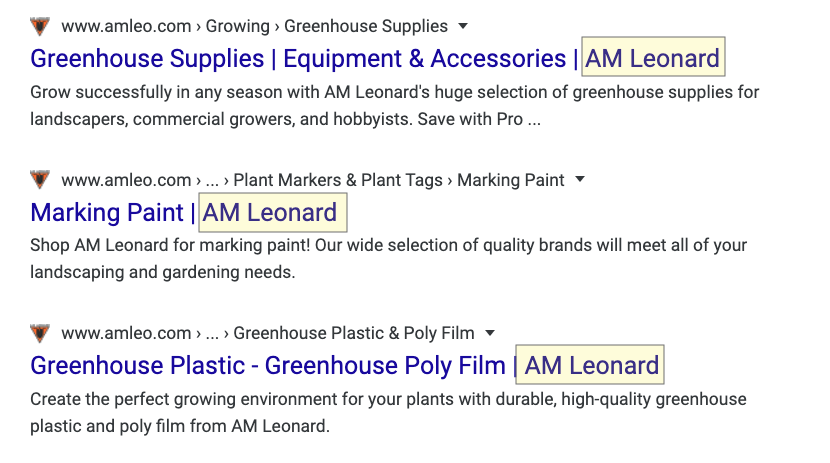
We’ve all seen sites like this. Heck, most of us do this on our own sites. The question is, does having our brand/site name at the end of every title actually help, or hurt?
But first, we also have to consider other types of boilerplate.
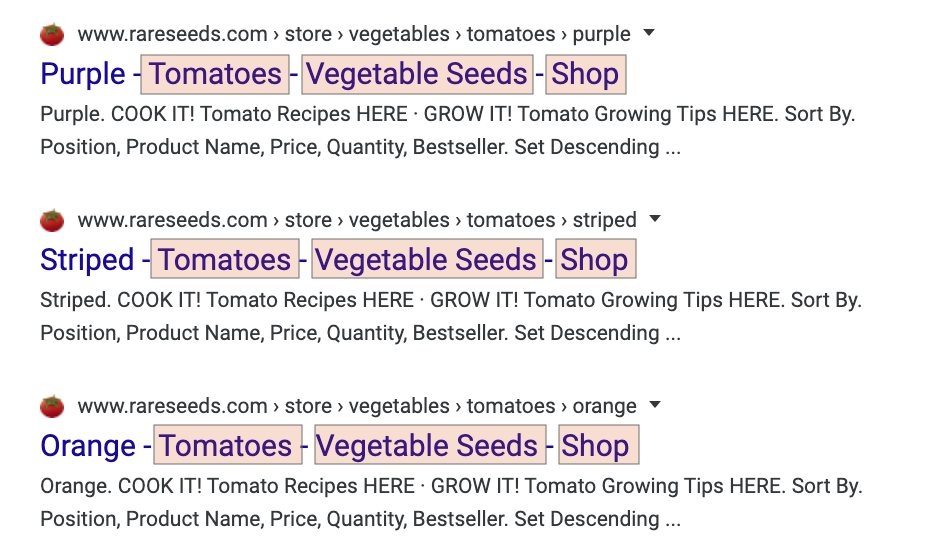
What is boilerplate? Boilerplate simply means standardized, non-unique pieces of text that are used over and over again. This often includes things like categories, product categories, author tags, and taglines.
In this example below, the boilerplate text on every title includes “Tomatoes – Vegetable Seeds – Shop.”
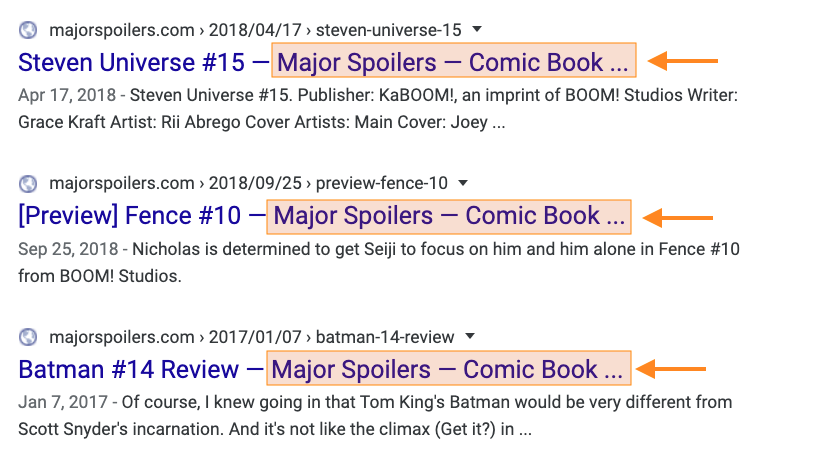
Sometimes boilerplate material can become quite long. The comic book review site Major Spoilers (awesome name!) often includes the same 65-character boilerplate on many pages:
“Major Spoilers – Comic Book Reviews, News, Previews, and Podcasts”
Of course, at this length, it’s so long that Google truncates every single title:
The problems that boilerplate can cause your SEO are threefold:
- Relevancy: Unnecessary words can make your title less relevant, both to search engines and users. For search engines, this could mean lower rankings. For users, this could result in fewer clicks.
- Uniqueness: Titles that share the same repeating text, and only vary from one another by a word or two, aren’t very unique. While this isn’t necessarily a problem, it goes against most SEO best practices, where uniqueness is key.
- Length: Boilerplate means you have less room to display other words in your title, and Google will often cut these off if they go beyond a certain length.
Experiment #1: Remove category from title
We decided to run a couple of boilerplate experiments here at Moz, to see if we could increase our rankings and traffic by removing some of the repeating parts of our titles.
We started with our Whiteboard Friday blog posts. Every time Moz publishes a new Whiteboard Friday, we traditionally include “Whiteboard Friday” in the title.
What would happen if we removed this from the titles?
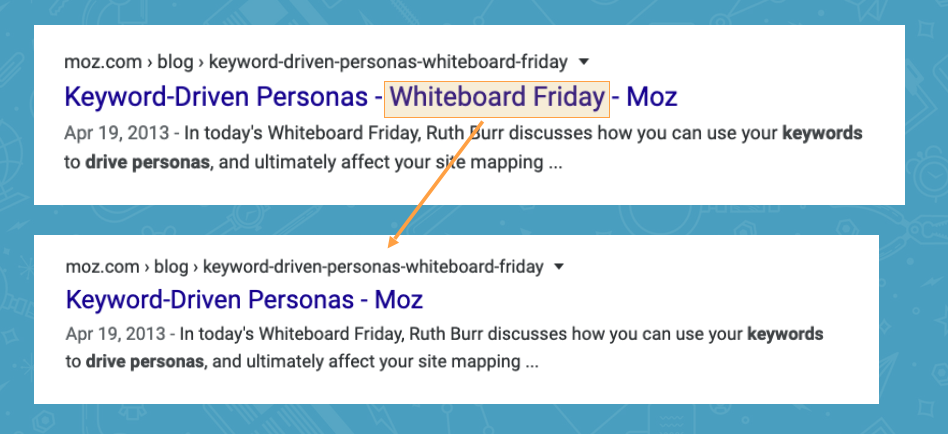
Using an A/B split test methodology — where we rolled the test out on 50% of the titles and used the other 50% as a control — we saw an amazing 20% uplift from this experiment.
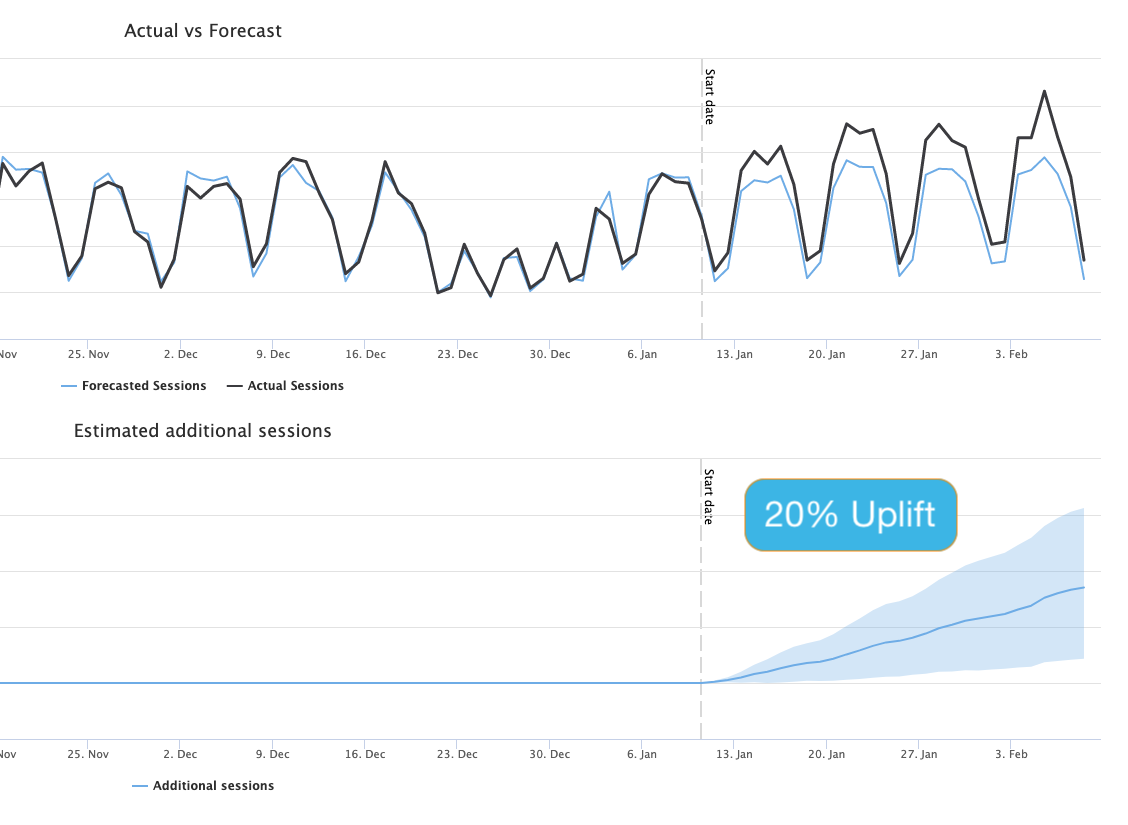
This chart represents the cumulative impact of the test on organic traffic. The central blue line is the best estimate of how the variant pages, with the change applied, performed compared to how we would have expected without any changes applied. The blue shaded region represents our 95% confidence interval: there is a 95% probability that the actual outcome is somewhere in this region. If this region is wholly above or below the horizontal axis, that represents a statistically significant test.
Honestly, the results surprised us. Whiteboard Friday is a popular brand (so we thought) but removing this boilerplate from our titles produced a significant uplift in traffic to those pages.
At this point, we got cocky…
Experiment #2: Remove brand from title
If removing the category name from Whiteboard Friday posts produced such a significant uplift, what if we removed our brand name from all titles?
For this A/B experiment, we did exactly that—removing the word “Moz” from 50% of our titles and measuring the results.
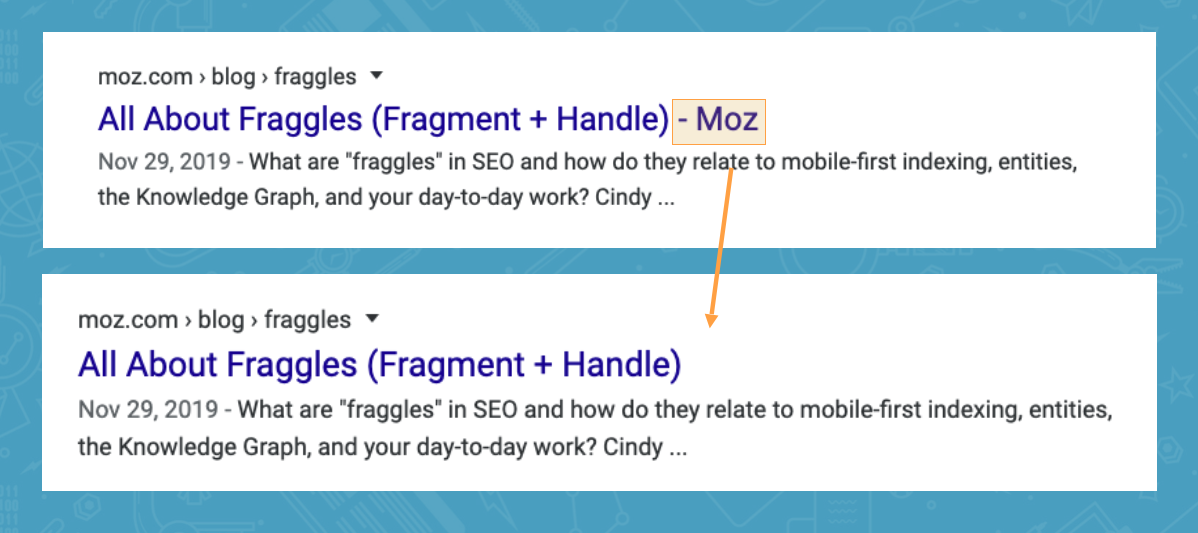
Crazy, right? If it worked by removing “Whiteboard Friday” would we see the same uplift by removing “Moz?”
Sadly, Google had other plans:
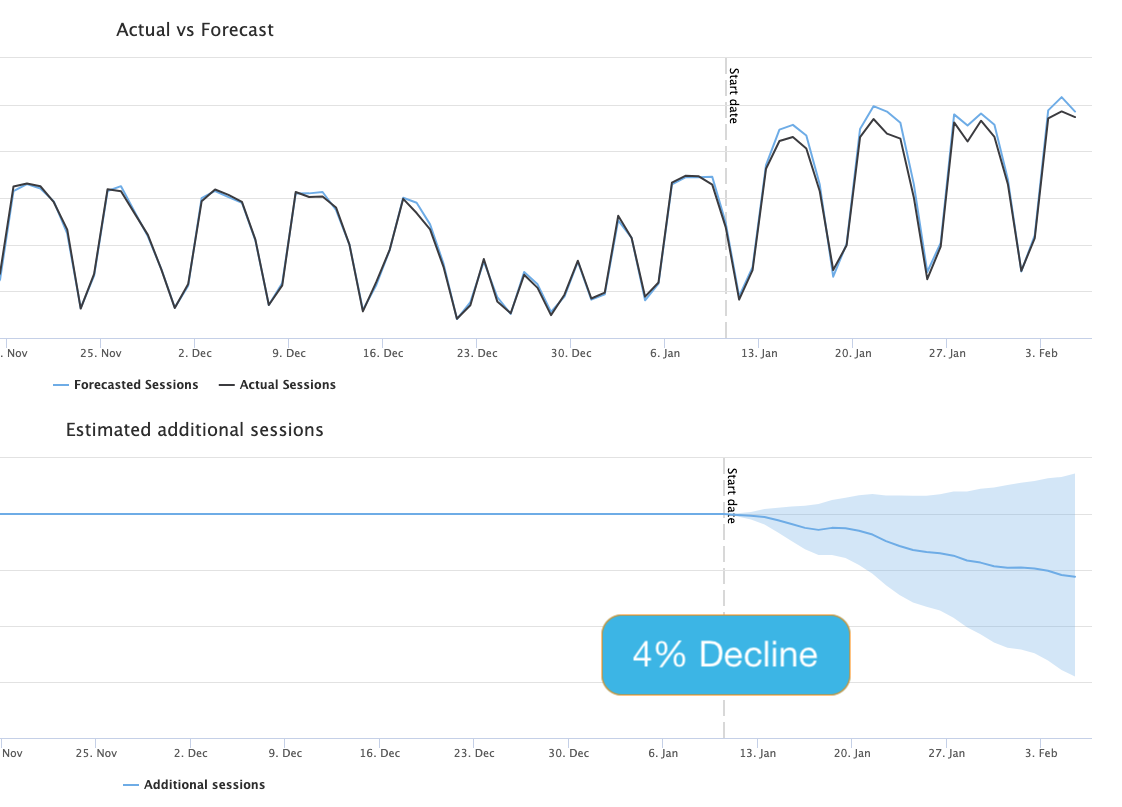
While this A/B test never reached full statistical significance, we actually saw a 4% decline in traffic by removing our brand from our title tags.
Boo!
So why did this test not produce the same gains? To be honest, I’ve removed the brand name from other site’s titles and seen as much as a 20% uplift.
It turns out that whether or not removing brand/boilerplate will be beneficial to your SEO depends on a few key factors, which you can gauge in advance.
How to know if removing boilerplate may succeed
Over 10 years of experience and literally millions of title tags, I’ve found that there are basically four factors that influence whether or not removing boilerplate from your titles might be beneficial:
- Brand Strength: Popular brand names in titles almost always perform better than unknown brands, even when people aren’t searching for your brand specifically. Amazon’s brand recognition, for example, likely gives a significant boost to including “Amazon” in every title, even when people aren’t specifically searching Amazon. Less recognizable brands, however, don’t always get the same boost, and can actually lead to fewer visits based on relevancy, length, and clickability (described next.)
- Relevancy: Are your boilerplate/brand keywords relevant to what your users search for? For example, if you’re site is about television repair, then boilerplate titles that say “Brad’s TV Repair” are going to be much more relevant than boilerplate that simply say “Brads.” (We’ll explore a way to determine your boilerplate’s brand strength and relevancy in the next section.)
- Length: In general, long boilerplate has the potential to do more harm than short boilerplate/brand words. Long boilerplate can dilute the relevance of your titles. So if you include “Buy Brad’s TVs, Television Repair, High Definition Servicing, Audio and Visual Equipment for Sale in Houston Texas and Surrounding Areas” – you may want to rethink your boilerplate.
- Clickability: Sometimes, boilerplate can make your titles more clickable, even if they aren’t terribly relevant. Words like “Sale”, “Solved”, “Free”, “2020”, “New”, and many others can lead to an increase in click-through rates (CTR.) Sometimes you can’t tell until you test, but in many cases even adding clickable elements to your boilerplate can lead to significant gains.
Simple technique for determining your brand strength and boilerplate relevancy
This simple technique will also show why removing “Whiteboard Friday” led to an increase in traffic while removing “Moz” from titles did not.
Here’s what you want to do: for each piece of boilerplate, determine the number of URLs on your site that rank/receive traffic for those keywords.
For this, we’ll use Google Search Console.
Simply enter your boilerplate/brand as a query filter (you may need to break it into chunks for longer boilerplate) and see how many URLs receive traffic for queries that include that keyword.
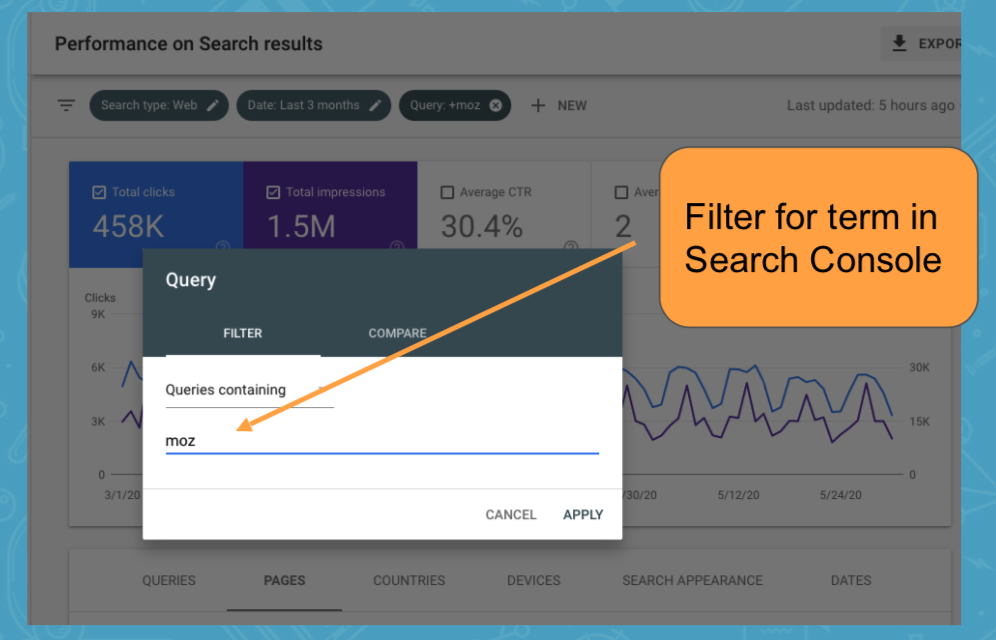
When we filter for keywords that contain our “moz” brand name, we find thousands of ranking URLs.
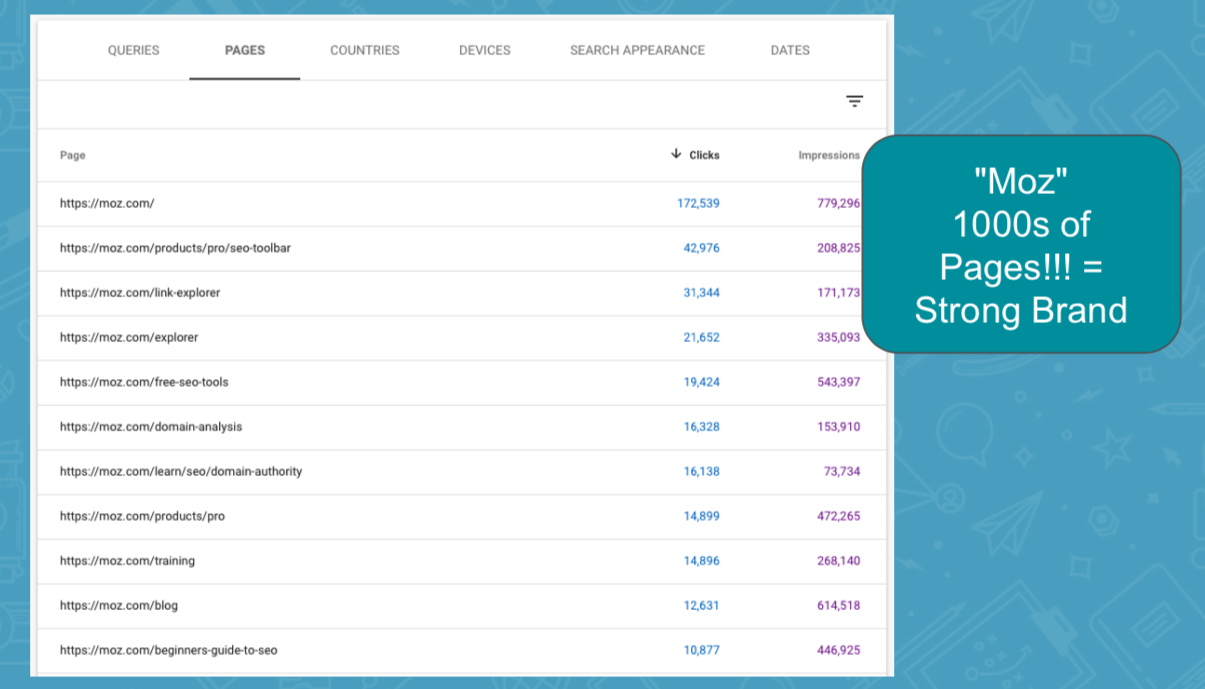
People are searching for things like:
- Moz DA Checker
- Moz Pro
- Moz SEO
- Moz Blog
- Etc., etc.
As our brand name is part of so many queries and leads to visits across thousands of pages, this tells us that “Moz” is a very strong brand, and we’d likely be smart to include it as part of our title tags.
“Moz” is also very short at only 3 characters, which doesn’t hurt either.
So what happens when we try this same technique with “Whiteboard Friday” — the boilerplate that led to a 20% uplift when we removed it? We see a very different result:
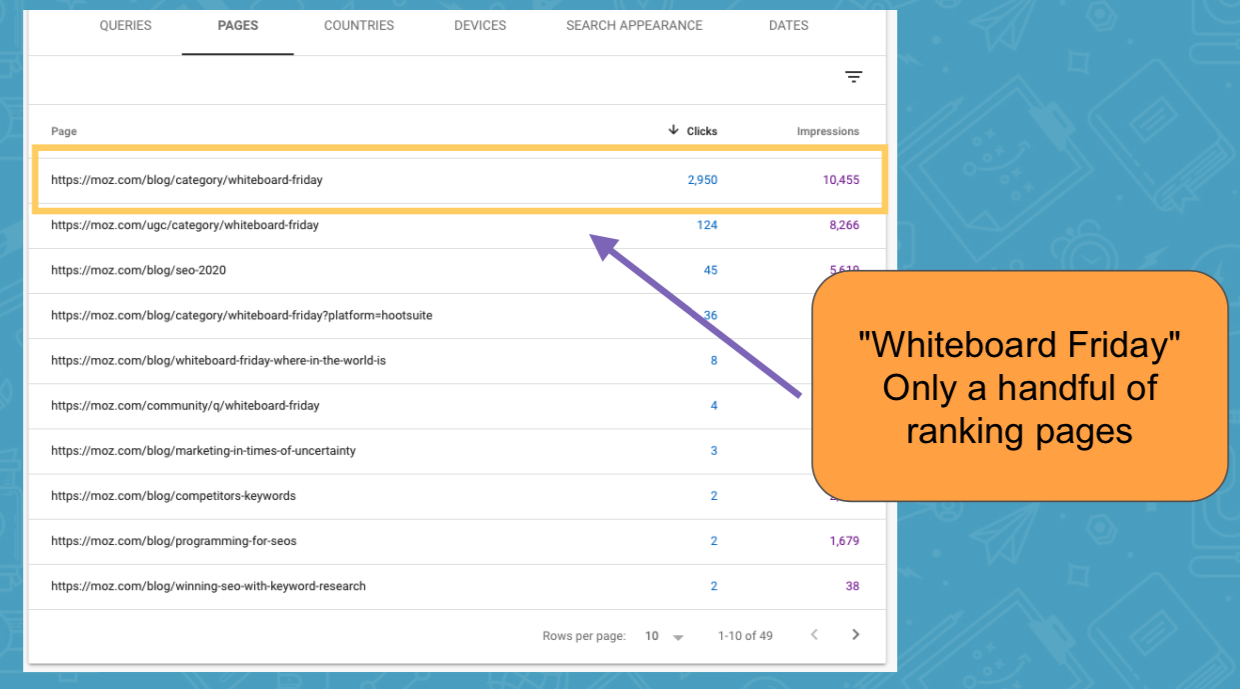
In this case, almost all the traffic for “Whiteboard Friday” search terms goes to only one or two pages.
For most Whiteboard Friday posts, the term is simply irrelevant. It’s not what people are searching for, and the brand isn’t strong enough to produce additional uplift.
Also, at 17 characters long, this boilerplate added significant length to each of our titles, in addition to possibly diluting the relevancy for what the posts were ranking for.
Final thoughts + bonus free title tag webinar
These tips can’t tell you definitively whether you should or shouldn’t include boilerplate or brand in your title tags, but they should give you a pretty good idea of when you should test things out.
Remember: Always test and evaluate before making any SEO change permanent. At least know the impact of the change you are making.
Also, please don’t be under the impression that you should always remove boilerplate from your titles. In some instances, actually adding boilerplate can produce an uplift, particularly when the boilerplate is:
- Recognizable: For example a strong brand
- Relevant: The right keywords
- Clickable: Encourages a high CTR
- Succinct: Not overly long
If you found value in the tips, and want to learn even more ways to optimize your title tags, we’ve made available a free webinar for you: SEO Master Class: Advanced Title Tag Optimization (For Any Site).
If you’ve got 40 minutes, it’s definitely worth a watch.
Best of luck with your SEO!
Sign up for The Moz Top 10, a semimonthly mailer updating you on the top ten hottest pieces of SEO news, tips, and rad links uncovered by the Moz team. Think of it as your exclusive digest of stuff you don’t have time to hunt down but want to read!
GSC Redirect Errors
GSC listing non existent uri’s containing html tags as redirect errors
GSC Redirect Errors
GSC listing non existent uri’s containing html tags as redirect errors
Seer Solves It: Using Facebook Ads to Inform SEO Meta Data
How To Leverage Facebook Ads To Write Effective SEO Meta Data
As a total Facebook advertising newbie, when I learned about Facebook Ad Library I was floored! The Ad Library provides advertising transparency by offering a comprehensive, searchable collection of all ads currently running from across Facebook apps and services, including Instagram.…
The post Seer Solves It: Using Facebook Ads to Inform SEO Meta Data appeared first on Seer Interactive.
Is Google prepping to phase out ETAs?
Some users aren’t seeing the Text ad creation option in their Google Ads Search campaigns.
Please visit Search Engine Land for the full article.
[Updated] Is Google prepping to phase out ETAs?
The Text ad creation option is no longer showing in some users’ Google Ads Search campaigns.
Please visit Search Engine Land for the full article.
SEO Site Migrations & Food Trucks: The Longest SEO Mythbusting Video Yet
In the longest SEO mythbusting video yet by Google’s Martin Splitt, he invited Glenn Gabe to talk about site migrations. It is a wonderful topic and they covered a heck of a lot. One of my favorite parts was the analogy with food trucks and how they …
15% Of Search Queries On Google Are New – No Change There
In 2007, 25% of all queries that searchers entered into the Google search box was never seen by Google before. That figure changed to 15% in 2013 and has remained at that figure according to Google even through today.
App store optimization success: Top five KPIs you must measure
Top five leading metrics that you need to measure App Store Optimization (ASO) success, user engagement, user retention, and business conversion.
The post App store optimization success: Top five KPIs you must measure appeared first on Search Engine Watch.