An improved search box within the search results
Webmaster level: All
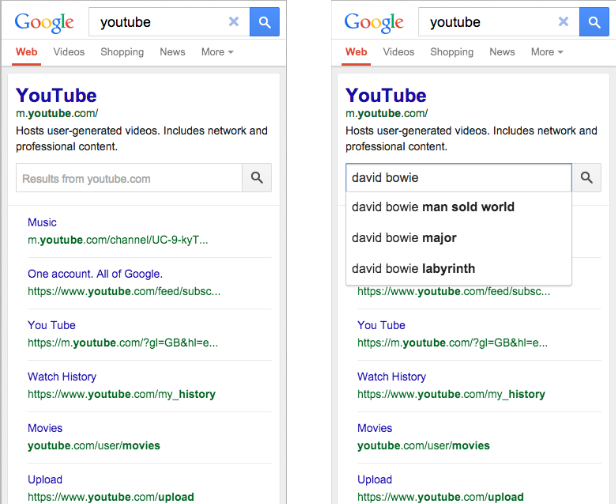
Today you’ll see a new and improved sitelinks search box. When shown, it will make it easier for users to reach specific content on your site, directly through your own site-search pages.
What’s this search box and when does it appear for my site?
When users search for a company by name—for example, [Megadodo Publications] or [Dunder Mifflin]—they may actually be looking for something specific on that website. In the past, when our algorithms recognized this, they’d display a larger set of sitelinks and an additional search box below that search result, which let users do site: searches over the site straight from the results, for example [site:example.com hitchhiker guides].
This search box is now more prominent (above the sitelinks), supports Autocomplete, and—if you use the right markup—will send the user directly to your website’s own search pages.

How can I mark up my site?
You need to have a working site-specific search engine for your site. If you already have one, you can let us know by marking up your homepage as a schema.org/WebSite entity with the potentialAction property of the schema.org/SearchAction markup. You can use JSON-LD, microdata, or RDFa to do this; check out the full implementation details on our developer site.
If you implement the markup on your site, users will have the ability to jump directly from the sitelinks search box to your site’s search results page. If we don’t find any markup, we’ll show them a Google search results page for the corresponding site: query, as we’ve done until now.
As always, if you have questions, feel free to ask in our Webmaster Help forum.
Posted by Mariya Moeva, Webmaster Trends Analyst, and Kaylin Spitz, Software Engineer


The 4 C’s of Social Media
UBM Tech’s 2013 Social Media @Work research report researched the role social media plays in the business technology market.
Post from Bas van den Beld on State of Digital
The 4 C’s of Social Media
GoogleRecon Day Four: Use Fetch As GoogleBot
More of the same old same old with tips from Google on reconsideration requests this week – but that was expected…
Block Determination and Link Distribution
As Google gets better and better at determining what blocks within your website serve what purpose, links within your main content are becoming much more important.
EU-Google Antitrust Deal May Be Collapsing
Since the first Google antitrust settlement proposal was announced in 2013 the company’s rivals and critics have complained loudly that it doesn’t go far enough to remedy what they see as Google’s unjustified “diversion” of their traffic to Google’s own…
Please visit Search Engine Land for the full article.
503: GONE
There have been a few occasions when Googlers stated that a 503 server response code would be interpreted by Google as a “hold on, something’s getting fixed, don’t update the index with what you find here” situation. That made great sense. How else could a tech-savvy webmaster pause re-indexing while performing an update that would […]
Keyword Research and Targeting Without Exact Match – Whiteboard Friday
Posted by randfish
Whatever the motives behind Google’s recent removal of exact-match keyword targeting from AdWords, the resulting uncertainty makes keyword research that much more difficult. In today’s Whiteboard Friday, Rand talks about the im…
Google’s Browseable Fact Repository – an Early Knowledge Graph
In earlier days at Google, when you used to ask a question, you could sometimes get a response providing answers to questions such as: “When was George W. Bush’s birth-date?”. We knew that Google could answer some questions like that, even if it might have been challenging, but we didn’t have much of a clue […]
The post Google’s Browseable Fact Repository – an Early Knowledge Graph appeared first on SEO by the Sea.
SearchCap: Google AdWords Callouts, Bing Ads Close Variants & Getty Images Sues Over Bing Image Widget
Below is what happened in search today, as reported on Search Engine Land and from other places across the web. From Search Engine Land: Getty Images Sues Microsoft For “Massive Infringement” Of Copyright By Bing Image Widget It didn’t take long for Bing’s new Image Widget…
Please visit Search Engine Land for the full article.
Getty Images Sues Microsoft For “Massive Infringement” Of Copyright By Bing Image Widget
It didn’t take long for Bing’s new Image Widget to come under fire for alleged copyright infringement. The feature, which enables online publishers to display photos pulled in by the Bing search engine, rolled out Aug. 22. Today, Getty Images filed suit in a New York federal court…
Please visit Search Engine Land for the full article.
Bing and Google Are Ready for Some Football
As the 2014 NFL season kicks off, Bing is making predictions, which it has also enabled in Cortana, and Google is launching a football-themed GIF generator to capitalize upon increased search interest.
Repositioning SEO Inside Your Company So Everyone Wins – September 23 Webcast
Digital Marketing Depot presents “Repositioning SEO Inside Your Company So Everyone Wins” on Tuesday September 23 at 1 PM EDT. This webcast is about why and how your company can benefit from repositioning search engine optimization (SEO) inside your company to give your branding efforts…
Please visit Search Engine Land for the full article.
Bing Ads Offers New Bulk Editing Tools
Bing Ads announced a new way advertisers can manage up to 1 million keywords, 500,000 ads, and 250,000 ad groups – all within the Web interface.
Close Variants Come To Broad Match Modifier In Bing Ads
A couple of weeks ago, Bing Ads announced it is testing close variants keyword matching on exact and phrase match terms. Today, they added close variants for broad match modifier keywords in the U.S. Using close variants means that the search engine wi…
Could DuckDuckGo Overtake Bing?
Amid growing privacy concerns and a deal with Apple, DuckDuckGo has the potential to become a major player in search.
The post Could DuckDuckGo Overtake Bing? appeared first on Search Engine Land.
Please visit Search Engine Land for the full article….
YouTube Keyword Tool Sunsets: Replaced By AdWords Display Planner Tool
The YouTube keyword tool has been shuttered for good. The company announced it would sunset on September 1st in favor of the Display Planner’s AdWords for video keyword suggestions. Users must have an AdWords account to access the Display Planner. Google began alerting users that the tool…
Please visit Search Engine Land for the full article.
Optimizing for Bandwidth on Apache and Nginx
Webmaster level: advancedEveryone wants to use less bandwidth: hosts want lower bills, mobile users want to stay under their limits, and no one wants to wait for unnecessary bytes. The web is full of opportunities to save bandwidth: pages served withou…
The Case for Closed-Loop Web Analytics
Our philosophy at SEER on the role of analytics for clients is pretty simple. Our goal is to provide the right information at the right time so that client decision makers can make better decisions with greater confidence. This goes far beyond basic reporting and actually starts with a deep understanding of client strategy (digital […]
Google Kerning Easter Egg Plays Tricks With Typography
Google UK’s Peter Far found an Easter Egg designed specifically for hardcore typography fans. If you search for [kerning] in one tab, and [typography kerning] in another, you’ll notice a little extra space between the lettering on the [kerning] search results page. Search Engine…
Please visit Search Engine Land for the full article.
Brand Terms: To Bid or Not to Bid? [Bing Ads Study]
A new study from Bing Ads explores the value of including your own brand terms in paid search marketing campaigns.