Matt Cutts Extends Leave From Google Into 2015
Following the news that Bing’s Duane Forrester had been let go, Matt Cutts is extending his leave from Google into the new year.
2 Creative Ways To Promote Vital But Infrequently-Searched-For Events With PPC
No search volume? No problem! Columnist Pauline Jakober provides helpful tips for campaigns focused on low search volume, high conversion terms.
The post 2 Creative Ways To Promote Vital But Infrequently-Searched-For Events With PPC appeared first on …
Q&A: Aleyda Solis on SEO in a multi-device world
Can you tell us a little about your presentation at the Festival?
I will speak about how to establish an effective SEO strategy in a multi-device search reality; which are the additional criteria to take into consideration and the tools to use to facilitate our work.
How do the approaches to mobile SEO differ from desktop?
Mobile, as well as desktop should be part of a multi-device SEO approach that takes into consideration and optimize for the specific characteristics, behavior, requirements, restrictions, specific search rankings factors and potential of each platform; making the most out of it.
Some of the aspects that are more important to take into consideration when optimizing for mobile is the balance between the content optimization (its volume, organization, technology used) vs. the speed & space limitations.
Additionally, in dependence on which type of mobile web approach is taken – responsive, parallel or dynamic – there’s the need to set it with tags, user agent detection and redirects so search engines can correctly identify it.
What are your thoughts on the best approach to mobile optimisation?
For some web businesses it could be directly a responsive web approach but for others this might not be enough.
They might need to personalize all their offer, from content to specific promotions to their mobile audience. They might have identified that their mobile audience behavior was completely different than the one of their desktop one, which would make them need a dynamic serving approach.
What do you think Google’s next move could be when it comes to mobile search?
App search. ASO is in its infancy. Google has already started enabling deep links for app content and this is only the beginning for a better and more mature app search experience and results.
Is optimising for mobile even more essential when appealing to international markets?
It depends on each country and the industry specific behavior. In some countries or in some specific industries too, like for locally targeted businesses.
For example, smartphones are more popular in some areas, or even the main way to search on the web.
This is why it is a must to always validate at the beginning with a research that not only takes into consideration the keywords and terms used, but the share per device type and the specific query behavior per device.
For example, I was doing a keyword research the other day for Mexico and Colombia for the same business, and not only the search volume and type of keywords differed but also the search audience using computers vs. mobile vs. tablets:

What are some of the mistakes you see when brands launch international sites?
Most of the mistakes are caused by the lack of an appropriate research and targeted strategy for each international web presence; which end-up making the sites:
- Not having correctly translated or localized content and overall web presence for the targeted audience.
- Showing some of the content in English despite being targeted to the French audience, leaving the URLs in English by default, showing prices in Dollars despite being targeted to a UK audience.
- Not having a clear international target, with a mixed country, language and region web versions, which end-up generating international search results misalignment issues, such as ranking with the Spain web version in Google’s Mexican results, or in the Google’s US results with the UK version etc.
- To create the same piece of content, prioritize their product or service offer and promote them in the exact same way in all of their markets without taking into consideration the different seasonalities, cultural differences and interests, etc. which will end-up making them to fail in most of the international markets.
How do approaches to SEO differ between countries?
An SEO process will differ from country to country in dependence on the spoken language and local terms used, the search behavior of the local audience, the potential search volume & competitors for the relevant products, services or business; seasonality, local & cultural preferences, etc.
So, even if two different countries might speak the same language, the SEO efforts and strategies used might differ.
This is both technical and cultural: one product could be more attractive than other, the high seasons could be different influencing the type of terms which are targeted; the local competitors might be others with different competition level and therefore the need of content and links related resources might be different, etc.
With link building becoming more difficult, is content now the main tool for SEOs?
Content, resources, assets, your own products and offering. For me is about how you answer your audience needs and connect with them, how well you identify the web ecosystem around your business operations, from brand, community and competitors and make the most of it too.
Content is of course is fundamental, but ‘just build the right content’ is a failed approach if you look to attract links.
Links are endorsements created by your audience so your content (and whatever you create) needs to be promoted to become visible to your target market, especially at the beginning.
What’s one piece of advice you would give for those looking to get the most out of mobile and international search?
Don’t implement anything based purely on ‘best practices’ without doing your own analysis and research, especially when it means a high level of investment.
Analyze which mobile approach or international market is the right one or the most attractive for you specifically; the one that would fulfill your needs, comply with your requirements and provide the expected ROI; by researching, analyzing and if in doubt, developing tests.
Aleyda will be speaking at our Festival of Marketing event in November, a two-day celebration of the modern marketing industry, featuring speakers from brands including LEGO, Tesco, Barclays, FT.com and more.
Attend MarTech San Francisco: The Marketing Tech Event of the Year
Harness the Power of Technology Driven Marketing – Best Rates Available Now The marketing technology world is on fire! Billions of dollars in investment. Billions of dollars in revenue. Big IPOs. Big partnerships. A new generation of marketing leaders. Hundreds of software programs entwined in…
Please visit Search Engine Land for the full article.
Should Hotels.com Get a Google Slap for Soliciting Paid Links From Bloggers?
By now, every SEO worth his or her salt knows that exchanging money for links is an absolute no-no in Google’s eyes. Apparently, Hotels.com didn’t get the memo.
Should Hotels.com Get a Google Slap for Soliciting Paid Links From Bloggers?
By now, every SEO worth his or her salt knows that exchanging money for links is an absolute no-no in Google’s eyes. Apparently, Hotels.com didn’t get the memo.
7 Quick Local Hits To Optimize For Black Friday & Cyber Mondays This Season
Time for local businesses to optimize for the holiday season. Columnist Chris Silver Smith provides 7 quick tips to boost rankings and, hopefully, sales.
The post 7 Quick Local Hits To Optimize For Black Friday & Cyber Mondays This Season appeared…
Fighting the Fear
People are held back by fear. It is not real but it can still prevent us from achieving our goals. Find out how to embrace fear and achieve success.
Post from Matt Beswick
4 Pitfalls to Avoid Heading Into the Holidays
Here are four pitfalls that seem to occur every year, along with some thoughts on how to best avoid them or deal with them as they occur.
Bing Images Finally Adds Animated GIF Filter
Just like Google, Bing has finally added a filter to their Bing Image search to filter images by animated GIFs only.
As many of you know, I love animated GIFs, so having two major search engines support an animated GIF filter…
Google Analytics Treemaps For AdWords Reporting Coming Soon
Google mentioned on Google+ on the Google Analytics account, that a new AdWords reporting feature named Treemaps is coming to the software.
Google: Duplicate URLs In The Disavow Is Not An Issue
An SEO asked on Twitter if listing the same URL in the disavow link file will hurt or what happens? Does listing it twice negate it? Does listing it twice show more importance? Or does Google ignore duplicate listings…
Google: Only SEOs Go To Page 35 In Google’s Search Results
Google’s John Mueller posted another funny on Google+, this one mocking how only SEOs travel as far as page 35 in the Google search results.
He wrote…
Matt Cutts Not Returning To Google In 2014: Will He Return In 2015?
Matt Cutts, Google’s currently on leave head of search spam, announced on Twitter that he is extending his leave into 2015.
In July, Matt Cutts shocked the SEO space by announcing he would be taking a few months off to spend time with his wife…
…
Using Analytical Analysis to Help Improve Conversions
The secret to getting the most success out of your initiatives typically lies in accessing the biggest hammer in your marketing tool bag, analytics!
Do exact match domains still work as an SEO tactic?
Exact match domains and search rankings
Exact match domains are those which match the search query precisely, as opposed to domains, such as glassesdirect.com, which merely contain a keyword they would hope to rank for.
EMDs have been used as a shortcut to higher rankings and, as such, can command high prices.
Google has been looking to reduce the value of low quality EMDs, but we can still see a few examples. Here, while you can watch movies online on Amazon, Netflix, Sky and many other ‘kosher’ sites, the SERPs are dominated by what seem to be pirate sites with exact domain names.

According to Jon Earnshaw, CTO of Intelligent Positioning:
The proliferation of EMD depends on the sector. There were historically many in the ‘watch movies online’ and ‘pay day loan’ related searches. This has a lot to do with the sectors in questions, where there are transient businesses attempting to sell perhaps not 100% bona-fide services. In the movies sector there were also huge amounts of eastern-european TLDs such as keyword.ro or keyword2.po
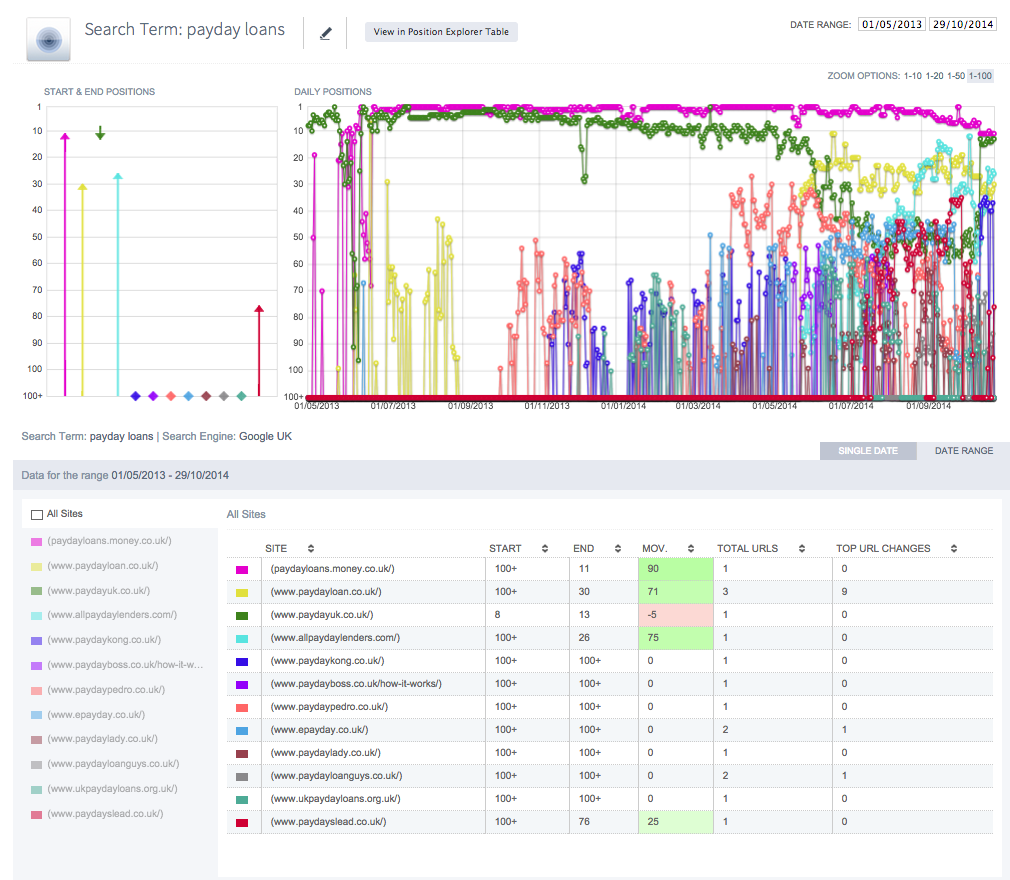
Our toolset collects and stores all returning URLs for particular search terms. Within the payday loans sector and watch movies sectors there are fewer EMDs and very close PMDs than this time last year.
However, that is not necessarily down to Google, but perhaps down the fly-by-night businesses succeeding and failing in the SERPs – see separate images which show the short termism of their success.
In this chart, the first batch of EMD sites for loans were prominent last year, and then collapsed:

The second batch shown below are new to the game and have proliferated recently:
Exact match doesn’t always work…
Here, though cheapflights.com has the exact domain for this query, it still ranks below Skyscanner, while Google’s own flight search function has pushed its organic listing further down the page.
This perhaps shows that it’s harder to achieve results with exact domains in more competitive verticals like this one.

EMDs: the stats
The canirank study mentioned earlier found the following:
- Keyword domains rank on average 11% higher than branded domains.
- Brand (non-EMD) domains needed an average of 40,000 more links to hit position one, and 35,000 more links to reach the Top 10.
- Branded domains needed 69% higher Domain Authority and 22% higher Page Authority to rank in the Top 10.
- Keyword domains were able to reach position one with half as much content, and only using the keyword half as frequently.

The report also recommends exact match domains as a shortcut to increased rankings, but is this a wise tactic?
I’ve been asking SEOs about the value (or otherwise) of such a tactic…
Are exact match domains an SEO tactic that works?
Marcus Tober, CTO and founder of Searchmetrics:
Online success does not depend on the domain name. At least not from a technical SEO perspective.
Of course, there are other benefits, such as branding and recognition value, but our analyses have shown, that the factor ‘Keyword in the domain name’ as an SEO tactic has lost its influence over recent years.
Andrew Girdwood, Media Innovations Director at DigitasLBi:
There’s an important question of focus.
If you’re planning on entering the competitive jobs board market and cover a range of geographies and industries then an exact match domain probably won’t be worth the mega bucks.
On the other hand, if your new site is specifically about “Media Jobs in Glasgow” then you may find an exact match domain suits you.
An even better SEO tactic is to coin a phrase which gets people searching for your domain. Buy the website “Quote Me Happy.com” before you run an intensive TV campaign around the phrase and injects it into the mind of millions.

Patrick Altoft, Director of Strategy at Branded 3:
It all depends on your goals & how well established your business is. It’s very rare that a major brand would be built on an exact match domain and we see very few examples of an EMD doing well in the long term.
Even if exact match domains were given some kind of boost it’s only for one keyword and when the vast majority of SEO traffic is long tail that isn’t going to help very much. The only way to build a business around EMD’s like this is to either rank for a really big keyword (which you need to be a big brand for anyway) or to have multiple sites (which is hard to do if you want to stay within Googles guidelines).
Kevin Gibbons, MD at BlueGlass:
It really depends on what your goals are. If you’re looking to build a long-term brand, I’d say it’s probably not the most important thing you should be focusing your time on.
However, if a very high percentage of traffic within your market comes from search, or if you’re looking at a shorter-term business model I can see why it would be an appealing approach.
My thoughts are if you can build a brand long-term – and get in some quicker wins to capitalise on extra organic traffic and double search listings in the meantime – providing you can justify the returns on your effort, why wouldn’t you do this?
Do you think some exact match domains are outranking more worthy sites?
Marcus Tober:
In the past, exact match domains indeed outranked more worthy sites, even if these keyword domains had only little or even no relevant content, because Google’s algorithm had been much more keyword driven.
But with the EMD Update rolled out by Google in late September 2012, most of these ‘spammy’ keyword domains have vanished from the search results.
Since Google is a machine, some rather irrelevant exact match domains may probably still be among the top ranking sites, but in the long term, it’s always the quality that matters. Consequently, most of the exact match domains currently ranking at the top are sites do indeed provide some value for the user and are therefore competitive regardless of the domain name.
Andrew Girdwood:
Weirdness happens all the time. The issue is really how long unexpected results persist. By and large I don’t see dodgy domains with nothing but a URL going for them ranking above a site that’s worked on both relevancy and authority.
When was the last time you saw a multiple-hyphen-dot-biz domain rank well in Google?
Patrick Altoft:
If you look at the ranking for one specific keyword then perhaps they do sometimes but this isn’t the way to measure SEO – you need to look at total traffic from organic search and an EMD doesn’t help with that.
Sometimes an EMD will outrank a more worthy site certainly, but the key success metric with SEO isn’t what is ranking well today it’s about what will rank well in the future. Google usually gets it right with rankings for big keywords and just because something is working today doesn’t mean it will work after the next update.
Kevin Gibbons:
Of course. Any ranking of sites (whether Google’s algorithm, or someone’s opinion) is always going to cause disagreement, because who’s to say which sites are more worthy or not?
Where I most often see exact match domains benefiting is for local sites. The Google Venice update probably isn’t spoken about enough (it’s penguin and panda relatives have obviously shadowed this somewhat).
But the appearance of local listings (based on searcher location) within competitive and generic queries is now very much commonplace in Google. In some cases could argue that these add value to a searcher, because it’s more targeted and localised content – but local domains would be where I’d place my effort in terms of getting the best results.
Is this something that Google needs to deal with?
Marcus Tober:
Google can measure quality quite well using user signals such as bounce-rate or time-on-site as a signal for relevant content and user satisfaction.
So the search engine already is pretty elaborate in filtering spammy keyword domains, both from a content and a technical perspective. That’s why I think, EMDs are not a current focus for Google.
But of course, there are always new challenges, so the work never ends.
Andrew Girdwood:
I think this is something Google will need to keep on its radar for a number of reasons.
One interesting reason is the physiological effect of an exact match domain when the searcher is on a small screen device or using a card based interface.
In the absence of a compelling brand in any set of results then the exact match domain may attract an even larger share of clicks. If the site is good enough to satisfy the search then that will give Google cause for thought.
There is the possible rise of exact match TLDs but then… how often do you see a .jobs site ranking for a job search?
The third reason I’ll leave you with is the ease of site creation these days. Google’s Udi Manber said that 20% to 25% of queries on any day are searches Google has never seen before.
It’s really easy to create a site with a domain that matches these ‘new keywords’. For example, you see this in computer games; when a new title is announced the first fan sites, places for reviews, tips and communities, tend to have domains named after the computer game.
When there’s a new concept that’s gaining traction the first sites that are often the best resource for searchers are exact match domains created to address that new trend.
Patrick Altoft:
Google is already dealing with the lower end of this with its unnatural link crackdown, we’ve seen plenty of EMD owners being told that their anchor text is unnatural and this makes it harder for them to build links.
The biggest ranking factor these days is engagement so any EMD that isn’t satisfying users will probably drop down the rankings anyway – and if the site is genuinely useful then it deserves to rank whether it’s an EMD or not.
Kevin Gibbons:
Yes it is, and although far from perfect, I do think Google have improved as more algorithm signals have been brought in to identify a brand.
Google is in a difficult situation here, because sometimes it’s just not that easy to associate a brand to a specific domain. For example, if a brand query goes up, it makes sense that the exact match domain rankings increase (especially if the listing has a high CTR), but what if that’s not really the result people are searching for?
This goes deeper into analysing the intent of the searcher, “Cheap Flights” is always an obvious query example, is this a brand query or a generic search? That’s a tough one for Google to fix.
There will never be a real right or wrong answer in rankings, it’s always in a state of flux – and that’s another reason why personalised search is so important.
It’s also important to remember that Google wants to reward brands – this means that they look for common brand signals such as links, anchor text, brand query volume, social engagement, CTRs and bounce rate (from SERPs) etc – and when they find the perfect mix of these factors, I think it will be much harder for exact match domains to benefit from increased coverage.
But until then, have fun experimenting!
More Than 36% of Traffic is From Mobile & Tablet, Find Out 5 Ways To Capture These Visits
More than 35% of the page views worldwide are made via mobile and tablet devices. Find out how to optimize your site for mobile and capture the maximum visits to your site.
Post from Jan-Willem Bobbink
Google’s Physical Web and its Impact on Search
Posted by Tom-Anthony
In early October, Google announced a new project called ”
The Physical Web,” which they explain like this:
The Physical Web is an approach to unleash the core superpower of the web: interaction on demand. People should be able to walk up to any smart device – a vending machine, a poster, a toy, a bus stop, a rental car – and not have to download an app first. Everything should be just a tap away.
At the moment this is an experimental project which is designed to promote establishing an open standard by which this mechanism could work. The two key elements of this initiative are:
URLs: The project proposes that all ‘smart devices’ should advertise a URL by which you can interact with that device. The device broadcasts its URL to anyone in the vicinity, who can detect it via their smartphone (with the eventual goal being this functionality is built into the smart phone operating systems rather than needing third-party apps).
Beacons: Not well known until Apple recently jumped on the bandwagon announcing iBeacons, beacon technology has been around for a couple of years now. Using a streamlined sibling of Bluetooth, called Bluetooth Low Energy (no pairing, range of ~70 metres / ~230 feet) it allows smartphones to detect the presence of nearby beacons and their approximate distance. Until now they’ve mostly been used to ‘hyper-local’ location based applications (check this blog post of mine for some thoughts on how this might impact SEO).
The project proposes adapting and augmenting the signal that Beacons send out to include a URL by which nearby users might interact with a smart device.
This post is about looking to the future at ways this could potentially impact search. It isn’t likely that any serious impact will happen within the next 18 months, and it is hard to predict exactly how things will pan out, but this post is designed to prompt you to think about things proactively.
Usage examples
To help wrap your head around this, lets look at a few examples of possible uses:
Bus times: This is one of the examples Google gives, where you walk up to a bus stop and on detecting the smart device embedded into the stop your phone allows you to pull the latest bus times and travel info.
Item finder: Imagine when you go to the store looking for a specific item. You could pull out your phone and check stock of the item, as well as being directed to the specific part of the store where you can find it.
Check in: Combined with using URLs that are only accessible on local wifi / intranet, you could make a flexible and consistent check in mechanism for people in a variety of situations.

I’m sure there are many many more applications that are yet to be thought up. One thing to notice is that there is no reason you can’t bookmark these advertised URLs and use them elsewhere, so you can’t be sure that someone accessing the URL is actually by the device in question. You can get some of the way there by using URLs that are only accessible within a certain network, but that isn’t going to be a general solution.
Also, note that these URLs don’t need to be constrained to just website URLs; they could just as well be
deep links into apps which you might have installed.
Parallels to the web and ranking
There are some obvious parallels to the web (which is likely why Google named it the way they did). There will be many smart devices which will map to URLs which anyone can go to. A corollary of this is that there will be similar issues to those we see in search engines today. Google already identified one such issue—ranking—on the page for the project:
At first, the nearby smart devices will be small, but if we’re successful, there will be many to choose from and that raises an important UX issue. This is where ranking comes in. Today, we are perfectly happy typing “tennis” into a search engine and getting millions of results back, we trust that the first 10 are the best ones. The same applies here. The phone agent can sort by both signal strength as well as personal preference and history, among many other possible factors. Clearly there is lots of work to be done here.
So there is immediately a parallel between with Google’s role on the world wide web and their potential role on this new physical web; there is a suggestion here that someone needs to rank beacons if they become so numerous that our phones or wearable devices are often picking up a variety of beacons.
Google proposes proximity as the primary measure of ranking, but the proximity range of BLE technology is very imprecise, so I imagine in dense urban areas that just using proximity won’t be sufficient. Furthermore, given the beacons are cheap (in bulk, $5 per piece will get you standalone beacons with a year-long battery) I imagine there could be “smart device spam.”
At that point, you need some sort of ranking mechanism and that will inevitably lead to people trying to optimise (be it manipulative or a more white-hat approach).
However, I don’t think that will be the sole impact on search. There are several other possible outcomes.
Further impacts on the search industry
1. Locating out-of-range smart devices
Imagine that these smart devices became fairly widespread and were constantly advertising information to anyone nearby with a smart devices. I imagine, in a similar vein to schema.org actions which provide a standard way for websites to describe what they enable someone to do (“affordances,” for the academics), we could establish similar semantic standards for smart devices enabling them to advertise what services/goods they provide.
Now imagine you are looking for a specific product or service, which you want as quickly as possible (e.g “I need to pick up a charger for my phone,” or “I need to charge my phone on the move”). You could imagine that Google or some other search engine will have mapped these smart devices. If the above section was about “ranking,” then this is about “indexing.”
You could even imagine they could keep track of what is in stock at each of these places, enabling “environment-aware” searches. How might this work? Users in the vicinity whose devices have picked up the beacons, and read their (standardised) list of services could then record this into Google’s index. It sounds like a strange paradigm, but it is exactly how Google’s app indexing methodology works.
2. Added context
Context is becoming increasingly important for all searches that we do. Beyond your search phrase, Google look at what device you are on, where you are, what you have recently searched for, who you know, and quite a bit more. It makes our search experiences significantly better, and we should expect that they are going to continue to try to refine their understanding of our context ever more.
It is not hard to see that knowing what beacons people are near adds various facets of context. It can help refine location even further, giving indications to the environment you are in, what you are doing, and even what you might be looking for.
3. Passive searches
I’ve spoken a little bit about passive searches before; this is when Google runs searches for you based entirely off your context with no explicit search. Google Now is currently the embodiment of this technology, but I expect we’ll see it become more and more

I believe could even see see a more explicit element of this become a reality, with the rise of conversational search. Conversational search is already at a point where a search queries can have persistent aspects (“How old is Tom Cruise?”, then “How tall is he?” – the pronoun ‘he’ refers back to previous search). I expect we’ll see this expand more into multi-stage searches (“Sushi restaurant within 10 minutes of here.”, and then “Just those with 4 stars or more”).
So, I could easily imagine that these elements combine with “environment-aware” searches (whether they are powered in the fashion I described above or not) to enable multi-stage searches that result in explicit passive searches. For example, “nearby shops with iPhone 6 cables in stock,” to which Google fails to find a suitable result (“there are no suitable shops nearby”) and you might then answer “let me know when there is.”
Wrap up
It seems certain that embedded smart devices of some sort are coming, and this project from Google looks like a strong candidate to establish a standard. With the rise of smart devices, whichever form they end up taking and standard they end up using, it is certain this is going to impact the way people interact with their environments and use their smart phones and wearables.
It is hard to believe this won’t also have a heavy impact upon marketing and business. What remains less clear is the scale of impact that this will have on SEO. Hopefully this post has got your brain going a bit so as and industry, we can start to prepare ourselves for the rise of smart devices.
I’d love to hear in the comments what other ideas people have and how you guys think this stuff might affect us.
Sign up for The Moz Top 10, a semimonthly mailer updating you on the top ten hottest pieces of SEO news, tips, and rad links uncovered by the Moz team. Think of it as your exclusive digest of stuff you don’t have time to hunt down but want to read!
Day of the Dead Google Video Doodle
Today on the Google home page in Mexico and the United States of America, is a special logo, aka Doodle…
Day Of The Dead Google Logo Celebrates Mexican Holiday With Latin-Inspired Art & Music
Today’s Google logo marks the Day of the Dead, a Mexican holiday to celebrate and pay tribute to deceased loved ones. Google’s logo has been replaced with a video complete with Latin-inspired music and art, featuring the traditional sugar skulls, orange marigolds and feasts often…
Please visit Search Engine Land for the full article.