Bing Ads Power Tools: Ad Insights
Want to glean deeper insights into your search ad performance? Columnist John Cosley discusses four valuable ad insights tools within Bing Ads.
The post Bing Ads Power Tools: Ad Insights appeared first on Search Engine Land.
Please visit Search Engin…
Increasing Search Visibility With Google’s Entity Search
Google’s move towards entity search is changing how search marketers operate, and columnist Thomas Stern discusses some ways in which we can adjust to this new reality.
The post Increasing Search Visibility With Google’s Entity Search appeared first on Search Engine Land.
Please visit Search Engine Land for the full article.
Mobile Optimization and the Google Algorithm Change – 7 Steps to Stay Friendly
Google wants to make it easier for people using mobile devices to access websites that have been optimized for use on that device. It is not long now until their algorithms for mobile search will shift to reflect this desire. …
Google’s John Mueller Answers Webmaster Questions With Images & GIFs
John Mueller is well known in the SEO space, he is responsible for helping webmasters learn best practices when it comes to building out web sites that work well with Google. So he answers a lot of questions in the help forums, as well as does many vi…
Google’s Matt Cutts Helps Launch Google Panda 5 & 6 Search
April Fools today… The Google Webmaster channels on both Google+ and Twitter shared a April Fools Prank on Google Panda 5 and Google Panda 6 release…
Google Launches Backwards Google Search
There are some people who like to read everything in reverse order and Google has built a search engine for them at http://com.google.
Any search you do is reversed or backwards…
Google’s Matt Cutts Builds SEO Spam Tool Named AutoSEO For April Fools
Matt Cutts, Google’s on leave head of search spam, announced on his personal blog his April Fools prank at http://seo.ninja named AutoSEO.
In short…
Google’s New Head Of Search Quality Is Me
This is not easy for me to announce, being that I’ve been covering Google and search quality here for well over ten years. It is both sad as well as exciting for me to tell you the news — I am going to be taking over the role of Google’s head of se…
Using Key PR Messages in Content Creation for SEO
Sometimes it’s hard to get SEO, content creation, and PR working effectively together, but these three tips can help.
Apprentice winner Mark Wright on SEO, algorithms & revolutionising the industry
There were also a few glaring errors in the process of setting up the company.
But what does Mark make of all the controversy and how are things going over at Climb Online?
Here is a verbatim write up of our Q&A, with some of the questions kindly provided by our Twitter followers…
Firstly, how is the business going so far?
On April 5 the business will be three months old and we now have 81 clients live and running campaigns.
We just employed our tenth staff member yesterday, so it’s growing and growing and growing.
We also have around four freelancers as well, so each week we seem to have more staff.

And you’ve mainly been targeting small businesses so far?
No, I wouldn’t say that. Our key customer would be achieving around £1.5m turnover with about 10-20 staff.
Our clients range from one of the largest insurers in the country down to some small garages that have maybe two workbenches in their shops.
There is a vast array, but I’d say most of our clients are medium-sized businesses.
You said you have a product that was going to revolutionise SEO, can you explain what you mean by that?
Well basically I think when I say ‘revolutionise’ I mean I’m going to change the industry for the better.
SEO is something that customers have previously looked on as a dark art where they don’t understand what an SEO analyst is actually doing to their website or how they’re helping their business.
Our SEO product is unbelievable….!! It will change the way SEO is done in the UK. White Hat, ethical techniques that get page 1 results.
— Mark Wright (@Mark_E_Wright) January 4, 2015
So we’re trying to make it easier for the customer to follow and also make results tangible.
I think for far too long people have gone into a business and said, “Give me £300 and I’ll make you number one on Google.”
That is the wrong attitude. Search is evolving to the point that getting to number one on Google isn’t a target, you need to help businesses understand why having a good website is important, why creating good social media and content is important, and also about having good quality links into their website.
It’s a full strategy, not so much a product.
We call it a product because we’re a business and that’s how we finance things, it’s through product, but SEO is a strategy based around good content and representing your business in an online space as well as possible.
You mentioned that you have an SEO platform you developed in-house. What does it do?
We’re in the process of creating a platform that is somewhere in between Majestic SEO and SEOmoz.
It’s a client-facing tool where they can check keyword reports, link opportunities, brand mentions, and competitive metrics, but also we can build the campaign work in, so we can investigate links and we can monitor it from our side and create content and update the site from our platform.
That’s something we’ve been working on pretty heavily for the past couple of months.
So the approach is the same, the difference is perhaps in how you’re educating customers?
Yes, it’s more from an education perspective. We don’t just do our work over the phone, we go out and sit down with our customers and do a full analysis and show them where their website is at that point in time from a compliance perspective and where their keywords are ranking as well.
But we never talk about the first page of Google, we seldom talk about keyword rankings, it’s all about good quality content, a good quality website, and an increase in visitor traffic.
Some people have a negative perception of the SEO industry, do you think you can improve that?
You’re never going to have all happy customers, because at the end of the day what we do is a form of advertising, and you’re never going to have 100% client satisfaction even though we do our utmost.
The main problem with the SEO industry at the moment is negative SEO and people with powerful skillsets going to the other side and harming businesses.
It’s something I’m seeing more and more, and where SEO used to be about improving keywords and getting sites up the search rankings, it’s now about doing that while also protecting businesses from the negative side of SEO.
I understand there have been negative SEO attacks on your own site? How have you dealt with those?
Ever since I won the Apprentice we’ve been subject to negative SEO attacks on our website.
We don’t know who by or why it’s been done, but I think it’s because we’re the new shiny toy, we’re signing off a lot of new customers and people want to prove that we can’t get our own website on the search results in order to suggest that we can’t help customers do the same.

I employ a guy four hours a day to disavow negative links and crawl the site using Google Webmaster Tools.
We have three or four pieces of software in place to stop negative SEO and DDOS attacks, but the attacks are huge and by people with vast skillsets.
Some people felt you had more experience in sales than in SEO, so perhaps didn’t have the experience to be running an agency. What’s your view on that?
I agree with them. I’ve got far more ability as a salesperson than I do as someone who could complete an SEO strategy.
To be honest, that’s my job. I’m not the guy who’s going in analysing the websites, writing the content, or building the links.
My job is to train the sales staff, run the company, employ people and make the business profitable with Lord Sugar.
We employ some of the best SEOs in the country. We’ve got people that have come from Wonga, Google and Facebook.
I was never under the illusion that I was going to be doing that side of things myself.
My job is to create a really good, fun place to work and I’ve never said that I’m an SEO expert.
I’m quite the opposite, I’m an avid lover of SEO and the online marketing industry, but my skillset is focused on finding a new way of communicating it to customers.
We’ve seen a trend for agencies to move towards becoming content marketing agencies with a broader view of digital marketing, rather than specifically focusing on SEO. Do you think your focus on SEO is slightly out-dated?
We probably have around 15 of our 80 customers doing SEO, then we have a large majority doing paid search, Google Shopping, remarketing, or display.
We then have a PR model that we use in conjunction with another company for more integrated projects, so I completely agree with you.
I think SEO as we know it is slowing down or certainly changing.
With the constant algorithm updates from Google you have to have a full solution to the way you go to market.
That might be keeping your website and social up to date and running it with a remarketing and Google Adwords campaign.
I think that approach is more sound than any other.
One of our followers asked how you would evaluate a site hit by the Penguin update. But I’m assuming if you’re not the expert that’s not a question you’d be able to answer?
Well look, Penguin as an update was based around the link-building algorithm and analysis would be purely based on scanning the site comprehensively for negative links and making sure to disavow those you don’t want.

But like you said, I’ve got a team of people with years of experience and the tools to do this.
My knowledge is somewhat better than most people you meet in the street, but in terms of analysing the impact of Penguin or Panda, I know enough to hold a conversation but it wouldn’t be up to me to go in and implement it.
What is your opinion on link building and whether recent updates have made it a less valuable tactic?
I’m seeing a number of things from the bigger campaigns I’m running.
Link building used to be the most effective way to gain search rankings, then content became the king, and now what I’m seeing is that some of the bigger companies we work with will come to us and only want nine new links but they’ll tell us exactly where they want them from.
I think link building is extremely important if you get the right links. It’s best to focus on quality over quantity and combine it with content that’s relevant for those links as well.
There’s been a lot of interest around your brand name. Did you check that the domain name was available before you chose the name Climb Online?
There are a lot of things about the Apprentice that people don’t know.
I submitted 100 potential company names before I went into the show, but when you’re on the Apprentice you’re not allowed a laptop or access to the internet.
So I had submitted the name Climb Online and the team came back to me and told me it was available, so we went with that.
I think about 8m people watched the final episode and the name they heard uttered for 60 minutes was Climb Online, so as a branding exercise I think it would’ve been negative to change the name of the company.
Also we already owned the trademarks for ‘Climb’ and ‘Online’ in regards to climbing search rankings.
SEOs can be quite vocal about their industry. Have you been surprised by their reaction to you?
The thing is that SEO is only one part of our business and it wasn’t even part of my original business plan. It’s something we skimmed over on the show and has become a huge talking point ever since.
We also focus on other industries like web development, PPC or display but they don’t seem to get involved with the hype as much.
We do have SEO campaigns though and yes the industry has been quite vocal about us, but I am proud to be part of the industry and I want to help the businesses in it as well as the industry itself.
Search Engine Optimization (SEO) Marketing – Singapore
Learn the Best Practices of SEO Marketing From UK’s Top Digital Marketing Research & Training Company!
Equip yourself with the latest 2014 SEO knowledge in this 2-day course, and unleash the power of SEO in the increasingly competitive online space.
This intensive 2-day course enables you to plan and build an organic search engine optimization (SEO) strategy. The right SEO strategy brings the right kind of visitors to your website, boosts online conversions and helps you stand out in the fiercely competitive online space. The course also gives you the latest updates on the increasingly tricky nature of SEO as search engine continuously innovates and online competition heats up.
Yoast joins CrowdFavorite!
This is the year that Yoast turns 5 years old. A natural time to reflect upon how the company is doing and what it should and should not be doing and what we want for the future. Today we’re proud to announce that we’ve been acquired by CrowdFavorite. Let me tell you the story of…
This post first appeared as Yoast joins CrowdFavorite! on Yoast. Whoopity Doo!
The Annual Print Yellow Pages Page Count And Other Anomalies
It is that time of year when I usually am beating a dead horse or three. With the arrival of my annual SuperPages Yellow Page Book(let?) I gleefully get out my ruler, Excel and last year’s book to see whether I can once again make fun of lament the decline of the one of Local’s … Continue reading The Annual Print Yellow Pages Page Count And Other Anomalies →
April Fools: Google’s Matt Cutts Starts New SEO Spam Tool AutoSEO
Matt Cutts, head of Google search spam, announces AutoSEO at seo.ninja, a tool to automated your SEO. Happy April Fools Day!
The post April Fools: Google’s Matt Cutts Starts New SEO Spam Tool AutoSEO appeared first on Search Engine Land.
Please visit Search Engine Land for the full article.
Support 4.0: Using Snapchat for all of Moz’s Support
Posted by Nick_Sayers
Innovation. Mobile. Community. Social. All words that come to mind when I think of Snapchat. Well, now a new word is creeping in… a word so disruptive to the Snapchat ecosphere that I’m going to bold it, then repeat it.
Support. Yes, support.
april fools placeholder
Moz has always been a customer-centric company. We innovate, and you enjoy. Moz is ready to take it further than ever.
Support+Snapchat is going to change how you talk to us and learn about the Moz products. Now read the following emotionally driven marketing copy to get a better sense of our new (industry-changing) means of support…
Move the needle on the go. Using Moz on the go with a desktop-based browser and have a question about Local Rankings? Just hold your phone up to your other screen and send us a snap of your issue. Make sure to shout loud enough. We love to hear you.
Why boil the ocean? This is easy. Sleek. And, dare we say, innovative. It’s like chat, but it completely disappears. You just need your phone and a crippling support issue.
A team of unicorns. We’ve “transitioned” the zebras and horses to unemployment. We now only have unicorns. They will be blowing you away while helping with your support needs. Get ready to puke rainbows, folks.
Game-changing privacy. NSA. FBI. CIA. NYPD. Google. Illuminati. They’re all watching. Feel secure that your in-depth support explanations will disappear soon after you receive them. You won’t have to worry about anyone knowing that you couldn’t find an export button without our help.
Don’t open the kimono. Keep it clean. Unicorns are sensitive. Think of Moz’s Snapchat as your sweet old grandmother’s mailbox. The one those old Scholastic books she ordered for you always arrived in. Don’t tell her you didn’t read them.
Now reach out. Feel the disruption in the
Support Force. Send a Snapchat to moz_help. And welcome to Support 4.0.
Sign up for The Moz Top 10, a semimonthly mailer updating you on the top ten hottest pieces of SEO news, tips, and rad links uncovered by the Moz team. Think of it as your exclusive digest of stuff you don’t have time to hunt down but want to read!
35 Ways To Burn Your Private Network
Private networks (or private blog networks – but they don’t necessarily have to be all blogs) are a great (albeit a bit expensive when done properly) way to take a shortcut on link building efforts if you’re fine with a …
Designing for Privacy
Information is a commodity. Corporations are passing around consumer behavioral profiles like brokers with stocks, and the vast majority of the American public is none the wiser of this market’s scope. Very few people actually check the permissions portion of the Google Play store page before downloading a new app, and who has time to pore over the tedious 48-page monstrosity that is the iTunes terms and conditions contract?
With the advent of wearables, ubiquitous computing, and widespread mobile usage, the individual’s market share of their own information is shrinking at an alarming rate. In response, a growing (and vocal) group of consumers is voicing its concerns about the impact of the effective end of privacy online. And guess what? It’s up to designers to address those concerns in meaningful ways to assuage consumer demand.
But how can such a Sisyphean feat be managed? In a world that demands personalized service at the cost of privacy, how can you create and manage a product that strikes the right balance between the two?
That’s a million dollar question, so let’s break it into more affordable chunks.
Transparency
The big problem with informed consent is the information. It’s your responsibility to be up front with your users as to what exactly they’re trading you in return for your product/service. Not just the cash flow, but the data stream as well. Where’s it going? What’s it being used for?
99.99% of all smartphone apps ask for permission to modify and delete the contents of a phone’s data storage. 99.9999% of the time that doesn’t mean it’s going to copy and paste contact info, photos, or personal correspondences. But that .0001% is mighty worrisome.
Let your users know exactly what you’re asking from them, and what you’ll do with their data. Advertise the fact that you’re not sharing it with corporate interests to line your pockets. And if you are, well, stop that. It’s annoying and you’re ruining the future.
How can you advertise the key points of your privacy policies? Well, you could take a cue from noted online retailer Zappos.com. Their “PROTECTING YOUR PERSONAL INFORMATION” page serves as a decent template for transparency.
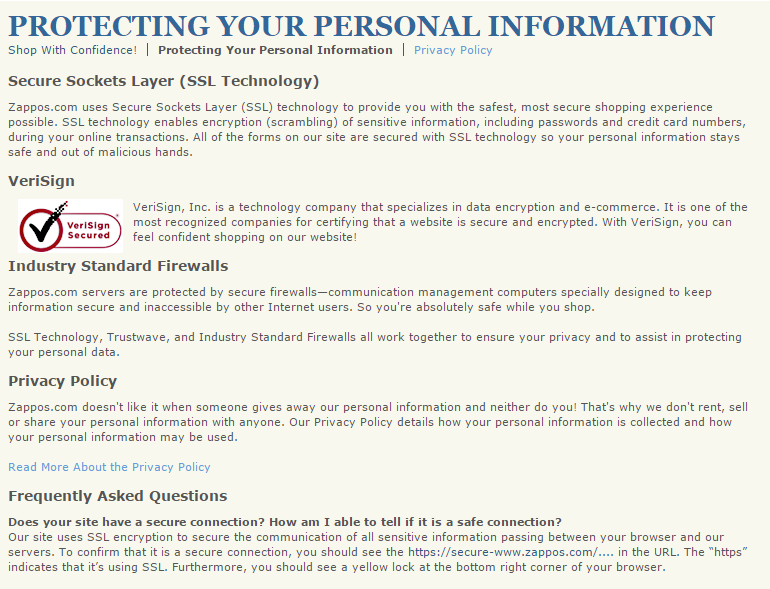
They have clearly defined policies about what they will and won’t do to safeguard shopper information. For one, they promise never to “rent, sell or share” user data to anyone, and immediately below, they link to their privacy policy, which weighs in a bit heavy at over 2500 words, but is yet dwarfed by other more convoluted policies.
They also describe their efforts to safeguard user data from malicious hacking threats through the use of SSL tech and firewalls. Then they have an FAQ addressing commonly expressed security concerns. Finally, they have a 24/7 contact line to assure users of personal attention to their privacy queries.
Now it should be noted that this is a template for a good transparency practices, and not precisely a great example of it. The content and intention is there, so what’s missing?
Good UX.
The fine print is indeed a little too fine, the text is a bit too dense (at least where the actual privacy policy is concerned), and the page itself is buried within the fat footer on the main page.
So who does a better job?
CodePen has actually produces an attractively progressive solution.
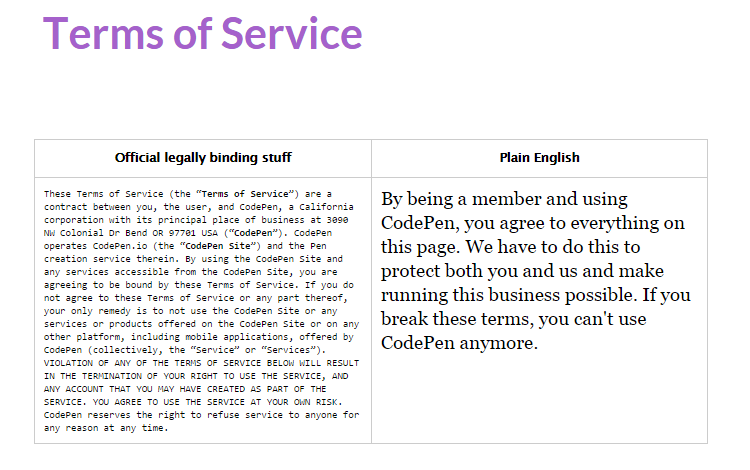
As you can see, CodePen has taken the time to produce two different versions of their ToS. A typical, lengthy bit of legalese on the left, and an easily readable layman’s version on the right. Providing these as a side by side comparison shows user appreciation and an emphasis on providing a positive UX.
This is all well and good for the traditional web browsing environment, but most of the problems with privacy these days stem from mobile usage. Let’s take a look at how mobile applications are taking advantage of the lag between common knowledge and current technology to make a profit off of private data.
Mobile Permissions
In the mobile space, the Google Play store does a decent job of letting users know what permissions they’re giving, whenever they download an app with its “Permission details” tab:
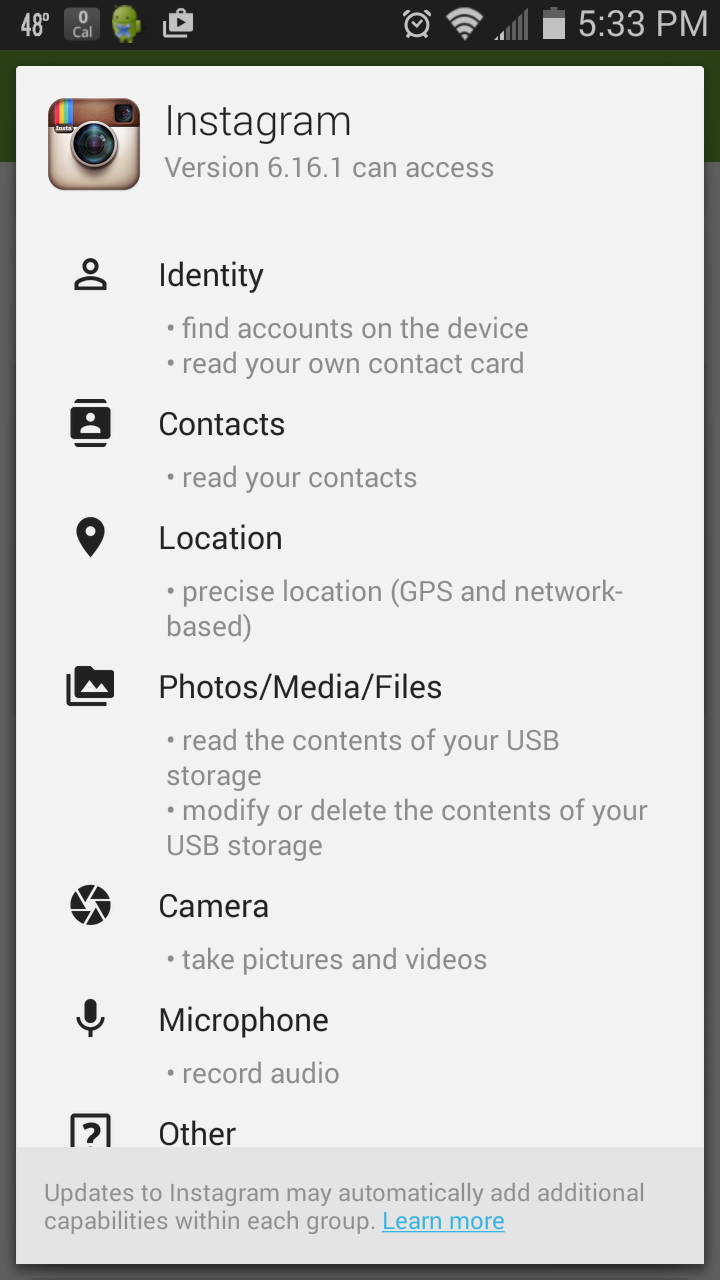
As you can see, Instagram is awfully nosy, but that’s no surprise. Instagram has come under fire for their privacy policies before. What’s perhaps more surprising, is the unbelievable ubiquity with which invasive data gathering is practiced in the mobile space. Compare Instagram’s permissions to another popular application you might have added to your smartphone’s repertoire:
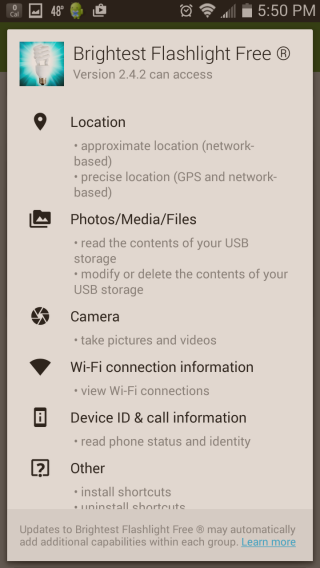
Why, pray tell, does a flashlight have any need for your location, photos/media/files, device ID and/or call information? I’ll give you a clue: it doesn’t.
“Brightest Flashlight Free” scoops up personal data and sells it to advertisers. The developer was actually sued in 2013 for having a poorly written privacy policy. One that did not disclose the apps malicious intentions to sell user data.
Now the policy is up to date, but the insidious data gathering and selling continues. Unfortunately, it isn’t the only flashlight application to engage in the same sort of dirty data tactics. The fact is, you have to do a surprising amount of research to find any application that doesn’t grab a bit more data than advertised, especially when the global market for mobile-user data approaches nearly $10 billion.
For your peace of mind, there is at least one example of an aptly named flashlight application which doesn’t sell your personal info to the highest bidder.
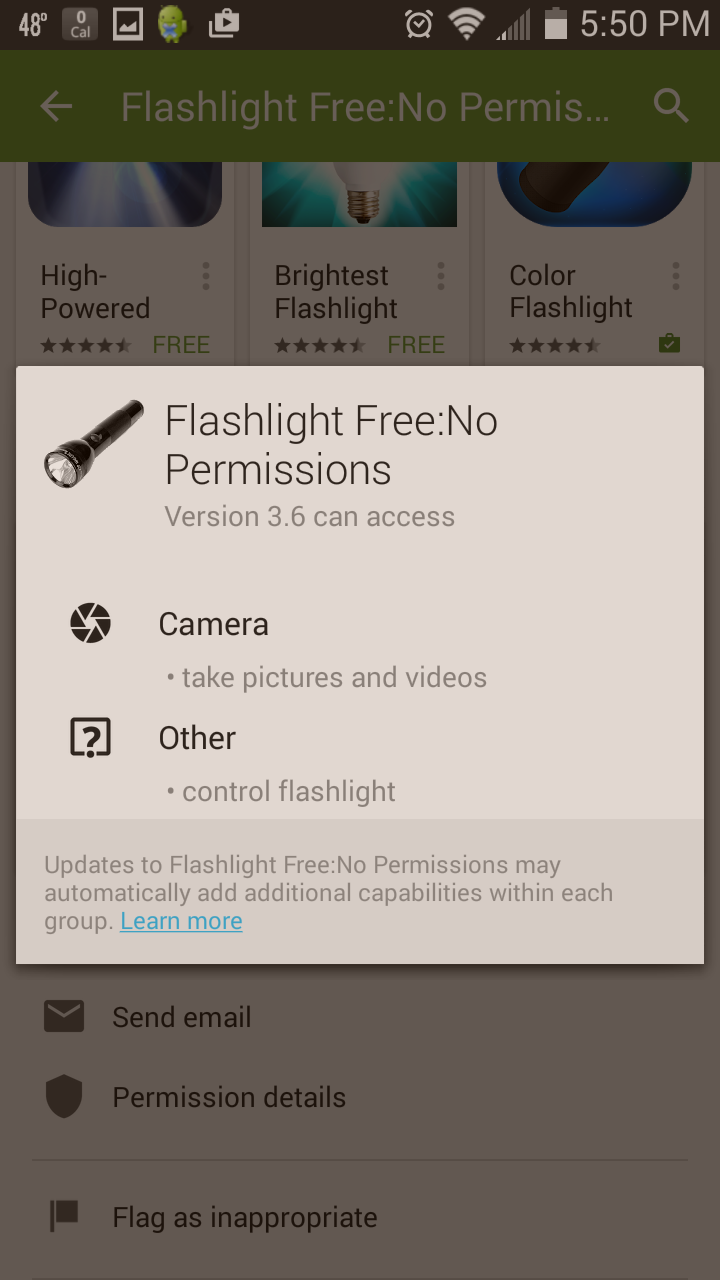
But don’t get too enthusiastic just yet. This is just one application. How many do you have downloaded on your smartphone? Chances are pretty good that you’re harboring a corporate spy on your mobile device.
Hell, even the Holy Bible takes your data:
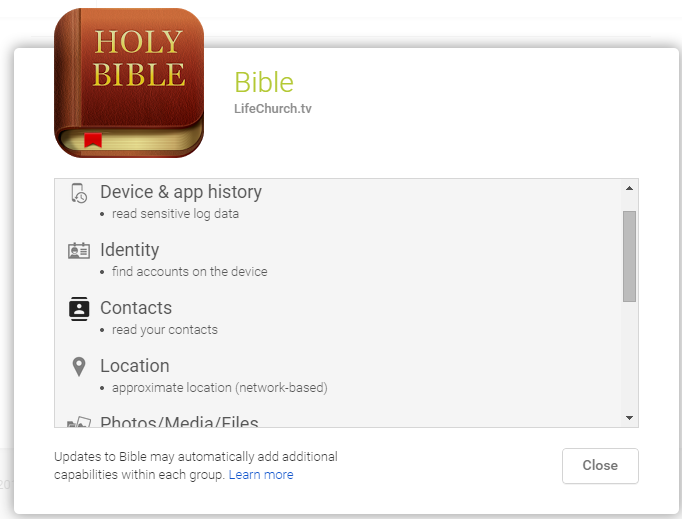
Is nothing sacred? To the App developer’s credit, they’ve expressed publicly that they’ll never sell user data to third party interests, but it’s still a wakeup call.
Privacy and UX
What then, are some UX friendly solutions? Designers are forced to strike a balance. Apps need data to run more efficiently, and to better serve users. Yet users aren’t used to the concerns associated with the wholesale data permissions required of most applications. What kind of design patterns can be implemented to bring in a bit of harmony?
First and foremost, it’s important to be utilitarian in your data gathering. Offering informed consent is important, letting your users know what permissions they’re granting and why, but doing so in performant user flows is paramount.
For example, iOS has at least one up on Android with their “dynamic permissions.” This means iOS users have the option of switching up their permissions in-app, rather than having to decide all or nothing upon installation as with Android apps.
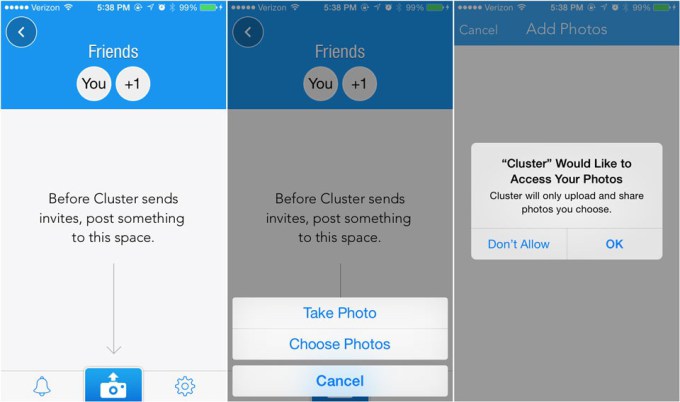
http://techcrunch.com/2014/04/04/the-right-way-to-ask-users-for-ios-permissions/
Note how the Cluster application prompts the user to give access to their photos as their interacting with the application, and reassures them of exactly what the app will do. The user is fully informed, and offers their consent as a result of being asked for a certain level of trust.
All of this is accomplished while they’re aiming to achieve a goal within the app. This effectively moves permission granting to 100% because the developers have created a sense of comfort with the application’s inner workings. That’s what designing for privacy is all about: slowly introducing a user to the concept of shared data, and never taking undue advantage of an uninformed user.
Of course, this is just one facet of the privacy/UX conversation. Informing a user of what they’re allowing is important, but reassuring them that their data is secure is even more so.
Safeguarding User Data
Asking a user to trust your brand is essential to a modern business model, you’re trying to engender a trust based relationship with all of your visitors, after all. The real trick, however, is convincing users that their data is safe in your hands—in other words, it won’t be sold to or stolen by 3rd parties, be they legitimate corporations or malicious hackers.
We touched on this earlier with the Zappos example. Zappos reassures its shoppers with SSL, firewalls, and a personalized promise never to share or sell data. All of which should be adopted as industry standards and blatantly advertised to assuage privacy concerns.
Building these safeguards into your service/application/website/what-have-you is extremely important. To gain consumer trust is to first provide transparency in your own practices, and then to protect your users from the wolves at the gate.
Fortunately, data protection is a booming business with a myriad of effective solutions currently in play. Here are just a few of the popular cloud-based options:
Whatever security solutions you choose, the priorities remain the same. Build trust, and more importantly: actually deserve whatever trust you build.
It hardly needs to be stated, but the real key to a future where personal privacy still exists, is to actually be better people. The kind that can be trusted to hold sensitive data.
Is such a future still possible? Let us know what you think in the comment section.
Kyle Sanders is a member of SEOBook and founder of Complete Web Resources, an Austin-based SEO and digital marketing agency.
Categories:
SearchCap: Google Maps Pac-Man, Google/Baidu China & Senator Lee FTC
Below is what happened in search today, as reported on Search Engine Land and from other places across the web.
The post SearchCap: Google Maps Pac-Man, Google/Baidu China & Senator Lee FTC appeared first on Search Engine Land.
Please visit Search Engine Land for the full article.
The Power of Persuasion: ABCs of Leveraging Personas for Search Success [#CZLNY]
During his session at ClickZ Live New York, Grant Simmons of Homes.com chatted about the value of personas in achieving search success.
Click-to-Call Deep Dive: Best Practices from Search Experts – April 16 Webcast
Tips for search marketers trying to turn mobile callers into customers.
The post Click-to-Call Deep Dive: Best Practices from Search Experts – April 16 Webcast appeared first on Search Engine Land.
Please visit Search Engine Land for the full article.