Seasonal pages and SEO: who’s ready for Euro 2016?
Seasonal events which can deliver relatively short-term traffic spikes, need to be planned for from an SEO perspective.
What is quality content?
Columnist Patrick Stox takes a comprehensive look at what Google might consider to be “quality content” and adds his own thoughts and tips based on his experience in the SEO industry.
The post What is quality content? appeared first on Search Engine L…
Do you have the right local SEO tools for the job?
Planning and executing a local search campaign requires a lot of data and insight, making a good local SEO tool stack invaluable. Columnist and local search expert Andrew Shotland shares his.
The post Do you have the right local SEO tools for the job?…
Will Search Engines Fall To AI?
With the advent of AI in our daily lives, do search engines need to fear for their future? Cedric Chambaz gives us his view.
Post from Cedric Chambaz
Google beats Apple to become world’s most valuable brand
Since 2011, Google and Apple have been competing to be the most valuable, according to Millward Brown Digital’s annual report. This year, Google is back on top.
Google Gets A Bird Watcher Doodle For Phoebe Snetsinger
Today on the Google home page in the United States and some other countries is a special Google Doodle, Google Logo, for Phoebe Snetsinger. Phoebe Snetsinger was a birder, a bird watcher, who saw 8,398 species of birds by the time she died at the youn…
Apple App Store To Get Search Ads
Apple is bringing search ads to their App Store. Apple announced it last night saying, “starting this summer, you’ll be able to participate in the Search Ads beta and see the ads in action…
When Will Your Local Business Show Up In Google’s One Box?
Joy Hawkins asked another excellent local SEO question in the Local Search Forums the other day. She asked why do some business listings get a local one box result…
7 ways to increase sales by creating trust
The key to converting a visitor into a client is the creation of trust. Your product can be the greatest thing on earth or the dullest office supply ever, both can be sold online when your visitor knows you are the best supplier for that product or service. We often advise on how to gain […]
How will the Local Source tag affect SEO?
In order to elevate its Google News feature to meet this standard, Google launched its newest component, the Local Source tag, on Monday, May 9.
Having Issues With Your Google Disavow File? Upload One Line At A Time
Like it or not, many SEOs use the disavow backlinks feature within Google which launched in 2012 mostly based on webmaster feedback.
But sometimes the disavow file can cause a headache for webmasters…
Google’s John Mueller On Flat (Not Growing) SEO Traffic
I always find it interesting when a Googler responds to a specific SEO question with an audit like response…
Phoebe Snetsinger Google doodle marks 85th birthday of famous bird watcher
Snetsinger is credited with seeing 8,393 bird species in her life timeline – the most of any birder at the time of her death.
The post Phoebe Snetsinger Google doodle marks 85th birthday of famous bird watcher appeared first on Search Engine Land.
P…
Do Website Engagement Rates Impact Organic Rankings?
Posted by larry.kim
[Estimated read time: 11 minutes]
Your organic click-through rate is ridiculously important. While it may not be a direct ranking signal that’s even part of Google’s core algorithm, I believe CTR is an indirect signal that definitely impacts rank. And if you improve your click-through rate, you should see your rankings and conversions improve.
Although having a high organic CTR is crucial, having positive website engagement metrics is even more critical. What value is there in getting hundreds or thousands of people to click on your brilliant headlines if those people don’t stick around for more than a few seconds?
If Google values dwell time, is there a way to see it? YES! Today I’ll share some data that shows the relationship between engagement rates (such as bounce rate and time on site) and rankings.
One important note before we get started: Please don’t focus too much on the absolute bounce rate and time on site figures discussed in this article. We are only looking at figures for one particular vertical. The minimum expected engagement will vary by industry and query type.
Does Google measure dwell time? How is that different from bounce rate & time on site?
Yes. We know Google measures dwell time, or how much time a visitor actually spends on a page before returning to the SERPs.
In 2011, Google announced a new option that allowed us to block domains from appearing in our search results. If you clicked on a result and then returned to the SERP from the website within a few seconds, Google’s blocked sites feature would appear. Clicking it would let you block all results from that site.

Google told us they would study the data and considered using it as a ranking signal.
Although that feature is no longer with us, we know it was based on whether (and how quickly) you bounced back. So we know Google is definitely measuring dwell time.
The problem is, we don’t have a way to measure dwell time. However, we can measure three engagement metrics that are proportional to and directionally equivalent to dwell time: bounce rate, time on site, and conversion rate.
Does Bounce Rate Impact Organic Position?
OK, let’s get the official Google line out of the way. Google’s Gary Illyes tweeted the following in 2015: “we don’t use analytics/bounce rate in search ranking.” Matt Cutts said similar in the past. Pretty clear, right?
However, I’m not saying that bounce rate is used as a direct ranking factor. And Google definitely doesn’t need Google Analytics to compute dwell time. What I believe is that, in some Rube Goldbergian way, bounce rate does in fact (indirectly) impact rankings.
Does the data back that up? We looked to see if the bounce rate of the pages/keywords we were ranking for had any relationship to their ranking. Check out this graph:
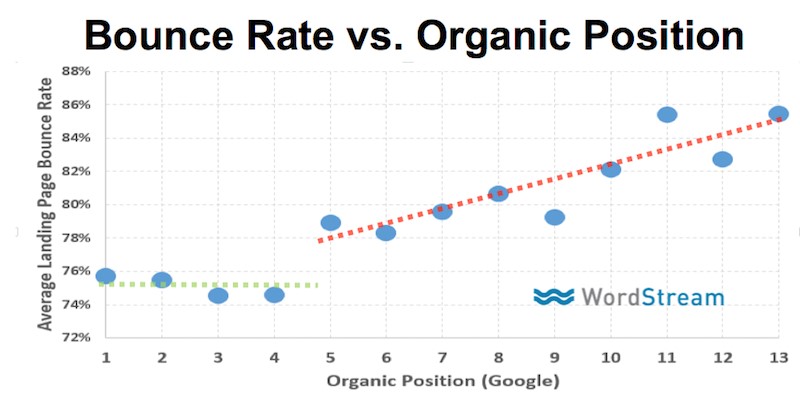
This is very peculiar. Notice the “kink” between positions 4 and 5? In mathematical terms, this is called a “discontinuous function.” What’s happening here?
Well, it seems like for this particular keyword niche, as long as you have a low bounce rate (below 76 percent) then you’re more likely to show up in positions 1 through 4. However, if your bounce rate is higher (above 78 percent), then you’re much less likely to show up in those coveted top 4 positions.
Am I saying bounce rate is part of the core search algorithm Google uses? No.
But I think there’s definitely a relationship between bounce rate and rankings. Looking at that graph, it leads me to believe that it’s no accident — but in fact algorithmic in nature.
My guess is that algorithms use user engagement as a validation method. Think of it more like a “check” on click-through rates within the existing algorithm that hasn’t been quantified.
Undoubtedly, click-through rates can be gamed. For example, I could promise you the digital equivalent of free beer and have a ridiculously high click-through rate.

Image via Fox.
But if there’s no free beer to be had, most (if not all) of that traffic will bounce right back.

Image via Fox.
So I believe Google is measuring dwell time (which is proportional to bounce rate) to check whether websites getting high CTRs actually deserve it and if the clicks are indeed valid, or if it’s just click bait.
One other question this discussion obviously raises is: do higher rankings cause higher engagement rates, as opposed to the other way around? Or could both of these be caused by some a completely unrelated factor?
Well, unless you work at Google (and even then!) you may never know all the secrets of Google’s algorithm. There are things we know we don’t know!
Regardless, improving user engagement metrics, like bounce rate, will still have its own benefits. A lower bounce rate is just an indicator of success, not a guarantee of it.
Does time on site impact organic position?
Now let’s look at time on site, another metric we can measure that is proportional to dwell time. This graph also has a “kink” in the curve:

It’s easy to see that if your keyword/content pairs have decent time on site, then you’re more likely to be in top organic positions 1–6. If engagement is weak on average, however, then you’re more likely to be in positions 7 or lower.
Interestingly, you get no additional points after you cross a minimum threshold of time on site. Even if people are spending 2 hours on your site, it doesn’t matter. I think you’ve passed Google’s test — passing it by even more doesn’t result in any additional bonus points.

Image via Fox.
Larry’s Theory: Google uses dwell time — which we can’t measure, but is proportional to user engagement metrics like bounce rate, time on site, and conversion rates — to validate click-through rates. These metrics help Google figure out whether users ultimately got what they were looking for.
Conversion rates: The ultimate metric
So now let’s talk about conversion rates. We know that higher click-through rates typically translate into higher conversion rates:

If you can get people really excited about clicking on something, that excitement typically carries through to a purchase or sign-up.
So what we need is an Engagement Rate Unicorn/Donkey Detector, to detect high and low engagement rates.

Before we go any further, we need to know: what is a good conversion rate?

On average across all industries, site-wide conversion rate for a website is around 2 percent (the donkeys), while conversion rates for the top 10 percent of websites (the unicorns) get 11 percent and above. While absolute conversion rates vary wildly by industry, unicorns always outperform donkeys by 3–5x regardless of industry.
Remember, conversion rates are a very important success metric because you get the most value (you actually captured leads, sold your product, got people to sign up for your newsletter, or visitors did whatever else it was you wanted them to do), which means the user found what they were looking for.
How do you turn conversion rate donkeys into unicorns?

Image via Fox.
The way you don’t get there is by making little changes. The difference between donkeys and unicorns is so huge. If you want to increase your conversion rates by 3x to 5x, then small, incremental changes of 2 or 3 percent usually won’t cut it.
What should you do?
1. Change your offer (in a BIG way)
Rather than A/B testing button color or image changes, you might be better off trashing your current offer and doing a new one.
Ask yourself: Why in the world are 98 percent of the people who see your offer not taking you up on it? Well, it’s probably because your offer sucks.
Image via Fox.
What can you offer that will resonate enough that +10 percent of people would be excited about signing up for it or buying it on the spot?
Be open-minded. The answer is probably something adjacent to what you’re currently doing.
For example, for my own company, five years ago our primary offer was to sign up for a trial of our software. It was somewhat complicated, people had to learn how to use the software, and not everyone made it through the process.
Then I had an epiphany: Why don’t I just grade people’s accounts without having them do a trial of our PPC management software, and just give them a report card? That increased my conversion and engagement rates by 10x, and the gains persisted over time. There is much more leverage in changing the offer versus, say, the image on an existing offer.
2. Use Facebook Ads
You can influence users even before they do searches. Brand awareness creates a bias in people’s minds which has a ridiculously huge impact on user engagement signals. We can do this with Facebook Ads.
You want to promote inspirational, compelling, memorable content to your target market. Although they’ll consume your content, they won’t convert to leads and sales right away. Remember, love takes time.

Image via Fox.
Rather, your goal is to bias them so in the future they’ll do a search for your product. If it’s an unbranded search, having been exposed to your marketing materials in the past, they’ll be more likely to click on and choose you now.
Facebook and many other vendors have conducted lift studies that prove that Facebook ads impact clicks and conversions you’ll get from paid and organic search.

You won’t get away with promoting junk. You have to promote your unicorns.
For this, we’ll use Facebook’s:
- Interest-Based Targeting to reach people who are likely to search for the things you’re selling.
- Demographic Targeting to reach people who are likely to search for the stuff you’re selling, maybe within the next month.
- Behavioral Targeting to reach the people who buy stuff that is related to the stuff you’re selling.
For example, let’s say you’re a florist or jeweler. You can target Facebook ads at people who will celebrate an anniversary within the next 30 days.

Why would you want to do this? Because you know these people will be searching for keywords relating to flowers and jewelry soon. That’s how you can start biasing them to get them to have happy thoughts about your business, increasing the likelihood that they’ll click on you, but more importantly, convert.
It’s not just Facebook. You can also buy image display ads on Google’s Display Network. You can use Custom Affinity Audiences to target people who have searched on keywords you’re interested in, but didn’t click through to your site (or you can specify certain categories related to your business).
3. Remarketing

Image via Fox.
People are busy and have short attention spans. If you aren’t using remarketing, essentially you’re investing a ton of time and money into your SEO and marketing efforts just to get people to visit one time. That’s crazy.
You want to make sure the people who gave you a look to see what your site was about never forget you so that subsequent searches always go your way. You want them to stay engaged and convert.
Remarketing greatly impacts engagement metrics like dwell time, conversion rate, and time on site because people are more familiar with you, which means they’re more likely to be engaged with you for longer.
There’s a reason we spent nearly a million dollars on remarketing last year. Investing in remarketing:
- Boosted repeat visits by 50 percent.
- Increased conversions by 51 percent.
- Grew average time-on-site by 300 percent.
These are huge numbers for a minimal investment (display ads average around $10 for 1,000 views).
It’s your job to convert or squeeze as much money as you can from people who are already in the market for what you sell. So use remarketing to increase brand familiarity and increase user engagement metrics, while simultaneously turning the people who bounced off your site in the past into leads now.
4. Clean up your bad neighborhoods!
If you’ve tried all of the above (and other ways to improve engagement rates) and still have bad neighborhoods on your websites that have low CTR and/or user engagement rates — just delete them. Why?
I believe that terrible engagement metrics will lead to a death spiral where your site gets less clicks, less leads, less sales, and even lower rankings. And who wants that?
Now, I don’t have any proof of this, but the software engineer in me suspects that it would be very difficult for Google to compute engagement rates for every keyword/page combination on the Internet. They would need to lean on a “domain-level engagement score” to fall back on in the event that more granular data wasn’t available. Google does something conceptually similar in AdWords by having both account-level and keyword-level Quality Scores. It’s also similar to how many believe that Google considers links pointing to your domain and also individual pages on your site when computing organic rankings (a moment of silence for our beloved Google PageRank Toolbar). Dumping your very worst neighborhoods — only if all attempts to resuscitate have failed miserably — would, in theory, raise a domain-level score, if it existed.
Obviously better CTRs, higher engagement rates, and improved conversion rates lead to more leads and sales. But I also believe that improvement in these metrics will lead to better organic search rankings, creating a virtuous cycle of even more clicks and conversions.
Conclusion
It’s becoming increasingly clear that organic CTR matters. But you might not realize that high CTRs with low engagement rates aren’t that meaningful.

Image via Fox.
So no cheap tricks, guys! Don’t invest in sites that specialize in gaming your click-through rates. Even though they might work now to an extent, they won’t work well in the future. Google is good at fighting click fraud on ad networks, so you can expect them to apply those same learnings to fight organic search click fraud.
I would prioritize click-through rate and conversion rate (or engagement) optimization at the very top of the most impactful on-page-SEO efforts.
At the very least you’ll get more conversions. But if I’m right, you’ll not only get more conversions, but you’ll get better rankings, which will lead to more conversions and even better rankings.
So use the tactics and strategies from this post to diagnose your engagement rates, and then start optimizing them!
Sign up for The Moz Top 10, a semimonthly mailer updating you on the top ten hottest pieces of SEO news, tips, and rad links uncovered by the Moz team. Think of it as your exclusive digest of stuff you don’t have time to hunt down but want to read!
Apple gets into the SEM business with paid-search for app developers
The possibility of an AdWords-like paid search model for the iOS App Store was first raised in April in a Bloomberg Report.
The post Apple gets into the SEM business with paid-search for app developers appeared first on Search Engine Land.
Please vis…
SearchCap: Bing News PubHub, AdWords features & ranking tips
Below is what happened in search today, as reported on Search Engine Land and from other places across the web.
The post SearchCap: Bing News PubHub, AdWords features & ranking tips appeared first on Search Engine Land.
Please visit Search Engine Land for the full article.
Meeker report: what you should know about the rise of visual content
Mary Meeker’s annual report indicates the steady increase of visual content and it leads to many interesting insights, both for users and brands.
com.google. android. google quick searchbox in Google Analytics is Organic Search Traffic
Android Google Search App Traffic Appears as Referral Source in Google Analytics
Over the last month, new referral source may have creeped into your Google Analytics reports called “com.google.android.googlequicksearchbox”. What is this? It’s actually organic search traffic from the google andriod app.…
The post com.google. android. google quick searchbox in Google Analytics is Organic Search Traffic appeared first on Seer Interactive.
All new Marketing Land report: “B2B Predictive Marketing Analytics Platforms”
Marketing Land’s all-new “B2B Predictive Marketing Analytics Platforms: A Marketer’s Guide” examines the market for B2B marketing analytics software platforms and the considerations involved in implementing this software into your business. This 35-page report is your source for…
Please visit Search Engine Land for the full article.
5 contemporary strategies that help improve your rankings
The rules of the SEO game have changed over the years, but columnist Pratik Dholakiya has some solid strategies for increasing search visibility and authority that you can safely use in 2016.
The post 5 contemporary strategies that help improve your r…