Bing Ads Upgraded URLs Now Supported
Bing Ads announced they now have added support for “upgraded URLs.” Upgraded URLs lets you separate the destination URLs from your tracking parameters…
Google Schedules Last Few Webmaster Hangouts Using Google Hangouts
As you all know, I am a big fan of the Google webmaster hangouts mostly done by John Mueller. We learn a lot of new tidbits from there and also start a bit of controversy after covering things he may or may not mean to say…
Google: Rel Canonical Not Supported For Images
Here is a quicky, just in case you didn’t know. Google doesn’t support the rel=canonical tag for redirecting images from one URL to another.
AdWords Express expands deeper click-to-call reporting, adds ad scheduling and more
Three new features arrive for small businesses using Google’s automated ad service.
The post AdWords Express expands deeper click-to-call reporting, adds ad scheduling and more appeared first on Search Engine Land.
Please visit Search Engine Land for…
Lucky To Be In Local SEO!
 I was talking to a young Local SEO type, a kid in his mid-30s, who was lamenting that his new gig at some dysfunctional digital marketing company sucked and he didn’t want to stick around but he, and most notably, his wife, were scared at the prospect of leaving a job so soon and what […]
The post Lucky To Be In Local SEO! appeared first on Local SEO Guide.
Marketers have high hopes for automated content
In a poll conducted to accompany the ClickZ Intelligence Digital Trends 2016 report, nearly a quarter of respondents identified content marketing as the key trend for their company this year.
How to Sell Projects: A Framework for Project Proposals
.jpg)
This blog post will be focused on external sales, i.e selling your company’s services to clients.
Ecommerce blogging: five proven reasons why it should be part of your SEO strategy
Should ecommerce businesses blog? That’s a question many ecommerce business owners find confusing; it’s easy to visualize the benefit a small business … read more
Are payday lenders prepared for Google’s paid search ban?
Further to this, Google is also banning ads for loans with an APR of 36% or higher in the US only. Ads sending you through to products where repayment is due within 60 days of the date of issue are also banned.
(UPDATE: As of the beginning of August 2016, the payday loan ban has still not been implemented by Google. There has been no official word as to why.)
This ban was introduced as research showed to Google that these loans can result in ‘unaffordable payment and high default rates’, which results in users entering a dangerous spiral of unrepayable debt.
So, what does this mean for websites and brands that are relying solely on paid ads to acquire business in this space?
This niche has been one of the most fiercely fought SERPs in recent years, historically dominated by black hat SEOs.
Because of this and the ‘spammy nature’ of queries, payday loans also saw the introduction of its own algorithm in 2013 to help improve the results provided by Google.
To analyse the paid space, we have a proprietary tool called Market Defender which assesses current bidding strategy based on positions/impression share and outputs your ‘digital market share’ based on total volume of available impressions from the keyword/s positions.
Below shows the share of voice within the paid payday loan space:
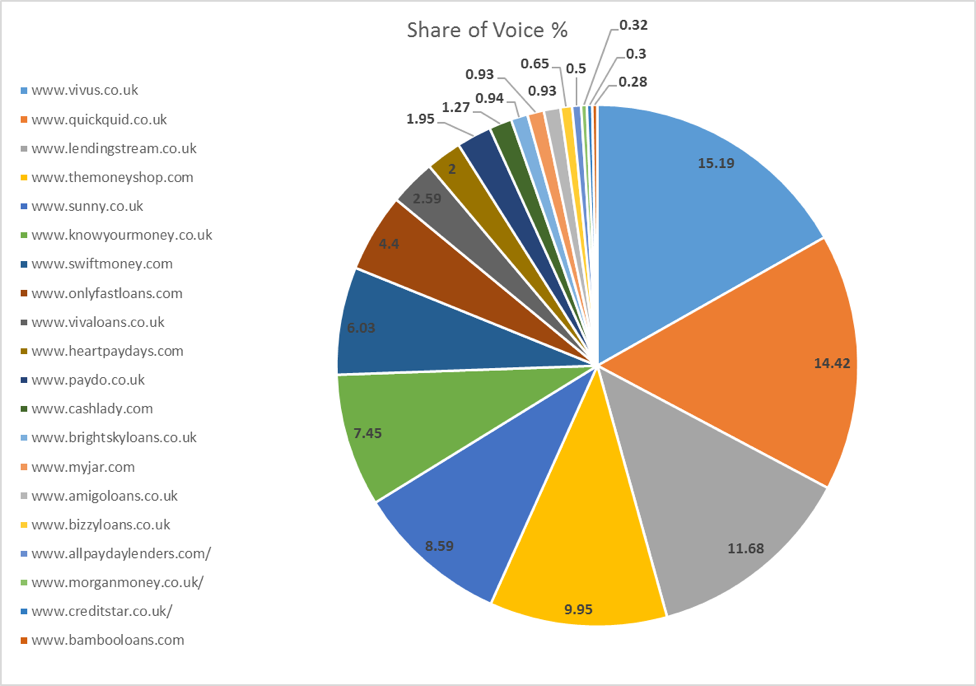
By directly comparing this against the best-performing websites in the payday loan organic search niche, we’re able to then begin our analysis.
To do this analysis, we’ve compiled 508 of the most competitive keywords within the space that has an estimated return of 403,857 visits if you were to rank first for each individual term.
We have removed all aggregator websites such as uSwitch to focus purely on the lenders themselves.
The chart below shows who these websites are:
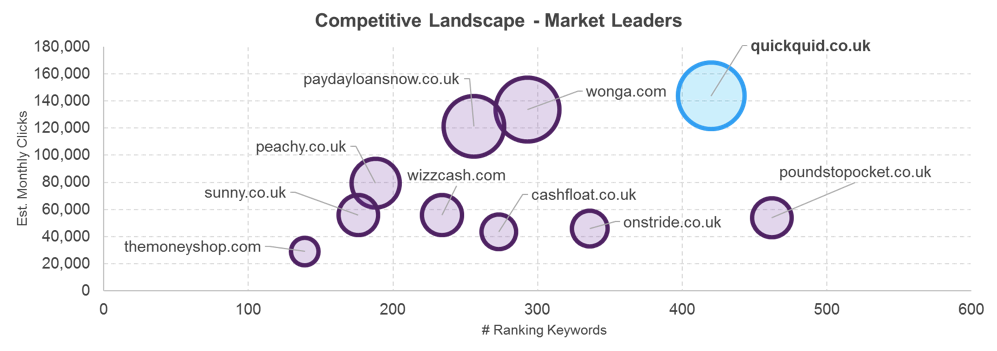
Broken down, we can see how each of the top performing websites in organic search is doing:
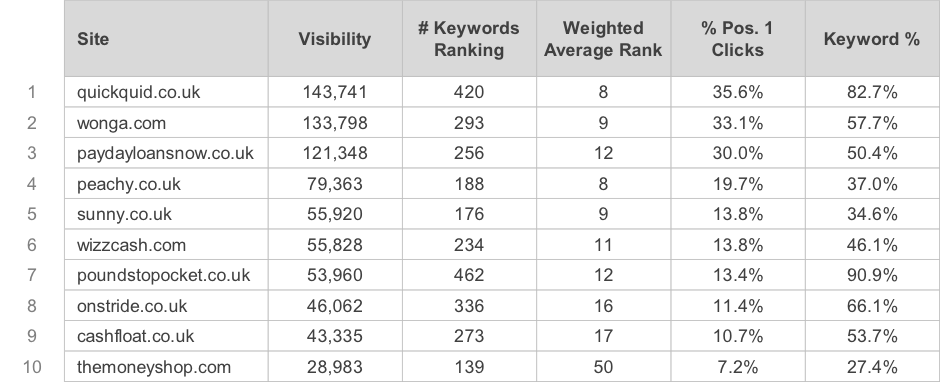
Now by overlaying the top performing websites in paid with organic, we’re able to identify how the best performing paid websites do in both channels:

You can quickly identify that 11 of the 20 websites do not have over 100 visibility in organic search.
This has to be a huge concern for these websites once Google’s new policy eventually comes into place.
Looking at two important organic metrics – domain authority and number of referring domains – we can dive a little deeper into how these websites stand up to one another.
The top 10 paid websites’ authority and number of referring domains can be seen below:

From this research it’s clear that quickquid.co.uk has had both paid and organic sewn up.
In organic, the site doesn’t have the highest authority, but does have the highest number of referring domains.
QuickQuid is close to being the market leader in paid and is the clear market leader in organic search, so let’s look at which bits it’s doing well.
Analysis of QuickQuid’s performance
QuickQuid’s link acquisition strategy is working well with links from websites such as inhabitant.com, lifehacker.com, lifehack.org, buzzfeed.com etc.
It’s generally assumed that distributing content about payday loans is difficult, but with the right strategy it can be simple.
QuickQuid isn’t limiting itself to payday lending, but day-to-day facts people are interested in, which is shareable and, most importantly, linkable!
The method QuickQuid has most often utilised is infographic creation on topics that have huge human interest; lifestyle and the environment.
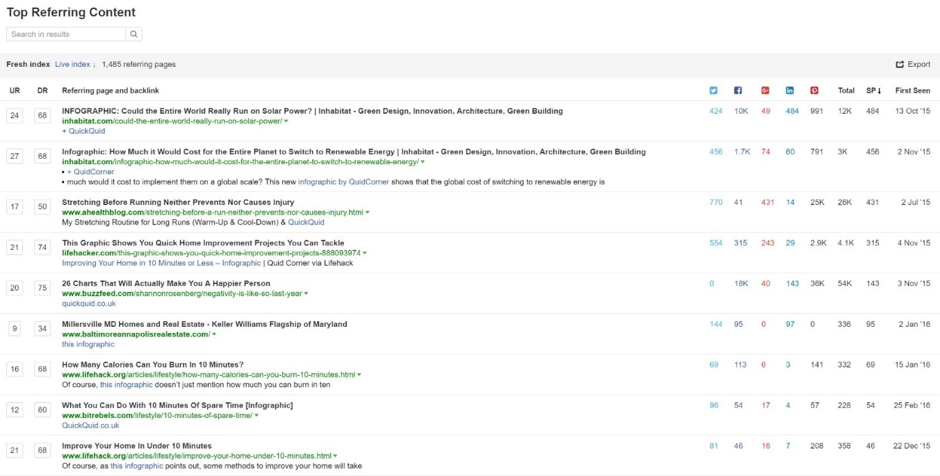
An infographic on ‘Could the entire world really run on solar power’ appears to have done very well – its placement on inhabitant.com acquired 9,900 Likes alone on Facebook, as well as 31 referring domains into the placement, which in turn links through to QuickQuid.
Another infographic on ‘How to create a spa day at home’ was included in a Buzzfeed article on making yourself a happier person.
Lastly, there’s an infographic on ‘How many calories can you burn in 10 minutes’, which has been placed on lifehack.org and attracted 273 shares.
Looking through the ‘Quid Corner’ blog, you’re able to quickly see that this is the company’s main method of content creation and link acquisition.
This method is working in an impressive manner and is helping lift QuickQuid’s website in a difficult niche.
Following on from what is clearly working for QuickQuid, I ran a mini ideation session to better understand how the content strategy might work for QuickQuid.
This is a rundown of our ideation:
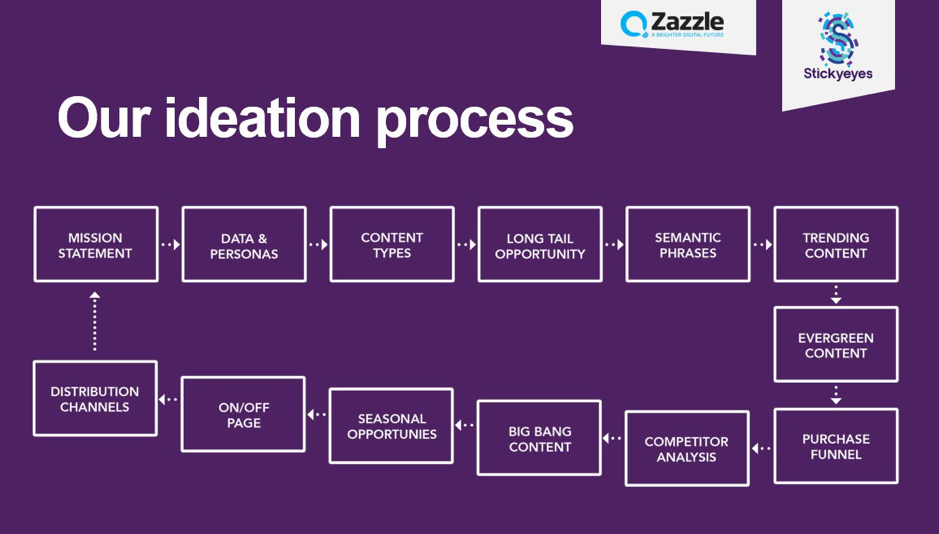
Content ideas
Instead of veering too left field, we’ve tried keeping our ideas related to finance in some capacity.
Below are the ideas, as well as content types we created.

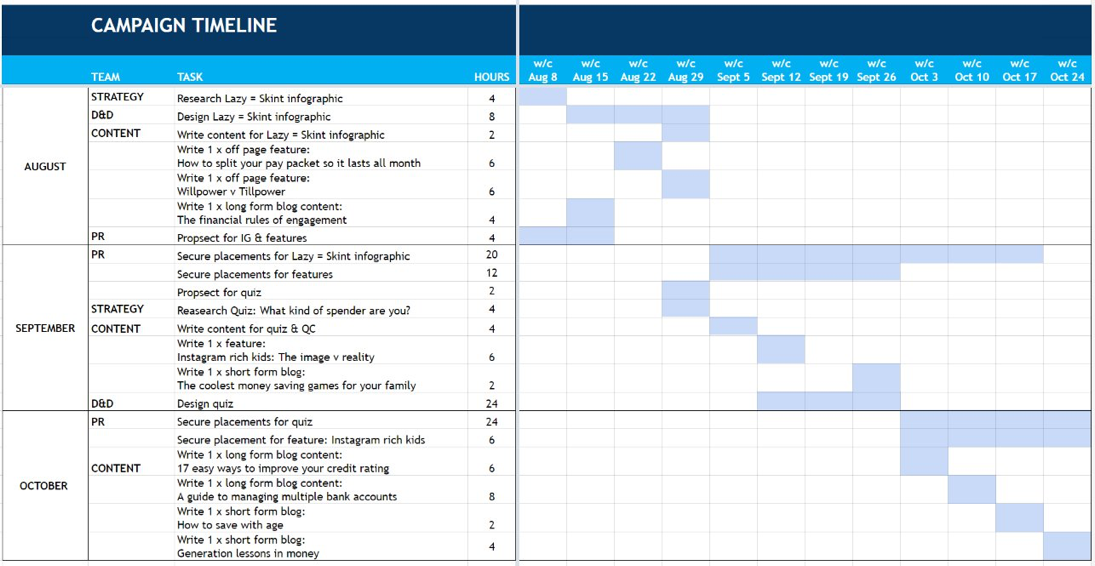
Content campaign plan
Below shows a potential content distribution plan that would take place over three months. It shows the different teams required to make it happen, as well as ensuring good content flow is achieved.
Constantly posting infographics may become tiring for your audience, so it’s important to mix up the content formats. This varies from short form blogs to quizzes.
In summary…
The analysis shows that 12 of the 20 websites are going to massively struggle once the ban is in place due to having next to zero visibility in organic search.
If it was a quick method of making money via paid acquisition, that’s fine, but if these websites want longevity, they’re going to have to begin looking at an organic strategy, and fast.
Are payday lenders prepared for Google’s paid search ban?
Further to this, Google is also banning ads for loans with an APR of 36% or higher in the US only. Ads sending you through to products where repayment is due within 60 days of the date of issue are also banned.
(UPDATE: As of the beginning of August 2016, the payday loan ban has still not been implemented by Google. There has been no official word as to why.)
This ban was introduced as research showed to Google that these loans can result in ‘unaffordable payment and high default rates’, which results in users entering a dangerous spiral of unrepayable debt.
So, what does this mean for websites and brands that are relying solely on paid ads to acquire business in this space?
This niche has been one of the most fiercely fought SERPs in recent years, historically dominated by black hat SEOs.
Because of this and the ‘spammy nature’ of queries, payday loans also saw the introduction of its own algorithm in 2013 to help improve the results provided by Google.
To analyse the paid space, we have a proprietary tool called Market Defender which assesses current bidding strategy based on positions/impression share and outputs your ‘digital market share’ based on total volume of available impressions from the keyword/s positions.
Below shows the share of voice within the paid payday loan space:
By directly comparing this against the best-performing websites in the payday loan organic search niche, we’re able to then begin our analysis.
To do this analysis, we’ve compiled 508 of the most competitive keywords within the space that has an estimated return of 403,857 visits if you were to rank first for each individual term.
We have removed all aggregator websites such as uSwitch to focus purely on the lenders themselves.
The chart below shows who these websites are:
Broken down, we can see how each of the top performing websites in organic search is doing:
Now by overlaying the top performing websites in paid with organic, we’re able to identify how the best performing paid websites do in both channels:
You can quickly identify that 11 of the 20 websites do not have over 100 visibility in organic search.
This has to be a huge concern for these websites once Google’s new policy eventually comes into place.
Looking at two important organic metrics – domain authority and number of referring domains – we can dive a little deeper into how these websites stand up to one another.
The top 10 paid websites’ authority and number of referring domains can be seen below:
From this research it’s clear that quickquid.co.uk has had both paid and organic sewn up.
In organic, the site doesn’t have the highest authority, but does have the highest number of referring domains.
QuickQuid is close to being the market leader in paid and is the clear market leader in organic search, so let’s look at which bits it’s doing well.
Analysis of QuickQuid’s performance
QuickQuid’s link acquisition strategy is working well with links from websites such as inhabitant.com, lifehacker.com, lifehack.org, buzzfeed.com etc.
It’s generally assumed that distributing content about payday loans is difficult, but with the right strategy it can be simple.
QuickQuid isn’t limiting itself to payday lending, but day-to-day facts people are interested in, which is shareable and, most importantly, linkable!
The method QuickQuid has most often utilised is infographic creation on topics that have huge human interest; lifestyle and the environment.
An infographic on ‘Could the entire world really run on solar power’ appears to have done very well – its placement on inhabitant.com acquired 9,900 Likes alone on Facebook, as well as 31 referring domains into the placement, which in turn links through to QuickQuid.
Another infographic on ‘How to create a spa day at home’ was included in a Buzzfeed article on making yourself a happier person.
Lastly, there’s an infographic on ‘How many calories can you burn in 10 minutes’, which has been placed on lifehack.org and attracted 273 shares.
Looking through the ‘Quid Corner’ blog, you’re able to quickly see that this is the company’s main method of content creation and link acquisition.
This method is working in an impressive manner and is helping lift QuickQuid’s website in a difficult niche.
Following on from what is clearly working for QuickQuid, I ran a mini ideation session to better understand how the content strategy might work for QuickQuid.
This is a rundown of our ideation:
Content ideas
Instead of veering too left field, we’ve tried keeping our ideas related to finance in some capacity.
Below are the ideas, as well as content types we created.
Content campaign plan
Below shows a potential content distribution plan that would take place over three months. It shows the different teams required to make it happen, as well as ensuring good content flow is achieved.
Constantly posting infographics may become tiring for your audience, so it’s important to mix up the content formats. This varies from short form blogs to quizzes.
In summary…
The analysis shows that 12 of the 20 websites are going to massively struggle once the ban is in place due to having next to zero visibility in organic search.
If it was a quick method of making money via paid acquisition, that’s fine, but if these websites want longevity, they’re going to have to begin looking at an organic strategy, and fast.
How to solve duplicate content local SEO issues for multi-location businesses
It can be difficult for businesses with multiple locations to craft unique, rich content for each individual location page, but columnist Joy Hawkins has some advice for how to do just that.
The post How to solve duplicate content local SEO issues for…
Make Understanding Your Customer Journey a Priority
A research report recently published by Millward Brown Digital revealed how 55% of senior marketers lack confidence in their organisation’s understanding of the customer journey. With the volume of new digital touchpoints increasing by a fifth each year, marketers across sectors are grappling with how to reach audiences with the right content in the right […]
The post Make Understanding Your Customer Journey a Priority appeared first on Builtvisible.
Now you can share results from the AdWords Ad Preview Tool with clients
Quickly let others see how ads appear in the search results.
The post Now you can share results from the AdWords Ad Preview Tool with clients appeared first on Search Engine Land.
Please visit Search Engine Land for the full article.
Snapchat moves into personalised mobile search
Is Snapchat considering an expansion into contextual search as a way to experiment with new promising features?
Ad Planner Alternatives: 4 API’s for Search Volume Data
Performing comprehensive keyword research for a large site can be a challenge. Often you’ll end up with tens of thousands of keywords from different sources, many of which have their own methods of estimating demand. Historically, this meant reprocessing an entire list of keywords through Google Keyword Planner. This data was far from perfect, but […]
The post Ad Planner Alternatives: 4 API’s for Search Volume Data appeared first on Builtvisible.
Not Provided Count Hits Over 96% Since Google’s HSTS Switch
Earlier this month, Google went HSTS with Google.com, which means it is hard to get to a non-HTTPS version of Google search…
Google AdWords Ad Preview Tool Lets You Share This Result
Google added a new feature to the Google AdWords ad preview tool that lets you share the result with your colleagues.
After you run a search in the tool, there is a new button at the top right that says “share this result…
Moz is Doubling Down on Search
Posted by SarahBird
Hi Moz community,
We wouldn’t be here without you, so I wanted to give you a brief update on some big changes happening at Moz.
Tl;dr: We’re focusing our efforts on core SEO such as rank tracking, keyword research, local listings, duplicate management, on-page, crawl, and links. In the future, we’ll no longer offer Moz Content or Followerwonk.
How is Moz’s strategy changing?
Back in 2012, we started to invest in a broad feature set because we wanted to serve all aspects of inbound marketing. We thought it would increase retention by providing more value to customers, and also align with where we believed the industry was headed. Thus, we invested in many new directions: social media marketing, local SEO, content marketing, keyword research, on-page optimization, topic analysis, a next-generation link index, enterprise sales, customer success, ambitious infrastructure projects, events, education programs, and more.
Increasing the breadth of the product suite added a lot of complexity to the business, but didn’t result in the growth we expected. We do, however, have momentum in our core SEO products, especially Moz Local and the new features in Pro.
Moz Local continues to provide a ton of value for customers who care deeply about Local SEO. Our new duplicate management features are cutting-edge. We’re seeing passion and enthusiasm like we haven’t seen in years about our Keyword Explorer feature in Moz Pro. We believe it’s the best of its kind in the market. Our rankings technology has also improved by leaps and bounds with more coming soon. Really soon.
Churn rates are at all-time lows and Average Revenue Per User (ARPU) is climbing for all of our SEO-focused products.
After a lot of analysis and soul searching, we decided to radically simplify our strategy to re-focus on what we love and what our customers value from us: search. Reducing product complexity also creates space for us to invest in the technical and business infrastructure we need to support growth. We’re also increasing investment in product marketing, CRO, SEO, and email marketing.
<3 Search is our hedgehog <3
We believe the search industry is as important as ever, and surprisingly doesn’t see near the investment it should, given the clear value of SEO as a channel. Organic results still get 80% of the clicks and a fraction of the marketing spend. Further, with a phone in every pocket, mobile and local searches continue to grow. Organizations ignore search at their peril.
We’re passionate about search, we’re good at it, and it’s driving the growth in our business. Classic hedgehog.
What does this mean for the company?
This is the gut-wrenchingly painful part. The hardest part of my job is asking people who have put their hearts and souls into Moz to part ways. To align the organization with this strategic shift, we will be asking about 28% of Mozzers to leave. They are a part of the Moz family and it is heartbreaking that they will not be working alongside us in the future.
We will do everything we can to give them the Mozziest transition possible, including severance, coaching, and assistance finding new roles. Because I know the caliber of folks we’re parting with, I am confident they will go on to do great things.
What does this mean for customers?
Customers will enjoy increased investment in core SEO features, especially in local. We’re on a roll with these products; we’re out to win this market and we believe we can. We’ve got updates planned for crawl and rank tracking that we think you’ll love. We know we’re behind in link technology right now, and we’re working on something ambitious. If you love SEO, please keep watching the blog for updates.
The strategy shift means we will not be investing in Followerwonk or Moz Content. Despite our efforts, we’re not seeing the growth we hypothesized from these products. We will find a graceful way to sunset Moz Content. We’re also looking for a good home for Followerwonk. It is beloved by many, but isn’t having the revenue impact we believed possible, and isn’t close enough to our core base to make sense in our product offering. More details to come.
Send good vibes.
As you can imagine, this is an emotional time for us internally. Hug a Mozzer near you because we need it this week. We’re so grateful for this community’s support and look forward to making SEO software you truly love.
Sign up for The Moz Top 10, a semimonthly mailer updating you on the top ten hottest pieces of SEO news, tips, and rad links uncovered by the Moz team. Think of it as your exclusive digest of stuff you don’t have time to hunt down but want to read!
10 tips to get your website to the top of Google search
There are hundreds of things you can do to top Google search, this is a list concentrating on the more recent SEO developments.
8 Surprising Conversation Starters for Publishers/Editors in Blogger Outreach
Rather than vie for Editors & Bloggers attention against everyone else with content requests start a conversation in a different way – earlier on in the outreach cycle. Chris Green shows some of his favourite ways to start the PR/Outreach process in a way which doesn’t include asking for a link.
Post from Chris Green