Google Granted Design Patent on Camera Bracelet
This design patent shows off a camera mounted on a bracelet. It doesn’t tell us anything about the camera beyond showing off the design of the camera. I looked for profiles of the inventors listed on the patent, and I think the ones I found may be the ones involved in the creation of this … Continue reading Google Granted Design Patent on Camera Bracelet →
The post Google Granted Design Patent on Camera Bracelet appeared first on SEO by the Sea.
Was the 3 Ad Limit Lifted For AdSense?
Used to be, you could only have three AdSense ads on a page at a time – but no longer!
read more
Helping users easily access content on mobile
In Google Search, our goal is to help users quickly find the best answers to their questions, regardless of the device they’re using. Today, we’re announcing two upcoming changes to mobile search results that make finding content easier for users.
Simplifying mobile search results
Two years ago, we added a mobile-friendly label to help users find pages where the text and content was readable without zooming and the tap targets were appropriately spaced. Since then, we’ve seen the ecosystem evolve and we recently found that 85% of all pages in the mobile search results now meet this criteria and show the mobile-friendly label. To keep search results uncluttered, we’ll be removing the label, although the mobile-friendly criteria will continue to be a ranking signal. We’ll continue providing the mobile usability report in Search Console and the mobile-friendly test to help webmasters evaluate the effect of the mobile-friendly signal on their pages.
Helping users find the content they’re looking for
Although the majority of pages now have text and content on the page that is readable without zooming, we’ve recently seen many examples where these pages show intrusive interstitials to users. While the underlying content is present on the page and available to be indexed by Google, content may be visually obscured by an interstitial. This can frustrate users because they are unable to easily access the content that they were expecting when they tapped on the search result.
Pages that show intrusive interstitials provide a poorer experience to users than other pages where content is immediately accessible. This can be problematic on mobile devices where screens are often smaller. To improve the mobile search experience, after January 10, 2017, pages where content is not easily accessible to a user on the transition from the mobile search results may not rank as highly.
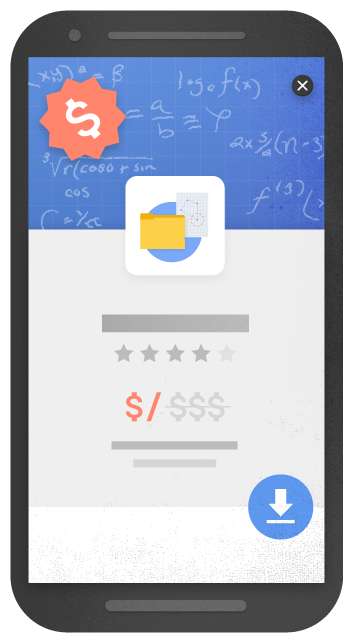
Here are some examples of techniques that make content less accessible to a user:
- Showing a popup that covers the main content, either immediately after the user navigates to a page from the search results, or while they are looking through the page.
- Displaying a standalone interstitial that the user has to dismiss before accessing the main content.
- Using a layout where the above-the-fold portion of the page appears similar to a standalone interstitial, but the original content has been inlined underneath the fold.
Examples of interstitials that make content less accessible

An example of an intrusive popup
An example of an intrusive standalone interstitial
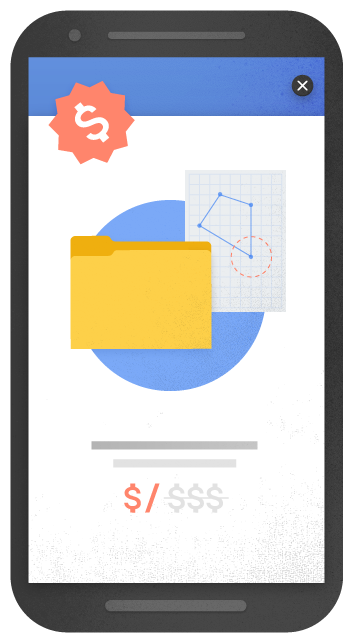
Another example of an intrusive standalone interstitial
By contrast, here are some examples of techniques that, used responsibly, would not be affected by the new signal:
- Interstitials that appear to be in response to a legal obligation, such as for cookie usage or for age verification.
- Login dialogs on sites where content is not publicly indexable. For example, this would include private content such as email or unindexable content that is behind a paywall.
- Banners that use a reasonable amount of screen space and are easily dismissible. For example, the app install banners provided by Safari and Chrome are examples of banners that use a reasonable amount of screen space.
Examples of interstitials that would not be affected by the new signal, if used responsibly
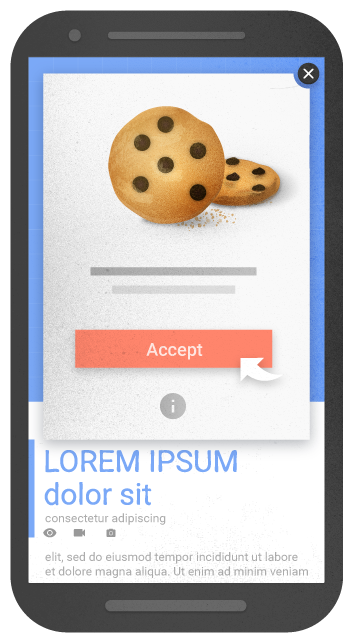
An example of an interstitial for cookie usage

An example of an interstitial for age verification
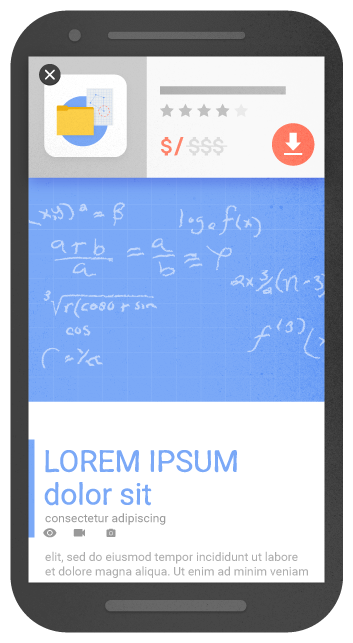
An example of a banner that uses a reasonable amount of screen space
We previously explored a signal that checked for interstitials that ask a user to install a mobile app. As we continued our development efforts, we saw the need to broaden our focus to interstitials more generally. Accordingly, to avoid duplication in our signals, we’ve removed the check for app-install interstitials from the mobile-friendly test and have incorporated it into this new signal in Search.
Remember, this new signal is just one of hundreds of signals that are used in ranking. The intent of the search query is still a very strong signal, so a page may still rank highly if it has great, relevant content. As always, if you have any questions or feedback, please visit our webmaster forums.
Posted by Doantam Phan, Product Manager


Google warns it will crack down on “intrusive interstitials” in January
Google will reinforce its emphasis on the mobile search experience with a new penalty affecting “intrusive interstitials” on mobile web pages.
The post Google warns it will crack down on “intrusive interstitials” in January appeared first on Search Engine Land.
Please visit Search Engine Land for the full article.
Google dropping “Mobile-friendly” label from search results
Google says the change is designed to declutter its search results.
The post Google dropping “Mobile-friendly” label from search results appeared first on Search Engine Land.
Please visit Search Engine Land for the full article.
Voice UI and intelligent assistants: trends to watch out for next
Earlier this year, a report from Consumer Intelligence Research partners (CIRP) pegged the sales of Amazon’s Echo at more than 3 million units.
Bing Ads opens pilot access for Expanded Text Ads
Advertisers can apply now to begin testing ETAs in their campaigns.
The post Bing Ads opens pilot access for Expanded Text Ads appeared first on Search Engine Land.
Please visit Search Engine Land for the full article.
Google Support Rel Canonical For PDFs
The other week we reported that Google doesn’t support real canonical for image search. But Google’s John Mueller clarified this morning that they do support it for PDFs in web search. He also added…
Google Keeps On Testing Card Style Layout
Back in May, we reported Google testing a card style layout for their search results. We reported it other time as well, and also back in 2013.
But now it seems more and more people are seeing the card layout at Google…
HireMoz.com Web Portal Showcases Some Of Those Who Were Laid Off By Moz
Moz did massive cuts last week, where 28% of their staff, or over 60 people…
The human side to SEO: the power of personas
On a fundamental level, effective search engine optimization (SEO) is about creating connections with your target audience. Columnist Ryan Shelley shows how personas can help you achieve these connections.
The post The human side to SEO: the power of …
Audience-First SEO: Increase ROI by Focusing On What Really Matters
In Google’s New York City office is a wall that lists some of the company’s most important mottos. Among these phrases, one sticks out: “Focus on the user and all else will follow.”
Why is this saying so important for digital marketers to remember?…
The post Audience-First SEO: Increase ROI by Focusing On What Really Matters appeared first on Seer Interactive.
Seven strategies for building a thriving community around your blog
The secret to creating an outstanding blog is to cultivate a strong community of fans that helps to generate new traffic.
.jpg)
Integrate lifetime value to benefit a customer-led SEO strategy
Columnist Chris Liversidge explains why fixing your analytics gaps and taking lifetime customer value into account can lead to better results in your organic search initiatives.
The post Integrate lifetime value to benefit a customer-led SEO strategy …
The basics of email marketing
Email marketing is a great tool to bind your audience to your website. It’s relatively easy to set up an email newsletter and send it to your audience. In this post, I’ll explain the basics of email marketing. Why is email marketing an important element of your growth and marketing strategy? Moreover, I’ll also give practical tips […]
Google ** To Find Local Web Sites In Google?
A Reddit thread has one person who spotted that if you search for [**] in Google, Google will primarily show you local web site.
I tried it myself and it looks legit…
Google Doesn’t Follow Links In SVGs
Although Google began crawling and indexing SVGs back in 2010, Google does not follow any links within the Scalable Vector Graphics. SVGs, Scalable Vector Graphics…
Google AdSense Drops Ad Limit Per Page Policy
Over the past 12 hours, I received a few emails and notifications from AdSense publishers that Google seems to have dropped the ad limit per page policy. In the past…
Google shares tips on using AMP for e-commerce
Google documents how to make your e-commerce site AMP-ready.
The post Google shares tips on using AMP for e-commerce appeared first on Search Engine Land.
Please visit Search Engine Land for the full article.