Five surprising benefits of high CTR across all marketing channels
A remarkable CTR is not only the most important thing in AdWords, but it is also extremely important for other marketing channels.
Google AdWords Sitelinks New Linear Format
Google seems to have launched a new user interface and layout for the AdWords Sitelinks. Instead of a 2 by 2 format or the card style format…
Google My Business API Version 3.1 Live
Google has launched version 3.1 of the Google My Business API…
Google My Business Adds Recommendations For Working With Local SEOs
The Google My Business help section added a new page for working with third parties – it aims at giving business owners guidelines when selecting a local SEO company or consultant.
Google wrote:
While Google My Business is free…
Google iOS App Touch ID To Reenter Incognito Mode Searches
Google new iOS search app now lets you search privately using incognito mode but the cool part is that you can leave the app and return to your private search.
The way they control the privacy in that instance is using Touch ID…
Gary Illyes: Google Penguin 4.0 Was One Of Our Nicest Launches
Did you know how proud Google is with the Penguin 4.0, real time, launch? Very proud.
Gary Illyes from Google said…
Google: AMP will override app deep links for the foreseeable future
Even if your user downloads your app, which has app indexing deployed, Google will show them the AMP page over your app page.
The post Google: AMP will override app deep links for the foreseeable future appeared first on Search Engine Land.
Please vi…
Penguin 4.0: what does it mean for SEO practitioners?
As you’re no doubt aware, Google finally rolled out its Google 4.0 algorithm update at the end of last week.
Top Tips for Creating your Integrated Digital Marketing Strategy for 2017
Thinking about your business marketing plans for 2017? Now is the perfect time for planning and refining your 2017 digital marketing strategy! Before putting pen to paper (or more likely mindmap to spreadsheet), take a step back and think about the integrated opportunities that can drive your strategic digital success in 2017 and beyond.
Post from Lee Wilson
The 10 things you need to know about Google Penguin 4.0
Here are the top 10 things you need to know.
1. Penguin is all about spam
As a refresher, Google’s Penguin algorithm is designed to identify spammy sites that slip through Google’s other filters.
It was first launched in 2012, and the last update was rolled out in October 2014.
2. It’s real-time
As Gary Illyes of Google’s Search Ranking Team explained:
Historically, the list of sites affected by Penguin was periodically refreshed at the same time.
Once a webmaster considerably improved their site and its presence on the internet, many of Google’s algorithms would take that into consideration very fast, but others, like Penguin, needed to be refreshed.
With this change, Penguin’s data is refreshed in real time, so changes will be visible much faster, typically taking effect shortly after we recrawl and reindex a page.
This is probably good news for sites that get hit by Penguin, as they won’t need to wait for an update for the chance to make changes and recover.
3. It’s granular
According to Illyes: “Penguin now devalues spam by adjusting ranking based on spam signals, rather than affecting ranking of the whole site.”
What does this mean in practical terms? That isn’t so clear.
Search Engine Land’s Barry Schwartz asked Google for clarification, and based on the company’s response, says:
Our best interpretation… is that Penguin might impact specific pages on a site, or it might impact sections or wide swaths of a site, while other pages are fine.
4. It’s in all languages and countries
Nobody escapes the Penguin.
5. It’s part of the core Google algorithm now
Until now, Penguin has been its own entity.
With Penguin 4.0, Google says that “Penguin is now part of our core algorithm,” which it notes consists of more than 200 other unique signals that can affect rankings.

6. There will be no more announcements of Penguin updates
Now that it’s part of the core algorithm and will work in real-time, Google says that it will no longer comment on future Penguin refreshes.
7. The effects probably won’t be seen immediately
It’s not known whether the new Penguin code has been rolled out to all of Google’s data centers.
But even if it has, it could take time before the effects are seen given that there are almost certainly many URLs that will need to be recrawled.
@dawnieando @rustybrick @Marie_Haynes @dr_pete @JohnMu yup, that one
— Gary Illyes (@methode) September 23, 2016
8. It will be difficult to identify Penguin’s fingerprints
Because of Penguin’s real-time nature, it will be increasingly difficult to identify whether ranking changes can be attributed to Penguin refreshes.
@512banque @methode Given the way these things roll out, I’d say “good luck” — I don’t think that’s easily possible, lots of things overlap
— John Mueller (@JohnMu) September 25, 2016
9. Google’s old advice stays the same
According to TheSEMPost’s Jennifer Slegg, a Google spokesperson confirmed that the company has not changed its linking guidelines, and despite rumors to the contrary, has also not changed its recommendation for using disavows.
@glenngabe OK, clearer: no change on using the disavow file. Use it thoughtfully, as always.
— John Mueller (@JohnMu) September 23, 2016
10. Google still wants you to focus on content quality, not SEO
Google’s Illyes closed the announcement of Penguin 4.0 with a reminder…
The web has significantly changed over the years, but as we said in our original post, webmasters should be free to focus on creating amazing, compelling websites.
While this almost certainly won’t put an end to the art and science we call SEO, updates like Penguin 4.0, coupled with the vast number of signals Google incorporates into its algorithm, mean that companies looking to earn and maintain top rankings can’t ignore the forest for the trees.
As TheSEMPost’s Slegg notes, it’s even possible that sites penalized by the last Penguin update two years ago that thought they cleaned up their act won’t see the recovery they hoped for.
As she observed: “A few years back, some ways of building links were seen as fine, while today they are definitely viewed as problematic.
“And some of the sites that previously had high quality links two years ago could be a low quality site today, if the site was abandoned or the site changed owners.”
For more on this topic, check out our international range of SEO Training Courses.
The 10 things you need to know about Google Penguin 4.0
Here are the top 10 things you need to know.
1. Penguin is all about spam
As a refresher, Google’s Penguin algorithm is designed to identify spammy sites that slip through Google’s other filters.
It was first launched in 2012, and the last update was rolled out in October 2014.
2. It’s real-time
As Gary Illyes of Google’s Search Ranking Team explained:
Historically, the list of sites affected by Penguin was periodically refreshed at the same time.
Once a webmaster considerably improved their site and its presence on the internet, many of Google’s algorithms would take that into consideration very fast, but others, like Penguin, needed to be refreshed.
With this change, Penguin’s data is refreshed in real time, so changes will be visible much faster, typically taking effect shortly after we recrawl and reindex a page.
This is probably good news for sites that get hit by Penguin, as they won’t need to wait for an update for the chance to make changes and recover.
3. It’s granular
According to Illyes: “Penguin now devalues spam by adjusting ranking based on spam signals, rather than affecting ranking of the whole site.”
What does this mean in practical terms? That isn’t so clear.
Search Engine Land’s Barry Schwartz asked Google for clarification, and based on the company’s response, says:
Our best interpretation… is that Penguin might impact specific pages on a site, or it might impact sections or wide swaths of a site, while other pages are fine.
4. It’s in all languages and countries
Nobody escapes the Penguin.
5. It’s part of the core Google algorithm now
Until now, Penguin has been its own entity.
With Penguin 4.0, Google says that “Penguin is now part of our core algorithm,” which it notes consists of more than 200 other unique signals that can affect rankings.
6. There will be no more announcements of Penguin updates
Now that it’s part of the core algorithm and will work in real-time, Google says that it will no longer comment on future Penguin refreshes.
7. The effects probably won’t be seen immediately
It’s not known whether the new Penguin code has been rolled out to all of Google’s data centers.
But even if it has, it could take time before the effects are seen given that there are almost certainly many URLs that will need to be recrawled.
@dawnieando @rustybrick @Marie_Haynes @dr_pete @JohnMu yup, that one
— Gary Illyes (@methode) September 23, 2016
8. It will be difficult to identify Penguin’s fingerprints
Because of Penguin’s real-time nature, it will be increasingly difficult to identify whether ranking changes can be attributed to Penguin refreshes.
@512banque @methode Given the way these things roll out, I’d say “good luck” — I don’t think that’s easily possible, lots of things overlap
— John Mueller (@JohnMu) September 25, 2016
9. Google’s old advice stays the same
According to TheSEMPost’s Jennifer Slegg, a Google spokesperson confirmed that the company has not changed its linking guidelines, and despite rumors to the contrary, has also not changed its recommendation for using disavows.
@glenngabe OK, clearer: no change on using the disavow file. Use it thoughtfully, as always.
— John Mueller (@JohnMu) September 23, 2016
10. Google still wants you to focus on content quality, not SEO
Google’s Illyes closed the announcement of Penguin 4.0 with a reminder…
The web has significantly changed over the years, but as we said in our original post, webmasters should be free to focus on creating amazing, compelling websites.
While this almost certainly won’t put an end to the art and science we call SEO, updates like Penguin 4.0, coupled with the vast number of signals Google incorporates into its algorithm, mean that companies looking to earn and maintain top rankings can’t ignore the forest for the trees.
As TheSEMPost’s Slegg notes, it’s even possible that sites penalized by the last Penguin update two years ago that thought they cleaned up their act won’t see the recovery they hoped for.
As she observed: “A few years back, some ways of building links were seen as fine, while today they are definitely viewed as problematic.
“And some of the sites that previously had high quality links two years ago could be a low quality site today, if the site was abandoned or the site changed owners.”
For more on this topic, check out our international range of SEO Training Courses.
How a Single Piece of Content Increased Our DA by +7 Points [Case Study]
Posted by sergeystefoglo
Content marketing has been discussed and researched more in the last 5 years than ever before.

Source: Google Trends
There are various kinds of content marketing strategies out there. Blog promotion, infographics, video strategies, and creative content are some. Depending on your goals, some are more effective than others.
At Distilled, we’ve been fortunate enough to work on many creative content pieces with some incredible clients. This article is going to focus on a piece of content that my team and I created for a client. We’ll take a look at both the creation process and the tangible results of the piece we made.
Note: In general, you don’t want to rely on one piece of content for link acquisition. It’s recommended to focus on multiple pieces throughout the year to add link diversity and give your content pieces a good chance to succeed. The following is simply a case study of one piece of content that worked well for my client.
Client backstory: We need links!
Our client is Ginny’s (shoutout to Matt and Cailey). Ginny’s is an ecommerce business based in the beautiful state of Wisconsin.
We knew that regardless of how much optimization was done on the site, their lack of incoming links would be a huge barrier to success. This quickly became a topic of discussion for us.

The general rule of thumb: the more linking root domains (LRDs) your site has, the stronger the domain authority should be. And the stronger the linking root domains are, the better it is for your DA. In other words, it’s better to get 1 strong link (DA 80+) than 10 weak links (DA 20-). Kudos if the links are topically relevant to your website/brand.

So, my team and I sat down and started thinking of different ways we could accomplish the task of increasing LRDs and (hopefully) DA for my client.
The process of creating a link-worthy story
Here are the steps my team and I went through for this particular client.
Note: For an extensive look at creating creative content, please see the following articles:
- How to Make Award-Winning Creative Content – Part 1
- How to Make Award-Winning Creative Content – Part 2
Ideation
The first step in the creative process is ideation, because without great ideas you can’t a have a great piece of content. It’s important to give yourself enough time for ideation. Don’t rush it, and be sure to include various team members with different backgrounds to get as many ideas as possible. Note: stock up on coffee/Red Bull and snacks for this.
Validation
Typically after an ideation session you’ll have many potential ideas. It’s important to go through and validate them. When I say “validate,” I mean making sure others haven’t already done something similar, or that creating the piece is actually possible (you have access to the right data, etc.)
Note: For more information on researching and validating your creative ideas, read this post titled “Researching Creative Ideas: 10 Dos and Don’ts.”
Pitching
At this point you’ll have a handful of ideas that are not only on-brand and interesting, but have great potential in being picked up by various sources. Put together a nice deck and pitch your ideas to the client. The goal is to get your client to pick one (or a few, depending on the budget).
Note: Here’s an awesome write-up on a framework for pitching creative ideas to your clients.
Gathering the data
Once your client signs off on a piece, it’s time to dive into the data! Depending on the piece you’re creating, this might look like scraping websites and doing a ton of research to get the right data you need. Take your time on this, as you want to make sure your data is accurate and relevant.
Design
During this part of the process, it’s a great idea to start mocking up some potential designs. If your piece is smaller, this might be a quick and simple task. If you have a data visualization, this will be longer. Typically, it’s a good idea to create 2–3 mockups and give your client some options.
Development
Once your client signs off on a particular design, it’s time to dive into development.
Copy
The actual copy for the piece doesn’t have to happen after the development, but it’s usually a good idea to allow the copywriter to see how much space they have to work with. What you don’t want is for your copywriter to write 500 words when the designer has made space for 100. Communication is key in this process.
Testing
Once the piece is built, it’s important to test it out on various browsers and devices. Ask people to give it a run and try to fix as many errors/bugs as possible.
Promotion
Depending on your timeline, you might want to start promotion sooner than this. The important thing to note is to consider pre-pitching and reaching out to contacts to gauge their interest in the piece as soon as possible. Keep your contacts updated and be sure to give them everything they need for their stories.
Note: For further reference on pitching journalists, please see this post titled, “Beyond the Media List: Pro-Active Prospecting for Pitching Creative Content.”
Launch
It’s time to launch!
Push
On the day the piece launches, be sure that you are reminding journalists, reaching out to contacts, sharing the piece on social media, and making your social campaigns live.
Celebrate
There are a lot of steps to building a creative piece, so don’t underestimate the work that goes into it! After you launch the piece be sure to have a beer, give yourself a pat on the back, or do whatever it is you need to do to celebrate.
Post-ideation: What we came up with
After the process outlined above, our team came up with 50 States of Bacon.
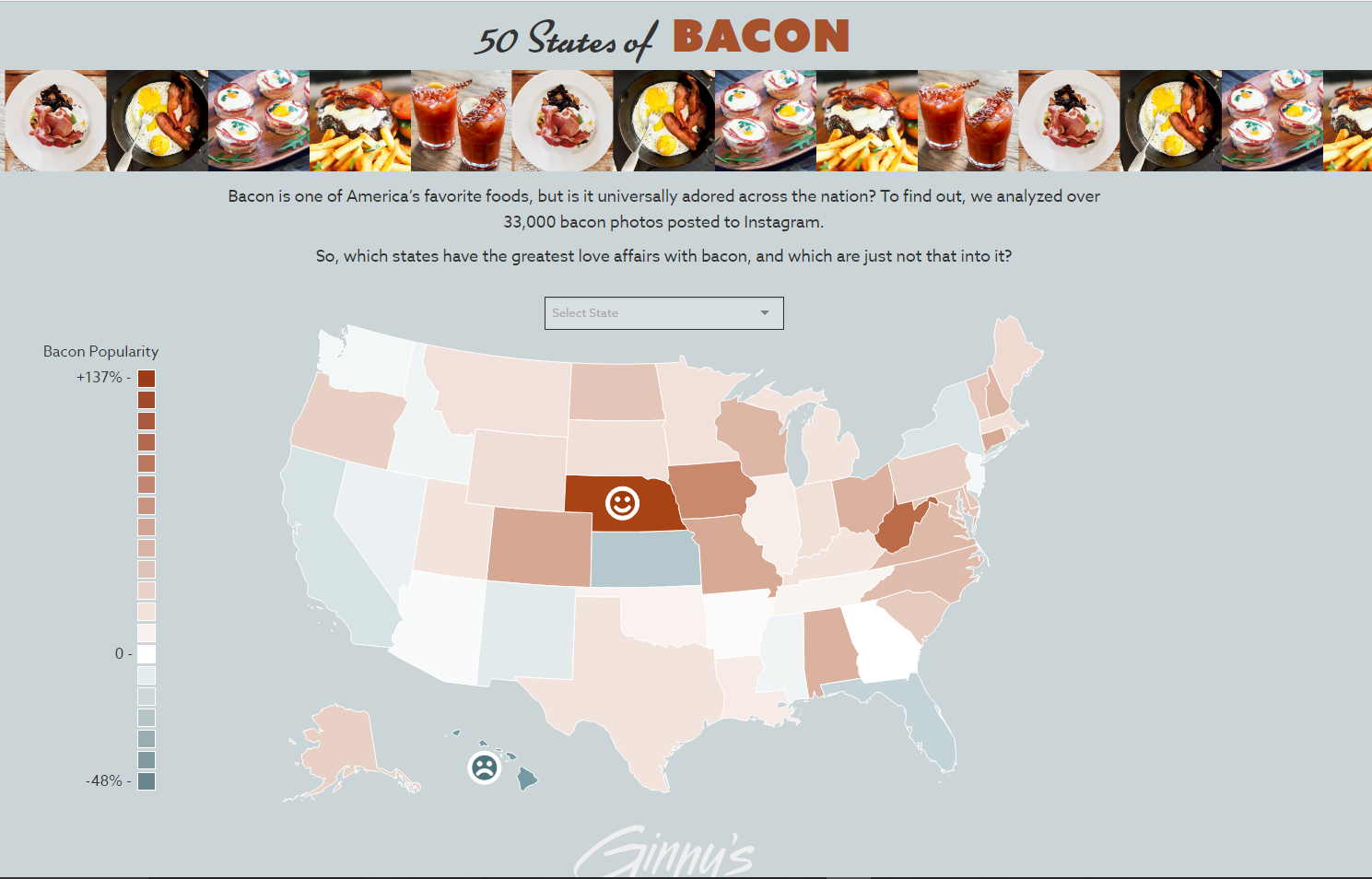
The idea was simple: Everyone likes bacon, but who likes it the most? Ginny’s caters to a lot of people who love deep frying, so this was on-brand. We decided to use Instagram’s (now difficult to access) API to extract 33,742 photos that were tagged with #bacon and located within the USA. To normalize for population distribution and Instagram usage, we also collected 64,640 photos with the tags #food, #breakfast, #lunch, and #dinner.

To make this data more visual, we made it interactive and included some fun facts for each state.

What happened after we launched the piece?
So, what happened after we launched the piece? Let’s dive in.
Here are some of the larger websites 50 States of Bacon got picked up on.
Website |
Domain Authority |
Other |
|---|---|---|
|
US News |
94 |
Tweeted from account (115K+) |
|
Mashable |
96 |
Tweeted from account (6.95M+) |
|
AOL Lifestyle |
98 |
Referred 1,200+ visitors |
|
Eater |
85 |
N/A |
|
Daily Dot |
85 |
Tweeted from account (274K+) |
Here is what the LRDs and DA looked like before we launched the piece, and then after 4 months of it being live:
Before Launch |
4 Months Later |
|
|---|---|---|
| Linking Root Domains | 450 | 600 |
| Domain Authority | 29 | 36 |
Let’s break this down by metric. Here’s a graph of the LRDs over time (we launched the piece at about the start of the uplift).

The domain authority didn’t budge until about 4 months after we launched the piece. We weren’t actively pursuing any other link-based campaigns during this time, so it’s safe to say the creative piece had a lot to do with this boost in DA.
Note: Since DA is refreshed with new pools of data, this observation wouldn’t have been as valid if the DA only moved one or two positions. But, since it moved 7 positions so close to the launch of this piece, I feel like it’s safe to assume the piece contributed greatly.
Does this mean if you do a similar piece that your DA will also increase? No. Does it give us a good example on what can happen? Absolutely.
A note on LRDs, DA, and setting expectations
Setting expectations with clients is hard. That’s even more true when you both know that links may be even more important than user engagement with your campaign. To make sure expectations are reasonable, you may want to encourage them to see this campaign as one of many over a long period of time. Then there’s less pressure on any individual piece.
So, it’s important to set expectations upfront. I would never tell a client that we can guarantee a certain number of links, or that we guarantee an increase in domain authority.
Instead, we can guarantee a piece of content that is well-built, well-researched, and interesting to their target audience. You can go one step further and guarantee reaching out to X amount of contacts, and you can estimate how many of those contacts will respond with a “yes” or “no.”
In fact, you should set goals. How much traffic would you like the piece to bring? What about social shares? What seems like a reasonable amount of LRD’s you could gain from a piece like this? Benchmark where you currently are, and make some reasonable goals.
The point I’m trying to make is that you shouldn’t promise your client a certain amount of links because, frankly, you’d be lying to them. Be upfront about what this looks like and show examples of work you’ve done before, but make sure to set their expectations correctly up front to avoid any conflicts down the road.
Conclusion
There’s a lot to be learned from the results of creative campaigns. The goal of this article is to share one piece that I’ve worked on with a client while highlighting some things that I learned/observed along the way. If you’d like to see more campaigns we’ve worked on at Distilled, take a look at our creative roundup for last year.
To wrap things up, here are the key takeaways:
- Creative pieces take a lot of thought, work, and time. Don’t underestimate the task at hand.
- Don’t frame the project as only focused on gaining links. Instead, aim for creating a compelling piece of content that is on-brand and has the potential to gain traction.
- Oftentimes it’s best not to put all your eggs in one basket. Plan multiple pieces throughout the year.
- If your research is right and you pitch the piece to the correct people, this is a strategy that can gain your domain some very strong LRDs. In this particular case, 110 linking root domains (and counting).
- …But those links won’t come easy. You need to pre-pitch, remind, and re-pitch your contacts. There are many great pieces of content being published daily; you need to be proactive about ensuring your spots online.
- There are other benefits to doing pieces like this aside from links. Social shares, brand awareness, and referral traffic are some other metrics to look at.
- It is possible to increase your DA by doing a piece like this, but it takes time. Be patient, and continue doing great work in the meantime.
Other thoughts
- There are some arguments to be made that a piece of content like this only has spikes and doesn’t do any good for a brand. I don’t believe this to be true. The way I see it, if a piece is too evergreen, it might not gain as many strong links. At the same time, if a piece is completely left-field and doesn’t fit with the brand, the links might not be as impactful. I think there’s a fine line here; it should be up to your best judgment on the pieces you should create.
- This piece could potentially be updated every year to gain more links or traction (although it would be a lot more difficult with Instagram drastically limiting their API).
- It’s possible that this piece didn’t have a direct impact on DA, but because there were no other link acquisition strategies during the 4 months, we can safely assume the two are correlated.
- There’s an argument to be made that jumping from the 20s to the 30s is much easier than from 40s to 50s when you’re speaking of DA. We know that it gets more difficult to increase DA as it gets higher, so do keep that in mind.
Sign up for The Moz Top 10, a semimonthly mailer updating you on the top ten hottest pieces of SEO news, tips, and rad links uncovered by the Moz team. Think of it as your exclusive digest of stuff you don’t have time to hunt down but want to read!
Daily Search Forum Recap: September 27, 2016
Here is a recap of what happened in the search forums today, through the eyes of the Search Engine Roundtable and other search forums on the web.
Search Engine Roundtable Stories:
Google Penguin 4…
SearchCap: Google iOS app, broken AMP & Apple results
Below is what happened in search today, as reported on Search Engine Land and from other places across the web.
The post SearchCap: Google iOS app, broken AMP & Apple results appeared first on Search Engine Land.
Please visit Search Engine Land for the full article.
Google iOS search app adds Touch ID for reentering your private searches
Google’s iOS search app can unlock your incognito mode private searches using Touch ID.
The post Google iOS search app adds Touch ID for reentering your private searches appeared first on Search Engine Land.
Please visit Search Engine Land for the fu…
Google AMP breaks the desktop search results
Looks like a bug with Google’s desktop search results were caused by accelerated mobile pages showing up in the desktop results.
The post Google AMP breaks the desktop search results appeared first on Search Engine Land.
Please visit Search Engine La…
Google Showing AMP Results On Desktop Results
Looks like there is a bug with Google’s implementation of AMP. Google is now showing AMP icons and content in the core desktop results. They recently launched AMP in the core mobile results but AMP should NOT show in the desktop results…
No, Google Won’t Send Manual Actions Notices For Penguin Penalties
I am sorry, I don’t understand why people think that with the real time Penguin algorithm out now that people think that Google will send out manual actions when a site is hit by Penguin…
Google May Have Rolled Out Penguin 4.0 Before Its Launch Date
As you know, Google announced the launch of Penguin 4.0, the real time Penguin algorithm, on Friday September 23, 2016. Many want to know if it is fully rolled out – it doesn’t seem so. Many want to know if it only started to roll out on Friday or if …
Google Penguin 4.0 Update Impact Seems Minimal
Everyone is asking me, did anyone see a recovery from the September 23, 2016 launch date of Penguin 4…