3 Ways to Improve Map Visualisations on Mobile
Designing and building data visualisations have long been a core part of the creative team’s offering at Distilled. As technology continues to develop, the way we work must also develop and adapt with it. Coming up with a good execution for a data vis piece can often be a tricky task in itself, without someone throwing in the inevitable “How does it look on mobile?” question into the mix.
Why are high-consideration customers becoming more decisive?
If you’re a brand selling high-consideration, ‘big ticket’ items like appliances, cars or luxury goods, the customer journey is vitally important.
Google Surveys 360 Replacing Google Consumer Surveys
Google announced yesterday that they are launching Google Surveys 360. It was previously called Google Consumer Surveys…
Google Search Console Advisory Board
Google has launched a Google Search Console Advisory Board, where they ask volunteers to join the board to give feedback on the Google Search Console…
Google On Sitewide Ranking Scores & How They May Be Used
Google’s John Mueller spoke about search ranking algorithms that are applied across the site. He mentioned it at the 42:47 mark into the hangout from Tuesday…
Google: No Need To Disavow Blogroll Or Sitewide Links
Google’s John Mueller said in the Google hangout this week that there is no need to disavow sitewide or blogroll links. He said this at the 2:12 mark of the hangout that if the links are natural and organic…
Google: There Is No Penguin Boost
I need to post about Penguin since it has been almost two days since I didn’t write about it.
This is a short one, just so you all are clear. There is no Penguin boost…
Technical SEO checklist: a webmaster’s guide to on-page optimisation
Presenting a guide to carrying out all the on-page checks that webmasters and SEOs need to carry out to ensure a website is optimised for search.
Unlocking creative big data: the greener pastures of cloud-based data infrastructure
An article by Cedric Chambaz for State of Digital: Unlock the creative potential of big data with machine learning, AI and a touch of left field thinking.
Post from Cedric Chambaz
Black Friday 2016: How are UK retailers optimising search landing pages?
Here’s a closer look at the opportunity it presents, as well as how retailers can best capture consumer interest through organic search.
What happened last year?
Despite murmurings that consumers are becoming fed up of Black Friday madness – and some retailers like Rei even taking a stance against it – last year’s figures speak for themselves.
While online searches in the UK were down, overall sales during the Black Friday period increased by an impressive 62%.
Likewise, overall sales in the US increased by 14.3%, and ecommerce sales are predicted to grow by 17% this year.
So, we can certainly see that Black Friday still presents a mammoth opportunity for retailers – the key is knowing how to seize it.
Identifying opportunities for organic search
The below chart, taken from a Black Friday report by PI Datametrics, highlights the most valuable search terms from November 2015.

While ‘Black Friday’ has the biggest search volume, it is only the fourth most valuable in the list in terms of ‘Organic Value’.
Organic value is a benchmark created by Pi Datametrics. It’s worked out as ‘search volume X CPC X PPC competition’ of a search term or group of search terms
On the other hand, we can see phrases that include the word ‘deals’ have greater potential for conversion, proving that it is worth optimising keywords based on this trend.
In fact, November is now the primary month for searches around ‘deals’, even overtaking words like ‘cheap’ when used in conjunction with products.

A missed opportunity for the UK
Interestingly, PI Datametrics has reported how US brands are dominating UK search results, showing how UK retailers are failing to optimise as well as their American counterparts.
For the term ‘Black Friday’, five out of the top 10 sites in Google UK are US-based, with Target appearing for a variety of terms including ‘best black Friday deals’ and ‘black Friday bargains’.
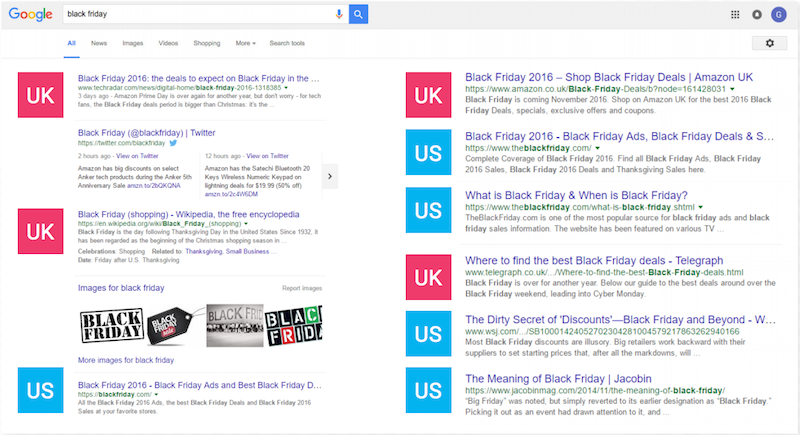
Again, this points to a need for greater optimisation, with many UK retailers failing to research crucial trends and keywords to give themselves an edge.
Meanwhile, US brands also appear to be making the most of data to re-target bargain-hungry consumers all year round.
The best UK perfomers
So, which brands are performing the best in terms of visibility in the UK?
Undoubtedly, Argos is head and shoulders above the rest, with a 53% share of the most valuable search terms across positions 1 to 10.
Likewise, it is also a consistent performer, ranking on page one for the term ‘Black Friday Deals’ all year round as opposed to during seasonal times only.
One of the main reasons for this is that it has a well-optimised long-term landing page, enabling it to capitalise on search interest before and after the event.
Moreover, this also allows it to build authority and consumer trust over time.
Here’s a closer look at Argos, as well as a few other examples of good (and mediocre) landing pages.
Argos
With its long-term page, Argos is a great example of how to optimise for a seasonal event.

As well as a prominent header, it also includes the repetiton of keywords combined with natural copy and useful information based around the event.

Debenhams
Debenhams is another good example, capitalising on interest in this year’s event as early as possible.
While it’s not the most attractive, it includes repetition of the core phrase, as well as keywords relating to Cyber Monday and Christmas.

Amazon
Amazon’s landing page aims to take advantage of the user’s interest in Black Friday by promoting current deals and discounts.
It’s a fairly dull page compared to the others on this list, but it includes similar information about why Black Friday and Cyber Monday exist.

Very
Very’s landing page has a great design, and includes a few impressive stats from 2015. Will consumers find this data particularly interesting though?
It could perhaps do with a more prominent mention of Black Friday 2016 to reassure customers that more deals are just round the corner.

John Lewis
Finally, John Lewis raises the question of whether Black Friday should be based around big ticket items only.
It is a well-optimised page, including informative content and regular mentions of Black Friday search terms.
However, the URL comes under the ‘electricals’ category, meaning it shuts out interest relating to clothing and homeware.

John Lewis traditionally puts a big focus on Christmas retail, and its festive TV ads are always much-anticipated.
Equally slashing prices wouldn’t really fit with its brand image, so it could be that the retailer prefers to take a low key approach to Black Friday.
Key points
Brands that want to make the most of the organic search opportunity in the lead up to Black Friday should follow a few simple rules:
- Create an ever-green landing page and keep it updated.
- Focus on a variation of keywords including ‘deals’ and ‘bargains’ to capture year-round interest.
- Black Friday isn’t prime time for every retailer – consider whether it is worth investing more in other seasonal events like Christmas or Halloween.
To learn more on this topic, check out Econsultancy’s range of search marketing training courses.
Black Friday 2016: How are UK retailers optimising search landing pages?
Here’s a closer look at the opportunity it presents, as well as how retailers can best capture consumer interest through organic search.
What happened last year?
Despite murmurings that consumers are becoming fed up of Black Friday madness – and some retailers like Rei even taking a stance against it – last year’s figures speak for themselves.
While online searches in the UK were down, overall sales during the Black Friday period increased by an impressive 62%.
Likewise, overall sales in the US increased by 14.3%, and ecommerce sales are predicted to grow by 17% this year.
So, we can certainly see that Black Friday still presents a mammoth opportunity for retailers – the key is knowing how to seize it.
Identifying opportunities for organic search
The below chart, taken from a Black Friday report by PI Datametrics, highlights the most valuable search terms from November 2015.
While ‘Black Friday’ has the biggest search volume, it is only the fourth most valuable in the list in terms of ‘Organic Value’.
Organic value is a benchmark created by Pi Datametrics. It’s worked out as ‘search volume X CPC X PPC competition’ of a search term or group of search terms
On the other hand, we can see phrases that include the word ‘deals’ have greater potential for conversion, proving that it is worth optimising keywords based on this trend.
In fact, November is now the primary month for searches around ‘deals’, even overtaking words like ‘cheap’ when used in conjunction with products.
A missed opportunity for the UK
Interestingly, PI Datametrics has reported how US brands are dominating UK search results, showing how UK retailers are failing to optimise as well as their American counterparts.
For the term ‘Black Friday’, five out of the top 10 sites in Google UK are US-based, with Target appearing for a variety of terms including ‘best black Friday deals’ and ‘black Friday bargains’.
Again, this points to a need for greater optimisation, with many UK retailers failing to research crucial trends and keywords to give themselves an edge.
Meanwhile, US brands also appear to be making the most of data to re-target bargain-hungry consumers all year round.
The best UK perfomers
So, which brands are performing the best in terms of visibility in the UK?
Undoubtedly, Argos is head and shoulders above the rest, with a 53% share of the most valuable search terms across positions 1 to 10.
Likewise, it is also a consistent performer, ranking on page one for the term ‘Black Friday Deals’ all year round as opposed to during seasonal times only.
One of the main reasons for this is that it has a well-optimised long-term landing page, enabling it to capitalise on search interest before and after the event.
Moreover, this also allows it to build authority and consumer trust over time.
Here’s a closer look at Argos, as well as a few other examples of good (and mediocre) landing pages.
Argos
With its long-term page, Argos is a great example of how to optimise for a seasonal event.
As well as a prominent header, it also includes the repetiton of keywords combined with natural copy and useful information based around the event.
Debenhams
Debenhams is another good example, capitalising on interest in this year’s event as early as possible.
While it’s not the most attractive, it includes repetition of the core phrase, as well as keywords relating to Cyber Monday and Christmas.
Amazon
Amazon’s landing page aims to take advantage of the user’s interest in Black Friday by promoting current deals and discounts.
It’s a fairly dull page compared to the others on this list, but it includes similar information about why Black Friday and Cyber Monday exist.
Very
Very’s landing page has a great design, and includes a few impressive stats from 2015. Will consumers find this data particularly interesting though?
It could perhaps do with a more prominent mention of Black Friday 2016 to reassure customers that more deals are just round the corner.
John Lewis
Finally, John Lewis raises the question of whether Black Friday should be based around big ticket items only.
It is a well-optimised page, including informative content and regular mentions of Black Friday search terms.
However, the URL comes under the ‘electricals’ category, meaning it shuts out interest relating to clothing and homeware.
John Lewis traditionally puts a big focus on Christmas retail, and its festive TV ads are always much-anticipated.
Equally slashing prices wouldn’t really fit with its brand image, so it could be that the retailer prefers to take a low key approach to Black Friday.
Key points
Brands that want to make the most of the organic search opportunity in the lead up to Black Friday should follow a few simple rules:
- Create an ever-green landing page and keep it updated.
- Focus on a variation of keywords including ‘deals’ and ‘bargains’ to capture year-round interest.
- Black Friday isn’t prime time for every retailer – consider whether it is worth investing more in other seasonal events like Christmas or Halloween.
To learn more on this topic, check out Econsultancy’s range of search marketing training courses.
Earning the Link: How to Pitch and Partner with the 5 Publisher Personas
Posted by QuezSays
I stood up from my office chair, stepped behind it and leaned on its back with both hands so I could stare at the email from a new angle. I was silenced by the response of the blogger:
“We’ve had a recent policy change here, and we no longer offer followed links. It’s hurting our reputation and being flagged by Google.”
In that moment, the game changed for me. I’ve received some interesting responses from editors and bloggers about links before, but never as adamant and uninformed as this. I realized that I needed to develop a communication strategy for my emails to publishing partners about links.
The challenge
Content marketing is a great way to amp up the reputation and visibility of your business. This includes well-placed bylines on high-authority sites that cover your market place. From our perspective, it’s completely appropriate to receive an attribution link in return. Creating interesting, authoritative, and valuable content is something my team excels at — that’s not the issue. The issue is working with publishing partners who have preconceived notions about links.
Publishers, bloggers, and editors have a wide range of opinions when it comes to links and how they’re treated by Google. This can create challenges for content creators who want to submit their work to these publishers but are being refused a link back to their site in their author attribution. A variety of people find themselves in this situation — SEOs, content marketing professionals, freelancers, thought leaders, etc.
The fact that people have different opinions on links is not exactly breaking news. My CEO, Eric Enge, does a good job recapping how this nofollow madness came about.
So how do you communicate with publishers in these circumstances in a way that’s credible, respectful, and effective?
After placing roughly 150 pieces of content on a wide range of sites, I’ve learned that it’s crucial to identify someone’s perspective to effectively communicate with them. There are so many myths and misconceptions about links and how Google treats links — you never know what perspective you’ll be dealing with.
This piece will help you quickly identify the perspective at hand, personify it, and from there, help you strategically communicate to give you the best chance of attaining that well-earned attribution link.
Step 1 – Pitch properly
As Rand Fishkin said in his 2012 Whiteboard Friday, “Stop link building and start link earning.” This context is the foundation of all communication with publishing partners.
Practice good pitching etiquette and do your homework researching the site. There are many resources that cover this, so I won’t go in-depth here. However, I will touch on my pitching strategy because I truly believe in its effectiveness.
When I draft all of my pitch emails, I refer to a sticky note stuck to my monitor that outlines the four sequential questions an editor is going to have when they receive my email:

1. What does this person want?
Answer this question in the subject of your email, and in the first sentence. Eric Enge suggests you treat this as your value proposition.
2. Is this credible?

Ask yourself the question, “What would make my communication more credible in this person’s eyes?”
For example:
- Name-dropping a big brand that is a part of the collaboration
- Mentioning an accolade that your writer has earned (e.g. rated top Southern mommy blogger back-to-back years)
- Highlighting other places the author has been published (e.g. monthly Forbes and USA Today contributor)
- Mentioning a very specific piece of information that proves you’ve spent a lot of time on their site:
- “Penny Pens has a lot of tips to share on how to road trip around the Midwest. I think this would complement your travel-heavy July editorial calendar. It would also build nicely off of Christina WritesALot’s piece on Choosing Travel Buddies Wisely.”
- Speaking directly to their content strategy:
- “I think that Bobby Beers UCLA Tailgating guide would be a great piece to help promote football ticket sales on your events page.”
Worth noting: If you’re unwilling to do the in-depth research that allows you to speak this way, don’t slapdash this communication. Go another route. “I read your recent article on plants and found it very interesting” doesn’t give you any credibility, and it can even hurt you by coming off as insincere. Emails like that already plague editors.
Don’t believe me? Check out Michael Smart’s article on how we’ve ruined the compliment approach to pitch introductions.
In fact, I’ve even seen software that mimics this approach for marketers that are trying to scale their outreach. The user selects the publication and editor and the software creates an email template that automatically pulls in the title of the last article the editor published. That is how manipulative the email outreach environment has become.
3. Is this valuable?

And
4. Will this work?

Ask yourself what details would be worth including here. Is the detail crucial to the communication? Would including it potentially prevent the recipient from understanding something or from responding?
For example, when I pitch writers that work for a big brand, sometimes I mention that we’re not interested in giving or receiving any compensation for the contribution I’m offering. I’ve had experiences where the editor sees the name of my Fortune 100 client and immediately thinks that I’m offering a sponsored post. Or they think that my writer wants payment and will immediately write off the opportunity because they don’t have the budget for another writer at that time.
By answering these questions clearly and in this order, I’m giving the editor permission to close the email at any time with the information they need to know that this opportunity is not going to work. This is the best gift you can give an editor. It shows that you respect their time and will keep the door open for future opportunities. It’s how to begin building trust in a long-term relationship.
Side note: Talking about links during pitching
I generally don’t talk about links with an editor upfront and often wait until they’ve had a chance to see the completed content. First of all, the attribution link is only one of the benefits we’re looking for (reminder: the others are reputation and visibility). It just doesn’t seem fair to talk to the editor about your author attribution before they see the piece. They don’t know you and want to see that you can deliver something valuable and non-promotional first.
It can also come off as unnatural to some editors. Do you really want to risk having your email mistaken for one of the hundreds of spam emails they regularly get promising “high-quality relevant content in exchange for only one dofollowed link!”? Unfortunately, talking about links right away can sometimes trigger an editor to see your content opportunity as low quality.
Step 2 – Earn the link
Once the editor requests your content, work with the writer or content creators until you have something that you’re proud to represent. Ask yourself this question: “Is this link-worthy?” If the answer isn’t a resounding “Heck yeah,” then you won’t have the leverage that you need later on if you end up in a sticky situation (i.e. if you aren’t given a link or you’re given a nofollow link). In those situations, you need to make a powerful request to remedy the situation. Are you willing to make that request for a piece of content your team created half-heartedly? That’s up to you. You need to decide what type of content you want associated with your personal brand.
In short, there are no shortcuts. Earn the editor’s respect and earn the link.

Step 3 – Write a simple “white-hat SEO” author attribution and submit
For example:
- Usually no more than two to three sentences
- Avoid direct-match rich anchor text
- Link to a page that has high relevance to the author or the content
- Don’t include more than one to two links
Step 4 – When encountering a nofollow link or missing link, communicate strategically
Once in a blue moon, when you check to see if an article you’ve submitted has been published, you’ll find a nofollow tag or a missing link.
What you SHOULDN’T do in this situation is send an email that justifies or explains why you deserve the link, or why the link is important to you. Don’t make an assumption as to why the link isn’t there. You don’t know what happened.
What you SHOULD do is make a simple request. There is no need for the email to be longer than three sentences:
“Hi Max, thanks for making Sally McWritesALot’s article look so great. It looks like the link in her attribution is nofollowed. Can you remove that nofollow tag?”
The editor’s response will give you hints on how to proceed. Below, I’ve outlined some of the flavors of responses you might get, with a publisher persona associated with each one that will help guide your communication strategy.
Skeptical Sally

- How to identify:
- Skeptical Sally might respond with something like this (real examples I’ve received):
- “I don’t allow follow links on the site in sponsored or guest content. As I’m sure you are aware, it can dramatically damage our Google ranking. I love Andrea’s piece, but can’t risk a portion of the site … this is my full-time job — and one that I love. My Google ranking can affect future business opportunities.”
- “We do not allow dofollow links any longer; this is in an effort to abide by SEO best practices for our blog.”
- Skeptical Sally might respond with something like this (real examples I’ve received):
- Skeptical Sally’s perspective:
- Sees links in general as very risky, especially a link that may be associated with a brand
- Due to their policy change, she now plans to put a nofollow tag on every outbound link, “just to be safe”
- Has an immediate skepticism of people asking for links
- Communication strategy:
- Move on. It is unlikely that Skeptical Sally will be open to a new perspective about links. If you try to educate her on the issue or talk through it, she may even get offended. Oftentimes, it’s just not worth impacting the relationship. After all, there may be ways to collaborate in the future that don’t involve content links (social media cross-promotion, interviews, etc.). Best to say thanks and move on. You still get the reputation and visibility benefits of the article that was published, but you now know that Sally’s site isn’t one where you can expect fair attribution.
Pseudo-Smart Steve

- How to identify:
- Pseudo-Smart Steve might respond with something like this (real examples I’ve received):
- “The [client] link is just to [client] and will appear spammy to Google. Big red flag.”
- Other language to look out for — any mention of “PageRank sculpting” or “retaining link juice”
- Pseudo-Smart Steve might respond with something like this (real examples I’ve received):
- Pseudo-Smart Steve’s perspective:
- Has absorbed some SEO advice from outdated or unreliable sources
- Knows that links are important, and wants to cash in on the best way to use them on his site
- May attempt some type of “page sculpting” strategy to prevent precious PageRank from leaking off of his domain (note that this notion is a myth)
- Communication strategy:
- Make an attempt to educate these people, standing shoulder to shoulder with them. Sometimes they are just doing the best they can with the knowledge that they have and are open to new information.
- For example, if the editor responds, “We prefer to nofollow as it retains the link juice,” then perhaps there is an opportunity to send them a link to a resource that will explain that the PageRank that would have been distributed to that nofollow link is NOT redistributed, it is essentially wasted (such as this Matt Cuts blog post).
- Important – I wouldn’t recommend explaining SEO concepts in-depth over email. What would be more credible and powerful is to make your point in a sentence or two and then provide a link to a resource that backs up your point from an obviously credible source (Google’s blog, something that contains a quote from Google, a reputable study, etc.). Empowering an editor with the information they need to make their own decision is powerful and helpful.
- Here are a couple of recently published resources to have bookmarked in case you are in a situation like this:
- The benefits of external links: Study – Outgoing Links Used As Ranking Signal
- Fear of linking out is unwarranted: Google’s Gary Illyes: I’m Angry News Sites Don’t Link Out, It’s Stupid
- Make an attempt to educate these people, standing shoulder to shoulder with them. Sometimes they are just doing the best they can with the knowledge that they have and are open to new information.
Here’s the extent I’d recommend explaining something in the email itself (real example):
- Me: “Regarding the link, you can nofollow if it’s an absolute sticking point for you. However, we do feel that since the link is going to a relevant page (where you can find more writing by Julia), there won’t be any risk. Also, there are millions of websites linking to [client], so we feel from that standpoint, it’s not really going to raise any red flags.”
- Editor: “OK — that all works. The nofollow link really isn’t a sticking point … I appreciate your feedback.”
Savvy Shelby

- How to identify:
- Responses that comment on how a topic relates to user experience, engagement, visibility, or other editorial areas
- Savvy Shelby’s perspective:
- Knows what she needs to know about links — that they are important to people, relevant to search engines, and are a form of currency when working with writers and freelancers
- Knows that there are things that she doesn’t know about links — that search engines and technical marketers know a lot more than she does about exactly how links work
- Knows that user experience is what really matters — that if a link doesn’t feel valuable to a user and isn’t a gesture to reward a contributor for a brilliant piece (trusting the contributor enough to know that it won’t be harmful), it may not be something she wants to include
- Communication strategy:
- If the link was omitted entirely, explain why including that link will positively impact user experience.
- Will it provide author credibility?
- Help users find more content that the author has written?
- Expand on the topic somehow?
- If the link has a nofollow tag, let the editor know that the author you are working with prefers to have the freedom to include a followed link in their attribution. This is why it’s so important that you’ve earned the link and provided incredibly valuable content to her and her audience. Trust must have been built by now.
- If the link was omitted entirely, explain why including that link will positively impact user experience.
Side note: Make this editor your best friend. They are your most powerful publishing partner.
Oblivious Oliver

- How to identify:
- There may not be specific language to look out for here, besides hints that suggest complete apathy or a lack of editorial structure or direction. Look for off-topic content or grammatical errors during your initial research. You probably don’t want to do a lot of work (and build an association) with a site that doesn’t scrutinize the work of their guest contributors.
- Oblivious Oliver’s perspective:
- Doesn’t know anything about links or an association between links and search engines
- He’s willing to do almost anything with links, as long as it doesn’t make the page look bad
- May be so hungry for original content that he’s willing to sacrifice quality in general
- Communication strategy:
- If you’re just realizing that you’re dealing with an Oblivious Oliver at this stage, it may be a sign that you’re not doing enough detailed research on the site upfront. Perhaps there were some hints within content on his site that you could have picked up on.
- Regardless, at this point it doesn’t matter. Follow through on your word to deliver a high-quality piece of content and move on to the next opportunity.
The biggest takeaway here is the simplest one: Email communication around controversial or misunderstood topics (such as links) is difficult. Because of this, it will benefit you to keep your communication in simple editorial vernacular until you have earned the right to talk about links — by providing something valuable. When you identify a Savvy Shelby, cultivate the relationship. And for the rest, I hope that this guide empowers you to respond in a manner that’s more effective and will get you results.
Sign up for The Moz Top 10, a semimonthly mailer updating you on the top ten hottest pieces of SEO news, tips, and rad links uncovered by the Moz team. Think of it as your exclusive digest of stuff you don’t have time to hunt down but want to read!
SearchCap: Trump & Clinton Google space, SEO alive & Keyword Planner
Below is what happened in search today, as reported on Search Engine Land and from other places across the web.
The post SearchCap: Trump & Clinton Google space, SEO alive & Keyword Planner appeared first on Search Engine Land.
Please visit Search Engine Land for the full article.
Google Intrusive Interstitials Mobile Penalty Only Looks At Search Click Through The Page
At the 12:10 mark in the Google hangout from yesterday, John Mueller said he met with the team yesterday about the Intrusive Interstitials Mobile Penalty that is coming in a few months and he said that right now…
Connect audience insight to your SEO strategy
Columnist Chris Liversidge believes that audience enrichment data is key to making better optimization decisions and that search marketers should be ready to engage with an audience-led strategy.
The post Connect audience insight to your SEO strategy …
Why crawl budget and URL scheduling might impact rankings in website migrations
You’ve down everything right from an SEO standpoint, but your website has still dropped in rankings following a site migration. What gives? Contributor Dawn Anderson breaks down how Google determines page importance and allots crawl budget.
The post W…
Google Has a New AMP Testing Tool
Similar to how mobile was a big deal and got its own tool, there is now a tool for you to test if your AMP pages are working correctly.
read more
Nine excellent examples of web form design
Filling in forms online can be a pain, but good design can make a lot of difference to the user experience.
SEO is not dead; it’s just a shape-shifter
Columnist Stephan Spencer talks about how search engine optimization has changed over the years, noting that it’s still very much alive — just vastly different from the way it once was.
The post SEO is not dead; it’s just a shape-shifter appeared first on Search Engine Land.
Please visit Search Engine Land for the full article.
Google adds forecasting and trend data for existing keywords in Keyword Planner
Select existing keywords (or campaigns) to see how bid scaling could affect performance. See how adding new keywords could impact traffic and spend.
The post Google adds forecasting and trend data for existing keywords in Keyword Planner appeared firs…