Search Buzz Video Recap: Google Snippets, Mobile Index, Site Quality, Yandex & AdWords
This week in search, I posted the monthly Google webmaster report for you all to catch up with. Some SEO think they saw a Penguin…
Mobile-first Indexing
Today, most people are searching on Google using a mobile device. However, our ranking systems still typically look at the desktop version of a page’s content to evaluate its relevance to the user. This can cause issues when the mobile page has less content than the desktop page because our algorithms are not evaluating the actual page that is seen by a mobile searcher.
To make our results more useful, we’ve begun experiments to make our index mobile-first. Although our search index will continue to be a single index of websites and apps, our algorithms will eventually primarily use the mobile version of a site’s content to rank pages from that site, to understand structured data, and to show snippets from those pages in our results. Of course, while our index will be built from mobile documents, we’re going to continue to build a great search experience for all users, whether they come from mobile or desktop devices.
We understand this is an important shift in our indexing and it’s one we take seriously. We’ll continue to carefully experiment over the coming months on a small scale and we’ll ramp up this change when we’re confident that we have a great user experience. Though we’re only beginning this process, here are a few recommendations to help webmasters prepare as we move towards a more mobile-focused index.
- If you have a responsive site or a dynamic serving site where the primary content and markup is equivalent across mobile and desktop, you shouldn’t have to change anything.
- If you have a site configuration where the primary content and markup is different across mobile and desktop, you should consider making some changes to your site.
- Make sure to serve structured markup for both the desktop and mobile version.
Sites can verify the equivalence of their structured markup across desktop and mobile by typing the URLs of both versions into the Structured Data Testing Tool and comparing the output.
When adding structured data to a mobile site, avoid adding large amounts of markup that isn’t relevant to the specific information content of each document.
- Use the robots.txt testing tool to verify that your mobile version is accessible to Googlebot.
- Sites do not have to make changes to their canonical links; we’ll continue to use these links as guides to serve the appropriate results to a user searching on desktop or mobile.
- If you are a site owner who has only verified their desktop site in Search Console, please add and verify your mobile version.
- If you only have a desktop site, we’ll continue to index your desktop site just fine, even if we’re using a mobile user agent to view your site.
If you are building a mobile version of your site, keep in mind that a functional desktop-oriented site can be better than a broken or incomplete mobile version of the site. It’s better for you to build up your mobile site and launch it when ready.
If you have any questions, feel free to contact us via the Webmaster forums or our public events. We anticipate this change will take some time and we’ll update you as we make progress on migrating our systems.
Posted by Doantam Phan, Product Manager


Mobile-first Indexing
Today, most people are searching on Google using a mobile device. However, our ranking systems still typically look at the desktop version of a page’s content to evaluate its relevance to the user. This can cause issues when the mobile page has less content than the desktop page because our algorithms are not evaluating the actual page that is seen by a mobile searcher.
To make our results more useful, we’ve begun experiments to make our index mobile-first. Although our search index will continue to be a single index of websites and apps, our algorithms will eventually primarily use the mobile version of a site’s content to rank pages from that site, to understand structured data, and to show snippets from those pages in our results. Of course, while our index will be built from mobile documents, we’re going to continue to build a great search experience for all users, whether they come from mobile or desktop devices.
We understand this is an important shift in our indexing and it’s one we take seriously. We’ll continue to carefully experiment over the coming months on a small scale and we’ll ramp up this change when we’re confident that we have a great user experience. Though we’re only beginning this process, here are a few recommendations to help webmasters prepare as we move towards a more mobile-focused index.
- If you have a responsive site or a dynamic serving site where the primary content and markup is equivalent across mobile and desktop, you shouldn’t have to change anything.
- If you have a site configuration where the primary content and markup is different across mobile and desktop, you should consider making some changes to your site.
- Make sure to serve structured markup for both the desktop and mobile version.
- Sites can verify the equivalence of their structured markup across desktop and mobile by typing the URLs of both versions into the Structured Data Testing Tool and comparing the output.
- When adding structured data to a mobile site, avoid adding large amounts of markup that isn’t relevant to the specific information content of each document.
- Use the robots.txt testing tool to verify that your mobile version is accessible to Googlebot.
- Sites do not have to make changes to their canonical links; we’ll continue to use these links as guides to serve the appropriate results to a user searching on desktop or mobile.
- If you are a site owner who has only verified their desktop site in Search Console, please add and verify your mobile version.
- If you only have a desktop site, we’ll continue to index your desktop site just fine, even if we’re using a mobile user agent to view your site.
- If you are building a mobile version of your site, keep in mind that a functional desktop-oriented site can be better than a broken or incomplete mobile version of the site. It’s better for you to build up your mobile site and launch it when ready.
If you have any questions, feel free to contact us via the Webmaster forums or our public events. We anticipate this change will take some time and we’ll update you as we make progress on migrating our systems.
Posted by Doantam Phan, Product Manager
Google begins mobile-first indexing, using mobile content for all search rankings
While called an ‘experiment,’ it’s actually the first move in Google’s planned shift to looking primarily at mobile content, rather than desktop, when deciding how to rank results.
The post Google begins mobile-first indexing, using mobile content for all search rankings appeared first on Search…
Please visit Search Engine Land for the full article.
Understanding FTC guidelines for influencer marketing
The FTC is cracking down on brands that aren’t following the rules and regulations for influencer marketing. Where they are and aren’t enforcing these rules, though, has left many confused.
Meet a Landy Award winner: Noble Studios drives traffic to Tahoe South to win Best SEO Initiative for Small Business
Noble Studios introduced a new approach to blogging and content creation for Tahoe South that resulted in a 134% increase in mobile site traffic.
The post Meet a Landy Award winner: Noble Studios drives traffic to Tahoe South to win Best SEO Initiat…
Successful SEO programs require content that supports the entire buy cycle
Columnist Joe Goers argues that many websites are focusing too much on the bottom of the funnel — to the detriment of their SEO success.
The post Successful SEO programs require content that supports the entire buy cycle appeared first on Search Engi…
Search in Pics: SEO Halloween, Google bomb, burger & basketball
In this week’s Search In Pictures, here are the latest images culled from the web, showing what people eat at the search engine companies, how they play, who they meet, where they speak, what toys they have and more. Google indoor basketball: Source: Instagram A Google nuclear bomb? Source:…
Please visit Search Engine Land for the full article.
Five most important search marketing news stories of the week
Welcome to our weekly round-up of all the latest news and research from around the world of search marketing and beyond.
Google tests a “back to top” button in the mobile search interface
Check out this new Google user interface test where Google shows a button to jump the mobile searcher back to the top of the search results page.
The post Google tests a “back to top” button in the mobile search interface appeared first on Search Engine Land.
Please visit Search Engine Land for the full article.
Walter Cronkite Google Doodle marks 100th birthday of America’s favorite journalist
Cronkite became known as the “most trusted man in America” during his career, reporting on the events that shaped our world.
The post Walter Cronkite Google Doodle marks 100th birthday of America’s favorite journalist appeared first on Search Engine Land.
Please visit Search Engine Land for the full article.
Google Logo Highlights The Top Walter Cronkite Journalist Moments
Today on Google.com in the United States of America is a special animated Google logo, Doodle, for the 100th birthday of the American journalist, Walter Cronkite…
Google Tests Clunky “Back To Top” Button In Mobile Search Results
Sergey Alakov, who finds all this crazy Google UI tests…
You Can Disable Your Google AdWords Automated Ad Extensions
Cassie from Google said in the Google AdWords Help forums that you can now disable automated ad extensions directly from the AdWords interface.
I guess this is a new feature and you were not able to disable the feature, the automated ad extensions…
…
Google: The Sitelinks Demotion Tool Didn’t Work For 6 Months Prior To Removal
As we reported a few weeks ago, Google removed the Sitelinks demotion tool from the Google Search Console.
But did you know that the tool did not work for about 6-months prior to that…
How to reduce HTTP requests to speed up your WordPress site
Having a website, online shop or blog that’s fast is a must nowadays. A fast website doesn’t only give your visitors a much better experience, but it also helps your website to rank. Sending fewer HTTP requests to the server can improve the loading times of your website. But why is that? What are HTTP […]
Google Home Services ads come to mobile search (then disappear again)
A trial of Google Home Services (GHS) ads on mobile is the clearest sign yet that Google intends to roll the GHS beta program out to the mobile platform and an insight into how it might look when it happens.
What We Learned in October – The Digital Marketing Month in a Minute
.jpg)
October saw many of the tech giants either expanding or narrowing their product offering.
Here’s to more HTTPS on the web!
Cross-posted from the Google Security Blog.
Security has always been critical to the web, but challenges involved in site migration have inhibited HTTPS adoption for several years. In the interest of a safer web for all, at Google we’ve worked alongside many others across the online ecosystem to better understand and address these challenges, resulting in real change. A web with ubiquitous HTTPS is not the distant future. It’s happening now, with secure browsing becoming standard for users of Chrome.
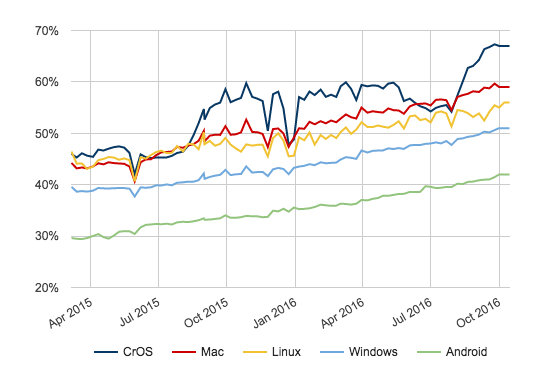
Today, we’re adding a new section to the HTTPS Report Card in our Transparency Report that includes data about how HTTPS usage has been increasing over time. More than half of pages loaded and two-thirds of total time spent by Chrome desktop users occur via HTTPS, and we expect these metrics to continue their strong upward trajectory.

Percentage of pages loaded over HTTPS in Chrome
As the remainder of the web transitions to HTTPS, we’ll continue working to ensure that migrating to HTTPS is a no-brainer, providing business benefit beyond increased security. HTTPS currently enables the best performance the web offers and powerful features that benefit site conversions, including both new features such as service workers for offline support and web push notifications, and existing features such as credit card autofill and the HTML5 geolocation API that are too powerful to be used over non-secure HTTP. As with all major site migrations, there are certain steps webmasters should take to ensure that search ranking transitions are smooth when moving to HTTPS. To help with this, we’ve posted two FAQs to help sites transition correctly, and will continue to improve our web fundamentals guidance.
We’ve seen many sites successfully transition with negligible effect on their search ranking and traffic. Brian Wood, Director of Marketing SEO at Wayfair, a large retail site, commented: “We were able to migrate Wayfair.com to HTTPS with no meaningful impact to Google rankings or Google organic search traffic. We are very pleased to say that all Wayfair sites are now fully HTTPS.” CNET, a large tech news site, had a similar experience: “We successfully completed our move of CNET.com to HTTPS last month,” said John Sherwood, Vice President of Engineering & Technology at CNET. “Since then, there has been no change in our Google rankings or Google organic search traffic.”
Webmasters that include ads on their sites also should carefully monitor ad performance and revenue during large site migrations. The portion of Google ad traffic served over HTTPS has increased dramatically over the past 3 years. All ads that come from any Google source always support HTTPS, including AdWords, AdSense, or DoubleClick Ad Exchange; ads sold directly, such as those through DoubleClick for Publishers, still need to be designed to be HTTPS-friendly. This means there will be no change to the Google-sourced ads that appear on a site after migrating to HTTPS. Many publishing partners have seen this in practice after a successful HTTPS transition. Jason Tollestrup, Director of Programmatic Advertising for the Washington Post, “saw no material impact to AdX revenue with the transition to SSL.”
As migrating to HTTPS becomes even easier, we’ll continue working towards a web that’s secure by default. Don’t hesitate to start planning your HTTPS migration today!
Posted by Adrienne Porter Felt and Emily Schechter, Chrome Security Team

Here’s to more HTTPS on the web!
Cross-posted from the Google Security Blog.
Security has always been critical to the web, but challenges involved in site migration have inhibited HTTPS adoption for several years. In the interest of a safer web for all, at Google we’ve worked alongside many others across the online ecosystem to better understand and address these challenges, resulting in real change. A web with ubiquitous HTTPS is not the distant future. It’s happening now, with secure browsing becoming standard for users of Chrome.
Today, we’re adding a new section to the HTTPS Report Card in our Transparency Report that includes data about how HTTPS usage has been increasing over time. More than half of pages loaded and two-thirds of total time spent by Chrome desktop users occur via HTTPS, and we expect these metrics to continue their strong upward trajectory.
Percentage of pages loaded over HTTPS in Chrome
As the remainder of the web transitions to HTTPS, we’ll continue working to ensure that migrating to HTTPS is a no-brainer, providing business benefit beyond increased security. HTTPS currently enables the best performance the web offers and powerful features that benefit site conversions, including both new features such as service workers for offline support and web push notifications, and existing features such as credit card autofill and the HTML5 geolocation API that are too powerful to be used over non-secure HTTP. As with all major site migrations, there are certain steps webmasters should take to ensure that search ranking transitions are smooth when moving to HTTPS. To help with this, we’ve posted two FAQs to help sites transition correctly, and will continue to improve our web fundamentals guidance.
We’ve seen many sites successfully transition with negligible effect on their search ranking and traffic. Brian Wood, Director of Marketing SEO at Wayfair, a large retail site, commented: “We were able to migrate Wayfair.com to HTTPS with no meaningful impact to Google rankings or Google organic search traffic. We are very pleased to say that all Wayfair sites are now fully HTTPS.” CNET, a large tech news site, had a similar experience: “We successfully completed our move of CNET.com to HTTPS last month,” said John Sherwood, Vice President of Engineering & Technology at CNET. “Since then, there has been no change in our Google rankings or Google organic search traffic.”
Webmasters that include ads on their sites also should carefully monitor ad performance and revenue during large site migrations. The portion of Google ad traffic served over HTTPS has increased dramatically over the past 3 years. All ads that come from any Google source always support HTTPS, including AdWords, AdSense, or DoubleClick Ad Exchange; ads sold directly, such as those through DoubleClick for Publishers, still need to be designed to be HTTPS-friendly. This means there will be no change to the Google-sourced ads that appear on a site after migrating to HTTPS. Many publishing partners have seen this in practice after a successful HTTPS transition. Jason Tollestrup, Director of Programmatic Advertising for the Washington Post, “saw no material impact to AdX revenue with the transition to SSL.”
As migrating to HTTPS becomes even easier, we’ll continue working towards a web that’s secure by default. Don’t hesitate to start planning your HTTPS migration today!
Posted by Adrienne Porter Felt and Emily Schechter, Chrome Security Team