Google temporarily disables ‘not mobile-friendly’ label in search results due to bug
A bug has forced Google to remove the mobile friendly label from the search results. Google is fixing the issue and will restore the label after the problem is resolved.
The post Google temporarily disables ‘not mobile-friendly’ label in search results due to bug appeared first on…
Please visit Search Engine Land for the full article.
How to write PPC text ads in 2017’s sophisticated environment
There are now so many ways to customize your search ads that optimization can seem complex. Columnist Matt Umbro discusses which components are likely to make the biggest impact on your CTR and conversion rates.
The post How to write PPC text ads in 2017’s sophisticated environment appeared…
Please visit Search Engine Land for the full article.
Five most interesting search marketing news stories of the week
This week, Pinterest’s acquisition of Google’s former image search lead, Randy Keller, as Head of Search shows how serious the social network is about visual search; and Twitter’s Q4 earnings have raised questions about the company’s long-term prospects.
Organic traffic & link building for small businesses
Link building is often one of the most challenging digital marketing tasks for small businesses. In this helpful how-to, columnist Marcus Miller explores how link building works today and what small businesses can do to get started.
The post Organic t…
Search in Pics: Google indoor clouds, Bing heart balloon & stroopwafels
In this week’s Search In Pictures, here are the latest images culled from the web, showing what people eat at the search engine companies, how they play, who they meet, where they speak, what toys they have and more. Indoor clouds at Google’s office: Source: Instagram Google sleeping…
Please visit Search Engine Land for the full article.
The perfect WordPress SEO permalink structure
In the past we received a lot questions regarding optimizing your WordPress SEO URL / permalink structure. Questions ranging from whether you should have the category in your permalink structure to the length of your slugs. In this post, we’ll address some of these questions and attempt to give you a better understanding of your […]
Google iOS app gets new local search filters, more AMP support & Gboard access
The latest update is part of version 23.0 for the Google iOS app.
The post Google iOS app gets new local search filters, more AMP support & Gboard access appeared first on Search Engine Land.
Please visit Search Engine Land for the full article.
10 outstanding digital marketing stats from this week
On we go…
73% of retailers fear cybercrime will negatively impact them in 2017
According to new research from Mimecast, retailers are hyper-aware of cyber-crime, with 73% believing that an attack will negatively impact their business in the year ahead.
65% also believe a malicious email is the most likely way they’ll be infected by ransomware, making retail the most fearful industry overall.
This news comes on the back of Mimecast’s security risk report which – from analysis of 26m emails – found 3.5m pieces of spam and 6,681 dangerous files.
Lingerie more popular than chocolate this Valentine’s Day
Criteo has revealed the most-searched for items this Valentine’s Day. Coming in at number one was ‘earrings’, followed by ‘men’s watches’ and ‘engagement ring’.
Interestingly, searches for lingerie increased a massive 366% in the lead up to the day itself, somewhat justifying many online retailer’s heavy promotion of the category.
More traditional items were also in demand, with searches for perfume and diamonds up 141% and 130% respectively.

Millennials drive traffic to luxury online retailers
Ahead of London Fashion Week, Hitwise has revealed how a new generation of affluent millennials are increasingly seeking out luxury brands.
According to data, 50% of website traffic to Louis Vuitton, Burberry and Gucci is driven by this demographic. Consequently, brands are expected to continue investing in digital efforts to engage with them.
Overall, there has been a 45% increase in website traffic to luxury fashion retailers over the past three years.

66% of marketers struggle to understand their audience
In the wake of Brexit and the US Presidential election, two-thirds of digital marketers are now questioning whether they truly know their audience.
This is according to a new survey from Greenlight, which also found that, as a result, 94% now intend to better understand what their customers are looking for.
37% plan to target subsets of their audience to ensure their brand is tapping into the conversations that suit their business. Typically, 57% rely on customer surveys and 59% use online forms to collect insight.
18-24 year olds dominate Snapchat usage
Data from Verto has revealed that, despite 18-24 year olds accounting for just 35% of Snapchat’s UK users, they account for 70% of the overall time spent on the platform.
In contrast, while 40% of Snapchat’s audience is aged over 35, this age group accounts for just 5% of usage time.
Other data shows that the average user spends 4hrs 22mins on Snapchat a month – a figure down from 5hrs 30mins just six months ago.
However, this is still much lower than Facebook, which has an average user time of 12hrs 43mins per month.

Proflowers.com leads in Valentine’s Day paid search ad spend
Adgooroo has revealed that ahead of the holiday, Proflowers.com generated a 7.3% share of total clicks on Valentine’s Day-related keywords.
This means the site beat out the likes of Hallmark, whose e-card website Hallmarkecards.com generated a 7.1% click share.
There was heavy competition in the greetings cards category, too, with Tinyprints.com generating a 3.4% click share, edging out American Greetings and Blue Mountain, which both saw a share of 2.5%.
26% of marketers feel unprepared for GDPR
New research from the DMA suggests that one in four businesses are still unprepared for the EU General Data Protection Regulation (GDPR), with just over half reporting that they feel prepared, and 5% believing it’s not their responsibility to do anything about it.
It’s not all bad news, however, as awareness of the GDPR has risen from 53% to 66% since June, while marketers’ personal feelings of readiness increased from 49% to 71%.
Despite this, there is still a clear need for urgency, with many marketers not believing their businesses will be compliant before the new rules come into place.

Almost 6m UK households have no savings
A five-year study from Experian has found that people in their 20s and 30s are far less well off than the previous generation, with nearly 1m households having received a loan or financial gift from other family members.
Experian found that almost 6m households in Britain have no savings, with 423,000 Britons relying on unauthorised overdrafts or payday loans to make ends meet.
Lastly, the report also highlights how over 35m people in Britain may be paying more than they should for inappropriate financial products and utility plans, with most failing to switch to a better deal.
66% of marketers no longer use mobile apps in campaigns
The State of Digital Commerce report by Episerver has revealed that two-thirds of marketing professionals are no longer using mobile apps in their marketing campaigns, choosing a responsive mobile presence instead.
The report also states that 32% of top retailers do not provide a mobile application across either iPhone or Android devices, and eight out of 10 top UK retailers have adopted a responsive ecommerce site.
The shift is said to be due to the surge in mobile search as well as the introduction of Google’s Accelerated Mobile Pages.

Changing attitudes to brand loyalty
The new Accenture Strategy report has highlighted how consumers’ allegiances towards brands are frequently changing.
In a survey of the attitudes of 25,426 consumers, Accenture found that 54% of US consumers have switched a provider in the past year, while 18% report that their own expectations about brand loyalty have changed.
Alongside personalisation, greater loyalty could be driven by an experiential approach – with 44% saying they are loyal to a brand that encourages the design or co-creation of products or services.
Lastly, 42% of US respondents are also loyal to brands that their family and friends do business with, while 37% are loyal to brands that actively support shared causes, such as charities or public campaigns.
10 outstanding digital marketing stats from this week
On we go…
73% of retailers fear cybercrime will negatively impact them in 2017
According to new research from Mimecast, retailers are hyper-aware of cyber-crime, with 73% believing that an attack will negatively impact their business in the year ahead.
65% also believe a malicious email is the most likely way they’ll be infected by ransomware, making retail the most fearful industry overall.
This news comes on the back of Mimecast’s security risk report which – from analysis of 26m emails – found 3.5m pieces of spam and 6,681 dangerous files.
Lingerie more popular than chocolate this Valentine’s Day
Criteo has revealed the most-searched for items this Valentine’s Day. Coming in at number one was ‘earrings’, followed by ‘men’s watches’ and ‘engagement ring’.
Interestingly, searches for lingerie increased a massive 366% in the lead up to the day itself, somewhat justifying many online retailer’s heavy promotion of the category.
More traditional items were also in demand, with searches for perfume and diamonds up 141% and 130% respectively.
Millennials drive traffic to luxury online retailers
Ahead of London Fashion Week, Hitwise has revealed how a new generation of affluent millennials are increasingly seeking out luxury brands.
According to data, 50% of website traffic to Louis Vuitton, Burberry and Gucci is driven by this demographic. Consequently, brands are expected to continue investing in digital efforts to engage with them.
Overall, there has been a 45% increase in website traffic to luxury fashion retailers over the past three years.
66% of marketers struggle to understand their audience
In the wake of Brexit and the US Presidential election, two-thirds of digital marketers are now questioning whether they truly know their audience.
This is according to a new survey from Greenlight, which also found that, as a result, 94% now intend to better understand what their customers are looking for.
37% plan to target subsets of their audience to ensure their brand is tapping into the conversations that suit their business. Typically, 57% rely on customer surveys and 59% use online forms to collect insight.
18-24 year olds dominate Snapchat usage
Data from Verto has revealed that, despite 18-24 year olds accounting for just 35% of Snapchat’s UK users, they account for 70% of the overall time spent on the platform.
In contrast, while 40% of Snapchat’s audience is aged over 35, this age group accounts for just 5% of usage time.
Other data shows that the average user spends 4hrs 22mins on Snapchat a month – a figure down from 5hrs 30mins just six months ago.
However, this is still much lower than Facebook, which has an average user time of 12hrs 43mins per month.
Proflowers.com leads in Valentine’s Day paid search ad spend
Adgooroo has revealed that ahead of the holiday, Proflowers.com generated a 7.3% share of total clicks on Valentine’s Day-related keywords.
This means the site beat out the likes of Hallmark, whose e-card website Hallmarkecards.com generated a 7.1% click share.
There was heavy competition in the greetings cards category, too, with Tinyprints.com generating a 3.4% click share, edging out American Greetings and Blue Mountain, which both saw a share of 2.5%.
26% of marketers feel unprepared for GDPR
New research from the DMA suggests that one in four businesses are still unprepared for the EU General Data Protection Regulation (GDPR), with just over half reporting that they feel prepared, and 5% believing it’s not their responsibility to do anything about it.
It’s not all bad news, however, as awareness of the GDPR has risen from 53% to 66% since June, while marketers’ personal feelings of readiness increased from 49% to 71%.
Despite this, there is still a clear need for urgency, with many marketers not believing their businesses will be compliant before the new rules come into place.
Almost 6m UK households have no savings
A five-year study from Experian has found that people in their 20s and 30s are far less well off than the previous generation, with nearly 1m households having received a loan or financial gift from other family members.
Experian found that almost 6m households in Britain have no savings, with 423,000 Britons relying on unauthorised overdrafts or payday loans to make ends meet.
Lastly, the report also highlights how over 35m people in Britain may be paying more than they should for inappropriate financial products and utility plans, with most failing to switch to a better deal.
66% of marketers no longer use mobile apps in campaigns
The State of Digital Commerce report by Episerver has revealed that two-thirds of marketing professionals are no longer using mobile apps in their marketing campaigns, choosing a responsive mobile presence instead.
The report also states that 32% of top retailers do not provide a mobile application across either iPhone or Android devices, and eight out of 10 top UK retailers have adopted a responsive ecommerce site.
The shift is said to be due to the surge in mobile search as well as the introduction of Google’s Accelerated Mobile Pages.
Changing attitudes to brand loyalty
The new Accenture Strategy report has highlighted how consumers’ allegiances towards brands are frequently changing.
In a survey of the attitudes of 25,426 consumers, Accenture found that 54% of US consumers have switched a provider in the past year, while 18% report that their own expectations about brand loyalty have changed.
Alongside personalisation, greater loyalty could be driven by an experiential approach – with 44% saying they are loyal to a brand that encourages the design or co-creation of products or services.
Lastly, 42% of US respondents are also loyal to brands that their family and friends do business with, while 37% are loyal to brands that actively support shared causes, such as charities or public campaigns.
How to Prioritize Your Link Building Efforts & Opportunities – Whiteboard Friday
Posted by randfish
We all know how effective link building efforts can be, but it can be an intimidating, frustrating process — and sometimes even a chore. In today’s Whiteboard Friday, Rand builds out a framework you can start using today to streamline and simplify the link building process for you, your teammates, and yes, even your interns.
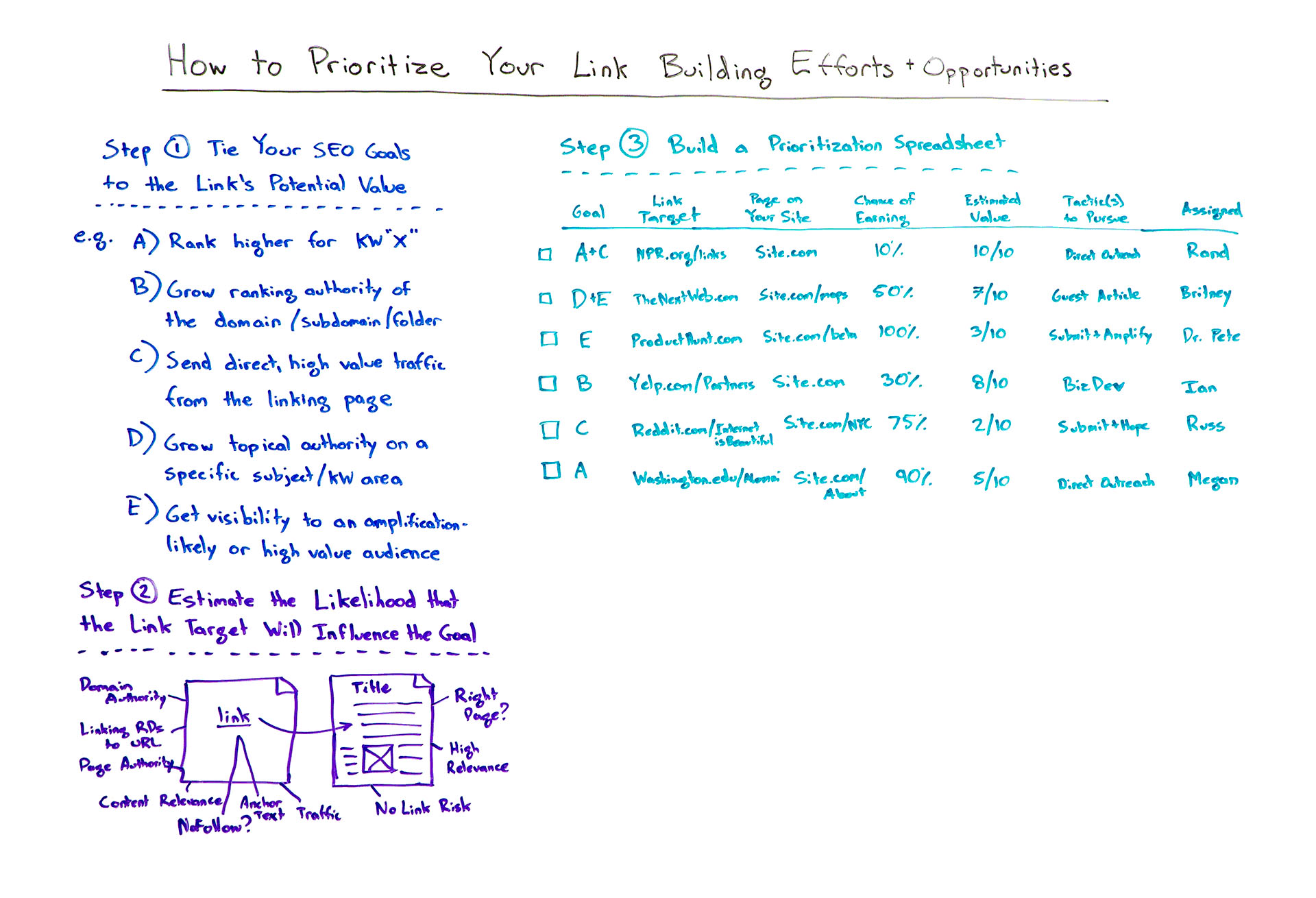
Click on the whiteboard image above to open a high-resolution version in a new tab!
Video Transcription
Howdy, Moz fans, and welcome to another edition of Whiteboard Friday. As you can see, I’m missing my moustache, but never mind. We’ve got tons of important things to get through, and so we’ll leave the facial hair to the inevitable comments.
I want to talk today about how to prioritize your link building efforts and opportunities. I think this comes as a big challenge for many marketers and SEOs because link building can just seem so daunting. So it’s tough to know how to get started, and then it’s tough to know once you’ve gotten into the practice of link building, how do you build up a consistent, useful system to do it? That’s what I want to walk you through today.
Step 1: Tie your goals to the link’s potential value
So first off, step one. What I’m going to ask you to do is tie your SEO goals to the reasons that you’re building links. So you have some reason that you want links. It is almost certainly to accomplish one of these five things. There might be other things on the list too, but it’s almost always one of these areas.
- A) Rank higher for keyword X. You’re trying to get links that point to a particular page on your site, that contain a particular anchor text, so that you can rank better for that. Makes total sense. There we go.
- B) You want to grow the ranking authority of a particular domain, your website, or maybe a subdomain on your website, or a subfolder of that website. Google does sort of have some separate considerations for different folders and subdomains. So you might be trying to earn links to those different sections to help grow those. Pretty similar to (A), but not necessarily as much of a need to get the direct link to the exact URL.
- C) Sending real high-value traffic from the ranking page. So maybe it’s the case that this link you’re going after is no followed or it doesn’t pass ranking influence, for some reason — it’s JavaScript or it’s an advertising link or whatever it is — but it does pass real visitors who may buy from you, or amplify you, or be helpful to achieving your other business goals.
- D) Growing topical authority. So this is essentially saying, “Hey, around this subject area or keyword area, I know that my website needs some more authority. I’m not very influential in this space yet, at least not from Google’s perspective. If I can get some of these links, I can help to prove to Google and, potentially, to some of these visitors, as well, that I have some subject matter authority in this space.”
- E) I want to get some visibility to an amplification-likely or a high-value audience. So this would be things like a lot of social media sites, a lot of submission type sites, places like a Product Hunt or a Reddit, where you’re trying to get in front of an audience, that then might come to your site and be likely to amplify it if they love what they see.
Okay. So these are our goals.
Step 2: Estimate the likelihood that the link target will influence that goal

Second, I’m going to ask you to estimate the likelihood that the link target will pass value to the page or to the section of your site. This relies on a bunch of different judgments.
You can choose whether you want to wrap these all up in sort of a single number that you estimate, maybe like a 0 to 10, where 0 is not at all valuable, and 10 is super, super valuable. Or you could even take a bunch of these metrics and actually use them directly, so things like domain authority, or linking root domains to the URL, or page authority, the content relevance.
You could be asking:
- Is this a nofollowed or a followed link?
- Is it passing the anchor text that I’m looking for or anchor text that I control or influence at all?
- Is it going to send me direct traffic?
If the answers to these are all positive, that’s going to bump that up, and you might say, “Wow, this is high authority. It’s passing great anchor text. It’s sending me good traffic. It’s a followed link. The relevance is high. I’m going to give this a 10.”
Or that might not be the case. This might be low authority. Maybe it is followed, but the relevance is not quite there. You don’t control the anchor text, and so anchor text is just the name of your brand, or it just says “site” or something like that. It’s not going to send much traffic. Maybe that’s more like a three.
Then you’re going to ask a couple of questions about the page that they’re linking to or your website.
- Is that the right page on your site? If so, that’s going to bump up this number. If it’s not, it might bring it down a little bit.
- Does it have high relevance? If not, you may need to make some modifications or change the link path.
- Is there any link risk around this? So if this is a — let’s put it delicately — potentially valuable, but also potentially risky page, you might want to reduce the value in there.
I’ll leave it up to you to determine how much link risk you’re willing to take in your link building profile. Personally, I’m willing to accept none at all.
Step 3: Build a prioritization spreadsheet

Then step three, you build a prioritization spreadsheet that looks something like this. So you have which goal or goals are being accomplished by acquiring this link. You have the target and the page on your site. You’ve got your chance of earning that link. That’s going to be something you estimate, and over time you’ll get better and better at this estimation. Same with the value. We talked about using a number out of 10 over here. You can do that in this column, or you could just take a bunch of these metrics and shove them all into the spreadsheet if you prefer.
Then you have the tactic you’re going to pursue. So this is direct outreach, this one’s submit and hope that it does well, and who it’s assigned to. Maybe it’s only you because you’re the only link builder, or maybe you have a number of people in your organization, or PR people who are going to do outreach, or someone, a founder or an executive who has a connection to some of these folks, and they’re going to do the outreach, whatever the case.
Then you can start to prioritize. You can build that prioritization by doing one of a couple things. You could take some amalgamation of these numbers, so like a high chance of earning and a high estimated value. We’ll do some simple multiplication, and we’ll make that our prioritization. Or you might give different goals. Like you might say, “Hey, you know what? (A) is worth a lot more to me right now than (C). So, therefore, I’m going to rank the ones that are the (A) goal much higher up.” That is a fine way to go about this as well. Then you can sort your spreadsheet in this fashion and go down the list. Start at the top, work your way down, and start checking off links as you get them or don’t get them. That’s a pretty high percentage, I’m doing real well here. But you get the idea.
This turns link building from this sort of questionable, frustrating, what should I do next, am I following the right path, into a simple process that not only can you follow, but you can train other people to follow. This is really important, because link building is an essential part of SEO, still a very valuable part of SEO, but it’s also a slog. So, to the degree that you can leverage other help in your organization, hire an intern and help train them up, work with your PR teams and have them understand it, have multiple people in the organization all sharing this spreadsheet, all understanding what needs to be done next, that is a huge help.
I look forward to hearing about your link building prioritization, goals, what you’ve seen work well, what metrics you’ve used. We will see you again next week for another edition of Whiteboard Friday. Take care.
Video transcription by Speechpad.com
Sign up for The Moz Top 10, a semimonthly mailer updating you on the top ten hottest pieces of SEO news, tips, and rad links uncovered by the Moz team. Think of it as your exclusive digest of stuff you don’t have time to hunt down but want to read!
Google’s Mobile First Index is Still Trundling on Towards a Launch
I was actually under the mistaken impression that tests for the mobile-first index were already live. Oops!
read more
SearchCap: Google Image search change, WSJ first click free & new Google ad extensions
Below is what happened in search today, as reported on Search Engine Land and from other places across the web.
The post SearchCap: Google Image search change, WSJ first click free & new Google ad extensions appeared first on Search Engine Land.
Please visit Search Engine Land for the full article.
No more free ride: Wall Street Journal pulls content out of Google’s “First Click Free” program
WSJ move might cause other publishers to remove content from Google’s program, if it turns out “Subscription” label doesn’t hurt conversions.
The post No more free ride: Wall Street Journal pulls content out of Google’s “First Click Free” program appeared first on Search Engine…
Please visit Search Engine Land for the full article.
Google rolls out 2013 Image Search design to more countries, webmasters complain of traffic loss
Did you notice a steep decline in your traffic from Google Image Search? You are not alone, it was due to a design change in some localized versions of the search engine.
The post Google rolls out 2013 Image Search design to more countries, webmasters…
Can we machine-learn Google’s machine-learning algorithm?
As Google becomes increasingly sophisticated in its methods for scoring and ranking web pages, it’s more difficult for marketers to keep up with SEO best practices. Columnist Jayson DeMers explores what can be done to keep up in a world where machine l…
Can Pinterest crack (and monetise) visual search?
Pinterest made a clear declaration of intent last week with the announcement that Li Fan, Google’s former head of image search, has joined the photo sharing site as Head of Engineering.
Yandex reports 22% YoY increase in revenue for Q4 2016
Russia’s largest search engine generated $364.7 million for the last quarter of 2016, and averaged 55.4% share of the country’s search market.
The post Yandex reports 22% YoY increase in revenue for Q4 2016 appeared first on Search Engine Land.
Pleas…
Broken link building made easy
Broken link building is a great tactic, but prospecting for broken links in your niche can be time-consuming and inefficient. Luckily, columnist Patrick Stox has a handy method for identifying relevant broken linking opportunities.
The post Broken lin…
Missed link-building opportunities: Reclaiming broken links
Link building is an investment, so don’t let your efforts go to waste! Columnist Janet Driscoll Miller shares two ways you can reclaim backlinks that are producing 404 errors.
The post Missed link-building opportunities: Reclaiming broken links appear…
Google is showing multiple ad extension types in a single swipeable carousel
In a new experiment, swipeable cards feature sitelinks, callouts, ratings and more in a mobile text ad.
The post Google is showing multiple ad extension types in a single swipeable carousel appeared first on Search Engine Land.
Please visit Search En…