Compare 9 paid search campaign management tools
Marketing Land’s “Enterprise Paid Media Campaign Management Platforms: A Marketer’s Guide” examines the market for paid search and other media campaign management platforms and the considerations involved in implementing this software into your business. This 50-page report…
Please visit Search Engine Land for the full article.
Google Posts for small businesses moves to Google My Business
Google has moved the management location of Google Posts and the company hopes to expand Posts to more businesses and organizations.
The post Google Posts for small businesses moves to Google My Business appeared first on Search Engine Land.
Please v…
Google Posts Now Within Google My Business
Maulik Panchal shared a screen shot on Twitter of the Google Posts feature, which enables businesses, organizations and personalities to share information in more real time within the knowledge panel in Google search…
Google Expands Reach Of Featured Snippets In European Regions
The folks at RankRanger posted on Twitter that their Google features tracking tool noticed massive increases in the chances a featured snippet will show up at the top of the Google search results in many European regions…
SearchCap: AMP, YP SEO product & PPC budgeting
Below is what happened in search today, as reported on Search Engine Land and from other places across the web.
The post SearchCap: AMP, YP SEO product & PPC budgeting appeared first on Search Engine Land.
Please visit Search Engine Land for the full article.
Do SMB websites matter anymore? YP doubles down on ‘yes’ with new ‘pro’ SEO product
Company says program resulted in a page one ranking on Google for 70 percent of keywords within a few months.
The post Do SMB websites matter anymore? YP doubles down on ‘yes’ with new ‘pro’ SEO product appeared first on Search Engine Land.
Please visit Search Engine Land for the full article.
Google: We Can Ignore Links On Any Site Including Forbes & Entrepreneur
Yesterday we covered how a link seller was trying to sell links to a Googler and we posted some advice around that not being the best idea. Well…
Learning SEO, Summer 2017
In January, I wrote a post titled, Advice Given to an Aspiring 14 Year-Old Entrepreneur Wanting to Learn SEO. I included in that post links to a number of pages that I thought might be helpful to someone learning SEO. On my walk this morning past the Omni La Costa Resort, I was thinking about […]
The post Learning SEO, Summer 2017 appeared first on SEO by the Sea ⚓.
Learn 3 proven methods for winning additional PPC budget from your clients
Looking to grow your PPC accounts? Columnist Jeff Baum explains that doing so means selling clients on the notion that your approach is the best way forward — and that more budget is required to execute the plan.
The post Learn 3 proven methods for w…
Is AMP the answer to format fragmentation?
Columnist Barb Palser makes the case for Facebook and other platforms to adopt Accelerated Mobile Pages.
The post Is AMP the answer to format fragmentation? appeared first on Search Engine Land.
Please visit Search Engine Land for the full article.
…
How to stop worrying about Google updates
Google is providing less information about algorithm updates these days, leaving SEOs scrambling for answers every time they experience a huge drop in traffic. But columnist Kristine Schachinger believes that all this panic is unnecessary. Read on to l…
Search Buzz Video Recap: Sell Links To Google, hreflang, Google Maps & The SEO Movie
This week in search I quickly go through the monthly Google webmaster report. I then discuss how someone sent a Googler an email about selling links to them. But Google tells us they ignore links from all types of sites and only penalizes the worst o…
Google My Business Website Appearing More Broadly – Release Imminent?
Google Website, their single page website builder, is becoming more widely available. The product is still in beta but the increasing user reports of its availability (h/t to Thibault Adda, the local seo at Darden Restaurants for his Tweet) and the increasing number of sites at the domain suggests that the product is moving toward release. … Continue reading Google My Business Website Appearing More Broadly – Release Imminent? →
Search in Pics: Marissa Mayer’s Yahoo birthday, Bing soccer match & Google stylish offices
In this week’s Search In Pictures, here are the latest images culled from the web, showing what people eat at the search engine companies, how they play, who they meet, where they speak, what toys they have and more. On Marissa Mayer’s birthday, Yahoo decorated her office: Source:…
Please visit Search Engine Land for the full article.
How to reduce the impact of images on your mobile site speed
With Google placing more and more emphasis on mobile site speed and user experience in order to achieve a good ranking, discovering issues with your mobile site speed is critical. But how can you fix those issues once you’re there?
The Power of A Great Agency Partner
They say a picture is worth a thousand words.
But successful marketing campaigns can be worth thousands to millions of dollars. And bad marketing campaigns…well, let’s just say companies really need to take a step back and evaluate the power and play of their intentions before broadcasting their message into the real world.…
The post The Power of A Great Agency Partner appeared first on Seer Interactive.
Interview with Marcus Tandler, OnPage.org – YoastCon speaker
We proudly introduce you to yet another pre-eminent speaker at YoastCon 2017: Marcus Tandler! Marcus, also known as Mediadonis, is co-founder and managing director at OnPage.org. This award-winning SaaS Tech-StartUp helps webmasters make better websites. Marcus started working in the SEO industry about 20 years ago, so he gained a lot of experience over the years. Read in […]
How Does Google Handle CSS + Javascript "Hidden" Text? – Whiteboard Friday
Posted by randfish
Does Google treat text kept behind “read more” links with the same importance as non-hidden text? The short answer is “no,” but there’s more nuance to it than that. In today’s Whiteboard Friday, Rand explains just how the search engine giant weighs text hidden from view using CSS and JavaScript.
Click on the whiteboard image above to open a high-resolution version in a new tab!
Video Transcription
Howdy, Moz fans, and welcome to another edition of Whiteboard Friday. This week we’re going to chat a little bit about hidden text, hidden text of several kinds. I really don’t mean the spammy, black on a black background, white on a white background-like, hidden text type of keyword stuffing from the ’90s and early 2000s. I’m talking about what we do with CSS and JavaScript with overlays and with folders inside a page, that kind of hidden text.
It’s become very popular in modern web design to basically use CSS or to use JavaScript to load text after a user has taken some action on a page. So perhaps they’ve clicked on a separate section of your e-commerce page about your product to see other information, or maybe they’ve clicked a “read more” link in an article to read the rest of the article. This actually creates problems with Google and with SEO, and they’re not obvious problems, because when you use something like Google’s fetch and render tool or when you look at Google’s cache, Google appears to be able to crawl and parse all of that text. But they’re not treating all of it equally.

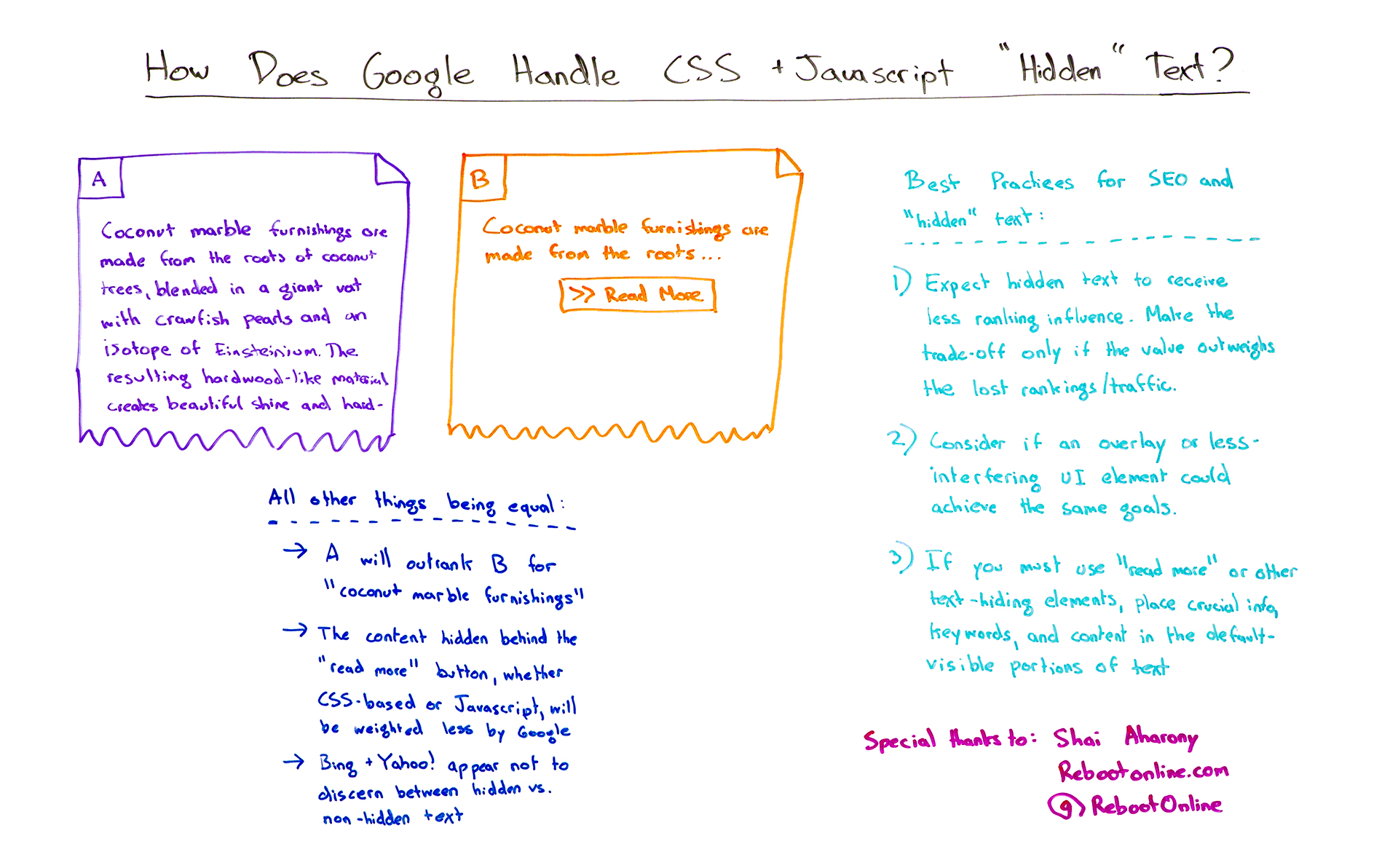
So here’s an example. I’ve got this text about coconut marble furnishings, which is just a ridiculous test phrase that I’m going to use for this purpose. But let’s say I’ve got page A, which essentially shows the first paragraph of this text, and then I have page B, which only shows part of the first sentence and then a “read more” link, which is very common in lots of articles.
Many folks do this, by the way, because they want to get engagement data about how many people actually read the rest of the piece. Others are using it for serving advertising, or they’re using it to track something, and some people are using it just because of the user experience it provides. Maybe the page is crowded with other types of content. They want to make sure that if someone wants to display this particular piece or that particular piece, that it’s available to them in as convenient a format as possible for design purposes or what have you.
What’s true in these instances is that Google is not going to treat what happens after this “read more” link is clicked, which is that the rest of this text would become visible here, they’re not going to treat that with the same weight that they otherwise would.
All other things being equal
So they’re on similar domains, they have similar link profiles, all that other kind of stuff.
- A is going to outrank B for “coconut marble furnishings” even though this is in the title here. Because this text is relevant to that keyword and is serving to create greater relevance, Google is going to weight this one higher.
- It’s also true that the content that’s hidden behind this “read more” here, it doesn’t matter. If it’s CSS-based, JavaScript-based, post load or loaded when the HTML is, it doesn’t matter, it’s going to be weighted less by Google. It will be treated as though that text were not as important.
- Interestingly, fascinatingly, perhaps, Bing and Yahoo do not appear to discern between these. So they’ll treat these more equally. Google is the only one who seems to be, at least right now, from some test data — I’ll talk about that in a sec — who is treating these differently, who is basically weighting this hidden content less.
Best practices for SEO and “hidden” text
So what can we discern from this? What should SEOs do when we’re working with our web design teams and with our content teams around these types of issues?
I. We have to expect that any time we hide text with CSS, with JavaScript, what have you, that it will have less ranking influence. It’s not that it won’t be counted at all. If I were to search for “hardwood-like material creates beautiful shine,” like that exact phrase in Google with quotes, both of these pages would come up, this one almost certainly first, but both of these pages would come up.
So Google knows the text is there. It just isn’t counting it as highly. It’s like content that isn’t carrying the same weight as it would if it were visible by default. So, given that we know that, we have to decide in the tradeoff situation whether it’s worth it to lose the ranking value and the potential visitors in exchange for whatever we’re gaining by having this element.
II. We’ve got to consider some creative alternatives. It is possible to make text visible by default and to instead have something like an overlay element. We could have a brief overlay here that’s easily close-able with a message. Maybe that could give us the same types of engagement statistics, because 95% of people are going to close that before they scroll down, or they’re going to receive a popover message or those kinds of things. Granted, as we’ve discussed previously on Whiteboard Friday, overlays have their own issues that we need to be aware of, but these are possible. We can also measure scroll depth by doing some JavaScript tracking. There’s lots of software that does that by default and plenty of GitHub repositories, that are open source, that we could use to track that. So there might be other ways to get the same goals.
III. If it is the case that you have to use the “read more” or any other text hiding elements, I would urge you to go ahead and place the crucial information, including the keyword phrases and the most related terms and phrases that you know are going to be very important to rankings, up in that most visible top portion of the page so that you maximize the ranking weight of the most important pieces rather than losing those below or behind whatever sorts of post-loading situation you’ve got. Make those the default visible portions of text.
I do want to give special thanks. One of the reasons that we know this, certainly Google has mentioned it on occasion, but over the course of the last few years there’s been a lot of skepticism, especially from folks in the web design community who have sort of said, “Look, it seems like Google can see this. It doesn’t seem to be a problem. When I search in quotes for this text, Google is bringing it back.” That has been correct.
But thanks to Shai — I’m sorry if I mispronounce your name — Aharony from Reboot Online, RebootOnline.com, and I’ll link to the specific test that they performed, but they performed some wonderful, large-scale, long-term tests of CSS, of text area, of visible text, and of JavaScript hiding across many domains over a long period and basically proved to us that what Google says is in fact true, that they are treating this text behind here with less weight. So we really appreciate the efforts of folks like that, who go through intense effort to give us the truth about how Google works.
That said, we will hopefully see you again next week for another edition of Whiteboard Friday. Take care.
Video transcription by Speechpad.com
Sign up for The Moz Top 10, a semimonthly mailer updating you on the top ten hottest pieces of SEO news, tips, and rad links uncovered by the Moz team. Think of it as your exclusive digest of stuff you don’t have time to hunt down but want to read!
SearchCap: Siri disappointment, link referrers & LiveRamp IdentityLink
Below is what happened in search today, as reported on Search Engine Land and from other places across the web.
The post SearchCap: Siri disappointment, link referrers & LiveRamp IdentityLink appeared first on Search Engine Land.
Please visit Search Engine Land for the full article.
New Bing Visual Search Detail View
Bing has extended its image search with a new detail view.
read more