Google’s new custom intent audiences and you
Columnist Allen Finn shares his thoughts on Google’s new custom intent audiences before diving into how you can add them to your Display campaigns.
The post Google’s new custom intent audiences and you appeared first on Search Engine Land.
Please visit Search Engine Land for the full article.
Jan Ingenhousz Google doodle marks 287th birthday of scientist behind photosynthesis discovery
Ingenhousz also served as the family doctor for Austria’s royal House of Habsburg under the rule of Austrian Empress Maria Theresa.
The post Jan Ingenhousz Google doodle marks 287th birthday of scientist behind photosynthesis discovery appeared first …
Killer demand gen strategy, Part 3: Facebook advertising
If you’ve been keeping up with this series, you’ve got your audience defined and designed creative to match. You’ve constructed smart Google Display Network campaigns to get those users pouring into your funnel. Now let’s talk some of the most powerful targeting capabilities of all.
Ask Yoast: WordPress themes and heading structure
Headings play an important role in structuring text, whether it’s on paper or online. Since reading from a screen is already quite difficult, you should make sure you make proper use of headings. There’s a hierarchy in heading tags, with <h1> being the most important, and <h6> the least important. This will help both your […]
The post Ask Yoast: WordPress themes and heading structure appeared first on Yoast.
Advanced SEO Strategies for 2018
Fundamental search engine optimization never changes. You only have three things to work with: content, links, and measurement. Content should come first. Links and measurement should come together. People who are impatient or who lack faith in the quality of…
Google Defends Inaccurate Mount Agung Eruption Search Listings
Google had some inaccurate news stories listed in their top stories section in search when people Googled [agung]. Mount Agung is currently erupting, you can check out the fake photos and videos of it on Twitter if you want or read about it on Wikiped…
Smarter Career Choices #3: Solve for the Global Maxima!
Today, a simple lesson that so many of us miss at great peril. In fact in your role, at this very moment, your company is making a mistake in terms of how it values your impact on the business. The lesson is about the limitation of optimizing for a local maxima, usually in a silo. […]
Smarter Career Choices #3: Solve for the Global Maxima! is a post from: Occam’s Razor by Avinash Kaushik
Tip: Beware Keyword Stuffing Ecommerce Website Category Pages To Rank For Various Other Keywords in Google
Quote: “The site was ranking the first page for the keyword (widget) and(widgets) in Australia since two weeks we moved all the way down to page five. Technical changes haven’t been made to the site the **only modification was we added more category landing text to rank for various other (keywords)**”
Read the full article here Tip: Beware Keyword Stuffing Ecommerce Website Category Pages To Rank For Various Other Keywords in Google
A Hobo Site Review can quickly identify any issues on your site that is holding your site back. See Hobo SEO Review Prices
© Copyright 2006-2017 Shaun Anderson https://www.hobo-web.co.uk/
Kim Krause Berg – The Search Community Honors You
This is part of the say something nice about an SEO/SEM series – feel free to nominate someone over here.
Kim Krause Berg, 59 years old, lives with her family rural hills northwest of Philadelphia, south of Allentown…
Google AdWord Auction Insights & Impression Share Data Refreshed Multiple Times A Day
Google posted on Twitter that Google AdWords now refreshes the auction insights and impression share reports data multiple times per day…
Join Google’s John Mueller For A Webmaster Hangout Live In Zurich
Google’s John Mueller posted on Twitter that he can try to coordinate a live hangout with in person SEOs and webmasters if you are in Zurich and the timing works out…
Tell Google Why & How You Want To Filter Voice Search Queries In Search Console
Google’s John Mueller posted on Twitter that he is looking at what webmasters and SEOs would do with voice search query data within Google Search Console. John wrote:
I hear folks asking about voice search data in Search Console often…
What Do Google’s New, Longer Snippets Mean for SEO? – Whiteboard Friday
Posted by randfish
Snippets and meta descriptions have brand-new character limits, and it’s a big change for Google and SEOs alike. Learn about what’s new, when it changed, and what it all means for SEO in this edition of Whiteboard Friday.
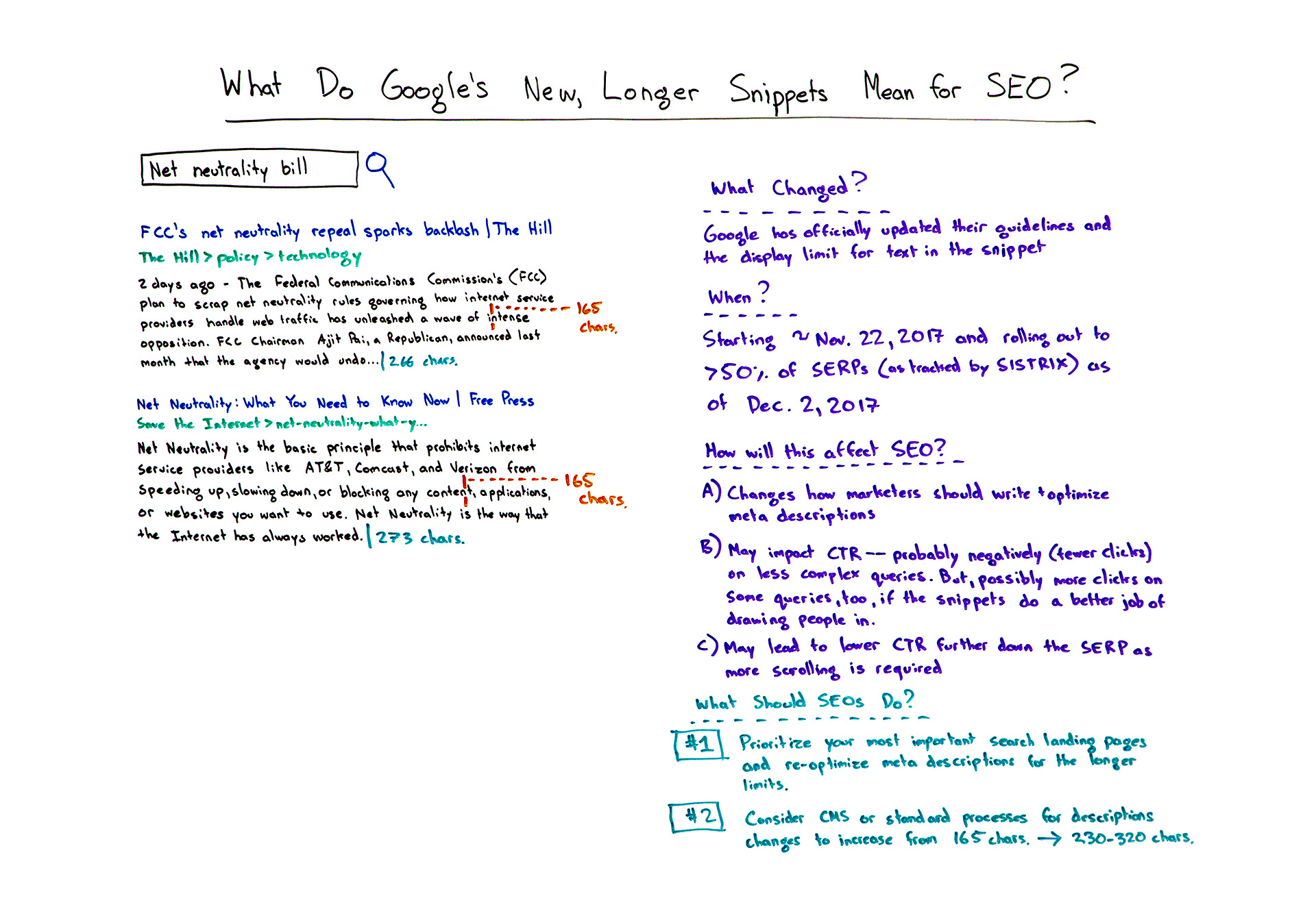
Click on the whiteboard image above to open a high-resolution version in a new tab!
&amp;lt;span id=”selection-marker-1″ class=”redactor-selection-marker”&amp;gt;&amp;lt;/span&amp;gt;
Video Transcription
Howdy, Moz fans, and welcome to another edition of Whiteboard Friday. This week we’re chatting about Google’s big change to the snippet length.
This is the display length of the snippet for any given result in the search results that Google provides. This is on both mobile and desktop. It sort of impacts the meta description, which is how many snippets are written. They’re taken from the meta description tag of the web page. Google essentially said just last week, “Hey, we have officially increased the length, the recommended length, and the display length of what we will show in the text snippet of standard organic results.”

So I’m illustrating that for you here. I did a search for “net neutrality bill,” something that’s on the minds of a lot of Americans right now. You can see here that this article from The Hill, which is a recent article — it was two days ago — has a much longer text snippet than what we would normally expect to find. In fact, I went ahead and counted this one and then showed it here.
So basically, at the old 165-character limit, which is what you would have seen prior to the middle of December on most every search result, occasionally Google would have a longer one for very specific kinds of search results, but more than 90%, according to data from SISTRIX, which put out a great report and I’ll link to it here, more than 90% of search snippets were 165 characters or less prior to the middle of November. Then Google added basically a few more lines.
So now, on mobile and desktop, instead of an average of two or three lines, we’re talking three, four, five, sometimes even six lines of text. So this snippet here is 266 characters that Google is displaying. The next result, from Save the Internet, is 273 characters. Again, this might be because Google sort of realized, “Hey, we almost got all of this in here. Let’s just carry it through to the end rather than showing the ellipsis.” But you can see that 165 characters would cut off right here. This one actually does a good job of displaying things.
So imagine a searcher is querying for something in your field and they’re just looking for a basic understanding of what it is. So they’ve never heard of net neutrality. They’re not sure what it is. So they can read here, “Net neutrality is the basic principle that prohibits internet service providers like AT&T, Comcast, and Verizon from speeding up, slowing down, or blocking any . . .” And that’s where it would cut off. Or that’s where it would have cut off in November.
Now, if I got a snippet like that, I need to visit the site. I’ve got to click through in order to learn more. That doesn’t tell me enough to give me the data to go through. Now, Google has tackled this before with things, like a featured snippet, that sit at the top of the search results, that are a more expansive short answer. But in this case, I can get the rest of it because now, as of mid-November, Google has lengthened this. So now I can get, “Any content, applications, or websites you want to use. Net neutrality is the way that the Internet has always worked.”
Now, you might quibble and say this is not a full, thorough understanding of what net neutrality is, and I agree. But for a lot of searchers, this is good enough. They don’t need to click any more. This extension from 165 to 275 or 273, in this case, has really done the trick.
What changed?
So this can have a bunch of changes to SEO too. So the change that happened here is that Google updated basically two things. One, they updated the snippet length, and two, they updated their guidelines around it.
So Google’s had historic guidelines that said, well, you want to keep your meta description tag between about 160 and 180 characters. I think that was the number. They’ve updated that to where they say there’s no official meta description recommended length. But on Twitter, Danny Sullivan said that he would probably not make that greater than 320 characters. In fact, we and other data providers, that collect a lot of search results, didn’t find many that extended beyond 300. So I think that’s a reasonable thing.
When?
When did this happen? It was starting at about mid-November. November 22nd is when SISTRIX’s dataset starts to notice the increase, and it was over 50%. Now it’s sitting at about 51% of search results that have these longer snippets in at least 1 of the top 10 as of December 2nd.
Here’s the amazing thing, though — 51% of search results have at least one. Many of those, because they’re still pulling old meta descriptions or meta descriptions that SEO has optimized for the 165-character limit, are still very short. So if you’re the person in your search results, especially it’s holiday time right now, lots of ecommerce action, if you’re the person to go update your important pages right now, you might be able to get more real estate in the search results than any of your competitors in the SERPs because they’re not updating theirs.
How will this affect SEO?
So how is this going to really change SEO? Well, three things:
A. It changes how marketers should write and optimize the meta description.
We’re going to be writing a little bit differently because we have more space. We’re going to be trying to entice people to click, but we’re going to be very conscientious that we want to try and answer a lot of this in the search result itself, because if we can, there’s a good chance that Google will rank us higher, even if we’re actually sort of sacrificing clicks by helping the searcher get the answer they need in the search result.
B. It may impact click-through rate.
We’ll be looking at Jumpshot data over the next few months and year ahead. We think that there are two likely ways they could do it. Probably negatively, meaning fewer clicks on less complex queries. But conversely, possible it will get more clicks on some more complex queries, because people are more enticed by the longer description. Fingers crossed, that’s kind of what you want to do as a marketer.
C. It may lead to lower click-through rate further down in the search results.
If you think about the fact that this is taking up the real estate that was taken up by three results with two, as of a month ago, well, maybe people won’t scroll as far down. Maybe the ones that are higher up will in fact draw more of the clicks, and thus being further down on page one will have less value than it used to.
What should SEOs do?
What are things that you should do right now? Number one, make a priority list — you should probably already have this — of your most important landing pages by search traffic, the ones that receive the most search traffic on your website, organic search. Then I would go and reoptimize those meta descriptions for the longer limits.
Now, you can judge as you will. My advice would be go to the SERPs that are sending you the most traffic, that you’re ranking for the most. Go check out the limits. They’re probably between about 250 and 300, and you can optimize somewhere in there.
The second thing I would do is if you have internal processes or your CMS has rules around how long you can make a meta description tag, you’re going to have to update those probably from the old limit of somewhere in the 160 to 180 range to the new 230 to 320 range. It doesn’t look like many are smaller than 230 now, at least limit-wise, and it doesn’t look like anything is particularly longer than 320. So somewhere in there is where you’re going to want to stay.
Good luck with your new meta descriptions and with your new snippet optimization. We’ll see you again next week for another edition of Whiteboard Friday. Take care.
Video transcription by Speechpad.com
Sign up for The Moz Top 10, a semimonthly mailer updating you on the top ten hottest pieces of SEO news, tips, and rad links uncovered by the Moz team. Think of it as your exclusive digest of stuff you don’t have time to hunt down but want to read!
SearchCap: Yahoo sues Mozilla, Google Lens review & celebs help Google
Below is what happened in search today, as reported on Search Engine Land and from other places across the web.
The post SearchCap: Yahoo sues Mozilla, Google Lens review & celebs help Google appeared first on Search Engine Land.
Please visit Search Engine Land for the full article.
Google: Read More AMP Links Can Go To Read More HTML Pages
The other day, Google announced a new penalty for AMP pages that have partial content with read more links that take you to the full content. We called it the AMP teaser penalty…
Google Responds To Blog Bribes: It Can Lead To Search Penalties
Over the past few days, the community has been buzzing about an article on The Outline named How brands secretly buy their way into Forbes, Fast Company…
The lowdown on driving app downloads with Universal App campaigns
Google’s Universal App campaigns use machine learning to automate app promotion. Columnist and Googler Matt Lawson goes under the hood to help you understand and master these campaigns.
The post The lowdown on driving app downloads with Universal App campaigns appeared first on Search Engine Land.
Please visit Search Engine Land for the full article.
Google’s latest SERPs updates for December 2017
Google’s latest SERPs update and report for December 2017 shows, as usual, November is a busy month, and December quietens down.
read more
Google’s latest SERPs updates for December 2017
Google’s latest SERPs update and report for December 2017 shows, as usual, November is a busy month, and December quietens down.
read more
Is holiday paid search more competitive in 2017 than 2016?
Columnist Andy Taylor explores year-over-year Auction Insights data from AdWords, revealing insights into this year’s holiday paid search landscape.
The post Is holiday paid search more competitive in 2017 than 2016? appeared first on Search Engine La…