Google To Show Publishers URLs With Google’s AMP Cache Later This Year
Google announced last night that they are working up a solution to show the publishers URL and not the Google AMP cache URL from google.com/amp in Google search…
Moz Won’t Be Updating Their Search Engine Ranking Factors
The last time Moz updated their search engine ranking factors study was over two years ago in August 2015. Well, that might be the last time they ever update it.
Moz said on Twitter that they have no plans on updating this study…
Yoast SEO 6.1
Welcome, 2018! And welcome to our first release of 2018: Yoast SEO 6.1. This is the first in a long line of new versions to be released in this new year. Yoast SEO 6.1 is mainly a bug fix release that makes sure that your favorite plugin runs like butter. Find out what’s new! Bye […]
The post Yoast SEO 6.1 appeared first on Yoast.
SEO Marketing
Search Engine Optimisation (SEO) is becoming increasingly tricky – continuous innovations between the rival search engines, coupled with increased activity from your competitors, means that you have to identify the right strategy for your business to rank well.
This SEO training course will enable you to build an organic search marketing strategy that will mean more of the right kind of visitors to your website, boost online conversions and stand out in today’s fiercely competitive online marketplace, ensuring the best possible return on investment.
SEO Marketing
Search Engine Optimisation (SEO) is becoming increasingly tricky – continuous innovations between the rival search engines, coupled with increased activity from your competitors, means that you have to identify the right strategy for your business to rank well.
This SEO training course will enable you to build an organic search marketing strategy that will mean more of the right kind of visitors to your website, boost online conversions and stand out in today’s fiercely competitive online marketplace, ensuring the best possible return on investment.
Google announces solution to longstanding AMP cache URL display problem
Later this year, the Google AMP cache will finally display publisher URLs, instead of Google URLs in the search results.
The post Google announces solution to longstanding AMP cache URL display problem appeared first on Search Engine Land.
Please vis…
It’s Google Home vs. Amazon Alexa at CES in the battle for the voice ecosystem
Google and Amazon both announce new device partnerships; the Google Assistant will be on new “smart display” devices, more TVs, speakers and in cars.
The post It’s Google Home vs. Amazon Alexa at CES in the battle for the voice ecosystem appeared first on Search Engine Land.
Please visit Search Engine Land for the full article.
Selling SEO to the C-Suite: How to Convince Company Executives to Support SEO
Posted by rMaynes1
The implementation of a solid SEO strategy often gets put on the back burner — behind website redesigns, behind client work, behind almost everything — and even when it is taken seriously, you have to fight for every resource for implementation. SEO must be a priority. However, convincing the company executives to prioritize it and allocate budget to SEO initiatives can feel like scaling a mountain.
Sound familiar?
Convincing company executives that SEO is one of the most critical elements of a holistic digital marketing strategy to increase website traffic (and therefore customers, sales, and revenue) won’t be easy, but these steps can increase the chances of your program being taken seriously, and getting the budget needed to make it a success.
Before you start: Put yourself in the shoes of the C-Suite and be ready to answer their questions.
While it’s no doubt frustrating that your executives don’t understand the importance of SEO, put yourself in their shoes and consider what is important to them. Have solid answers ready to questions.
CEOs are decision-makers, not problem-solvers. They are going to ask:
- Why should we invest in SEO vs. [insert another strategy here]?
- Is this going to be profitable?
- Do you have proven results?
- What does success look like? What are your KPIS?
CIOs and CFOs will fixate on cost reductions. They are going to ask:
- What will this cost us?
- Can similar results be achieved at a reduced cost?
- What level of spend will maximize ROI?
CMOs want to ensure the organization’s message is distributed to targeted audiences in order to meet sales objectives. They will ask:
- How many more qualified leads will this bring us?
- What will this do to increase our brand exposure?
- What is our competition doing?
CEOs are unbelievably busy. In the nicest way, they don’t care about details, and they don’t care about tactics (because they simply do not have time to care). What do they care about? Results.
For example, the CEO of a large insurance broker sits in his office and Googles the term “Seattle insurance.” Success for him is seeing his company listed at #1 in the organic results. He doesn’t want to know how it was achieved, but for as long as that’s the result, he’s happy to invest.
Getting the support you need for your SEO strategy can be tough, to say the least, especially if there is no understanding, no interest, and no funding from the C-level executives in your company — and unfortunately, without these, your SEO plans will never get off the ground.
However, executive-level buy-in is crucial for a successful SEO campaign, so don’t give up!
Educate your stakeholders
1. Start at the beginning: Define what SEO is, and what it isn’t
It might sound like a no-brainer, but before you even start, find out your C-Suite’s SEO expertise level. Bizarre as it may sound, some might not even really fully understand what SEO is, and the concept of keywords might be entirely alien.
Start from the very beginning with examples of what SEO is, and what it isn’t.
Include:
- How people search for your business online with non-branded industry keywords. Use analytics to show that this is what people are actually searching for.
- Show what happens when you conduct a simple search for a related keyword. Where does your business rank and where do your competitors rank?
If you want to go into a bit more detail, you can show things like where keywords appear in your page content, or what meta-data in the titles and description fields look like. Gather as much valuable insight as you can from the CMO to help tailor your presentation to fit the style the CEO is used to. It will vary from CEO to CEO. Same story — but a different approach to getting the message across.
Remember, keep it high-level. When talking to your C-Suite about SEO, it’s important to talk to them in a language they’ll understand. If your presentation includes references to “schema,” “link audits,” or “domain authority,” start again, scrapping the technical jargon. Instead, talk about how SEO helps businesses connect directly with people who are searching online for the products and services that are being offered by the company. Highlight how it’s a powerful business development tool that aligns your business with customer intent, one that targets potential customers further down the sales funnel because it attracts traffic mostly from people who are in the market to convert. Focus on the purpose of an SEO program being to build a sustainable base of monthly quality potential customers by generating additional traffic to the website.
Use hard facts to support your points. For example:
- 72% of marketers say relevant content creation was the most effective SEO tactic (Source: https://www.hubspot.com/marketing-statistics)
- 71% of B2B researchers start with a generic search. (Source: https://www.hubspot.com/marketing-statistics)
- Conversion rates are 10 times higher on search than from social on desktops, on average. (Source: GoDaddy 2016)
- Half of search queries are four words or longer. Not including long-tail keywords could mean losing potential leads. (Source: Propecta 2017).
- Companies that published 16+ blog posts per month got almost 3.5X more traffic than companies that published 0–4 monthly posts. (Source: https://www.hubspot.com/marketing-statistics)
2. The meat of your presentation: Why SEO is so important
Once you’ve shown what SEO is, you can move onto why it’s so important to the organizational goals. Sounds simple, but this is probably the most difficult part of convincing your executives of the need for an SEO strategy.
C-Suite executives are not interested in the how of SEO. They want to know the why (the value, the return on investment), and the when (how long it will take to see the results and the ROI of this endeavor). It’s almost guaranteed that they’re not going to want to know the minute details and tactics of your proposed strategy.
Outline the project at a high level, and don’t get bogged down in the details. If the CEO is well-educated in other channels (like paid search, offline marketing, print marketing, or display advertising), try to use SEO examples that can be understood in a relative way to how these other channels perform.
Note: To sell SEO to the C-suite doesn’t necessarily mean you’re committing to doing all of this work yourself. You might be pitching for the budget to use an SEO agency to do all of this for you.
Break out the proposed project into 4 sections, each with a “what” and a “why.”
1. SEO audit:
Your website is a business development tool, and so the SEO audit is focused on assessing how well the site is performing currently. Talk about how you’ll assess the website in several areas to understand any problems impacting site performance and identify any potential optimization opportunities to make it more search engine-friendly, and to align it to business objectives both from a technical and content perspective.
2. Recommendations:
From the audit, determine what needs to be done and when. Not all tactics will work for all organizations, and as an SEO expert, you’ll be able to review the business and draw on your past experience to determine what’s going to earn the highest ROI. Prioritize recommendations and have a case to present for each, proving how it’s more important than another recommendation, and how it will impact the overall business if implemented. Ensure that those critical SEO components that will expedite the results are implemented first. Be sure to address these questions:
- What combination of tactics is going to work best for this organization?
- What is going to have the biggest impact now, and what can wait?
- What should be a top organizational priority?
- Do you have access to the internal resources and knowledge to be able to implement the recommendations, or do you need to consider using an external agency?
3. Implementation:
Whether this is an internal project or you’re engaging an SEO agency, the project lead should be very hands-on, making SEO recommendations and guiding the IT team through the successful implementation of as many of them as possible so as to have the biggest impact on organic search. At times it can feel like you have to jump through hoops to get the smallest recommendation implemented, and that’s understandable. However, if you endeavor to understand the internal IT processes, you can customize recommendations to fit the IT team’s schedule. You’ll see more success that way.
This is one of the biggest obstacles that Mediative, as an agency, runs into. We conduct SEO audits and provide recommendations for success, in priority order — but getting access to internal IT resources and getting your SEO recommendations into the implementation queue can be incredibly challenging.
We worked with a Fortune 500 company for four years on SEO, covering the major areas of site architecture and site content, with the ultimate goal of increasing site traffic. At any given time, there were 40+ active SEO initiatives — open tickets with the client’s IT department — all of which had an impact on the SEO of the client’s website. However, they represented only about 20% of the total open tickets for all IT service requests in this client’s IT department; as a result, vying for precious IT resources became a huge challenge. A great SEO agency will learn to adapt tactics to fit in with whatever sort of IT procedures your company already has in place.
4. Goals and measurement of results:
HubSpot has presented the core metrics that CEOs care about the most; you should address these metrics with benchmarks and informed predictions (not vague guesses) for how SEO can improve them. Unlike channels such as paid search, it can be difficult to give the exact cost and the exact number of leads or revenue SEO can generate. The key here is to get the understanding of the CMO to help present your case to the CEO. SEO or organic search traffic (when measured properly with analytics) can be the biggest driver of low-cost traffic and quality visitors to your website.
- Customer Acquisition Cost (CAC) – This is the total cost of acquiring a customer in the organization. If you can show how SEO acquires customers below the company average, you’re already winning.
- Time to Payback CAC – This is the number of months it takes you to earn back the CAC you spent to get a new customer. Again, if you can show that SEO reduces this number, it will increase the likelihood of your program getting the thumbs up.
- Marketing Originated Customer % – This ratio shows what percentage of your new business is driven by marketing efforts, a sure-fire way to secure more SEO budget if you can prove exactly how many new customers it’s driving.
Look at simpler metrics as well, such as:
- Traffic to your website.
- Number of leads generated.
- Decreased bounce rates.
Inform your executives that you’ll be measuring these metrics in conjunction with other metrics, such as average ranking position, to see the overall impact of your SEO efforts.
- Use industry research to put a monetary value on ranking higher. For example, the fictional company Acme Shoes sells shoes online. The company website recently ranked #4 on a desktop Google search for [women’s shoes].
- A #4 ranking sends the website 20,000 unique visitors per month.
- The average value of a website visitor has been calculated at $20, therefore ranking at #4 is valued at $400,000/month.
- Research has shown that, on average, the #4 ranking gets 7.3% of Google results page clicks, and the #1 ranking gets 32.8% of page clicks — 4.5x more. Therefore, it can be estimated that increasing ranking to #1 will lead to 90,000 monthly unique visitors.
- The estimated revenue from ranking #1 for [women’s shoes]: $1.8m/month.
- Present different scenarios. For example, what would happen if no SEO efforts are made over the next 12 months? Now in contrast, what do you predict will happen with $X of investment, and how that would increase even further if doubled? Be sure to have a few options available, not just all-or-nothing.
- Be very specific about the goals at each level of investment. Find examples of SEO strategies that have had great results. Best case would be results from your own tests in preparation for a larger project, but sometimes even small SEO tests are not approved until the C-suite has bought in. In this case, find case studies from your industry, or research/results of similar tactics to those that you want to implement. The C-Suite want tangible, real-world solutions that are proven to work, not vague ideas.
Tip: A lot of SEO is “free” — it just takes time, knowledge, and resources (which is where it gets expensive) to make it successful. Use the word “free” as much as you can. For example, an online listings component of an SEO strategy may utilize free directory listings.
In summary, an SEO project may address all 4 sections listed above very well, but the key is communication. Great SEO agencies are strong communicators with all stakeholders involved — the marketing team, IT teams, content writers, designers, code developers, etc. It’s important to remember that following best practices, executing SEO tactics in a timely manner, and measuring the results all require clear and concise communication at different levels of the organization.
Congratulations! You’ve perfectly pitched SEO to your C-Suite. You’re almost guaranteed to get the green light! So what now?
Manage expectations from day one.
Basketball player Michael Jordan was once quoted as saying: “Be true to the game, because the game will be true to you. If you try to shortcut the game, then the game will shortcut you. If you put forth the effort, good things will be bestowed upon you. That’s truly about the game, and in some ways that’s about life, too.”
He could have been talking about SEO.
SEO is a commitment. To reap the long-term benefits, you have to put in the effort with minimal gains at first. Make sure your C-Suite knows this. They might get frustrated that after 3 months of effort, the results are not prominent. But that’s how SEO goes. SEO isn’t a “set it and forget it” tactic. It’s an ongoing program that builds successes with time and consistency.
By setting realistic expectations that it will take several months before results are seen, there won’t be pressure to try other tactics, like paid search or display advertising, at the expense of SEO. Of course, these tactics can complement your SEO efforts and can provide a short-term benefit that SEO can’t, but don’t be swayed from SEO as a core strategy. Stay the course, and keep focused on the long-term benefits of what you’re doing. It will be worth it!
Continually measure and track performance
You should be ready at the drop of a hat to provide up-to-date results with performance measured to key metrics (to the last month) of how your SEO efforts are stacking up. You never know when cost-cutting measures might be implemented, and if you’re not ready with solid results, it might be your program that gets cut.
Show how your SEO efforts compare to other programs in the company, such as social media marketing or paid search. Search is always evolving, so keep up and be seen keeping up. Never stop selling!
In the case of our Fortune 500 client, we were able to implement all of the key SEO initiatives by prioritizing and building cases for implementation. After several months, organic search traffic and revenue was leading all other digital marketing channels for this client — more than PPC and email marketing. Organic search generated approximately 30% of all visits to the client’s site, while maintaining year-over-year growth of 20–25%. This increase was not simply from branded traffic, however — year-over-year non-branded traffic had increased approximately 50%.
These are the kind of results that are going to make the company executives sit up and take SEO seriously.
To conclude:
As the proponent for SEO in your organization, you play a critical role in ensuring that the strategies with the quickest and biggest impact on results are implemented and prioritized first. There’s no magic bullet with SEO – no one thing that works. A solid SEO strategy — and one that will convince stakeholders of its worth — is made up of a myriad of components from audits to content development, from link building to site architecture. The trick is picking what is going to work for your organization and what isn’t, and this is no mean feat!
For more SEO tips from Mediative, download our new e-book, The Digital Marketer’s Guide to Google’s Search Engine Results Page.
Sign up for The Moz Top 10, a semimonthly mailer updating you on the top ten hottest pieces of SEO news, tips, and rad links uncovered by the Moz team. Think of it as your exclusive digest of stuff you don’t have time to hunt down but want to read!
SearchCap: New Google Search Console, bug delists Google News publishers & AdWords drops more addiction ads
Below is what happened in search today, as reported on Search Engine Land and from other places across the web.
The post SearchCap: New Google Search Console, bug delists Google News publishers & AdWords drops more addiction ads appeared first on Search Engine Land.
Please visit Search Engine Land for the full article.
Google accidentally removes news publishers from Google News
It is expected that affected publishers will be reinstated by the end of the day.
The post Google accidentally removes news publishers from Google News appeared first on Search Engine Land.
Please visit Search Engine Land for the full article.
Google removes addiction treatment ads from UK search results
The move follows the September crackdown in the US on referral agents using AdWords.
The post Google removes addiction treatment ads from UK search results appeared first on Search Engine Land.
Please visit Search Engine Land for the full article.
…
Matt Umbro – The Search Community Honors You
This is part of the say something nice about an SEO/SEM series – feel free to nominate someone over here.
Matt Umbro, 32 years old…
Google News Removing Hundreds Of News Publishers
If you check out the Google News Help forums you will see many many complaints from news publishers that their news site is no longer in the Google News index…
Google My Business Expands Requesting Ownership Help Page
Google has updated the help document around how to request ownership of a business listing in the Google Maps and local area. Google wrote on Twitter “we’ve updated our Help Center article on requesting ownership of a verified business…
Google: We Never Index All Known URLs
Google’s John Mueller said on Twitter that they “never index all known URLs” and calls that “pretty normal.”
This comes after a complaint that the URLs the webmaster submitted to Google via Google Sitemaps were not all indexed by Google according to…
Google Search Algorithm Update Tweaks Continue Into January
It seems that while it may have kind of quieted down a bit over the first few days of the new year – starting around January 5th and 6th throughout the past couple days…
Introducing the new Search Console
A few months ago we released a beta version of a new Search Console experience to a limited number of users. We are now starting to release this beta version to all users of Search Console, so that everyone can explore this simplified process of optimizing a website’s presence on Google Search. The functionality will include Search performance, Index Coverage, AMP status, and Job posting reports. We will send a message once your site is ready in the new Search Console.
We started by adding some of the most popular functionality in the new Search Console (which can now be used in your day-to-day flow of addressing these topics). We are not done yet, so over the course of the year the new Search Console (beta) will continue to add functionality from the classic Search Console. Until the new Search Console is complete, both versions will live side-by-side and will be easily interconnected via links in the navigation bar, so you can use both.
The new Search Console was rebuilt from the ground up by surfacing the most actionable insights and creating an interaction model which guides you through the process of fixing any pending issues. We’ve also added ability to share reports within your own organization in order to simplify internal collaboration.
Search Performance: with 16 months of data!
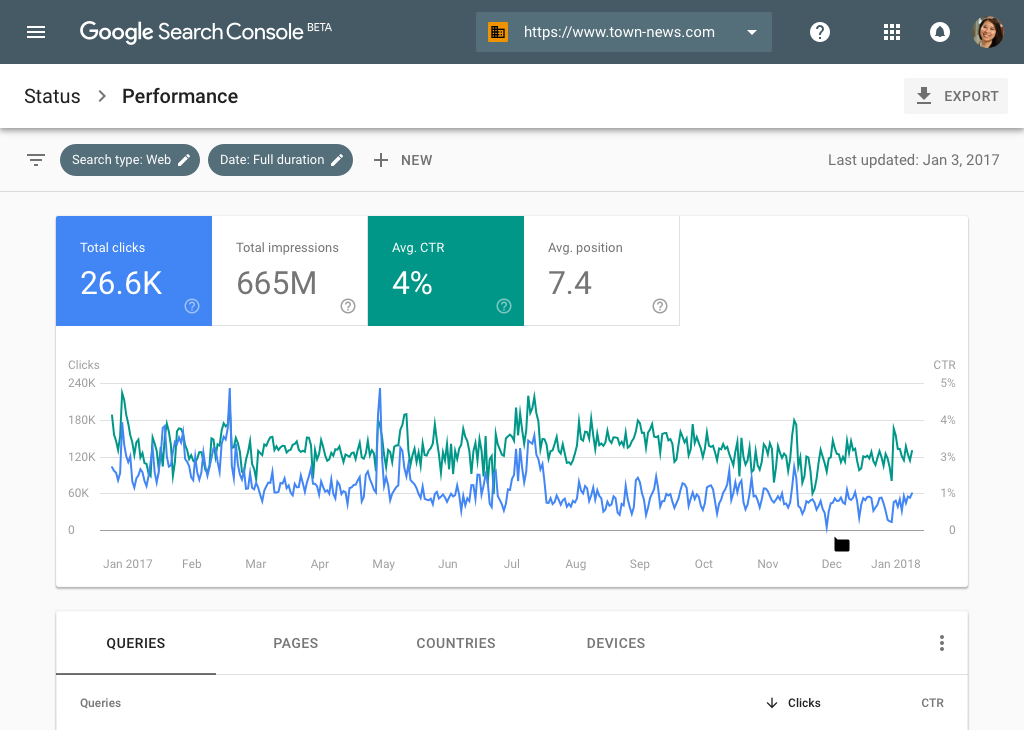
If you’ve been a fan of Search Analytics, you’ll love the new Search Performance report. Over the years, users have been consistent in asking us for more data in Search Analytics. With the new report, you’ll have 16 months of data, to make analyzing longer-term trends easier and enable year-over-year comparisons. In the near future, this data will also be available via the Search Console API.
Index Coverage: a comprehensive view on Google’s indexing
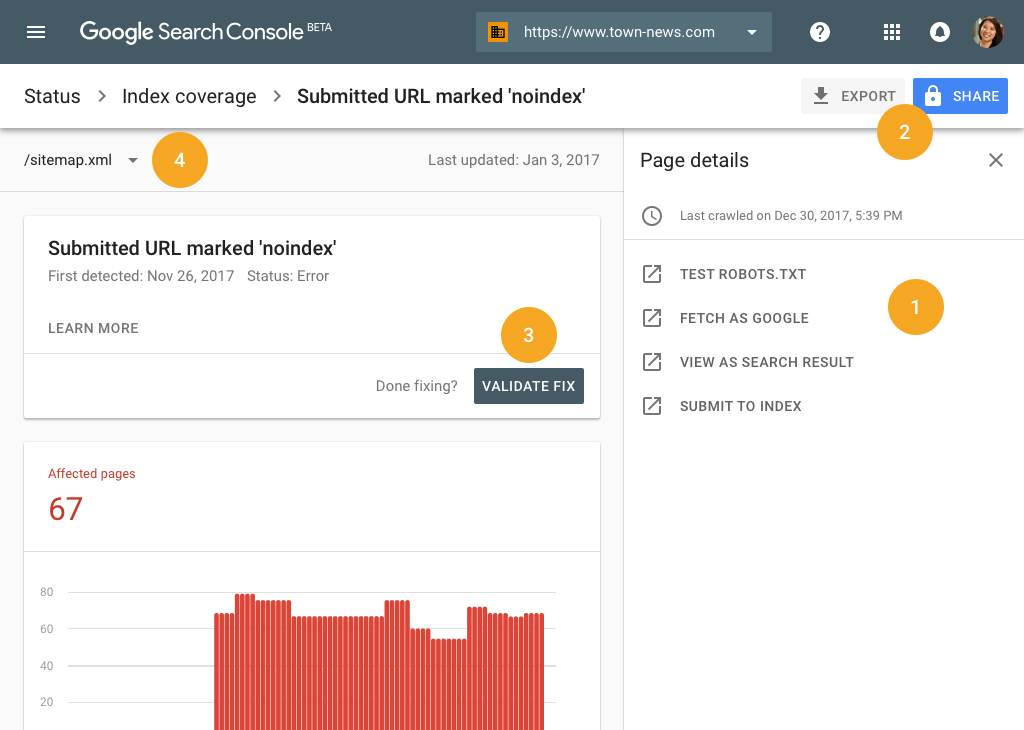
The updated Index Coverage report gives you insight into the indexing of URLs from your website. It shows correctly indexed URLs, warnings about potential issues, and reasons why Google isn’t indexing some URLs. The report is built on our new Issue tracking functionality that alerts you when new issues are detected and helps you monitor their fix.
So how does that work?
- When you drill down into a specific issue you will see a sample of URLs from your site. Clicking on error URLs brings up the page details with links to diagnostic-tools that help you understand what is the source of the problem.
- Fixing Search issues often involves multiple teams within a company. Giving the right people access to information about the current status, or about issues that have come up there, is critical to improving an implementation quickly. Now, within most reports in the new Search Console, you can do that with the share button on top of the report which will create a shareable link to the report. Once things are resolved, you can disable sharing just as easily.
- The new Search Console can also help you confirm that you’ve resolved an issue, and help us to update our index accordingly. To do this, select a flagged issue, and click validate fix. Google will then crawl and reprocess the affected URLs with a higher priority, helping your site to get back on track faster than ever.
- The Index Coverage report works best for sites that submit sitemap files. Sitemap files are a great way to let search engines know about new and updated URLs. Once you’ve submitted a sitemap file, you can now use the sitemap filter over the Index Coverage data, so that you’re able to focus on an exact list of URLs.
Search Enhancements: improve your AMP and Job Postings pages
The new Search Console is also aimed at helping you implement Search Enhancements such as AMP and Job Postings (more to come). These reports provide details into the specific errors and warnings that Google identified for these topics. In addition to the functionally described in the index coverage report, we augmented the reports with two extra features:
- The first feature is aimed at providing faster feedback in the process of fixing an issue. This is achieved by running several instantaneous tests once you click the validate fix button. If your pages don’t pass this test we provide you with an immediate notification, otherwise we go ahead and reprocess the rest of the affected pages.
- The second new feature is aimed at providing positive feedback during the fix process by expanding the validation log with a list of URLs that were identified as fixed (in addition to URLs that failed the validation or might still be pending).
Similar to the AMP report, the new Search Console provides a Job postings report. If you have jobs listings on your website, you may be eligible to have those shown directly through Google for Jobs (currently only available in certain locations).
Feedback welcome
We couldn’t have gotten so far without the ongoing feedback from our diligent trusted testers (we plan to share more on how their feedback helped us dramatically improve Search Console). However, your continued feedback is critical for us: if there’s something you find confusing or wrong, or if there’s something you really like, please let us know through the feedback feature in the sidebar. Also note that the mobile experience in the new Search Console is still a work in progress.
We want to end this blog sharing an encouraging response we got from a user who has been testing the new Search Console recently:
“The UX of new Search Console is clean and well laid out, everything is where we expect it to be. I can even kick-off validation of my fixes and get email notifications with the result. It’s been a massive help in fixing up some pesky AMP errors and warnings that were affecting pages on our site. On top of all this, the Search Analytics report now extends to 16 months of data which is a total game changer for us” – Noah Szubski, Chief Product Officer, DailyMail.com
Are there any other tools that would make your life as a webmaster easier? Let us know in the comments here, and feel free to jump into our webmaster help forums to discuss your ideas with others!
Posted by John Mueller, Ofir Roval and Hillel Maoz


Introducing the new Search Console
A few months ago we released a beta version of a new Search Console experience to a limited number of users. We are now starting to release this beta version to all users of Search Console, so that everyone can explore this simplified process of optimizing a website’s presence on Google Search. The functionality will include Search performance, Index Coverage, AMP status, and Job posting reports. We will send a message once your site is ready in the new Search Console.
We started by adding some of the most popular functionality in the new Search Console (which can now be used in your day-to-day flow of addressing these topics). We are not done yet, so over the course of the year the new Search Console (beta) will continue to add functionality from the classic Search Console. Until the new Search Console is complete, both versions will live side-by-side and will be easily interconnected via links in the navigation bar, so you can use both.
The new Search Console was rebuilt from the ground up by surfacing the most actionable insights and creating an interaction model which guides you through the process of fixing any pending issues. We’ve also added ability to share reports within your own organization in order to simplify internal collaboration.
Search Performance: with 16 months of data!
If you’ve been a fan of Search Analytics, you’ll love the new Search Performance report. Over the years, users have been consistent in asking us for more data in Search Analytics. With the new report, you’ll have 16 months of data, to make analyzing longer-term trends easier and enable year-over-year comparisons. In the near future, this data will also be available via the Search Console API.
Index Coverage: a comprehensive view on Google’s indexing
The updated Index Coverage report gives you insight into the indexing of URLs from your website. It shows correctly indexed URLs, warnings about potential issues, and reasons why Google isn’t indexing some URLs. The report is built on our new Issue tracking functionality
that alerts you when new issues are detected and helps you monitor their fix.
So how does that work?
- When you drill down into a specific issue you will see a sample of URLs from your site. Clicking on error URLs brings up the page details with links to diagnostic-tools that help you understand what is the source of the problem.
- Fixing Search issues often involves multiple teams within a company. Giving the right people access to information about the current status, or about issues that have come up there, is critical to improving an implementation quickly. Now, within most reports in the new Search Console, you can do that with the share button on top of the report which will create a shareable link to the report. Once things are resolved, you can disable sharing just as easily.
- The new Search Console can also help you confirm that you’ve resolved an issue, and help us to update our index accordingly. To do this, select a flagged issue, and click validate fix. Google will then crawl and reprocess the affected URLs with a higher priority, helping your site to get back on track faster than ever.
- The Index Coverage report works best for sites that submit sitemap files. Sitemap files are a great way to let search engines know about new and updated URLs. Once you’ve submitted a sitemap file, you can now use the sitemap filter over the Index Coverage data, so that you’re able to focus on an exact list of URLs.
Search Enhancements: improve your AMP and Job Postings pages
The new Search Console is also aimed at helping you implement Search Enhancements such as AMP and Job Postings (more to come). These reports provide details into the specific errors and warnings that Google identified for these topics. In addition to the functionally described in the index coverage report, we augmented the reports with two extra features:
- The first feature is aimed at providing faster feedback in the process of fixing an issue. This is achieved by running several instantaneous tests once you click the validate fix button. If your pages don’t pass this test we provide you with an immediate notification, otherwise we go ahead and reprocess the rest of the affected pages.
- The second new feature is aimed at providing positive feedback during the fix process by expanding the validation log with a list of URLs that were identified as fixed (in addition to URLs that failed the validation or might still be pending).
Similar to the AMP report, the new Search Console provides a Job postings report. If you have jobs listings on your website, you may be eligible to have those shown directly through Google for Jobs (currently only available in certain locations).
Feedback welcome
We couldn’t have gotten so far without the ongoing feedback from our diligent trusted testers (we plan to share more on how their feedback helped us dramatically improve Search Console). However, your continued feedback is critical for us: if there’s something you find confusing or wrong, or if there’s something you really like, please let us know through the feedback feature in the sidebar. Also note that the mobile experience in the new Search Console is still a work in progress.
We want to end this blog sharing an encouraging response we got from a user who has been testing the new Search Console recently:
“The UX of new Search Console is clean and well laid out, everything is where we expect it to be. I can even kick-off validation of my fixes and get email notifications with the result. It’s been a massive help in fixing up some pesky AMP errors and warnings that were affecting pages on our site. On top of all this, the Search Analytics report now extends to 16 months of data which is a total game changer for us” – Noah Szubski, Chief Product Officer, DailyMail.com
Are there any other tools that would make your life as a webmaster easier? Let us know in the comments here, and feel free to jump into our webmaster help forums to discuss your ideas with others!
Posted by John Mueller, Ofir Roval and Hillel Maoz
Google to roll out new Search Console features in coming weeks
After comprehensive beta user testing, Google begins release of the new Google Search Console reports to all verified users.
The post Google to roll out new Search Console features in coming weeks appeared first on Search Engine Land.
Please visit Se…
What the development of visual search will mean for SEO
Columnist Kristopher Jones talks visual search — its current state, its implications for the future and strategies for SEOs looking to capitalize on this evolving technology.
The post What the development of visual search will mean for SEO appeared f…