A NodeJS Script for Accessing the Google Search Console API
 One of the biggest challenges for SEOs is Google itself. The black box of Google, as Dan described it to me early on at my time at LSG, limits its displayed metrics in Google Search Console to representative calculations. Google causes even more SEO indigestion when you try to claw out a site’s historical performance […]
The post A NodeJS Script for Accessing the Google Search Console API appeared first on Local SEO Guide.
SearchCap: Google Search Console live, Quora ad targeting & Google search app update
Below is what happened in search today, as reported on Search Engine Land and from other places across the web.
The post SearchCap: Google Search Console live, Quora ad targeting & Google search app update appeared first on Search Engine Land.
Please visit Search Engine Land for the full article.
Bing explains how AI-powered intelligent answers can show users two points of view for the same query
Multi-perspective answers is another example of how Bing is using artificial intelligence to inform richer search results.
The post Bing explains how AI-powered intelligent answers can show users two points of view for the same query appeared first on…
Case study: On-page + off-page SEO working together = success
Contributor Eric Enge offers an insightful case study on the positive effects SEO-focused content created by local influencers can have on driving targeted traffic.
The post Case study: On-page + off-page SEO working together = success appeared first …
Technical SEO in the age of semantic search and Google
Contributor Ryan Shelley explains that technical SEO is more important than ever — but for long-term ranking success, understanding how Google processes data is key.
The post Technical SEO in the age of semantic search and Google appeared first on Se…
Joy Hawkins – The Search Community Honors You
This is part of the say something nice about an SEO/SEM series – feel free to nominate someone over here.
Joy Hawkins, 31, lives in Uxbridge, ON…
Google Drops Unused Quick Links From Google Search App
The Google Search App for iOS and Android has removed the top quick links buttons from the screen. I guess it wasn’t used much…
Google Adds SEO Audits To The Lighthouse Chrome Extension
Google announced on the Webmaster blog that they have updated the Lighthouse Chrome Extension to add SEO Audit features.
Google said “you can now do a basic SEO Health-check in Chrome (Canary) DevTools or with the Lighthouse extension…
Google AdWords Missed Call Ad Extension?
Reena Jha shared a screen shot of a weird Google AdWords ad extension that not only shows the call extension but also a “missed call” button…
Google AdWords Impressions & Clicks May Show After Campaign Was Paused
A Google AdWords advertiser complained on Twitter that two days after pausing a campaign, he is still seeing clicks…
Google officially announces the new Google Search Console is available for everyone
The Search Console UX team shares how user feedback played a role in the evolution of the new version.
The post Google officially announces the new Google Search Console is available for everyone appeared first on Search Engine Land.
Please visit Sea…
Google removes tappable shortcuts from search app
Less than a year after launching this feature, Google has removed the shortcuts offering quick answers on weather, sports & entertainment info.
The post Google removes tappable shortcuts from search app appeared first on Search Engine Land.
Please visit Search Engine Land for the full article.
8 key Google Analytics reports for SEO
Google Analytics is a treasure trove of insightful data – and it’s free. However, with so much data available at our fingertips, it can be a bit of a minefield, and most people only scratch the surface. In order to continually build on and improve your campaign, you need to pay close attention to the nitty-gritty of your data.
Quora adds more contextual & behavioral ad-targeting options
The platform is steadily enhancing its advertising offerings.
The post Quora adds more contextual & behavioral ad-targeting options appeared first on Search Engine Land.
Please visit Search Engine Land for the full article.
How listening to our users helped us build a better Search Console
The new Search Console beta is up and running. We’ve been flexing our listening muscles and finding new ways to incorporate your feedback into the design. In this new release we’ve initially focused on building features supporting the users’ main goals and we’ll be expanding functionality in the months to come. While some changes have been long expected, like refreshing the UI with Material Design, many changes are a result of continuous work with you, the Search Console users.
We’ve used 3 main communication channels to hear what our users are saying: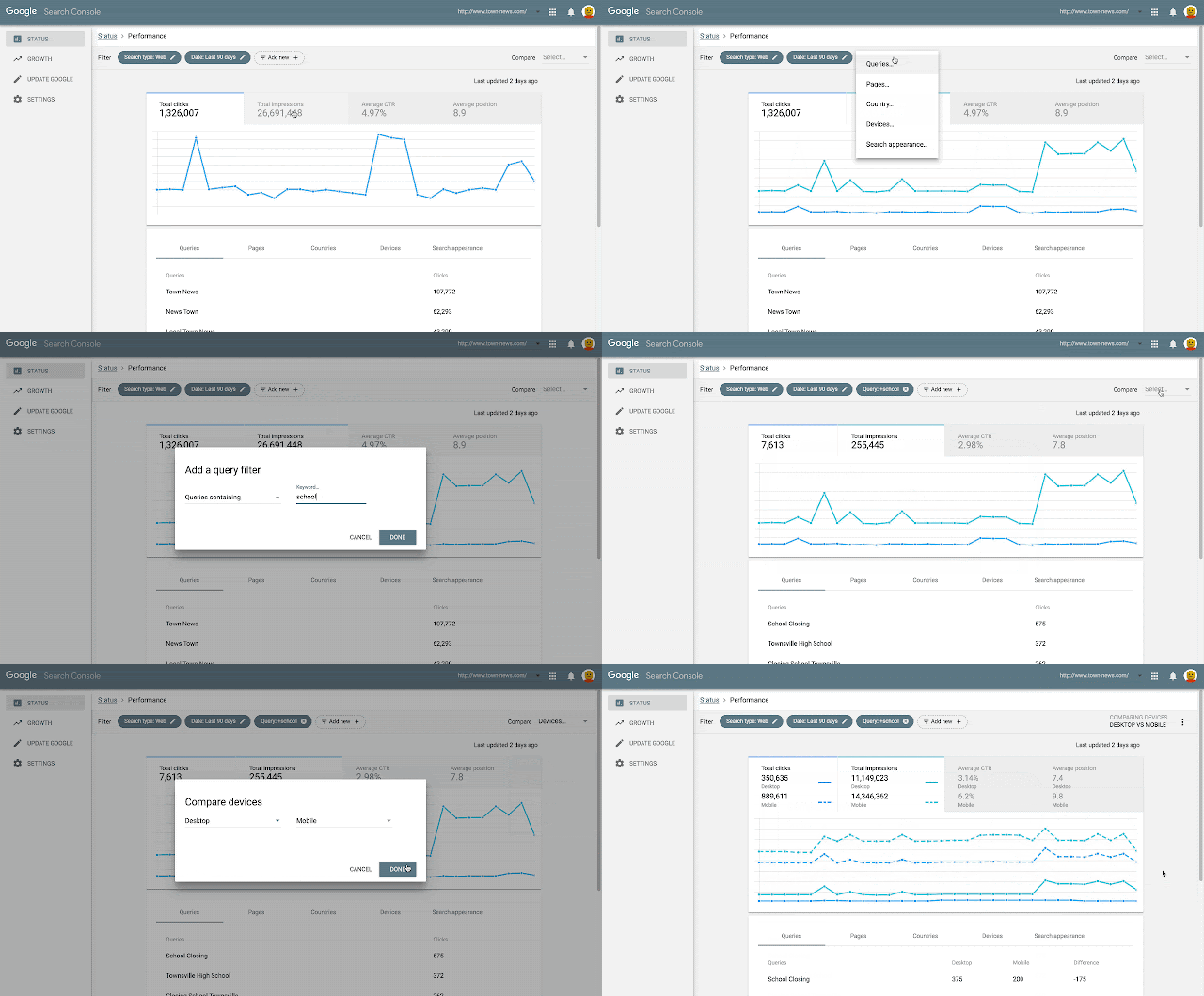
We’ve used 3 main communication channels to hear what our users are saying:
- Help forum Top Contributors – Top Contributors in our help forums have been very helpful in bringing up topics seen in the forums. They communicate regularly with Google’s Search teams, and help the large community of Search Console users.
- Open feedback – We analyzed open feedback comments about classic Search Console and identified the top requests coming in. Open feedback can be sent via the ‘Submit feedback’ button in Search Console. This open feedback helped us get more context around one of the top requests from the last years: more than 90 days of data in the Search Analytics (Performance) report. We learned of the need to compare to a similar period in the previous year, which confirmed that our decision to include 16 months of data might be on the right track.
- Search Console panel – Last year we created a new communication channel by enlisting a group of four hundred randomly selected Search Console users, representing websites of all sizes. The panel members took part in almost every design iteration we had throughout the year, from explorations of new concepts through surveys, interviews and usability tests. The Search Console panel members have been providing valuable feedback which helped us test our assumptions and improve designs.
In one of these rounds we tested the new suggested design for the Performance report. Specifically we wanted to see whether it was clear how to use the ‘compare’ and ‘filter’ functionalities. To create an experience that felt as real as possible, we used a high fidelity prototype connected to real data. The prototype allowed study participants to freely interact with the user interface before even one row of production code had been written.

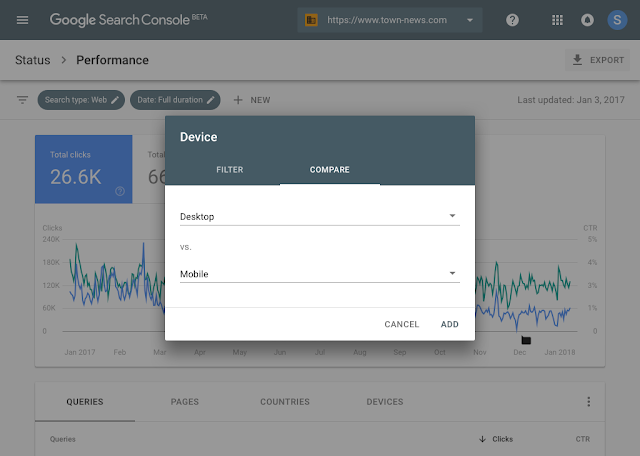
In this study we learned that the ‘compare’ functionality was often overlooked. We consequently changed the design with ‘filter’ and ‘compare’ appearing in a unified dialogue box, triggered when the ‘Add new’ chip is clicked. We continue to test this design and others to optimize its usability and usefulness.

We incorporated user feedback not only in practical design details, but also in architectural decisions. For example, user feedback led us to make major changes in the product’s core information architecture influencing the navigation and product structure of the new Search Console. The error and coverage reports were originally separated which could lead to multiple views of the same error. As a result of user feedback we united the error and coverage reporting offering one holistic view.
As the launch date grew closer, we performed several larger scale experiments. We A/B tested some of the new Search Console reports against the existing reports with 30,000 users. We tracked issue fix rates to verify new Search Console drives better results and sent out follow-up surveys to learn about their experience. This most recent feedback confirmed that export functionality was not a nice-to-have, but rather a requirement for many users and helped us tune detailed help pages in the initial release.
We are happy to announce that the new Search Console is now available to all sites. Whether it is through Search Console’s feedback button or through the user panel, we truly value a collaborative design process, where all of our users can help us build the best product.
Try out the new search console.
We’re not finished yet! Which feature would you love to see in the next iteration of Search Console? Let us know below.
Posted by the Search Console UX team


Five Strategies for Slaying the Data Puking Dragon.
If you bring sharp focus, you increase chances of attention being diverted to the right places. That in turn will drive smarter questions, which will elicit thoughtful answers from available data. The result will be data-influenced actions that result in a long-term strategic advantage. It all starts with sharp focus. Consider these three scenarios… Your […]
Five Strategies for Slaying the Data Puking Dragon. is a post from: Occam’s Razor by Avinash Kaushik
What We Learned in January 2018: The Digital Marketing Month in a Minute

Facebook plans significant changes to news feed
Facebook seemed to be always in the press through January, as it announced major changes to its news feed, with the main action to make posts from businesses, brands and media less prominent.
How to Face 3 Fundamental Challenges Standing Between SEOs and Clients/Bosses
Posted by sergeystefoglo
Every other year, the good people at Moz conduct a survey with one goal in mind: understand what we (SEOs) want to read more of. If you haven’t seen the results from 2017, you can view them here.
The results contain many great questions, challenges, and roadblocks that SEOs face today. As I was reading the 2017 Moz Blog readership survey, a common thread stood out to me: there are disconnects on fundamental topics between SEOs and clients and/or bosses. Since I work at an agency, I’ll use “client” through the rest of this article; if you work in-house, replace that with “boss.”
Check out this list:

I can definitely relate to these challenges. I’ve been at Distilled for a few years now, and worked in other firms before — these challenges are real, and they’re tough. Through sharing my experience dealing with these challenges, I hope to help other consultants and SEOs to overcome them.
In particular, I want to discuss three points of disconnect that happen between SEOs and clients.
- My client doesn’t understand the value of SEO and it’s difficult to prove ROI.
- My client doesn’t understand how SEO works and I always have to justify my actions.
- My client and I disagree about whether link building is the right answer.
Keep in mind, these are purely my own experiences. This doesn’t mean these answers are the end-all-be-all. In fact, I would enjoy starting a conversation around these challenges with any of you so please grab me at SearchLove (plug: our San Diego conference is selling out quickly and is my favorite) or MozCon to bounce off more ideas!
1. My client doesn’t understand the value of SEO and it’s difficult to prove ROI
The value of SEO is its influence on organic search, which is extremely valuable. In fact, SEO is more prominent in 2018 than it has ever been. To illustrate this, I borrowed some figures from Rand’s write up on the state of organic search at the end of 2017.
- Year over year, the period of January–October 2017 has 13% more search volume than the same months in 2016.
- That 13% represents 54 billion more queries, which is just about the total number of searches Google did, worldwide, in 2003.

Organic search brings in the most qualified visitors (at a more consistent rate) than any other digital marketing channel. In other words, more people are searching for things than ever before, which results in more potential to grow organic traffic. How do we grow organic traffic? By making sure our sites are discoverable by Google and clearly answer user queries with good content.

Source: Search Engine Land
When I first started out in SEO, I used to think I was making all my clients all the moneys. “Yes, Bill, if you hire me and we do this SEO thing I will increase rankings and sessions, and you will make an extra x dollars!” I used to send estimates on ROI with every single project I pitched (even if it wasn’t asked of me).
After a few years in the industry I began questioning the value of providing estimates on ROI. Specifically, I was having trouble determining ift I was doing the right thing by providing a number that was at best an educated guess. It would stress me out and I would feel like I was tied to that number. It also turns out, not worrying about things that are out of our control helps control stress levels.
I’m at a point now where I’ve realized the purpose of providing an estimated ROI. Our job as consultants is to effect change. We need to get people to take action. If what it takes to get sign-off is to predict an uplift, that’s totally fine. In fact, it’s expected. Here’s how that conversation might look.

In terms of a formula for forecasting uplifts in SEO, Mike King said it best:
“Forecast modeling is questionable at best. It doesn’t get much better than this:”
- Traffic = Search Volume x CTR
- Number of Conversions = Conversion Rate x Traffic
- Dollar Value = Traffic x # Conversions x Avg Conversion Value
TL;DR:
- Don’t overthink this too much — if you do, you’ll get stuck in the weeds.
- When requested, provide the prediction to get sign-off and quickly move on to action.
- For more in-depth thoughts on this, read Will Critchlow’s recent post on forecast modeling.
- Remember to think about seasonality, overall trends, and the fact that few brands exist in a vacuum. What are your competitors doing and how will that affect you?
2. My client doesn’t understand how SEO works and I always have to justify my actions
Does your client actually not understand how SEO works? Or, could it be that you don’t understand what they need from you? Perhaps you haven’t considered what they are struggling with at the moment?
I’ve been there — constantly needing to justify why you’re working on a project or why SEO should be a focus. It isn’t easy to be in this position. But, more often than not I’ve realized what helps the most is to take a step back and ask some fundamental questions.
A great place to start would be asking:
- What are the things my client is concerned about?
- What is my client being graded on by their boss?
- Is my client under pressure for some reason?
The answers to these questions should shine some clarity on the situation (the why or the motivation behind the constant questioning). Some of the reasons why could be:
- You might know more about SEO than your client, but they know more about their company. This means they may see the bigger picture between investments, returns, activities, and the interplay between them all.
- SEO might be 20% of what your client needs to think about — imagine a VP of marketing who needs to account for 5–10 different channels.
- If you didn’t get sign off/budget for a project, it doesn’t mean your request was without merit. This just means someone else made a better pitch more aligned to their larger goals.
When you have some answers, ask yourself, “How can I make what I’m doing align to what they’re focused on?” This will ensure you are hitting the nail on the head and providing useful insight instead of more confusion.
That conversation might look like this:

TL;DR
- This is a good problem to have — it means you have a chance to effect change.
- Also, it means that your client is interested in your work!
- It’s important to clarify the why before getting to in the weeds. Rarely will the why be “to learn SEO.”
3. My client and I disagree about whether link building is the right answer
The topic of whether links (and by extension, link building) are important is perhaps the most talked about topic in SEO. To put it simply, there are many different opinions and not one “go-to” answer. In 2017 alone there have been many conflicting posts/talks on the state of links.
- My colleague Tom Capper presented this deck at SearchLove San Diego last year which goes into detail about whether or not Google needs links anymore (accompanying blog post here).
- Malcolm Slade from Epiphany presented this deck at BrightonSEO last year which dives into brand influence on search, and what that means for the topic of links.
- Branded3 released an overview of ranking factors for 2018. The biggest factor? Links.
- /r/BigSEO searches from the past month show that people have many questions still.
The quick answer to the challenge we face as SEOs when it comes to links is, unless authority is holding you back do something else.
That answer is a bit brief and if your client is constantly bringing up links, it doesn’t help. In this case, I think there are a few points to consider.
- If you’re a small business, getting links is a legitimate challenge and can significantly impact your rankings. The problem is that it’s difficult to get links for a small business. Luckily, we have some experts in our field giving out ideas for this. Check out this, this, and this.
- If you’re an established brand (with authority), links should not be a priority. Often, links will get prioritized because they are easier to attain, measurable (kind of), and comfortable. Don’t fall into this trap! Go with the recommendation above: do other impactful work that you have control over first.
- Reasoning: Links tie success to a metric we have no control over — this gives us an excuse to not be accountable for success, which is bad.
- Reasoning: Links reduce an extremely complicated situation into a single variable — this gives us an excuse not to try and understand everything (which is also bad).
- It’s good to think about the topic of links and how it’s related to brand. Big brands get talked about (and linked to) more than small brands. Perhaps the focus should be “build your brand” instead of “gain some links”.
- If your client persists on the topic of links, it might be easier to paint a realistic picture for them. This conversation might look like this:

TL;DR
- There are many opinions on the state of links in 2018: don’t get distracted by all the noise.
- If you’re a small business, there are some great tactics for building links that don’t take a ton of time and are probably worth it.
- If you’re an established brand with more authority, do other impactful work that’s in your control first.
- If you are constantly getting asked about links from your client, paint a realistic picture.
Conclusion
If you’ve made it this far, I’m really interested in hearing how you deal with these issues within your company. Are there specific challenges you face within the topics of ROI, educating on SEO, getting sign-off, or link building? How can we start tackling these problems more as an industry?
Sign up for The Moz Top 10, a semimonthly mailer updating you on the top ten hottest pieces of SEO news, tips, and rad links uncovered by the Moz team. Think of it as your exclusive digest of stuff you don’t have time to hunt down but want to read!
SearchCap: Super Bowl search ads, Google SEO audit tool & WordPress
Below is what happened in search today, as reported on Search Engine Land and from other places across the web.
The post SearchCap: Super Bowl search ads, Google SEO audit tool & WordPress appeared first on Search Engine Land.
Please visit Search Engine Land for the full article.
Google adds new SEO Audit category to Chrome’s Lighthouse extension
The popular auditing tool used by developers and search marketers now enables users to run basic SEO checks against site pages.
The post Google adds new SEO Audit category to Chrome’s Lighthouse extension appeared first on Search Engine Land.
Please visit Search Engine Land for the full article.