The 2018 Search Engine Land Awards Shortlist
Congratulations to all of the individuals, agencies and internal brand teams that have been named to this year’s shortlist of finalists. Over 600 members of the search community are expected to celebrate at the awards ceremony and afterparty during SMX Advanced in Seattle.
Please visit Search Engine Land for the full article.
How much is too much? Faceted navigation and SEO
Contributor Eric Enge shares guidelines and handy workarounds you can follow to avoid indexing ‘too many’ faceted navigation pages.
Please visit Search Engine Land for the full article.
A review of the payday loans algorithm in 2018
Daniel Tannenbaum looks at the history of the payday loans algorithm for SEO and what is required today from brands to be more successful.
Google releases Lighthouse version 3.0
Have you upgraded to Lighthouse 3.0 yet? If not, here is what is new and great in the new version of Google’s tool for web developers.
Please visit Search Engine Land for the full article.
Ask the SMXpert: SEO markup and structured data
Looking for insights into newer markup options and advanced structured data? SMXpert Alexis Sanders shares additional pointers to help you refine, update and optimize your content.
Please visit Search Engine Land for the full article.
Six Google Shopping opportunities you may be overlooking
Get more from your PLA ad spend by out-thinking your competition.
Please visit Search Engine Land for the full article.
Please visit Search Engine Land for the full article.
Technical considerations before purchasing a commerce platform
Choosing a commerce platform is one of the most crucial and important decisions you’ll make in the early life of your business. The choices are endless, but what’s really important? Pius Boachie provides a list of some key considerations.
Your Inside Look at Moz’s Brand New Tool Link Explorer
Moz has officially rolled out their new link-building tool, Link Explorer, and the Seer Team got an exclusive opportunity to test out the tool before its release. Not only did we get to try Link Explorer and provide feedback prior to launch, the Moz team visited our San Diego office to have an open dialog about all things link building, including most-used tools, best practices and strategies, and the challenges and difficulties associated with the link-building process.…
The post Your Inside Look at Moz’s Brand New Tool Link Explorer appeared first on Seer Interactive.
Backlink Blindspots: The State of Robots.txt
Posted by rjonesx.
Here at Moz we have committed to making Link Explorer as similar to Google as possible, specifically in the way we crawl the web. I have discussed in previous articles some metrics we use to ascertain that performance, but today I wanted to spend a little bit of time talking about the impact of robots.txt and crawling the web.
Most of you are familiar with robots.txt as the method by which webmasters can direct Google and other bots to visit only certain pages on the site. Webmasters can be selective, allowing certain bots to visit some pages while denying other bots access to the same. This presents a problem for companies like Moz, Majestic, and Ahrefs: we try to crawl the web like Google, but certain websites deny access to our bots while allowing that access to Googlebot. So, why exactly does this matter?
Why does it matter?
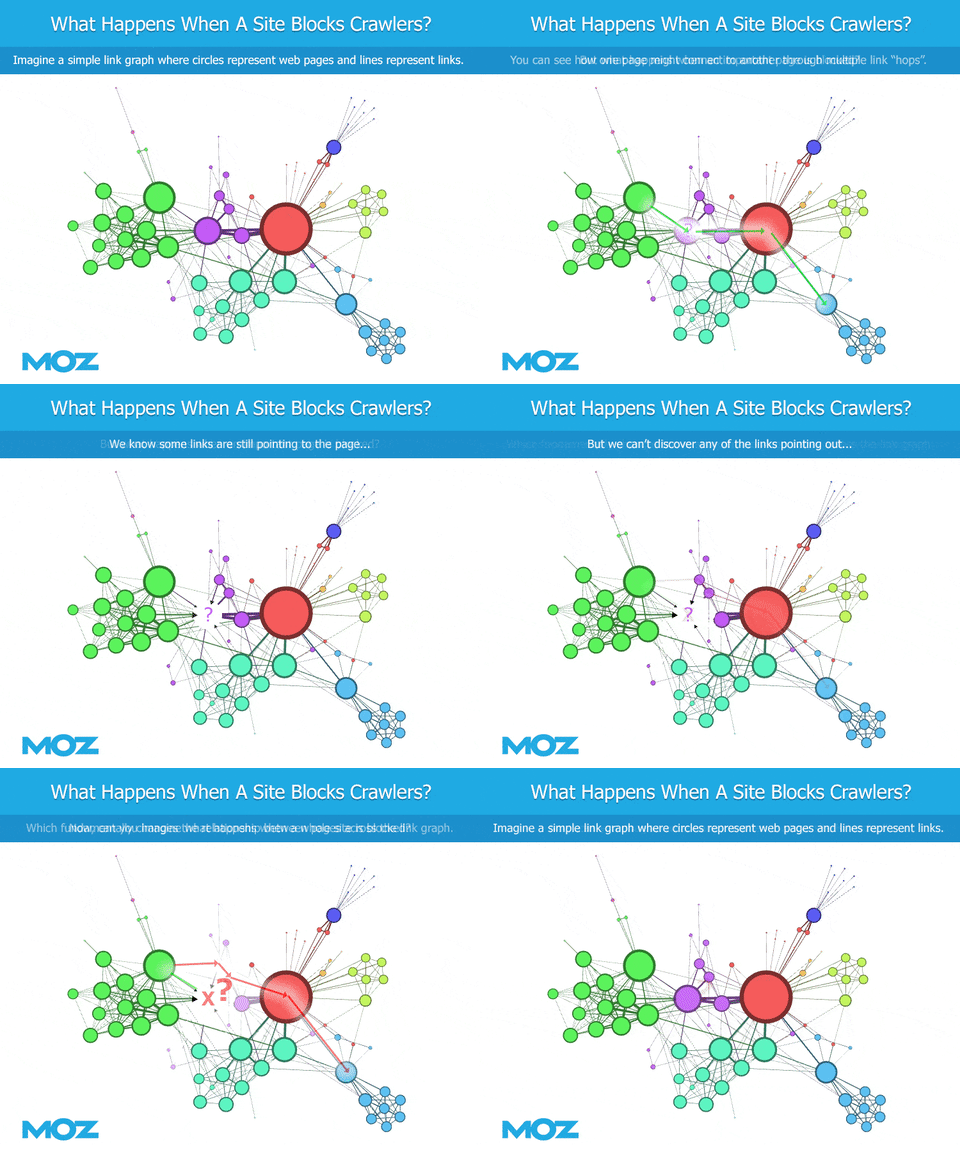
As we crawl the web, if a bot encounters a robots.txt file, they’re blocked from crawling specific content. We can see the links that point to the site, but we’re blind regarding the content of the site itself. We can’t see the outbound links from that site. This leads to an immediate deficiency in the link graph, at least in terms of being similar to Google (if Googlebot is not similarly blocked).
But that isn’t the only issue. There is a cascading failure caused by bots being blocked by robots.txt in the form of crawl prioritization. As a bot crawls the web, it discovers links and has to prioritize which links to crawl next. Let’s say Google finds 100 links and prioritizes the top 50 to crawl. However, a different bot finds those same 100 links, but is blocked by robots.txt from crawling 10 of the top 50 pages. Instead, they’re forced to crawl around those, making them choose a different 50 pages to crawl. This different set of crawled pages will return, of course, a different set of links. In this next round of crawling, Google will not only have a different set they’re allowed to crawl, the set itself will differ because they crawled different pages in the first place.
Long story short, much like the proverbial butterfly that flaps its wings eventually leading to a hurricane, small changes in robots.txt which prevent some bots and allow others ultimately leads to very different results compared to what Google actually sees.
So, how are we doing?
You know I wasn’t going to leave you hanging. Let’s do some research. Let’s analyze the top 1,000,000 websites on the Internet according to Quantcast and determine which bots are blocked, how frequently, and what impact that might have.
Methodology
The methodology is fairly straightforward.
- Download the Quantcast Top Million
- Download the robots.txt if available from all top million sites
- Parse the robots.txt to determine whether the home page and other pages are available
- Collect link data related to blocked sites
- Collect total pages on-site related to blocked sites.
- Report the differences among crawlers.
Total sites blocked
The first and easiest metric to report is the number of sites which block individual crawlers (Moz, Majestic, Ahrefs) while allowing Google. Most site that block one of the major SEO crawlers block them all. They simply formulate robots.txt to allow major search engines while blocking other bot traffic. Lower is better.

Of the sites analyzed, 27,123 blocked MJ12Bot (Majestic), 32,982 blocked Ahrefs, and 25,427 blocked Moz. This means that among the major industry crawlers, Moz is the least likely to be turned away from a site that allows Googlebot. But what does this really mean?
Total RLDs blocked
As discussed previously, one big issue with disparate robots.txt entries is that it stops the flow of PageRank. If Google can see a site, they can pass link equity from referring domains through the site’s outbound domains on to other sites. If a site is blocked by robots.txt, it’s as though the outbound lanes of traffic on all the roads going into the site are blocked. By counting all the inbound lanes of traffic, we can get an idea of the total impact on the link graph. Lower is better.

According to our research, Majestic ran into dead ends on 17,787,118 referring domains, Ahrefs on 20,072,690 and Moz on 16,598,365. Once again, Moz’s robots.txt profile was most similar to that of Google’s. But referring domains isn’t the only issue with which we should be concerned.
Total pages blocked
Most pages on the web only have internal links. Google isn’t interested in creating a link graph — they’re interested in creating a search engine. Thus, a bot designed to act like Google needs to be just as concerned about pages that only receive internal links as they are those that receive external links. Another metric we can measure is the total number of pages that are blocked by using Google’s site: query to estimate the number of pages Google has access to that a different crawler does not. So, how do the competing industry crawlers perform? Lower is better.

Once again, Moz shines on this metric. It’s not just that Moz is blocked by fewer sites— Moz is blocked by less important and smaller sites. Majestic misses the opportunity to crawl 675,381,982 pages, Ahrefs misses 732,871,714 and Moz misses 658,015,885. There’s almost an 80 million-page difference between Ahrefs and Moz just in the top million sites on the web.
Unique sites blocked
Most of the robots.txt disallows facing Moz, Majestic, and Ahrefs are simply blanket blocks of all bots that don’t represent major search engines. However, we can isolate the times when specific bots are named deliberately for exclusion while competitors remain. For example, how many times is Moz blocked while Ahrefs and Majestic are allowed? Which bot is singled out the most? Lower is better.

Ahrefs is singled out by 1201 sites, Majestic by 7152 and Moz by 904. It is understandable that Majestic has been singled out, given that they have been operating a very large link index for many years, a decade or more. It took Moz 10 years to accumulate 904 individual robots.txt blocks, and took Ahrefs 7 years to accumulate 1204. But let me give some examples of why this is important.
If you care about links from name.com, hypermart.net, or eclipse.org, you can’t rely solely on Majestic.
If you care about links from popsugar.com, dict.cc, or bookcrossing.com, you can’t rely solely on Moz.
If you care about links from dailymail.co.uk, patch.com, or getty.edu, you can’t rely solely on Ahrefs.
And regardless of what you do or which provider you use, you can’t links from yelp.com, who.int, or findarticles.com.
Conclusions
While Moz’s crawler DotBot clearly enjoys the closest robots.txt profile to Google among the three major link indexes, there’s still a lot of work to be done. We work very hard on crawler politeness to ensure that we’re not a burden to webmasters, which allows us to crawl the web in a manner more like Google. We will continue to work more to improve our performance across the web and bring to you the best backlink index possible.
Thanks to Dejan SEO for the beautiful link graph used in the header image and Mapt for the initial image used in the diagrams.
Sign up for The Moz Top 10, a semimonthly mailer updating you on the top ten hottest pieces of SEO news, tips, and rad links uncovered by the Moz team. Think of it as your exclusive digest of stuff you don’t have time to hunt down but want to read!
Programming Note: Offline Monday For Shavous 5778
This is just a heads up that I am currently offline today for the Jewish holiday of Shavout. Anything posted today, Monday the 21st of May, was scheduled and pre-written last week. In fact, this post was written Thursday, May 17th, and scheduled to b…
Jason Acidre – The Search Community Honors You
This is part of the say something nice about an SEO/SEM series – feel free to nominate someone over here…
Learn from the SMX Advanced family
♫ Here’s the story of a lovely conference…♫
Please visit Search Engine Land for the full article.
Please visit Search Engine Land for the full article.
SearchCap: Google’s new local search world, Abraham Ortelius Google doodle & more
Below is what happened in search today, as reported on Search Engine Land and from other places across the web.
Please visit Search Engine Land for the full article.
Please visit Search Engine Land for the full article.
Poll: How SEOs Measure Changes To Backlink Profile
I can honestly tell you, I have personally not looked at my backlink profiles in years. Not in Google Search Console links report, not in third party tools…
60% Of SEOs Say They Hurt A Web Site In Google With Spammy Links
A few months ago, I asked you all to take a poll around if you have ever hurt a web site using spammy links to downgrade their rankings in Google search. The good news is that 66% of those who responded said they never tried to do so…
Google: Ranking Is Nothing Without Conversion
The topic of HTML validation has been covered here time and time again – we know Google doesn’t downgrade or boost a web site with bad or good HTML validation…
Bing Ads Bans Cryptocurrency Advertisements
Advertisers who want to use Bing Ads to promote the sale of cryptocurrency, the digital asset such as Bitcoin and others, are not going to be able to do so in June. Bing announced they will be disallow cryptocurrency advertising on their platform…
…
No need for Google: 12 alternative search engines in 2018
Here are 12 alternatives to escape your reliance on Google for all things search in 2018.
How to survive Google’s new local search world
Google has made some significant changes in the area of local search. Contributor Wesley Young gives an overview of the important changes and shares tips on how to keep your local business visible in the search results.
Please visit Search Engine Land …
Insights into a newsroom: learnings for content marketing
Print media may be on the decline, but there’s a lot that content marketers can learn from this profession. While content that targets a Google algorithm is a good strategy to have, you should also create content that builds and engages with people. Julia Ogden shares some tips from her background as a print journalist.