Google Drops Magnifying Glass In Search Bar For Text Search Button
Google has dropped the magnifying glass in the search bar and substituted it for a text based search button. We saw Google testing this out a couple months ago and it now seems to be almost fully live.
Google Search Algorithm Tweaked To Show Less Porn For Lesbian, Teen & Other Queries
Google has apparently updated its search algorithm to show less pornographic content and search results for queries around lesbian, teen, school girl, and other related queries. Pandu Nayak from Google told The Next Web “We have taken measures in cas…
Google Launches New Image Search Preview Box, Upsetting Some Searchers
As expected, Google has launched a redesign to the Google Image Search preview image box. Google has gone with the sticky interface, where the image preview box sticks to the right side and you can independently scroll through other images or the imag…
Take The New Search Ranking Factors Survey
As some of you may have heard in my interview with Rand Fishkin, he was planning on relaunching the search ranking factors survey. Well, he did it and you can participate in the survey over here.
Vlog #8: Mary Bowling Ignitor Digital On Local SEO & Google My Business Data
In episode #8 of the vlog series at the Search Engine Roundtable I interviewed Mary Bowling (@marybowling) of Ignitor Digital Marketing. Mary and I and I started off talking about her work…
How to Identify & Optimize Paid Search Fluctuations
Problem 1: How do I efficiently monitor campaign performance, and identify what caused changes over time?
One of the most common ways to keep a pulse on campaign performance is through regular reports. Unfortunately, reporting is a challenge that every digital marketer faces.…
The post How to Identify & Optimize Paid Search Fluctuations appeared first on Seer Interactive.
Google discontinues Trips mobile app
Users will be directed to use Search and Maps for their travel planning.
Please visit Search Engine Land for the full article.
How YouTube can help your non-video campaigns in Google Ads
Here’s how you can boost campaigns with video in lightbox ads, display, universal apps and more.
Please visit Search Engine Land for the full article.
Google Local Shows Photos to Match the User Query – And what it Means to You
Google Local has always been aggravating when it comes to showing your photos. Google would swap out your photos seemingly randomly. Your carefully chosen profile photo would suddenly disappear and be replaced with a skanky alternative of Google’s choosing. There never seemed to be rhyme or reason. But I have noticed that changing. Not the … Continue reading Google Local Shows Photos to Match the User Query – And what it Means to You →
Why should you attend SMX?
Just for you: 11 awesome reasons to attend SMX East, November 13-14 in NYC!
Please visit Search Engine Land for the full article.
Googlebot evergreen rendering in our testing tools
Today we updated most of our testing tools so they are using the evergreen Chromium renderer. This affects our testing tools like the mobile-friendly test or the URL inspection tool in Search Console. In this post we look into what this means and …
Video: Mary Bowling on the growth of local SEO and importance knowledge panels
What a fun discussion with this local SEO legend, who has devoted her life to helping small businesses succeed.
Please visit Search Engine Land for the full article.
Google Search Console sending performance report emails
Your clients may be getting emails from Google Search Console with their performance for the month.
Please visit Search Engine Land for the full article.
Google testing tools now support evergreen Googlebot
After three months, the Google testing tools are now using the latest version of Googlebot.
Please visit Search Engine Land for the full article.
Google Local Pack Tests Image Carousel For Each Local Listing
Google is crazed about carousels and here is another format of the Google local pack. This local pack shows not one image, but an image carousel per local listing in the local pack.
Google Still Working On Evergreen GoogleBot Support For Tools
Back in May, three months ago, Google released the evergreen GoogleBot. Basically GoogleBot is on the same version as your version of Chrome, which gives Google more capabilities to crawl and access your web pages. But the tools, tools within Google …
Google Search Team Stricter With Google’s Internal SEO Team
John Mueller from Google said that the Google search team is very strict with Google’s internal SEO team. He said on Reddit “I imagine the SEO team at Google has a pretty hard time comparatively, given how strictly we separate the rest of search from t…
How to Screen and Recruit the Best SEO Content Writers
Posted by Victor_Ijidola
It’s easy to find writers; they’re everywhere — from a one-second Google search to asking on LinkedIn.
But hiring the best ones? That’s the daunting task marketers and business owners face. And you do not just need writers, you need exceptional SEO content writers.
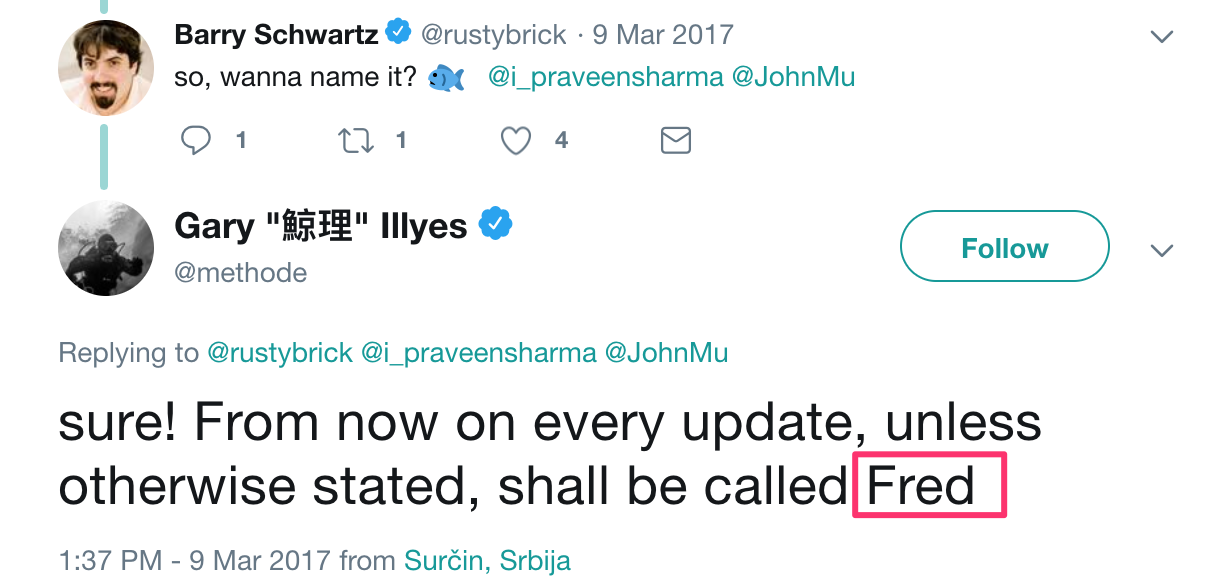
Mainly because that’s what Google (aka the largest traffic driver of most sites) has clearly been clamoring for since their Panda update in 2011, RankBrain in 2015, and their “Fred” update (and by the way, Gary Illyes from Google coined “Fred’ for every unnamed Google update) in March, 2017.
It’s obvious how each of these major updates communicates Google’s preference for excellent SEO writers:
If you’re a frequent Moz reader, you probably know how they work — but if not: Panda penalizes every webpage with content that adds little to no value to people online, giving more visibility to content pieces that do. On its own, the RankBrain update has made Google almost as smart as humans — when choosing the most relevant and high-quality content to rank on page #1 of search engine result pages (SERPs).
The “Fred” update further tackled sites with low-quality content that aren’t doing anything beyond providing information that’s already available on the internet. It also penalized sites that prioritized revenue above user experience.
After this update, 100+ sites saw their traffic drop by 50 percent to 90 percent.
It is evident that Google has, through these core updates, been requiring brands, publishers, and marketers to work with SEO content writers who know their onions; the ones who know how to write with on-page SEO mastery.
But how do you find these exceptional wordsmiths? Without a plan, you will have to screen tens (or even hundreds) of them to find those who are a good fit.
But let’s make it easier for you. Essentially, your ideal SEO writers should have two key traits:
- Good on-page SEO expertise
- A great eye for user experience (i.e. adding relevant images, formatting, etc.)
A writer with these two skills is a great SEO writer. But let’s dig a bit deeper into what that means.
(Note: this post is about hiring exceptional SEO content writers — i.e., wordsmiths who don’t need you monitoring them to do great work. So, things can get a bit techie as you read on. I’ll be assuming your ideal writer understands or is responsible for things like formatting, on-page SEO, and correctly uploading content into your CMS.)
1. On-page SEO knowledge
By now, you know what on-page SEO is. But if not, it’s simply the elements you put on a site or web page to let search engines understand that you have content on specific topics people are searching for.
So, how do you know if a writer has good on-page SEO knowledge?
Frankly, “Can you send me your previous writing samples?” is the ideal question to ask any writer you’re considering hiring. Once they show their samples, have them walk you through each one, and ask yourself the following questions:
Question A: Do they have ‘focus keywords’ in their previous samples?
Several factors come into play when trying to rank any page, but your ideal writer must know how to hold things down on the keyword side of things.
Look through their samples; see if they have optimized any content piece for a specific keyword in the past so you can know if they’ll be able to do the same for your content.
Question B: How do they use title tags?
Search engines use title tags to detect the headings in your content.
You know how it works: put “SEO strategy” — for example — in a few, relevant headings on a page and search engines will understand the page is teaching SEO strategy.
Essentially, your ideal SEO writer should understand how to use them to improve your rankings and attract clicks from your potential customers in search results.
Are title tags really that important? They are. Ahrefs, for instance, made their title tag on a page more descriptive and this alone upped their traffic by 37.58%.

So, look through the titles in your candidate’s samples, especially the h1 title. Here’s what you should look for when examining how a candidate uses HTML tags:
i. Header tags should, ideally, not be more than 60 characters. This is to avoid results that look like this in SERPs:

(three dots in front of your titles constitutes bad UX — which Google frowns at)
ii. The subheadings should be h2 (not necessarily, but it’s a plus)
iii. Headings under subtopics should be h3 (also not necessary, but it’s a plus)
Look for these qualities in your candidate’s work and you’ll be able to confirm that they properly implement title tags in their content, and can do the same for you.
But some writers may not have control over the title tags in their published works — that is, the sites they wrote for probably didn’t give them such access. In this case, request samples they published on their own site, where they actually have control over these tags.
Question C: What do they know about internal linking?
Orbit Media once shared how they used internal linking to shoot a blog post from position #29 up to #4.
So, it’s important that your writers know how to contextually link to your older content pieces while writing new content. And it works for good reason; internal linking helps you:
- Communicate the relevance and value of your pages to Google (the more links a page gets, the more authority it has in Google’s eyes)
- Demonstrate to Google that your site contains in-depth content about any specific topic
- Tell Google your site has easy navigation — which means it has good UX and is well-structured.
Internal linking is a major key to search ranking, so you need writers who have internal linking in their pocketful of tools. But also ensure they do it using proper anchor texts; in a recent LinkedIn post, expert editor Rennie Sanusi hinted at two key anchor text elements to look for in your candidate’s samples:
- [Anchor texts] should clearly explain where they’ll take your reader to
- [Anchor texts] shouldn’t be too long
Question D: Do they write long-form content?
The average word count of a Google first page result is 1,800+ words long — according to research from Backlinko.

Google has been all about in-depth content since its inception; you’re probably familiar with their mission statement:

Every algorithm change they make is geared toward achieving this mission statement, and ranking long-form content helps them in the process as well.
Because, to them, writing longer content means you’re putting more information that searchers are looking for into your content.
So you need writers who can produce long-form content. Check their samples and confirm they know how to write long-form content on a regular basis.
Question E: Have they ranked for any important keywords?
Ultimately, you need to see examples of important keywords your ideal content writer has ranked for in the past. This is the utmost test of their ability to actually drive search traffic your way.
That’s it for finding writers who know on-page SEO. But as you know, that’s only one part of the skills that makes a great SEO content writer.
The other important bit is their ability to write content that engages humans. In other words, they need to know how to keep people reading a page for several minutes (or even hours), leading them to take actions that are important to your business.
2. A great eye for user experience
Keeping readers on a page for long durations also improves your ranking.
In the aforementioned Backlinko study, researchers analyzed 100,000 sites and found that “websites with low average bounce rates are strongly correlated with higher rankings.”
And you know what that means; your ideal SEO writer should not only write to rank on search engines, they must also write to attract and keep the attention of your target audience.
So, look for the following in their samples:
Headlines and introductions that hook readers
You need writers who are expert enough to know the types of headlines and opening paragraphs that work.
It’s not a hard skill to spot; look through their samples. If their titles and introductions don’t hook you, they probably won’t hook your audience. It’s really that simple.
Explainer images and visuals
The report also revealed that: “Content with at least one image significantly outperformed content without any images.”
But of course, they have to be relevant images (or other visual types). And many times (if not most of the time), that means explainer images — so look out for those in their samples. And there are two examples of explainer images:
Example #1: Explainer images with text and pointers

This one has elements (an arrow and a text) on it, explaining how the image is relevant to the topic the content is about.
Example #2: Explainer images without text and pointers

Why does this image not have any text or arrows on it? It’s a self-explanatory screenshot, that’s why.
As long as it’s used appropriately — where the “online sales of Nike products” is mentioned in the content — it gets its message across.
In general, your ideal SEO writers need to know how to use tools like Skitch and Canva to create these images. Remember, you’re on a hunt for the exceptional ones.
References and citing resources
Your ideal writer should link to stats or studies that make their points stronger. This one’s pretty self-explanatory. Check the links in their samples and make sure they cite genuine resources.
Examples
Illustrations make understanding easier. Especially if you’re in a technical industry (and most industries have their geeky side), your ideal writer should know how to explain their points with examples.
Simply search their samples — using Command + F (or Ctrl F if you’re using Windows) — for “example,” “instance,” or “illustration.” This works, because writers usually mention things like “for example,” or “for instance” when providing illustrations.
Excellent SEO content writers = Higher search rankings
Getting SEO content writers who have all the skills I’ve mentioned in this article are possible to find. And hiring them means higher search rankings for your content. These writers are, again, everywhere. But here’s the thing — and you’ve probably heard it before: You get what you pay for.
Exceptional SEO content writers are your best bet, but they’re not cheap. They can send your search traffic through the roof, but, like you: They want to work for people who can afford the quality they provide. So, if you’re going on a hunt for them, ready your wallet.
But ensure you get their samples and ask the questions in this guide as you deem fit. If you’re paying for content that’ll help you rank higher on Google, then you really should get what you pay for.
Did you find any of my tips helpful? Let me know in the comments below!
Sign up for The Moz Top 10, a semimonthly mailer updating you on the top ten hottest pieces of SEO news, tips, and rad links uncovered by the Moz team. Think of it as your exclusive digest of stuff you don’t have time to hunt down but want to read!
Five search reports for ecommerce you can pull now to prep for Q4
For ecommerce companies, it’s not too early to start preparing for the holiday season. Here are five search reports to pull now as you strategize for EOY.
The post Five search reports for ecommerce you can pull now to prep for Q4 appeared first on Search Engine Watch.
Five search reports for ecommerce you can pull now to prep for Q4
For ecommerce companies, it’s not too early to start preparing for the holiday season. Here are five search reports to pull now as you strategize for EOY.
The post Five search reports for ecommerce you can pull now to prep for Q4 appeared first on Search Engine Watch.